Popl publishes individual pricing at $0 Free, $7.99 Pro, and $14.99 Pro+, plus Teams cards at $5 or $4 per user per month with a five-user minimum.
Badge scanning, AI enrichment, and event ROI attribution sit only in the two event tiers, both of which are quote-only rather than listed publicly.
The Event Lead Capture Platform prices on enrichment credits, not seats, with buyer-reported tiers of $6,000 for 500 credits up to $17,500 for 2,500.
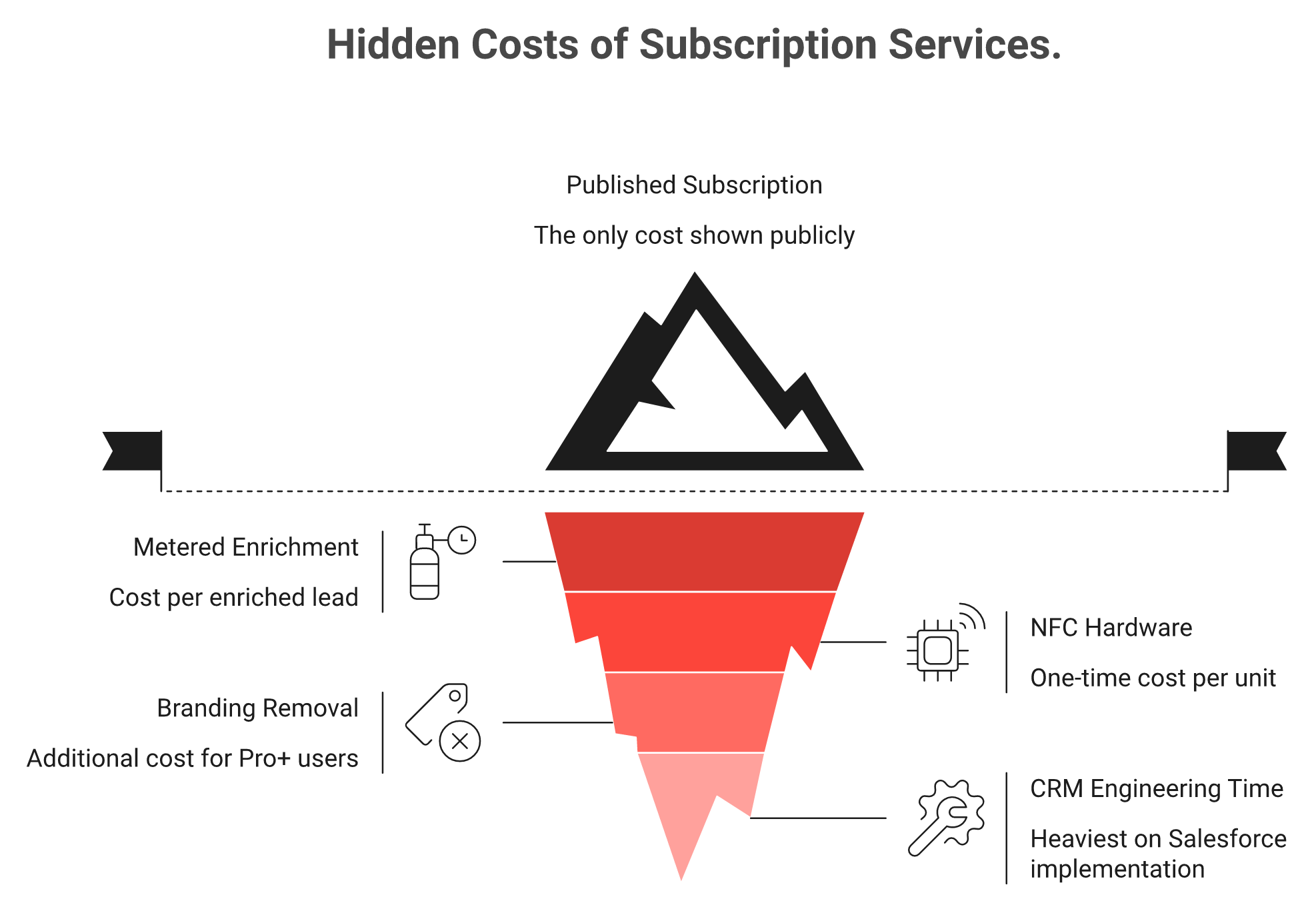
Hidden layers drive real cost: $0.50 to $2.00 per enriched lead, NFC hardware, roughly $144 a year to remove branding, and Salesforce integration time.
Cost complaints concentrate where price is negotiated, with 385 of about 5,292 G2 reviews mentioning expensive and 256 mentioning additional costs.
The only comparable unit across rental scanners, per-seat cards, and annual platforms is cost per booked meeting, not cost per seat.
Q1. How much does Popl cost in 2026? [toc=1. Popl Pricing At A Glance]
A field marketing lead opens a spreadsheet three weeks before FABTECH. Booth space, drayage, flights, and carpet are already locked. The last line reads "lead capture app," and the cell is empty, because the vendor's site shows a price for cards and a "talk to sales" button for everything else.
Popl costs $0 for Free, $7.99/mo for Pro ($79.99/yr), and $14.99/mo for Pro+ ($11.99/mo annual). Teams Digital Business Card is $5/user/mo, or $4 annually, with a five-user minimum. Teams Event Lead Capture is usage-based and quote-only. The bundled Event Lead Capture Platform was buyer-reported at $6,000/yr for 500 enrichment credits up to $17,500/yr for 2,500.
💰 The six tiers on one screen
Popl Pricing Tiers in 2026
Tier
Price
Pricing lever
Who it fits
Free
$0
None
Trial only
Pro
$7.99/mo or $79.99/yr
Per user
Solo rep, one card
Pro+
$14.99/mo, $11.99/mo annual
Per user
Solo rep, branding removed
Teams Digital Business Card
$5/user/mo, $4 annual, 5-user min
Per seat
Card rollout, no badge scanning
Teams Event Lead Capture
Quote only
Scans and enrichment
Exhibiting teams
Event Lead Capture Platform
Buyer-reported $6,000 to $17,500/yr
Enrichment credits
Unlimited users, annual contract
Badge scanning, AI enrichment, and event ROI attribution appear only in the two event tiers. That matters. A team that buys the $4 seat plan has bought digital cards, not a lead capture app built for booth teams.
⚠️ What is published and what is not
Two of these numbers come from Popl directly. The individual plan prices are on the product pages, and the $5 or $4 seat rate sits in Popl's own help documentation for small teams.
Everything in the event tiers is quote-based. Popl's pricing page states that team and event customers get pricing over a call rather than a public list. The $6,000 to $17,500 credit range comes from a single buyer report and is unverified by Popl. Treat it as a directional anchor, not a rate card.
🧾 Where each buyer actually lands
Solo reps and small sales pods land on Pro or Pro+. Teams that want branded cards across the company land on Teams Digital Business Card at $4 or $5 per seat.
Any company exhibiting at trade shows lands in a quote. Badge scanning is gated behind the event tiers, so a 5-to-15-show-a-year exhibitor never buys off the published price list.
⏰ Price this against the booth, not the month
Here is the framing that keeps budget owners honest. One practitioner running a small show described the real baseline plainly: "The booth itself was around $3 to $4,000. All in all it's going to be anywhere between 10 to $15,000 for us to do this show."
Against a $10,000 to $15,000 show, and far more at $20K to $200K per show for industrial exhibitors, a $4 seat is rounding error. It stays rounding error next to what an organizer badge scanner costs per show. The metered layer is where the money actually moves, and that layer is invisible until the quote call.
Q2. Which Popl individual plan actually works: Free, Pro, or Pro+? [toc=2. Free, Pro And Pro+]
There is a moment on day one of a show when the free plan stops working. A rep has talked to seven people. She opens the app to check the fourth one's title, and the app shows her the last five contacts only.
Free gives one branded card and lets you view only your five most recent connections, so it functions as a trial. Pro at $7.99/mo adds unlimited links, lead capture mode, CRM auto-sync, and analytics, but still shows "Powered by Popl." Pro+ at $14.99/mo is the first tier that removes branding and adds five cards plus custom lead-capture forms.
❌ The five-contact wall
The free tier caps contact visibility at your five most recent connections, and limits you to one card. That cap is the single most complained-about limit on review sites.
For a booth, five is not a limit. It is a ceiling reached before the first coffee break. A productive rep on a busy floor works through dozens of conversations a day, which is the bar any free lead capture app has to clear.
📇 What the paper-card baseline actually looks like
It helps to remember what the free tier is competing against. One operator ran the experiment deliberately: "I went in with a hundred business cards. One week later two people emailed. Within about another 30 days maybe five or six reached out."
That is a 90-plus percent failure rate on paper. A free tier that hides your contacts after five does not beat it. It just moves the loss into an app.
⭐ Pro versus Pro+ in one table
Popl Pro Versus Pro+ Feature Comparison
Capability
Pro ($7.99/mo)
Pro+ ($14.99/mo, $11.99 annual)
Digital cards
1
Up to 5
Lead capture mode
✅
✅
CRM auto-sync
✅
✅
Custom lead-capture forms
❌
✅
Branded push notifications
❌
✅
Popl branding removed
❌
✅
Badge scanning
❌
❌
Note the last row. Neither individual tier scans badges. That capability lives in the event tiers only, so neither plan works as a badge scanning app on a show floor.
💸 The branding line costs about $144 a year
Removing "Powered by Popl" is not a feature upgrade. It is a $7 per month jump, which works out to roughly $143.88 more per user per year.
For a solo consultant, that is optional. For a rep handing a card to a buyer on a $200K deal, a vendor logo on your card is a brand decision, not a billing one.
🗣️ What buyers say about the price and the paywall
"The cost is very high considering it's mostly a digital business card sharing app. It's not much different than adding a QR code to my business card." - Brooke N., Popl - G2 Verified Review
"I scanned someone else's card and now get sales emails from Popl and didn't want an extra app or account, but I am forced to have one just so I can view their email and phone number. Plus, my understanding is people have to pay for that?!" - Mike K., Popl - G2 Verified Review
"The contact information was saved, even though I didn't have the app or an account yet. Which meant I could easily go back later and set it up. It is very seamless." - Howard N., Popl - G2 Verified Review
The pattern is consistent. Reviewers like the card and question what the subscription buys beyond it.
Q3. What does Popl Teams cost at 5, 25, 50, 100, 200, and 500 seats? [toc=3. Teams Seat Pricing]
Popl Teams Digital Business Card is $5.00 per user per month billed monthly, or $4.00 annually, minimum five users. At $4/user/year-billed that is $1,200/yr for 25 seats, $2,400 for 50, $4,800 for 100, $9,600 for 200, and $24,000 for 500 before any event-tier fees. Every seat gets Pro+ features plus admin dashboard, SSO, and role-based permissions.
🧮 The seat math and the floor
Small team pricing is seat-based and billed monthly or annually. The floor is five users, so the smallest possible Teams contract is $240 a year at the annual rate.
The annual rate saves 20 percent against monthly. On a 100-seat rollout that difference is $1,200 a year, which is worth one line in the negotiation.
Popl Teams Annual Cost by Seat Count
Seats
Annual rate ($4/user/mo)
Monthly rate ($5/user/mo)
5
$240/yr
$300/yr
25
$1,200/yr
$1,500/yr
50
$2,400/yr
$3,000/yr
100
$4,800/yr
$6,000/yr
200
$9,600/yr
$12,000/yr
500
$24,000/yr
$30,000/yr
Read those as list-price reference points, not as quotes. Popl's documented seat pricing covers small teams, and larger deployments move into a custom conversation.
🔐 What the admin layer buys RevOps
The seat price is not really buying cards. It is buying control over cards.
Teams includes a central admin dashboard, company branding controls, team analytics, card templates, subteam groups, CRM integrations, HR integrations, SSO, and role-based permissions. For a RevOps lead, SSO and role-based permissions are the difference between a managed rollout and 80 personal accounts, and they matter as much as how captured leads land in Salesforce.
⚠️ Where list price stops
Published seat pricing is documented for small teams, in the 1-to-20 member range. Past that, the pricing conversation moves to sales.
This is the point most budget spreadsheets break. A 200-seat number calculated from the published rate is a useful anchor, and it is not a quote you can hold anyone to.
👥 Under-licensing is a lead-abandonment risk
There is a temptation to license only the "serious" reps and let everyone else share a login. That saves a few hundred dollars and creates a bottleneck.
One story from the field makes the cost visible. A buyer was told flatly that one person "is the only person in all of New York state that can sell you a rent to buy car." When one seat holds the whole workflow, day-two scan volume queues behind one person.
✅ Before you calculate anything
Count every body who will stand in the booth, including SEs, product folks, and the founder who shows up Thursday. Then add the reps who floor-walk without staffing the booth.
That headcount, times the annual rate, is your card-plan floor. The event-tier fees sit on top of it, which is the practical argument for universal lead capture that is not tied to a single show or seat count.
Q4. Why is Popl's event lead capture pricing quote-only? [toc=4. Why Pricing Is Quote-Only]
Every competing article about Popl pricing says the same thing about the missing number. They call it a dark pattern, a friction tactic, or a sales trap. Almost none of them explain the actual reason, which is more interesting and more useful when you are the one taking the call.
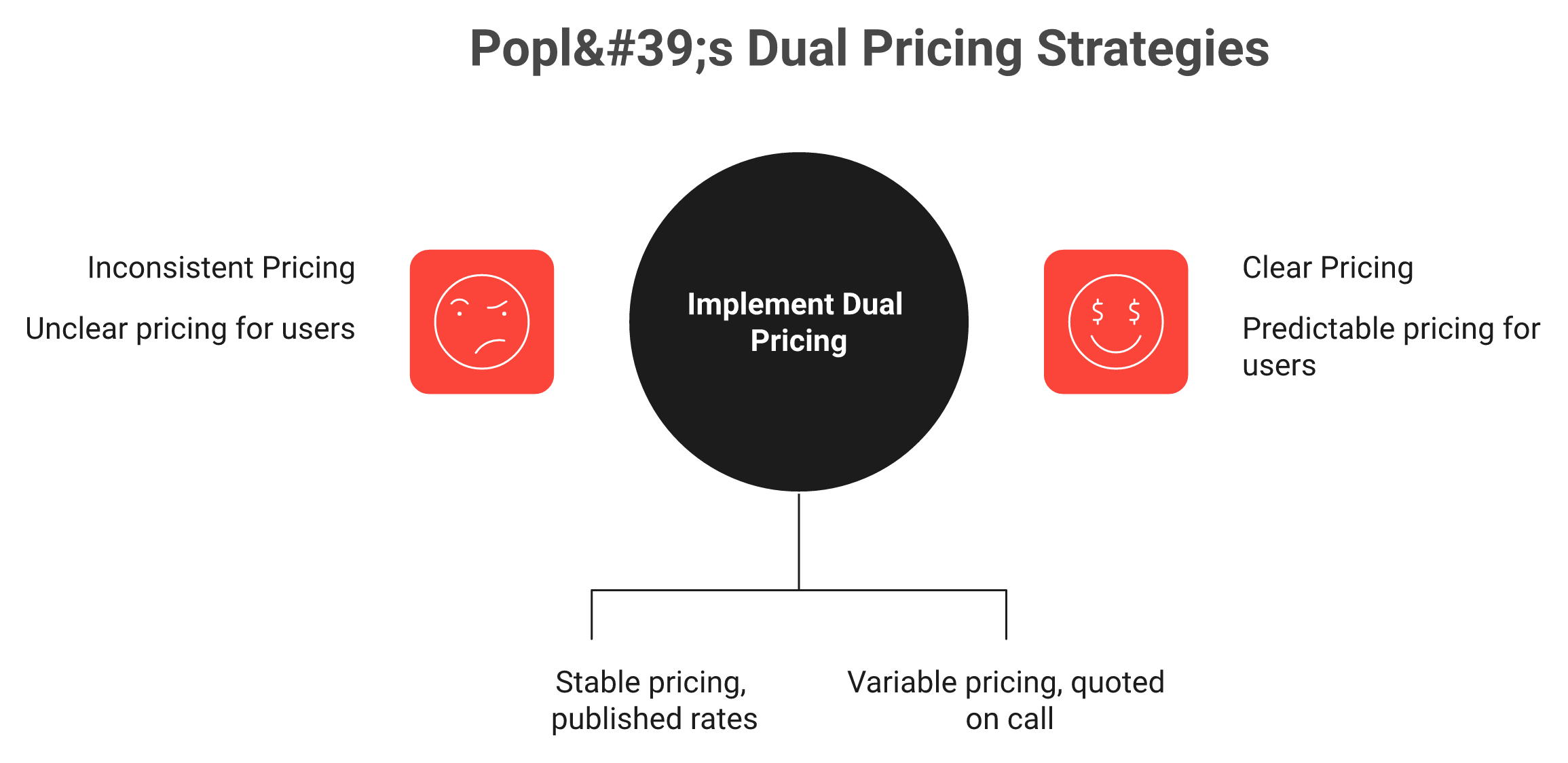
Popl publishes card seats but quotes event lead capture because they are different businesses. Digital business cards are the established revenue base, priced per seat. Event lead capture is the newer motion, priced on usage, badge scans, and enrichment credits, which varies too widely by show calendar to list. Any deployment beyond a handful of individual users is effectively quote-based.
🏗️ Two products, two pricing levers
Look at the structure rather than the intent. Popl's revenue base is digital business cards, and the event lead capture motion arrived later, with the brand repositioning toward in-person GTM.
A card is a stable unit. One person, one card, one seat, twelve months. That prices cleanly on a public page.
An event program is not stable. Scans depend on how many shows you exhibit at, how big the booths are, and how many reps you staff. Two companies with identical headcount can differ tenfold in annual scan volume.
Popl publishes card seats and quotes event capture because the two products have fundamentally different pricing levers.
📊 Usage pricing resists a public rate card
Popl's own pricing page routes team and event buyers to a conversation instead of a checkout. Third-party trackers note the event platform starting around $6,000 annually, which is also why buyers end up reading up on Popl alternatives before the first call.
That is why the number moves. The lever at the top tier is enrichment credits, not seats, so the quote is really a forecast of your annual show calendar.
🔄 The mismatch worth naming
Here is the part the category avoids saying out loud. Capture and enrich vendors price the input, meaning scans and credits.
The buyer is measured on the output, meaning meetings booked and pipeline sourced. Those two units do not convert into each other on their own, and closing that gap is the buyer's job, not the vendor's.
🧭 How to walk into the call
Quote-based vendors price against uncertainty. Remove the uncertainty and the quote tightens.
Bring three things: your confirmed show calendar for the next twelve months, your staffed headcount per show, and a realistic scan estimate per rep per day. A team that arrives with a forecast negotiates a credit tier, while a team that arrives with a headcount gets sold one.
⏰ Set the anchor before the demo
Decide your walk-away number before anyone shares a screen. Anchor it to total show spend, not to a monthly per-seat feeling. An event ROI calculator gets you to that figure faster than a spreadsheet built from scratch.
The published seat rates from section three give you the floor. The credit tiers give you the ceiling, and the gap between them is the whole negotiation. If you are also weighing enterprise scanners, the Popl and iCapture comparison shows how differently two vendors in the same category shape a contract.
Q5. What are Popl enrichment credits and what have buyers been quoted? [toc=5. Enrichment Credit Tiers]
At the bundled Event Lead Capture Platform tier, the lever is enrichment credits, not seats: a flat annual fee covers unlimited users, and price scales with how many contacts Popl auto-enriches per year. One buyer reported $6,000/yr for 500 credits, $10,500 for 1,000, and $17,500 for 2,500, unverified by Popl and best treated as a directional anchor.
🔍 What a credit actually is
A credit is spent when the platform enriches one scanned contact. Enrichment means filling in the data a badge does not carry, such as work email, job title, company size, or LinkedIn profile.
The badge scan itself is not the billable unit at this tier. The lookup that happens after the scan is. That distinction matters when you forecast, because a scan you never enrich costs nothing extra, and it is worth understanding before you compare any lead retrieval app for trade shows.
📉 The reported tiers, with the caveat attached
The three figures above come from a single buyer comment, republished in a 2026 competitor teardown, and Popl has not confirmed them. Other trackers place the event platform starting near $6,000 a year, which is consistent.
Read that as a range, not a rate card. Popl's own site says event pricing is usage-based and set on a call, and the company states you are charged only for badge-scan leads.
Buyer-Reported Popl Enrichment Credit Tiers
Reported tier
Annual figure
Effective cost per credit
500 credits
$6,000
$12.00
1,000 credits
$10,500
$10.50
2,500 credits
$17,500
$7.00
The per-credit rate falls as volume rises. That is the only part of the model you can negotiate on directly.
🧮 Forecast against the show calendar, not the fiscal year
Here is the calculation to run before the call. Multiply reps in the booth, times show days, times realistic scans per rep per day, times number of shows.
Six reps across a four-day show at 25 scans a day is 600 enrichments. That is one entire entry tier consumed at a single event. Teams that budget annually and staff aggressively discover this in month three.
⏰ Credits are a meter on follow-up capacity
One line from the field sums up why this matters. The money in a trade show is made in the follow-up, not in the scan.
Credits cap how many of those follow-ups get usable contact data attached. Running out mid-season does not just cost money. It quietly returns you to a contact list with holes in it, which defeats the point of collecting leads at a trade show in the first place.
🗣️ What buyers say about the scanning layer
"I didn't really use Popl because it didn't scan bar codes like I thought it would. Scanning badges should have given the name and contact info, but it didn't work when I tried it." - Drew D., Popl - G2 Verified Review, 0.5 stars
"I do not like anything about it except the idea to remove paper business cards, but there are other apps that do the same." - Liliana P., Popl - G2 Verified Review, 0.5 stars
Both reviews sit at the low end of the distribution, and neither is representative on its own. They matter here for one reason. If enrichment is the billable unit, scanning reliability is what you are actually buying, so test it on your show's badge format before signing a credit tier.
Q6. What hidden costs land after the show? [toc=6. Hidden Costs And TCO]
Buyers report per-enriched-lead fees of roughly $0.50 to $2.00 on top of subscription at the event tier, the most common source of post-show sticker shock. Add NFC hardware from about $9.99 to $79.99 per unit, Pro+ for branding removal at roughly $144 per user per year, and internal engineering time for CRM field mapping, Salesforce especially.
💸 The invoice nobody forecast
The pattern repeats every fall show season. A team signs in July on a per-seat number, staffs a big booth in October, and opens an invoice in November that does not match the spreadsheet.
The gap is almost always metered enrichment. User reports describe $0.50 to $2.00 per enriched lead layered on top of subscription. On 800 enriched leads, that is $400 to $1,600 nobody planned for.
The subscription is the tip. Metered enrichment and integration time are what actually move the invoice.
🧾 The seven cost layers
The Full Popl Cost Stack Beyond Subscription
Cost layer
What it runs
Base subscription
$0, $7.99, $11.99 to $14.99, or $4 to $5 per user per month for Teams
Branding removal
Pro+ required, about $144 per user per year
Per-scan enrichment
$0.50 to $2.00 per enriched lead, buyer-reported
Enrichment credit packages
About $6,000 to $17,500 per year, buyer-reported
NFC hardware
Roughly $9.99 to $79.99 per unit, one-time
CRM integration work
Internal engineering time, heaviest on Salesforce
Volume discounts
Available, unpublished, negotiation only
Only the first row appears on a public page. The other six show up in quotes, invoices, or your own team's calendar.
⚠️ The CRM line is a people cost, not a software cost
Field mapping is the work of matching app fields to CRM fields so records land clean. It sounds trivial until dedup rules and required fields get involved.
A Capterra reviewer put the Salesforce experience bluntly: "The import to Salesforce is horrible." If your revenue team lives in Salesforce, ask for a live sync demo using your own object model, not the vendor's sandbox, and hold it to the same standard as any Salesforce lead capture workflow you already run.
🗣️ What the metered model feels like from the buyer seat
"Having to create an account to view the info is not practical or helpful. Plus, my understanding is people have to pay for that?! Why?" - Mike K., Popl - G2 Verified Review, 0.5 stars
"The contact information was saved, even though I didn't have the app or an account yet. Which meant I could easily go back later and set it up. It is very seamless." - Howard N., Popl - G2 Verified Review, 1 star
The second quote is a fair counterweight. Reviewers who like the product like the capture experience, and the complaints cluster around what it costs to actually use the data.
✅ Price the season, not the month
Run the total across your real calendar. For a team doing 8 to 15 shows, add subscription, credits, hardware, and one week of internal integration time.
Against a booth program at $20K to $200K per show, software stays a small line. It stops being small when the metered layer is discovered instead of forecast, and one operator's framing holds up: the cabs and the hotel rooms cost more than the app, right up until the app bills by the lead. Running the same numbers through an event ROI calculator makes the season total visible before you sign.
Q7. What do buyer reviews say about whether Popl is worth the price? [toc=7. Review Sentiment On Cost]
Cost is the dominant complaint pattern. Across roughly 5,292 G2 reviews, 385 mention "expensive" and 256 mention "additional costs," concentration large enough to read as signal. A separate teardown counted "expensive" 332 times across 5,565 reviews. Capterra reviewers flag Salesforce import quality. Positive reviews cluster on card usability, not event-tier economics.
📊 How the counting works, and what it does not prove
Review platforms tag recurring words across a review body. Counting those tags is a crude method, and it is still more honest than picking three quotes that suit an argument.
What the count shows is theme concentration. What it cannot show is severity, company size, or which tier the reviewer was on. Treat it as a map of where friction lives, not a verdict.
❌ Three complaint clusters that repeat
The first cluster is price relative to perceived value. Reviewers frame the product as a card-sharing app and question the subscription against that frame.
The second is the account and paywall barrier for recipients. The third is CRM sync quality, with Salesforce named most often. Each cluster maps to a different tier, which is why generic star ratings mislead here.
"The cost is very high considering it's mostly a digital business card sharing app. It's not much different than adding a QR code to my business card." - Brooke N., Popl - G2 Verified Review
"None. I'd love it if you could easily send and receive info, but everyone has to have a Popl account in order to do so. That creates a HUGE barrier that other competitors don't have." - Mike K., Popl - G2 Verified Review, 0.5 stars
⭐ The fair counter-case
Popl holds well over 4,000 G2 reviews and a 4.6 average, alongside a 4.8 App Store rating across roughly 81,000 ratings. A handful of one-star reviews does not overturn that.
The satisfied majority praises the card experience, the tap-to-share flow, and enrichment coverage. Those reviewers are mostly individual users on published pricing, which is exactly the group whose price is transparent. Buyers weighing the same trade-off often end up reviewing Popl alternatives before committing.
⚠️ Why the ratings split by tier
Read the distribution by product, not by brand. The card product has thousands of happy reviewers and a public price.
The event product has a smaller reviewer base and a quoted price. Cost complaints concentrate where the price is negotiated, which is a predictable pattern in any usage-billed category.
🧭 What to do with this before you sign
Ask the vendor for two references on your own tier, not the company's best logo. Ask both what their invoice looked like after their largest show.
One field-sales truth applies here. A large share of decision makers already feel vendors do not understand their situation, and the fastest way to test that is to make the reference call about the invoice, not the demo.
Q8. How does Popl's cost compare to badge-scanner rental and to alternatives? [toc=8. Cost Versus Alternatives]
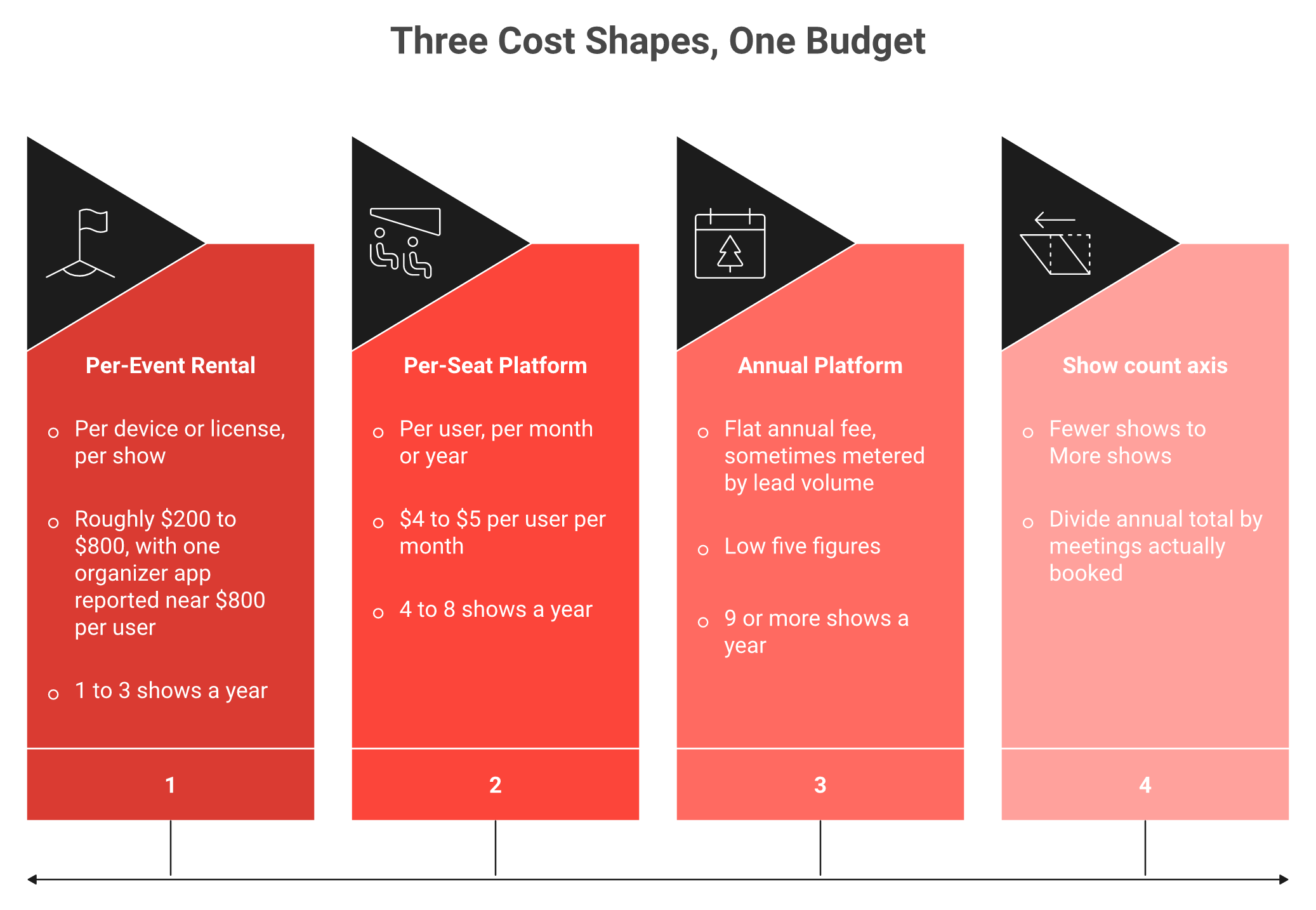
Three cost shapes compete for the same budget: organizer badge-scanner rental at roughly $200 to $800 per device per show, per-seat card platforms like Popl Teams at $4 to $5 per user per month, and annual event-capture platforms in the low five figures. Rental looks cheapest per show and is usually the most expensive per booked meeting, because the data serves the organizer's workflow.
💰 The three shapes, defined
Show count, not sticker price, decides which of these three cost shapes is cheapest for your team.
Per-event rental bills by device or license, per show. Per-seat platforms bill by user, per month or year. Annual platforms bill a flat fee, sometimes metered by lead volume.
These do not convert into each other cleanly. A team at three shows a year and a team at fifteen will reach opposite conclusions from the same rate card, which is why the best event lead capture software in 2026 depends heavily on show count.
📋 What the market charges
Event Lead Capture Pricing by Cost Shape
Option
Cost shape
Reported price
Organizer rental scanner (displacement reference)
Per device, per show
$200 to $800, one Freeman app reported near $800 per user
Popl Teams (cards)
Per seat
$4 to $5 per user per month
Popl Event Lead Capture
Usage-based
Quote only, around $6,000/yr reported
Mobly
Annual, per-event volume
Subscription, quote
Blinq
Annual
From about $2,400/yr
Captello
Per-event license
From $500/yr for one event license
Momencio
Single-event plans
Under $300 per event reported
BoothIQ
Flat monthly
$499/mo, about $6,000/yr
iCapture
Annual
$8,000+/yr
Sources are the vendors' own pages and 2026 comparison teardowns. The organizer's rental scanner sits in the table as the incumbent you are displacing, not as a peer product. For a closer read on two of these contract shapes, see the Popl and iCapture comparison.
🗣️ What exhibitors actually pay for rental
"We pay between 150 to 300 per scanner. It depends on the show that we're going to." - commenter, r/marketing Reddit Thread
"Freeman is the most common organizer for shows and the QR app they have is (or last time I looked) was like $800 per user." - commenter, r/sales Reddit Thread
That spread, $150 to $800 per user per show, is the number to beat. Twelve mobile licenses at one show came in around $1,200 to $1,300 for one team in the same thread.
❌ Why rental is expensive where it counts
Rental saves the contact and ends at the CSV. The scan feeds the organizer's system first, and you receive a file, sometimes days later.
One exhibitor's assessment of the organizer badge was harsher than any review site: the tag collects leads for them, and does nothing for you. Cheap per show, expensive per meeting, which is the case for universal lead capture that you own across every show.
✅ Scenario picks by show count
1 to 3 shows a year: per-event pricing wins, so rental or a single-event plan is defensible. 4 to 8 shows: per-seat or flat-rate annual usually crosses over.
9 or more shows: annual platforms almost always win on total cost, and metered models need a hard credit forecast first. Whichever shape you pick, divide the annual total by meetings actually booked, because that is the only unit these three models share, and it is the number that matters most when measuring event ROI.
Q9. What does the price not buy, and what is your cost per booked meeting? [toc=9. Cost Per Booked Meeting]
Divide total annual platform cost, including metered enrichment, by meetings actually booked from events. The denominator is where budgets die: up to 80% of trade-show leads never receive follow-up, only 47% of exhibitors track leads through the sales cycle, and conversion runs near 10% when follow-up happens inside 48 hours. Licensing does not create follow-up.
❌ The denominator nobody prints on a pricing page
Every Popl pricing article, including the ones ranking above this one, stops at the numerator. They tell you what the software costs and never ask what it produces.
The industry data on the other side is unkind. CEIR and Exhibit Surveys research, cited across 2026 roundups, puts unfollowed trade-show leads as high as 80 percent, with a separate CEIR figure at 79 percent receiving no follow-up at all.
📉 Speed is the whole variable
Follow-up inside 48 hours converts near 10 percent. Wait longer and the curve falls off hard.
That is why a cheap seat can be an expensive decision. A $4 license that still leaves the follow-up to a post-show email batch has not changed the denominator at all, which is the real test of any lead capture app you are pricing.
🧮 The formula, worked on a real calendar
Take a mid-size industrial exhibitor at six shows a year. Assume 25 seats on the annual card plan at $1,200, plus a mid-tier credit package at $10,500. Total: $11,700.
Now the output side. Six shows at 300 qualified conversations each is 1,800 leads. If a fifth get properly worked and 8 percent convert to meetings, that is 144 meetings.
Cost Per Booked Meeting Worked Example
Line
Value
Annual software total
$11,700
Qualified conversations per year
1,800
Meetings booked (post-event follow-up)
144
Cost per booked meeting
$81
Meetings if booked on the floor instead (2x)
288
Cost per booked meeting
$41
The software cost never changed. Only the denominator did. Running the same inputs through an event ROI calculator gives you both figures in one pass.
💰 Put it beside the cost of the lead itself
Context matters here. Industry benchmarks place the cost of a trade-show lead around $112, against roughly $259 for a field-sales lead.
Software is a small slice of that $112. The expensive part is the booth, the flights, and the four days of rep time attached to every conversation you fail to work, which is exactly what measuring event ROI is supposed to surface.
⚠️ Run the math backwards, not forwards
Most teams start with a budget and ask what they can afford. Start with the pipeline target instead.
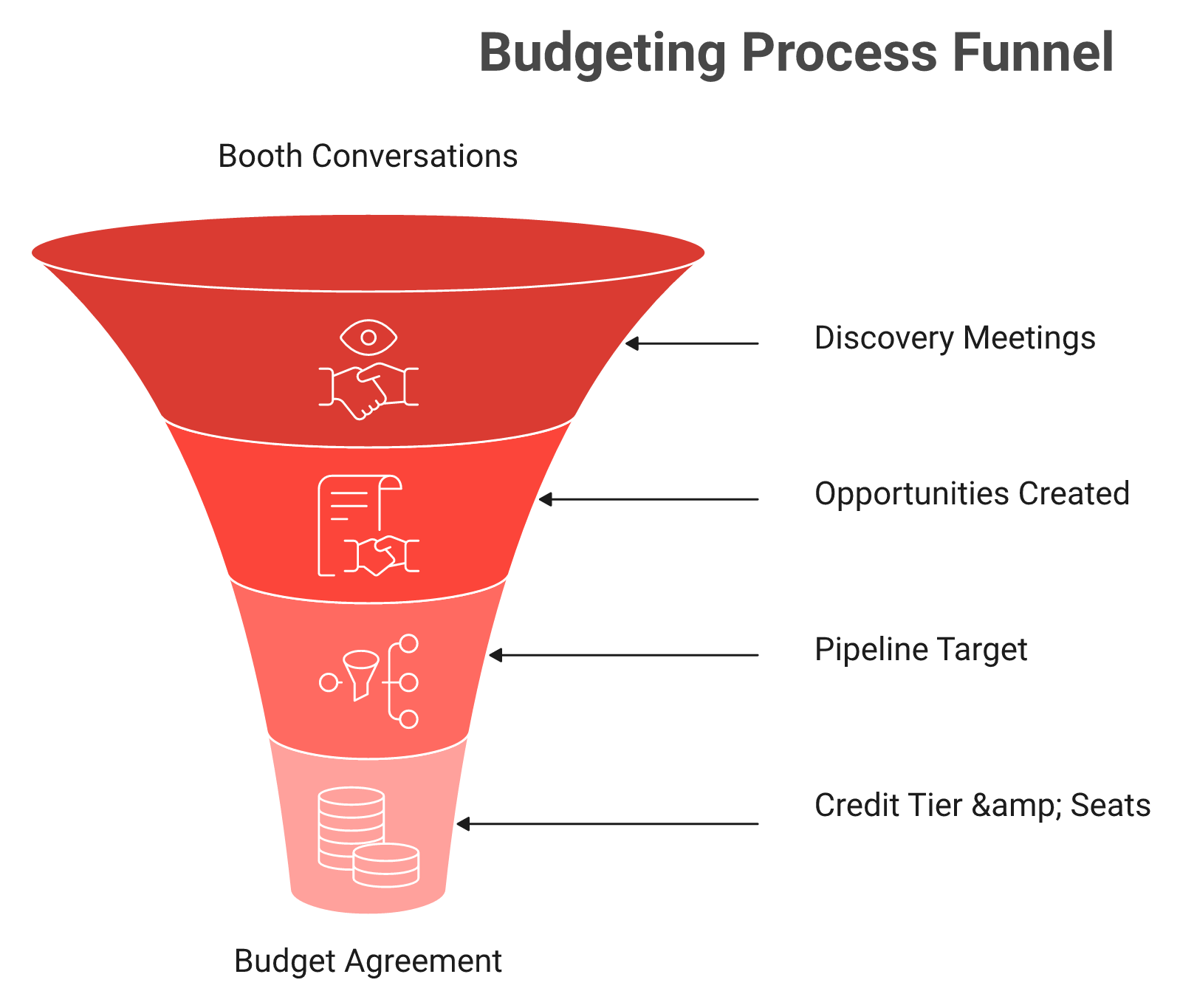
Work backwards: pipeline target, then opportunities needed, then discovery calls needed, then qualified booth conversations needed. That last number is your scan forecast, and it sizes your credit tier for you.
Size the denominator before the quote. Scans, meetings, and opportunities set the tier, not the other way round.
One operator's line cuts through the tooling debate entirely. The goal is not to scan badges, the goal is to sell meetings.
⏰ What changes on the quote call
Walk in with a cost-per-meeting target instead of a per-seat ceiling. It reframes the conversation from licensing to outcomes.
There is a harder version of this framing worth sitting with. Only about one in twenty exhibiting companies actually acts on the leads they capture. The license is not buying capture. It is buying a seat inside that five percent, and only if the workflow for collecting leads at a trade show is real.
Q10. What should you ask on the Popl quote call? [toc=10. Quote Call Checklist]
Two levers move: seats on the Teams card plan and enrichment credits on the event platform. Volume discounts exist but are unpublished, and licenses are reassignable per Popl's own FAQ. Ask for credit rollover, per-scan overage rates in writing, a live CRM sync demo using your own field mapping, hardware bundled at cost, and a single-show pilot before annual commitment.
🧭 Why the quote moves at all
Quote-based vendors price against uncertainty. When a rep cannot tell how many scans you will run, the quote absorbs that risk on their side, not yours.
Remove the uncertainty and the number tightens. A buyer who arrives with a confirmed show calendar, staffed headcount, and a scan forecast is negotiating a tier. A buyer who arrives with a headcount is being sold one.
💸 The two levers, plainly
Seats govern the card plan. Credits govern the event platform, and the per-credit rate falls as volume rises.
Everything else is packaging. Hardware, onboarding, and support tiers are usually where a rep can concede without touching the headline rate. Buyers who want a second data point on contract shape often read the Popl and iCapture comparison before the call.
✅ The ten questions
What is the exact per-scan or per-enriched-lead overage rate, in writing?
Do unused enrichment credits roll over to the next contract year?
What happens the month we exceed the tier, do we auto-upgrade or get billed at spot rate?
What is the volume discount at our seat count, and at the next tier up?
Are licenses reassignable mid-contract when a rep leaves?
Can we see a live Salesforce or HubSpot sync using our own field mapping, not a sandbox?
What is the dedup behavior when three reps scan the same person at one show?
Is NFC hardware bundled, and at what unit price?
What are the offline capture limits when expo-hall Wi-Fi drops?
Can we run one show as a paid pilot before committing to twelve months?
⚠️ The answers that should worry you
Question six is the one that separates a good call from an expensive one. A reviewer's blunt verdict on the Salesforce path was that the import is horrible.
If the rep will not map your own objects live, assume integration work lands on your team. Price that as engineering hours in your total, not as a footnote, and compare it against how a native Salesforce lead capture setup should behave.
📇 Test the workflow, not the feature list
Ask them to demo the whole loop in one sitting. Scan, add context, sync, and send the follow-up.
Time it. One practitioner's discipline is to organize every contact within 48 hours, at the hotel, before the night is over. If the tool cannot support that on a demo screen, it will not support it at 4pm on day two, and the same test applies to every lead capture app for trade shows on your shortlist.
⏰ Set your anchor before anyone shares a screen
Decide your walk-away number in advance, tied to cost per booked meeting from the previous section. Published seat rates give you the floor. Reported credit tiers give you the ceiling. If the quote lands above both, the Popl alternatives worth pricing are the ones with a published rate card.
Here is the question worth carrying into the next 18 months of these calls. As every vendor in this category adds meeting booking and AI enrichment, the feature list stops separating them, so the real question becomes which contract shape lets you prove pipeline to a CFO without a spreadsheet in the middle. If you have run this negotiation recently, the overage clause you got is the part worth comparing notes on.
FAQ's
How much does Popl cost per user in 2026?
Popl splits into two product families with very different pricing logic. The individual plans are published; the team and event plans are not.
Free: $0, one digital card, Popl branding attached, and only the five most recent connections viewable.
Pro: $7.99 per month, or $79.99 billed yearly, adding unlimited links, lead capture mode, CRM auto-sync, and analytics.
Pro+: $14.99 per month, or $11.99 per month billed annually, adding up to five cards, custom lead-capture forms, and branding removal.
Teams Digital Business Card: $5.00 per user per month, or $4.00 billed annually, with a five-user minimum.
Teams Event Lead Capture: usage-based, quoted on a call.
Event Lead Capture Platform: flat annual fee covering unlimited users, priced by enrichment credits.
One detail changes the whole calculation for exhibitors. Badge scanning does not appear on any individual plan or on the Teams card plan. A team that buys the $4 seat has bought digital business cards, not an event lead capture system.
Treat the published rates as the floor of your budget rather than the total. Every deployment past a handful of individual users becomes a custom quote.
Is the Popl free plan usable for a trade show?
Not for a staffed booth. The free tier works as a product trial and stops working as soon as conversation volume rises.
Two limits cause the problem:
Contact visibility is capped at your five most recent connections, so the sixth conversation pushes the first one out of view.
You get one digital card, and it carries Popl branding until you reach Pro+.
A rep working a busy floor clears dozens of conversations in a single day. Five visible contacts is a ceiling reached before the first coffee break, not a constraint you manage around.
The free plan also does not include badge scanning, which is the function most exhibitors are actually shopping for. That capability is gated behind the event tiers.
The fair comparison is not free software against paid software. It is free software against the paper business card, and the paper card has a documented failure rate above 90 percent when measured by inbound replies after a show. A free tier that hides your contacts after five does not beat that baseline. It moves the same loss into an app, where it is harder to notice until the follow-up window has already closed.
Why does Popl not publish event lead capture pricing?
Because cards and events are two different businesses with two different pricing levers, and only one of them prices cleanly on a public page.
A digital business card is a stable unit. One person, one card, one seat, twelve months. That is straightforward to list.
An event program is not stable. Scan volume depends on how many shows you exhibit at, how large the booths are, and how many reps you staff. Two companies with identical headcount can differ tenfold in annual scan volume, which makes a single published rate meaningless.
Popl's pricing page routes team and event buyers to a conversation rather than a checkout, and third-party trackers place the event platform starting near $6,000 annually.
The practical consequence is worth naming. Capture and enrich vendors price the input, meaning scans and enrichment credits. The buyer is measured on the output, meaning meetings booked and pipeline sourced. Those two units do not convert into each other automatically, and closing that gap remains the buyer's job.
Walk into the call with a confirmed show calendar, staffed headcount per show, and a realistic scan estimate. Quote-based vendors price against uncertainty, so removing it tightens the number.
What hidden costs should exhibitors budget for beyond the subscription?
The sticker price is one of at least seven cost layers, and only the first appears on a public page.
Per-scan enrichment: buyers report roughly $0.50 to $2.00 per enriched lead on top of subscription at the event tier.
Enrichment credit packages: buyer-reported at about $6,000 to $17,500 per year depending on volume.
Branding removal: requires Pro+, adding roughly $144 per user per year.
NFC hardware: physical cards and tags run about $9.99 to $79.99 per unit as a one-time cost.
CRM integration work: internal engineering hours, heaviest on Salesforce field mapping and dedup rules.
Volume discounts: available but unpublished, so they only surface through negotiation.
The metered enrichment line is the usual source of post-show sticker shock. On 800 enriched leads, a $0.50 to $2.00 range means $400 to $1,600 that never appeared in the July spreadsheet.
Price the season rather than the month. For a team running eight to fifteen shows a year, add subscription, credits, hardware, and roughly one week of internal integration time before comparing anything.
How does Popl's cost compare to renting the organizer's badge scanner?
Three incompatible cost shapes compete for the same budget, and comparing them on sticker price alone produces the wrong answer.
Organizer rental scanner: roughly $200 to $800 per device or license, per show. Exhibitors on Reddit report paying $150 to $300 per scanner, with one organizer app quoted near $800 per user.
Per-seat card platforms: $4 to $5 per user per month, billed annually.
Annual event capture platforms: low five figures, sometimes metered by lead volume.
Rental looks cheapest per show and is usually the most expensive per booked meeting. The scan feeds the organizer's system first, and the exhibitor receives a file afterward, sometimes days later.
Use show count as the deciding variable:
One to three shows a year: per-event pricing is defensible.
Four to eight shows: per-seat or flat annual usually crosses over.
Nine or more shows: annual platforms almost always win on total cost, provided the credit forecast is done first.
Whichever shape you choose, divide the annual total by meetings actually booked. That is the only unit all three models share.
Enjoyed the read? Join our team for a quick 30-minute chat — no pitch, just a real conversation on how we’re rethinking Event Intelligence in B2b.

.png)

.png)
.png)