Blinq Reviews: G2, Capterra, and Reddit Verdicts Compared
Written by
Sridhar Ranganathan
Last Updated :
August 15, 2026
Skim in:
13
mins
TL;DR
Blinq holds 4.8/5 on G2 across roughly 8,949 reviews and 4.9/5 on Capterra across 702, but most of that volume rates card sharing, not booth lead capture.
The dominant complaint is recipient-side: save friction appears in 39% of 67 relevant Capterra mentions, and link-trust confusion in 48% of 44.
Trustpilot's 3.3/5 across roughly 3,370 reviews belongs to blinq.com, a different Washington DC company, not blinq.me in Melbourne.
Seats start at $4.99 per card monthly with a five-card minimum, but scanning and CRM export are credit-metered, so the subscription is never the full bill.
There is no substantive 2026 r/b2bmarketing thread on Blinq for booth capture, and several popular video reviews carry affiliate disclosures.
B2Brain measures the same decision on Leads-to-Meeting, running 52% on the floor against an 8% industry average for post-event follow-up.
Q1. Is Blinq worth it for a B2B exhibitor in 2026? [toc=1. Blinq Verdict 2026]
Blinq is worth it when the job is sharing a polished digital card. It holds 4.8/5 on G2 across roughly 8,949 reviews, 4.9/5 on Capterra across 702, and 4.8/5 on Google Play across 31.1K ratings. For a booth team, the picture narrows. Scanning and CRM export are credit-metered, and the most repeated complaint is recipients failing to save the contact.
⏰ Six weeks out, staring at 8,900 five-star reviews
A Field Marketing head I spoke with had FABTECH on the calendar and a shortlist of three tools. She opened the G2 page for Blinq and found a wall of praise. Her actual question was different: will this produce meetings my CEO can see in Salesforce?
That gap is the whole problem. A star rating tells you whether an app is pleasant. It does not tell you whether a $70K booth produced pipeline, which is the question the booth ROI math actually answers.
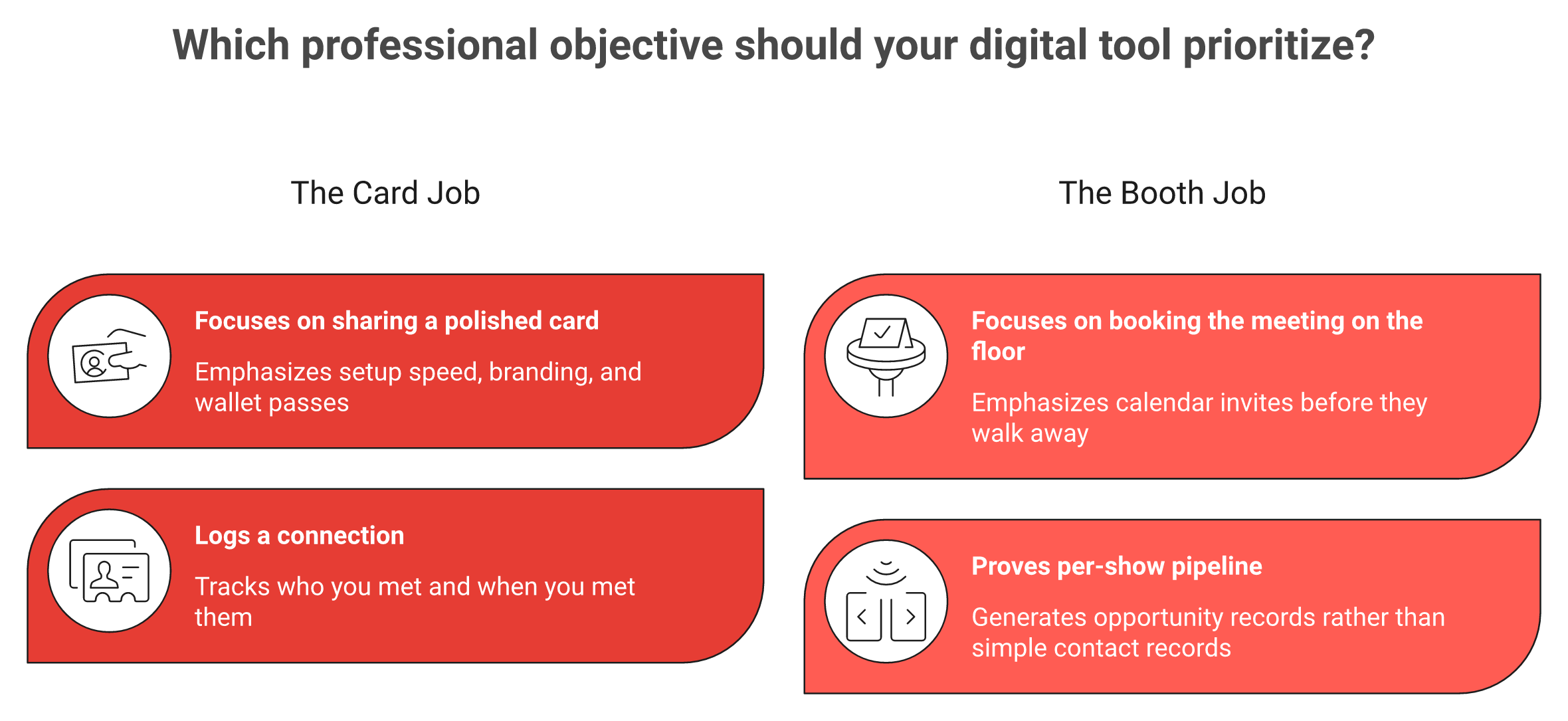
Most Blinq reviews rate the card job on the left. Exhibitors are buying the booth job on the right.
⭐ What the numbers actually say, by platform
Blinq Ratings Across Review Platforms, August 2026
Platform
Score
Reviews
What it mostly rates
G2
4.8/5
~8,949
Card sharing, team card management
Capterra
4.9/5
702
Ease of use, setup speed
Google Play
4.8/5
31.1K
Consumer app experience
Trustpilot (blinq.com)
3.3/5
~3,370
A different company entirely
Blinq's own site claims 4.9/5 across 150,000 app-store ratings. Both things are true at once. The app is well liked, and most of that liking comes from a job that is not booth lead capture.
Reviewers are honest about the ceiling. One G2 reviewer summed up the pattern in a single line.
"Blinq looks great and when it works it's a good user experience and good branding for the person showing their business card. They have a good depth of tools on the backend to manage a team of users." — Verified User in Hospitality, Blinq - G2 Verified Review (1★, Sept 2025)
"Nothing yet. This hasn't helped me with my business." — Lupita E., Blinq - G2 Verified Review (0.5★, Sept 2025)
💰 The decision rule that should structure your evaluation
Ask which job you are buying for. If the job is looking professional when you hand over contact details, Blinq is a strong pick, and the free tier is real.
If the job is booth pipeline, apply the exhibitor's math instead. A ~$70K booth with a 10x pipeline target needs roughly 50 opportunities. That means about one in five booth visitors must become a qualified meeting, which is exactly what the booth-day workflow has to deliver.
Peer review sites are also feeding the machines now. As one operator put it, a lot of what AI assistants say about vendors "comes directly from G2." That makes review-mix skew a ranking problem, not just a reading problem.
⚠️ Where I could be reading this wrong
My read is that credit-metered scanning punishes high-volume booths hardest. I might be overweighting that, since a team running two shows a year may never feel it. Model your own volume before you decide.
B2Brain scores the same decision on a different number: Leads-to-Meeting, meetings booked divided by qualified booth leads, running 52% on the floor against an 8% industry average for post-event follow-up. No competitor in this category tracks LTM at all, which is exactly why review scores feel like the only available evidence. If you want the workflow behind that number, Book a Demo.
Q2. What do reviewers consistently praise about Blinq? [toc=2. What Reviewers Praise]
Capterra logs positive sentiment in 98% of 109 ease-of-use mentions. Reviewers cite five-minute setup, brand-consistent team cards, wallet passes, and a free tier that works without a credit card. One G2 reviewer called it "the most common app I saw being used at a conference," which matters more than it sounds. A card standard only works when the other person already recognises it.
✅ Setup speed is the single most repeated compliment
Nobody praises Blinq for depth. They praise it for how fast it disappears into the workflow.
Reviewers describe getting a branded card live in one sitting. For a distributed team rolling out 40 cards before a conference, that is a real operational win.
"The initial setup was also easy, which is a significant advantage when adopting a new tool. I found the concept neat because it appeared to resolve the need for physical business cards, especially useful at networking events where QR codes could be easily scanned." — Sarah H., Blinq - G2 Verified Review (0.5★, Nov 2025)
Note the star rating on that quote. The praise is genuine, and the verdict is still negative, which is the shape of the whole Blinq corpus.
📇 Adoption density is an underrated strength
A digital card is a network product. Its value rises when the person across the table has seen one before.
Blinq reports 2.5 million users across 500,000 companies, including staff at 93% of Fortune 500 firms. That reach is backed by a $25M Series A in May 2025, with HubSpot Ventures participating. The polish is funded, and it shows.
"For one, it is the most common app I saw being used at a conference I went to a couple weeks ago, which allowed for streamlined use. It also allows me to add people I add to Blinq straight to my contacts in my phone." — Verified G2 reviewer, Blinq - G2 Verified Review (April 2025)
🗂️ Contact history helps with the memory problem
The feature reviewers mention that actually touches field work is the connection log. Seeing when you met someone is a small thing that solves a real one, and it is the shallow end of what universal lead capture is meant to do.
"I like that I can see the exact day or number of days ago that I've connected with a person. Being able to see exactly what information I'm sharing with them, including a photograph, is great. This feature helps me remember who they are, especially when there are a lot of similar names." — Verified G2 reviewer, Blinq - G2 Verified Review (3★, June 2025)
⚠️ Which strengths survive the walk to the booth
Brand consistency travels well. So does the free tier for a founder attending a first US show.
What stops at the coffee meeting is the workflow after the exchange. A logged connection is not a qualified lead, and a saved contact is not a booked meeting.
On social proof, honesty matters more than spin. B2Brain has 17 G2 reviews against Blinq's 8,800-plus, which is a real gap and a stated velocity campaign, so the case rests on the LTM outcome rather than the review count.
Q3. What are the most common Blinq complaints across G2, Capterra, and Trustpilot? [toc=3. Common Complaints]
Three failure modes repeat across platforms. Recipient-side save friction appears in 39% of 67 relevant Capterra mentions. Link-trust confusion appears in 48% of 44. The third is connectivity, described by one reviewer as failing "especially in places with poor internet connectivity." A 0.5-star G2 review puts the pattern bluntly: "the recipient never actually gets the card."
📉 Why a 4.8 average hides the expensive failures
Averages measure the sender's experience. Every complaint below is about the recipient, the person who was never asked to rate anything.
That asymmetry is why this pattern survives a high score. You do not get a support ticket from the prospect who gave up saving your card.
Blinq Complaint Patterns by Failure Mode
Failure mode
Frequency
Source
Date
Recipient cannot save contact
39% of 67 mentions
Capterra clusters
2026
Shared link looks untrustworthy
48% of 44 mentions
Capterra clusters
2026
Fails on weak venue connectivity
Repeated in 1 to 2★ G2 reviews
G2
Oct 2025
Admin backend bugs, App Clip failures
Repeated in 1★ G2 reviews
G2
Sept 2025
❌ Save friction, in the reviewers' own words
This is the dominant complaint, and it is remarkably consistent across two years.
"It's supposed to be a convenient way to transfer your business card but every time I've tried to use it, the recipient never actually gets the card. I've tried texting it, sharing the link, etc. but it doesn't work." — Lupita E., Blinq - G2 Verified Review (0.5★, Sept 2025)
"After scanning there are too many steps for people to share their data or store mine. I spend 5 mins or more working with the person to get the info exchange. Most end up just handing me their business card, so at that stage, what's the point." — Paul, Blinq - TrustPilot Verified Review (3★, May 2026)
Five minutes per exchange is not a UX annoyance at a booth. At peak, it is the difference between 30 conversations and 8.
🔗 Trust and delivery problems compound the friction
Two separate issues make the link itself the weak point.
One reviewer reported the hosting domain being flagged as malware, which killed the workflow entirely. Another described App Clips failing to open for recipients, making the exchange unreliable for a whole team. Neither problem shows up in a badge scanning app comparison built from feature lists.
⚠️ The complaint operators should weight heaviest
The follow-up organisation problem is the one that costs pipeline, and almost nobody flags it.
"When you do share your info, it saves the person's 'business card' as contact info in their phone. This makes it tough to find again after a big tradeshow, event, etc. With paper business cards, you have them all stacked later in one place for follow ups. With Blinq, all the follow ups are just in your sea of contacts." — Verified G2 reviewer, Blinq - G2 Verified Review (2★, May 2025)
Recipient-side failure is the expensive kind. You never learn which leads you lost, so it never appears in the post-show review.
B2Brain built Recent Leads for the adjacent rush-hour problem, letting a rep scan now and add voice context later, with a structured CRM record produced in about 4.2 seconds. The gap being solved is the same one these reviews describe: capture that does not survive the crowd. The full sequence sits in how event lead capture works.
Q4. How much should you trust Blinq's review scores? [toc=4. Review Score Credibility]
Four caveats. Most of Blinq's ~8,900 G2 reviews rate card sharing, not booth lead capture. Trustpilot's 3.3/5 across ~3,370 reviews belongs to blinq.com, a Washington DC company, not blinq.me in Melbourne. The top Reddit result is a 2022 r/smallbusiness thread, not a field-marketing verdict. Several popular video reviews carry affiliate disclosures.
🔍 The review corpus is answering a different question
Most people think review volume equals confidence. In this category, volume mostly signals which job the tool is used for.
G2 places Blinq in the digital business card category, where its Address Book score sits at 8.5 and Accuracy Verification at 8.7, both under category average. Those are precisely the dimensions a booth team depends on.
Blinq also publishes its own roundup of the best event lead capture software and ranks itself first in it. That is normal vendor behaviour, and it is not third-party evidence.
⚠️ Two different companies, one confused score
This trips up procurement teams constantly.
blinq.me is the Melbourne-based digital business card company. blinq.com is an unrelated Washington DC business carrying a 3.3/5 Trustpilot score across roughly 3,370 reviews.
If a vendor memo cites 3.3/5, check the domain before it reaches your CFO.
💬 Reddit's silence is itself the finding
I went looking for a 2026 r/b2bmarketing thread where exhibitors debate Blinq for booth capture. It does not exist.
The most-surfaced organic thread is a 2022 r/smallbusiness question asking whether clients will accept a QR card at all. What Reddit is loud about is the badge scanner default, and one operator's framing has stuck with me: the organizer's lanyard "collects leads for them, it does nothing for you."
"Need to order business cards. Anyone have any experience using Blinq (QR code for contact info and NFC card)? Any positive/negative feedback from clients?" — r/smallbusiness, Reddit Thread (2022)
The same operator described the follow-up reality plainly, and it matches what I see in deployments: roughly one in twenty businesses acts on the show lead list before three months have passed. That is the pattern a conference badge scanner alone will never fix.
💸 Follow the incentives on every surface
Three incentive layers sit between you and an honest verdict.
Vendor comparison blogs are written by competitors selling an alternative.
Video reviews frequently disclose affiliate partner links.
Review sites let rivals buy placement on your product page.
None of that makes the data useless. It means you weight repeated one-star patterns above averages, and dated verbatims above scores. The same discipline applies when you read a head-to-head like HiHello vs Blinq.
B2Brain's read is that the standard advice gets review research backwards, because buyers sort by score when they should sort by job-to-be-done, then measure the tool on Leads-to-Meeting rather than stars. I might be pushing that too hard, but the 52% versus 8% gap between on-floor booking and post-event follow-up is the number that survives contact with a QBR.
Q5. What does Blinq actually cost across an 8-to-15-show season? [toc=5. True Season Cost]
Business seats start at $4.99 per card per month billed annually, with a five-card minimum, so roughly a $24.95 monthly floor. Usage credits are billed on top, monthly in arrears. Blinq's help centre prices one credit per enriched lead at $9.99. Third-party teardowns model five credits per scan at about $1 each, or a Lead Capture add-on from $199 monthly.
💰 The subscription is never the bill
A VP Sales approved Blinq at $4.99 per seat and thought the events line was settled. The credits arrived after the show, and nobody had modelled them.
Blinq's lead capture is usage-based by design. You pay for CRM-ready leads on top of the seat cost, which is a different shape from what B2Brain costs per event.
💸 Two sources, two very different prices
This is the part no ranking page flags. Blinq's own documentation and the competitor teardowns do not agree.
Blinq Lead Capture Pricing by Source, 2026
Source
Unit
Price
Type
Blinq Help Center, Jul 2026
1 credit per enriched lead
$9.99 per credit
Vendor primary doc
Blinq pricing page
Business seat
$4.99 per card per month, annual
Vendor primary doc
Wave Connect, Feb 2026
5 credits per scan
~$1 per credit
Competitor estimate
MagicLink, Jun 2026
Lead Capture add-on
From $199 per month
Competitor estimate
Treat the bottom two rows as labelled competitor estimates, not facts. Ask Blinq directly which model applies to your contract.
⏰ A 100-badge show, modelled two ways
Take one mid-size industrial show. Five reps, 100 scans, and 100 CRM exports.
On the third-party model, that lands near $1,000 for a single show. On Blinq's published credit price, 100 enriched leads reach a much larger number. Either way, the seat cost is the small line.
Now run it across a season. Eight shows at that volume put your capture spend somewhere between $8,000 and a figure that needs finance approval, which is why the event ROI calculator matters more than a price page.
⚠️ The denominator most buyers get wrong
Cost per scan is the wrong unit. A trade show is hunting at a baited field, so the software is marginal against booth build, drayage, and hotel rooms.
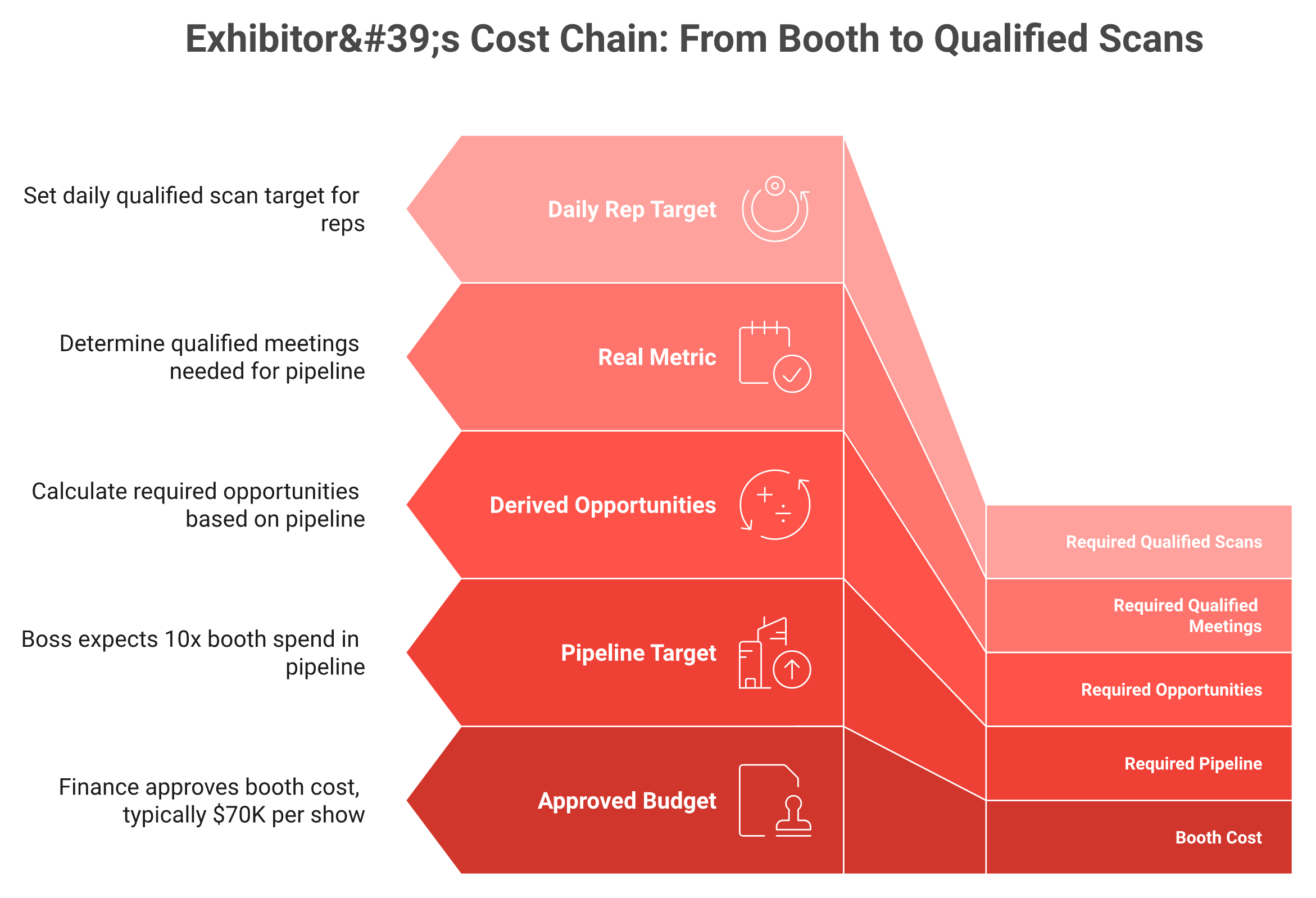
What matters is cost per booked meeting. The chain runs booth cost, then required pipeline, then required meetings, then required qualified scans.
Here is the math I use with founders. A ~$70K booth with a 10x pipeline target needs about 50 opportunities. At roughly 12% discovery-to-close, that means about 180 discovery calls, so close to one in five booth visitors must become a qualified meeting.
✅ What to model before you sign
Four inputs, and you can build this in a spreadsheet in ten minutes.
Scans per rep per day, times reps, times show days.
Credit price confirmed in writing by the vendor.
Expected meetings booked, not leads captured.
Total divided by meetings, compared against your outbound cost per meeting.
Only the fourth number tells you anything. As one operator put it, the money in a trade show is made in the follow-up, not the capture, which is the whole argument for measuring event ROI at the meeting level.
Price per scan tells you nothing. This is the chain that decides whether a show pays for itself.
B2Brain publishes the outcome benchmark instead of a per-scan rate: 31 scans a day for a productive rep, with a qualified event meeting costing roughly 60% of an outbound meeting and about 40% of paid acquisition. Those are the two numbers a CFO can actually compare against existing spend.
Q6. Does Blinq hold up on a convention floor and get follow-up out fast enough? [toc=6. Floor and Speed Test]
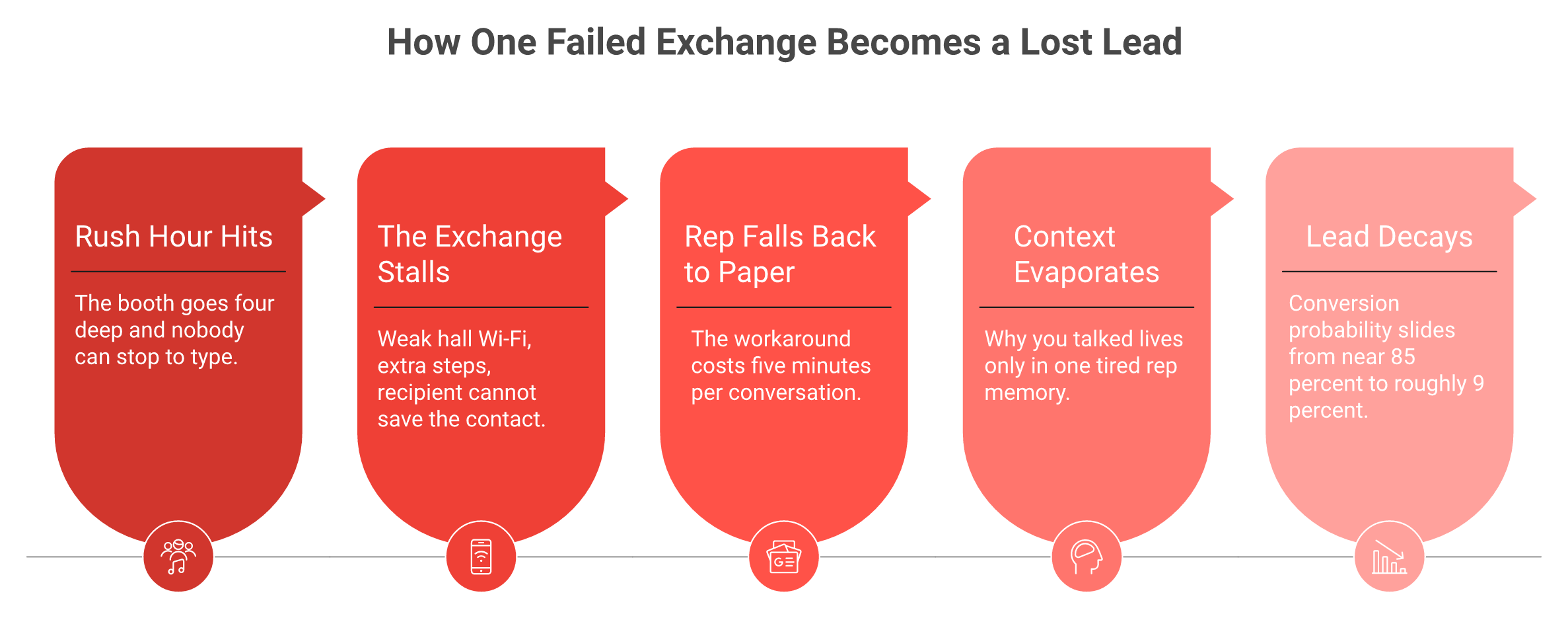
Reviewers report the exchange degrading exactly where booths live, meaning dead Wi-Fi, rush hour, and recipients asked to fill in a form. That matters because conversion probability runs near 85% within two hours of the conversation, falling to roughly 9% after a week. B2Brain measures the same window with Leads-to-Meeting, booking the follow-up on the floor rather than chasing it later.
⏰ 11:40am on Day 2, and the booth is four deep
Picture a 20x20 at an industrial show. Two AEs, one Field Marketer, and a queue that will not clear until lunch.
A plant manager stops for ninety seconds. The rep opens the app, and the exchange stalls on the recipient's phone.
❌ What happens next is the whole problem
A stalled exchange is not a usability complaint. It is the first step in a measurable pipeline loss.
The rep gives up and takes a paper card. The context of that conversation now lives in one person's short-term memory.
Reviewers describe this exact failure, repeatedly and in detail.
"I find the functionality of Blinq Digital Business Cards not very impressive, as it doesn't always work reliably when scanning the barcode, especially in places with poor internet connectivity. This has made it necessary for me to consider purchasing printed business cards as a backup." — Kasha A., Blinq - G2 Verified Review (1.5★, Oct 2025)
"The app tries to launch App Clips for the recipient of the business card. This means that sometimes the recipient can't open it and fundamentally limiting the use of the app. If staff can't rely on it to work for all recipients then it's easier to use a different solution." — Verified User in Hospitality, Blinq - G2 Verified Review (1★, Sept 2025)
⚠️ The step count is the hidden cost
A third reviewer described the form-filling requirement as cumbersome in busy settings. At rush hour, that is not friction. That is a lost lead, and it is why offline reliability sits at the top of every honest lead retrieval app checklist.
Only 47% of exhibitors track leads through the sales cycle at all, per CEIR. If the capture step fails silently, that number gets worse and nobody notices.
✅ The speed threshold that actually decides ROI
One operator gave me the cleanest test I have heard. The prospect should get a "nice meeting you" message within 15 minutes of walking away.
Anything slower rides the decay curve down. Waiting until you get home is the most expensive habit in field marketing.
B2Brain's Recent Leads exists for the rush-hour case, letting a rep scan now and add voice context later. In our deployments, a structured CRM record comes out in about 4.2 seconds, which is roughly a fifth of the time typed notes take. The sequence is laid out in how event lead capture works.
⚠️ Four conditions to test before you commit
Run these on a Tuesday afternoon, not at the show.
Airplane mode capture, then reconnect and check the sync.
Recipient save on both an iPhone and an Android device.
Three reps scanning the same account, then check for duplicates.
Time from handshake to first outbound message.
I could be overweighting connectivity here, since a downtown hotel conference is a friendlier network than a 500,000 square foot hall. Test on your own floor.
B2Brain books the discovery meeting before the prospect leaves, pulling the AE's live calendar and sending a dual invite to both sides, which is what produces the 52% Leads-to-Meeting rate against an 8% industry average for post-event follow-up.
Q7. Can Blinq prove pipeline in Salesforce or HubSpot after the show? [toc=7. CRM Sync and Attribution]
Blinq offers native CRM sync on Business and Enterprise plans, but export is credit-metered alongside enrichment. Reviewers describe contacts landing in a phone address book rather than a workable list. A contact record is not an opportunity, and attribution gaps start at exactly that object. B2Brain writes to the opportunity level and reports 100% event-to-CRM attribution per show.
📇 A synced contact is not a pipeline number
This is the distinction RevOps teams care about and marketing decks skip. Contact sync creates a person record. Attribution needs an opportunity record tied to a show.
If your tool only writes contacts, the show never appears in a pipeline report. The Field Marketer then defends the budget with a scan count instead of a number that stands up in Salesforce lead capture reporting.
"When you do share your info, it saves the person's 'business card' as contact info in their phone. This makes it tough to find again after a big tradeshow, event, etc. With Blinq, all the follow ups are just in your sea of contacts you have to try and remember." — Verified G2 reviewer, Blinq - G2 Verified Review (2★, May 2025)
💸 Export is metered, which changes behaviour
Credits cover enrichment and CRM-ready leads together. Teams then start rationing which leads get pushed.
That is the worst possible filter. The rep decides on Day 3, tired, and without pipeline data.
"There is no support. Because I lost my phone and as a result lost my Blinq contacts and couldn't retrieve them." — Verified User in Mining & Metals, Blinq - G2 Verified Review (1.5★, April 2025)
⚠️ The missing bookends
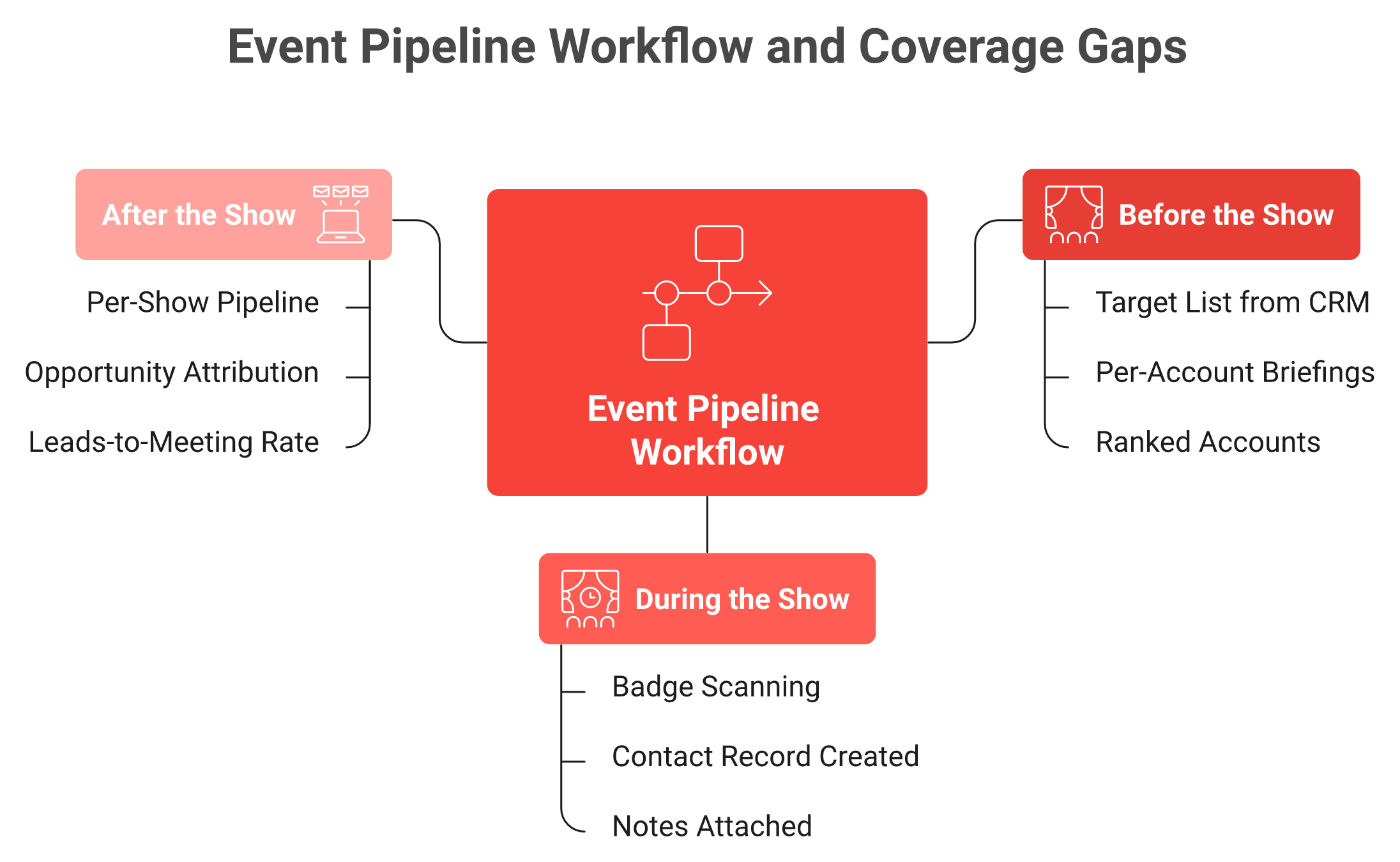
Capture covers the middle. The pipeline question is decided at the two ends nobody instruments.
Blinq covers the during-the-show moment well. The two ends of the workflow are thin.
There is no briefing built from your own CRM pipeline before the show. There is no per-show pipeline report after it, which is the gap the offline to pipeline model exists to close.
I saw a version of this failure outside our category. A buyer sat stuck in a purchase for months because, in his words, the rental system did not talk to the sales system. Systems that do not share an object model lose deals quietly.
✅ Four questions for the demo call
Ask these in order, and ask for a screen share.
Does a scanned lead create a contact only, or a contact and an opportunity?
Which fields map, and what happens on a duplicate?
Is export credit-metered, and at what price per lead?
Can you show per-show pipeline sourced, by rep and by segment?
CRM Sync and Attribution Capabilities Compared
Capability
Blinq
Badge scanner
B2Brain
Contact sync to CRM
Yes, plan-gated
CSV export
Yes, native
Opportunity-level attribution
Not documented
No
Yes
Pre-event briefing from your CRM
No
No
Yes
Per-show pipeline report
No
No
Morning after, by 9am
Digital business card
Yes
No
No
That last row is an honest gap on our side. B2Brain has no digital card product, and our third-party enrichment is lighter than Popl or Momencio.
B2Brain is Salesforce-native and HubSpot-native rather than integrated, and the morning-after offline-to-pipeline report reaches the CMO by 9am with meetings booked, pipeline sourced, and LTM broken out by show, rep, and segment.
Q8. Who is Blinq right for, and who should look elsewhere? [toc=8. Best Fit and Misfit]
Blinq fits individuals and distributed teams whose main job is showing up well: branded cards, wallet passes, email signatures, and light capture. It fits poorly for a five-rep industrial booth needing offline reliability, multi-rep dedup, in-booth meeting booking, and opportunity-level attribution. B2Brain serves that second profile, defined as 5 or more shows a year with Salesforce or HubSpot already in the stack.
✅ Three profiles that should buy it
The fit cases are genuine, and I would not argue against them.
A founder or consultant who wants a professional card and no printing bill.
A distributed team of 20 to 200 needing brand consistency across signatures and wallet passes.
An enterprise standardising card provisioning, where SSO and SCIM matter.
Blinq reports users at 93% of Fortune 500 companies, which tells you the card rollout motion works at scale.
❌ Two profiles that should look elsewhere
State this as a structural trade-off, not a flaw. Blinq is a card product that added capture. It is not an events pipeline system, which is a different job from the one covered in a trade show app roundup.
A booth team running 8 to 15 shows a year at $20K to $200K per show.
Any team whose CMO must show sourced pipeline per show at the QBR.
The five-card minimum also sets a floor near $24.95 monthly, which is awkward for a three-person team.
⚠️ Do not judge any tool by scan count
Volume-first capture attracts the wrong people. One operator put it plainly: iPad raffles pull in non-decision-making employees who sign up for everything.
A tool that makes scanning easy but leaves qualification out will inflate your lead count and flatten your close rate.
Which Tool Fits Which Buying Situation
Buying situation
Best pick
Why
Solo professional, no CRM
Blinq
Free tier, fast setup
Distributed team, brand consistency
Blinq
Team card management
Enterprise card provisioning
Blinq
SSO and SCIM
5+ industrial shows, ACV $25K+
B2Brain
On-floor booking, LTM reporting
One-off conference, consumer audience
Neither
Buy nothing, use paper
That last row matters. B2Brain is a poor fit for solo booths, consumer-facing sellers, no-CRM teams, and developer summits, and I would rather say so than sell into a bad deployment.
💰 The single tie-breaker question
Ask what you will be asked in the Monday pipeline review. If the question is "did people get your details," Blinq is the right shape.
If the question is "where is the pipeline from that show," you need a tool that books meetings and writes opportunity records. Contact information is not where anything happens. Pipeline is where the buyer's world moves, and that is the premise behind the booth-day workflow.
Blinq's 8,800-plus G2 review wall is real, and it is a digital-card moat earned in a different category. Both things stay true at once.
B2Brain is built for the misfit profile above: 5 or more shows a year, two or more booth reps, ACV above $25,000, and Salesforce or HubSpot already in the stack, with a first event free for two users so the test runs on a live floor. If that is your profile, Book a Demo.
Q9. What are the best Blinq alternatives for event lead capture in 2026? [toc=9. Blinq Alternatives Ranked]
Six names cover the realistic shortlist: B2Brain, BoothIQ, BoothMaven, Zuddl, Popl, and Momencio. They split into meeting-booking platforms that close at the booth and capture-plus-enrich tools that hand you a richer contact list. B2Brain reports 52% Leads-to-Meeting on the floor against an 8% industry average post-event. Choose on the trade-off you are escaping.
⭐ The five criteria that actually separate them
Skip feature grids. These five decide the outcome.
Five Criteria That Separate Event Lead Capture Tools
Criterion
Why it decides
In-booth meeting booking
Converts interest before memory fades
CRM sync depth
Contact record or opportunity record
Attribution reporting
Whether the show shows up in pipeline
Offline reliability
Expo halls have hostile Wi-Fi
Cost shape
Per-seat, per-credit, or per-event
✅ The shortlist, in plain terms
1. B2Brain
Books the discovery meeting on the floor in under 30 seconds, with a dual calendar invite to the prospect and the routed AE. Pre-event briefings are built from your own CRM pipeline, not a prediction database, and the sequence is documented in the three-motion workflow. Wrong for solo booths, consumer sellers, and teams with no CRM. Native app is iOS only, and there is no digital business card.
2. BoothIQ
Voice notes as the hero, free individual tier, and $499 monthly for teams. Escapes the note-taking bottleneck. Admits iOS-only. Thin on third-party review evidence, with no G2 listing.
3. BoothMaven
Instant booth booking plus native Apollo enrichment, from $49 monthly with a single-event option. Escapes annual lock-in. Small vendor, early track record.
4. Zuddl
Universal lead capture inside a broader event platform. Escapes tool sprawl for teams already running Zuddl events. Heavier than a booth team needs, and worth comparing against a purpose-built lead capture app for trade shows.
5. Popl
Strong digital card core, event capture added more recently, roughly $6K a year usage-based. Escapes card-printing entirely. Buyer reports on badge scanning are mixed, which is the recurring theme across Popl alternatives.
"I didn't really use Popl because it didn't scan bar codes like I thought it would. Scanning badges should have given the name and contact info, but it didn't work when I tried it." — Drew D., Popl - G2 Verified Review (0.5★, May 2026)
6. Momencio
LiveMicrosite per prospect, plus intent scoring. Escapes generic follow-up email. Adds a content step your reps must maintain.
⚠️ Booking is commoditising, so judge the layer underneath
I expect the fair objection here. BoothIQ, BoothMaven, and Zuddl all ship in-booth booking now.
So the feature is not the difference. The difference is whether before, during, and after sit on one shared data layer, and whether anyone reports Leads-to-Meeting at all. Today nobody else measures it.
"I like how it imports into our CRM and has a buildable form that we can create. It does not always work with every conference, if the conference does not provide an API kit for integration." — Verified User in Consulting, Captello - G2 Verified Review (3.5★)
💰 One honest caveat before you shortlist
No digital tool is universally right. In sourcing hubs like the Canton Fair, exhibitors still expect a physical card before they will talk business.
And the organizer's rented badge scanner is not a peer product on this list. It saves a contact, hands the data to the organizer, and ends at a CSV, which is the structural limit of any conference badge scanner.
⏰ Where I think this goes next
My read is that differentiation moves up the stack over the next 18 months, from capture to pipeline activation. Booking becomes table stakes. Configurable next-best-actions that mirror each team's sales process become the moat.
B2Brain runs that workflow as Scan, Add Context, Execute Next-Best-Action, with the morning-after offline-to-pipeline report reaching the CMO by 9am so the Field Marketer answers the pipeline question with a number. The per-show economics sit on the Show Pass and Pipeline plans page.
I am still unsure how fast buyers will start asking vendors for an LTM number in RFPs. If you are running an RFP this season, I would like to know whether you asked, and you can raise it when you Book a Demo. That answer tells me more about where the category is than any funding round.
FAQ's
Is Blinq worth it for a B2B exhibitor in 2026?
It depends entirely on which job you are buying for. Blinq is a genuinely strong digital business card product, holding 4.8/5 on G2 across roughly 8,949 reviews and 4.9/5 on Capterra across 702.
Worth it if the job is sharing a polished, branded card and keeping a light connection log.
Weaker fit if the job is producing booked meetings and per-show pipeline your CFO can see.
For a booth team the picture narrows quickly. Scanning and CRM export are credit-metered, and the most repeated complaint across platforms is that recipients cannot save the contact. That failure is invisible to you, because the person who gave up never files a support ticket.
Run the exhibitor's math before you decide. A roughly $70K booth with a 10x pipeline target needs about 50 opportunities, which means close to one in five booth visitors must become a qualified meeting. B2Brain measures that outcome directly as Leads-to-Meeting, at 52% on the floor against an 8% industry average for post-event follow-up. If you want to see how the capture, booking, and reporting steps connect, we documented the three-motion workflow in full.
What are the most common Blinq complaints in verified reviews?
Three failure modes repeat across G2, Capterra, and Trustpilot, and all three are recipient-side rather than sender-side.
Contact save friction. Present in 39% of 67 relevant Capterra mentions. Reviewers report the recipient never receiving or successfully saving the card.
Link trust and delivery. Present in 48% of 44 relevant mentions. One Trustpilot reviewer reported the hosting domain being flagged as malware.
Connectivity and step count. Multiple G2 reviewers describe the scan failing where internet is weak, and the exchange taking five minutes or more in busy settings.
A fourth complaint matters most to exhibitors and is rarely flagged: shared contacts land in the phone address book rather than a workable follow-up list, so after a large show the leads sit in a sea of contacts.
That last one is a pipeline problem, not a usability problem. B2Brain built Recent Leads for the adjacent rush-hour case, letting a rep scan now and add voice context later, with a structured CRM record produced in about 4.2 seconds. The same reliability questions apply to every tool in the category, which is why we test them in our review of lead capture apps for trade shows.
How much does Blinq actually cost for a full trade-show season?
The subscription is never the bill. Business seats start at $4.99 per card per month billed annually, with a five-card minimum, so roughly a $24.95 monthly floor.
Usage credits are billed on top, monthly in arrears.
Blinq's own help centre prices one credit per enriched lead at $9.99.
Third-party teardowns model five credits per scan at about $1 each, or a Lead Capture add-on from $199 monthly. Treat those as labelled competitor estimates, not facts.
Model a single mid-size show: five reps, 100 scans, and 100 CRM exports. On the third-party model that lands near $1,000 for one show. Across eight shows, your capture spend needs finance approval.
The bigger error is the denominator. Cost per scan tells you nothing, because a trade show is already an expensive baited field. Cost per booked meeting is the number that survives a QBR. B2Brain publishes the outcome benchmark instead of a per-scan rate: 31 scans a day for a productive rep, with a qualified event meeting costing roughly 60% of an outbound meeting and about 40% of paid acquisition. You can compare that shape against our Show Pass and Pipeline plans.
Why is Blinq's Trustpilot score so much lower than its app rating?
Because they belong to two different companies, and almost no ranking page corrects the confusion.
blinq.me is the Melbourne-based digital business card company, reporting 4.9/5 across roughly 150,000 app-store ratings.
blinq.com is an unrelated Washington DC business carrying a 3.3/5 Trustpilot score across roughly 3,370 reviews.
If a vendor memo quotes 3.3/5, check the domain before it reaches your CFO. That said, blinq.me does carry its own separate low-star Trustpilot reviews, covering malware flags on the hosted card page and too many steps in the exchange.
The wider lesson for procurement is to weight the evidence properly. Repeated one-star patterns with dates beat aggregate averages, and dated verbatims beat scores. Video reviews frequently carry affiliate disclosures, and vendor comparison blogs are written by competitors selling an alternative. Blinq also publishes its own event lead capture roundup and ranks itself first in it, which is normal vendor behaviour rather than third-party evidence. We apply the same scrutiny in our head-to-head on HiHello versus Blinq, where the ratings tell a different story from the workflow.
What are the best Blinq alternatives for event lead capture?
Six names cover the realistic shortlist for a booth team: B2Brain, BoothIQ, BoothMaven, Zuddl, Popl, and Momencio. They split into two shapes.
Meeting-booking platforms that close the follow-up at the booth.
Capture and enrich tools that hand you a richer contact list and leave the meeting to a post-show sequence.
Score them on five criteria: in-booth meeting booking, CRM sync depth, attribution reporting, offline reliability, and cost shape. The organizer's rented badge scanner is not a peer product on that list. It saves a contact, hands the data to the organizer, and ends at a CSV.
Be honest about the trend. In-booth booking is commoditising, since BoothIQ, BoothMaven, and Zuddl all ship it now. The durable difference is whether before, during, and after sit on one shared data layer, and whether anyone reports Leads-to-Meeting at all. B2Brain books the discovery meeting on the floor in under 30 seconds with a dual calendar invite to the prospect and the routed AE, then delivers the morning-after report to the CMO by 9am. If you are shortlisting this season, Book a Demo and bring your show calendar.
Enjoyed the read? Join our team for a quick 30-minute chat — no pitch, just a real conversation on how we’re rethinking Event Intelligence in B2b.

.png)

.png)
.png)