A rep can leave a voice note. AI writes it up into a structured CRM field in about 4.2 seconds,
so nothing has to be typed at the booth, and text notes are there too for anyone who prefers them.
Mobly also lets a rep record a voice memo, but doesn't publish whether it becomes a structured
CRM record the way this one does, or stays a clip a colleague has to play back.
52% of qualified booth leads become a booked meeting on the floor, against an 8% industry average. First event free for two reps, so you can measure it on your own show.
B2BrainEvent intelligence
Capturing the conversation
Voice notes
A rep can instantly book a meeting with a qualified booth visitor, just using voice notes. AI transcribes it, enriches the lead, and updates structured CRM fields in real time.
✓Books the meeting at the booth, live calendar, clash detection
✓Voice note → structured CRM record in about 4.2 seconds
✓Real-time Salesforce & HubSpot write, as the conversation ends
✓Published outcome metric: 52% Leads-to-Meeting
✓Per-show pipeline report by 9am
MoblyEvent marketing platform
Capturing the conversation
Voice memo
A rep can record a voice memo and attach it to the lead. Mobly doesn't publish whether it's transcribed into a structured CRM field or stays a clip you replay later.
✗Meeting scheduled via a connected Calendly or Chili Piper account, not natively in one motion
✗Voice memo captured; transcription into a CRM field not stated publicly
✗Native sync confirmed; write timing and object depth not detailed publicly
✗Pulse fires an email or text on scan; no published booked-meeting rate
✗Insights dashboard for leads, reps and events; no same-day auto-report stated
Used at the booth by revenue teams at
ZetwerkAvCarbHippoVideo
ZetwerkAvCarbHippoVideo
131 events supported · 15,200 booth leads captured to date
The short answer
Two tools, two different jobs.
Mobly started as a universal scanner built to replace rented badge hardware, and has been layering
an event-marketing platform on top since — picking which shows to attend, building registration
pages, triggering same-day outreach. B2Brain started at the booth's pipeline problem: proving what a
$20,000 to $200,000 booth actually produced. Everything below follows from that.
Choose B2Brain if
You fund the booth and have to show the pipeline number.
Your reps come back with meetings on calendars instead of a contact list, and the show gets credit in Salesforce or HubSpot the same day.
A staffed booth with quota-carrying AEs
Eight or more shows a year to compare
Salesforce or HubSpot already running clean
Your review asks for pipeline, not scan volume
Choose Mobly if
Wide CRM reach and same-day outreach are the actual job.
Mobly is genuinely strong at connecting to whatever CRM or marketing automation platform you already run, and at getting an email or text out the moment a badge is scanned. If a small team runs a handful of shows a year and wants one flat-fee tool spanning event selection through follow-up, that architecture fits.
A small team running a handful of shows a year
Marketo, Pardot, Zoho, Pipedrive or Eloqua is your CRM or MAP of record
A same-day email or text is enough, not a booked meeting
Picking which shows to attend and building registration pages matter as much as the booth
Feature by feature
B2Brain vs Mobly, line by line
Seven things decide this purchase. Here is where each tool lands on all seven.
Mobly details reflect its public site, FAQ, App Store and G2 listings as of September 2026. Where
Mobly doesn't publish an answer, the row says so rather than guessing. If we have something wrong,
email support@b2brain.com and we will correct it.
Capability
Event intelligenceB2Brain
Capture + event marketingMobly
01 / Who it was built for
Primary buyer
Field marketer, VP Sales, RevOps
Field or event marketer at a small or mid-market team
Product originWhere the architecture started
Booth pipeline attribution
A universal scanner built to replace rented badge hardware, later expanded into event selection, registration pages and follow-up triggers
Scoreboard it reports
✓Leads-to-Meeting and pipeline sourced
—Leads captured, enrichment yield, and rep/event dashboards
02 / Capture on the floor
Badge QR code required?Determines whether the tool works at shows you have no licence for
✓No. Reads the name and company text on the badge
✓No. OCR reads badges, cards and handwritten notes; QR is one supported format, not a requirement
Works at any show without an organizer licence
✓Yes, on any badge format
✓Yes — markets itself as one app for every event, no event-specific hardware
Capture surfaces
Badge, business card, LinkedIn screenshot, unstructured and handwritten badges
Badge, business card, LinkedIn profile, handwritten notes, QR, or manual search by name and company
Manual lookup, no badge neededAnd graceful fallback on an unreadable badge
✓Search the account, note it, book from it
✓Search by name and company, or add manually
Conversation contextVoice in English (US), Spanish (Mexico) and Spanish (US). The badge image and the audio clip stay attached to the record
✓Voice notes or text notes. AI writes a ~30s voice note up into a structured record in ~4.2s
—Voice memos, typed notes and tags at capture. Not stated publicly whether the voice memo is transcribed into a structured CRM field
Custom qualifier form per eventScoring, hot/warm/cold, and budget, authority, need and timeline
✓Configured per event, booth or product
✓Tags and custom qualifying info at capture
Qualification timing
✓ICP scored at the moment of capture
✓Every lead ICP-scored at capture, per Mobly's own claim
Enrichment starts
✓At the scan, in the background
✓At the scan, through a data enrichment waterfall
Offline behaviourCapture keeps working. Transcription, enrichment, scoring and booking run in the cloud and catch up on reconnect
✓Scan and record notes with no signal. 150 captures held per device
✓Captures saved locally and synced once back online; per-device capture limit not stated publicly
Scan-to-saved latency
Median under 5 seconds, 5 seconds at the 95th percentile
Not published
Mobile platformsNative app versus wrapped web view affects offline behaviour
✓iOS and Android, both native. Web as an installable PWA
✓iOS and Android apps
Native Play Store appRequired by most MDM policies
✓Yes
✓Yes
03 / Turning the conversation into a commitment
Meeting booked at the booth
✓Core workflow, under 30 seconds
—Possible through a connected Calendly or Chili Piper account, per Mobly's FAQ; not the core capture motion
Next best actionThe note's intent is read and the right action is prompted
✓Configurable to your sales process
—Pulse fires an automatic email or text the instant a badge is scanned
Calendar inviteGoogle Workspace and Microsoft 365
Dual invite to prospect and owning AE, or event QR the prospect scans
A scheduling link via the connected Calendly or Chili Piper account; mechanics beyond that are not detailed publicly
Meeting outcome tracked
✓Invite accepted, held, rescheduled, no-show
—Not stated publicly
Clash detection
✓Conflicts flagged, alternative slots suggested
—Not stated publicly
Act on the lead without leaving the appOpen the account, email with the address pre-filled, view LinkedIn, or call
✓Available the moment enrichment lands
—Text/iMessage engagement available in-app; broader in-app account actions not detailed
AE routingTerritory, vertical or named account
✓Live calendar pulled at the booth
—Tag-based routing, not tied to a live calendar
Deal record created
✓Opportunity with stage, from the voice note
—Contact and lead records; opportunity/stage creation not detailed publicly
04 / CRM sync and attribution
SalesforceLead or Contact object, configurable at setup, Contact by default
✓Native, real-time write to Lead, Contact, Account, Opportunity and Campaign
Native sync; object-level write depth not detailed publicly
HubSpot
✓Native, real-time write to Contact, Company and Deal
✓Native, certified HubSpot App Partner
Write timing
✓As the conversation ends
—Described as real-time; exact timing not detailed publicly
Dedupe on writeContacts matched on email, accounts on company domain
✓Handled at capture, including three reps scanning one buyer
—Not stated publicly
Field mappingCustom fields, picklists, required fields, set per event
✓Configured once in onboarding
✓Custom tags and contextual data pass through to CRM fields
Campaign attributionWhether the show gets credit in the QBR
✓Campaign and Campaign Member records created per show
—Insights dashboard reports leads, reps and events; Campaign/Campaign-Member record creation not stated publicly
Lead source stamping
✓Every record tagged B2Brain and the event name
—Not detailed publicly
Rep attribution
✓Every lead carries who held the conversation
✓Insights includes rep-level dashboards
Account-level viewEveryone your team met from one company
✓Other contacts at that account surfaced at capture
—Not stated publicly
Shared teammate notesTwo reps meet the same person on the same floor
✓The second rep sees what was already discussed, at the scan
—Activations tracks how often your team engages the same prospect across sub-events; a shared live note at the point of a second scan isn't stated
Enrichment source
✓Your own CRM first, not only a cold database
Third-party enrichment waterfall, human-validated, per Mobly's own claim
Show-over-show memory
✓Year two opens with year one attached
—Not stated publicly
05 / What it costs
Pricing model
Per event, or an annual platform subscription. Quoted on a call
Flat, quote-based subscription; a free single-user tier with monthly credit caps
Published team pricingNeither vendor lists a price. Both quote after a demo
—No. Quoted on a call
—No. Quoted after a demo
Per-enriched-lead feesWhat a busy show costs you
✓None. No enrichment credits, no overage
None claimed on the paid flat-subscription plan, per Mobly's own comparison page
Lead caps
✓None
—None stated on paid plans; the free tier caps at 5 mobile and 10 export credits a month
Seats
Unlimited users on the annual plan
Unlimited users and events claimed on the paid plan; the free tier is single-user
Try before you commit
✓First event free, two reps
—Free single-user tier, credit-capped; no full-event, multi-rep pilot stated
✕Not published yet. Testimonials and the LTM figure are the current proof
✓MedTrainer cut list-prep time from about five hours to 20–30 minutes per list, across roughly 80 events a year
Time to live before a show
About 2 hours, no RevOps engineering
Not stated publicly
Rep training required
✓None. Usable on day two of a show without a session
Reviewers describe it as quick to learn; no formal training claim published
Switching cost if you leave
✓Low. Two hours of config, nothing to unpick
—Not stated publicly
Vertical playbooksShow calendars and buyer archetypes
Manufacturing, Supply Chain, Energy, Construction
Horizontal; published case studies span ecommerce, medtech, HR tech and energy
07 / Security, data and support
GDPRData processing agreement and standard contractual clauses
✓DPA on request
—Privacy policy references GDPR rights (access, rectification, erasure); DPA availability not stated publicly
Your data never trains a shared AI modelYou record customer conversations, so this one matters
✓Never. No customer voice or text is used to train shared models
✕Not stated publicly
Where voice and prompt data is processed
United States, via Google Cloud. Held with your data for up to 12 months, deleted on request
✕Not stated publicly
Roles and audit logAdmin, manager, rep, viewer
✓Role-based access with a full audit log
—Not stated publicly
Data deletion on request
✓Deleted within 7 days of a written request
—Not stated publicly beyond the erasure rights referenced in the privacy policy
Never overwrites your verified CRM data
✓Never. Contact fields are system-owned; reps can only add notes
—Not stated publicly
Sync reliabilityWhat RevOps inherits on Monday morning
✓Idempotent on retry, with a full edit history on every lead
—Not published
Full data export on demandThe you-can-leave test
✓Yes. Filtered CSV export any time, no request needed
✓CSV export available
Support during show hoursIn the show's own timezone, when a booth fails at 9am Tuesday
✓9am to 4pm local on show days, by email and a shared Slack channel
—A dedicated support team is available during events, and Mobly says it will send a teammate to your booth in person on request; specific hours aren't published
Named implementation contact
✓Every customer, on every plan
—Not stated publicly
Where these numbers come from.
B2Brain figures (52% Leads-to-Meeting, ~4.2s structured record, ~30s voice note, 31 scans per rep per day,
under 5s scan-to-saved) are from B2Brain customer data across events run between January and August 2026,
and are self-reported. The 8% post-event industry average, the 42-hour average exhibitor response time and
the 47% of exhibitors who track leads through the sales cycle are from CEIR published research.
Mobly figures are from getmobly.com (including its FAQ, product and integrations pages), its published
MedTrainer case study, its Apple App Store listing and its G2 profile, all checked in September 2026. Rows
marked "not stated publicly" mean exactly that — the capability may exist, Mobly simply hasn't
published it where we could verify it. Run the free first event and measure your own LTM rather than
taking ours.
The golden workflow — scan, add context, execute the next best action — stated plainly, in the order a rep actually hits them.
01 · Context capture
Records the conversation as a voice note.
A rep taps the mic and leaves a voice note of about thirty seconds. AI transcribes it and
writes it up into a structured CRM record in roughly 4.2 seconds — the pain, the use case, the buying
signal, in their own words, with nothing typed in.
Text notes stay available for anyone who prefers them, or for the moments when a voice note is not practical.
At rush hour they do not annotate at all. Snap the whole queue, one badge after another,
without the app ever blocking the next scan, then add context at the break from the recent
feed while it is still fresh. A note left unsaved is kept as a draft rather than lost.
Scoring states its reasoning rather than only a number, so a colleague picking the lead
up on Monday can see why it was ranked the way it was.
Mobly also lets a rep capture a voice memo, and layers on tags and qualifying notes at the same time.
What its site doesn't say is whether that memo is written up into a structured, searchable CRM field
the way this one is, or stored as an audio clip a colleague has to play back.
31
Scans a day by a productive rep. Below eight, the problem is booth staffing, not software.
“Snap a pic, add a quick voice note and save. Enriched data and context is quickly added.”
Jason DumoisInterim Chief Growth Officer, HippoVideo
02 · Meeting booking
Books the follow-up meeting at the booth.
Qualify with two or three scored questions, pull the owning AE's live calendar,
send a dual invite, and write the meeting to the CRM against the show campaign.
Four steps, under 30 seconds, while the prospect is still in front of you.
The app reads the intent in the note and prompts the next best action, so the rep is
not deciding what to do — they are confirming it. If the slot is taken, clash detection
offers alternatives before the invite goes out.
Conversion sits near 85% within two hours of the conversation and falls to roughly 9%
after a week. Average exhibitor response time is around 42 hours.
Mobly's Pulse can fire an email or text message the instant a badge is scanned, and a connected
Calendly or Chili Piper account lets a rep send a scheduling link from the floor. Meetings beat
emails for B2B pipeline velocity — a calendar invite booked in the room converts differently than
a link competing with four hundred other post-show emails.
52%
Leads-to-Meeting booked on the floor, against an 8% industry average post-event.
“With B2Brain, we can now exactly attribute pipeline and leads to every event.”
Caroline RaffettoHead of Events and Marketing, LumberFi
03 · Pipeline reporting
Sends a per-show pipeline report the next morning.
The Offline-to-Pipeline report: one auto-generated summary by 9am the day after every show,
delivered to your inbox as a shareable link or PDF. Leads, meetings, deals and closed-won revenue
attributed to the show, with sourced and influenced split out. Deliberately unbranded, so you
present it as your work.
It ranks the quality opportunities and states why each one qualified, in the rep's own words,
with the recommended next action. It also flags accounts that showed intent but came back
without enough context — the follow-up you would otherwise miss.
It also reads across every conversation at the show and reports which product and engagement
terms buyers actually used — aggregate voice of customer from the floor, not a survey.
A live dashboard runs underneath it during the show: scans and meetings by rep and by hour, and
the share of each rep's leads that carry an audio note, which is the honest measure of whether
the booth team is capturing context or only badges. Across a season it compares LTM and sourced
pipeline show over show.
Mobly's Insights module tracks leads, rep performance and event ROI, and recommends which shows
are worth the budget next year. What it doesn't state publicly is a same-day, auto-delivered
report or a booked-meeting benchmark like Leads-to-Meeting. A dashboard answers how many. A
pipeline report answers how much, and from where.
100%
Event-to-CRM attribution, measured at capture time rather than reconciled on Friday.
“It streamlines lead capture, is easy to load into our CRM, insuring timely follow up and trackability.”
Chris RobertsonDirector Sales & Marketing, AvCarb
Cost, normalised
Two pricing shapes carry two different risks.
A flat subscription is predictable but the same price whether the show is quiet or packed.
Per-event pricing scales with a calendar you already plan a year ahead.
B2Brain · Show Pass
First event free
two reps, one show · per-event or annual pricing after, quoted on a call
Per-enriched-lead fees
None
Annual commitment
Not required
Pilot
First event free, two reps, no card
Mobly · flat subscription
Not publicly disclosed
quote-based flat subscription after a demo · free single-user tier, credit-capped
Per-enriched-lead fees
None claimed on the paid plan
Annual commitment
Not stated publicly
Pilot
Free tier: unlimited email credits, 5 mobile and 10 export credits a month
Mobly does not publish a price; the flat subscription is quoted after a demo. Its own site claims no
per-event or per-user fees on the paid plan, and the free tier caps at 5 mobile and 10 export credits
a month. Ask for the credit definitions and the cap in writing before you sign, since a "flat" plan
can still turn into a seat or credit negotiation at renewal. For reference, an organizer's own scanner
rental runs about $600 per device per show, which is the alternative both tools are really competing against.
Run the math down from the booth invoice, not up from the licence fee.
A $70,000 show carrying a 10× pipeline expectation. You enter the booth spend once and every figure below follows from it.
$70K
All-in show cost you enter
$700K
Pipeline expected
~50
Opportunities needed
~180
Discovery calls needed
1 in 5
Booth visitors must become a qualified meeting
The report divides that spend by leads and by meetings, so you get cost per lead and cost per
booked meeting for every show and can compare them side by side across a season. A scan is not
a commitment, so scan volume cannot close the gap above. For reference, a qualified event meeting
costs roughly 60% of an outbound meeting and about 40% of paid acquisition.
Where we lose
When Mobly is the better buy.
Being honest here saves everyone a bad quarter. If any of these describe your setup, we are the wrong purchase and we would rather say so before the demo.
Procurement needs SOC 2 today
Mobly holds SOC 2 Type II. We do not, and we are not going to dress that up. We also have no SAML or SCIM single sign-on, and we store data in the US only. If your security review gates on any of those three, buy Mobly this year and talk to us next year.
You want a published case study with hard numbers today
Mobly can point to MedTrainer: list-prep time cut from about five hours to 20–30 minutes per list, across roughly 80 events a year. We don't have a named case study with numbers published yet — our proof today is the 52% LTM figure and named testimonials, both self-reported.
Your CRM or MAP isn't Salesforce or HubSpot
Mobly natively connects to Marketo, Pardot, Zoho, Pipedrive and Eloqua, plus generic webhooks. We're native on Salesforce and HubSpot only; Pipedrive, Zoho and GoHighLevel are in progress, and we don't support Dynamics 365, Marketo or Pardot natively. If your stack runs on one of those today, that's their tool.
Event selection and registration pages are part of the job
Mobly's Scout recommends which shows to attend and Host builds branded registration pages before the show. We're built for the booth itself — capture, context, and the booked meeting — not for picking the show or running registration.
The B2Brain demand capture app is the best and most seamless in the market today. Its smooth integration with HubSpot CRM ensures we don't lose any lead at tradeshows, even when there is a rush.
Gopal KrishnaHead of Sales & Marketing NA, Zetwerk
“
At large trade shows, streamlining leads and capturing context is a real problem. With B2Brain in hand, our team can focus on the conversations and gains valuable insights from each interaction, right after a show.
Eddie MoralesTrade Show and Event Manager, Dometic
“
Our sales team has used B2Brain at several large tradeshows, making us immensely productive. It streamlines lead capture and is easy to load into our CRM, insuring timely follow up and trackability.
Chris RobertsonDirector Sales & Marketing, AvCarb
Before you book
The questions that actually come up.
Is it worth switching from Mobly mid-season?
Switching is a data-portability question, not a software question. Export contacts, notes and enrichment history from your current tool. Map fields in a Salesforce or HubSpot sandbox before touching production. Check your renewal date, since annual or flat-subscription terms rarely prorate. Keep the old tool live for one overlapping show as a fallback.
We will run the migration for you: we import your historical leads from prior events and map your fields before the first show, so year one opens with your history attached rather than empty. The first-event-free pilot for two people is the cheapest honest test. Measure meetings booked against your last comparable show, not against a demo.
Is B2Brain available on Android?
Yes. There is a fully native Android app on the Google Play Store alongside the native iOS app, so a mixed-device booth team runs the same build with the same offline behaviour. There is also an installable web app for anyone who would rather not install anything.
Because both apps are native rather than wrapped web views, offline capture behaves identically on either platform — which matters more than it sounds when half your reps are on Android in a hall with no signal.
Does it need the QR code on the badge?
No. B2Brain reads the name and company text printed on the badge rather than scanning a QR code, so it works at any show on any badge format, and on business cards and LinkedIn profile screenshots too. The only requirement is that the name stays inside the capture frame.
This is why there is no organizer licence to buy and no show where the tool simply does not work. If a badge is genuinely unreadable, the rep falls back to manual lookup by name or company.
How do we know the 52% figure holds on our floor?
You don't, and you shouldn't take it on faith. It is our own customer data, self-reported, and it should read as a claim until you have tested it against your own badges, your own reps and your own show.
So test it cheaply. Run the free first event with two reps, then compare meetings booked against your last comparable show. We will also put you on a reference call with a customer in your vertical before you commit.
How fast can we be live before our next show?
Most teams are live within about two hours. Reps download the app from the App Store or Google Play and sign in with Google, Microsoft, Apple or a one-time passcode to a work email. The CRM integration is configured in a single onboarding session, and no RevOps engineering is required for standard Salesforce or HubSpot connections.
Sign in with Google or Microsoft first — that grants the calendar permission the in-booth booking flow needs. Adding a teammate on the show floor takes one QR scan, so a rep pulled onto the booth at short notice is capturing within a minute.
What happens to a scan when there is no signal?
The part that cannot be recovered later — the badge and the conversation — keeps working with no signal. Reps scan badges and business cards and record voice or text notes offline, and the device holds up to 150 captures before you need to reconnect.
We would rather be precise about the rest than oversell it. Transcription, enrichment, ICP scoring and meeting booking all run in the cloud, so they resume the moment you are back online rather than working in the hall. Ask every vendor exactly which features stop when the WiFi does, and get it in writing — vague answers here are how teams lose a day of leads.
How is the CRM sync different from any other tool with a Salesforce logo?
A logo on a website is not a sync model. Ask three questions of any vendor, in this order. Is the write real-time or batched, which decides whether an SDR can email during the show. Does it create campaign member records, which decides whether the show gets credit in the quarterly review. Does it dedupe when three reps scan the same visitor, which decides how much cleanup RevOps does on Monday.
B2Brain writes the lead, the context and the booked meeting natively as the conversation ends. Contacts are matched on email and accounts on company domain, so duplicates do not accumulate. Notes attach to both the person and the account, so the context survives even after that person leaves the company. On Salesforce you choose whether new leads land on the Lead or the Contact object at setup.
Can we test it against our own CRM before we commit?
Yes. Connect a Salesforce or HubSpot sandbox before you buy, capture five test leads, and inspect the records yourself rather than taking the sync model on trust.
Do we have to drop Mobly to try B2Brain?
No, and we would not recommend it for the first show. Run both at one event, put B2Brain on the booth team and keep Mobly as the fallback, then compare meetings booked rather than leads captured. If the tools disagree, the pipeline report settles it.
What is Leads-to-Meeting, and why should we adopt it?
LTM is meetings booked divided by qualified booth leads, measured per show, per rep and per booth area. Teams booking on the spot typically reach 40% or more, against roughly 9% for teams relying on post-event SDR follow-up.
It matters because a lead count is a story and LTM is a number. If your CFO asks what a show generated, one of those answers survives the meeting.
First event free · two reps · no annual lock-in
Your next show is six weeks away. Walk in with a target list. Walk out with meetings booked.
Fifteen minutes, your own show calendar, a live walkthrough of the LTM dashboard. No slides. We configure your first show for you.
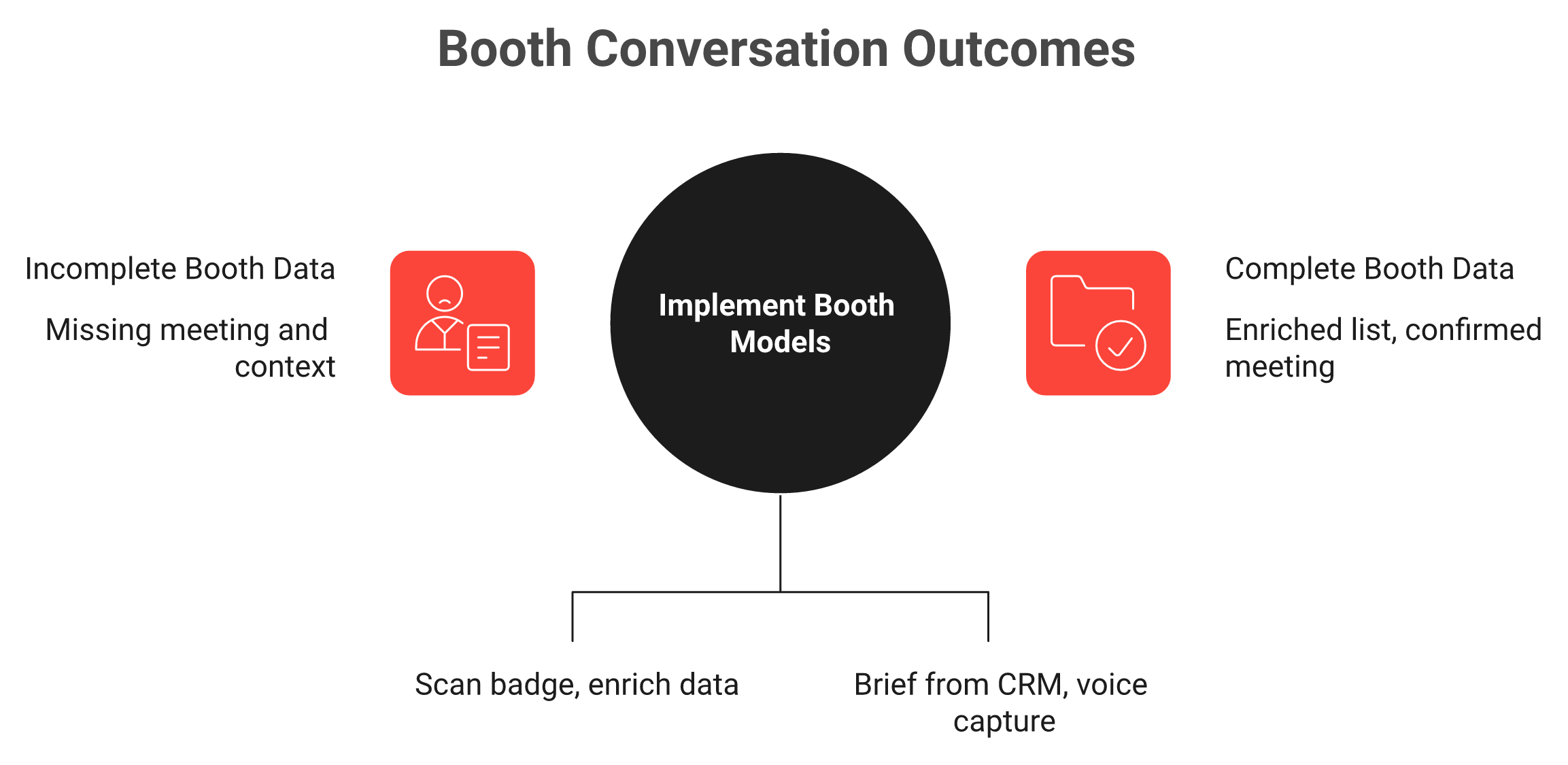
Mobly is a capture-and-enrich app. B2Brain is a capture-to-meeting layer. Both scan badges, but only one books the discovery meeting before the visitor leaves the booth.
Mobly enriches deeper through routed data providers with human validation. B2Brain enriches from your own CRM pipeline, which reps trust because they already own the data.
Both sync natively to Salesforce and HubSpot. Mobly writes contacts, leads, and campaign members. B2Brain also writes the meeting and the opportunity for deal-level attribution.
The real leak is execution, not data. Momencio measured 80% of show leads getting zero follow-up, and reply rates fall from an index of 100 same-day to 9 after two weeks.
Mobly holds roughly 108 G2 reviews at 4.8, while B2Brain has 17 at 4.5. Mobly wins social proof. Pricing opacity is its most repeated complaint.
Judge both on cost per booked meeting, not cost per lead. B2Brain reports 52% Leads-to-Meeting on the floor against an 8% industry average post-event.
Q1. What is the real difference between B2Brain and Mobly?
Mobly is a capture-and-enrich app: it scans badges, cards, and QR codes, enriches contacts through routed data providers, and syncs them to Salesforce or HubSpot. B2Brain is a capture-to-meeting layer: it briefs reps from your own CRM, books the meeting at the booth, and reports per-show Leads-to-Meeting pipeline. Both capture. Only one closes the loop on the floor.
📦 The shoe box problem never actually went away
An old friend in industrial sales described the classic version to me. All the business cards go in a shoe box, Jimmy carries the box home, and on Monday he pulls out three. Six months later, somebody finds the box.
Software digitized the box. It did not empty it. Contact information is not where anything happens, and pipeline is where your world moves.
🔀 Two product categories, not two feature lists
Mobly's own positioning is an AI-powered event marketing platform built around capture, enrichment, and automated outreach on scan. That is a real category, and Mobly does it well, as our own teardown of what Mobly captures reliably lays out in detail.
B2Brain sits one layer up. B2Brain measures Leads-to-Meeting (LTM), the share of qualified booth conversations that become booked meetings, and reports 52% booked on the floor against an 8% industry average for post-event follow-up.
The split is architectural, not featural: one path ends with an enriched contact, the other ends with a booked meeting and an opportunity record.
⭐ How the three real options compare
Most shortlists have three options, not two. The organizer's rented badge scanner is the incumbent you are actually displacing, which is the displacement story behind universal lead capture.
Badge Scanner vs Mobly vs B2Brain: Core Differences
Criterion
Organizer badge scanner
Mobly
B2Brain
Primary output
Contact list, often a CSV
Enriched contact in CRM
Booked meeting plus CRM record
Enrichment
None
Provider-routed, human-validated
From your own CRM pipeline
Books meeting on floor
❌ No
❌ Not natively
✅ Under 30 seconds
Pipeline reporting
❌ None
Event dashboards
Per-show pipeline plus LTM
Where Mobly wins
Nothing
Enrichment depth, Android, 100+ G2 reviews
Review base is only 17
💬 What buyers actually report
"I like that the interface is very user friendly, streamlined, clear and only includes the buttons/features that you'd need, especially during a busy event." — Verified User in Events Services, 3.5 stars, Mobly G2 Verified Review
"It was challenging to get it to sync with Salesforce. I also wish we were able to get more contact matches on attendee lists." — Ece K., 4 stars, Mobly G2 Verified Review
🧠 My read on why the category argues about the wrong thing
B2Brain's read is that the standard advice gets this backwards. Teams compare capture features because features are easy to tabulate. Outcomes are not.
I could be wrong about how fast this shifts. My honest expectation is that booking becomes table stakes within 18 months, since BoothIQ, BoothMaven, and Zuddl already ship a version of it.
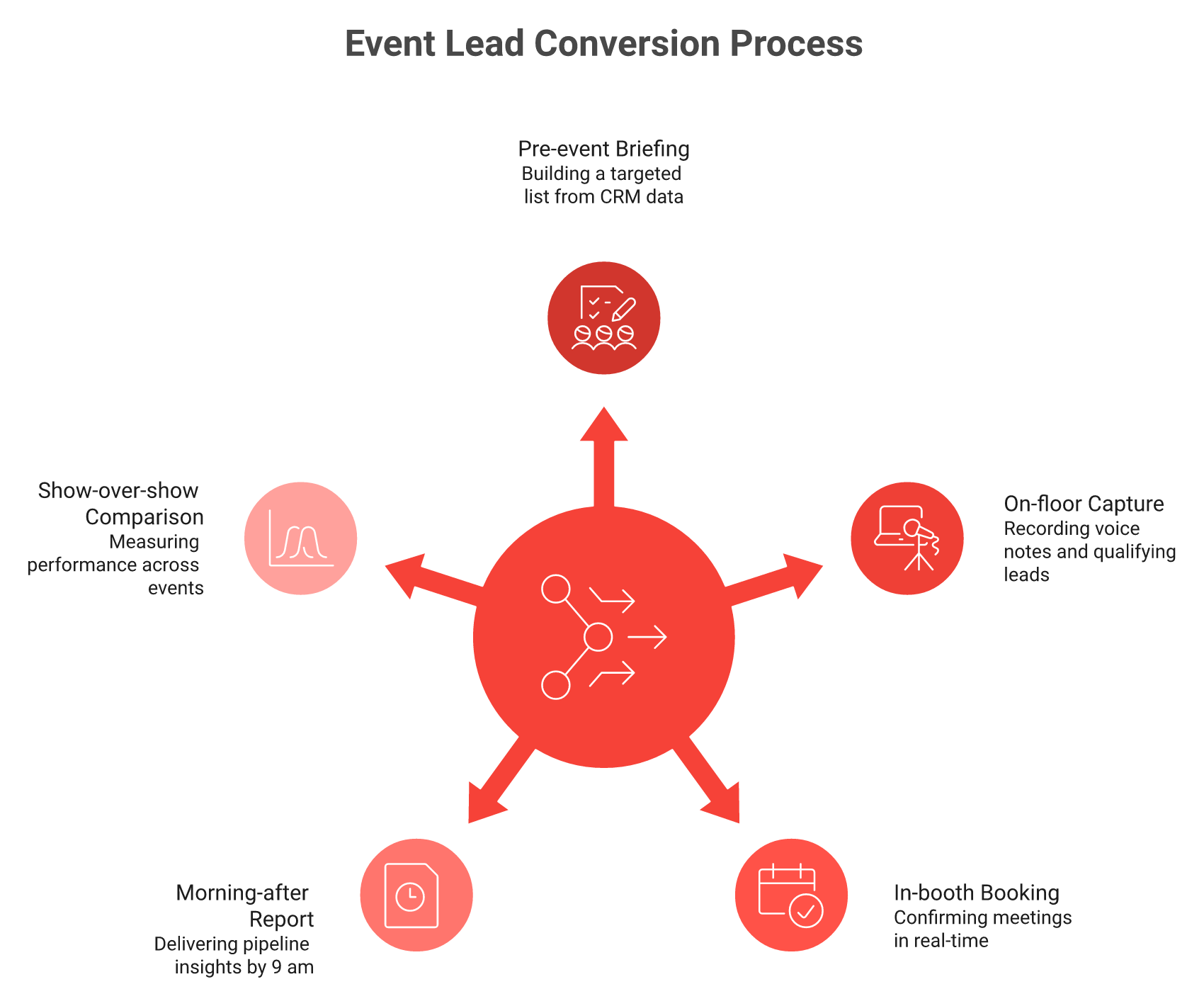
B2Brain covers Before, During, and After on one shared intelligence layer, which is the part rivals have not replicated: a CRM-grounded pre-event briefing, on-floor booking, and a morning-after pipeline report tied to the same records. That is how event lead capture works when the three motions sit on one data layer.
Q2. Where does event lead follow-up actually break, bad data or unexecuted follow-up?
Follow-up breaks at execution, not data completeness. Momencio's 2026 report measured 80% of trade show leads receiving zero follow-up across 20 major US shows. Average B2B response time runs 42 hours. BoothMaven platform data shows reply rates falling from an index of 100 same-day to 47 at 48 to 72 hours, and 9 after two weeks.
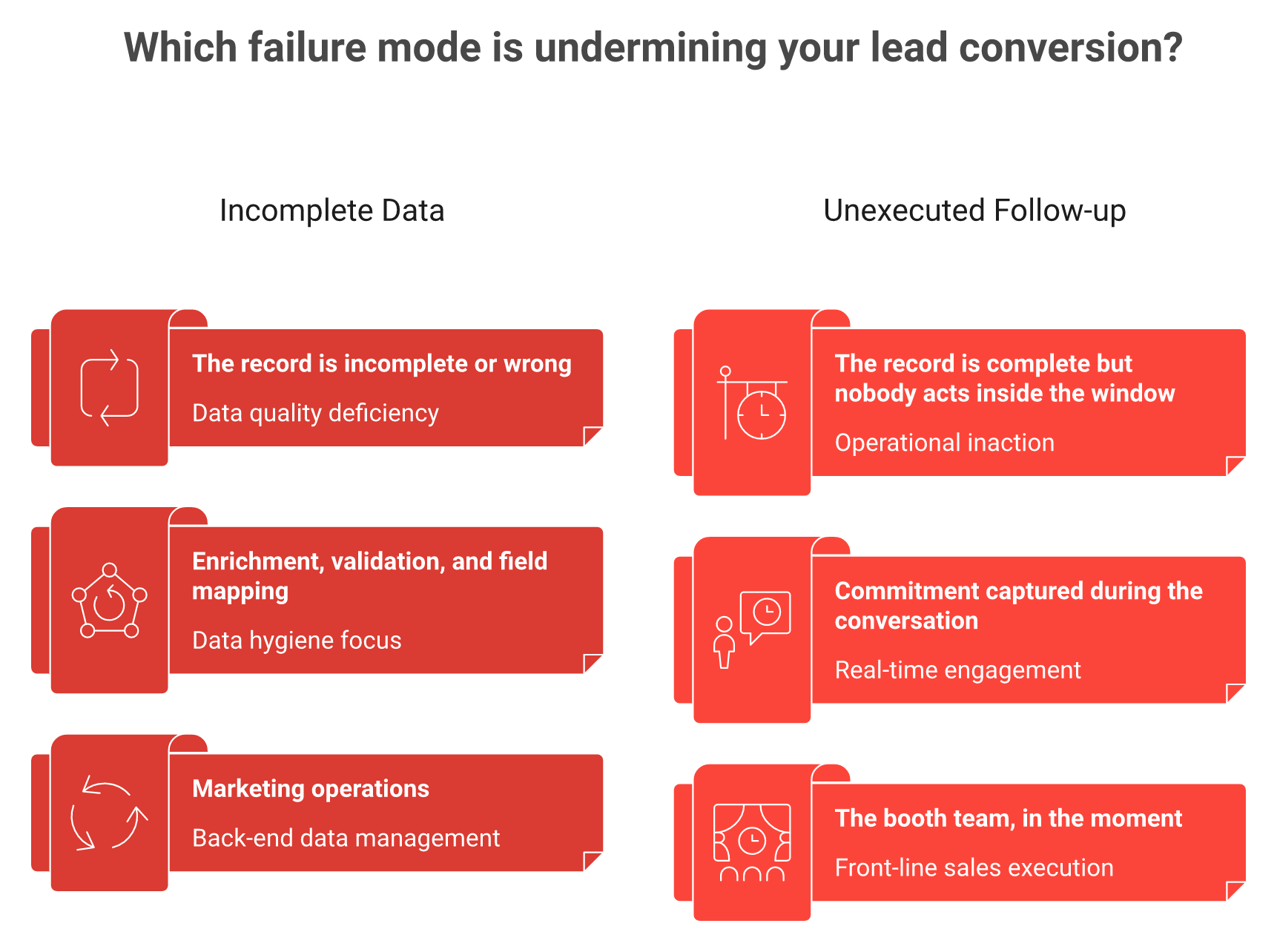
🔍 Two failure modes that look identical in a spreadsheet
Mode one is incomplete data: a badge scan with no email, no title, no company size. Enrichment fixes this.
Mode two is unexecuted follow-up: perfect data that nobody acts on inside the window when the buyer still remembers you. Enrichment does nothing for this, and mode two is where the money goes.
Most exhibitors buy enrichment to fix a problem that lives on the execution side of this diagram.
📉 The receipts on mode two
A 2026 Momencio study across 20 major US shows found 80% of trade show leads receive no follow-up at all. CEIR benchmark research found only 47% of exhibitors track leads through the sales cycle.
An operator at a Chicago print expo ran the cleanest test I have seen. He handed out 100 business cards, got two follow-ups inside a week, and five or six across the next 30 days. The structural fix is the one described in how to collect leads at a trade show.
⏰ The decay curve, in numbers
Reply rates do not decline gently. They fall off a cliff, and the cliff arrives before most teams are home from the airport.
Trade Show Reply-Rate Decay by Follow-Up Delay
Time since booth conversation
Reply-rate index
Same day
100
Within 24 hours
92
48 to 72 hours
47
4 to 7 days
31
15+ days
9
Source: BoothMaven platform data, 2,400+ North American exhibitors, 2024 to 2026.
💸 What this means for tool selection
There is a popular workaround: wait a few days so the prospect gets settled, then send a nurture sequence. That advice is expensive. By day four you are working with an index of 31.
B2Brain was built against mode two specifically. Ask B2Brain to book the discovery slot while the prospect is still at the booth, and the 42-hour window disappears because there is nothing left to chase.
🧭 The uncomfortable part of the math
Run your own numbers before you evaluate any vendor. A $70K booth with a 10x pipeline target and a 12% discovery-to-close rate means roughly 1 in 5 booth visitors must become a qualified meeting. The event ROI calculator runs that chain for you.
If you do not know that ratio, no amount of enrichment will save the show. Honestly, I think this is the single most useful hour a Field Marketer can spend before signing anything.
B2Brain reports LTM at 52% on the floor against an 8% post-event industry average, which is the ratio that math actually depends on. We publish it because no competitor tracks the metric at all, and it is the number behind going from offline to pipeline.
Q3. How do capture methods and on-floor reliability compare?
Mobly offers four capture methods including badge scan, card OCR, QR, and manual entry with voice-to-text notes. B2Brain captures with context attached, producing a structured CRM record in about 4.2 seconds per scan. Popl's 2026 grid disputes Mobly on universal capture while Mobly's own page claims on-device OCR, so test both against your show's badge format before signing.
📱 What each tool captures
Mobly publishes four capture paths: badge scan, business card OCR, QR, and manual entry, with voice-to-text notes layered on top. Reviewers confirm the voice notes work well under time pressure.
B2Brain's Golden Workflow is Scan, Add Context, Execute Next-Best-Action. Voice is just the vehicle. The captured context is the asset, and it takes roughly a fifth the time of typed notes.
⚠️ Adjudicating the claim conflict
Popl's 2026 comparison grid marks Mobly as absent on universal capture and real-time CRM sync. Mobly's own product page claims both. Vendor grids are marketing, so go to reviews instead.
"Sometimes Mobly can be finicky, where it doesn't sync all the leads I've scanned, doesn't scan leads properly, whether it was a blurry picture or the service made it delayed." — Verified User in Events Services, 3.5 stars, Mobly G2 Verified Review
"Feels a bit clunky. Never sure if details are saved. Would prefer free fields accessible from opening the app." — Thor C., 3.5 stars, Mobly G2 Verified Review
📶 Offline behavior is the row nobody tests
Expo hall Wi-Fi fails on Day 2 at 2pm, every time. That reviewer complaint about leads not syncing is the sound of a connectivity assumption breaking.
B2Brain is offline-ready and syncs on reconnect, so the scan queue survives dead Wi-Fi. Ask any vendor to demo airplane mode, not just a clean booth Wi-Fi scan, and check it against how a conference badge scanner app behaves at scale.
⭐ The rush-hour problem, and one workaround
At 4pm on Day 2 nobody can stop to take notes. Operators improvise: photograph the person holding their card so you can reconstruct who was who later.
B2Brain ships "Recent Leads" for exactly that moment, letting a rep clear a rush and add context minutes later without losing the thread. Reps open the app roughly 500 times across a four-day show, so this is where usability actually gets decided.
✅ What to test on your floor
Run a 20-scan pilot before you commit. Bring three badge types and one deliberately blurry card, and treat it the way you would test any lead capture app for trade shows.
Test the show's badge format directly. MODEX, FABTECH, and PACK EXPO do not print the same badge.
Time scan to structured record, not scan to photo saved.
Turn Wi-Fi off mid-scan, then reconnect and count what survived.
Have two reps scan the same buyer and check for duplicates.
B2Brain logs scan to structured CRM record in about 4.2 seconds, and that number is measured on the floor rather than in a demo environment.
Q4. Which tool enriches a scanned lead better, data waterfall or CRM-grounded context?
Mobly enriches deeper, routing each scan through multiple providers with human validation, which reviewers praise most. B2Brain enriches from your own CRM: pipeline stage, open opportunities, and account history, so reps trust data they already own. Deeper firmographics do not create urgency, and only 8% of B2B companies respond to a lead within five minutes.
🔎 How Mobly's enrichment actually works
Mobly routes a scanned badge through a waterfall of data providers, with human validation on top. You buy contact matches, so enrichment has a per-contact cost.
This is a genuine strength and I will not pretend otherwise. If your gap is thin contact records, Mobly is the better buy on this row.
💬 What reviewers say about the trade-off
"I find Mobly very user-friendly and seamless. We really like the voice notes feature, because when you're short on time between talking to people, it's very easy to get information on a lead. The cost of matches per contact, I think, is kinda high." — Ece K., 4 stars, Mobly G2 Verified Review
"The benefits of having a place to store contacts that also has expedited enhancements is very helpful. The app is a little buggy. I think the contacts made a few duplicates." — Verified User in Consumer Goods, 3.5 stars, Mobly G2 Verified Review
🧩 Why CRM-grounded context beats a firmographic append
A firmographic append tells a rep the company has 800 employees. It does not tell her there is an open $240K opportunity, stalled at proposal, owned by a colleague.
B2Brain's pre-event briefing is built from the customer's own CRM pipeline rather than a vendor prediction database, and teams using it book 2.4x more booth meetings than cold floor-walking. Reps trust it because they already own the data, which is the point of lead capture that writes straight into Salesforce.
⚡ Enrichment does not create urgency
One field marketer put the real problem plainly: teams scan everything, hand it to sales, and let sales filter the garbage. Scoring the lead at the moment of the conversation removes that entire step.
Only 8% of B2B companies respond to an inbound lead within five minutes, and the average sits at 42 hours. A perfectly enriched record that sits for 42 hours is still a dead record.
❌ Where B2Brain is honestly weaker
B2Brain's third-party enrichment depth is lighter than Mobly's, Popl's, or Momencio's. Our own reviewers say so.
"The main thing is the contact data. It's just not very good. The accuracy of emails is hit or miss, around 60 to 70%." — Jorgealfa P., 3.5 stars, B2Brain G2 Verified Review
There are two other gaps worth knowing: the native app is iOS-only (web app otherwise), and there is no digital business card. If enrichment breadth is your top criterion, buy Mobly.
B2Brain's position is narrower and deliberate: enrich from data you already trust, then convert the conversation into a booked meeting and a CRM record the same minute. That is the row we compete on, and the fastest way to test it is the booth-day workflow for booth teams or a Book a Demo walkthrough.
Q5. Does Mobly book the meeting at the booth, or route it for later?
No. Mobly captures, scores, and can auto-fire email or SMS on scan, but the meeting itself is booked afterwards by your follow-up engine. B2Brain books it on the floor: voice note, qualification, then a dual calendar invite to the prospect and the right AE in under 30 seconds, while the conversation is still fresh.
📲 What a Mobly scan actually triggers
Mobly's model is capture, enrich, score, then activate outreach. Its Pulse feature can fire an email or SMS the moment a badge is scanned.
That is a real improvement on a rented scanner. The visitor gets a touch while they are still in the hall, which is faster than most exhibitors manage.
⏰ What still has to happen after the scan
An automated email is a touch, not a commitment. Somebody still has to reply, agree on a time, and land on a calendar.
That work moves to your SDR queue or your marketing automation sequence. One field marketer put the standard fix well: within 15 minutes the prospect gets a note saying you will reach out next week. It works, but it buys attention, not a slot.
✅ The 30-second version, timestamped
B2Brain compresses that into the conversation itself, with the invite routed to the correct AE's calendar before the rep moves to the next badge. Here is the sequence we measure on the floor, and it is the core of the three-motion workflow.
Scan to Booked Meeting: The 30-Second Booth Sequence
Elapsed time
What happens
0:00
Rep scans the badge, one tap
0:03
Prior CRM context surfaces: open opportunity, owner, stage
0:05
Rep talks for about 20 seconds, voice capture running
0:12
Structured CRM record written, qualification tagged
0:20
Live AE calendar pulled, 30-minute slot offered
0:28
Dual invite accepted by prospect and AE, synced to CRM
⚠️ Booking alone is not a moat, and I will say so
BoothIQ, BoothMaven, and Zuddl all ship some version of in-booth booking now. I fully expect the fair objection: "BoothIQ does this too, so what is different?"
The answer is never the feature. It is the layer underneath: one shared intelligence layer across Before, During, and After, a briefing grounded in your own CRM, and per-customer Next-Best-Action configurability. Ask any vendor which of those three they actually own.
🧠 Why booking is only today's default action
The workflow B2Brain runs is Scan, Add Context, Execute Next-Best-Action. Booking is simply the most common action in 2026, not the definition of the product.
For some customers the right action is a sample shipment, a spec-sheet handoff, or a partner intro. My read right now is that this configurability, not the calendar widget, is what keeps a team on one platform for three seasons instead of one.
💸 The economics of a slot versus a touch
Compare two outcomes from the same booth conversation. One produces an email in an inbox, and one produces a 30-minute discovery call on Thursday at 2pm.
The second is worth roughly ten times the first, because discovery-to-close runs near 12% while inbox-touch-to-discovery runs far lower. Captello's own comparison page scores Mobly's meeting management as partial rather than native, which matches what buyers describe in our Mobly review.
B2Brain treats the booked meeting as the unit of work, not the scan. That is why the platform reports Leads-to-Meeting at 52% on the floor against an 8% post-event industry average, and why the number is published per show rather than per quarter.
Q6. How does CRM sync work in each, contact sync or opportunity attribution?
Both push natively to Salesforce and HubSpot with no CSV step, which already beats a rented badge scanner. The difference is what lands: Mobly syncs enriched contacts and leads with campaign mapping, while B2Brain writes the meeting and the opportunity, making the show attributable at deal level rather than contact level.
🔌 Sync model and latency
Mobly writes leads and contacts to Salesforce or HubSpot, with matching credits consumed per enriched contact. Sync happens on connectivity, which matters more than vendors admit.
B2Brain is Salesforce-native and HubSpot-native at parity, and queues offline then syncs on reconnect. Rented scanners still hand you a CSV days later, which is the workflow both tools replace, as covered in lead retrieval apps for trade shows.
Contact or Lead record, with enrichment fields populated
Campaign member, mapped to the show campaign
Activity or Task, holding the booth conversation notes
Event or Meeting record, with the confirmed time
Opportunity, created or linked to the existing deal
Contact sync tells you the record arrived. Only the last two objects answer where the pipeline is.
Mobly reliably covers the first three. B2Brain writes all five, which is why the platform reports 100% event-to-CRM attribution at opportunity level rather than contact level.
💬 What buyers report about sync
"It was challenging to get it to sync with Salesforce. The integration process was difficult for my team to accomplish and took a long time." — Ece K., 4 stars, Mobly G2 Verified Review
"The app is a little buggy. I think the contacts made a few duplicates." — Verified User in Consumer Goods, 3.5 stars, Mobly G2 Verified Review
"Had issues with integration with the current tracking system. Had to call for support on interface integration. The support too wasn't very responsive." — Sachin A., 4.5 stars, B2Brain G2 Verified Review
⚠️ Dedup when six reps scan the same buyer
At a large industrial show, one buyer walks your booth three times in two days. Three reps scan the badge, and your CRM now holds three records.
Duplicate contacts break attribution before anybody notices. B2Brain merges repeat scans against the same account record and keeps each conversation as a separate activity, so context survives without record bloat.
❌ The trap: "did the data arrive" is the wrong question
Contact sync answers a logistics question. It tells you the record landed.
Attribution answers the business question your CEO asks on Monday. A RevOps lead I worked with described inheriting a stack where the rental system did not talk to the sales system, so nurture emails went out with mismatched sender names and missing images.
🧾 What to demand in the demo
Bring your own sandbox and run a live write. Do not accept a slide, and if you want it walked through live, Book a Demo.
Scan one badge, then watch the record appear and note the exact latency.
Ask which five objects were written, and confirm in the CRM yourself.
Turn off Wi-Fi, scan three badges, reconnect, and count survivors.
Scan the same badge from two devices and inspect for duplicates.
B2Brain supports four native integrations deliberately, and builds a new one in roughly a day, which is a different bet than a 6,000-logo directory. Field mapping usually finishes inside one RevOps working session.
Q7. Can either tool give you a per-show pipeline number you can defend to finance?
Mobly reports lead volume, engagement, and which events earned budget. B2Brain reports a rate, Leads-to-Meeting, meaning meetings booked divided by qualified conversations captured, plus a per-show pipeline report by 9am the next morning. CEIR benchmark research finds only 47% of exhibitors track leads through the sales cycle, so either beats a spreadsheet.
📊 What each dashboard shows
Mobly's Insights view reports lead counts, engagement, and which events earned their budget. For a team currently working from a CSV, that is a genuine upgrade.
B2Brain delivers a different artifact: the morning-after offline-to-pipeline report, in the CMO's inbox by 9am, broken out by show, booth area, rep, and segment. The Field Marketer walks into the Monday review with a number, not a narrative.
🧮 Defining LTM in one line
Leads-to-Meeting (LTM) is the share of qualified booth conversations that became booked meetings. The formula is meetings booked divided by qualified conversations captured.
LTM is to events what cost-per-click is to advertising. B2Brain measures it per show, on the floor, and reports 52% against an 8% industry average for post-event follow-up, which is the spine of generating new pipeline from events.
The number finance accepts is produced upstream: briefing, capture, booking, then the morning-after report.
💰 The math your CFO is actually running
Work backwards from spend, not forwards from scans. Here is the chain on a $70K booth with a 10x pipeline target, and the same chain sits inside measuring event ROI.
Booth Spend to Required Qualified Scans: The CFO Chain
Step
Number
Booth cost
$70,000
Pipeline target at 10x
$700,000
Average deal size
$25,000
Opportunities needed
28
Discovery calls needed at 12% close
~180
Qualified scans needed at 52% LTM
~350
Rep-days needed at 31 scans per rep-day
~11
That last row is the honest constraint. Three reps across four days gets you there, and two reps does not.
⏰ Why slow capture kills the number
One seller told me his longest enterprise deal took 524 days to close. Velocity problems compound from the very first touch.
CEIR research found only 47% of exhibitors track leads through the sales cycle, and 79% of trade show leads receive no follow-up at all. You cannot defend a pipeline number built on a process nobody measures.
❌ What neither tool can prove
Be careful with the word revenue. Neither platform can promise it, because enterprise and ABM cycles run three to six months at the fast end, and a year at the slow end.
What both can prove is pipeline sourced and influenced. B2Brain deliberately claims revenue pipeline rather than revenue, since a revenue claim sets an expectation the sales cycle cannot honor.
🧭 The reporting gap our own reviewers flag
I will not pretend this is finished work. One B2Brain reviewer wanted deeper leadership reporting than the platform shipped at the time.
"Reporting is basic. We can see usage and lead stats, but there are no rep performance dashboards, no clear ROI reporting like time saved or deals influenced." — Ole O., 4 stars, B2Brain G2 Verified Review
B2Brain built the per-show pipeline report because of feedback exactly like that, and LTM is stated per show so two events sit on the same axis. The Field Marketer funds the booth, so we made the report the thing that makes her the hero in the review.
Q8. What do verified reviewers say, and where do vendor claims contradict them?
Mobly holds 4.8 out of 5 across roughly 108 G2 reviews and 4.8 on the App Store, praised for setup speed, voice-to-text, and enrichment accuracy. B2Brain holds 4.5 across 17 reviews, cited for CRM fit and account intelligence. Mobly wins social-proof volume, and pricing opacity is its most repeated criticism.
⭐ The social-proof scoreboard, stated honestly
Mobly has roughly 108 G2 reviews and a 4.8 App Store rating. B2Brain has 17 G2 reviews at 4.5.
The wider category is more lopsided still: Blinq sits at 8,800+ reviews, Popl at 4,400+, and Cvent at 2,100+ for lead capture. B2Brain is running a review-velocity campaign, and until it lands, that gap is a real evaluation risk you should weigh, the same way you would weigh what Popl reviewers report.
✅ What Mobly reviewers praise
The praise clusters tightly around speed and simplicity under booth pressure.
"We really like the voice notes feature, because when you're short on time between talking to people, it's very easy to get information on a lead so you can refer back to it later." — Ece K., 4 stars, Mobly G2 Verified Review
"It provides customers' contact details from name badges, and I can use it with my mobile phone." — Thor C., 3.5 stars, Mobly G2 Verified Review
⚠️ The complaint patterns that repeat
Three themes recur across Mobly's mid-star reviews: sync reliability, per-contact match cost, and uncertainty about whether a scan saved.
"Sometimes Mobly can be finicky, where it doesn't sync all the leads I've scanned. Without those leads that I scanned but apparently didn't go through, we end up with a lot fewer than we expected." — Verified User in Events Services, 3.5 stars, Mobly G2 Verified Review
Thor C. adds the version I hear most at booths: "never sure if details are saved." B2Brain ships the Recent Leads queue for that exact anxiety, showing the rep what captured and what still needs context.
❌ Where vendor grids contradict the reviews
Popl's 2026 comparison grid marks Mobly as absent on real-time CRM sync, while Mobly's own pages claim multi-object mapping and attribution. Both are marketing artifacts.
Reviews split the difference: sync exists, and it is finicky under load. Operators in exhibitor threads are blunter about rented scanners generally, one describing lead lists that get acted on three months later, if at all, in this r/EventProduction Reddit Thread.
💬 What B2Brain reviewers actually say
The pattern in our thin review base is consistent, and it is about research and CRM fit rather than booth hardware.
"What I appreciate most about B2Brain is its ability to deliver real-time, actionable insights that have a direct impact on the quality of outreach. The integrations work seamlessly." — Verified User in Accounting, 5 stars, B2Brain G2 Verified Review
🧠 How I would read a review wall in your position
Review count measures distribution and age, not fit. A 4.8 average across 108 reviews tells you the app rarely fails, and it says nothing about whether meetings got booked.
B2Brain's read is that the standard buying advice gets this backwards: sort by outcome first, then check reviews for reliability risk. Ask both vendors for one number, the share of booth conversations that became booked meetings, and see who can answer, then pressure-test it against the best event lead capture software in 2026.
Q9. What does each cost across an 8-to-15-show season?
Mobly prices as a quote-based flat subscription with unlimited events and users, plus a free single-user tier. The cost is identical at ten leads or a hundred, with no public per-event entry point. B2Brain is demo-priced with a first-event-free trial for two users. Judge both on cost per booked meeting, not cost per lead.
💰 What each vendor actually publishes
Mobly's own comparison table sells the flat-subscription shape against pay-per-event pricing, and it lists unlimited events and users as the benefit. There is a free single-user tier with limited monthly credits, which is the same trade-off covered in free lead capture app options.
The number Mobly does not publish is the price. Blinq's 2026 roundup flags exactly that opacity, and buyers repeat it in reviews.
💸 Where the enrichment meter runs
Flat does not mean unmetered. Contact matches are bought per contact, so a busy show adds cost outside the subscription line.
"I also wish we were able to get more contact matches on attendee lists. The cost of matches per contact, I think, is kinda high." — Ece K., 4 stars, Mobly G2 Verified Review
⭐ The season model, three ways
Here is how the three real options behave across a season. Assume 8 shows for a mid-market team and 15 for a heavy exhibitor, then check the numbers against Show Pass and Pipeline plans.
Season Cost Shape: Badge Scanner vs Mobly vs B2Brain
Cost driver
Organizer badge scanner
Mobly
B2Brain
Pricing shape
Per device, per show rental
Flat annual quote
Annual, demo-priced
Typical scanner rental
~$600 per device per show
Not applicable
Not applicable
8-show cost driver
Rentals multiply by device
Flat, plus match credits
Flat, no match meter
15-show cost driver
Rentals multiply again
Flat, credits rise with volume
Flat
Entry risk
Sunk per show
Free single-user tier
First event free, 2 users
B2Brain offers the first event free for two users, which turns the decision into one show of real floor data instead of a procurement argument.
❌ Why the software line is the wrong place to hunt savings
One consumer-goods founder told me she spent over $35,000 decorating a booth, before rental. At her second Expo West, she spent $950 and did better.
Software is rarely where the leak lives. The leak is the 400 scans that never became meetings, and the booth spend that produced them.
⏰ Switch the metric to cost per booked meeting
Mobly's own content cites roughly $811 as the cost per in-person lead, the highest of any B2B channel. That number only stings if leads are your unit of work.
Change the denominator. At 52% Leads-to-Meeting, B2Brain's benchmark data puts a qualified event meeting at about 60% of an equivalent outbound meeting and about 40% of paid acquisition, which is the whole point of moving from offline to pipeline.
🧮 The arithmetic worth doing before any demo
Take your last show and run four numbers. It takes ten minutes and it changes the conversation with your CFO, and the event ROI calculator runs the same chain.
Total show cost, including travel, booth, and drayage.
Qualified conversations captured, not badges scanned.
Meetings actually booked from those conversations.
Divide cost by meetings. That is your real price per meeting.
Most teams land somewhere between $2,000 and $6,000 per booked meeting on their first honest pass. Reps clear roughly 31 productive scans per day, so staffing changes that number faster than software does.
B2Brain prices annually and makes the first event free because the number that matters is only visible after one real show. My read is that any vendor unwilling to be measured on cost per booked meeting is asking you to buy on volume instead.
Q10. Which team should pick which, and how hard is the switch?
Pick Mobly if enrichment completeness is your gap, your follow-up engine already runs in HubSpot or Salesforce, and you need Android plus a free tier. Pick B2Brain if reps book meetings live on industrial floors and finance wants a per-show pipeline number. Neither suits solo booths, consumer sellers, or teams without a CRM.
🏭 The Field Marketing head running 12 industrial shows
She funds the booth and owes the pipeline answer. Her gap is almost never contact data. It is the gap between conversation and calendar.
B2Brain is built for this profile: exhibitors running 5 to 15 shows a year, $20K to $200K per show, ACVs above $25K, on Salesforce or HubSpot. Verdict for her: B2Brain, with Mobly as the pick if enrichment breadth outranks booking, and the booth-day workflow is where that decision plays out.
📈 The VP Sales running booth-ROI math
He wants meetings on AE calendars and a rate he can forecast against. Volume reports do not help him staff a booth.
Ask for one number from each vendor: the share of booth conversations that became booked meetings. Verdict: B2Brain if the answer matters, Mobly if his SDR team already converts reliably.
🧹 The RevOps lead inheriting dirty event data
His problem is duplicates, missing campaign members, and orphaned contacts from three seasons of scanners. Reviewers name this pain directly.
"The app is a little buggy. I think the contacts made a few duplicates." — Verified User in Consumer Goods, 3.5 stars, Mobly G2 Verified Review
B2Brain writes to four native integrations by design, and builds a new one in about a day, so mapping usually closes in one working session. Verdict: either tool beats a CSV, and dedup behavior should decide it.
🚀 The founder building a first events machine
Think of the India-headquartered team flying into a US show for the first time. Cash is finite and the booth is already booked.
"Mobly is easy to understand and navigate, so it was a snap to learn. I love the ability to customize certain fields within the app that makes it relevant to our market." — Kevin M., 4 stars, Mobly G2 Verified Review
Verdict: start with whichever offers a real trial, and measure one show honestly before signing an annual deal.
✅ Five things to configure before doors open
Setup takes days, not quarters. One B2Brain reviewer reported being production-ready in under 30 minutes, and the sequence follows how event lead capture works before, during, and after the show.
Create the show campaign in the CRM, before any scanning.
Set lead-owner routing rules by territory or segment.
Turn on dedup matching against account records.
Load the pre-event target list, cross-referenced with open pipeline.
Test offline capture with Wi-Fi disabled, then reconnect.
Reps open the app roughly 500 times across a four-day show, while dashboards get opened about four times. Train on the app, not the dashboard, and the same rule holds for any lead capture app for trade shows.
❌ Where B2Brain is the wrong buy
The native app is iOS-only, so mixed-device teams need the web app. There is no digital business card, and third-party enrichment depth is lighter than Mobly's.
B2Brain is also exhibitor-only, so attendees, organizers, solo booths, consumer sellers, and teams without a CRM should look elsewhere. Naming the misfit early saves everyone a quarter, and floor-walking teams are covered separately in what gets captured on the floor.
🧭 Where I think this goes next
Booking will be commodity within 18 months, since three challengers already ship it. Differentiation moves up the stack, to pipeline activation and per-customer Next-Best-Action configuration.
The open question I am sitting with: will finance start asking for LTM by name, the way it now asks for CPC? If your CFO already does, I would genuinely like to hear how that conversation started, so Book a Demo and bring the number with you.