You can quote a cost per lead for every channel except the one you spend the most on per day.
Paid has a cost per click. Content has a cost per MQL. Events has a spreadsheet, a headcount, and a number nobody wants to divide.
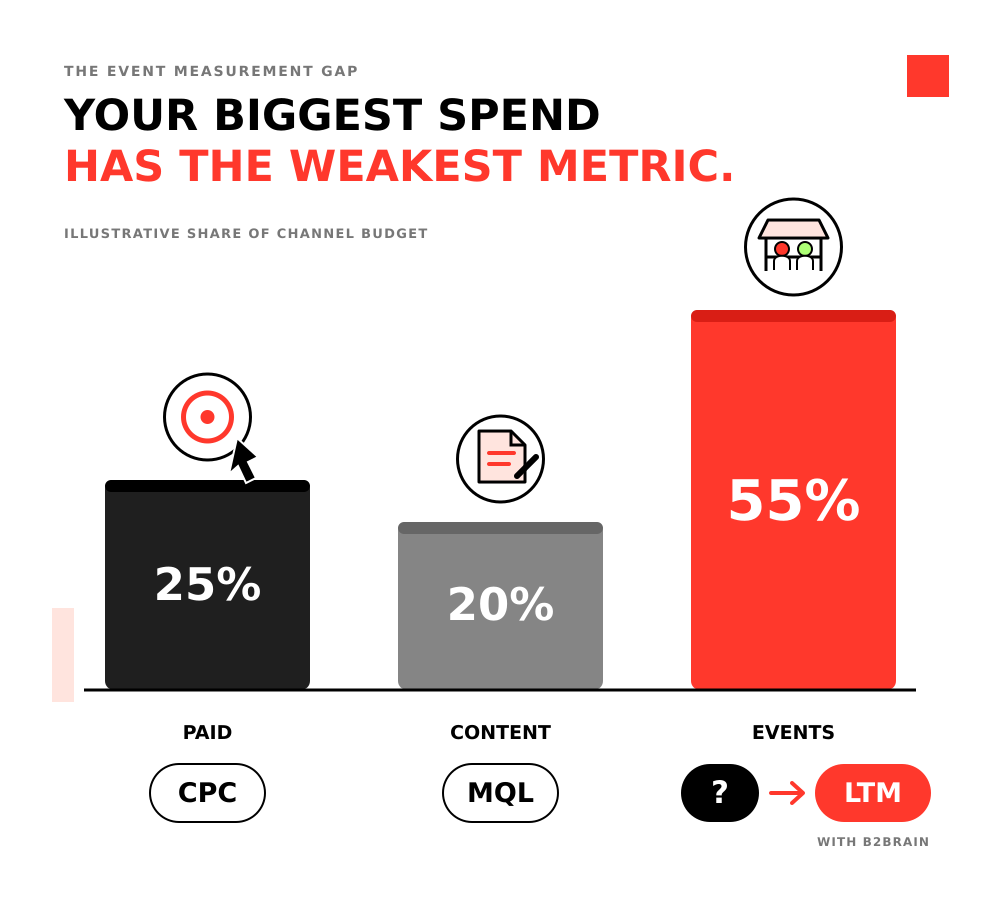

Your team spends more per day at a show than on any other channel, and reports back the least
A mid-sized exhibit runs into tens of thousands of dollars once you count the booth, the build, the travel, the hotel, the shipping and the people standing in it for three days. Digital would never be asked to justify that spend with a list of names.
Events is asked, and the honest answer is usually assembled by hand: your field marketer chasing six reps for their scans, some of it in a photograph, some in a spreadsheet, some in an email, some still in someone's head. By the time it reaches your CRM the context that made a conversation worth having is gone.
So the reporting line that comes back to you is a count of leads. Not which accounts are real. Not which reps did the work. Not whether the show is worth repeating.
Three things a badge scanner has never produced
1. Which of your people actually worked the floor
Every report breaks down by rep: leads scanned, accounts touched, how many carried a real note, how many carried a voice recording. Not to police anyone, but because rep behaviour is the single biggest driver of what a show returns, and until now you have had no visibility into it at all.
2. Which accounts are worth your sales team's Monday
Not the whole list. A short table of the accounts that matter, each with the reason in the rep's own words, the timing the prospect named, and the next action with an owner against it.
3. Whether this show earns its place next year
Every event produces the same report in the same shape, so shows become comparable to each other rather than each being argued on its own merits.
The number we think you should hold events to
Leads-to-Meeting. Of the people your team spoke to, how many agreed to a next conversation. It works as a channel metric for three reasons: your reps can move it directly, it is measurable the day the show ends, and it maps to pipeline rather than to activity.
Here is what it looks like across twelve reports we have delivered to eight companies. We are showing you the spread rather than our best number, because the spread is the useful part.
Look at the companies with three shows each. The engineering firm ran 10 to 17.6 percent across a nuclear expo, a clean power show and a storage show. The IT service management vendor ran 3.1 to 7.8 percent across three entirely different events. Same tool, same months, results two to three times apart and stable within each team.
That is the point of the metric. It is not measuring the show. It is measuring your team's practice at the show, which means it is something you can actually manage.
Two behaviours move it, and neither is software. Whether a rep writes the note while the conversation is still in their head, and whether they book the next meeting on the spot rather than promising to follow up. At the bottom of that table sits a team that scanned 80 badges and wrote 10 notes.
That is why we run an enablement session before your first show rather than sending you a login.
It comes out of a budget line you already approve
Every show already carries a lead retrieval line, the scanner rental your field marketer books with the organiser, per show, every show, forever. That rental buys a device that captures a name and nothing else, and it needs its own training every time.
The straightforward way to buy B2Brain is to point those existing lines at it. Take the shows you have already committed to this year, add up what lead retrieval costs across them, and buy that block instead. No new budget line, no new approval, and your team keeps one tool across every show rather than relearning a different rented device at each one.
If it works, the annual plan is there. It should be the second conversation, not the first.
What happens when the constraint comes off
A customer in the construction payroll software industry committed to seventeen events at the start of 2026. They have now passed thirty. The reason is not that events got cheaper. It is that adding a person to a show stopped being a project, so the programme could grow without the reporting falling apart behind it. They now recommend B2Brain to the sponsors and vendors at their own events.
85% of everyone who scans also pulls the intelligence
Measured across 416 users over 180 days. The part of the product that could have been ignored is the part people use most.
Seventy six full post-event reports, over 20 companies
Run one show. Then decide.
Your next event, two users, the full platform, no card. You get the same report your team would get every time, on your own leads, from your own floor. If the report is not better than what lands on your desk today, you have lost nothing.