iCapture Pricing 2026: Plans, Licenses, and Cost Structure
Written by
Sridhar Ranganathan
Last Updated :
August 13, 2026
Skim in:
13
mins
TL;DR
iCapture publishes no pricing. The most widely cited anchor is roughly $8,000 per year, listed on G2 and the HubSpot App Marketplace, with every contract quoted individually.
Licensing is flat-rate annual with unlimited users and unlimited events, so cost per rep falls sharply at scale and rises sharply for two-show programs.
Four cost layers stack on the license: Year 1 implementation of $5,000 to $50,000, per-registrant fees of $7 to $12, organizer device rentals of $400 to $735, and tier-gated modules.
There is no free plan and no self-serve trial, and buyers report auto-renewal billing disputes plus app-store sync failures during live shows.
Cvent ownership splits the ROI math: existing Cvent shops get bundling leverage, non-Cvent shops pay full price for platform depth they cannot use.
Cost per booked meeting beats cost per scan. CEIR finds only 47% of exhibitors track leads through the sales cycle, so most capture spend is measured against nothing.
Q1. How much does iCapture cost in 2026, and why is there no price page? [toc=1. iCapture Cost Snapshot]
iCapture does not publish pricing. The most widely cited anchor is roughly $8,000 per year for the base annual subscription, listed on G2 and on the HubSpot App Marketplace. Licensing is flat-rate annual with unlimited users and unlimited events, not per seat. Implementation, per-registrant fees, and organizer scanner rentals are quoted separately and sit on top.
💰 The number, and where it actually comes from
Two near-first-party listings carry the $8,000 figure. G2's pricing tab shows iCapture Essentials starting at $8,000 per year. HubSpot's marketplace listing shows the same number, last updated 08/11/2025.
Everything else you will read is buyer-reported. Third-party analyses put real contracts anywhere from $5,000 to $25,000 and up, depending on scope. Treat the $8,000 as a floor, not a quote.
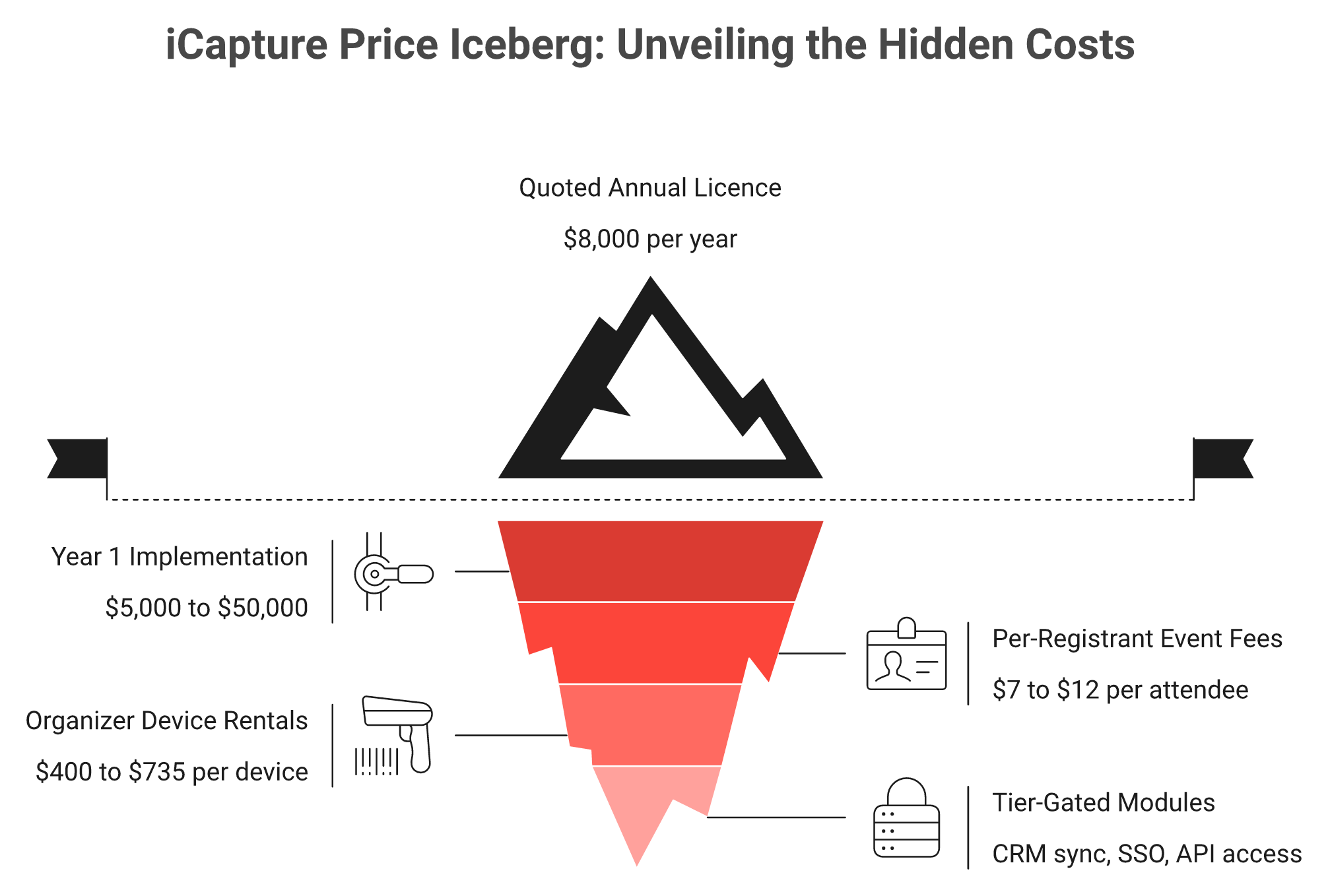
The quoted licence is the tip. Implementation, per-registrant fees, device rentals, and gated modules sit beneath it.
⏰ Why the quote gate exists, and what it costs you
Cvent prices iCapture by modules selected, expected event volume, attendee counts, and contract term. There is no sign-up button. You pick a plan, request a quote, and sign a contract.
That gate costs you two to three weeks of evaluation time. I have watched Field Marketers burn a full budget cycle waiting on three quotes while the fall show calendar closed. If you are six weeks out from a show, that delay is the real price.
⭐ The four levers that move your number
Volume and term do most of the work. The rest is footprint.
Event count per year. Flat-rate pricing rewards ten shows and punishes two.
Attendee volume. Per-registrant fees scale with badge counts, not booth size.
Contract term. Multi-year signatures buy discount and cost you flexibility.
Cvent footprint. Existing Cvent customers get bundling leverage that standalone buyers do not.
✅ Five questions to ask on the quote call
Walk in with these written down. Vague answers are themselves an answer.
What is the all-in Year 1 number, including implementation?
Is CRM sync included in this tier, or is it an upgrade?
What are per-registrant fees at a 15,000-attendee show?
Does this cover organizer scanner rentals, or are those separate?
What are the auto-renewal terms and the notice window?
⚠️ The comparison nobody runs
Set the license next to the booth build. Exhibitors report that a booth arrives bare, and each wall panel runs about $600 to dress.
Against a $70,000 booth program, an $8,000 license is a rounding line. The question is never whether you can afford it. The question is whether it moves your meetings number.
Here is my read after fifteen years of running this math. If you cannot state the cost per booked meeting, you are negotiating the wrong variable. I could be wrong on where the price lands for your team, but the ratio holds.
B2Brain publishes both per-event and annual pricing, with a first event free for two users. That lets a team compare what B2Brain costs per event against one real show floor before any annual signature.
Q2. What plans does iCapture offer, and which product are you actually pricing? [toc=2. Plans and Tier Gates]
iCapture sells one annual subscription covering unlimited users, badge scanning, event analytics, and native CRM integrations. Third parties describe a de facto four-tier ladder: Standard, Pro, Enterprise, and Enterprise+. Separately, the $79-per-month figure on Software Advice and SourceForge belongs to iCapture Survey, a different product. No iCapture tier includes AI enrichment, voice-to-text notes, or AI follow-up drafting.
📋 The official position: one subscription
iCapture's own framing is a single tier. It includes unlimited users, badge scanning, event performance analytics, and native connections to CRM and marketing automation systems.
There is no published Basic, Pro, or Enterprise ladder on the vendor side. What triggers a bigger contract is scope, not a feature button. If you are mapping this against universal lead capture as a category, the tier language matters less than the gates.
⚠️ The reported ladder, flagged as unverified
Third-party sources describe four practical tiers based on feature pages verified in early 2026. I am reporting these as buyer-reported, not vendor-confirmed. Ask your rep to confirm each row in writing.
The last two rows matter more than the first ten. No tier ships voice notes or AI follow-up drafting.
That means the note-taking burden stays on your reps at 4pm on Day 2, when the booth is three deep. Reps hate typing. Whatever they skip is context you never recover.
🔍 You may be pricing the wrong product entirely
Search "iCapture pricing" and you will hit two listings quoting $79 per user per month. Those pages describe iCapture Survey, an electronic data capture product for surveys.
It is not the trade show lead capture app. If a $79 figure appears in your procurement doc, someone copied the wrong row. Verify the vendor entity before you build a budget on it.
💡 The gate that actually decides value
Look at where CRM sync sits. On the reported ladder, it is a Pro-and-above capability.
When real-time write-back is an upgrade, the base product is priced against capture volume. Pipeline lives in the CRM, not in a CSV. My read is that this single gate tells you what the tool was built to optimize, which is why lead capture that writes straight into Salesforce belongs in the base evaluation.
In head-to-head terms, B2Brain records voice notes that take about one-fifth the time of typed notes, with scan-to-note under five seconds and CRM write-back in the base product.
B2Brain treats context capture as the product, not an add-on tier. Voice-to-text booth notes and Salesforce or HubSpot write-back ship in the base subscription, which keeps the qualification detail attached to the lead instead of stranded in a rep's memory. See how event lead capture works across the three motions.
Q3. What costs sit on top of the annual license? [toc=3. Hidden Cost Layers]
Four layers stack on the subscription. Year-1 implementation runs $5,000 to $50,000 per a January 2026 Cvent cost analysis. Per-registrant event fees run $7 to $12 per attendee. Organizer scanner rentals at Cvent-managed shows run $400 to $735 per device per event. CRM sync, SSO, and API access are tier-gated add-ons rather than included capabilities.
💸 Layer one: Year 1 implementation
Implementation is the layer that breaks budgets. A January 2026 analysis of Cvent pricing puts Year 1 onboarding between $5,000 and $50,000, stacked on the annual license.
The spread is enormous because scope is undefined at quote time. Ask for a written cap before signing.
📈 Layer two: per-registrant fees
Per-registrant fees run $7 to $12 per attendee per event. This is where large shows get expensive fast.
A 15,000-attendee show does not cost the same as a 2,000-attendee regional. Model your two biggest shows, not your average one. That is the number procurement will be surprised by in month nine.
🏷️ Layer three: the rental line nobody quotes
Software does not replace the organizer's hardware at every show. Scanner rentals at Cvent-managed events run $400 to $735 per device per event based on 2025 and 2026 exhibitor order forms. It is worth reading those figures beside a lead retrieval app for trade shows before you approve the order form.
Exhibitors report the same pain in the open. It is the single most repeated complaint in trade show threads.
"The badge scanners provided by event organizers are typically overpriced and unreliable, costing between $500 to $800 for each event." — u/anonymous exhibitor, r/smallbusiness Reddit Thread
"The Lead Retrieval and Badge Scanning provided by the event organizers feels pretty expensive. Several individuals at Ai4 invested approximately $800 in a badge scanner." — u/anonymous, r/SaaS Reddit Thread
🔌 Layer four: API kits and gated modules
Badge API kits are a real per-show charge across this category, not an iCapture quirk. A verified Captello buyer put a number on it.
"Every time we have a show with lead scanning, I have to purchase an API kit that costs between $700 and $1200. It's become costly." — RebeccaGrace K., Marketing Captello - G2 Verified Review
CRM sync, SSO, and API access sit behind tier gates on the reported ladder. Each one is a separate line on the purchase order.
✅ What is negotiable, and what is not
Implementation and term length move. Per-registrant and organizer rentals mostly do not.
Negotiable: implementation scope and cap, contract term, discount at multi-year, and number of gated modules bundled.
Rarely negotiable: per-registrant fees, organizer device rentals, and third-party badge API kits.
Every layer here prices access to the badge. None of them prices the outcome your budget was approved for. That distinction is the whole argument.
B2Brain includes Salesforce and HubSpot sync in the base subscription rather than gating CRM write-back behind an upgrade tier, so the cost of getting booth data into the pipeline is not a separate purchase order line. That is the shape of the booth-day workflow we build for.
Q4. What is the three-year total cost for a 10-show program? [toc=4. Three-Year TCO]
Base subscription totals roughly $24,000 over three years at the reported $8,000 anchor. Adding Year-1 implementation, per-registrant fees, and device rentals pushes a realistic 10-show program well past the $15,000 to $30,000 range cited as the category norm. Event managers have reported Cvent bills exceeding $100,000 annually once add-ons are counted.
🧮 The assumptions behind this model
State assumptions before numbers. Otherwise the total is unfalsifiable.
Five booth reps, ten shows per year, and a three-year term.
Average 6,000 badge-scanned attendees engaged per year across shows.
Mid-range implementation, not the floor and not the ceiling.
Two devices rented per show where the organizer requires hardware.
📊 The layer-by-layer build
iCapture Three-Year Cost Build, 10-Show Program
Cost layer
3-year figure
Basis
Base annual subscription
~$24,000
Reported $8,000/yr anchor
Year 1 implementation
$5,000 to $50,000
Jan 2026 Cvent cost analysis
Per-registrant fees
$7 to $12 per attendee/event
Buyer-reported
Organizer device rentals
$400 to $735 per device/event
2025 to 2026 exhibitor order forms
Gated modules (CRM sync, SSO, API)
Quote-dependent
Tier-gated add-ons
Realistic 3-year range
$45,000 to $120,000+
Stacked, mid-range assumptions
⚠️ The two variables that swing the total
Implementation and show size do almost all of the damage. Rep count does almost none.
Flat-rate licensing means a 25-rep team pays the same base as a 5-rep team. That is genuinely favorable at scale. The offsetting risk is that attendee-based fees rise with exactly the shows you care most about.
💰 Now put it next to the booth
A three-year software line of $45,000 to $120,000 sounds heavy in isolation. It is not heavy next to the booth program it supports. Run it through an event ROI calculator before you argue about the license.
One operator I take seriously admitted spending over $35,000 decorating a single booth, then said the money could have been used far better. That is the misallocation this table exists to prevent.
✅ The ratio that makes the number defensible
Run the chain in this order: booth cost, required pipeline, required meetings, and required qualified scans. The license only earns its place if it moves the meetings line.
CEIR benchmark research finds only 47% of exhibitors track leads through the sales cycle at all. If you are in the other 53%, no TCO model can tell you whether the spend worked, which is the practical case for measuring event ROI per show rather than per season.
B2Brain's published benchmark is that a qualified event meeting costs about 60% of an equivalent outbound meeting and about 40% of a paid-acquisition meeting. I use that as the denominator, though I will hedge it honestly: it reflects B2Brain deployments, not the whole category.
B2Brain reports Leads-to-Meeting of 52% booked on the floor against an 8% industry average booked post-event, which gives a three-year TCO an outcome to divide by instead of a scan count. That is the offline to pipeline math, and you can Book a Demo to see it run against your own show list.
Q5. What are the trial, contract, and reliability risks you are underwriting? [toc=5. Contract and Reliability Risk]
There is no free plan and no self-serve trial. Access begins with a demo request and closes as an annual contract, with documented auto-renewal complaints including a November 2025 Trustpilot reviewer billed for an unused term. Cvent's iCapture app sits between 2.6 and 3.0 stars on Google Play, and StatusGator has tracked more than 730 Cvent outages.
❌ No trial means the pilot happens on your show floor
You cannot test iCapture before you buy it. There is no free tier and no sandbox signup.
That matters more than it sounds. Your first real test is a live booth with real prospects and a real booth spend behind it. If you want a lower-risk comparison, look at how a free lead capture app handles a single show before committing budget.
⚠️ The contract clauses to redline first
Annual terms with automatic renewal are the documented pain point. A November 2025 Trustpilot reviewer reported being billed for the remainder of a term on software they never used, and PissedConsumer rates Cvent 1.5 stars with matching complaints.
Four clauses deserve a redline before signature.
Auto-renewal notice window. Ask for 30 days, not 90.
Implementation cap. Put a ceiling on the $5,000 to $50,000 range in writing.
Uptime remedy. Define what happens when sync fails during a show.
Exit data rights. Confirm you can export leads in full on termination.
🔻 What buyers report when the floor gets hostile
The ratings split sharply by surface. On G2, iCapture holds 4.7 across 96 reviews in the lead retrieval category. On the app stores, the picture is rougher.
"I dislike how iCapture randomly cuts out when syncing, especially when connecting to hotel wifi." — Verified User, Event Marketing iCapture - G2 Verified Review
"The app would show an eternal 'uploading captures' loading icon that would never finish. In the end, we only got data for approximately one-third of the scans we captured." — Verified User, Exhibitor Cvent iCapture - Apple App Store Verified Review
"Scanned leads the whole day only to find out the leads never synced. Paid more than 35k for the conference to get leads and ended up having a very bad experience with this app." — Verified User, Exhibitor Cvent LeadCapture - Google Play Verified Review
✅ Not every report is negative
Balance matters here. Plenty of G2 reviewers describe clean CRM flow at scale.
"All leads go straight into HubSpot and our MQLs sync over to Salesforce, allowing our sales team to begin follow-up on leads as soon as the same day the lead is captured." — Verified User, Marketing Operations iCapture - G2 Verified Review
My read is that reliability here is configuration-sensitive, not uniformly bad. Field mapping and API setup decide your outcome. I might be reading the split too strongly, but the pattern is consistent across two years of reviews.
💸 Price the downside, not just the license
Run the risk math. One lost scanning day at a $35,000 conference costs more than an entire annual license.
That is why offline reliability belongs in the pricing conversation, not the features conversation. Ask what happens when expo hall Wi-Fi dies at 2pm on Day 1. This is the failure mode any badge scanning app has to survive.
B2Brain runs offline-ready capture that syncs on reconnect, and delivers the morning-after offline-to-pipeline report to the CMO by 9am. A floor outage becomes a delayed sync, not a lost show.
Q6. Does the Cvent acquisition change what you pay and what you get? [toc=6. Cvent Ownership Impact]
Cvent acquired iCapture in 2024. It still ships under its own name but shares a roadmap with Cvent LeadCapture, which only works at Cvent-managed events. If you already pay for Cvent, iCapture slots in cheaply. If you do not, you pay full price for a tool built around another platform, and post-acquisition updates have centered on interface and badge-scan API maintenance.
🧩 Two products, one roadmap
Buyers routinely confuse the two. Cvent iCapture is the standalone universal capture app for exhibitors, usable at any show. Cvent LeadCapture is the native module that works only at Cvent-managed events.
They share a codebase and a roadmap. That is the fact that decides your price. For a side-by-side on the standalone app, see Popl vs iCapture.
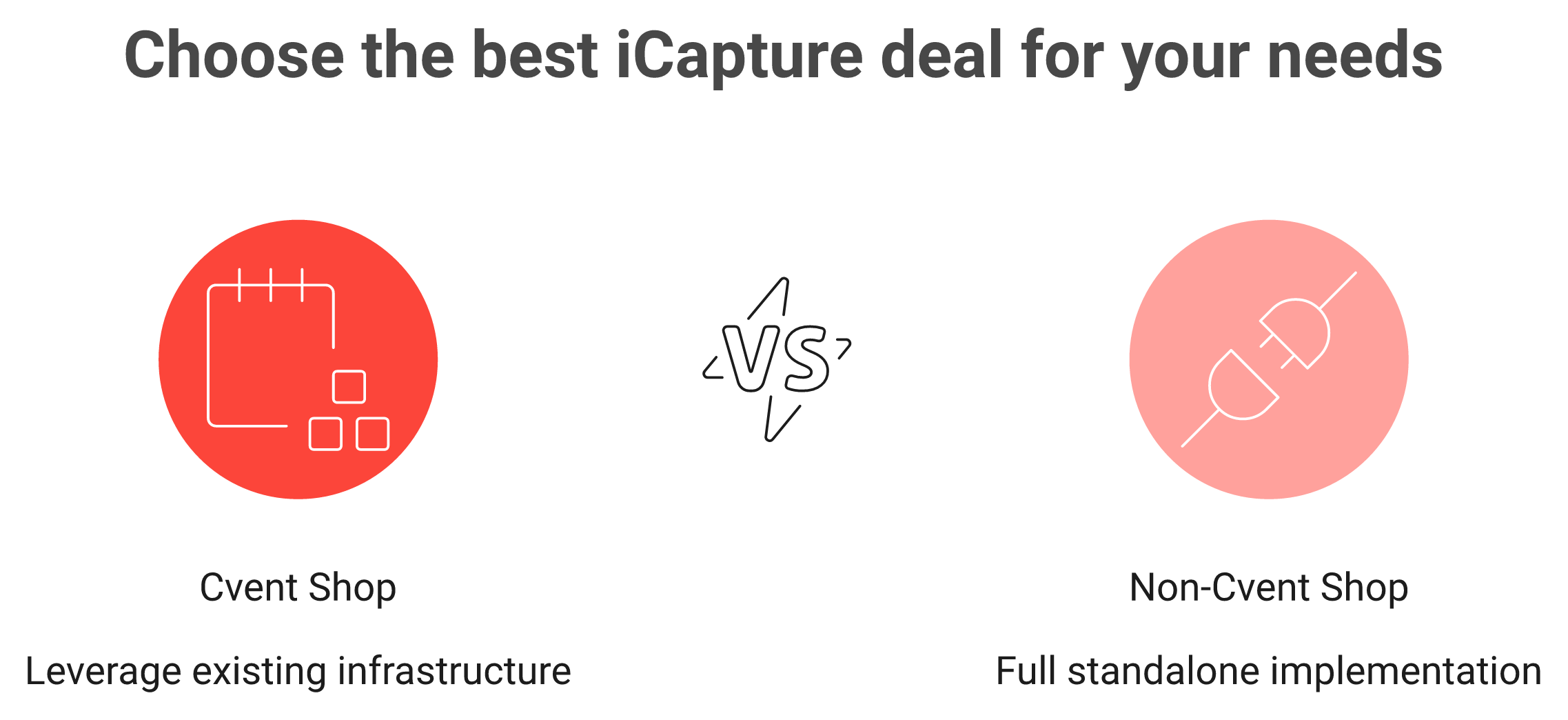
Cvent ownership splits the buying decision into two different deals at the same list price.
💰 The two ROI paths, side by side
The same $8,000 buys very different value depending on your stack.
iCapture ROI Paths by Existing Stack
Dimension
Existing Cvent shop
Non-Cvent shop
Contract leverage
Bundling discount available
Standalone list price
Setup effort
Slots into existing event config
Full standalone implementation
Data continuity
Registration and badge data already aligned
Manual reconciliation
Strategic value
Consolidation of vendors
Dependency on a platform you do not use
If you are not on Cvent, you are paying for integration depth you cannot use. That is the honest version of the buying decision.
⏰ What slowed feature velocity costs you in 2026
Post-acquisition changes have focused on modernizing the interface, improving load times, and enhancing badge-scan APIs. Major feature launches have been limited.
Look at what is missing across every tier: AI enrichment, voice-to-text notes, and AI follow-up drafting. Those are not exotic requests in 2026. They are what a rep needs at 4pm on Day 2 when the booth is three deep, and they are table stakes in any current review of the best event lead capture software.
⭐ The pattern behind the pattern
Acquired capture tools optimize for platform alignment. Independent tools optimize for the booth floor. That divergence shows up in your follow-up speed, not in the feature list.
I have watched this play out in advertising tooling for years. Once a point product joins a suite, the roadmap serves the suite. Nobody decides this maliciously. It is just gravity.
🔍 The question the acquisition actually raises
Contact information is not where anything happens. Pipeline is where your world moves.
An acquisition that improves badge-scan APIs does not move your meetings number. Ask your rep what shipped in the last twelve months that changed a customer's leads-to-meeting rate. If the answer is interface work, you have your answer.
✅ Where organizer dependency shows up on the invoice
Here is the practical test. Ask what your cost looks like at three shows run by three different organizers.
Organizer Dependency Across Lead Capture Options
Capability
Cvent LeadCapture
Cvent iCapture
B2Brain
Works at non-Cvent shows
❌
✅
✅
CRM sync in base product
Tier-dependent
Tier-dependent
✅ Salesforce and HubSpot native
Cost varies by organizer
✅ Yes
Partially
❌ No
B2Brain is Salesforce-native and HubSpot-native with no event-platform dependency, so cost and capability do not shift with which organizer runs the show. I will concede the honest gap: the native app is iOS, with Android served through the web app. The full sequence sits before, during, and after the show.
Q7. Is iCapture cheaper than renting the organizer's badge scanner? [toc=7. Rental Break-Even Math]
Usually yes, above roughly six shows. Organizer rentals run $400 to $735 per device per event, so five reps across twenty shows costs $30,000 to $40,000 a year for contextless scans locked in the organizer's portal. A flat $8,000 annual license with unlimited users breaks even at roughly three to six shows depending on rep count.
💸 What rentals actually cost, from the people paying them
Order forms say $400 to $735 per device. Exhibitors in the open say the same thing, sometimes higher.
"The badge scanners provided by event organizers are typically overpriced and unreliable, costing between $500 to $800 for each event." — Verified exhibitor, r/smallbusiness Reddit Thread
"The Lead Retrieval and Badge Scanning provided by the event organizers feels pretty expensive. Several individuals at Ai4 invested approximately $800 in a badge scanner." — Verified exhibitor, r/SaaS Reddit Thread
🧮 The break-even formula
Write this on a napkin before your next quote call.
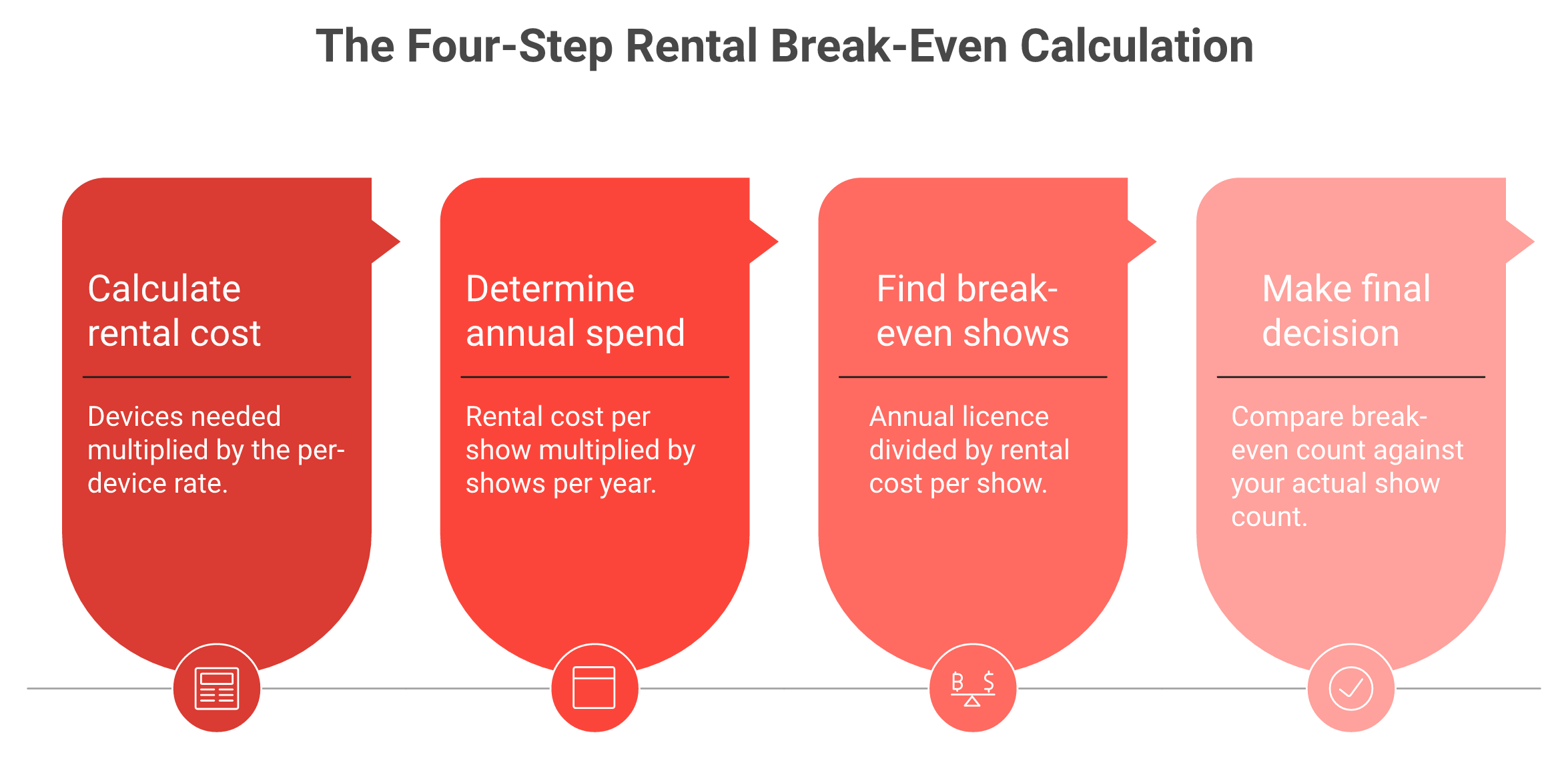
Rental cost per show = devices needed x per-device rate.
Annual rental spend = rental cost per show x shows per year.
Break-even shows = annual license divided by rental cost per show.
Compare that to your actual show count.
The variable that moves it most is devices, not shows. Two reps at three shows is a different business than six reps at twelve. A phone-based conference badge scanner changes the device line entirely.
Run this on your own show count before you accept or reject a quote.
📊 Worked example: five reps, twelve shows
Assume three devices per show at $550 each. That is $1,650 per show, and $19,800 per year in rentals.
An $8,000 flat license breaks even at just under five shows. By show twelve, you have spent $11,800 more on rentals than on software. That is before you count the CSV cleanup nobody logs.
⚠️ Where rentals still win
Be honest about the small case. One or two shows a year, two reps, and no CRM in play: rent the scanner.
"Basic event-provided scanners are usually fine if you only exhibit once or twice a year." — Verified exhibitor, r/tradeshows Reddit Thread
A license you use twice is worse economics than a rental you use twice. My read is that the crossover sits between four and six shows for most teams.
⭐ The comparison the math hides
The rental scanner is not a peer product. It is the displacement reference.
It collects data for the organizer, and it hands you a CSV. Anything a badge scanner captures, B2Brain captures with context attached, then books the meeting and writes the CRM record.
✅ Give the ratio a real denominator
Per-scan cost is meaningless without a scan volume you can defend. B2Brain benchmarks a productive booth rep at 31 scans per day, which gives buyers a grounded denominator instead of a guess.
Five reps at 31 scans across three days is roughly 465 scans per show. At $1,650 in rentals, that is about $3.55 per contextless contact.
B2Brain prices per event and annually, with the first event free for two users. That lets a team compare a real show's capture cost against its own rental invoice before committing to a season-long contract. The current Show Pass and Pipeline plans are published, not quote-gated.
Q8. What does iCapture cost per booked meeting, not per scan? [toc=8. Cost Per Booked Meeting]
Divide fully loaded annual cost by meetings booked, not badges scanned. Blended cost per trade-show lead runs $283 to $450. CEIR finds only 47% of exhibitors track leads through the sales cycle, and 79% of leads receive no follow-up at all. B2Brain measures Leads-to-Meeting as its contracted outcome and reports 52% booked on the floor against an 8% post-event industry average.
📉 Why cost per scan is the wrong ratio
Cost per scan flatters every vendor in this category. It rewards volume, and volume is the cheapest thing to produce at a booth.
Scans are not pipeline. A contact record with no context and no next step is an expense, not an asset. That gap is the whole reason how you collect leads at a trade show matters more than what you paid per badge.
📚 The evidence that most capture spend is priced against nothing
The follow-up failure data is brutal and well documented. CEIR benchmark research finds only 47% of exhibitors track leads through the sales cycle, and 79% of trade show leads never receive any follow-up.
Category research puts the rest of the picture in place: up to 80% of event leads never reach the CRM, and average response time runs about 42 hours.
One operator I take seriously put it plainly after years of watching this: roughly one in twenty companies who get a lead list actually acts on it, and usually three months late. Your software price buys entry to that 5%. It does not buy membership.
🧮 The calculation, run two ways
Take a fully loaded $20,000 first-year cost across ten shows. Assume 465 scans per show, so 4,650 scans a year.
Cost Per Booked Meeting at Two Conversion Rates
Scenario
Leads-to-meeting rate
Meetings booked
Cost per booked meeting
Post-event follow-up baseline
8%
372
~$54
On-the-floor booking
52%
2,418
~$8
The license price did not change. The denominator did. That is the entire argument of this article in one table.
⏰ Why the denominator moves at all
Conversion probability runs about 85% within two hours of the conversation, then falls to roughly 9% after a week. Booth memory decays just as fast.
You are not competing with other vendors on follow-up. You are competing with the prospect's Tuesday.
The spend stays fixed. What changes the economics is how many booth conversations become booked meetings.
✅ What to demand from any vendor to make this measurable
Ask five questions of iCapture, of B2Brain, and of everyone else on your list.
Can the tool book a meeting on the floor, or only capture a contact?
Does it write the meeting to Salesforce or HubSpot as an event-attributed record?
Can it report meetings booked per show, per rep, and per segment?
What leads-to-meeting rate do comparable customers run?
Can I see a per-show pipeline report before I sign?
If a vendor cannot answer question four, you are buying capture and hoping for pipeline. Most of that answer lives in measuring event ROI properly.
B2Brain publishes 52% Leads-to-Meeting booked on the floor against an 8% industry average booked post-event, and reports it per show alongside multi-touch attribution. That gives a Field Marketer one number to bring to the Monday pipeline review, and you can Book a Demo to see the report format.
Q9. Which iCapture alternatives publish pricing, and how do their cost shapes compare? [toc=9. Alternatives by Cost Shape]
Alternatives split by cost shape rather than feature set. B2Brain prices per event and annually, with a first event free for two users. Captello and Momencio quote annually. Popl and Blinq sell per seat with published tiers. CompuLead and Validar price per event. Cvent LeadCapture is bundled into enterprise contracts and works only at Cvent-managed shows.
📊 The shortlist, by how you pay
Compare the billing model first. Features converged years ago.
iCapture Alternatives Compared by Cost Shape
Tool
Cost shape
CRM depth
Books meetings on the floor
Per-show pipeline reporting
B2Brain
Per event and annual, first event free
Salesforce and HubSpot native
✅ Yes, dual calendar invite
✅ LTM and attribution
iCapture
Annual, quote only, ~$8,000 anchor
Native, tier-gated
❌ Capture and qualify
Partial, event analytics
Captello
Annual quote, plus API kits per show
CRM import
❌ Engagement focus
Partial
Popl
Per seat, published tiers
Integrations
❌ Bolt-on
❌
Blinq
Per seat, published tiers
Integrations
❌
❌
Cvent LeadCapture
Bundled enterprise
Cvent-aligned
❌
Partial
B2Brain is the only row here with a Before, During, and After shared data layer, including pre-event briefings built from the buyer's own CRM pipeline. That is the three-motion workflow in one product.
💸 Per-seat pricing looks cheap until you count reps
Seat-based tools price well for two people. They price badly for a twelve-person booth team.
"The price, $140 a year? No way, would rather print thousands of business cards." — Fabian T., Sales Popl - G2 Verified Review
"The cost is very high considering it's mostly a digital business card sharing app. It's not much different than adding a QR code to my business card." — Brooke N., Marketing Popl - G2 Verified Review
If seat pricing is your sticking point, the trade-offs are laid out across the Popl alternatives comparison.
⚠️ Annual quote tools hide per-show charges
Annual pricing does not mean all-in pricing. Badge API kits are billed per show across several vendors.
"It does not always work with every conference, if the conference does not provide an API kit for integration." — Verified User in Consulting, Marketing Captello - G2 Verified Review
Ask every vendor the same question: what is the marginal cost of adding one more show in October? The answer separates a true universal lead capture setup from a per-show rental in software clothing.
🧭 Four scenarios, four different answers
Match the cost shape to your program, not to the demo.
Enterprise Cvent shop, 15+ shows. iCapture's flat rate and bundling leverage are hard to beat.
10-show industrial program, non-Cvent stack. Annual flat rate only wins if CRM sync sits in your tier.
Founder building a first events machine. Per-event pricing protects cash while the program is unproven.
Migration-averse RevOps team. Weight native CRM write-back above every other criterion.
Your goal is not to scan badges. Your goal is to sell meetings.
I will say the uncomfortable part. Scanning parity arrived years ago, and every tool here reads a badge fine. The divergence is what happens in the ninety seconds after the scan.
Honest social proof note: Blinq holds the top G2 position with 8,800-plus reviews, Popl carries 4,400-plus, and B2Brain has 17. My read is that review volume measures distribution, not floor conversion, though I hold that view loosely.
B2Brain leads on the criterion this table is built around: the meeting booked before the prospect walks away, tied to a per-show pipeline number. The honest gaps stay honest, iOS-only native app, no digital business card, and lighter third-party enrichment than Popl or Momencio. Full billing detail sits on the Show Pass and Pipeline plans page.
Q10. Is iCapture worth it for your show count, and what should you check before signing? [toc=10. Fit Verdict and Redlines]
One to three shows a year: rent the organizer scanner or buy per event. Four to nine shows on a non-Cvent stack: the flat annual license is defensible only if CRM sync is included in your tier. Ten or more shows with large teams inside Cvent: unlimited users and events makes iCapture's flat rate genuinely efficient.
🧭 The decision tree, by show count
Show volume decides this more than features do.
One to three shows. Rent. A license you use twice is worse economics than a rental you use twice.
Four to nine shows. Buy annual only with CRM sync in-tier and an implementation cap in writing.
Ten or more shows, inside Cvent. The flat rate wins, especially with a large booth team.
Ten or more shows, outside Cvent. Shortlist against tools without platform dependency.
Small programs solve this differently, and honestly.
"Honestly I just use a business card scanner app on my phone. Any meaningful conversation will result in exchanging info." — Verified exhibitor, r/sales Reddit Thread
Be honest about the misfits before you spend a budget cycle.
Solo booths and one-off attendance.
Teams with no CRM in the stack.
Consumer-facing sellers where badge data does not map to accounts.
Programs that need AI enrichment or voice notes, which no iCapture tier includes.
Form-change turnaround is a real friction point for fast-moving programs.
"Sometimes it can take a couple of days to get changes made to your lead capture form." — Verified User, Event Marketing iCapture - G2 Verified Review
✅ The eight redlines before signature
Take this list into procurement. Every item is a documented risk, not a hypothetical.
Auto-renewal notice window, stated in days.
Implementation fee cap, written into the order form.
CRM sync confirmed in your tier, not the tier above.
Per-registrant fees modeled at your two largest shows.
Organizer device rentals, in scope or out.
Uptime remedy when sync fails on a show day.
Full lead export rights on termination.
A named reference customer with a comparable show count.
⏰ The one question that ends the demo early
Ask what percentage of scanned leads became booked meetings for a customer like you last season.
Most vendors cannot answer. That silence tells you the product was built to capture, not to convert. B2Brain measures Leads-to-Meeting as a contracted outcome, reporting 52% booked on the floor against an 8% post-event industry average, which is the core of generating new pipeline from events.
⭐ Do not defer the proof
The oldest mistake in this category is waiting until after the show to find out whether the system worked. That is the same error as waiting until after the show to enter the leads.
Run one show. Measure meetings, not scans. Then decide. The sequence for the booth-day workflow is straightforward once meetings are the metric.
B2Brain configures Next-Best-Action per customer, so the post-scan step matches your qualification model instead of a generic follow-up template. Booking a meeting is simply the most common next action today.
💡 Where I think this goes next
My read is that pricing pages in this category will start quoting cost per booked meeting within eighteen months. Capture is becoming a commodity, and buyers are running the ROI math themselves.
If you are building next season's budget now, I would genuinely like to hear what your leads-to-meeting number was at your last show, and whether anyone asked you for it. Book a Demo if you want to run that number against your fall show list.
FAQ's
How much does iCapture cost per year in 2026?
iCapture does not publish pricing. The most widely cited anchor is approximately $8,000 per year for the base annual subscription, shown on the G2 pricing listing and on the HubSpot App Marketplace listing dated 08/11/2025.
Treat that figure as a floor rather than a quote. Third-party analyses put real contracts anywhere from $5,000 to $25,000 and higher depending on scope, event volume, and contract term.
Four things move the number in a negotiation:
Event count per year. Flat-rate pricing rewards ten shows and punishes two.
Attendee volume. Per-registrant fees scale with badge counts, not booth size.
Contract term. Multi-year signatures buy discount and cost flexibility.
Cvent footprint. Existing Cvent customers hold bundling leverage standalone buyers do not.
The comparison we run with field marketers is different. Against a booth program where a single wall panel runs about $600 to dress, an $8,000 license is a rounding line. The question is whether it moves your meetings number, not whether you can afford it. B2Brain publishes both per-event and annual pricing openly, so you can benchmark what B2Brain costs per event against any quote you receive before signing anything.
Does iCapture offer a free trial or a free plan?
No. iCapture has no free plan, no self-serve signup, and no published single-event license. Access begins with a demo request and closes as an annual contract negotiated through sales.
That matters more than a missing button. Your first genuine test of the product happens on a live show floor, with real prospects and real booth spend already committed.
Two contract details deserve attention before signature:
Auto-renewal. A November 2025 Trustpilot reviewer reported being billed for the remainder of a term on software they never used, and PissedConsumer rates Cvent 1.5 stars with matching complaints.
Notice window. Ask for 30 days rather than 90, written into the order form.
If a pilot matters to you, structure one anyway. Ask for a single-show scope with a written exit, or shortlist vendors that let you prove the workflow on one event first.
B2Brain runs a first event free for two users, which puts the pilot on a real booth floor instead of in a sandbox. You can see the full sequence of how event lead capture works before committing to a season-long agreement.
Is iCapture priced per user, per event, or per year?
iCapture is priced per year, not per seat and not per event. One annual subscription covers unlimited users and unlimited events, which is unusual in this category and genuinely favourable at scale.
The practical effect is straightforward:
A 25-rep booth team pays the same base as a 5-rep team, so cost per rep falls sharply as the program grows.
A team running two shows a year pays the same base as one running fifteen, so small programs subsidise nothing.
Show size still costs you, because per-registrant fees of $7 to $12 per attendee scale with badge volume.
Third parties describe a de facto four-tier feature ladder (Standard, Pro, Enterprise, Enterprise+), with CRM sync sitting at Pro and above. Confirm which tier your quote covers, because a base tier without real-time write-back prices the tool against capture volume rather than pipeline.
B2Brain offers both per-event and annual pricing so cash-sensitive programs are not forced into a twelve-month commitment for three shows. If CRM write-back is your gating criterion, the mechanics of lead capture into Salesforce are worth reviewing before you compare licence prices.
What hidden costs sit on top of the iCapture licence?
Four layers stack on the annual subscription, and none of them appear in the headline number.
Year 1 implementation. A January 2026 analysis of Cvent pricing puts onboarding between $5,000 and $50,000, stacked on the licence.
Per-registrant fees. $7 to $12 per attendee per event, which is where a 15,000-attendee show diverges sharply from a 2,000-attendee regional.
Organizer device rentals. $400 to $735 per device per event at Cvent-managed shows, per 2025 and 2026 exhibitor order forms.
Tier-gated modules. CRM sync, SSO, and API access each sit behind an upgrade rather than inside the base product.
Implementation and contract term are negotiable. Per-registrant fees, organizer rentals, and third-party badge API kits generally are not, so model your two largest shows rather than your average one.
Every layer here prices access to the badge. None of them prices the outcome the budget was approved for. B2Brain includes Salesforce and HubSpot sync in the base subscription, so getting booth data into the pipeline is not a separate purchase order line. That is the same logic behind measuring event ROI per show rather than per season.
Is iCapture worth it compared with renting the organizer's badge scanner?
Above roughly six shows a year, usually yes. Below four, usually no.
Organizer rentals run $400 to $735 per device per event on published order forms, and exhibitors on Reddit report $500 to $800 per event in practice. Five reps across twenty shows can reach $30,000 to $40,000 a year for contextless scans that stay locked in the organizer's portal.
Run the break-even yourself:
Rental cost per show equals devices needed multiplied by the per-device rate.
Break-even shows equals the annual licence divided by rental cost per show.
At three devices per show at $550, an $8,000 licence breaks even at just under five shows.
Be honest about the small case. One or two shows a year with two reps and no CRM in play, rent the scanner. A licence you use twice is worse economics than a rental you use twice.
B2Brain benchmarks a productive booth rep at 31 scans per day, which gives buyers a real denominator instead of a guess when comparing per-scan cost. The wider trade-offs are covered in our breakdown of lead retrieval apps for trade shows.
Enjoyed the read? Join our team for a quick 30-minute chat — no pitch, just a real conversation on how we’re rethinking Event Intelligence in B2b.

.png)
.png)

.png)