8 Best Event Lead Capture Software for B2B Teams doing Trade Shows in 2026 (Full Comparison)
Last Updated :
June 29, 2026
Skim in:
12
mins
.png)
Q1: What are the 8 best event lead capture software tools for B2B trade-show teams in 2026? [toc=1. The 8 Best Tools]
The eight strongest event lead capture tools for B2B trade-show teams in 2026 are B2Brain, iCapture, Captello, Popl, Momencio, Blinq, BoothIQ, and Mobly. They differ less on badge scanning, which is now commoditized, and more on pricing transparency, CRM sync model, offline reliability, and whether the tool books a meeting on the floor or just hands sales another list to filter.
A booth team's money is already spent. Industry roundups put owned lead-capture apps against rented organizer scanners precisely because the rental ends at a CSV that lands days late. The tool you pick decides whether that spend turns into a calendar full of meetings or a folder full of cold emails.
Why this list scores conversion, not scans
I once watched a field marketer named Priya stand at her own Monday pipeline review with a spreadsheet of 412 badge scans and nothing to say. The CEO asked one question, "So where's the pipeline?" She had contacts. She did not have meetings. That gap, between a contact list and a booked calendar, is the whole reason this category exists, and it is the lens I will judge all eight tools through.
Here is the contrarian part. Most "best of" lists rank tools by capture features. I think that read gets it backwards. As one operator put it, software is being commoditized, so the data, whatever it is for you, is your biggest asset. Scanning a badge is table stakes now. What separates these eight is what happens in the next 30 seconds and the next 30 hours, which is exactly what the three-motion workflow is built to capture.
Our Evaluation Criteria
I picked criteria that actually change a purchase decision for a 5-to-15-show-a-year B2B team, not generic feature checklists.
- On-floor capture speed: How fast a scan turns into a structured, context-rich CRM record, scan-to-note latency in seconds.
- Offline reliability: Whether capture survives the hostile, dead-zone Wi-Fi of a packed expo hall and syncs on reconnect.
- In-booth meeting booking: Whether the tool books the follow-up meeting before the prospect walks away, or leaves that to a post-show SDR chase.
- CRM sync model: Native real-time push to Salesforce or HubSpot versus an end-of-day CSV import.
- Pipeline attribution: Whether you can report per-show pipeline and conversion, not just a contact count, to a CMO or CFO.
- Pricing model and transparency: Per-event versus annual, and whether the price is published or hidden behind a sales call.
- Vertical and stage fit: Whether the tool fits industrial and growth-stage B2B teams, not just enterprise event ops.
Who This Guide Is For
- VP Sales or CRO running the booth-ROI math, whose reps get paid on meetings booked, not scans.
- Field and event marketing heads who must prove per-show pipeline to the CMO or CFO.
- Founders taking a vertical B2B company to its first major US show with a small team.
- RevOps leads who own CRM hygiene, dedup, and attribution after the show.
- Teams switching off an organizer badge scanner, iCapture, Captello, Popl, Momencio, or Blinq.
This guide is not for solo booths, consumer-facing sellers, no-CRM teams, one-off attendance, or developer and AI-summit events. If that is you, a cheap organizer scanner is probably fine, and I will say so honestly.
Simple Provider List
This is a ranked shortlist, numbered for scannability. The order reflects how directly each tool closes the contact-to-pipeline gap for a B2B revenue team, not a numeric score.
- 1.1 B2Brain: Best for revenue and field-marketing teams whose KPI is meetings booked and provable per-show pipeline.
- 1.2 iCapture: Best for enterprise event teams standardizing capture and ROI reporting across many shows.
- 1.3 Captello: Best for booths that run gamification and interactive activations to drive scans.
- 1.4 Popl: Best for rep-led teams that want digital business cards plus basic lead capture.
- 1.5 Momencio: Best for marketers who want post-capture content engagement and microsites.
- 1.6 Blinq: Best for individuals and SMB teams who prioritize fast digital-card sharing.
- 1.7 BoothIQ: Best for teams that want AI-assisted follow-up and on-phone badge scanning.
- 1.8 Mobly: Best for mobile-first capture with voice notes and enrichment across events.
Master Comparison Table
How to read this table
Scan the last two columns first. Pricing transparency and CRM sync model are where most of the regret lives. A tool that hides its price behind a sales call, or that drops your leads into a CSV you import a week later, costs you the lead-decay window. The detailed sections below walk each tool against the criteria so you can sort them into a free trial, a paid pilot, or an "avoid for our use case" bucket. To see how the same intelligence layer runs before, during, and after the show, start with the B2Brain profile below.
1.1 B2Brain: Best for revenue and field-marketing teams proving per-show pipeline
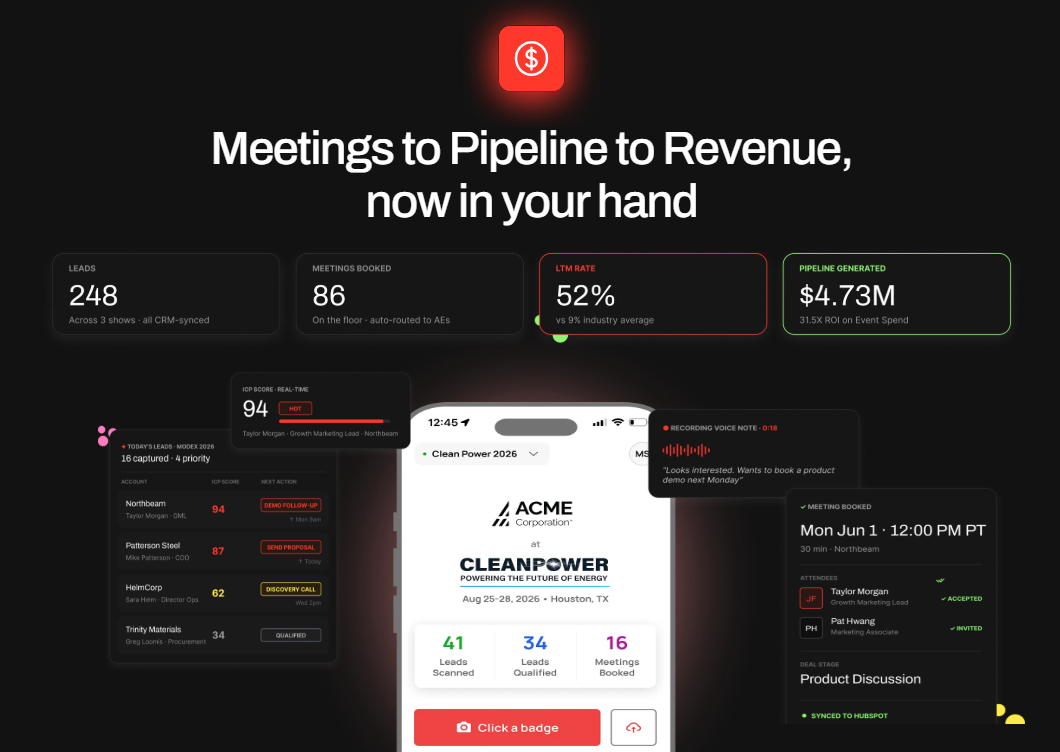
B2Brain event lead capture dashboard showing 248 leads, 86 meetings booked, 52% LTM rate, and $4.73M pipeline
Overview ⭐
B2Brain is an event lead capture app, not a badge scanner. We built it around a single idea, contact information is not where anything happens, pipeline is. The product captures every booth conversation with context, books the discovery meeting on the floor, and writes the record to Salesforce or HubSpot, then reports per-show pipeline back to the people who funded the booth. It serves B2B revenue and field-marketing teams running 5 to 15 shows a year, mostly in manufacturing, supply chain, energy, and growth-stage vertical B2B. You can see how we generate new pipeline from events across the full motion.
Core Services
- Voice-first capture, tap once, talk for about 30 seconds, get a structured CRM record out in roughly 4.2 seconds, about one-fifth the time of typed notes.
- On-spot meeting booking that pulls the AE's live calendar and dual-invites the prospect and the right rep before they leave the booth.
- Pre-event target lists and one-page account briefings grounded in your own CRM pipeline, not a cold prediction database.
- Offline-ready capture that syncs on reconnect when expo-hall Wi-Fi dies.
- A morning-after offline-to-pipeline report showing pipeline sourced, meetings booked, and attribution by show, booth area, rep, and segment.
Key Features
- On-floor capture speed: Sub-30-second scan-to-booked-meeting, voice notes run roughly one-fifth the time of typed notes.
- Offline reliability: Built offline-first for hostile floor Wi-Fi, queues and syncs on reconnect.
- In-booth meeting booking: Books the 30-minute follow-up on the AE's calendar at the booth, with a dual invite.
- CRM sync model: Salesforce-native and HubSpot-native, real-time, with opportunity creation, not just contact sync.
- Pipeline attribution: Reports Leads-to-Meeting LTM, the share of qualified booth leads that became a scheduled meeting.
Why Companies Consider B2Brain
The decision logic is usually a failed event season. The booth cost real money, the leads went cold, and the boss wants a pipeline number nobody can produce. Teams pick B2Brain when "where's the pipeline?" needs an answer with a figure attached, not a contact export. This is the core job for booth teams who own the floor-day result.
The honest objection I hear most is "BoothIQ also books meetings, so what's different?" Fair. Booking is just today's most common Next-Best-Action in our Golden Workflow, Scan, Add Context, Execute NBA. The durable difference is the three-phase shared layer, the CRM-grounded pre-event briefing, and the owned conversion number. B2Brain reports 52 percent LTM on the floor versus an 8 percent industry average for post-event follow-up. No competitor on this list tracks LTM at all.
Ideal Customer Profile
- Company size 50 to 500 employees, mid-market B2B.
- Vertical manufacturing, supply chain and logistics, energy, construction, vertical SaaS.
- Buyer role VP Sales, field or event marketing head, founder, RevOps.
- Shows per year 5 to 15, with 20K to 200K spend per show.
- Stack Salesforce or HubSpot, ACV 25K and up.
Pricing 💰
Per-event Show Pass with no annual lock-in, plus an annual Pipeline plan for teams running many events. The first event is free for two users as a zero-risk trial. You can review the full Show Pass and Pipeline plans before you commit.
When to Shortlist ✅
- Your reps are paid on meetings booked, and you need them booked on the floor.
- You owe a CMO or CFO a per-show pipeline number after every event.
- You run Salesforce or HubSpot and want native, real-time sync.
- You want pre-event briefings built from your real pipeline, not a cold database.
When Not to Shortlist ❌
- You run solo booths, one-off attendance, or consumer-facing events.
- You have no CRM to sync to, so attribution has nowhere to land.
- You need deep third-party contact enrichment as the core feature, our enrichment is lighter than Popl, Mobly, or Momencio, and we lean on your own CRM data instead.
- You require a fully native Android app today, our native app is iOS-first.
Customer Reviews
I want to be straight here. B2Brain's public G2 reviews largely describe our account-intelligence roots, and they tell an honest, mixed story worth reading before you buy.
"The AI Conversation Summarization and Auto-CRM Entry feature is a standout, it's significantly better than other tools we've tried. Reps actually rave about it instead of dreading another sales tool."
Ole O. B2Brain G2 Verified Review
"Reporting is basic. We can see usage and lead stats, but there are no rep performance dashboards, no clear ROI reporting like time saved or deals influenced."
Ole O. B2Brain G2 Verified Review
B2Brain has 17 G2 reviews against Blinq's 8,800-plus, and we treat that as a real gap and a stated velocity campaign, not something to hide. We would rather you weigh us on the LTM outcome than the review count.
1.2 iCapture: Best for enterprise event teams standardizing capture across many shows
Overview
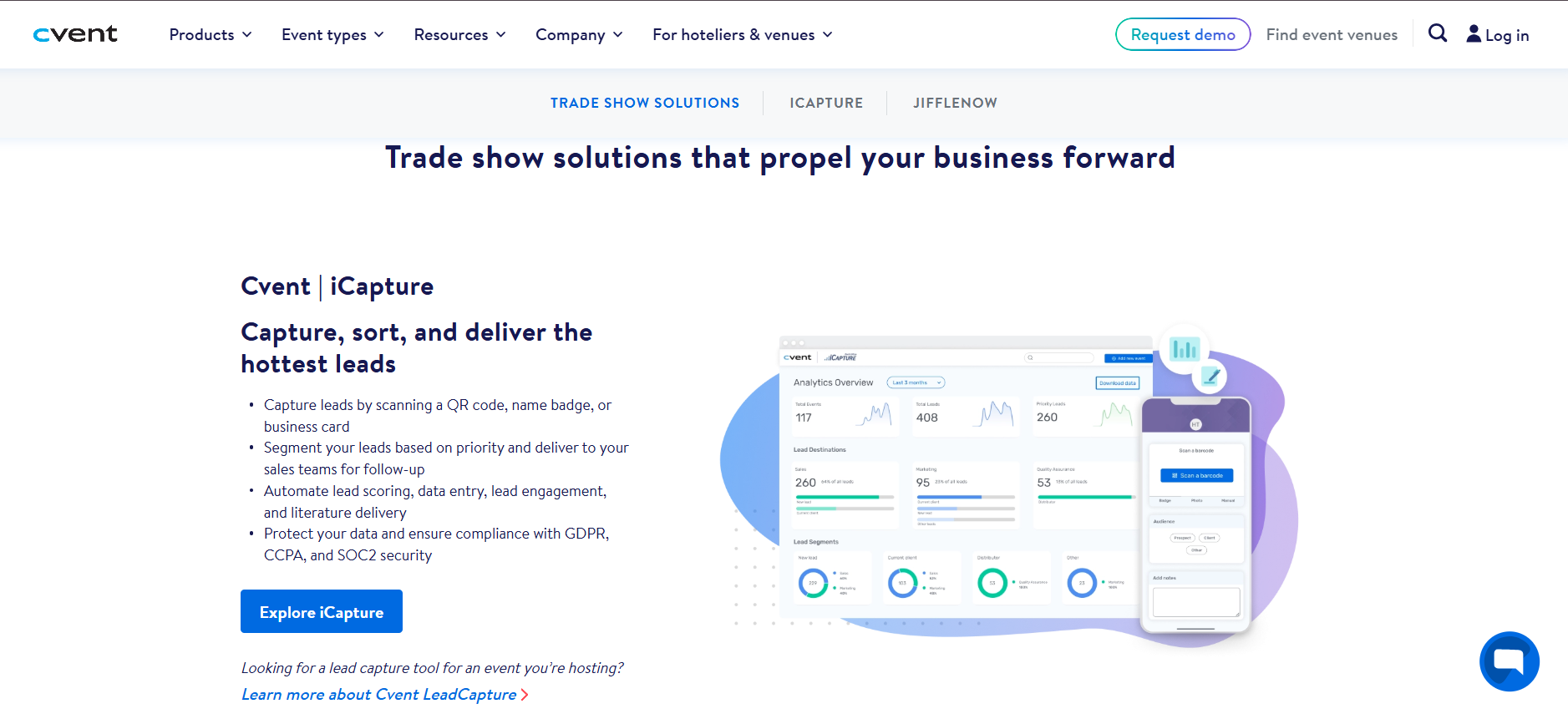
iCapture is a universal lead capture platform aimed at larger event programs that run many shows and need consistent data and ROI reporting across all of them. It captures badges and business cards, maps fields to your systems, and pushes leads into your stack. It now sits inside the Cvent ecosystem, which matters if you weigh vendor independence.
Core Services
- Universal badge and business-card capture across most show floors.
- Custom qualifying forms and field mapping.
- Event metrics and staff-performance reporting.
- Lead routing and assignment to reps.
Key Features
- On-floor capture speed: Fast capture with automatic assignment to a rep once a lead is scanned.
- Offline reliability: Reliable capture, a long-standing strength for enterprise floors.
- In-booth meeting booking: Not a core feature, iCapture captures and reports, booking is left to follow-up.
- CRM sync model: Syncs leads into systems, though some users note it does not always integrate natively with every CRM.
- Pipeline attribution: Strong event-metrics and ROI reporting, a long-standing strength.
- Pricing transparency: Pricing is not publicly disclosed.
Why Companies Consider iCapture
Enterprise teams pick iCapture for reliability and reporting at scale. When you run dozens of events, knowing which days were busiest and which reps actually used the app is worth a lot. The structural trade-off is that it ends at captured-and-reported leads, the workflow stops short of a booked meeting on the floor. For teams that want to close that gap, compare it against the booth-day workflow.
Ideal Customer Profile
- Company size mid-market to enterprise.
- Buyer role event operations, field marketing, marketing ops.
- Shows per year 10-plus, often standardized across a portfolio.
- Stack teams comfortable with the Cvent ecosystem.
Pricing 💰
Annual subscription, with pricing not publicly disclosed and quoted on request. Independent roundups place it near 8K dollars per year.
When to Shortlist ✅
- You run dozens of shows and need one consistent capture standard.
- Event metrics and staff-performance reporting matter to you.
- You are already comfortable inside the Cvent stack.
When Not to Shortlist ❌
- You need the meeting booked on the floor, not captured for later.
- Vendor independence matters and Cvent ownership is a concern.
- You want published pricing before a sales call.
Customer Reviews
"It does not natively integrate with our CRM, so we have to do some manual work to get the leads where they need to go."
Verified User in Marketing and Advertising iCapture G2 Verified Review
"The reporting and analytics are strong, and it has been reliable across the many trade shows we attend each year."
Verified User in Events Services iCapture G2 Verified Review
1.3 Captello: Best for gamified, high-traffic booth activations
Overview
Captello is a lead capture and engagement platform best known for interactive games and activations that pull traffic to a booth. It captures leads through buildable forms and feeds them into one hub that connects to your CRM. It fits teams whose booth strategy leans on engagement and foot traffic.
Core Services
- Interactive games and gamified activations.
- Buildable lead capture forms.
- One central lead hub across events.
- CRM integration and lead routing.
Key Features
- On-floor capture speed: Fast form-based capture, with games driving the scan volume.
- Offline reliability: Capture can depend on the show providing an API or integration kit.
- In-booth meeting booking: Not a core feature, the focus is engagement and capture.
- CRM sync model: Imports to CRM through forms, with custom field mapping.
- Pricing transparency: Subscription plus per-show API and integration kits that add cost.
Why Companies Consider Captello
Teams choose Captello when the booth plan is to draw a crowd with games and capture that crowd at scale. It genuinely leads on interactive activations. The catch is recurring per-show kit costs, and capture that depends on the show providing the right integration. Volume without on-floor qualification can still leave you sorting garbage later, which is where what gets captured on the floor with context matters.
Ideal Customer Profile
- Company size mid-market to enterprise.
- Buyer role field and experiential marketing.
- Shows per year several, with large, high-traffic booths.
- Stack teams running engagement-led activations.
Pricing 💰
Subscription plus per-show API and integration kits. Reviewers cite kit costs of 700 to 1,200 dollars per show.
When to Shortlist ✅
- Your booth strategy is built around games and activations.
- You want high scan volume from foot traffic.
- You have budget for per-show integration kits.
When Not to Shortlist ❌
- You want predictable pricing without per-show kit costs.
- You need the meeting booked on the floor, not just a high scan count.
- You depend on capture working without a show-provided API kit.
Customer Reviews
"Every time we have a show with lead scanning, I have to purchase an API kit that costs between 700 and 1,200 dollars. It's become costly."
RebeccaGrace K. Captello G2 Verified Review
"They are very good with follow up, even during the holidays. Their training has been very proactive and they have been with us every step of the way."
Jennifer H. Captello G2 Verified Review
1.4 Popl: Best for rep-led digital-card and basic capture
Overview ⭐
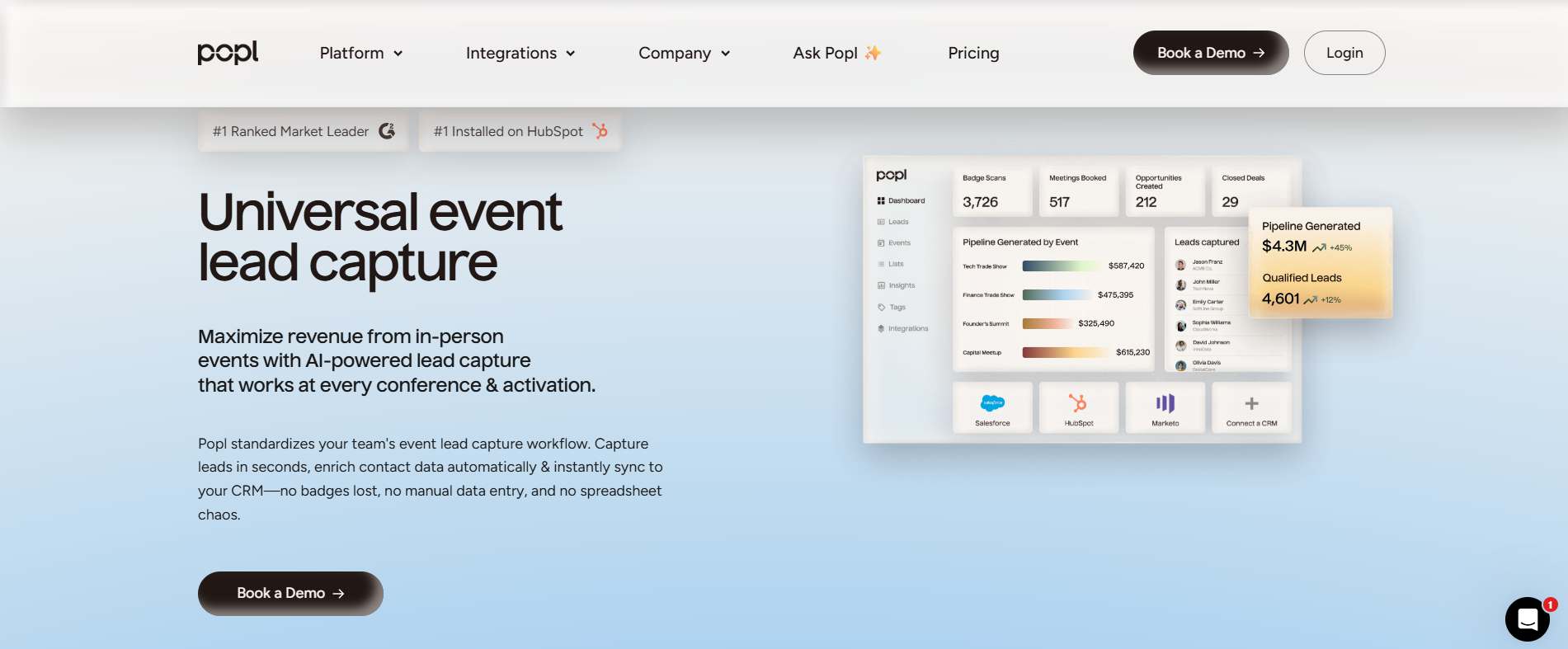
Popl started as a digital business card and grew lead capture on top of that base. Reps tap or scan to share a card, and a QR form pulls a prospect's details. It fits rep-led teams that want a modern alternative to paper cards, with lead capture as an add-on rather than the core design.
Core Services
- Digital business cards with tap and QR sharing.
- QR-based lead capture forms.
- Contact storage and basic export.
- Team card management and branding.
Key Features
- On-floor capture speed: Fast for card sharing, lead capture works through a QR form the prospect fills out.
- In-booth meeting booking: Not a native feature, the workflow ends at a captured contact.
- CRM sync model: Integrations exist, but capture centers on the rep's card, not an opportunity write.
- Offline reliability: Card sharing can stumble when a recipient must download an app or create an account.
- Pricing transparency: Per-seat subscription, reviewers cite roughly 140 dollars a year and note no full free version.
Why Companies Consider Popl
Teams pick Popl when reps want to ditch paper cards and the booth is a secondary use case. The structural caution is real, though. Popl leads with the rep's digital card, so the buyer often has to act, download, or create an account just to be captured. That friction surfaces again and again in reviews and pulls attention away from the conversation.
Ideal Customer Profile
- Company size SMB to mid-market.
- Buyer role individual reps, sales managers.
- Shows per year occasional, alongside everyday networking.
- Stack teams wanting digital cards first, capture second.
Pricing 💰
Per-seat subscription with a freemium-style trial. Reviewers report pricing around 140 dollars per year per user and note there is no free version of the service, only a trial.
When to Shortlist ✅
- Your reps mainly want a polished digital business card.
- Networking and one-to-one sharing matter more than booth volume.
- You accept that capture is a secondary feature.
When Not to Shortlist ❌
- You need badge scanning that just works, one reviewer's badge scan did not work at a conference.
- You want the meeting booked on the floor, not a contact saved.
- You dislike forcing prospects to download an app or make an account to be captured.
Customer Reviews
"The physical card that syncs to a phone is fun and creative."
Mike K. Popl G2 Verified Review
"I needed it for scanning, but it didn't seem to perform that function. It really didn't work for me."
Drew D. Popl G2 Verified Review
"The price, 140 dollars a year? No way, I would rather print thousands of business cards. It seems to need the other person to also make a card."
Fabian T. Popl G2 Verified Review
1.5 Momencio: Best for post-capture content engagement
Overview
Momencio is a lead capture and engagement platform built around its LiveMicrosite idea, where a captured lead receives a personalized content page and follow-up email. It serves marketers who want to turn a booth or stage interaction into ongoing content engagement, not just a stored contact.
Core Services
- Business-card and badge capture with automated follow-up email.
- LiveMicrosites that deliver personalized content after capture.
- CRM integration for captured leads.
- Engagement analytics on content opened after the event.
Key Features
- On-floor capture speed: Solid card capture, one reviewer praised effortless business card capture.
- CRM sync model: Integrates with CRM, a noted selling point for buyers replacing clunky tools.
- In-booth meeting booking: Not the core focus, the design centers on post-capture content, not a booked meeting.
- Offline reliability: Reviewers flag slow logins and single sign-on that does not work, needing mobile sync.
- Pricing transparency: Subscription, pricing is not publicly disclosed.
Why Companies Consider Momencio
Marketers choose Momencio when the follow-up content matters as much as the capture. Sending a tailored microsite right after a booth chat can keep a brand warm. The trade-off is depth versus simplicity. One reviewer admitted they were only utilising 60 percent of the tool, which tells you the learning curve is real for a busy field team.
Ideal Customer Profile
- Company size mid-market to enterprise.
- Buyer role field and event marketing, demand gen.
- Shows per year several, often with stage or presentation moments.
- Stack CRM-connected marketing teams.
Pricing 💰
Subscription pricing. Momencio does not publicly disclose its pricing, so confirm structure and per-event terms in a quote.
When to Shortlist ✅
- Post-event content engagement is central to your follow-up.
- You run presentations or keynotes where a landing asset collects leads.
- You want analytics on what content a lead opened.
When Not to Shortlist ❌
- You need the meeting booked on the floor, not a content email after.
- You want fast, frictionless login at a busy booth without SSO issues.
- Your team has no time to learn a deep, feature-rich platform.
Customer Reviews
"Lead scanning at events. Quick followups from sales team. Lead engagements. All of these things increase revenues for us and speed up deal closing cycles."
Martin D. Momencio G2 Verified Review
"Logins are a little slow, and the single sign on does not work, it requires syncing on the mobile app."
Jia Li T. Momencio G2 Verified Review
1.6 Blinq: Best for fast digital-card sharing for SMB
Overview
Blinq is a digital business card platform and the social-proof leader of this group, holding the top G2 spot with more than 8,800 reviews. It is excellent at sharing a clean, branded card fast. It fits individuals and SMB teams who prioritize networking over structured booth pipeline.
Core Services
- Digital business cards with QR and link sharing.
- Team card management and branding controls.
- Contact capture forms.
- Integrations with common tools.
Key Features
- On-floor capture speed: Quick to share a card, capturing the other person often needs a form or app step.
- In-booth meeting booking: Not a feature, Blinq is a card-sharing tool at its core.
- CRM sync model: Integrations exist, but leads land as contacts, not booth-context records.
- Offline reliability: Reviewers report QR codes failing in poor connectivity, needing paper-card backup.
- Pricing transparency: Freemium and per-seat subscription tiers.
Why Companies Consider Blinq
Buyers pick Blinq for polish and ease. It looks great and sets up in minutes. The honest limitation for a booth team is structural, leads scatter into your phone contacts. As one reviewer said, after a big tradeshow all the follow ups are just in your sea of contacts you have to try and remember. That is the shoe box, just digital, and the opposite of offline to pipeline.
Ideal Customer Profile
- Company size individuals to SMB.
- Buyer role reps, founders, networkers.
- Shows per year occasional, plus daily networking.
- Stack light or no CRM dependency.
Pricing 💰
Freemium tier plus paid per-seat subscriptions. Confirm which features sit behind the paid tiers before rollout.
When to Shortlist ✅
- You want the cleanest, fastest digital card on the market.
- Networking matters more than structured booth pipeline.
- You are an individual or small team without heavy CRM needs.
When Not to Shortlist ❌
- You need booth leads organized for follow-up, not scattered in contacts.
- You depend on reliable scanning in dead-zone expo Wi-Fi.
- You want meetings booked and pipeline attributed, not cards shared.
Customer Reviews
"Blinq looks great and when it works it's a good user experience and good branding for the person showing their business card."
Verified User in Hospitality Blinq G2 Verified Review
"With Blinq, all the follow ups are just in your sea of contacts you have to try and remember."
Madison Z. Blinq G2 Verified Review
"It doesn't always work reliably when scanning the barcode, especially in places with poor internet connectivity. This has made it necessary to consider purchasing printed business cards as a backup."
Kasha A. Blinq G2 Verified Review
1.7 BoothIQ: Best for AI-assisted follow-up, no booth required
Overview
BoothIQ is a newer entrant focused on on-phone badge scanning and AI-assisted follow-up, pitched at teams that want to capture and draft outreach without a full booth setup. It sits in the meeting-booking and AI-follow-up lane of the category.
Core Services
- On-phone badge and business-card scanning.
- AI-assisted follow-up message drafting.
- Lead organization and export.
- CRM connections.
Key Features
- On-floor capture speed: Phone-based scanning aimed at quick capture without hardware.
- In-booth meeting booking: Markets meeting-booking and AI follow-up as core differentiators.
- CRM sync model: Connects to CRM, though depth is not clearly stated in available sources.
- Offline reliability: Not clearly stated in available sources.
- Pricing transparency: Published tiers vary, confirm current structure directly.
Why Companies Consider BoothIQ
Teams look at BoothIQ when they want AI to speed up follow-up and do not want to manage hardware. It is the closest peer to B2Brain on the meeting-booking feature itself. The architectural question to ask is whether booking is part of a three-phase, CRM-grounded layer or a standalone feature. That is exactly the "BoothIQ also does this" objection, and the honest answer is to compare the pre-event briefing, the LTM number, and the three-motion workflow, not just the booking button.
Ideal Customer Profile
- Company size SMB to mid-market.
- Buyer role sales reps, founders, small field teams.
- Shows per year a handful, sometimes attending without a booth.
- Stack teams wanting AI follow-up over heavy reporting.
Pricing 💰
Subscription with published tiers that vary by plan. Confirm current pricing and any per-event terms directly with BoothIQ.
When to Shortlist ✅
- You want AI to draft follow-up fast after capture.
- You attend shows without always running a full booth.
- You prefer phone-based scanning over rented hardware.
When Not to Shortlist ❌
- You need a three-phase, CRM-grounded layer, not a standalone booking feature.
- You require proven offline reliability at large-floor scale, which is not clearly documented.
- You need a per-show pipeline and LTM report for a CFO.
Customer Reviews
No verified customer reviews were available in the provided source set for this provider. I will not manufacture any. Treat BoothIQ's claims as vendor self-stated until you can verify them in a pilot.
1.8 Mobly: Best for mobile-first capture with voice notes
Overview
Mobly is a mobile-first event lead capture app that scans badges and business cards, adds voice notes, and enriches contact data before pushing to the CRM. It frames itself around AI-powered event marketing and fits teams that want fast capture plus enrichment across many events.
Core Services
- Mobile badge and business-card scanning.
- Voice-note capture for lead context.
- Contact enrichment from attendee lists.
- Salesforce and CRM sync.
Key Features
- On-floor capture speed: Reviewers call the interface user friendly and fast for busy events.
- In-booth meeting booking: Not a core feature, the workflow centers on capture and enrichment.
- CRM sync model: Syncs to Salesforce, but reviewers report it was challenging to get it to sync.
- Offline reliability: Reviewers note sync can be finicky, missing scanned leads when Wi-Fi drops.
- Pricing transparency: Subscription with per-match enrichment costs that several users call high.
Why Companies Consider Mobly
Teams choose Mobly for quick mobile capture and the voice-note feature, which reps genuinely like for adding context between conversations. The trade-offs are sync reliability and enrichment cost. When scanned leads silently fail to sync, you end up with a lot fewer than expected, which is the exact failure a RevOps lead should stress-test.
Ideal Customer Profile
- Company size SMB to enterprise.
- Buyer role field marketing, sales reps.
- Shows per year several, often spread across events.
- Stack Salesforce or CRM users wanting enrichment.
Pricing 💰
Subscription plus per-contact enrichment match costs. Reviewers say the cost of matches per contact is kinda high, so model the enrichment spend across a full season.
When to Shortlist ✅
- You want mobile-first capture with voice notes for context.
- Enrichment from attendee lists matters to your team.
- You run many events and want one consistent capture app.
When Not to Shortlist ❌
- You need rock-solid offline sync, reviewers report dropped leads.
- You need the meeting booked on the floor, not captured for later.
- You want predictable pricing without per-match enrichment costs.
Customer Reviews
"We really like the voice notes feature because when you're short on time between talking to people, it's very easy to get information on a lead."
Ece K. Mobly G2 Verified Review
"Sometimes Mobly can be finicky, where it doesn't sync all the leads I've scanned. We end up with a lot fewer than we expected."
Verified User in Events Services Mobly G2 Verified Review
"It was challenging to get it to sync with Salesforce. The cost of matches per contact, I think, is kinda high."
Ece K. Mobly G2 Verified Review
Q2: Why do most trade-show leads die before sales ever calls, and does an owned app beat the rented badge scanner? [toc=2. Why Most Leads Die]
Most trade-show leads die because the rented scanner captures a name with no context, the organizer's CSV arrives days late, and the buyer forgets the conversation before anyone follows up. Conversion falls from about 85 percent within two hours to roughly 9 percent after a week. An owned app beats the rented scanner for any pipeline team, it captures context, scores on the spot, works offline, and syncs to your CRM the same day.
The shoe box graveyard is still real
Picture a rep named Jimmy after a show. He has a shoe box of business cards on his desk. He pulls out three he remembers, and the rest sit there. Six months later, someone finds the box and asks what it is.
That is not a storage problem. It is a context problem. The badge scan saved a name and an email, but it lost the only thing that mattered, why you talked to that person.
The badge scan is a contextless name ⚠️
Here is the blunt operator read on rented scanners. As one veteran put it, do not trust the badge scan, because maybe one out of 20 businesses acts on it three months later. The scanner collects leads for them, it does nothing for you.
The organizer rents you access to your own leads. They also tend to overcharge for basics, the same way a show charges you for handwashing stations and trash service. The contact is captured, but the workflow ends at a CSV you do not even get for days, which is the opposite of offline to pipeline.
The lead-decay curve is brutal
The reason late follow-up fails is math, not effort. A booth lead is hottest in the first two hours, when the conversation is fresh for both sides.
After that, the curve falls off a cliff. Conversion drops from roughly 85 percent within two hours to about 9 percent after a week. The money in a trade show is made in the follow-up, and a CSV that lands next Tuesday has already missed the window.
Why the CSV delay kills pipeline ⏰
The organizer acts like a broker between you and your own leads. You scan today, they process, then they hand back a file later. By the time sales calls, the buyer has visited 40 other booths and forgotten yours.
Owned app versus rented scanner
This is the core own-versus-rent decision. The trade-show world moved through three generations, paper cards, rented scanners at 200 to 500 dollars per device, and now exhibitor-owned universal capture apps. Universal capture means an app you own that works across every show, versus lead retrieval, which is the organizer's scanner tied to one event. To see how an owned app runs before, during, and after the show, compare the two models below.
Owned apps like B2Brain, iCapture, and Captello replace the rented scanner because they let you keep the data, add context, and sync the same day, not next week.
When the rented scanner is still fine ✅
I will be honest here. If you attend one show a year, have no CRM, and just want a contact list, the organizer's scanner is fine. You do not need a platform for a one-off.
For anyone running a real pipeline motion across multiple shows, though, renting access to your own leads is the trap. Own the capture, own the context, and own the follow-up window, which is exactly the job for booth teams.
What buyers say
"I needed it for scanning, but it didn't seem to perform that function. It really didn't work for me."
Drew D. Popl G2 Verified Review
"Still better than using a legacy conference badge scanner. I was able to not have to put notes into a spreadsheet."
Will N. Mobly G2 Verified Review
"It does not always work with every conference, if the conference does not provide an API kit for integration."
Verified User in Consulting Captello G2 Verified Review
Q3: What criteria actually matter when choosing event lead capture software in 2026? [toc=3. How to Evaluate]
Score tools on seven criteria, on-floor capture speed, offline reliability, in-booth meeting booking, CRM sync model (native real-time versus CSV import), pipeline attribution, vertical fit, and pricing shape. Add two trust checks, is pricing published or quote-only, and is the vendor independent or owned by a registration giant. Badge scanning is table stakes, differentiation now lives in whether leads convert and reach the CRM with context.
The seven criteria that move the decision
Vague feature sheets all look the same. Here is a rubric you can lift straight into a vendor scorecard and test on a demo call.
1. On-floor capture speed ⏰
This is how fast a scan becomes a complete, context-rich record. It matters because a rep talking to 60 people cannot type notes. Test it by timing one scan to a finished, scored lead in the demo.
2. Offline reliability ⚠️
Expo-hall Wi-Fi dies under load. The tool must capture offline and sync on reconnect. Ask the vendor to demo airplane mode, then watch it sync.
3. In-booth meeting booking ✅
This is the criterion the category ignores. Can the tool book the follow-up meeting on the rep's calendar before the prospect walks away? Ask to see a live calendar pull and a dual invite, not a request-a-meeting form. This is the heart of the booth-day workflow.
4. CRM sync model
There is a real gap between native real-time push and an end-of-day CSV import. Native means the tool writes to Salesforce or HubSpot directly, CSV import means a file you upload later. Ask which one, and ask if it creates opportunities or only contacts.
5. Pipeline attribution
Can you report pipeline sourced per show, not just a contact count? This is what answers the CFO. Ask to see the actual report a CMO would get the morning after, the kind that proves you can generate new pipeline from events.
6. Vertical fit
A tool tuned for enterprise event ops may not fit a 5-rep industrial booth. Match the tool to your buyer and show type. Ask for a customer in your vertical.
7. Pricing shape 💰
Per-event versus annual changes your math across an 8-to-15-show season. Model the full-season cost, not the sticker. Reviewing Show Pass and Pipeline plans side by side shows how the shape changes the total.
Two trust checks before you sign
Beyond features, two checks protect you from regret.
- Pricing transparency: Is the price published, or is it quote-only behind a sales call? Quote-only is not disqualifying, but it tells you to negotiate harder.
- Vendor independence: Is the vendor independent, or owned by a registration giant? Cvent owns iCapture, and Maritz owns CDS, which can tie your capture tool to one ecosystem.
The conversion criterion the category skips ⭐
Here is where I will plant a flag. Scanners should be for scoring, not just collecting. Most teams just say here you go sales and hand over a list to filter out the garbage.
The fix is qualifying on the floor. When you scan a badge, you mark it hot, warm, or cold in the moment, while you remember the conversation. This matters because roughly 60 percent of lost sales trace back to poor qualification, not bad leads.
At B2Brain, we built the rubric around one number we call LTM, or Leads-to-Meeting, qualified booth leads that became a booked meeting. We also ground pre-event briefings in your own CRM pipeline, not a cold prediction database, because your trusted data beats a stranger's guess. To understand how event lead capture works across all three motions, that number is the spine. No competitor reports LTM, which is exactly why I think it belongs on every scorecard.
Q4: How do the 8 tools stack up one by one on capture, CRM sync, offline, and meeting booking? [toc=4. The Tools, One by One]
All eight sync to Salesforce or HubSpot, but the model varies, native real-time push versus end-of-day CSV import, and that gap decides whether a lead is workable the same evening or a week later. Offline reliability and true in-booth meeting booking, not just capture, separate the field further. Most tools capture and enrich, only a few close the loop by booking the meeting on the spot.
The spec grid
Differentiation has moved up the stack. Capture is Layer 1, enrichment is Layer 2, and pipeline activation, booking the meeting, is Layer 3, where most tools stop short.
One by one
1.1 B2Brain ⭐
Best for revenue teams whose KPI is meetings booked. We capture by voice in about 4.2 seconds, book the meeting on the AE's live calendar before the prospect leaves, and write a native record to Salesforce or HubSpot. We report LTM, 52 percent on the floor versus an 8 percent post-event industry average. You can see what gets captured on the floor in practice. Honest gaps, iOS-first with a lighter Android app, lighter third-party enrichment than Popl or Mobly, and no digital business card.
1.2 iCapture
Best for enterprise teams standardizing capture across many shows. Strong, reliable capture and event ROI reporting. Sync is solid, but one reviewer noted it does not natively integrate with our CRM. The loop ends at captured-and-reported, not a booked meeting. Now owned by Cvent, which matters for independence.
1.3 Captello
Best for gamified, high-traffic booths. Genuine leader on interactive games and activations. Buildable forms import to CRM. The catch is per-show API kits at 700 to 1,200 dollars and capture that depends on the show providing one.
1.4 Popl
Best for rep-led teams wanting digital cards first. Capture is a recent add-on to a card-sharing core, so prospects often must act or create an account to be captured. Reviewers also flag badge scanning that did not work for them. No on-floor booking.
1.5 Momencio
Best for post-capture content engagement, where its LiveMicrosites genuinely lead. Capture plus a tailored follow-up page and email. Reviewers report slow logins and broken single sign-on, and a learning curve. Booking is not the focus.
1.6 Blinq
Best for fast digital-card sharing and the social-proof leader with 8,800-plus G2 reviews. Polished and quick. For booths, leads scatter into phone contacts, and QR codes can fail in poor signal. It is a card tool, not a pipeline tool.
1.7 BoothIQ
Best for AI-assisted follow-up without a full booth, and the closest peer to B2Brain on booking. It markets meeting-booking and AI drafts. Sync depth and offline behavior are not clearly stated in available sources, and no verified reviews were in the source set.
1.8 Mobly
Best for mobile-first capture, with voice notes reps genuinely like. Enriches from attendee lists. The trade-offs are sync that can be finicky and drop scanned leads, plus per-match enrichment costs reviewers call high.
What buyers say
"The AI Conversation Summarization and Auto-CRM Entry feature is a standout, it's significantly better than other tools we've tried."
Ole O. B2Brain G2 Verified Review
"It was challenging to get it to sync with Salesforce. The cost of matches per contact, I think, is kinda high."
Ece K. Mobly G2 Verified Review
"With Blinq, all the follow ups are just in your sea of contacts you have to try and remember."
Madison Z. Blinq G2 Verified Review
Q5: What do real users say on G2, Capterra, and Reddit about these tools? [toc=5. What Real Users Say]
Verified reviews surface consistent floor-failure patterns, enrichment misses on international or uncommon badges, app lag during high-traffic show hours, and pricing locked behind a sales call before any trial. Field-marketing communities add the harder truth, that scanned leads dumped on sales without scoring or context rarely get worked, no matter which tool captured them.
The patterns that repeat across tools
Glossy vendor pages all promise the same thing. Verified reviews tell you where each tool actually breaks on the floor. I read these as warnings to stress-test in a demo, not as star counts.
"Sometimes Mobly can be finicky, where it doesn't sync all the leads I've scanned. We end up with a lot fewer than we expected."
Verified User in Events Services Mobly G2 Verified Review
"Every time we have a show with lead scanning, I have to purchase an API kit that costs between 700 and 1,200 dollars. It's become costly."
RebeccaGrace K. Captello G2 Verified Review
"Logins are a little slow, and the single sign on does not work, it requires syncing on the mobile app."
Jia Li T. Momencio G2 Verified Review
These are not edge cases. They are the recurring failure modes a revenue team should test before committing, which is why we built how event lead capture works to be offline-first and native to your CRM.
The harder truth no tool fixes by default
Here is the pattern field marketers admit about themselves. As one put it, scanners should be for scoring, not just collecting, yet teams just say here you go sales and hand over a list to filter out the garbage. That is not a software bug. It is a workflow choice. A 35K booth and a clean scan still produce nothing if the lead lands on a rep's desk with no score and no context. The tool that wins is the one that makes scoring on the floor the default, not an afterthought, which is the core job for booth teams.
Q6: How much does event lead capture software cost in 2026, and what is the real cost-per-booked-meeting? [toc=6. Cost and ROI]
Pricing falls into three shapes, per-event passes, annual subscriptions, and quote-only pricing hidden behind a sales call. The number that actually matters is not the sticker, it is cost-per-booked-meeting, because a meeting is what turns into pipeline. Model the full-season cost and the meetings each tool can realistically book before you sign.
The three pricing models
Hidden on-request pricing is the tax you pay for not modeling cost yourself. Here is the shape of the market so you can budget before the sales call, and you can compare it against published Show Pass and Pipeline plans.
Why on-request should make you negotiate
When a vendor hides the number, you lose your anchor. Treat quote-only pricing as a signal to push for a trial and a per-season figure, not a per-show one.
The number finance actually wants
Sticker price is the wrong unit. Cost-per-booked-meeting is the right one, because a meeting is what turns into pipeline. Here is the math I share openly. A roughly 70K booth, with a boss who wants 10x pipeline, needs about 50 opportunities and roughly 180 discovery calls to hit a 1M pipeline target. That means about 1 in 5 booth visitors must become a qualified meeting.
The ROI rule operators use
At B2Brain, we publish that 60/40 benchmark and price on a Show Pass with the first event free, so you can test the cost-per-booked-meeting math on your own floor before you commit. We tie it to a per-show pipeline report a CFO can actually read, the kind that proves you can generate new pipeline from events.
Q7: Which tool is right for your team, and how do you turn its leads into provable pipeline? [toc=7. Pick and Prove Pipeline]
Match the tool to your buyer type and show type, then run a same-day workflow that scores on the floor, books the meeting before the prospect leaves, and forces every lead into a CRM campaign. The tool gets you the contact, the workflow turns it into provable pipeline.
Pick by scenario
Generic rankings do not help you. Your buyer type and show type do. Here is the self-select map.
- Revenue team measured on meetings and pipeline: Pick B2Brain or BoothIQ, since both center booking. Skip B2Brain if you run solo booths, have no CRM, or need a native Android app today.
- Enterprise team in the Cvent stack: Pick iCapture for reliability and reporting at scale. Skip it if vendor independence matters, or you need the meeting booked on the floor.
- Gamification-led booth: Pick Captello for games and activations. Skip it if you want predictable pricing without per-show API kits.
- Engagement-led field marketing: Pick Momencio for post-capture microsites. Skip it if you need frictionless login and on-floor booking.
- SMB or rep-led, digital-card first: Pick Popl or Blinq for fast card sharing. Skip them if you need organized, scored booth pipeline, not scattered contacts.
Speak your own dialect
A VP Sales runs booth-ROI math. A field marketing head dreads the CMO asking where is the pipeline? A founder at a first US show needs a small team and per-event pricing. Pick the tool that answers your version of the question, and see what gets captured on the floor for floor-walking teams.
The same-day playbook that makes any tool produce pipeline
Picking the tool is half the job. The workflow is the other half. Poor initial capture is why some B2B deals drag past 500 days.
- Score on the spot. Mark each lead hot, warm, or cold while you remember the conversation. Roughly 60 percent of lost sales trace to poor qualification.
- Capture context. Record why you talked, by voice if you can, before the next person walks up.
- Fire a same-day touch. Send a relevant follow-up within about 15 minutes to an hour, while you are still fresh in their mind. Conversion falls from about 85 percent within two hours to roughly 9 percent after a week.
- Force CRM attribution. Organize every event by campaign so you track sourced and influenced pipeline. Do not give them a few days to settle. Post-event ghosting kills the lead.
- Run the per-show pipeline report. Bring pipeline sourced, meetings booked, and conversion to the QBR.
The 15-minute window
The single highest-leverage tactic is speed. A same-day email beats a polished one sent next week, every time. The follow-up window is the whole game, and it is exactly what the three-motion workflow is built to protect.
A question I am sitting with
After watching thousands of booth conversations, I keep coming back to one idea, contact information is not where anything happens, pipeline is. B2Brain is built around that spine, score on the floor, book the meeting before they walk away, and hand the CMO a pipeline number the next morning. I might be wrong on the edges, but I do not think the category's capture more, sort later default survives much longer. So here is my open question for you at your next show, what would change if every rep had to book the meeting on the floor, not promise to follow up? Try it on one booth, and tell me what your follow-up window looks like after.
FAQ's
What is the best event lead capture software for B2B trade-show teams in 2026?
The eight strongest tools we evaluated for 2026 are B2Brain, iCapture, Captello, Popl, Momencio, Blinq, BoothIQ, and Mobly. They differ less on badge scanning, which is now commoditized, and more on four things that decide a purchase, pricing transparency, CRM sync model, offline reliability, and whether the tool books a meeting on the floor.
Here is the read we keep coming back to. A best fit depends on your buyer type and show type, not a single ranking.
- iCapture suits enterprise teams standardizing capture across many shows.
- Captello fits gamified, high-traffic booths.
- Popl and Blinq fit rep-led, digital-card-first teams.
- Momencio fits engagement-led field marketing.
- B2Brain and BoothIQ fit revenue teams measured on meetings booked.
We built B2Brain for teams whose KPI is meetings booked and provable per-show pipeline, capturing context by voice, booking the meeting at the booth, and reporting Leads-to-Meeting LTM. You can see how event lead capture works across the before, during, and after motions before you shortlist.
Does an owned lead capture app actually beat a rented organizer badge scanner?
For any team running a real pipeline motion across multiple shows, yes. The rented organizer scanner captures a name and a badge with no context, and the organizer holds your data, then releases a CSV that often lands days late.
That delay is the problem, because lead value decays fast. Conversion falls from about 85 percent within two hours to roughly 9 percent after a week, so a file you upload next Tuesday has already missed the window.
An owned app changes the model in four ways.
- You own the data from the first scan, not the organizer.
- You capture conversation context and score the lead on the spot.
- It works offline and syncs on reconnect when expo Wi-Fi dies.
- It pushes to your CRM the same day, not next week.
We will be honest, if you attend one show a year with no CRM, the organizer scanner is fine. For everyone else, renting access to your own leads is the trap, which is why we built B2Brain for booth teams that need to own the capture and the follow-up window.
How much does event lead capture software cost in 2026?
Pricing falls into three shapes, and the shape matters as much as the number.
- Per-event passes, where you pay per show with no annual lock-in.
- Annual subscriptions, one yearly fee across all shows, used by iCapture, Captello, Popl, and Blinq.
- Quote-only pricing, disclosed only on a sales call, common with iCapture, Momencio, and several enterprise tools.
The number finance actually wants is not the sticker, it is cost-per-booked-meeting, because a meeting is what turns into revenue pipeline. The math we share openly, a roughly 70K booth aiming for 10x pipeline needs about 50 opportunities and roughly 180 discovery calls, which means about one in five booth visitors must become a qualified meeting.
When a vendor hides the number, treat quote-only pricing as a signal to push for a trial and a per-season figure, not a per-show one. We publish that benchmark and price on a Show Pass with the first event free, so you can test the math on your own floor. Compare our Show Pass and Pipeline plans before the sales call.
Which features actually matter when choosing event lead capture software?
Badge scanning is table stakes now, so we score tools on seven criteria you can lift straight into a vendor scorecard.
- On-floor capture speed, how fast a scan becomes a context-rich record.
- Offline reliability, capturing in dead-zone Wi-Fi and syncing on reconnect.
- In-booth meeting booking, booking the follow-up before the prospect walks away.
- CRM sync model, native real-time push versus an end-of-day CSV import.
- Pipeline attribution, reporting per-show pipeline, not just a contact count.
- Vertical fit, matching the tool to your buyer and show type.
- Pricing shape, modeling the full-season cost.
Add two trust checks, is the price published or quote-only, and is the vendor independent or owned by a registration giant. The criterion the category skips is conversion, scanners should be for scoring, not just collecting, since roughly 60 percent of lost sales trace to poor qualification. We center our scorecard on the Leads-to-Meeting metric, and you can see how we generate new pipeline from events rather than just hand sales a list.
How do we turn captured booth leads into provable pipeline?
Picking the tool is half the job. The same-day workflow is the other half, and it is what makes any tool produce pipeline.
- Score on the spot, marking each lead hot, warm, or cold while you remember the conversation.
- Capture context, recording why you talked, by voice if you can, before the next person walks up.
- Fire a same-day touch within about 15 minutes to an hour, while you are still fresh in their mind.
- Force CRM attribution, organizing every event by campaign to track sourced and influenced pipeline.
- Run the per-show pipeline report, bringing pipeline sourced, meetings booked, and conversion to the QBR.
The single highest-leverage tactic is speed, because the follow-up window is the whole game. We built our approach around one spine, contact information is not where anything happens, pipeline is, so we score on the floor, book the meeting before they walk away, and hand the CMO a number the next morning. See what gets captured on the floor for floor-walking teams to model your own follow-up window.
.png)

.png)
.png)