Popl Reviews 2026: Features, Pricing, Ratings, and Limitations
Written by
Sridhar Ranganathan
Last Updated :
August 14, 2026
Skim in:
13
mins
TL;DR
Popl rates 4.6/5 on G2 across 6,300+ reviews and 4.7/5 on Capterra, but roughly 4.1/5 on Trustpilot, because each surface measures a different thing.
Popl publishes Free, Pro at $7.99, and Pro+ at $14.99, yet does not publish Teams pricing; users report enrichment-credit quotes of $6,000 to $17,500 per year.
The card-first architecture creates recipient friction at a booth, with reviewers describing account prompts and multiple steps before contact details appear.
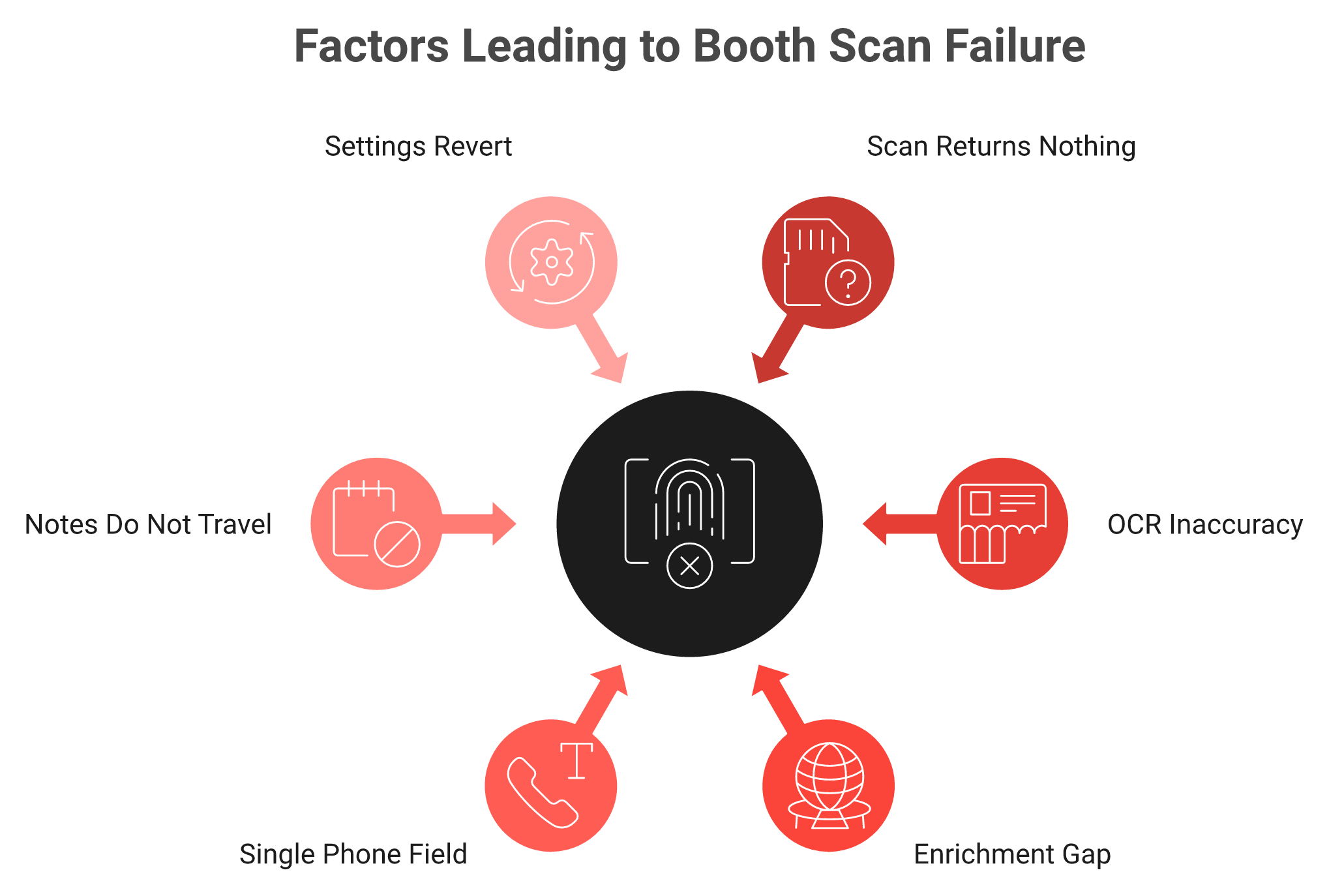
Documented failure modes include badge scans returning nothing, inaccurate card OCR, a single phone field, unsearchable notes, and settings that revert to defaults.
Contact sync is not attribution; only an opportunity record answers the CFO question about what pipeline a show actually created.
Score every vendor on lead-to-meeting conversion, not scan volume; B2Brain reports 52% on the floor against roughly 8% for industry post-event follow-up.
Q1. Is Popl worth it in 2026? [toc=1. The Verdict]
Popl is worth it if your primary job is digital business cards and fast contact exchange, rated 4.6/5 on G2 across 6,300+ reviews and 4.7/5 on Capterra. B2B teams exhibiting at 5 to 15 industrial shows a year should scrutinise unpublished Teams pricing reported at $6,000 to $17,500 per year, the five-contact free-plan cap, and badge-scan reliability.
Six weeks out from PACK EXPO, the PO for the booth is signed and the tool is not. A Field Marketing head I spoke with had $84,000 committed to the floor space. She had $0 committed to what happens after a rep says hello.
That order of operations is backwards, and it is completely normal.
⭐ Where Popl genuinely earns the money
Popl is the biggest name in this space by revenue, and the strength is real. Rep-side sharing is fast, the cards look good, and setup takes minutes.
Even a competitor founder concedes the point in print. Wave Connect's own alternatives post says that if event lead capture is your top priority, Popl itself is still the best pick (Feb 2026). That is the fairest thing anyone has written about it, and it is worth reading alongside the wider list of Popl alternatives for trade-show teams.
"I like the style of the different products. I have the business card and the watch band and I use both of them equally." Verified G2 reviewer, 5 stars, Popl - G2 Verified Review
⚠️ Where the money stops making sense
The one-star pattern is not about looks. It is about cost against job-to-be-done, and about the scanner failing on the day it mattered.
"The cost is very high considering it's mostly a digital business card sharing app. It's not much different than adding a QR code to my business card." Brooke N., Popl - G2 Verified Review
"I didn't really use Popl because it didn't scan bar codes like I thought it would. Scanning badges should have given the name and contact info, but it didn't work when I tried it." Drew D., 0.5 stars, Popl - G2 Verified Review
One failed scan is an anecdote. A failed scan on Day 2 of a show you paid $84,000 for is a budget line you cannot defend, which is the whole case for a booth-day workflow built for exhibitors.
✅ The verdict in three lines
My rule is the altitude rule. Judge a tool by the outcome it is accountable for, not by the length of its feature list.
Popl Verdict by Buyer Type
Buyer
Verdict
Networkers, consultants, distributed sellers
Buy it, the card layer is the product you actually want
Hybrid teams, occasional booths
Workable, pilot one show before a season contract
B2B exhibitors, 5 to 15 industrial shows, $25K+ ACV
Shortlist it against pipeline-accountable tools, including B2Brain, and score on booked meetings
Contact information is not where anything happens. Pipeline is where your world moves.
B2Brain measures the same booth minute differently, reporting 52% of leads converted to a booked meeting on the floor against roughly 8% for industry post-event follow-up. That is the number I would make every vendor on your shortlist answer for, including mine, and you can see the offline to pipeline math behind it.
Q2. What is Popl, and how does its card-first architecture shape the booth experience? [toc=2. Card-First Architecture]
Popl is a digital business card platform (YC W21, roughly $12.2M ARR) that added event lead capture and now markets an in-person GTM platform. The centre of gravity is still the NFC card and shared profile. At a booth, that shows up as recipient-side steps, account prompts, and a contact record built around a person rather than an opportunity.
I like walking through how this category actually evolved, because the origin explains the product.
📇 Paper, then rented scanners, then cards
For thirty years, exhibitors used paper and the organizer's rented badge scanner. Then a wave of consumer-friendly card apps arrived, built for the individual rep sharing their own details.
Popl came from that wave. Lead capture was bolted on top later, with the event push landing around late 2025.
🧩 What "card-first" means in the code
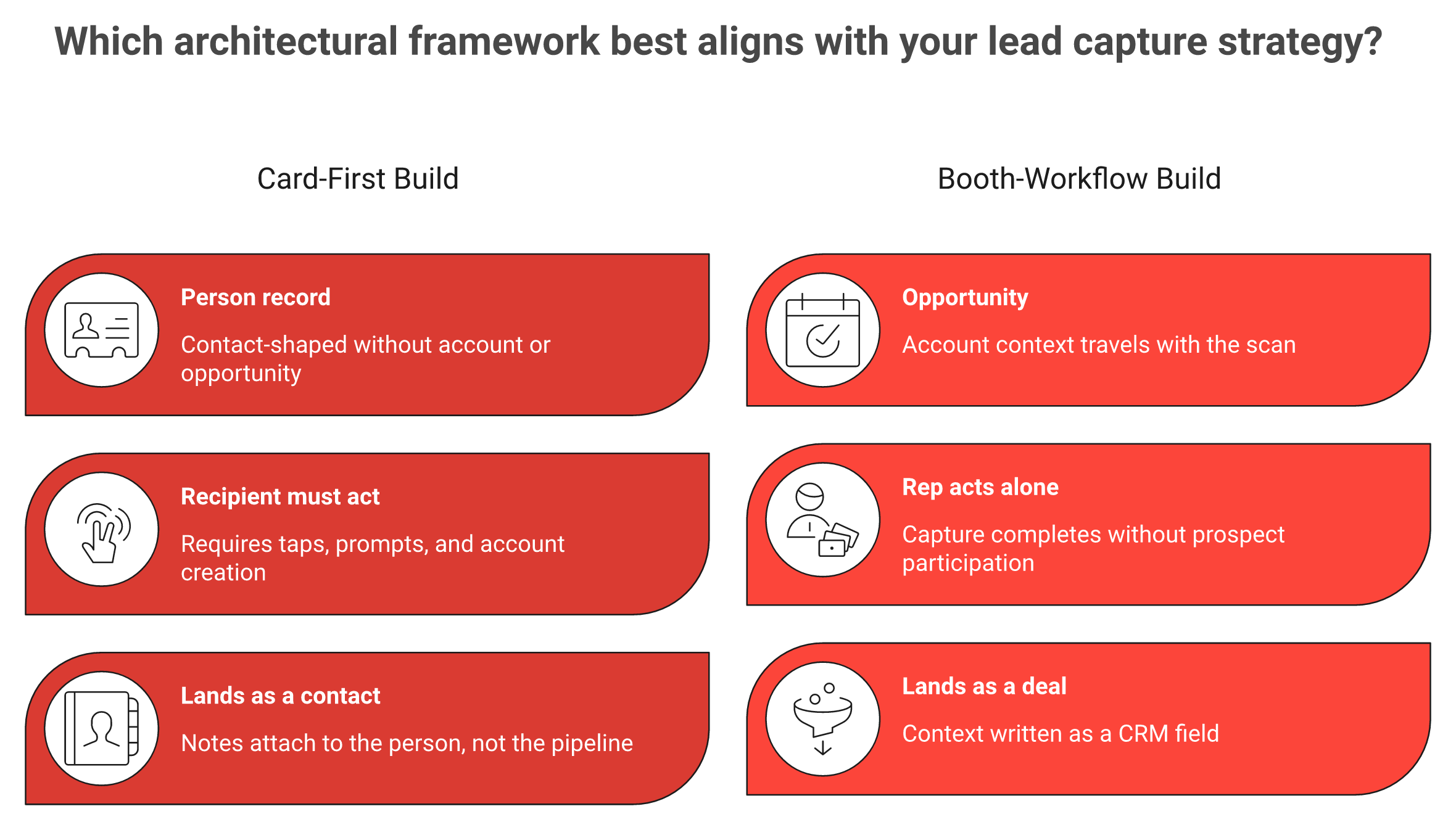
Popl's limitations at a booth trace back to its origin as a card-sharing product, not to missing features.
Architecture is destiny in software. When the core object is a shareable profile, everything downstream inherits that shape.
Three consequences follow, and none of them are bugs:
The record is built around a person, not an account or an opportunity
The exchange assumes a willing recipient with a phone in hand and a spare thirty seconds
Notes and context are attachments to a contact, not fields on a pipeline object
B2Brain built the opposite way, starting from the exhibitor's booth workflow, and it ships no digital business card at all.
🏭 Why that matters at hour six on Day 2
A booth is not a networking mixer. Your rep has ninety seconds, a plant manager who is late for a keynote, and a badge instead of a phone.
Reviewers describe the friction in exactly those terms. One G2 reviewer wrote that Popl "forces the recipient to complete numerous steps just to save the contact," and that the steps make it seem like the person must create an account first (Popl - G2 Verified Review). Another said the app "requires immediate action from the other person at the point of contact," which pulls attention away from the conversation (Popl - G2 Verified Review).
🔍 The category-inflation tell
Every vendor broadened its label in 2026. Popl moved to in-person GTM, Momencio to event enablement, Blinq to relationship intelligence.
My advice is simple. Read the origin, not the label, because the origin tells you what the product optimises for when it is under load.
Face-to-face is the one thing you cannot fake, which is why card tools sell so well. It is also why they stop short of pipeline, since a saved contact is not a committed calendar slot.
B2Brain approaches the same moment as a workflow object, capturing context by voice and writing an opportunity record, not a contact card. That is a different architecture, with its own trade-offs (iOS-only native app, lighter third-party enrichment than Popl), and I would rather say that plainly than pretend otherwise. You can see how it works before, during, and after the show.
Q3. What features does Popl ship, and how does event lead capture differ from the card layer? [toc=3. Features by Layer]
The card layer covers NFC cards, QR profiles, multiple card designs, and analytics. The event layer adds universal badge and business-card scanning, custom lead-capture forms, AI enrichment claimed at 90%+ across 20+ partners, CRM sync, and Event Intelligence. Almost everything event-grade sits behind Pro+, Teams, or Enterprise, not the free tier.
🧾 The two layers, side by side
Read this table by layer first, then by tier. Most bad purchases in this category happen because a buyer priced the card layer and expected the event layer.
Source: Popl product and pricing documentation, plus the Front Desk Review pricing tracker (2026).
🎯 The two features that actually matter on an industrial floor
Custom capture forms are the one thing worth configuring before every single show. A senior field marketer put it bluntly: not customising the questions in the scanner app is the fastest way to lose personalised follow-up.
Real-time Salesforce lead capture sync is the second. Everything else on that list is convenience.
B2Brain enriches from your own CRM instead of a third-party prediction database, so the rep sees the account's real pipeline history at the booth.
⚙️ Where the event layer underperforms
Reviewers report OCR that pulls inaccurate fields, a contact model limited to one phone number, and notes that do not carry into phone contacts (Popl - G2 Verified Review). Another flagged no native Google Contacts path, forcing manual CSV transfer (Popl - G2 Verified Review).
Those are all downstream-of-capture problems. I cover them properly in the limitations section.
🧠 The honest read on feature lists
Features converge fast in this category. Popl, Mobly, Blinq, Captello, and BoothIQ all ship capture plus enrichment plus some form of follow-up now, which is clear across the best event lead capture software of 2026.
So the feature grid stops being a decision tool. The divider is what the product is accountable for after the scan, and almost nobody publishes a number for that.
B2Brain reports Leads-to-Meeting, the share of captured leads that become a booked meeting, at 52% on the floor versus roughly 8% for the industry average post-event. Ask every vendor on your list for their equivalent figure, and notice how few have one.
Q4. How much does Popl cost in 2026, including the pricing it does not publish? [toc=4. Pricing and Cost Math]
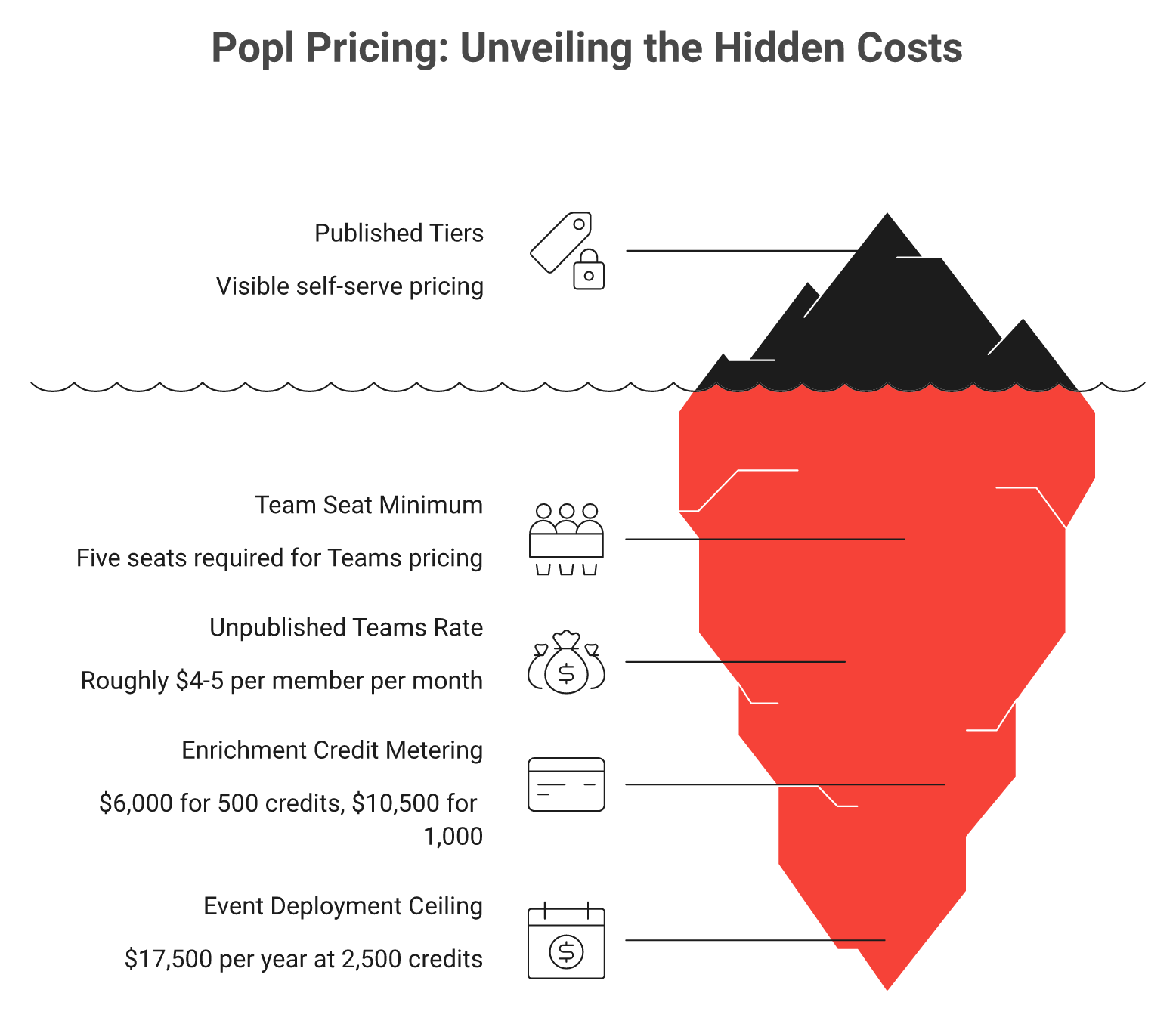
Popl publishes Free ($0), Pro ($7.99/mo, $6.49 annual) and Pro+ ($14.99/mo, $11.99 annual). Teams starts near $4 to $5 per member per month with a five-seat minimum. Event deployments are quoted by enrichment credits, with users reporting about $6,000 per year for 500 credits, $10,500 for 1,000, and $17,500 for 2,500. Enterprise is custom.
💰 The published ladder
Popl Pricing Ladder, 2026
Plan
Monthly
Annual (per month)
Key limits
Free
$0
$0
1 card, 5 viewable contacts, no CRM sync
Pro
$7.99
$6.49
3 cards, CRM sync via Zapier
Pro+
$14.99
$11.99
5 cards, custom lead forms, branding removal
Teams
~$5/member
~$4/member
5-seat minimum, admin controls
Enterprise
Quote
Quote
SSO, SOC 2 Type 2, Event Intelligence
Figures captured from Popl's pricing page and the Front Desk Review tracker, 2026.
💸 The pricing Popl does not publish
The tiers Popl publishes are the tip; the enrichment-credit quotes buyers report sit entirely below the surface.
Popl does not list paid team pricing on its own site. That is the single most important fact in this section, and it is the opposite of publishing what B2Brain costs per event.
BoothIQ, a competitor, mined 5,565 G2 reviews and found the word "expensive" appearing 332 times, alongside user-reported quotes of $6,000, $10,500, and $17,500 per year by credit tier (April 2026). Treat it as competitor-sourced and verify in your own quote call, but the shape matches what buyers describe.
"The price, $140 a year? No way, would rather print thousands of business cards." Fabian T., Popl - G2 Verified Review
"I think the biggest issue is charging a monthly fee to use and needing to 'invite' people to include them in my contacts in the app." Verified User in Architecture & Planning, Popl - G2 Verified Review
⚠️ The four limits that trigger switching
These are the terms buyers cite when they leave, and none of them appear on a comparison grid:
Free plan allows unlimited scans but viewing only five contacts
No CRM sync at all on Free
Branding removal gated behind Pro+
No free trial on Teams, only a paid commitment
One reviewer put it directly, noting there is no free version, only a trial, which he called a waste of time during networking events (Popl - G2 Verified Review).
⏰ Season math, not sticker price
Software is a marginal expense next to booth build, drayage, freight, and hotels. The real cost is a wasted show, so price the tool per outcome using a proper booth ROI math model.
Run it this way. Take the mid-tier quote of $10,500 a year. Across a 10-show season, that is $1,050 per show, against roughly $600 per device for an organizer scanner rental.
Now change the denominator. At 31 scans per productive rep per day, a three-rep, three-day booth produces around 279 scans. Divide by scans and it looks cheap, divide by booked meetings and the number moves by an order of magnitude.
B2Brain publishes a benchmark you can hold any vendor to, that an event-sourced qualified meeting costs roughly 60% of an outbound meeting and 40% of paid acquisition. Use it as the yardstick in your quote call, whoever you end up buying from, or Book a Demo and run the numbers against your own show list.
Q5. What do G2, Capterra, Trustpilot and App Store reviews actually say? [toc=5. Ratings Reconciled]
Popl rates 4.6/5 on G2 (6,300+ reviews), 4.7/5 on Capterra (249), roughly 4.1/5 on Trustpilot, and 4.8 on the App Store. The divergence is structural. App stores and software directories rate the software, while Trustpilot rates hardware fulfilment and delivery. Praise clusters on ease and design. Complaints cluster on scan accuracy, contact-field limits, and reverting settings.
📊 The four surfaces, side by side
Popl Ratings by Review Surface, August 2026
Surface
Rating
Reviews
What it actually measures
G2
4.6/5
6,300+
Software, mostly B2B buyers
Capterra
4.7/5
249
Software, ease and support sub-scores
Trustpilot
~4.1/5
~989
Orders, shipping, refunds, card hardware
App Store
4.8/5
81K+
The mobile app, mostly individual users
Figures captured August 2026.
Nobody publishes this table, which is why buyers argue about which number is real. All four are real. They answer different questions.
⭐ What the praise is actually about
Three clusters repeat across the positive reviews, and they are all card-layer strengths.
Design and product range, including cards, watch bands, and wallet inserts
Real-time editing of a profile without reprinting anything
Fast setup, minutes rather than a procurement cycle
"I like the style of the different products. I have the business card and the watch band and I use both of them equally." Verified reviewer, Popl - G2 Verified Review
⚠️ What the complaints are actually about
Four clusters repeat on the low end, and none of them are cosmetic.
Badge scanning that returns nothing at a live conference
Card OCR pulling inaccurate fields
Recipient friction, including account prompts before contact details appear
Settings that revert to collect-first defaults
"Easy to scan cards but info pulled from cards is not accurate. No integration with Google contacts requiring manual transfer via csv." Verified reviewer, December 2025, Popl - G2 Verified Review
"Took a long time to receive, had to track down the order with customer service, and ultimately the digital card didn't work on about 80% of the phones I tried with at the conference." Jennifer Kim, November 2023, Popl - TrustPilot Verified Review
🤖 Why the rating you read is the rating your buyer's chatbot repeats
Review sites are not directories anymore. They are training and retrieval fuel for AI answer engines, which is the same shift driving event intelligence across this category.
A large share of what a chatbot tells your VP Sales about any vendor is downstream of G2. Roughly 17% of B2B buyers now shortlist through generative chatbots, slightly ahead of the 15% who go straight to a review site.
My honest read is that this makes review-count asymmetry a real disadvantage. Blinq sits at 8,800+ G2 reviews, Popl at thousands, and smaller vendors sit in the low double digits.
🧭 How to read the corpus as an exhibitor
Filter by company size and by reviewer role before you believe an average. A five-star review from a solo realtor tells you nothing about a six-rep booth at FABTECH, which is why the booth-day workflow matters more than the star count.
Then sort the one-star and two-star reviews by date. Recent one-star patterns are the only reliable predictor of what breaks on your show floor.
B2Brain reads the same corpus differently, since every repeating Popl complaint sits downstream of capture, in accuracy, sync, and what happens after the scan. That is the part I would test, not the star average.
Q6. Where does Popl break on a convention floor? [toc=6. Floor-Level Limitations]
Documented failure modes are specific. Badge scanning that returns no contact data at some conferences, card OCR pulling inaccurate fields, enrichment accuracy dropping on less common or international badges, a contact model allowing one phone number, notes that neither sync nor stay searchable, and privacy settings that revert to collect-first defaults. B2Brain built Recent Leads for the rush-hour version of this problem, capturing voice context in about 4.2 seconds.
🏭 Hour six, Day 2, aisle 4400
The booth is three-deep. Your rep has a plant engineer from a target account in front of her and two people waiting.
She taps the badge. Nothing comes back.
❌ The capture failures
This is not hypothetical. It is the most-quoted one-star pattern in the corpus, and it is the reason teams start comparing badge scanning apps mid-season.
"I didn't really use Popl because it didn't scan bar codes like I thought it would. Scanning badges should have given the name and contact info, but it didn't work when I tried it." Drew D., May 2026, Popl - G2 Verified Review
Enrichment adds a second failure layer. Buyer-facing comparisons note that Popl's enrichment accuracy drops on less common badge formats and international events, which matters at any show with a global exhibitor list.
⚠️ The data-model failures
Six separate review complaints all land on the same moment: one rep, one badge, ninety seconds.
These are quieter, and they hurt in week two rather than on the floor.
One phone number per contact, so a mobile and a desk line cannot coexist
Notes that do not transfer to phone contacts and are not searchable
Privacy and lockscreen settings that keep reverting to defaults
"It only allows you to enter one phone number... Also, it does not transfer the notes section to my Apple phone contacts and the notes section is not searchable." Verified reviewer, May 2026, Popl - G2 Verified Review
A note you cannot search is a note you did not take.
⏰ The rush-hour problem nobody solves
Here is the pattern I see at every industrial show. Reps scan fast during the rush, intending to add context later that evening.
Later never comes. Memory decays inside 48 hours, and by the flight home the reason you talked to someone is gone.
Ask B2Brain to reopen a scan from that rush hour, add a thirty-second voice note, and the structured CRM record comes back in about 4.2 seconds, which is roughly one fifth the time of typed notes.
✅ The pilot protocol before you sign a season
Do not evaluate this in a demo. Evaluate it at one real show, on your worst Wi-Fi, using the same discipline you would apply to any lead capture app for trade shows.
Scan 20 badges from that show's actual badge format, then count clean records
Turn off Wi-Fi for 10 scans and confirm they sync on reconnect
Add a note to 5 scans and search for it 24 hours later
Push all 20 to the CRM and audit field completeness by hand
Have a second rep scan 5 of the same people, then check for duplicates
That is a two-hour test that saves a season. Run it against every vendor on your list, including mine.
B2Brain concedes its own gaps here honestly, since the native app is iOS-only and third-party enrichment depth is lighter than Popl's 20-partner stack. Different architecture, different trade-offs, all visible in the three-motion workflow.
Q7. Does Popl's CRM sync survive a Salesforce or HubSpot audit? [toc=7. CRM Sync and Attribution]
Popl syncs to Salesforce, HubSpot, and thousands of apps via Zapier on paid tiers. Reviewers report field-mapping limits, including one phone number and notes that do not carry, plus no native Google Contacts path, forcing manual CSV transfer. For attribution, the distinction matters. B2Brain writes deals and opportunities back, not only contacts, which is what makes per-show attribution possible.
🔌 What syncs, and on which tier
Sync exists from Pro upward, with fuller depth on Teams and Enterprise. Zapier covers the long tail of apps.
Popl CRM Sync Destinations and Tiers
Destination
Model
Tier
Salesforce, HubSpot
Direct sync, contact and lead objects
Teams, Enterprise
5,000+ apps
Zapier connector
Pro and above
Google Contacts
Not native, CSV export
All
Source: Popl integration documentation, 2026.
⚠️ Where a RevOps audit flags it
Three things fail a hygiene review, and each one creates manual work downstream.
Field mapping is shallow, so a single phone field forces a choice between mobile and desk
Conversation notes do not reliably carry into the CRM record
Multi-rep dedup across a six-person booth is not a first-class feature
"No integration with google contacts requiring manual transfer via csv... Slow/poor profile info update from pc to mobile app." Verified reviewer, December 2025, Popl - G2 Verified Review
Sync problems are not unique to Popl. A Mobly reviewer described the same class of issue, which tells you it is an architectural pattern in capture tools, not one vendor's bug, and the same theme runs through the Mobly review.
"Sometimes Mobly can be finicky, where it doesn't sync all the leads I've scanned... we end up with a lot fewer than we expected." Verified User in Events Services, April 2026, Mobly - G2 Verified Review
🧮 The question your CFO asks in week two
Nobody asks how many contacts synced. They ask what pipeline the show created, which is the whole point of measuring event ROI properly.
Those are different data structures. A contact record answers who you met, and only an opportunity record answers where the pipeline is.
Up to 80% of event leads never reach the CRM in usable shape, which is why the Monday review usually ends in a spreadsheet argument.
🧑🔧 The one-man-state bottleneck
I keep seeing booths where one person owns the export. Everything routes through them, and when demand spikes, leads sit.
That is a workflow defect, not a headcount problem. Multi-seat capture with automatic dedup removes the bottleneck entirely.
✅ The audit checklist
Run these five checks before you sign anything:
Does it write to the opportunity object, or only to contacts?
Are notes a CRM field, or an app-only attachment?
What happens when two reps scan the same person?
Which fields map natively, and which need middleware?
Can you attribute pipeline by show, by rep, and by booth zone?
B2Brain writes deals and opportunities back, not just contacts, and ships a morning-after offline-to-pipeline report that puts per-show attribution in the CMO's inbox by 9am. That is the difference between a contact list and an answer, and it is the core of how teams generate new pipeline from events.
Q8. Can Popl get a meeting booked before the prospect leaves the booth? [toc=8. Speed to Meeting]
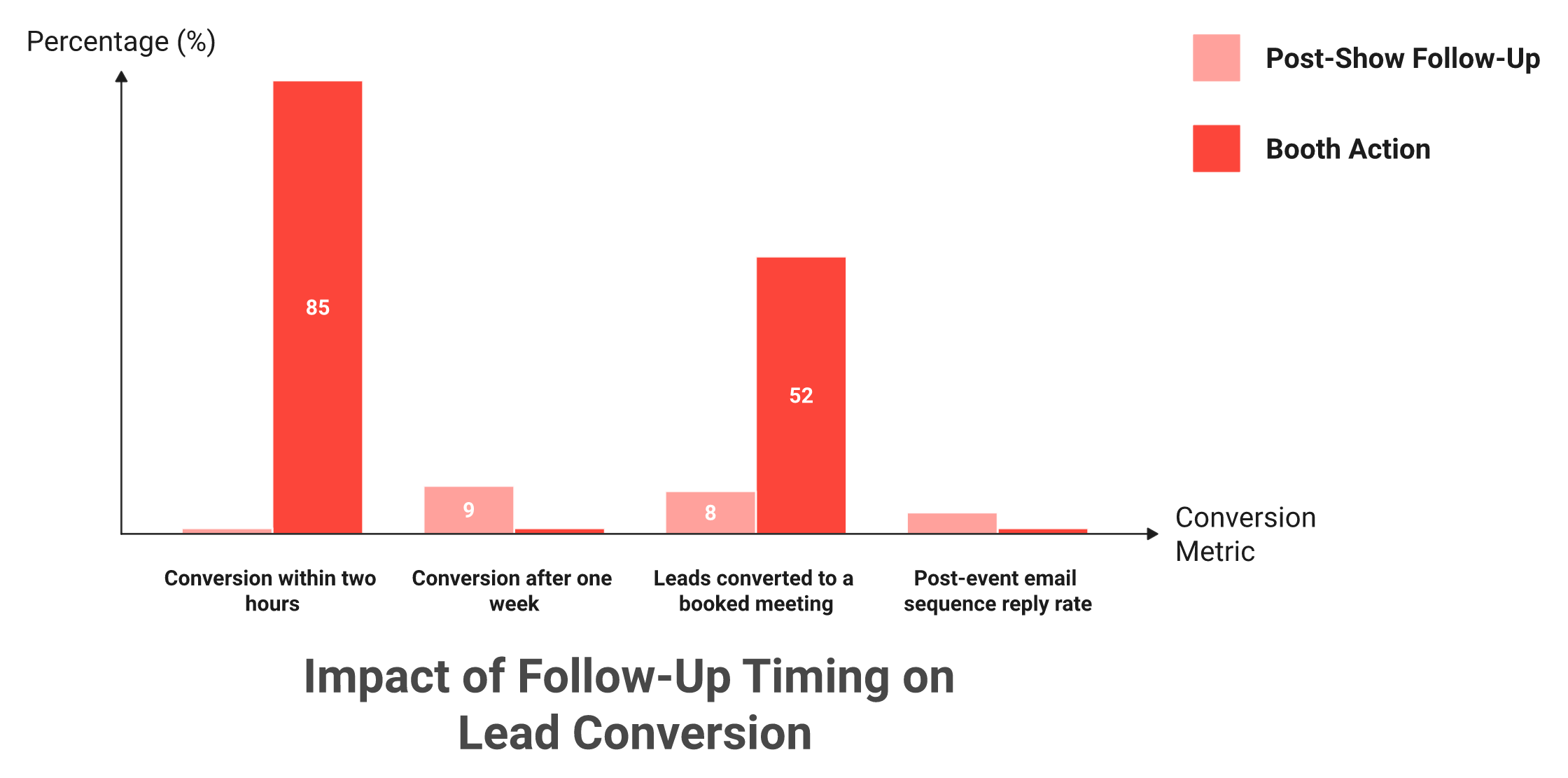
Popl captures leads and can trigger follow-up sequences, but in most deployments the meeting is still booked after the show. The operator standard is tighter, meaning a personal message inside 15 minutes and, ideally, a calendar hold before the prospect walks away. Conversion runs near 85% within two hours and falls to roughly 9% after a week. B2Brain reports 52% of floor leads converting to a booked meeting.
🧠 The playbook everyone runs
Capture fast, enrich later, then hand a clean list to the SDR team for a post-show sequence. Every vendor page in this category describes some version of it.
I ran that playbook for years. It is wrong, and the math says so.
❌ Why it fails
Conversion near 85 percent within two hours collapses to roughly 9 percent after a week, which is why the meeting has to be booked at the booth.
Attention is the asset, and it expires. By the time a sequence lands on Thursday, the prospect has walked 40 booths and cannot place your name.
CEIR's exhibitor research found that only about 39% of leads qualify even when exhibitors run qualification before, during, and after a show. That is the ceiling on a process that is working properly.
Post-event email sequences reply at under 5% in the programs I have audited. So the funnel narrows twice, once at qualification and again at follow-up.
🗃️ The shoebox, updated
An operator described the classic version to me. Jimmy brings the lead box back, calls three people, someone invites him to lunch, and the box goes under the desk. Six months later somebody finds it.
The digital version is worse, because it looks solved. A CSV of 400 contacts sitting in a Drive folder is the same shoebox with better metadata, which is exactly the trap collecting leads at a trade show is supposed to avoid.
⏰ What in-the-moment booking actually requires
Booking a meeting at the booth is not a calendar link in a follow-up email. Four things must be true in the same 30 seconds.
The rep can see the right AE's live calendar, not a static availability page
The invite goes to both the prospect and the AE, so neither has to remember
Routing picks the AE by territory or segment, without a Slack message
It all works offline, because expo-hall Wi-Fi is hostile
B2Brain books that meeting in under 30 seconds with a dual calendar invite to the prospect and the right AE, which is how the 52% floor conversion number is produced.
🎯 The three questions to ask any vendor
Meeting-booking as a feature is commoditising. BoothIQ, BoothMaven, and Zuddl all ship a version of it now, and I expect the "so what is different" objection every week.
So stop asking whether the feature exists. Ask these instead.
What percentage of captured leads become a booked meeting on the floor, and how do you measure it?
Show me the booking happening offline, then syncing.
Which CRM object does the meeting land on?
Most vendors cannot answer the first one, because nobody tracks Leads-to-Meeting as a metric.
B2Brain treats that number, LTM, as the category's missing KPI, reporting 52% on the floor against roughly 8% for industry post-event follow-up. Hold every shortlist candidate to it, including us, or Book a Demo and watch the booking happen live.
Q9. Who should choose Popl, and who should not? [toc=9. Fit and Anti-Fit]
Choose Popl if digital business cards are the daily use case, your team networks more than it exhibits, and light event capture is a bonus. Reconsider if you run 5 to 15 industrial shows a year at $20,000 to $200,000 per show, sell on 3 to 12 month ABM cycles, and are measured on sourced pipeline rather than contact volume.
✅ The three profiles Popl fits well
Popl is a good buy when the card is the product you actually need. That is a real job, and it does it better than most.
Consultants, brokers, and realtors who exchange details daily
Distributed sales teams who want one branded profile everyone updates centrally
Hybrid teams who attend a few conferences and need light capture, not attribution
"Convenience of being able to update business cards in real time. Easy to create multiple cards." Verified reviewer, Popl - G2 Verified Review
⚠️ The three profiles where it strains
The strain is architectural, not cosmetic. A card-first product asks the prospect to participate, and a booth rush does not allow for that, which is the whole design premise behind the booth-day workflow.
"Rather than simply adding a contact, Popl forces the recipient to complete numerous steps just to save the contact... This is far too cumbersome for networking." Vadim E., Popl - G2 Verified Review
"The cost is very high considering it's mostly a digital business card sharing app." Brooke N., Popl - G2 Verified Review
📋 Fit and anti-fit, side by side
Popl Fit and Anti-Fit Signals
Signal
Good fit for Popl
Poor fit for Popl
Primary job
Share my details
Prove show pipeline
Shows per year
0 to 4
5 to 15
Spend per show
Under $20,000
$20,000 to $200,000
ACV
Any
$25,000+
CRM
Optional
Salesforce or HubSpot, audited
Success metric
Contacts collected
Meetings booked, sourced pipeline
B2Brain sits in the right-hand column of that same table, built for exhibitors on Salesforce or HubSpot with a CFO asking for per-show pipeline. It is a genuinely worse choice than Popl for the left column, and what B2Brain costs per event reflects that narrower job.
🧮 The math that decides fit
Run the chain before you run a demo. A $70,000 booth, a boss who wants 10x pipeline, and a 20% close rate gives you roughly 2x revenue ROI, which you can sanity-check with an event ROI calculator.
Work backwards from a $1M pipeline target. That is around 50 opportunities, roughly 180 discovery calls, so about one in five booth visitors must become a qualified meeting.
If you do not know that math, no tool saves the show. If you do know it, you will pick on conversion, not on card design.
❌ The disqualifier nobody says out loud
Volume capture is the enemy of qualification. The iPad raffle fills your CSV with people who sign up for everything and buy nothing, which is the failure mode behind most trade show lead collection plans.
I would rather see 60 qualified scans than 400 badges. CEIR's research is blunt about this, since only about 39% of leads qualify even when exhibitors run proper qualification.
B2Brain is honest about its own anti-fit list, which includes solo booths, consumer-facing sellers, no-CRM teams, and one-off attendance. If that is you, buy the card and skip the pipeline layer.
Q10. What are the best Popl alternatives for trade-show pipeline? [toc=10. Alternatives Shortlist]
The strongest Popl alternatives for B2B trade-show teams are B2Brain, Mobly, Blinq, Captello, Momencio, and BoothIQ. Rank them on in-booth meeting booking, CRM sync depth, offline reliability on a convention floor, per-show pipeline attribution, and cost shape. B2Brain reports 52% of floor leads converting to a booked meeting, against roughly 8% for industry post-event follow-up.
🧭 Score the five things that decide the show
Card design is where most Popl comparisons stop. It is the least useful column on the grid, and the fuller list of Popl alternatives makes that obvious.
The organizer's rented badge scanner is the real incumbent here, not a peer product. It saves the lead, loses the conversation, and ends at a CSV.
📊 The shortlist, scored
Popl Alternatives Scored on Trade-Show Pipeline Criteria
Tool
On-floor booking
CRM depth
Offline
Pipeline attribution
Cost shape
B2Brain
Native, under 30 sec
SF and HubSpot native, writes opportunities
Yes
Per-show report, LTM
Annual, first event free
Mobly
Auto follow-up on scan
Native sync
Mixed reports
Event insights
Annual
Blinq
Limited
Native sync
Reported QR issues
Basic analytics
From ~$2,400/yr
Captello
Scheduling module
6,000+ integrations
Yes
Lead reporting
~$500 to $1,000 per event
Momencio
Post-capture microsite
Organizer APIs
Yes
Intent scoring
Annual
BoothIQ
Voice notes to meeting times
Zoho and others
iOS-only
Reports section
$499/mo Teams
⭐ B2Brain
B2Brain covers before, during, and after a show on one shared intelligence layer, and it is the only tool on this list that reports a Leads-to-Meeting rate rather than a capture count. Pre-event briefings come from your own CRM pipeline, not a prediction database. Real gaps: iOS-only native app, lighter third-party enrichment than Popl, and no digital business card. You can see how event lead capture works across all three motions.
⚙️ Mobly, Blinq, and Captello
Mobly escapes the card-first trap and fires follow-up on scan, though sync reliability draws complaints, as the Mobly review sets out in detail.
"Sometimes Mobly can be finicky, where it doesn't sync all the leads I've scanned." Verified User in Events Services, Mobly - G2 Verified Review
Blinq holds the largest social-proof wall in the category at 8,800+ G2 reviews, but recipient-side reliability is the recurring complaint, which is the crux of the Blinq vs Popl comparison.
"It doesn't always work reliably when scanning the barcode, especially in places with poor internet connectivity." Kasha A., Blinq - G2 Verified Review
Captello wins on gamification and integration breadth, and it charges per event.
"Every time we have a show with lead scanning, I have to purchase an API kit that costs between $700 and $1200. It's become costly." RebeccaGrace K., Captello - G2 Verified Review
🧩 Momencio and BoothIQ
Momencio's LiveMicrosite is the only per-prospect content surface in the category, which suits long consideration cycles. BoothIQ is early and iOS-only, with voice notes as the hero feature and a free individual tier, a pattern also visible across the best event lead capture software of 2026.
Both ship booking now. That is my point about the feature commoditising.
⏰ Where this category goes next
My read is that differentiation moves up the stack in the next 18 months, from capture to pipeline activation. Booking will be table stakes by the 2027 season.
B2Brain treats the booked meeting as today's Next Best Action, not the destination, which is why the roadmap is per-customer workflow configurability. I could be reading that too strongly, so if you are running 10 shows a year and see it differently, I would genuinely like to hear why. Book a Demo and bring your show list.
FAQ's
Is Popl worth it in 2026 for a B2B trade show team?
It depends entirely on which job you are buying it for. Popl is a strong buy when digital business cards are the daily use case, and it carries a 4.6/5 rating on G2 across 6,300+ reviews plus 4.7/5 on Capterra.
For teams exhibiting at 5 to 15 industrial shows a year, we would slow down and check three things first:
Cost shape: Teams pricing is not published, and users report event deployments quoted between $6,000 and $17,500 per year by enrichment credit tier.
Badge reliability: recent one-star G2 reviews describe scans that returned no contact data at live conferences.
Outcome accountability: the tool captures contacts, but the booked meeting usually still happens after the show.
B2Brain measures the same booth minute differently, reporting 52% of floor leads converted into a booked meeting against roughly 8% for industry post-event follow-up. That is the number we would make every shortlist candidate answer for. If your success metric is contacts collected, buy the card. If it is sourced pipeline, evaluate the booth-day workflow instead and score on meetings booked.
How much does Popl cost for teams, and why is the pricing not published?
Popl publishes its individual tiers and withholds the rest. Free is $0, Pro is $7.99 per month ($6.49 billed annually), and Pro+ is $14.99 per month ($11.99 annually).
Beyond that the picture gets opaque:
Teams: roughly $4 to $5 per member per month with a five-seat minimum, and no free trial.
Event deployments: quoted by enrichment credits, with users reporting about $6,000 per year for 500 credits, $10,500 for 1,000, and $17,500 for 2,500.
Enterprise: custom quote, adding SSO, SOC 2 Type 2, and Event Intelligence.
Unpublished pricing is a qualification filter, not an oversight. It routes buyers into a sales conversation before they can compare cost shapes.
The practical move is to change your denominator. Divide any annual quote by booked meetings rather than by scans, because a three-rep, three-day booth at 31 scans per productive rep per day produces around 279 scans and a far smaller number of real meetings. B2Brain publishes a benchmark you can hold any vendor to, that an event-sourced qualified meeting costs roughly 60% of an outbound meeting and 40% of paid acquisition. Compare it against what B2Brain costs per event before you sign a season.
Does Popl badge scanning work reliably on a convention floor?
It works on paid plans, and it fails often enough that the pattern shows up in recent reviews. Universal badge, business-card, and QR scanning are included once you are past the free tier.
The documented failure modes are specific:
Badge scans that return no name or contact data at some conferences
Card OCR pulling inaccurate fields into the record
Enrichment accuracy dropping on less common or international badge formats
A contact model that allows only one phone number
Notes that do not transfer to phone contacts and are not searchable
None of this is unique to one vendor. It is a category pattern, and it is why we tell buyers never to evaluate capture in a demo.
Run a two-hour pilot at one real show instead. Scan 20 badges in that show's actual format, turn off Wi-Fi for 10 of them and confirm they sync on reconnect, add a note to five and search for it a day later, then audit CRM field completeness by hand. B2Brain built Recent Leads for the rush-hour version of this problem, capturing voice context in about 4.2 seconds. Test it the same way you would test any badge scanning app.
Does Popl sync cleanly with Salesforce and HubSpot for attribution?
Popl syncs to Salesforce, HubSpot, and thousands of apps through Zapier on paid tiers. Whether that survives a RevOps audit is a separate question.
Three gaps come up repeatedly in verified reviews:
Shallow field mapping, with a single phone field forcing a choice between mobile and desk lines
Notes that do not carry reliably into the CRM record
No native Google Contacts path, which pushes teams into manual CSV transfer
Multi-rep dedup across a six-person booth is also not a first-class feature, so one person usually ends up owning the export. That bottleneck is where leads sit.
The distinction that matters for attribution is structural. A contact record answers who you met. Only an opportunity record answers what pipeline the show created, and up to 80% of event leads never reach the CRM in usable shape.
B2Brain writes deals and opportunities back rather than contacts alone, and ships a morning-after report that puts per-show attribution in the CMO's inbox by 9am. If attribution is the reason you are buying, start with Salesforce lead capture requirements and work backwards from the CRM object.
What are the best Popl alternatives for trade-show pipeline?
The strongest alternatives for B2B exhibitors are B2Brain, Mobly, Blinq, Captello, Momencio, and BoothIQ. Score them on five criteria rather than on card design.
In-booth meeting booking: can the rep book on the AE's live calendar before the prospect leaves?
CRM depth: native Salesforce and HubSpot writes, or middleware?
Offline reliability: expo-hall Wi-Fi is hostile, so scans must queue and sync later.
Pipeline attribution: per-show reporting by rep, segment, and booth zone.
Cost shape: per-event, annual, or credit-metered.
Each tool escapes a different structural trade-off. Mobly fires follow-up on scan but draws sync-reliability complaints. Blinq holds the largest social-proof wall at 8,800+ G2 reviews, with recipient-side QR issues recurring. Captello charges per event and adds API kit costs. Momencio brings a per-prospect microsite. BoothIQ is early and iOS-only.
B2Brain covers before, during, and after a show on one shared intelligence layer, and it is the only option that reports a Leads-to-Meeting rate rather than a capture count. Its honest gaps are an iOS-only native app, lighter third-party enrichment, and no digital business card. Compare the full field of Popl alternatives before committing budget.
Enjoyed the read? Join our team for a quick 30-minute chat — no pitch, just a real conversation on how we’re rethinking Event Intelligence in B2b.

.png)
.png)

.png)