Popl vs iCapture: Which Fits Trade Shows, Which Fits Networking — and Why You Might Be Comparing the Wrong Two
Last Updated :
June 25, 2026
Skim in:
12
mins
.png)
Q1. iCapture or Popl: Which One Actually Fits Your Trade Show? [toc=1. The 30-Second Verdict]
I have watched a Field Marketer stand at the FABTECH press desk on Day 2, badge gun in hand, doing the math out loud: "We scanned 412 people. How many turned into meetings?" The honest answer was four. That gap, between a scan and a booked meeting, is the real reason you are comparing these two tools.
Pick iCapture if your deals happen at a manned booth and you need a rock-solid, offline badge scanner you can run across many shows. Pick Popl if your value is your people working the hallways, and you want mobile NFC and QR capture tied to digital cards. They solve two different jobs: booth ROI versus networking reach. Neither was built to answer the question your CFO actually asks.
⚠️ The Question Underneath the Question
Here is what I think most "Popl vs iCapture" searches are really about. You are not choosing a scanner. You are trying to stop a familiar thing from happening.
The thing is this: a rep brings 400 contacts back from the show. Monday comes. They follow up with three. The rest sit in a CSV nobody opens again. One operator put the real question plainly: should I buy a tool for my booth (iCapture style) or a tool for my people (Popl style), and how do I make sure the data does not die in a shoebox before Monday morning?
That last part is the whole game. A contact list is not pipeline. A booked meeting is, which is exactly what generating new pipeline from events depends on.
💰 What You Should Actually Be Solving For
So before you weigh feature for feature, name the outcome you need. You want to walk out of the show with meetings on the calendar, and a per-show pipeline number you can defend in the Monday review, not 400 names you will apologize for in three weeks.
My read, after 15 years of running and rebuilding booth programs, is that the booth-versus-people choice is the wrong frame if neither tool converts the conversation into a next step on the spot. Hold that thought. First, let me show you what each tool was genuinely built to do, because the origin of each one predicts exactly where it breaks, and where the booth-day workflow needs to start.
Q2. What Are iCapture and Popl Actually Built For? [toc=2. What Each Is Built For]
A Popl card and an iCapture booth scanner can sit on the same table and look like rivals. They are not. One was born to run a booth. The other was born to replace a paper business card. That origin shapes everything, from the data you get to the moment it fails you.
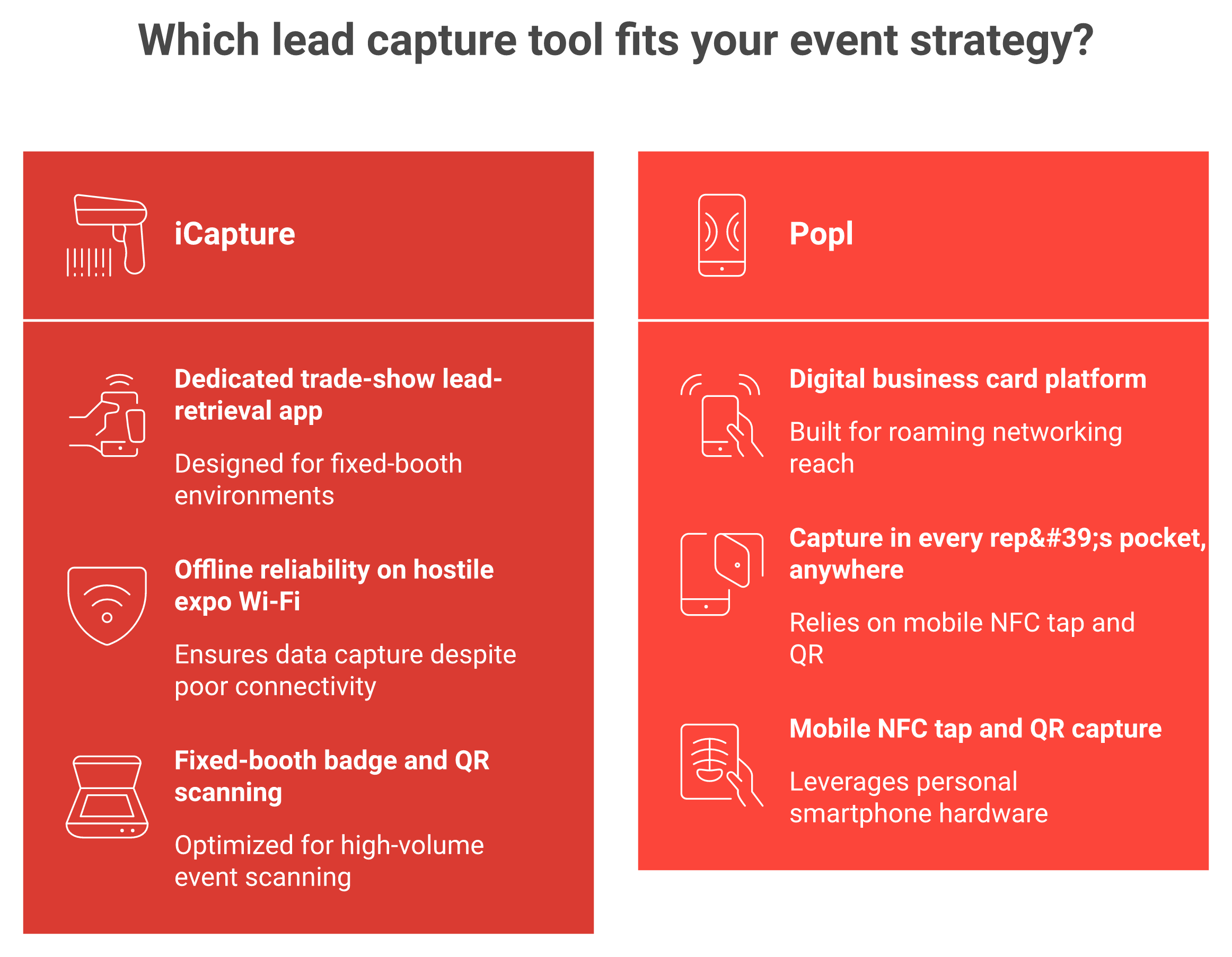
iCapture is a dedicated trade-show lead-retrieval app. "Lead retrieval" means scanning the attendee badge to pull their contact details. It does fixed-booth badge and QR scanning, custom qualifying surveys, and it works offline on a bad convention floor. It is priced per event or per device, and it leans enterprise-reliable.
Popl started life as a digital business card. You tap your phone (NFC, the same chip that runs Apple Pay), or share a QR code, and your contact details land on the other person's phone. Popl added event lead capture more recently, and now markets an AI lead-capture app for go-to-market teams. One is a booth tool. The other is a people tool.
✅ How To Tell Them Apart In One Sentence
Think of it as fixed capture versus mobile capture. As one field-marketing operator described the mobile motion, it is the touch-to-touch of the iPhone, or a dot card where they scan your QR code to get your full contact info, or you are just texting them the moment you meet anyone. That is Popl's world: a rep, in motion, anywhere.
iCapture's world is the opposite: a stationed scanner, a steady badge format, and a survey you built in advance. Both capture a contact. Neither, on its own, captures why you talked to that person or what happens next, which is the heart of what gets captured on the floor.
⚠️ Where Each One Starts To Strain
The reviews tell the origin story better than any spec sheet. iCapture users praise the speed-to-lead and the auto-sync, but the structural seam shows up too.
"It does not natively integrate with our CRM."
Mcallaster M. iCapture G2 Verified Review
Popl's seam is different. Because it grew from digital cards, the lead-capture job can feel bolted on for people who came expecting a scanner.
"I didn't really use Popl because it didn't scan bar codes like I thought it would. Scanning badges should have given the name and contact info, but it didn't work when I tried it."
Drew D. Popl G2 Verified Review
This is the honest baseline. At B2Brain we built an event lead capture app, not a badge scanner and not a digital card, precisely because the job that matters sits after the contact: context, the booked meeting, and the CRM record. You can see how event lead capture works once we have the full landscape.
Q3. Booth vs. Hallway: Who Is Each Tool Really For? [toc=3. Booth vs Hallway Fit]
There is an old argument in field marketing that never fully resolves, and you can hear both sides at any industrial show. One camp says the money is made standing at the booth. The other says the best deals start in the hallway, between sessions, over coffee. Your tool choice quietly takes a side in that argument, whether you mean it to or not.
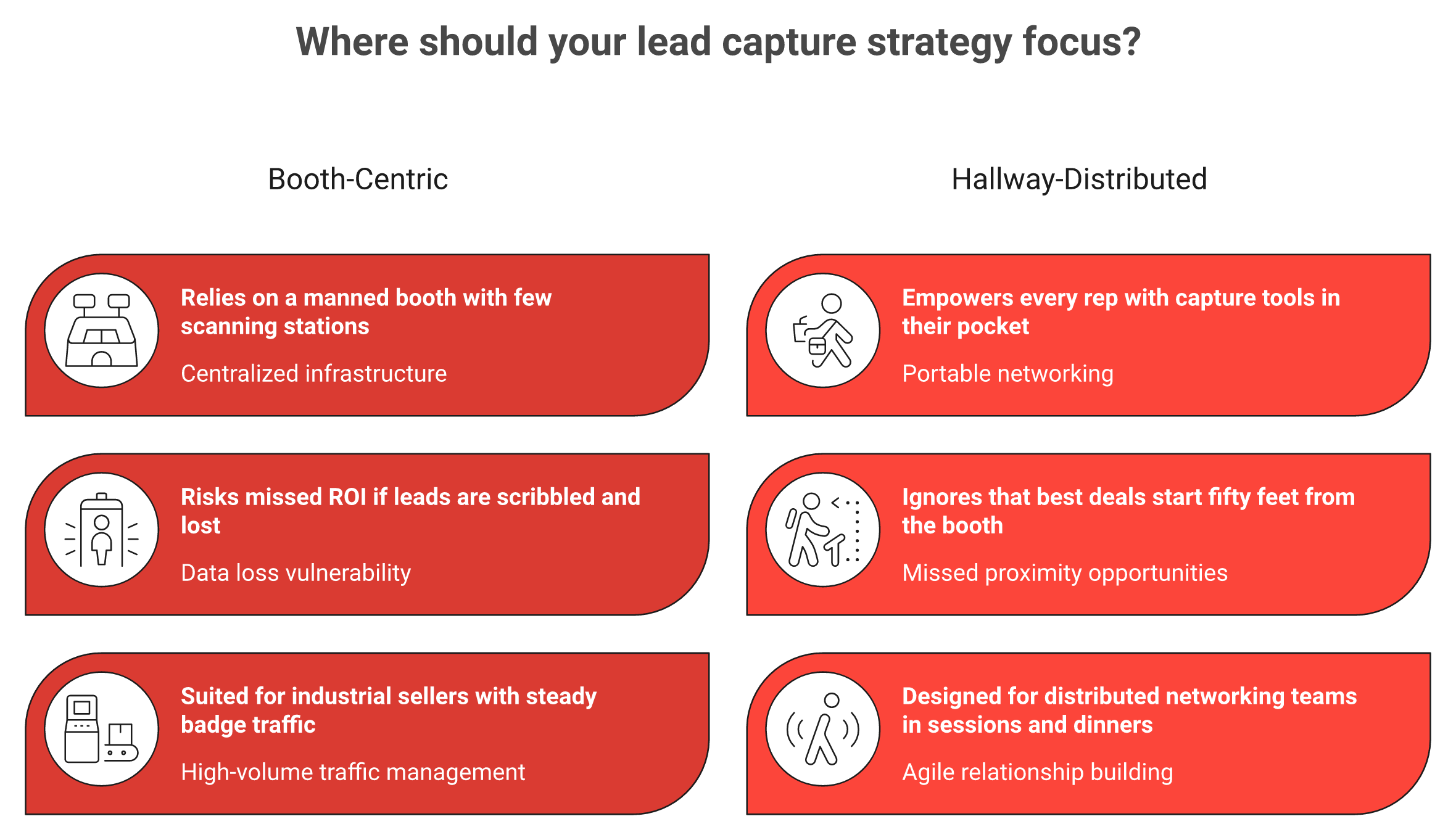
iCapture takes the booth side. It suits teams whose deals happen at a manned booth with a few scanning stations, a steady stream of badges, and a survey you tuned in advance. The pain it removes is a busy booth where leads would otherwise be scribbled on paper and lost.
Popl takes the people side. It suits teams where every rep, in a session or a dinner or a hallway, needs capture in their pocket. The pain it removes is the high-intent conversation that happens fifty feet from your booth and never makes it into any system.
⚠️ The "It Depends" Nobody Wants To Say Out Loud
The veteran event-seller Perry Belcher is blunt that his money was always made at the booth, and for many industrial sellers that is simply true. Other field marketers, like Kate Hammond and Kayla Drake, argue the opposite: the serendipity in the hallway is where the real opportunity gets created, so every employee needs portable capture, not just two scanners chained to a counter.
I think both are right, which is exactly the problem. Here is the honest split, and where for booth teams the line really sits.
| If your reality is... | The natural fit | Why |
|---|---|---|
| Heavy booth traffic, few stations, industrial badges | iCapture | Fixed, offline, survey-driven booth capture |
| Distributed reps networking everywhere | Popl | Mobile NFC/QR capture in every pocket |
| Both at once, with context attached | Neither, fully | Covered below |
✅ The Gap Hiding In The Middle
Most teams need both behaviors. You have a booth and people roaming. Here is the part neither tool was built to close: capturing the conversation with context, then turning it into a booked meeting before the person walks away.
A newer class of tools, including the offline-to-pipeline approach we take at B2Brain, tries to capture both the booth scan and the hallway conversation on one shared layer, with the why attached, not just the contact. Hold that thread. Once we walk the comparison criteria, you will see why the booth-versus-hallway question is the wrong place to stop, and why offline to pipeline is the better lens.
Q4. How Do iCapture and Popl Compare on the Criteria That Decide Event ROI? [toc=4. Side-by-Side Criteria Table]
I have sat in enough vendor demos to know the trap: you end up comparing fifty features and forget the only number your boss cares about. So let me anchor this on the criteria that actually move event ROI, and add the one column the rival comparison pages quietly leave blank.
Across seven criteria, iCapture leads on offline reliability and per-event simplicity. Popl leads on mobile reach, AI enrichment, and digital-card branding. Neither was designed to book the meeting at the booth or report pipeline per show, which is the criterion that decides whether your booth spend pays back.
📊 The Side-by-Side That Matters
| Criterion | iCapture | Popl | What to watch |
|---|---|---|---|
| On-floor capture speed | Fast badge/QR scan | Fast tap/QR, plus card scan | Speed of contact, not speed of context |
| Offline reliability | Strong, works offline | Captures, but leans on sync to enrich | Expo Wi-Fi is hostile; test before you trust |
| CRM-sync model | Syncs, but not always native | App-based sync, account often required | "Days later in the CRM" kills speed-to-lead |
| In-booth meeting booking | Not a core function | Not a core function | The gap a third category fills |
| Pipeline attribution / LTM | Event metrics, ROI math | Lead reports | Neither reports LTM, the meetings number |
| Vertical fit | Broad, enterprise events | Broad, networking-led | Industrial badge formats vary |
| Pricing shape | ~$8,000/yr, unlimited | Per-seat annual subscription | More shows vs. more people |
⚠️ Reading The Table Honestly
The two empty cells are the point. In-booth meeting booking and LTM (Leads-to-Meeting, the share of qualified booth leads that become a scheduled meeting) are the criteria neither tool scores on, because neither was architected for them. A good field-marketing instinct already knows this. As one operator put it, when I scan your badge I am going to mark you hot, warm, or cold, and score you immediately, so that work is already done. The tool should make that the default, not an afterthought.
Buyers feel the seam in both directions. iCapture's reliability is real.
"We recently used iCapture at an event and it was seamless. It made capturing leads and pushing them into our systems incredibly simple."
Natalie S. iCapture G2 Verified Review
Popl's value is real too, but narrower than the booth buyer expects.
"Lead capture is likely the most positive element of Popl. However, it's far too cumbersome when all someone wants is your contact information."
Vadim E. Popl G2 Verified Review
✅ The Column The Rival Pages Skip
This is where a third category sits. At B2Brain, we score the two empty cells on purpose: book the AE's 30-minute follow-up on their live calendar before the prospect leaves, and report LTM per show. The benchmark we see is roughly 52% LTM booked on the floor against an 8% industry average for post-event follow-up, which is the gap that the three-motion workflow is built to close. I could be wrong on the exact spread for your vertical, but the direction is not subtle: a contact list and a booked meeting are not the same asset, and only one of them survives the weekend. If you want to pressure-test that math, Book a Demo and bring your own show calendar.
Q5. What Do iCapture and Popl Actually Cost Over a Show Season? [toc=5. Cost Over a Season]
Most pricing pages hide the number that matters. They quote you a license. They never quote you the cost per booked meeting, which is the only figure your CFO will remember.
iCapture runs roughly $8,000 per year for unlimited users and unlimited events. That flat shape gets cheaper the more you exhibit, so a heavy show calendar dilutes the cost per event. Popl is a per-seat annual subscription, usage-based, landing around $6,000 per year depending on seats and matches. That shape scales with your team size, not your show count.
💰 The Two Cost Shapes, Side By Side
Over an 8-to-15-show season, the cheaper tool depends on one question: do you have more shows, or more people? If you want to sanity-check this against what B2Brain costs per event, the math is worth running.
| Cost driver | iCapture | Popl |
|---|---|---|
| Pricing shape | Flat, ~$8,000/yr unlimited | Per-seat, ~$6,000/yr, scales with seats |
| Gets cheaper when | You add more shows | It does not; cost rises with seats |
| Gets pricier when | Flat regardless | You add more reps or contact matches |
| Benchmark to beat | Organizer rental, ~$600/device per show | Same |
The organizer's rented scanner sits underneath both, at roughly $600 per device per show. Rent two devices across twelve shows, and you are already near $14,000, with nothing to show on Monday but a CSV.
⏰ The Denominator Nobody Prints
Here is the reframe I push every field marketer toward: stop dividing by scans, start dividing by booked meetings. A booth that costs $35,000 just to decorate, before rental, demands a return, and the rule of thumb I work to is roughly 3x closed-won ROI.
So the real math runs backward. Booth cost, then required pipeline, then required meetings, then required qualified scans. If you do not know that chain, you do not know what you are buying, which is why offline to pipeline is the lens that matters.
At B2Brain we report cost-per-booked-meeting on purpose, because a qualified event meeting is worth roughly 60% of an outbound meeting and about 40% of paid acquisition. I could be wrong on your exact ratios, but the point stands: neither vendor reports the denominator that decides whether the season paid back. You can see Show Pass and Pipeline plans for how we price against that denominator.
Q6. What Do Real Users Say Goes Wrong With Each Tool? [toc=6. Real User Complaints]
I trust a one-star review more than any feature page. The complaint pattern tells you where a tool breaks at 4pm on Day 2, when the booth is slammed and nobody can stop to take notes.
There is a failure mode every operator knows. A rep, call him Jimmy, brings the box of cards back. Monday morning he pulls out three. The box gets shoved under a desk. Six months later, somebody finds it. Both tools here can feed that exact spiral.
⚠️ iCapture: Reliable, But The Handoff Lags
The iCapture pattern is consistent: solid offline capture, but a CRM handoff that can feel slow or indirect, and an interface some find dated.
"It does not natively integrate with our CRM."
Mcallaster M. iCapture G2 Verified Review
To be fair, the reliability side is real when it works, and that balance matters.
"We recently used iCapture at an event and it was seamless. It made capturing leads and pushing them into our systems incredibly simple."
Natalie S. iCapture G2 Verified Review
❌ Popl: Slick App, But Capture Confusion
Popl's pattern is the mirror image. The app experience is praised, but the lead-capture and badge-scan job can confuse buyers who expected a scanner, and the steps can feel heavy.
"I didn't really use Popl because it didn't scan bar codes like I thought it would. Scanning badges should have given the name and contact info, but it didn't work when I tried it."
Drew D. Popl G2 Verified Review
"Lead capture is likely the most positive element of Popl. However, it's far too cumbersome when all someone wants is your contact information."
Vadim E. Popl G2 Verified Review
🚩 The Complaint They Share
Strip away the specifics, and both reviews point at the same hole. You end up with a contact list, not a record of who actually wants to buy. As one veteran put it bluntly, maybe one in twenty businesses act on a lead list three months later, so the list alone does almost nothing for you. That shared gap, not any single bug, is the real story across these reviews, and it is exactly what what gets captured on the floor is built to fix.
Q7. Are You Comparing the Wrong Two Tools? [toc=7. The Wrong-Two Reframe]
Here is the uncomfortable part. If both tools just hand you a list to chase after the show, then "iCapture or Popl" is the wrong question. You are tuning the wrong variable. The choice that matters is not booth tool versus people tool. It is list versus booked meeting.
⏰ The Decay Math That Breaks Both
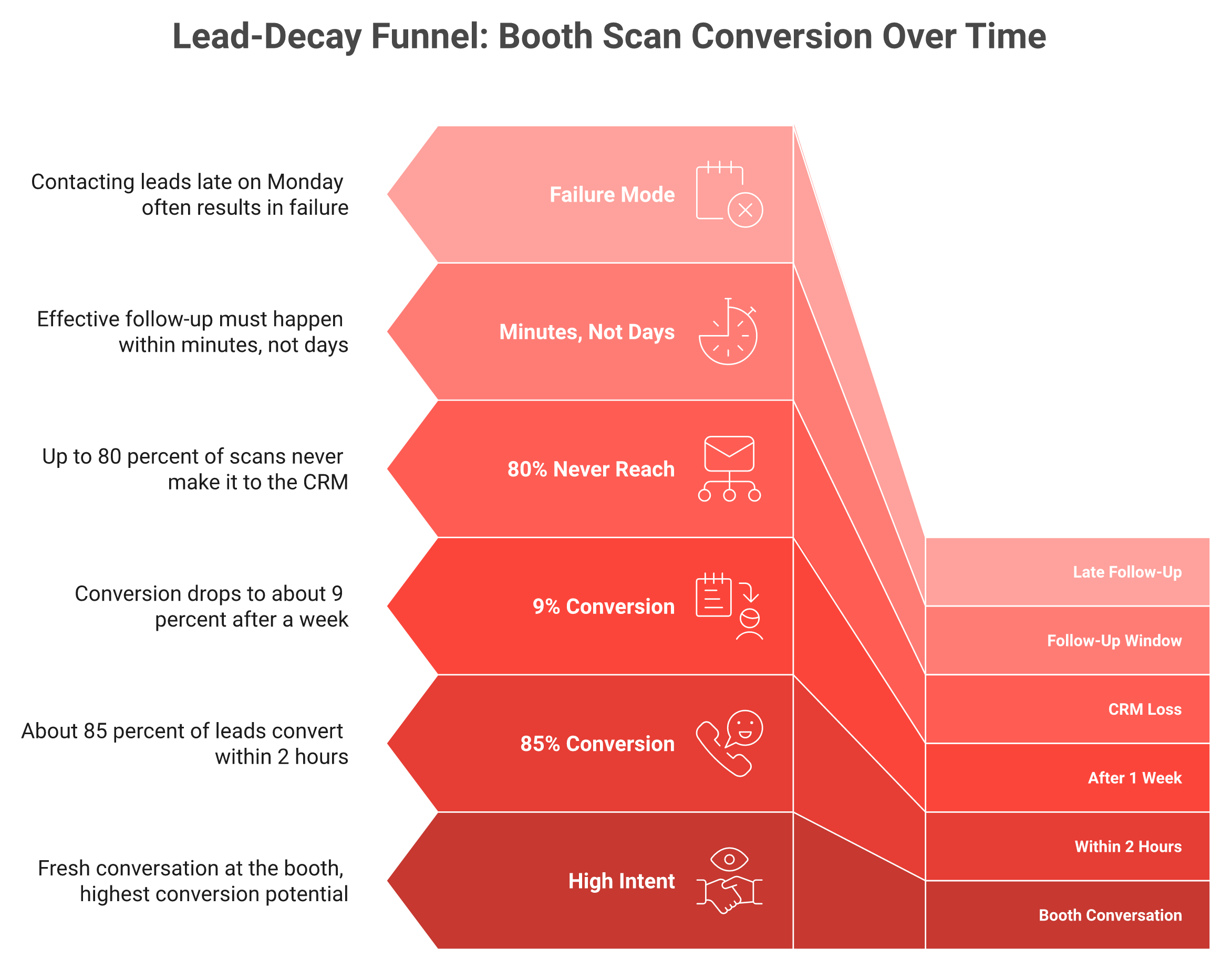
Watch what happens to a scan over time. Up to 80% of scanned leads never make it into the CRM at all. Of the ones that do, conversion falls from roughly 85% within two hours to about 9% after a week.
That decay is the whole problem. A prospect gets your follow-up while still walking away from the booth, and it lands. The same message a week later is noise. The window is minutes, not days, and a list-based tool quietly bets against that window.
✅ The Booking Outcome: Capture, Then Book On The Spot
This is where a third category lives. At B2Brain, the workflow is to capture the context by voice in about 4.2 seconds, score the lead on the spot, then book the AE's 30-minute follow-up on their live calendar before the prospect leaves. We call the metric LTM, Leads-to-Meeting, the share of qualified booth leads that become a scheduled meeting.
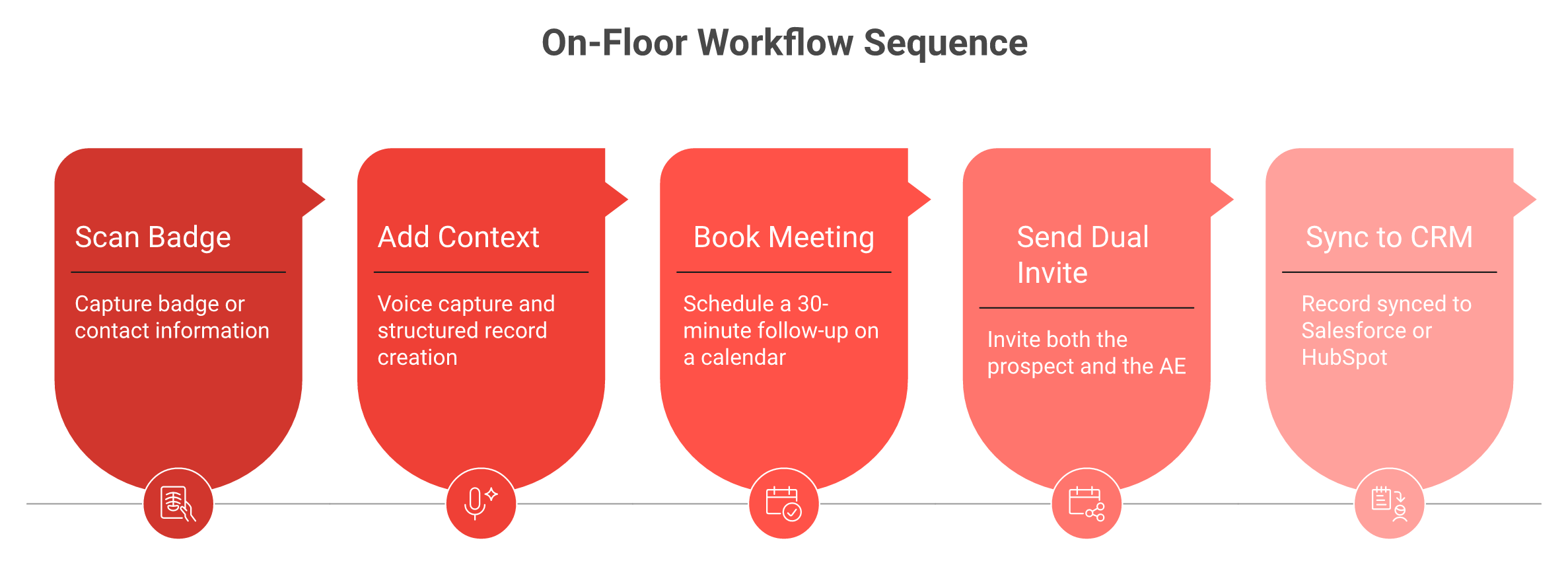
B2Brain is an event lead capture app, not a badge scanner and not a digital card. Anything a scanner captures, we capture too, then we add the why, route the meeting to the right AE, and write the CRM record. That is the speed-to-meeting job neither iCapture nor Popl was built for, and it is the heart of how event lead capture works.
💰 The Attribution Outcome: A Pipeline Number For The CFO
Booking is only half the job. The other half is proving it. By 9am the morning after, the offline-to-pipeline report shows pipeline sourced, meetings booked, LTM, and multi-touch attribution by show, booth area, rep, and segment.
The benchmark we see is roughly 52% LTM booked on the floor against an 8% industry average for post-event follow-up. The deeper moat is structural: B2Brain is the only layer covering Before (a CRM-grounded briefing built from your own pipeline), During (capture plus booking), and After (the report), with per-customer Next-Best-Action steps that mirror your sales process. Meeting-booking challengers ship the booking feature, but not that three-phase shared layer. That is the difference, and it is why teams generate new pipeline from events instead of collecting lists.
Q8. How Do You Choose the Right Setup for Your Next Show? [toc=8. Choosing Your Setup]
Forget the feature grid for a second. The right tool falls out of one honest question: where does your money actually get made at a show? Match the tool to that, and the choice gets simple.
✅ Match The Tool To Your Reality
- Choose iCapture if you exhibit at many industrial shows from a manned booth, and need bulletproof, offline badge scanning across a heavy calendar.
- Choose Popl if your value is distributed reps networking everywhere, in sessions, hallways, and dinners, and you want capture in every pocket.
- Choose an event lead capture app like B2Brain if your goal is booked meetings and defensible per-show pipeline, and you run Salesforce or HubSpot. This is the booth-day workflow built for booth teams.
⚠️ When To Skip All Three
I would rather lose the sale than waste your budget, so here is the honest guardrail. Skip all of these if you run a solo booth, sell consumer, attend one-off, or have no CRM. The spend will not pay back, and no tool fixes a booth with no follow-up engine behind it.
Also skip the gimmicks. The iPad raffle trap pulls in non-decision-makers, and a paid broker handing out swag fills your list with names nobody will ever close. B2Brain fits a specific profile, which is for booth teams running roughly 5-to-15 shows a year, $20K-to-$200K per show, and an ACV (average contract value) of $25K or more.
💰 Your Monday-Morning Move
Before you pick anything, run the math yourself. Take your booth cost, divide by your target pipeline-to-spend ratio, work back to the number of qualified meetings you need, and then check what your current setup actually delivers. My read is that most teams discover their real LTM is far below what one booked-meeting tool could give them. Do not take that on faith. Run your own number, then choose, and if you want a second set of eyes, Book a Demo.
FAQ's
What is the difference between iCapture and Popl for trade shows?
They look like rivals, but they were built for different jobs. iCapture is a dedicated trade-show lead-retrieval app: fixed-booth badge and QR scanning, qualifying surveys, and offline reliability on a hostile expo floor.
Popl started as a digital business card. You tap a phone using NFC, or share a QR code, and your details land on the other person. Popl added event lead capture more recently.
- iCapture is a booth tool, stationed and survey-driven.
- Popl is a people tool, mobile and built for reps networking anywhere.
Here is the part both miss. Each one captures a contact, not the reason you talked to that person, and not the next step. We built B2Brain to capture the conversation with context, then book the meeting before the prospect walks away. You can see how event lead capture works across the three motions. Origin predicts where each tool strains, so match the tool to where your deals actually start.
How much do iCapture and Popl cost over a full show season?
The two pricing shapes are different, so the cheaper option depends on your calendar, not a sticker price.
- iCapture runs roughly 8,000 dollars a year for unlimited users and events. That flat shape gets cheaper the more shows you exhibit at.
- Popl is a per-seat annual subscription, around 6,000 dollars, that scales with team size rather than show count.
Underneath both sits the organizer rental, near 600 dollars per device per show. Rent two devices across twelve shows, and you are already close to 14,000 dollars with only a CSV to show for it.
We push every field marketer toward a better denominator: cost per booked meeting, not cost per scan. A booth that costs 35,000 dollars to decorate demands a return, so work backward from pipeline to required meetings. You can compare Show Pass and Pipeline plans against that math. Neither vendor reports the number that decides whether the season paid back.
What do real users complain about with iCapture and Popl?
We trust review patterns more than feature pages, because they show where a tool breaks at 4pm on Day 2.
iCapture earns praise for reliable, seamless capture, but the recurring seam is the CRM handoff. One verified G2 reviewer noted it does not natively integrate with their CRM, and others find the interface dated.
Popl draws strong app ratings, but the lead-capture job can confuse buyers who expected a scanner. Reviewers report badge scanning that did not return contact info, and a flow that feels cumbersome when someone just wants your details.
- iCapture pattern: dependable capture, slower or indirect CRM sync.
- Popl pattern: slick app, capture confusion and a heavier flow.
The shared complaint is the real story. You end up with a contact list, not a record of who wants to buy. That is exactly the gap what gets captured on the floor is built to close, by attaching context to every conversation, not just a name.
Do iCapture or Popl book meetings and prove event pipeline?
Honestly, no, and that is the heart of the matter. Both hand you a list to chase after the show, which means you are optimizing the wrong variable.
The decay math is brutal. Up to 80 percent of scanned leads never reach the CRM, and conversion falls from roughly 85 percent within two hours to about 9 percent after a week. A list-based tool quietly bets against that window.
- Neither tool books the follow-up meeting at the booth.
- Neither reports LTM, the share of qualified leads that become a scheduled meeting.
We built B2Brain as a third category. We capture context by voice in about 4.2 seconds, book the AE's 30-minute follow-up on their live calendar before the prospect leaves, then deliver a morning-after report with pipeline sourced and multi-touch attribution. The benchmark we see is roughly 52 percent LTM on the floor against an 8 percent post-event average. That is how teams generate new pipeline from events instead of collecting names.
How do I choose the right trade show lead capture tool for my team?
Start with one honest question: where does your money actually get made at a show? The right tool falls out of that answer.
- Choose iCapture if you exhibit at many industrial shows from a manned booth and need bulletproof, offline scanning.
- Choose Popl if your value is distributed reps networking everywhere, in sessions, hallways, and dinners.
- Choose an event lead capture app like B2Brain if your goal is booked meetings and defensible per-show pipeline on Salesforce or HubSpot.
Skip all three if you run a solo booth, sell consumer, attend one-off, or have no CRM, because the spend will not pay back. We fit a specific profile, which is for booth teams running roughly 5 to 15 shows a year with an average contract value of 25,000 dollars or more.
Before you pick anything, run your booth-cost to required-meetings math, then check what LTM your current setup really delivers. If you want a second set of eyes, you can Book a Demo and bring your own show calendar.
.png)

.png)
.png)