Blinq is free for two cards, Premium is $9.99 monthly or $7.33 annually, Business is $6.99 per card monthly or $4.99 annually, and Enterprise is quote-only.
Business bills per card, not per seat, with a five-card minimum, so the practical entry point is roughly $300 a year before anyone scans a badge.
Event lead capture is billed separately on usage, and three published sources disagree on the rate, ranging from $1 per credit to $9.99 per enriched lead.
For a 25-rep team across ten shows, the capture layer, not the card subscription, becomes the dominant cost line by a wide margin.
No Blinq tier books a meeting at the booth or reports pipeline per show, which is the gap exhibitors feel in the Monday review.
Negotiate the per-lead rate, a season volume cap, card true-down at renewal, and exit terms before signing an annual commitment.
Q1. How much does Blinq cost in 2026? [toc=1. Blinq Pricing Overview]
Blinq is free for two cards. Premium is $9.99 monthly, or $7.33 billed annually, for up to five cards. Business is $6.99 per card monthly, or $4.99 billed annually, with a five-card minimum. Enterprise is quote-only with volume pricing and invoice billing. Event lead capture is billed separately on usage.
A Field Marketing lead I spoke with last season had one line item left open on her MODEX budget sheet. Booth build was locked. Drayage was locked. The capture tool was a blank cell, because the vendor's pricing page gave her a per-card number and her CFO wanted a per-show number. Those are not the same question.
💰 The four tiers, exactly as published
Blinq Pricing Tiers 2026
Plan
Monthly
Annual
Cards included
Free
$0
$0
2
Premium
$9.99
$7.33/mo
up to 5
Business
$6.99 per card
$4.99 per card/mo
5 minimum
Enterprise
Custom
Custom
from 100
Annual billing cuts roughly 27% off Premium and 29% off Business. Blinq also runs a 7-day Premium trial and a 30-day Business trial.
⭐ What each tier boundary actually gates
Free buys card sharing. It does not buy the universal scanner, AI Notetaker, contact enrichment, or export.
Premium adds the scanner, the notetaker, enrichment, branded QR codes, and contact export. Business is the first tier with native CRM sync, admin controls, custom qualifiers, event campaigns, and attribution. Enterprise adds enforced SSO, SCIM provisioning, invoice billing, and a dedicated CSM. If your workflow ends in a CRM, read how lead capture writes into Salesforce before you compare tiers.
⚠️ The number the table does not show
Business is described as unlimited usage where you pay only for leads captured. That single phrase moves the real cost outside the plan card, which is why the sticker price is not the budget number. Section three deals with it in full.
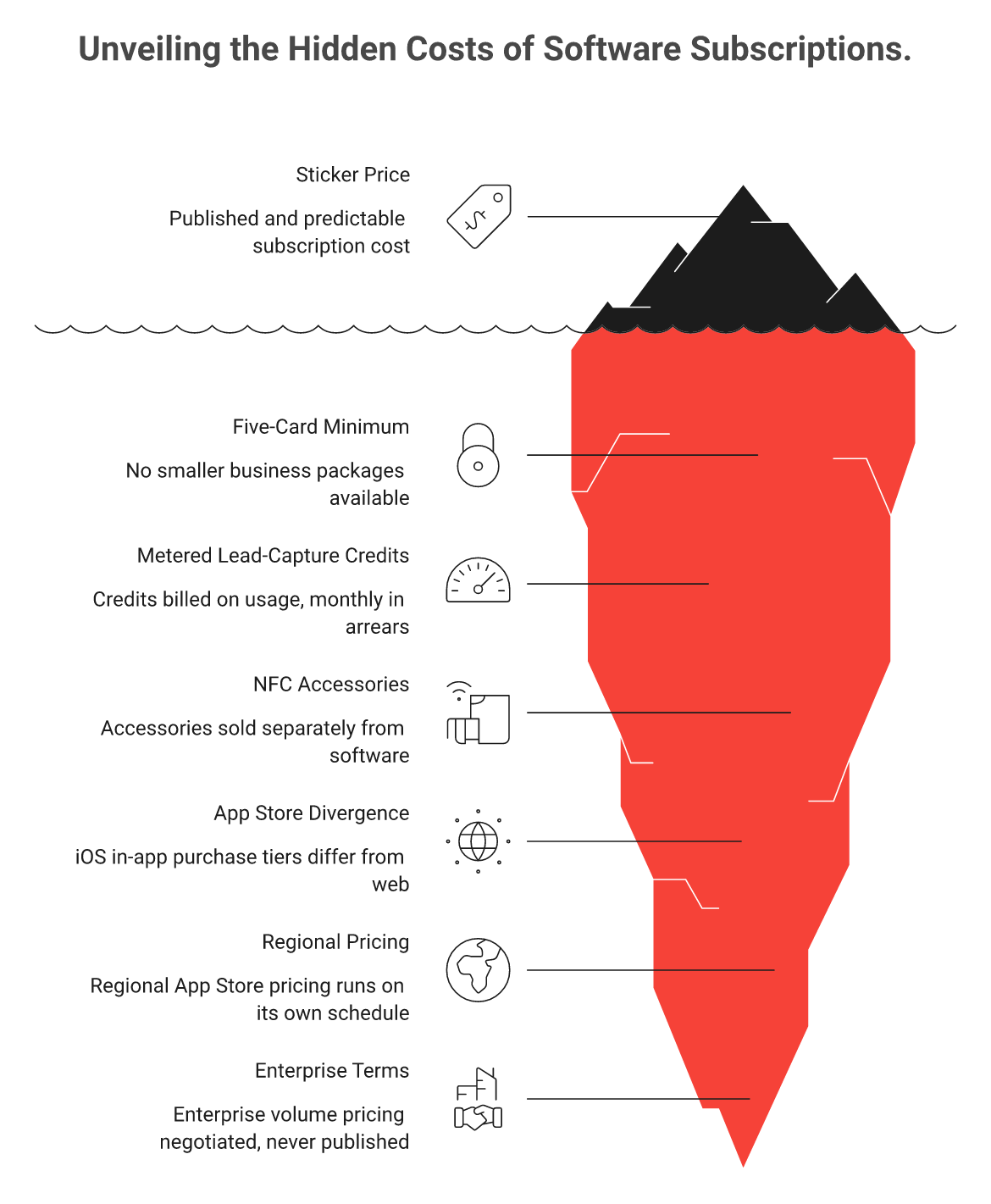
The published tier price is the peak. The five-card minimum, metered capture credits, and quote-only Enterprise terms sit below the waterline.
I would price this the way you price any event line. A trade show is hunting at a baited field. Everyone in the aisle is there to do a deal. Against the booth spend, the flights, the hotel, and the cabs, a card subscription is a rounding error. The expensive mistake is buying a per-person tool when your unit of value is a show.
✅ The math the CFO will actually ask for
Here is the ROI chain I run with every buyer. A $70K booth. The boss wants 10x pipeline. At a 20% close rate, that is roughly 2x revenue return. Discovery to close runs near 12%, so a $1M pipeline target needs about 50 opportunities and roughly 180 discovery calls. Work backwards and roughly one in five booth visitors has to become a qualified meeting.
Divide any pricing table by that number instead of by headcount. If you do not know this math, you do not know what you are buying. The event ROI calculator runs the same chain in one screen.
B2Brain prices per show rather than per card: a Show Pass starts at $200 per event, with the first event free for two people, so the budget line matches the way exhibit spend is actually approved. The full breakdown of Show Pass and Pipeline plans is published, not quoted.
Q2. Does Blinq bill per user or per card, and where does the free plan stop? [toc=2. Billing Unit and Tier Limits]
Blinq Business bills per card, per month, not per seat, and enforces a five-card minimum, so the practical floor is roughly $300 a year on annual billing. Free covers two cards with unlimited sharing but excludes the universal scanner, AI Notetaker, contact export, and CRM sync. Enterprise packages start at 100 cards.
Think of it like printing. You are not buying a subscription for a person. You are buying a subscription for every card that exists in the account.
🧾 Why the $4.99 number misleads booth teams
The headline figure is per card, per month, on annual billing. Five cards is the floor for Business. So the smallest real Business invoice is about $25 a month, or roughly $300 a year, before anyone scans a badge.
Scale that against a booth roster and the shape becomes clear.
Blinq Business Cost by Card Count
Cards
Annual at $4.99
Monthly at $6.99
5 (minimum)
~$299
~$419
12 reps
~$719
~$1,007
25 reps
~$1,497
~$2,097
100 (Enterprise floor)
~$5,988
~$8,388
⚠️ Automated provisioning is a cost multiplier
Business includes automated card provisioning and bulk creation via API. That is convenient in HR and expensive in finance. Every contractor, every booth-only helper, and every regional variant card is another billable line.
Audit the card list before renewal, not after. I have watched teams discover a third of their cards belonged to people who had not attended a show in a year.
❌ Where the free plan stops for exhibitors
Free gives two cards and unlimited sharing. It stops at four gates that matter on a floor: no universal scanner for badges and paper cards, no AI Notetaker, no CSV export, and no native CRM sync. Teams evaluating the zero-cost route should compare it against a purpose-built free lead capture app for booth work.
If your workflow ends in Salesforce or HubSpot, Free is not an option. It is a personal networking tool.
✅ The unit-of-value test
There is honest contested ground here. In sourcing hubs like the Canton Fair, paper cards are still standard and still fast, so a per-card digital subscription is not automatically the right unit for every market.
Ask a simpler question. Is your unit a person, or a show? A 12-rep booth attending one show is one event, not 12 annual identities. When those two units disagree, the pricing model quietly picks the vendor's side. This is exactly the split covered in the Blinq versus Popl comparison.
Buyers notice the mismatch. One Blinq reviewer described the aftermath plainly:
"With paper business cards, you have them all stacked later in one place for follow ups. With Blinq, all the follow ups are just in your sea of contacts you have to try and remember." — Madison Z., Blinq - G2 Verified Review
B2Brain charges per show and per booth team, so a 12-rep booth working one event does not convert into 12 annual card seats sitting idle between shows. That is the booth-day workflow priced the way exhibitors actually buy.
Q3. What does Blinq event lead capture cost on top of the subscription? [toc=3. Lead Capture Cost]
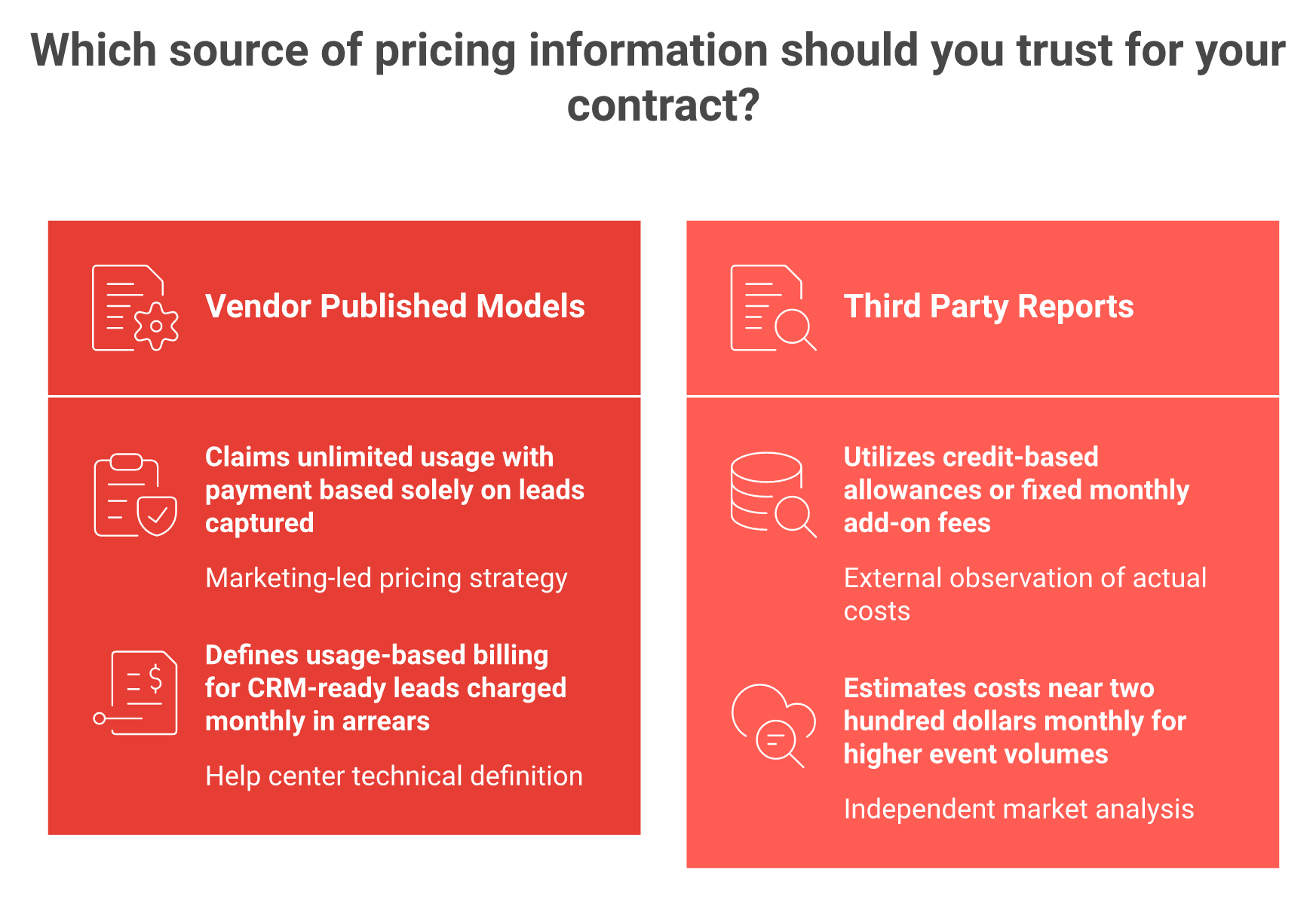
Blinq Business advertises unlimited usage with payment only for leads captured. The Help Center describes usage-based billing for CRM-ready leads charged monthly in arrears, while third-party comparisons report a Lead Capture add-on near $199 monthly and per-credit pricing after a free allowance. Confirm the rate in writing before a show.
This is the part no page-one article reconciles, so here is the method, the sources, and the dates.
📄 Three published models, three different answers
Blinq's own pricing page, 2026: Business includes "unlimited usage, pay only for leads captured."
Blinq Help Center, updated July 2026: capture is usage-based, billed for CRM-ready leads, additional to the standard subscription.
Third-party comparison, June 2026: 500 free credits, then $1 per credit, with a Lead Capture add-on at $199 monthly for higher event volume.
A practitioner review from July 2026 put it the way a buyer experiences it, saying the price jump hides in the event lead capture add-on.
⏰ Why the shape matters more than the rate
Metered capture inverts booth incentives. A busy Tuesday at PACK EXPO produces a bigger invoice than a dead Thursday. Budgets do not work that way. They are approved in January as a fixed number.
I could be reading this too strongly, but every metered-capture deployment I have watched produces the same quiet behaviour by Day 2. Reps start deciding which conversations are "worth" a scan. That is the failure mode a universal lead capture setup is meant to remove.
💸 Model the range before you sign
Blinq Capture Cost Range Per Show
Captured leads per show
At $1 per credit
At $9.99 per lead
200
~$200
~$1,998
600
~$600
~$5,994
The spread between those columns is larger than the entire annual subscription for a 25-card team. That is the whole argument for getting the rate in writing.
Vendor documentation and third-party reporting describe Blinq's capture billing three different ways, which is why the rate belongs in writing.
⭐ What buyers say about metered card tools
"The price, $140 a year? No way, would rather print thousands of business cards." — Fabian T., Popl - G2 Verified Review
"I think the biggest issue is charging a monthly fee to use and needing to 'invite' people to include them in my contacts in the app." — Verified User in Architecture & Planning, Popl - G2 Verified Review
"Every time we have a show with lead scanning, I have to purchase an API kit that costs between $700-$1200. It's become costly." — RebeccaGrace K., Captello - G2 Verified Review
That last one is the pattern to watch. Per-show variable charges are normal in this category, and they are almost never on the pricing page.
✅ Three questions for the sales call
What is the exact per-lead or per-credit rate on my contract, in writing?
Is there a season cap, and what happens at 600 leads in one show?
Does an enriched lead and a scanned lead bill the same?
Price the capture layer against speed, not against card count. If the tool cannot get a message moving while the prospect walks away from your booth, the rate is academic. That speed test is the whole point of a lead capture app built for trade shows.
B2Brain does not meter scans, so a 600-lead show never produces a larger invoice than a quiet one, and the show budget survives a good day on the floor.
Q4. What hidden fees and cost surprises sit outside Blinq's plan card? [toc=4. Hidden Fees and Add-Ons]
Six costs sit outside the headline price: the five-card minimum, usage-based lead credits billed in arrears, NFC accessories sold separately, iOS in-app purchase pricing that differs from web checkout, regional price variation, and quote-only Enterprise terms. Blinq.io is a separate AI testing company, not this product.
Most hidden fees are not deception. They are unit-of-value mismatches. Blinq's unit is the identity. An exhibitor's unit is the show.
💸 The six line items to put in your procurement doc
1. The five-card minimum. Business will not sell you three cards. The floor is five, roughly $300 a year annually billed.
2. Usage-based lead credits. Billed monthly in arrears, additional to the subscription, so the invoice lands after the show.
3. NFC accessories. Physical cards and tags are sold separately from the software, typically in the $40 to $60 range per unit.
⚠️ Where the same product carries different prices
4. App Store versus web checkout. Blinq's iOS listing carries its own in-app purchase tiers, including annual and monthly options that do not always match the web pricing page.
5. Regional variation. The India App Store listing prices Premium in rupees on its own schedule, so a global team can pay different amounts for identical cards.
6. Quote-only Enterprise. Volume pricing, custom contract terms, and invoice billing are all negotiated, not published. Nothing wrong with that, but you cannot budget from a page that says "custom."
❌ The naming collision that wastes an hour
Blinq.io is an unrelated AI test-automation company with plans running from about $20 to $499 monthly. If a pricing comparison you found quotes those figures, you are reading about the wrong company.
The same confusion shows up across digital-card roundups, which is why the HiHello versus Blinq breakdown is worth reading beside any pricing page.
⭐ What buyers report when value and price disconnect
"It's supposed to be a convenient way to transfer your business card but every time I've tried to use it, the recipient never actually gets the card. I'd like a refund." — Lupita E., Blinq - G2 Verified Review
"Too many people had issues reading the QR code; either their phone requested a download of the app or the code just didn't register at all. It worked correct maybe 1/5 times in practice." — Verified User in Construction, Blinq - G2 Verified Review
Blinq is the most-reviewed product in this segment with roughly 8,800 G2 reviews at 4.8 out of 5, which is real social proof. These are minority reports, and they are the ones that cost money at a booth.
⏰ The genuinely expensive fee is delay
Organise contacts within 48 hours or the brain loses the detail. Any cost structure that pushes data entry to the flight home is the one that actually bills you, in pipeline rather than dollars.
If you want the mechanics of that timing, the walkthrough of how event lead capture works covers before, during, and after the show on one layer, and Book a Demo is the fastest way to pressure-test it against your own show calendar.
B2Brain publishes Show Pass pricing per event and annual Pipeline pricing with no per-lead metering, so the show budget is fixed before the floor opens.
Q5. What does Blinq cost a 25-rep team across a 10-show year? [toc=5. Ten-Show Cost Model]
At 25 cards on annual Business billing, Blinq's subscription runs roughly $1,500 a year. Across ten shows, the capture layer, not the cards, becomes the dominant line. Model 200 to 600 captured leads per show, then divide by meetings actually booked to get the number a CFO will ask for.
🧮 The assumptions, stated openly
Every cost model is only as good as its inputs, so here are mine.
25 booth reps, each with one card, on annual Business billing at $4.99 per card per month.
10 shows a year, which is mid-range for the industrial exhibitors I work with.
200 captured leads per show at the low end, 600 at the high end.
Capture billed on usage, with published third-party figures ranging from $1 per credit to $9.99 per enriched lead.
💰 Subscription versus capture, side by side
Blinq Ten-Show Cost Model for 25 Reps
Line item
Low scenario
High scenario
25 cards, annual Business
~$1,497
~$1,497
Captured leads, 10 shows
2,000
6,000
Capture at $1 per credit
~$2,000
~$6,000
Capture at $9.99 per lead
~$19,980
~$59,940
Total range
~$3,497 to $21,477
~$7,497 to $61,437
The subscription is the smallest number on that table in every column. The capture rate you negotiate is the whole ballgame.
⏰ Cost per lead is the wrong denominator
Divide by meetings, not by contacts. A contact is a cost. A meeting is the start of pipeline.
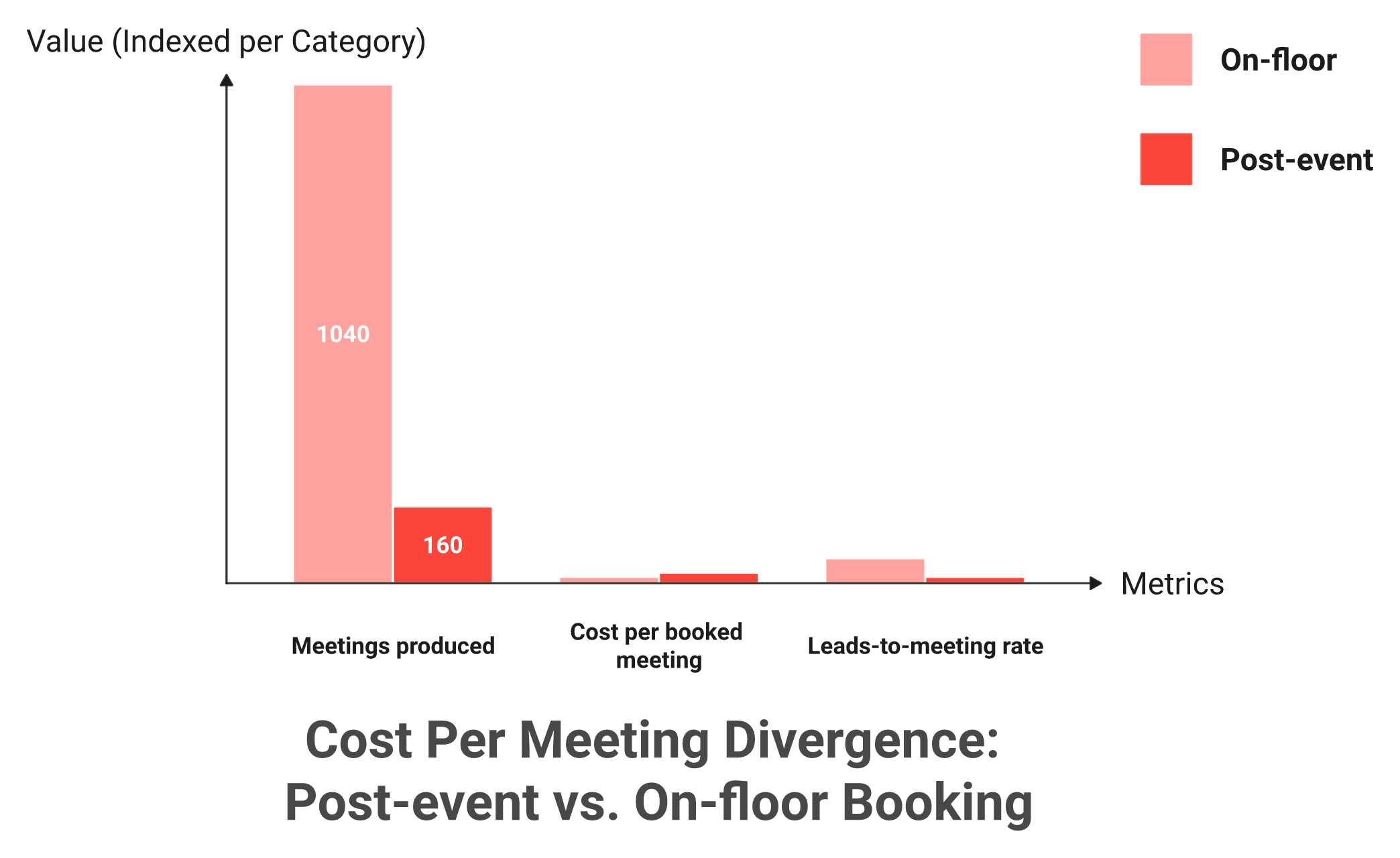
Take the low scenario at $1 per credit. That is roughly $3,497 for 2,000 captured leads, or about $1.75 per lead. Now apply an 8% post-event meeting rate, the industry average, and you get 160 meetings at roughly $22 each.
Apply 52% instead, and the same spend produces 1,040 meetings at roughly $3.40 each. Same tool cost. Wildly different answer. The mechanics behind that gap are laid out in measuring event ROI.
Identical spend, two follow-up rates. The leads-to-meeting denominator changes cost per booked meeting by roughly six times.
⭐ The 1-in-20 problem behind the math
Only about one company in twenty actually works the leads it captures. I ran a small test years ago, handing out 100 cards at a single show. Two people emailed inside a week, and maybe five or six over the next month.
Against a booth that costs $20K to $200K, software price is close to noise. What you are really buying is membership in the 5% that acts.
✅ How to build your own version of this table
Pull your card count from the admin panel, not from headcount.
Get the per-lead rate in writing, then multiply by your busiest show, not your average one.
Divide total cost by meetings booked, and bring that single number to the budget review.
B2Brain reports 52% leads-to-meeting on the floor against an 8% industry average post-event, and that denominator is what makes any cost-per-meeting model meaningful. The same math drives how teams generate new pipeline from events.
Q6. How does Blinq's cost shape compare to other event lead capture options? [toc=6. Blinq vs Alternatives Cost]
Blinq starts near $2,400 a year, Popl runs around $6,000 on usage-based terms, iCapture sits near $8,000 flat for unlimited users and events, and organizer-rented scanners cost roughly $380 to $500 per user per show. Rental looks cheapest until a five-rep booth attends eight shows.
📊 Four pricing shapes, one table
Cost shape matters more than the entry number, because shape decides behaviour on the floor.
Event Lead Capture Pricing Shapes Compared
Option
Entry cost
Billing shape
Pricing published?
Best fit
B2Brain
Show Pass from $200 per event
Per event or annual
Yes
Booth teams measured on meetings
Blinq
~$2,400/yr
Per card plus metered capture
Partly, capture is quoted
Card-first teams
Popl
~$6,000/yr
Usage-based, team quote-gated
Largely quote-gated
Rep-led capture programs
iCapture
~$8,000/yr flat
Unlimited users and events
Quote-gated
Enterprise reliability buyers
Captello
$500 to $1,000 per event
Per event plus API kits
Partly
Gamification-heavy booths
Rented badge scanner
$380 to $500 per user per show
Per device, per show
Yes, via organizer
One-off attendance
💸 When rental stops being the cheap option
Five reps at $450 a device is $2,250 for one show. Eight shows is $18,000, and you own nothing afterwards. The full rental math sits in the breakdown of the lead retrieval app for trade shows.
The scanner is also not really yours. It collects leads for the organizer, hands you a file, and the relationship ends when the hall closes.
⚠️ Per-event charges hide inside subscriptions too
This is the pattern buyers report most often in the mid-market.
"Every time we have a show with lead scanning, I have to purchase an API kit that costs between $700-$1200. It's become costly." — RebeccaGrace K., Captello - G2 Verified Review
"It does not always work with every conference, if the conference does not provide and API kit for integration." — Verified User in Consulting, Captello - G2 Verified Review
Two reviewers, two years apart, same structural cost. That is a shape problem, not a support problem.
❌ Metered pricing teaches reps to scan less
Here is the part vendors do not put in the deck. When capture is metered, someone eventually decides which conversations deserve a credit.
Under-scanning costs more than any subscription line. A missed scan at 4pm on Day 2 is a missed opportunity that never enters the CRM at all. That is the failure a conference badge scanner comparison rarely prices in.
"I didn't really use Popl because it didn't scan bar codes like I thought it would. Scanning badges should have given the name and contact info, but it didn't work when I tried it." — Drew D., Popl - G2 Verified Review
✅ The procurement question worth asking
Ask each vendor one thing. Does my invoice go up when my booth has a great day?
If the answer is yes, you are buying a metered tool and you need a cap. If the answer is no, you can budget the show in January and forget it.
B2Brain sits in the per-event lane with a Show Pass from $200, priced against the booth rather than the headcount, so a busy floor never changes the number. The full Show Pass and Pipeline plans are published on one page.
Q7. Is Blinq worth the price, and what do buyers say about it? [toc=7. Value Verdict and Reviews]
Blinq holds roughly 4.8 out of 5 across about 8,800 G2 reviews, the largest review base in the segment, ahead of Popl at 4.6 across 5,565. It earns its price for teams whose job is professional presence and contact exchange. G2's own alternatives page flags pricing concerns for both products.
⭐ What the buyer hoped to buy
The typical buyer is a marketing manager who wants one branded card system across 25 people. Blinq does that job well, with SOC 2 Type II, GDPR compliance, SSO, and native sync across 20-plus CRMs.
At $4.99 per card annually, that is a fair price for brand control and a clean contact record.
⚠️ Three complaints that repeat
The negative reviews cluster into a pattern worth knowing before you sign.
"I find the functionality of Blinq Digital Business Cards not very impressive, as it doesn't always work reliably when scanning the barcode, especially in places with poor internet connectivity. This has made it necessary for me to consider purchasing printed business cards as a backup." — Kasha A., Blinq - G2 Verified Review
"Using the backend panel as an administrator is buggy and unreliable. The app tries to launch App Clips for the recipient of the business card. This means that sometimes the recipient can't open it." — Verified User in Hospitality, Blinq - G2 Verified Review
"The whole process has become outdated with Apple's AirDrop connect feature that shares contacts instantly." — Verified User in Food & Beverages, Blinq - G2 Verified Review
Connectivity, admin reliability, and a shrinking moat against native phone features. Two of those three matter enormously in a concrete-floored expo hall.
❌ What review volume does not measure
Read the aggregate score correctly. It measures adoption breadth across two and a half million users, not fit for a 15-show industrial season.
I could be reading this too strongly, but a 4.8 built mostly on individual card-sharing tells you very little about how the tool performs when six reps are scanning simultaneously on Day 2. The same caveat applies across the best event lead capture software for 2026.
✅ Two buyer profiles, one yes and one no
Yes: A 30-person consulting firm that wants branded cards, clean contact capture, and Salesforce sync. Blinq is well priced for that.
No: A logistics vendor running ten shows a year whose Field Marketing head must report pipeline per show. The card subscription solves a different problem, which is why the split is worth reading in the HiHello versus Blinq comparison.
Honest disclosure on the other side of the table. B2Brain carries 17 G2 reviews against Blinq's 8,800, which is a real gap in social proof, and the counter is a different measured outcome: meetings booked before the prospect leaves the aisle.
Q8. What does Blinq's price not buy for a trade-show exhibitor? [toc=8. Attribution and Meeting Gaps]
No Blinq tier books a meeting on the booth floor or reports pipeline per show. The plans deliver cards, capture, enrichment, CRM sync, and card analytics. Exhibitors who must show a CFO how many pipeline dollars came from a specific show need an attribution layer the card subscription does not include.
🧠 The common view, and why it breaks
Most buyers assume capture plus enrichment equals event tooling. Scan the badge, enrich the record, push it to the CRM, done.
That view treats a contact as the deliverable. It is not. Contact information is not where anything happens. Pipeline is where a revenue team's world moves.
❌ Card analytics are not pipeline attribution
Blinq's analytics rows cover attribution, ROI, campaigns, card analytics, and custom reporting. Those measure card and campaign activity.
They do not answer the question a CFO asks in the Monday review, which is how many pipeline dollars this specific show sourced. Those are different data models, not different report skins. The distinction is unpacked in event intelligence.
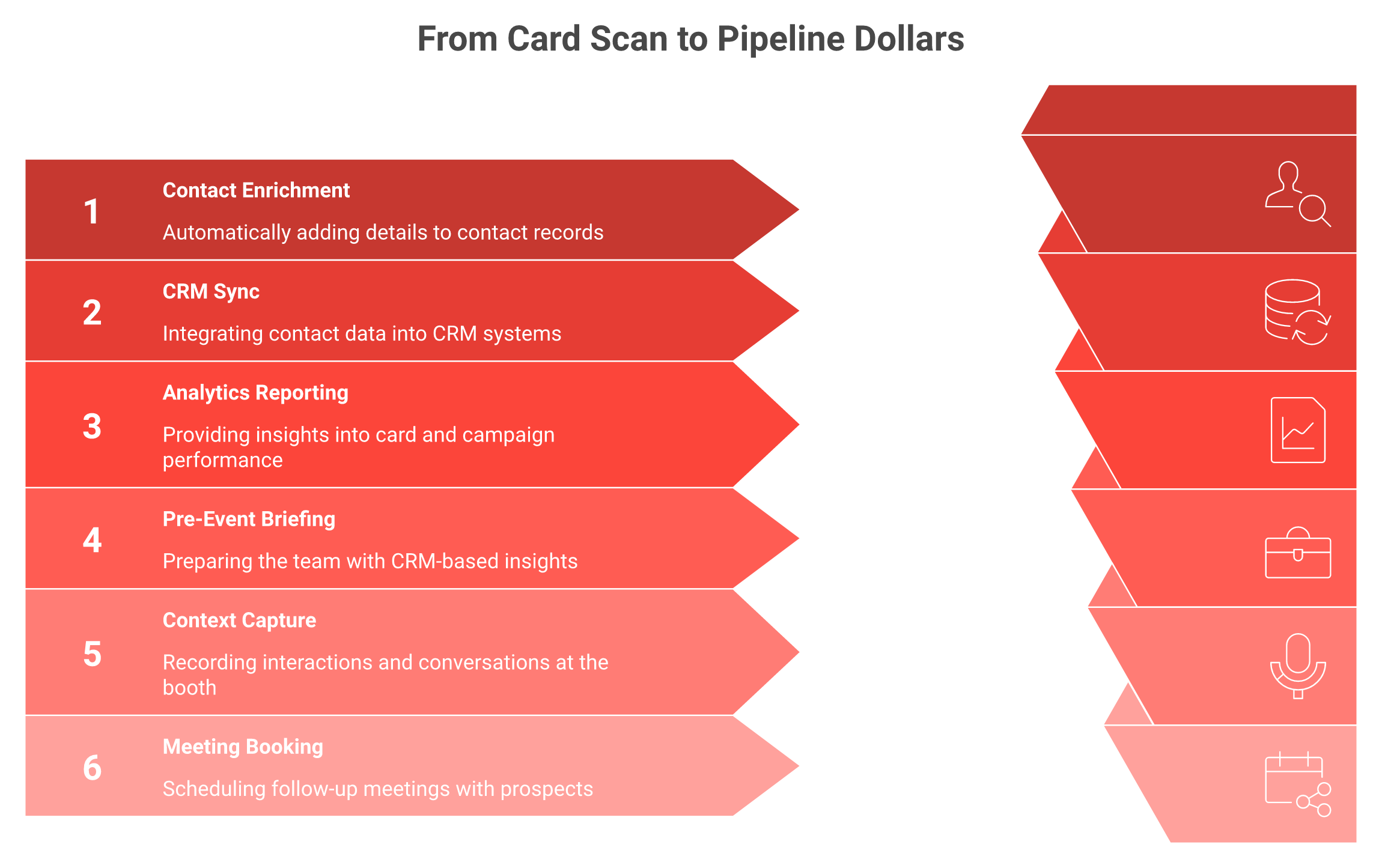
Capture, enrich, and sync is one job. Briefing, on-floor booking, and per-show pipeline attribution is a different one.
⏰ The shoebox has gone digital
There is an old story every event operator recognises. Jimmy brings the lead box back from the show, calls three people on Monday, gets invited to lunch, and shoves the box under his desk. Six months later, somebody finds it.
A CSV export is the same box with better formatting. The workflow still ends at a list, and the list still decays. Conversion probability runs near 85% within two hours of contact and falls to roughly 9% after a week. Teams fixing this usually start with how to collect leads at a trade show.
⚠️ The objection I get asked directly
Founders ask me why booking a meeting is not just a feature anyone can ship. Fair question, and BoothIQ, BoothMaven, and Zuddl all ship some version of it now.
My read is that the feature is the easy part. The hard part is the shared layer underneath it: a briefing built from your own CRM before the show, context captured during it, and one report after it that reconciles all three. That is the three-motion workflow in practice.
✅ Budget for the outcome, then price the tool
Flip the order of the purchase decision.
Decide the pipeline number the show must produce.
Work back to meetings required, then to qualified conversations required.
Only then ask what a tool costs per meeting delivered.
Do this and pricing pages stop being confusing. They become one input in a chain you already control.
Where the card subscription honestly is not the right fit, B2Brain covers the gap with pre-event briefings grounded in your own CRM pipeline, sub-30-second scan-to-booked-meeting with AE routing, and a morning-after offline-to-pipeline report. If you want it pressure-tested against your own show calendar, Book a Demo.
Q9. Which Blinq plan should you choose, and what should you negotiate? [toc=9. Plan Choice and Negotiation]
Solo networkers stay on Free or Premium. Teams needing CRM sync and admin control need Business at five cards minimum. Organisations requiring SSO, SCIM, and invoice billing need Enterprise. Negotiate the per-lead capture rate, a per-season volume cap, card-count true-down at renewal, and annual-term exit conditions.
The plan choice is usually easy. The contract is where the money actually moves.
🧭 Four scenarios, four answers
You network solo, no team. Free covers two cards. Premium at $7.33 a month annually adds the scanner, AI Notetaker, enrichment, and contact export. Stop there. If all you need is capture without the subscription, compare it against a free lead capture app built for booth work.
You run a 5 to 25 person team with a CRM. Business is the only tier with native CRM sync, admin controls, custom qualifiers, and event attribution. Budget the five-card floor even if you have four people. The sync mechanics are worth checking against lead capture into Salesforce before you commit.
🏢 The two harder cases
You are enterprise with a security review. Enforced SSO, SCIM provisioning, custom contract terms, and invoice billing all sit in Enterprise, which starts at 100 cards. Get IT into the first call, not the third.
You exhibit at 8 to 15 shows a year. This is the case where plan choice is the wrong question. Your cost driver is captured leads, not cards, and your success metric is meetings booked. That is the booth-day workflow problem, not a card problem.
⏰ Test it on a real floor, not a quiet week
Blinq offers a 7-day Premium trial and a 30-day Business trial. Spending the 30 days in the office tells you nothing useful.
Run it at an actual show. Expo-hall Wi-Fi, six reps scanning at once, and a 4pm rush on Day 2 are the only conditions that matter. Any evaluation that defers the real test until after the event is wasted. The same stress test applies to any lead capture app for trade shows.
💰 Five things to negotiate, phrased exactly
The capture rate. "Put the per-lead or per-credit rate in the order form, not the quote email."
A season cap. "Cap total capture charges at X dollars across our 2027 show calendar."
Card true-down. "Let us reduce card count at renewal without penalty."
Exit terms. "What happens if we cancel in month seven of a twelve-month term?"
Enrichment definition. "Does a scanned lead and an enriched lead bill at the same rate?"
Ask for the cap in writing. Vendors rarely offer one unprompted, and most will grant it against an annual commitment.
✅ What to bring to the internal approval
Take three numbers to your CFO, not a pricing page. Total annual cost at your busiest show volume. Meetings booked per show last year. Cost per booked meeting.
That third number decides the purchase. Everything above it is detail. The event ROI calculator produces all three in one pass, and the published Show Pass and Pipeline plans give you a fixed figure to model against.
B2Brain offers a first event free for two people, which lets a team benchmark its own leads-to-meeting rate on a real floor before signing anything.
🔮 What I am still sitting with
My read right now is that per-card pricing has maybe eighteen months left as the default in this category. Once buyers start dividing spend by meetings booked instead of by seats, the metered-capture model becomes hard to defend at a budget review.
I could be early on that. If you have run both models across a full show season, I would genuinely like to hear which one survived your Q4 renewal conversation. Walk me through your show calendar and Book a Demo, or read how the offline to pipeline chain gets measured before you renew anything.
FAQ's
How much does Blinq cost in 2026?
Blinq publishes four tiers, and the annual toggle changes the numbers meaningfully.
Free: $0 for two digital cards, with unlimited sharing and unlimited contact creation.
Premium: $9.99 per month, or $7.33 per month billed annually, for up to five cards.
Business: $6.99 per card per month, or $4.99 per card per month billed annually, with a five-card minimum.
Enterprise: quote-only, starting at 100 cards, with volume pricing and invoice billing.
Annual billing cuts roughly 27% off Premium and 29% off Business. Trials run 7 days on Premium and 30 days on Business.
The number the plan table does not show is event lead capture, which is billed separately on usage. For a booth team, that line usually matters more than the subscription.
B2Brain prices differently, per show rather than per card, with a Show Pass starting at $200 per event. We built it that way because exhibit budgets get approved per show, not per headcount. You can compare the two shapes against the published Show Pass and Pipeline plans before you model a full season.
Does Blinq charge per user or per card?
Blinq Business bills per card, per month, not per seat. That distinction changes the real entry cost more than any discount does.
Because five cards is the floor, the smallest Business invoice is roughly $25 a month, or about $300 a year on annual billing. Here is how it scales:
Automated provisioning and bulk creation through the API make this easy to lose track of. Every contractor, booth-only helper, and regional variant card is another billable line. Audit the card list before renewal, not after.
The deeper question is whether your unit of value is a person or a show. A 12-rep booth attending one event is one event, not twelve annual identities. B2Brain charges per show and per booth team for exactly that reason, which suits the booth-day workflow better than a per-card annual contract that sits idle between shows.
How much does Blinq event lead capture cost on top of the subscription?
This is the least clear part of Blinq's pricing, and it is worth getting in writing before a show.
Three published sources describe it differently:
Blinq's own pricing page states that Business includes unlimited usage where you pay only for leads captured.
Blinq's Help Center describes capture as usage-based, billed for CRM-ready leads, charged monthly in arrears on top of the subscription.
Third-party comparisons from mid-2026 report 500 free credits, then $1 per credit, plus a Lead Capture add-on near $199 per month for higher event volume.
The spread matters. A 200-lead show costs roughly $200 at $1 per credit and roughly $2,000 at $9.99 per enriched lead. Across ten shows, that difference dwarfs the entire card subscription.
Metered capture also changes rep behaviour. By Day 2, someone starts deciding which conversations deserve a credit, and under-scanning costs more than any subscription line. B2Brain does not meter scans, so a busy floor never produces a larger invoice. If you want the arithmetic for your own show calendar, run it through the event ROI calculator before you sign.
What hidden fees should exhibitors expect with Blinq?
Most of these are not deceptive. They are unit-of-value mismatches between a card platform and an event program.
The five-card minimum. Business will not sell you three cards, so a four-person team still pays for five.
Usage-based lead credits. Billed monthly in arrears, so the invoice arrives after the show is already over.
NFC accessories. Physical cards and tags are sold separately, typically in the $40 to $60 range per unit.
App Store versus web checkout. The iOS listing carries its own in-app purchase tiers that do not always match web pricing.
Regional variation. Some regional App Store listings price Premium on a separate schedule.
Quote-only Enterprise. Volume pricing and contract terms are negotiated, so you cannot budget from the page.
One more practical note. Blinq.io is an unrelated AI test-automation company, so any comparison quoting $20 to $499 monthly is describing a different product entirely.
The genuinely expensive cost is delay. Any structure that pushes data entry to the flight home bills you in lost pipeline, which is why the three-motion workflow is designed around same-floor capture.
Is Blinq worth the price for a trade-show exhibitor?
It depends entirely on what you are being measured on.
Blinq holds roughly 4.8 out of 5 across about 8,800 G2 reviews, the largest review base in the segment, ahead of Popl at 4.6 across 5,565. It is well priced for teams whose job is professional presence, branded contact exchange, and clean CRM records, backed by SOC 2 Type II, GDPR compliance, SSO, and native sync across 20-plus CRMs.
It is a weaker fit where the deliverable is booked meetings and per-show pipeline attribution. No tier books a meeting on the booth floor, and card analytics are not the same data model as pipeline sourced by show.
Good fit: a 30-person consulting firm wanting branded cards and Salesforce sync.
Poor fit: a logistics vendor running ten shows whose Field Marketing head must report pipeline per show.
Honest disclosure on our side: B2Brain carries 17 G2 reviews against Blinq's 8,800, a real gap in social proof. Our counter is a different measured outcome, 52% leads-to-meeting on the floor against an 8% industry average post-event. That is the number behind offline to pipeline.
Enjoyed the read? Join our team for a quick 30-minute chat — no pitch, just a real conversation on how we’re rethinking Event Intelligence in B2b.

.png)

.png)
.png)