HiHello vs Blinq: Features, Pricing, Team Plans, and Which Fits Solo Reps vs Sales Teams
Written by
Sridhar Ranganathan
Last Updated :
June 25, 2026
Skim in:
14
mins
TL;DR
- Blinq wins on price and clean team scaling at $4.99 per card monthly on Business; HiHello wins on customization, video cards, and template depth. - Both share contact details by QR, NFC, link, and Apple Wallet, and both add card scanning, but they are built for networking presence, not booth-lead qualification. - Blinq Business adds SSO, Active Directory sync, and native Salesforce, HubSpot, and Zapier connectors; HiHello layers integrations onto higher tiers. - Watch the ceilings: free tiers cap cards at two to five, and export sits behind paid plans, which pushes sales users up fast. - Solo reps and networkers should pick on price and design; booth teams measured on pipeline need on-floor qualification, in-the-moment meeting booking, and per-show attribution. - Neither card app tracks Leads-to-Meeting, the metric that compares meetings booked on the floor, around 52 percent, against an 8 percent post-event industry average.
Q1: HiHello vs Blinq: Which Digital Business Card Wins for You in 2026? [toc=1. Verdict Up Front]
Blinq wins on price and clean team scaling, at $4.99 per card each month on its Business plan, with admin control and CRM sync. HiHello wins on customization, multimedia cards, and template depth. Both excel at sharing a card. Neither tells you whether that contact became a booked meeting. For solo reps and general networking, choose on price and design. For sales teams measured on pipeline, the card is step one, not the finish line.
🏁 The short answer most buyers actually need
Picture a Field Marketer at 4pm on Day 2 of a packed show. A senior buyer stops by, taps a phone, and a card lands in their contacts. That moment feels like a win.
The hard question comes Monday. Did that tap become a meeting? Both tools handle the tap beautifully. The verdict splits on two axes: cost and simplicity, versus design and flexibility.
⚖️ Blinq vs HiHello on the two axes that matter
Blinq is the cheaper, cleaner choice for teams that want fast setup and tidy administration. HiHello is the richer choice when card design, video, and template variety matter to your brand.
Blinq vs HiHello: The Two Decision Axes
Decision axis
Blinq
HiHello
Price and team scaling
Stronger, $4.99/card/month on Business
Higher feature bundle per tier
Customization and multimedia
Simpler, faster
Stronger, video and template depth
Best fit
Teams wanting low-friction rollout
Brands wanting design control
I run B2Brain, an event lead capture app, so I look at these tools from a pipeline seat. On their own job, sharing a professional identity, both are good products.
🔌 Where the comparison stops short
Here is the open loop. Sharing a card and capturing pipeline are two different jobs.
A digital card answers "who am I." It does not answer "did this conversation move into the pipeline." That second question is the one your CFO asks at the quarterly review, and it is where this whole comparison gets interesting. It is also the core of how we think about moving offline to pipeline.
Q2: What Are HiHello and Blinq, and What Job Do They Actually Do? [toc=2. What They Are]
HiHello and Blinq are digital business card apps. You share contact details by QR code, NFC tap, link, or Apple Wallet, and the recipient saves you instantly. Both add card scanning to capture other people's details. They are built for individual professional networking and presence, replacing the paper card, not for qualifying booth leads, booking meetings on the floor, or attributing trade-show pipeline.
HiHello and Blinq solve the exchange; the harder pipeline work begins after the tap
📇 Concept: what a digital business card really is
A digital business card (a shareable online profile that holds your contact details) replaces the paper rectangle in your wallet. Instead of handing over cardstock, you share a link.
Both tools support four ways to share. Each one is fast, and each one drops you straight into the other person's phone.
QR code: the recipient scans and saves you.
NFC tap: a phone-to-phone tap, no app needed for the receiver.
Link: sent by text, email, or chat.
Apple Wallet: stores the card alongside boarding passes and tickets.
🎯 Application: the job they do, and the job they skip
Here is the honest scope. These apps are genuinely good at presence and exchange. They make you look polished and make saving your details effortless.
What they do not do is the revenue work. They do not score a lead as hot or cold, they do not book a meeting while the buyer is standing there, and they do not tie a conversation to a pipeline number. That gap matters more than most buyers realize at signup.
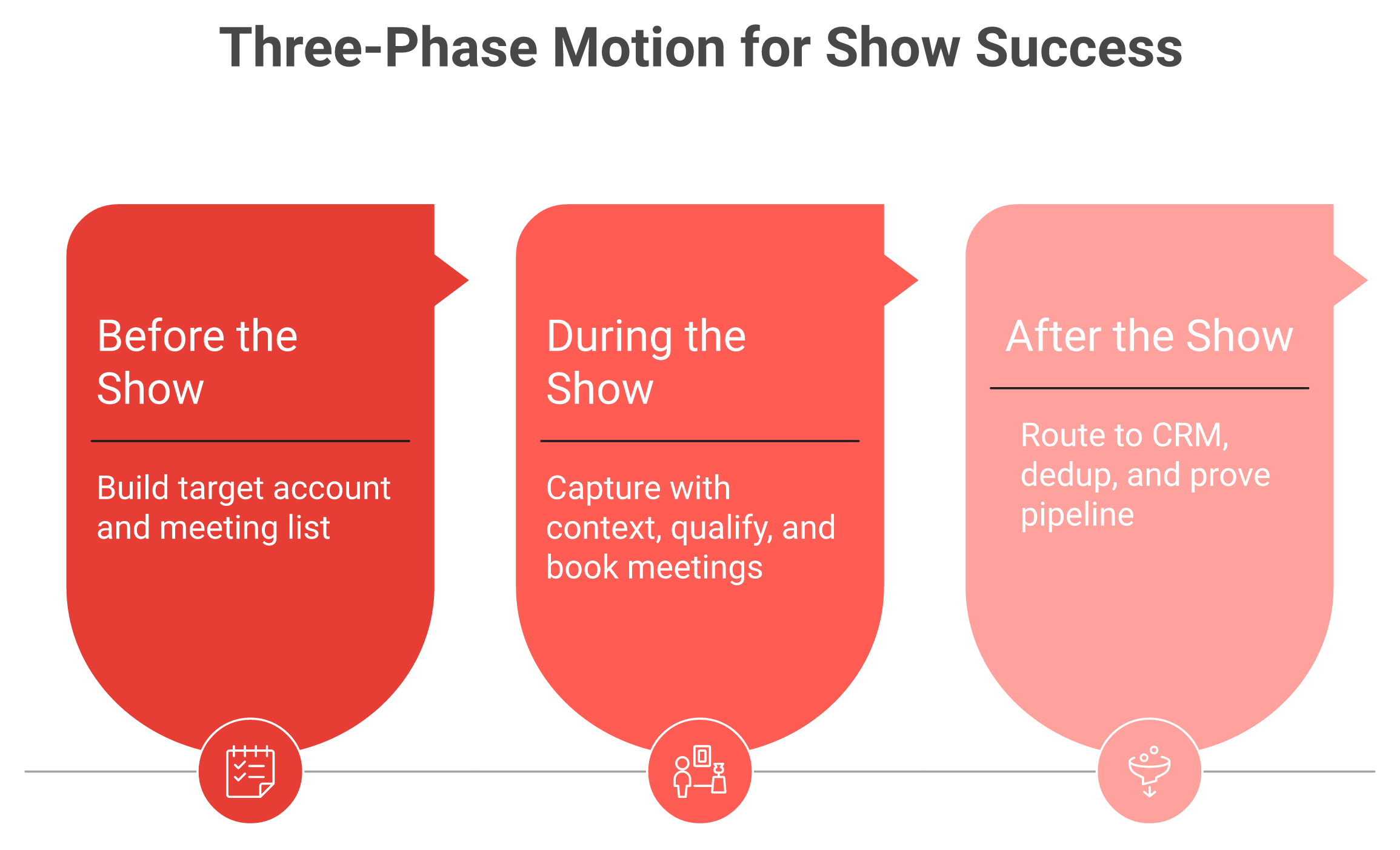
The offline-to-pipeline motion runs across all three phases of a trade show, not just the booth tap.
A buyer who ran an experiment makes the point well. He gave away exactly 100 paper cards at a print expo in Chicago. One week later, two people had emailed him back. Digital cards exist because paper leaks like that. But a faster exchange does not fix the follow-up, which is a separate job entirely, and the one B2Brain was built for booth teams to own.
Q3: How Do HiHello and Blinq Compare Feature by Feature? [toc=3. Feature Comparison]
Both support QR, NFC, link, and Apple Wallet sharing plus card scanning. HiHello leads on customization, with multiple designs, video, and template depth. Blinq leads on simplicity, fast setup, and clean administration. Both list CRM and SSO support on higher tiers; how deep and how reliable that sync runs is the team-plan question. Reviewers consistently call HiHello the richer tool and Blinq the simpler, faster one.
🧩 The feature matrix, read like a procurement sheet
I built this table the way a RevOps buyer would, criterion by criterion, no marketing gloss. Use it to shortlist, not to crown a winner.
HiHello vs Blinq: Feature-by-Feature Comparison
Criterion
Blinq
HiHello
Sharing methods
QR, NFC, link, Apple Wallet
QR, NFC, link, Apple Wallet
Card customization
Clean, simpler design
Richer, more templates
Multimedia (video)
Limited
Video supported
Card scanning / capture
Yes, scan to contact
Yes, scan to contact
Analytics
On paid tiers
On paid tiers
Brand / admin controls
Strong team admin
Strong on Business tier
CRM support (flag)
Yes, native connectors
Yes, higher tiers
SSO support (flag)
Yes, Business/Enterprise
Yes, higher tiers
The CRM and SSO rows are a yes/no here on purpose. How well that sync actually holds up is a team-plan question I take apart in the pricing and team sections.
🗣️ What the pattern says, and what users report
The pattern is consistent. HiHello is the more flexible, design-forward tool. Blinq is the faster, more administratively tidy one. Reviews back this up, including the rough edges.
"Blinq looks great and when it works it's a good user experience and good branding... [but] using the backend panel as an administrator is buggy and unreliable." Verified User in Hospitality Blinq G2 Verified Review
"Too many people had issues reading the QR code, either their phone requested a download of the app or the code just didn't register at all. It worked correctly maybe 15 times in practice." Verified User in Construction Blinq G2 Verified Review
My read, and I could be wrong on the exact weighting, is that reliability under real conditions matters more than feature count. B2Brain lives in that same hostile expo-hall reality, which is why offline capture is a core design choice in how the three-motion workflow works, not a feature line.
Q4: HiHello vs Blinq Pricing: What Do the Free, Pro, Business, and Enterprise Tiers Cost? [toc=4. Pricing & Tiers]
Blinq offers a free plan (up to 2 cards), Premium at roughly $7.33 per month (up to 5 cards, branded QR, CSV export), Business at $4.99 per card each month (CRM sync, admin, Active Directory), and Enterprise (SSO, API). HiHello offers a free tier, Professional from about $6 per month, and Business from around $5 per user each month for teams of five or more. Blinq is generally cheaper per seat at team scale; HiHello bundles more customization into its paid tiers.
💰 The tier-by-tier breakdown
Lead with the numbers, because pricing is where this decision gets made. Here is each tier, side by side.
HiHello vs Blinq: Pricing by Tier
Tier
Blinq
HiHello
Free
Up to 2 cards, QR sharing, Apple Wallet
Free tier available
Premium / Professional
~$7.33/mo, up to 5 cards, branded QR, CSV export
~$6/mo Professional
Business
$4.99/card/mo, CRM sync, admin, AD
~$5/user/mo, teams of 5+
Enterprise
SSO, API, custom onboarding
Custom, volume pricing
🧮 The per-seat math a team should actually run
Take a 10-person booth team. On Blinq Business at $4.99 per card monthly, that is roughly $599 per year for the group. HiHello at around $5 per user monthly lands close, near $600 per year, but bundles more customization.
Acting on the floor books far more meetings than the 8 percent post-event industry average.
Now think the way a Field Marketer thinks. The sticker price is per seat times the team times renewal, not the headline number. At a season of 8 to 15 shows, both tools are a rounding error against booth spend. It is worth comparing that against what B2Brain costs per event when pipeline, not presence, is the goal.
⚠️ The ceilings nobody mentions at signup
Watch the caps. Blinq's lower tiers limit you to 2 or 5 cards, and contact export sits behind Premium. These limits push sales users to paid tiers quickly.
One buyer's framing stuck with me. He spent $35,000 just decorating a booth, then at a later show spent $950 and got results he called just as effective. Spend follows outcome, not line item. The same logic applies here: a few hundred dollars a year is trivial if the tool turns conversations into pipeline, which is exactly why teams Book a Demo to see the offline to pipeline workflow before a season starts.
Q5: Which Tool Is Better for Teams: Admin, Brand Control, and CRM Sync? [toc=5. Team Plans & CRM]
For teams, both offer admin dashboards, brand templates, and centralized management. Blinq Business adds SSO, Active Directory sync, field locking, and native CRM connectors for Salesforce, HubSpot, and Zapier; Enterprise enforces SSO and adds API access. HiHello covers brand control and integrations on higher tiers. The deciding RevOps question is not "can it sync." It is "does the contact arrive clean, deduped, and qualified enough to act on."
🛠️ Where the team tiers line up, and where Blinq pulls ahead
On core team controls, the two are close. Both give you an admin dashboard, brand templates, and centralized card management.
Blinq edges ahead on enterprise plumbing. Its Business tier adds SSO (single sign-on, one login across tools), Active Directory sync, field locking, and native CRM connectors. HiHello matches the basics and layers integrations onto its higher tiers.
⚠️ A sync that fires is not a record a rep will work
Here is the pain RevOps feels three weeks later. A sync that pushes a name and email into the CRM is not the same as a record a rep will actually open.
Raw card data arrives thin. No qualification, no context, and often duplicates when two reps scan the same buyer. Users report exactly this gap.
"Easy to share, hard to find contact info later... all the follow ups are just in your sea of contacts you have to try and remember." Madison Z. Blinq G2 Verified Review
✅ What "good" actually looks like for a team
Good means the qualification happens at the moment of capture, not in a cleanup pass on Monday. A field marketer I trust scores every conversation hot, warm, or cold on the spot, and jots one distinguishing detail so the lead is never a blur later.
That discipline is the real bar. This is where B2Brain sits apart from a card app: we attach qualification, the spoken context of the conversation, and dedup at the moment of capture, so the CRM record lands clean and ready, not as a raw list to triage later. You can see how event lead capture works across the booth-day workflow.
Match your way of working to the right pick: design and price for solo reps, pipeline depth for booth teams.
Q6: What Do Real Users Say About HiHello and Blinq? [toc=6. User Reviews]
Reviewers praise Blinq for speed, clean setup, and value, and HiHello for customization, video cards, and template variety. The recurring limitation across both is that they are loved as presence and exchange tools but rarely credited with closing the loop to pipeline. Independent reviewers note that free-tier ceilings push sales users to paid tiers fast, and that neither tool enforces follow-up. That discipline stays on the rep.
⭐ What users genuinely like
The praise is real, and it clusters around ease. Blinq users like how fast it is to set up and hand over a card.
HiHello users like the design range and the polish. Both tools clear the basic bar of replacing paper without friction, which is no small thing at a busy booth.
❌ The complaints that repeat
The complaints cluster too, and they matter more than the praise. Reliability under real conditions comes up again and again, alongside app-download friction for the recipient.
"Its supposed to be a convenient way to transfer your business card but every time I've tried to use it, the recipient never actually gets the card." Lupita E. Blinq G2 Verified Review
"I find it problematic that Blinq requires the person receiving my information to download the app for effective use. This additional step can make the process feel cumbersome." Sarah H. Blinq G2 Verified Review
"It doesn't always work reliably when scanning the barcode, especially in places with poor internet connectivity. This has made it necessary for me to consider purchasing printed business cards as a backup." Kasha A. Blinq G2 Verified Review
🧭 The honest takeaway for a sales user
Here is the resolution. These are good cards, and the reviews confirm it. The gap is what happens after.
Neither tool enforces follow-up. A field marketer with 10-plus years running booths at companies like Autodesk put it plainly to me: the leads pile up like a shoebox under a desk, and six months later someone finds them. I do not say this to knock either app. I say it because at B2Brain, that exact gap is the problem we chose to work on, and it is the one a card app was never meant to solve. It is the heart of moving offline to pipeline.
Q7: Solo Rep or Sales Team? How to Pick Based on How You Actually Work [toc=7. Solo vs Sales Teams]
If you are a solo professional or networker, pick on price and design: Blinq for cheap simplicity, HiHello for customization and video. A small team needing brand control and basic CRM sync should treat Blinq Business as the cleaner default. But a sales team staffing booths at trade shows, measured on meetings and pipeline rather than cards shared, finds that a card app alone leaves the hardest part of the job undone.
👤 If you are a solo rep or networker
This one is simple. For one person handing out a card at meetups and conferences, either tool is fine.
Choose Blinq if you want cheap and frictionless. Choose HiHello if your card design and a bit of video matter to how you present. Both do the solo job well.
👥 If you run a small team
For a handful of people who need consistent branding and basic CRM sync, Blinq Business is the tidier default. Admin control and native connectors come standard on that tier.
Pick HiHello instead if customization is the priority, and your team values template range over the lowest seat price. Either way, you are buying presence, not pipeline.
⏰ If you are a sales team staffing a booth
Here is where the decision changes shape. A booth rep is measured on booked meetings, not cards shared.
A card app captures the contact in five seconds, then stops. It does not score the lead, and it does not enforce the follow-up. The data backs the urgency.
One in 20 businesses acts on a scanned list three months later.
The winner reaches out inside 15 minutes, while the conversation is still warm.
That speed-to-meeting gap is exactly the job a card app cannot do. For booth teams at industrial shows running Salesforce or HubSpot, this is where an event lead capture app like B2Brain fits: capture the conversation with context, book the discovery meeting on the right AE's calendar before the prospect walks away, and route it all into the CRM. See what gets captured on the floor and what B2Brain costs per event.
Q8: Beyond the Card: What Happens to a Contact After the Tap? [toc=8. After the Scan]
A digital business card solves the exchange. It does not qualify the lead, book the meeting while the buyer is still at the booth, or tell your CFO which show generated pipeline. For booth teams, the metric that matters is not cards shared. It is Leads-to-Meeting (LTM), the share of conversations that became booked meetings: around 52% booked on the floor versus an 8% industry average chased after the show. That is the gap between a contact list and a defensible pipeline number.
🛑 The problem both tools share
Blinq and HiHello stop at the exchange. The card lands in the contacts, and the workflow ends there.
The contact still goes cold. Nothing about a saved card moves a deal forward, because contact information is not where anything happens. Pipeline is where your buyer's world moves.
💸 Why the contact goes cold
Think about the math on attention. Most post-show follow-up arrives days late, in an inbox already crowded with 40 identical "great to meet you" emails.
Reply rates on those sequences sit under 5%. As one field marketer told me, "I'm still waiting on emails from 2015." Speed is the whole game, and a card app does not give you any.
📊 The three jobs a card app does not do
Reframe the decision around what actually drives trade-show return. Three jobs sit beyond the tap.
On-floor qualification: score the lead hot, warm, or cold during the conversation, not weeks later.
In-the-moment booking: put the meeting on the right AE's calendar before the buyer leaves the booth.
Per-show attribution: tie pipeline to a specific show so the CFO sees a number, not a story.
Together those add up to the LTM lens. No card app tracks LTM, because it was never their job.
🎯 Where B2Brain fits, and where it does not
This is the gap we built B2Brain for. It is the offline-to-pipeline layer that books the meeting at the booth and proves the pipeline across before, during, and after the show, on one shared intelligence layer: CRM-grounded pre-event briefings, voice-first capture in about 4.2 seconds, on-spot booking, and a morning-after report showing pipeline and LTM by show.
Let me be honest about the boundary. B2Brain is not a digital business card you hand out at every coffee meeting, and it is not built for solo networkers or consumer sellers. If you need a daily card, Blinq or HiHello is your tool. If you need to walk out of a show with booked meetings and a pipeline number you can defend, that is a different job, and a different category. When you are ready to see it on your own pipeline, Book a Demo.
FAQ's
Is HiHello or Blinq cheaper for a sales team?
For a team, Blinq is generally the cheaper, cleaner choice, and HiHello bundles more customization into its paid tiers.
Blinq: free for up to two cards, Premium around $7.33 per month, and Business at $4.99 per card each month with CRM sync, admin, and Active Directory.
HiHello: a free tier, Professional from about $6 per month, and Business from around $5 per user each month for teams of five or more.
For a 10-person booth team, both land near $600 per year, so the gap is small. We tell operators to think per seat times the team times renewal, not the sticker price.
The real cost question is what the tool returns, not what it costs. A few hundred dollars a year is a rounding error against booth spend, so the tool that turns conversations into pipeline wins on value. That is the lens behind what B2Brain costs per event, where we price against pipeline, not seats.
What is the main difference between HiHello and Blinq?
The difference splits cleanly on two axes, customization versus simplicity.
HiHello leads on design: multiple card styles, video, and template depth for teams that care about brand presentation.
Blinq leads on speed and tidy administration: fast setup, clean admin controls, and native CRM connectors on its Business tier.
Both share the same core. You exchange contact details by QR code, NFC tap, link, or Apple Wallet, and both add card scanning to capture other people's details.
Here is the part neither tool solves. Both stop at the exchange. They do not qualify a lead, book a meeting while the buyer is at the booth, or tie a conversation to a pipeline number. That after-the-tap work is a different job. For booth teams, we built the offline-to-pipeline layer that covers it, and you can see how event lead capture works across the whole show. Sharing a card and capturing pipeline are two separate jobs, and the right pick depends on which one you actually need.
Do HiHello and Blinq sync with Salesforce and HubSpot?
Yes, both offer CRM sync on higher tiers, but the deeper question for RevOps is not whether it syncs.
Blinq Business adds SSO, Active Directory sync, field locking, and native connectors for Salesforce, HubSpot, and Zapier; Enterprise adds API access.
HiHello covers brand control and integrations on its higher tiers.
The honest catch is that a sync firing is not the same as a record a rep will work. Raw card data arrives thin: no qualification, no conversation context, and often duplicates when two reps scan the same buyer at the same show.
What good looks like is qualification, context, and dedup attached at the moment of capture, so the CRM record lands clean rather than as a raw list to triage on Monday. That is the bar we hold ourselves to, and it is the heart of how we move offline to pipeline. A clean, deduped, qualified record is worth far more to a sales team than a fast push of a bare name and email.
Which is better for solo reps versus sales teams at trade shows?
It depends on how you actually work, and the line is clear.
Solo rep or networker: pick on price and design. Blinq for cheap simplicity, HiHello for customization and video.
Small team: Blinq Business is the tidier default for brand control and basic CRM sync; choose HiHello if customization outweighs the lowest seat price.
Booth sales team: a card app alone leaves the hardest part undone.
A booth rep is measured on booked meetings, not cards shared. A card app captures the contact in seconds, then stops. It does not score the lead or enforce follow-up, and speed is the whole game: one in 20 businesses acts on a scanned list three months later, while the winner reaches out inside 15 minutes.
For booth teams at industrial shows running Salesforce or HubSpot, that gap is exactly the job we do for booth teams: capture with context, book the meeting on the right AE's calendar before the prospect leaves, and route it into the CRM.
What happens to a contact after I scan it with HiHello or Blinq?
With both tools, the contact lands in your phone or CRM, and the workflow ends there. That is the gap.
The contact still goes cold. Most post-show follow-up arrives days late, in an inbox crowded with identical emails, and reply rates on those sequences sit under 5 percent. Contact information is not where anything happens. Pipeline is where your buyer's world moves.
Three jobs sit beyond the tap, and no card app does them:
On-floor qualification: score the lead during the conversation, not weeks later.
In-the-moment booking: put the meeting on the right AE's calendar before the buyer leaves.
Per-show attribution: tie pipeline to a show so the CFO sees a number.
Together those add up to Leads-to-Meeting, around 52 percent booked on the floor versus an 8 percent post-event average. We track it, and we built B2Brain as the offline-to-pipeline layer that proves it. When you are ready to see it on your own pipeline, Book a Demo.
Enjoyed the read? Join our team for a quick 30-minute chat — no pitch, just a real conversation on how we’re rethinking Event Intelligence in B2b.

.webp)



.png)

.png)
.png)