10 Best HiHello Alternatives Compared (Features, Pricing & Free Plans) in 2026
Written by
Sridhar Ranganathan
Last Updated :
August 1, 2026
Skim in:
13
mins
TL;DR
The ten alternatives split into three tiers: tools that book the meeting at the booth, tools that capture and enrich a contact, and card-only apps that just share details.
Verified reviewers leave HiHello for four reasons, and three of them are record problems, not card problems: no contact returned on scan, thin custom fields, and unreliable CRM writeback.
Free plans are not a switching reason. Blinq, Linq, Popl, and Uniqode all publish $0 tiers, and HiHello is already free at entry level.
The decisive number is cost per booked meeting, not cost per seat. At 8% versus 52% Leads-to-Meeting, 400 booth leads produce 32 meetings or 208.
Card apps price per seat per year for daily use, event tools price per show for five to fifteen uses. Comparing them monthly is a category error.
Choose by situation: B2Brain for per-show pipeline accountability, Blinq for cheap company-wide cards, iCapture for large flat-cost crews, and stay on HiHello for one booth a year with no CRM.
Q1. What Are the 10 Best HiHello Alternatives in 2026? [toc=1. The 10 Alternatives]
The 10 best HiHello alternatives in 2026 are B2Brain, Blinq, Popl, Mobly, Momencio, Captello, iCapture, BoothIQ, Linq, and Uniqode. They fall into three tiers: tools that book the meeting at the booth, tools that capture and enrich a contact, and card-only apps that share details. B2Brain leads because it is the only one reporting Leads-to-Meeting, at 52% booked on the floor against an 8% industry average post-event.
Most people searching this term think they are shopping for a card. Some are. But if you exhibit, the money at stake is not the $8 a month you pay for a card app. It is the $20,000 to $200,000 already sunk into one booth. That spend does not fail because your QR code looked plain. It fails because the badge-scan dump arrives as a contact list, nobody acts on it inside 72 hours, and lead conversion falls from roughly 85% within two hours to about 9% after a week. I evaluated ten providers on the criteria below, written for revenue-accountable buyers, not networkers.
🔍 Our Evaluation Criteria
The structural trade-off you are escaping. Every tool here has a design ceiling. A card app ends at the share. A rented badge scanner ends at the CSV. Naming the ceiling matters more than naming the features.
On-floor meeting booking. Does the tool put a confirmed 30-minute meeting on an AE's calendar before the visitor walks away, or does it queue a follow-up email?
CRM sync model. Native real-time write to Salesforce or HubSpot, batch CSV import, or waiting on an organizer export. These are not the same product.
Capture with context. A badge gives you a contact. Context is why you talked to them. Voice notes, qualification tier, and next action decide whether the record is usable in six weeks.
Sharing and capture mechanics. QR, NFC hardware, native Apple or Google Wallet pass, badge scanning. HiHello issues a contact file, not a real wallet pass, which is a common switching reason.
Cost shape. Per-seat annual for daily use, versus per-show for 5 to 15 uses a year. Comparing them monthly is a category error.
Pipeline attribution. Can the tool answer "where is the pipeline from this show" with a number a CFO accepts?
Disclosure, because six of the seven pages ranking for this query are published by a company selling a competing card, and most rank themselves first: I co-founded B2Brain, which sells event lead capture. Every price below is either published by the vendor or drawn from a dated verified review. Where I could not verify a figure, I say so rather than estimate.
🎯 Who This Guide Is For
Field and event marketing heads who fund the booth and must show pipeline in the Monday review.
VP Sales or CRO running the booth-ROI math on 5 to 15 shows a year.
RevOps owners who inherited a CRM full of event contacts with no source fields.
Founders taking a vertical B2B company to a first major US show.
Teams who bought HiHello, Blinq, or Popl for a booth and found the contact never reached the CRM.
The Shortlist
1.1 B2Brain: Best for exhibitors who must prove per-show pipeline
1.2 Blinq: Best for scaling company-wide cards on a budget
1.3 Popl: Best for NFC hardware plus basic event capture
1.4 Mobly: Best for enriched scans with same-day outreach
1.5 Momencio: Best for post-capture content engagement
1.6 Captello: Best for gamification and integration breadth
1.7 iCapture: Best for enterprise reliability with unlimited users
1.8 BoothIQ: Best free starting point for a single rep
1.9 Linq: Best free NFC-backed card for people who attend rather than exhibit
1.10 Uniqode: Best card-only option when compliance is the constraint
Master Comparison Table
10 Best HiHello Alternatives in 2026 Compared
Provider Name
Best For
Key Strength
Pricing Model
B2Brain
Field marketing heads proving per-show pipeline to the CMO
Books the discovery meeting on the floor and reports LTM
Per-event Show Pass from $200, annual Pipeline plan, first event free for two people
Blinq
Companies rolling out branded cards across many employees
Team admin depth at the lowest published team price
Free tier, Business at $4.99 per card monthly
Popl
Reps who want NFC hardware plus light lead capture
Physical NFC card range with a large install base
Free tier, paid plans reported near $140 per seat annually
Mobly
Booth teams who want enriched scans and instant follow-up email
Human-validated enrichment with voice notes on scan
Subscription plus per-contact match fees, full pricing not publicly disclosed
Momencio
Marketers whose value lands in post-show content follow-up
Per-prospect microsites with engagement scoring
Custom quote, not publicly disclosed
Captello
Enterprise teams running booth games across many shows
Very broad integration and activation library
Annual license plus per-show API kit purchase, reported at $700 to $1,200 per show
iCapture
Enterprise event teams needing unlimited scanning users
Predictable flat pricing with human-checked transcription
Annual flat license, reported near $8,000 per year
BoothIQ
A single rep testing voice capture at one show
Voice memo to structured lead in seconds, free for individuals
Free individual tier, Teams plan reported at $499 monthly
Linq
Individuals who attend shows rather than exhibit
Free NFC-backed card and badge hardware
Free tier, paid seat upgrades
Uniqode
Card-only buyers with a compliance requirement
Strongest compliance posture among card-only tools
Free tier, paid seat plans
1.1 B2Brain: Best for exhibitors who must prove per-show pipeline [toc=1.1 B2Brain]
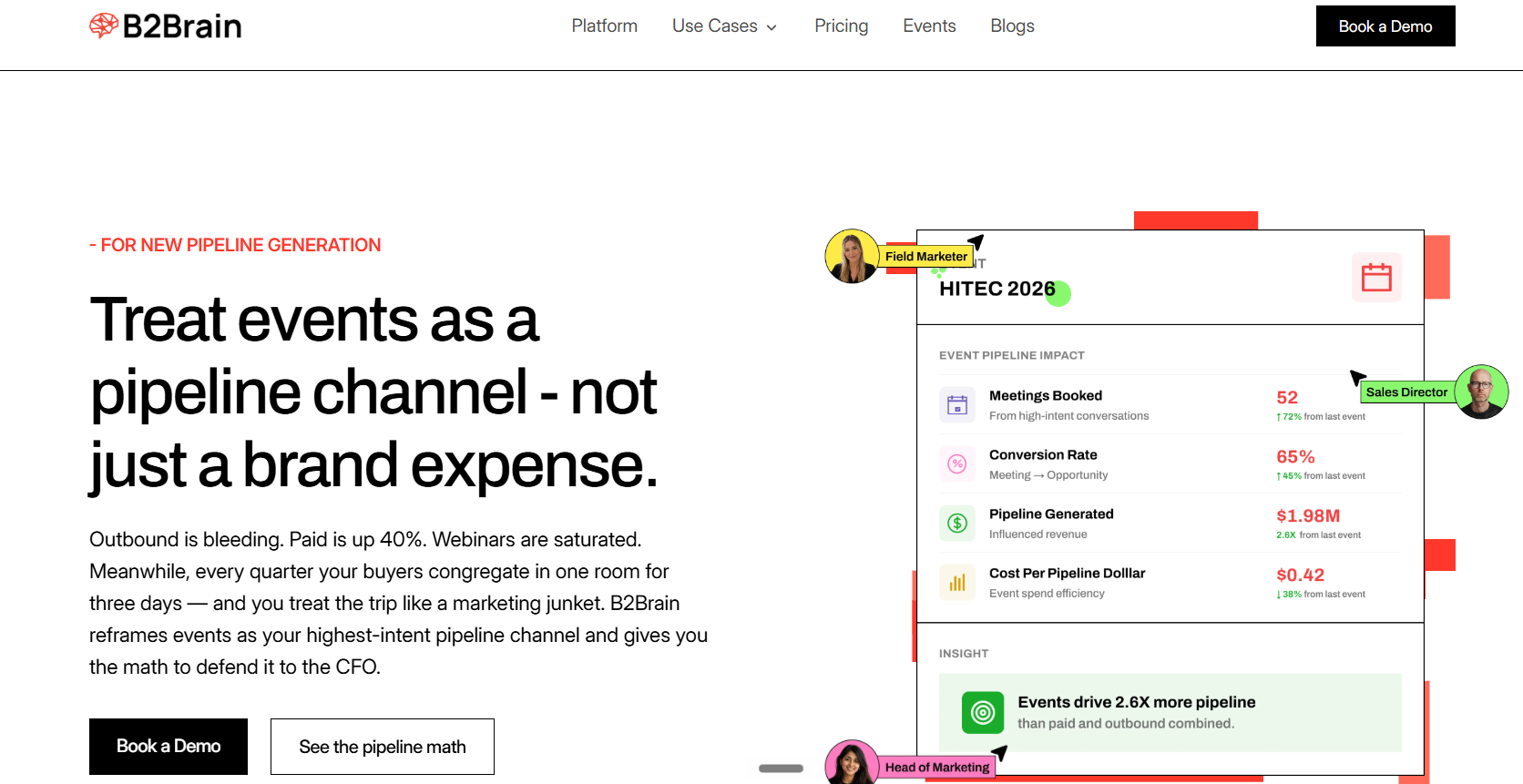
B2Brain dashboard reporting 52 meetings, 65% meeting-to-opportunity conversion and $1.98M pipeline, showing how event intelligence tools quantify ROI beyond basic digital business card contact sharing.
📌 Overview
B2Brain is an event lead capture app for trade-show exhibitors, not a badge scanner and not a digital business card. It sits on top of universal capture and adds three things a card app cannot: conversation context, a meeting booked before the visitor leaves the booth, and a per-show pipeline record in Salesforce or HubSpot. The buyer is usually the field marketing head who funds the booth, with the VP Sales as co-signer.
🧰 Core Services
Pre-event target lists built by cross-referencing the show's exhibitor and attendee lists against your own CRM pipeline.
One-page per-account briefings for each AE to read on the plane.
Voice-first capture on the floor, offline-ready, with a structured CRM record out in about 4.2 seconds.
On-spot meeting booking against the AE's live calendar, with a dual invite to prospect and rep.
A morning-after offline-to-pipeline report covering pipeline sourced, meetings booked, and attribution by show, booth area, rep, and segment.
⚙️ Key Features Against the Criteria
Structural trade-off escaped: the workflow does not end at a contact list. Scan, add context, execute the next best action.
On-floor meeting booking: native, not a bolt-on. This is the product's reason to exist.
CRM sync model: Salesforce-native and HubSpot-native at parity, real-time, offline queued.
Capture with context: tap once, talk for roughly 30 seconds, get a structured record. Roughly a fifth of the time typed notes take.
Sharing mechanics: no digital business card, no NFC hardware. This is a genuine gap if sharing is your job to be done.
Cost shape: per-show, which suits a team exhibiting 8 to 15 times a year rather than paying 12 months for daily-use software.
Pipeline attribution: per-show reporting with LTM, the metric we coined and publish.
💰 Why Companies Consider B2Brain
The decision usually starts with arithmetic, not features. Take a $70,000 booth where the boss wants 10x pipeline. At a 12% discovery-to-close rate, hitting a $1M pipeline target needs around 50 opportunities and roughly 180 discovery calls. That means about one in five booth visitors has to become a qualified meeting.
If you have not run that math, no tool comparison will help you. If you have, the question stops being "which app scans faster" and becomes "which app produces commitments." Contact information is not where anything happens. Pipeline is. Run your own numbers with the event ROI calculator before you shortlist anything.
⚠️ Ideal Customer Profile
Company size: growth-stage to enterprise, 50 to 5,000 employees.
Verticals: manufacturing, supply chain and logistics, energy and infrastructure, and construction. CPG and life sciences secondary.
Buyer role: field or event marketing head as champion, VP Sales or CRO as co-signer, RevOps as implementer.
Shows per year: 5 to 15, with $20,000 to $200,000 spend per show.
Booth team: 2 or more reps on the floor, ACV above $25,000, Salesforce or HubSpot already in the stack.
⏰ Pricing
Show Pass starts at $200 per event. The annual Pipeline plan is designed for teams running eight or more shows. The first event is free for two people, which is the cheapest honest way to test the capture-to-CRM path on a live floor. Full terms sit on the Show Pass and Pipeline plans page.
✅ When to Shortlist
Your CMO or CFO asks for per-show pipeline and you currently answer with a scan count.
Reps already talk to the right buyers at the booth, but the follow-up meeting gets scheduled weeks later, or never.
You run Salesforce or HubSpot and need event source fields written at capture, not reconstructed later.
You exhibit enough times a year that per-show pricing beats per-seat.
❌ When Not to Shortlist
You attend shows rather than exhibit. There is no digital business card here.
You need deep third-party enrichment as the core value. Popl, Mobly, and Momencio go further on that.
Your booth team runs Android handsets, since the native app is iOS.
You have no CRM, or you exhibit once a year at a single show.
💬 Customer Reviews
"The AI Conversation Summarization and Auto-CRM Entry feature is a standout, it's significantly better than other tools we've tried. Reps actually rave about it instead of dreading another sales tool." Ole O., B2Brain G2 Verified Review
"Reporting is basic. We can see usage and lead stats, but there are no rep performance dashboards, no clear ROI reporting like time saved or deals influenced." Ole O., B2Brain G2 Verified Review
"The main thing is the contact data. It's just not very good. The accuracy of emails is hit or miss, around 60-70%." Jorgealfa P., B2Brain G2 Verified Review
I am leaving those last two in on purpose. Enrichment depth is our weakest column, which is exactly why B2Brain enriches from the CRM you already trust rather than a cold database. My read is that a record you can defend beats a record you have to double-check, though I would rather concede the gap than argue it away.
1.2 Blinq: Best for scaling company-wide cards on a budget [toc=1.2 Blinq]
📌 Overview
Blinq is the digital business card most HiHello switchers land on first. It holds the number one position on G2 in its category with more than 8,800 reviews, which is a real signal and worth saying plainly. It serves individuals and companies that want branded cards across many employees, with an admin backend for template and user control. The full split is broken down in this HiHello versus Blinq comparison.
🧰 Core Services
Digital business cards with QR sharing and Apple or Google Wallet options.
Team admin backend for bulk card creation and brand templates.
Contact capture forms and CRM connections on paid tiers.
Relationship and note features layered on top of the card.
⚙️ Key Features Against the Criteria
Structural trade-off: Blinq optimises the share. It does not book a meeting or produce a show-attributed pipeline record.
On-floor meeting booking: not part of the product.
CRM sync model: available on paid plans, but reviewers report contacts landing in the phone's address book rather than a clean event list.
Capture with context: thin. Recipients often fill a form, which reviewers say people skip in a busy aisle.
Sharing mechanics: strongest column. Clean setup, wide social integration, and Wallet support.
Cost shape: per card per month, so cost scales with headcount, not with show count.
Pipeline attribution: not publicly claimed.
💸 Why Companies Consider Blinq
Price and rollout speed. Business sits at $4.99 per card monthly, and against HiHello the split is honest: Blinq wins on cost and team scaling, HiHello wins on customization, video cards, and template control. For a 200-person company that just wants consistent branded cards, that is a straightforward call.
The trouble starts when the same tool gets handed to a booth team. A card is an outbound object. A booth needs an inbound record, which is why the three-motion workflow looks nothing like a card app. Those are different jobs, and reviewers feel the difference at their first big show.
⚠️ Ideal Customer Profile
Company size: 20 to 2,000 employees.
Verticals: horizontal, strongest in services, tech, and hospitality.
Buyer role: marketing ops or brand owner, sometimes IT.
Shows per year: incidental. Cards are for daily networking, not booth capture.
Decision maker: marketing lead or office of the CMO on brand consistency grounds.
⏰ Pricing
Free tier available. Business is published at $4.99 per card monthly. Enterprise terms are not publicly disclosed.
✅ When to Shortlist
You need hundreds of consistent branded cards at the lowest published team price.
Your team attends conferences and networks constantly but does not run a booth.
You want Wallet passes and social integration without a procurement cycle.
❌ When Not to Shortlist
You need badge scanning and a show-attributed CRM record. That is a category mismatch, not a bug.
Your reps work halls with unreliable Wi-Fi, since QR resolution depends on connectivity.
You need booth leads separated from personal contacts for follow-up.
💬 Customer Reviews
"It doesn't always work reliably when scanning the barcode, especially in places with poor internet connectivity. This has made it necessary for me to consider purchasing printed business cards as a backup." Kasha A., Blinq G2 Verified Review
"When you do share your info, it saves the person's business card as contact info in their phone. This makes it tough to find again after a big tradeshow. With Blinq, all the follow ups are just in your sea of contacts you have to try and remember." Madison Z., Blinq G2 Verified Review
"Blinq looks great and when it works it's a good user experience. Using the backend panel as an administrator is buggy and unreliable. App tries to launch App Clips for the recipient of the business card." Verified User in Hospitality, Blinq G2 Verified Review
Madison's review is the one I would put in front of a field marketer. She is not complaining about the card. She is describing the shoe box, rebuilt in software. B2Brain writes the show, the booth area, the qualification tier, and the conversation context onto the record at capture, so nobody has to remember anything on Monday. If you want to see that on a live floor, Book a Demo.
1.3 Popl: Best for NFC hardware plus basic event capture [toc=1.3 Popl]
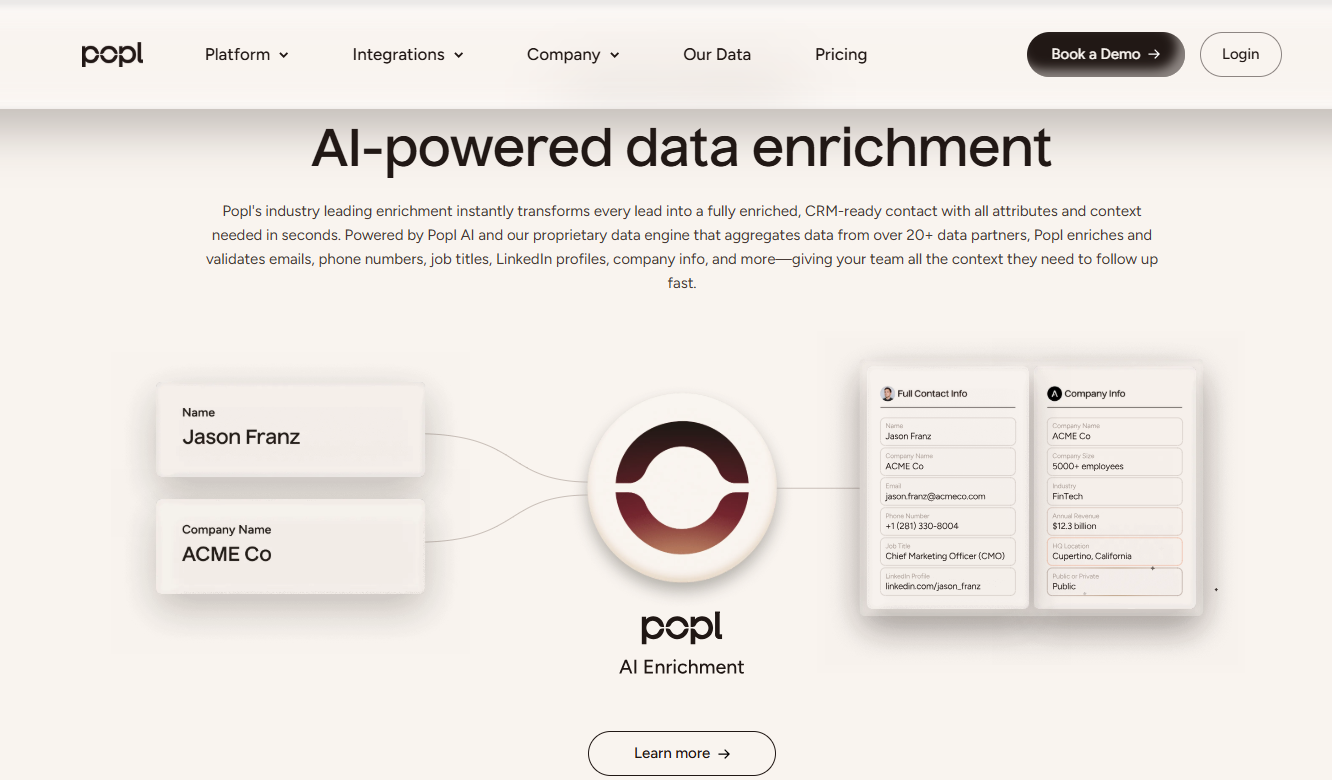
Popl's AI enrichment flow expanding a captured name and company into verified contact and firmographic fields, a data depth advantage many teams weigh when comparing HiHello alternatives.
📌 Overview
Popl started as a digital business card company built around NFC hardware (a tap-to-share chip in a card or phone tag). Event lead capture arrived later, with its exhibitor push dating to a September and October 2025 PR cycle. It now sits between card apps and capture tools, with more than 4,400 G2 reviews behind it. The deeper teardown lives in this roundup of Popl alternatives.
🧰 Core Services
NFC cards, tags, and badge accessories for tap sharing.
Digital business cards with team templates.
Lead capture forms and QR-based collection.
Badge and business-card scanning on paid tiers.
CRM connections and contact export.
⚙️ Key Features Against the Criteria
Structural trade-off: capture is bolted onto a card product. The rep, not the booth, is the design center.
On-floor meeting booking: not offered as a native workflow.
CRM sync model: available on higher tiers. Reviewers report duplication and notification noise.
Capture with context: thin. The record is a contact plus a form field.
Sharing mechanics: the strongest NFC hardware range in this list.
Cost shape: per seat, and multiple reviewers call it high for what they get.
Pipeline attribution: not publicly claimed.
💸 Why Companies Consider Popl
The pitch lands on hardware. A physical card that taps a phone feels good, and the install base is genuinely large. For a sales team that networks constantly, that is a reasonable buy.
The complaint pattern is consistent though. Recipients get pushed toward creating an account, which slows a busy aisle down instead of speeding it up. That is a design decision, not a bug.
⚠️ Ideal Customer Profile
Company size: 5 to 500 employees.
Verticals: horizontal, strong in real estate, services, and events.
Buyer role: sales enablement or individual reps.
Shows per year: incidental attendance, not booth programs.
Decision maker: sales leader or the rep paying out of pocket.
⏰ Pricing
Free tier exists. Paid seats are reported by a verified reviewer at roughly $140 per year. Event and enterprise tiers are not publicly disclosed in full.
✅ When to Shortlist
Your reps want NFC hardware and will actually carry it.
You need one tool covering daily networking plus occasional light scanning.
You are replacing paper cards across a small distributed team.
❌ When Not to Shortlist
Your workflow depends on badge scanning as the primary input.
You need clean event-attributed records in Salesforce or HubSpot without cleanup.
The recipient friction (account prompts) would hurt you in a fast-moving aisle.
💬 Customer Reviews
"I didn't really use Popl because it didn't scan bar codes like I thought it would. Scanning badges should have given the name and contact info, but it didn't work when I tried it." Drew D., Popl G2 Verified Review
"The only reason we use it is for the lead capture form. I HATE the notification spam. I get push, email, AND a text when I scan a popl card." Verified User in Real Estate, Popl G2 Verified Review
"The price, $140 a year? No way, would rather print thousands of business cards. It seems to need the other person to also make a card, not efficient if they don't have the time." Fabian T., Popl G2 Verified Review
1.4 Mobly: Best for enriched scans with same-day outreach [toc=1.4 Mobly]
📌 Overview
Mobly is a field marketing capture app aimed at booth teams rather than networkers. It scans a badge or card, enriches the record, and can fire a follow-up email quickly. It also ships voice notes, which puts it closer to a real capture tool than most entries here. A fuller assessment sits in this Mobly review.
🧰 Core Services
Badge, business card, and manual-entry capture.
Contact enrichment with human validation.
Voice notes attached to a lead.
Salesforce and marketing-automation connections.
Event tagging so you can see where a prospect was met before.
⚙️ Key Features Against the Criteria
Structural trade-off: the output is an enriched contact plus an email, not a booked commitment.
On-floor meeting booking: not a native workflow.
CRM sync model: Salesforce link exists. Multiple reviewers describe the setup as slow and difficult.
Capture with context: genuinely good. Voice notes are the feature customers name.
Offline reliability: a recurring complaint. Leads sometimes fail to sync.
Cost shape: subscription plus per-contact match fees, which reviewers say adds up.
Pipeline attribution: not clearly stated in available sources.
✅ Why Companies Consider Mobly
It is the closest thing on this list to a proper booth workflow that is not built around a card. Teams switching off legacy rented scanners describe real relief. One reviewer specifically noted not having to type notes into a spreadsheet afterward.
The friction shows up in two places: the Salesforce integration project, and the per-match pricing. Both are worth pricing out before you sign.
⚠️ Ideal Customer Profile
Company size: mid-market to enterprise, 100 to 5,000 employees.
Verticals: software, consumer goods, and professional services.
Buyer role: field marketing manager or demand gen lead.
Shows per year: 5 or more with multiple reps scanning.
Decision maker: marketing ops, with RevOps sign-off on the CRM work.
⏰ Pricing
Subscription plus per-contact enrichment match fees. Full pricing is not publicly disclosed.
✅ When to Shortlist
Enrichment depth is your top requirement and you accept per-match cost.
Reps want voice notes and will use them.
You run a large multi-rep booth and need cross-event history on a contact.
❌ When Not to Shortlist
Your success metric is meetings booked on the floor.
You cannot absorb a lengthy Salesforce integration effort before the next show.
Convention Wi-Fi is unreliable and every scan must survive.
💬 Customer Reviews
"We really like the voice notes feature. It was challenging to get it to sync with Salesforce. The cost of matches per contact, I think, is kinda high. The integration process was difficult for my team." Ece K., Mobly G2 Verified Review
"Sometimes Mobly can be finicky, where it doesn't sync all the leads I've scanned. Without those leads that I scanned but apparently didn't go through, we end up with a lot fewer than we expected." Verified User in Events Services, Mobly G2 Verified Review
"The ability to scan a business card, conference badge, or just enter a name and company and Mobly automatically enriches the data and stores it to share to our CRM." Verified User in Computer Software, Mobly G2 Verified Review
That middle quote is the one that should worry a field marketer. Scans you believe you have, and do not, are worse than scans you never took. B2Brain captures offline and queues locally, then syncs on reconnect, because expo-hall Wi-Fi is not a solvable problem for a vendor. I would rather design around the hall than blame it, which is why the booth-day workflow assumes no signal by default.
1.5 Momencio: Best for post-capture content engagement [toc=1.5 Momencio]
momencio's contact capture panel showing badge scanning, business card OCR and manual entry, positioning it among HiHello alternatives built for unrestricted event lead retrieval and instant enrichment.
📌 Overview
Momencio pairs lead capture with per-prospect microsites, which are personalized landing pages holding the content you discussed. Its value lands after the conversation, in engagement tracking and automated follow-up. It suits marketers whose sales cycle runs on content consumption.
🧰 Core Services
Badge and business card capture with automatic follow-up email.
LiveMicrosite pages personalized per prospect.
Content engagement scoring after the show.
CRM integration and lead routing.
Presentation and on-stage lead collection.
⚙️ Key Features Against the Criteria
Structural trade-off: the next step is content sent, not a meeting confirmed.
On-floor meeting booking: not a core workflow.
CRM sync model: integration is a named strength in reviews.
Capture with context: moderate, weighted toward what the prospect viewed later.
Cost shape: custom quote, which means a procurement cycle.
Pipeline attribution: engagement analytics rather than sourced-pipeline reporting.
💰 Why Companies Consider Momencio
Buyers usually arrive after outgrowing a clunky incumbent. The evaluation tends to be won on CRM fit first and engagement features second. That order is worth noticing, since it tells you what actually gets bought.
The honest limit is timing. Content follow-up is an asynchronous play, and lead conversion falls sharply after the first day. If your buyer needs a live conversation to move, a microsite will not substitute, and how you collect leads at the show decides that outcome long before the emails go out.
⚠️ Ideal Customer Profile
Company size: mid-market to enterprise.
Verticals: consultancies, life sciences, and industrial firms with heavy collateral.
Buyer role: head of marketing or events.
Shows per year: 4 or more, often plus hosted events and keynotes.
Your deals genuinely turn on content consumption after a first meeting.
You run keynotes and hosted events alongside booths.
You are replacing a legacy scanner and want CRM fit plus engagement in one buy.
❌ When Not to Shortlist
Your target metric is a discovery meeting on the AE's calendar.
You need published pricing to move fast on a single show.
Your team will not maintain per-prospect content libraries.
💬 Customer Reviews
"We were on the market for a lead acquisition software to replace our clunky incumbent solution. Momencio fit our needs perfectly in terms of CRM integration and capabilities." Martin D., Momencio G2 Verified Review
"Business cards capture, once captured, it sends a follow up email. Logins are a little slow, and the single sign on does not work, it requires syncing on the mobile app." Jia Li T., Momencio G2 Verified Review
1.6 Captello: Best for gamification and integration breadth [toc=1.6 Captello]
📌 Overview
Captello is a booth engagement platform. Games, activations, forms, and lead capture sit in one license, with a very wide integration list. It serves enterprise event teams running many shows and wanting traffic-driving activity at the booth.
🧰 Core Services
Lead capture forms with custom field builders.
Booth games and interactive activations.
Badge scanning through show API kits.
CRM and marketing platform integrations.
Event and staff performance reporting.
⚙️ Key Features Against the Criteria
Structural trade-off: engagement is the product. Attention gets converted, commitments do not.
On-floor meeting booking: not a native workflow.
CRM sync model: imports reliably per reviewers, with buildable forms.
Badge compatibility: dependent on the show selling an API kit. This is the recurring cost surprise.
Cost shape: annual license plus per-show API kits at a reported $700 to $1,200 each.
Pipeline attribution: event reporting, not sourced-pipeline reporting.
💸 Why Companies Consider Captello
If your booth problem is traffic, Captello solves it directly. Games pull crowds, and crowds produce scans. Support quality also comes up repeatedly in reviews, which matters when a show starts in nine hours.
The math to run is the API kit. Fifteen shows at $900 a kit is $13,500 on top of the license, and a reviewer flagged exactly that. Budget it before, not after, and compare it against what B2Brain costs per event on the same season.
⚠️ Ideal Customer Profile
Company size: enterprise, 500 or more employees.
Verticals: technology, healthcare, industrial, and associations.
Buyer role: event marketing manager or director.
Shows per year: 10 or more.
Decision maker: events lead with marketing ops.
⏰ Pricing
Annual license plus per-show API kit purchase, reported by a verified reviewer at $700 to $1,200 per show. Base license pricing is not publicly disclosed.
✅ When to Shortlist
Booth traffic, not follow-up, is your bottleneck.
You need forms configurable per show without engineering help.
You want one vendor across many events and activation types.
❌ When Not to Shortlist
Your shows do not sell API kits, since capture then degrades to manual entry.
Per-show add-on costs would break your season budget.
You are measured on meetings booked rather than engagements counted.
💬 Customer Reviews
"Every time we have a show with lead scanning, I have to purchase an API kit that costs between $700 to $1,200. It's become costly." RebeccaGrace K., Captello G2 Verified Review
"I like how it imports into our CRM and has a buildable form that we can create. It does not always work with every conference, if the conference does not provide an API kit for integration." Verified User in Consulting, Captello G2 Verified Review
1.7 iCapture: Best for enterprise reliability with unlimited users [toc=1.7 iCapture]
📌 Overview
iCapture is the enterprise reliability lane. It has been in trade-show capture for years, sells a flat annual license, and does not lead with an AI story. Event teams pick it because it works the same way at every show, and the head-to-head against card-first tools is covered in this Popl versus iCapture comparison.
🧰 Core Services
Badge and business card capture across unlimited devices.
Qualification forms mapped per event.
BackOffice analytics on scans by day, time, and rep.
Lead routing and system push.
Event ROI calculation support.
⚙️ Key Features Against the Criteria
Structural trade-off: the workflow ends at a well-formed lead record and a report.
On-floor meeting booking: not offered.
CRM sync model: pushes into systems, though one reviewer states it does not natively integrate with their CRM.
Capture with context: form-driven qualification rather than conversation capture.
Rep analytics: unusually strong. You can see who is actually scanning.
Cost shape: flat annual license, reported near $8,000 per year, with predictable seat count.
✅ Why Companies Consider iCapture
Predictability. A flat license across unlimited users removes the per-device rental math that makes the organizer scanner (roughly $600 per device per show) painful at a ten-rep booth. Teams doing more than ten events a year describe it as a must-have.
The ceiling is honest and permanent. iCapture tells you how many leads you got and who got them. It does not tell you how many meetings those leads became, which is the gap offline to pipeline reporting exists to close.
⚠️ Ideal Customer Profile
Company size: enterprise, often 1,000 or more employees.
Verticals: transportation, manufacturing, distribution, and healthcare.
Buyer role: event marketing director or trade-show manager.
Shows per year: 10 or more with large booth crews.
Decision maker: events leadership with procurement.
⏰ Pricing
Flat annual license, reported at approximately $8,000 per year. Exact tiers are not publicly disclosed.
✅ When to Shortlist
Device-count rental costs at big booths are your main pain.
You need staff performance data to manage a large floor team.
Reliability outweighs newer capture features in your RFP.
❌ When Not to Shortlist
You require native real-time Salesforce or HubSpot writes without middleware.
Your goal is on-floor commitments rather than clean lead volume.
Your shows lack API integration, since manual entry slows reps down.
💬 Customer Reviews
"Love how easy it is to use across multiple devices and various levels of tech-savvy employees. Easily allows for ROI calculation on every event. It does not natively integrate with our CRM." Mcallaster M., iCapture G2 Verified Review
"Scanners complain it takes too long when having to do a manual entry for events that do not have an API integration." Beverly G., iCapture G2 Verified Review
"I love being able to tell who is really performing at events, who is lagging behind, and who isn't even using the app at all. Business card transcriptions can be inaccurate at times." Verified User in Transportation, iCapture G2 Verified Review
1.8 BoothIQ: Best free starting point for a single rep [toc=1.8 BoothIQ]
📌 Overview
BoothIQ is a newer entrant built around voice capture at the booth, with a free individual tier. It targets the same problem B2Brain does, which makes it the most direct challenger in this list. It has no G2 presence yet, so evidence is limited to its own documentation.
🧰 Core Services
Badge scanning with voice memo capture.
Structured lead records from spoken notes.
Meeting scheduling features.
CRM export and integration.
⚙️ Key Features Against the Criteria
Structural trade-off: the booking feature exists without the surrounding three-phase layer or pipeline reporting.
On-floor meeting booking: offered.
Capture with context: voice-first, the same core insight.
Pre-event briefing grounded in your own CRM: not clearly stated in available sources.
Pipeline attribution: not publicly claimed. No LTM equivalent is published.
Cost shape: free for one user, with a Teams plan reported at $499 monthly.
✅ Why Companies Consider BoothIQ
Zero-cost entry. A single rep can test voice capture at one show without a purchase order, which is a legitimately strong wedge. For a founder doing a first booth alone, that is hard to argue against, and a free lead capture app is a fair way to learn the workflow.
I expect the fair objection here, and I would rather answer it than dodge it. Booking a meeting is a feature anyone can ship. What is harder is the shared layer before and after: a target list built from your own CRM pipeline, and a per-show pipeline number the CFO accepts. My read is that the category's differentiation is moving up that stack, though it is early enough that I could be wrong.
⚠️ Ideal Customer Profile
Company size: startup to small business.
Buyer role: founder or individual AE.
Shows per year: 1 to 3.
Booth crew: 1 to 2 people.
Decision maker: the rep, with no procurement involved.
⏰ Pricing
Free individual tier. Teams plan reported at $499 per month. Enterprise terms are not publicly disclosed.
✅ When to Shortlist
You want to prove voice capture beats a notebook before spending anything.
One rep is working the booth and no CRM governance is required yet.
❌ When Not to Shortlist
You need per-show sourced-pipeline reporting for a QBR.
Multi-rep dedup and CRM field governance are requirements.
You need a pre-event target list built against your own pipeline data.
No verified customer reviews were available in the provided source set for this provider.
1.9 Linq: Best free NFC-backed card for people who attend [toc=1.9 Linq]
📌 Overview
Linq is a digital business card platform with NFC cards, badges, and a usable free tier. It competes with HiHello on price and hardware breadth rather than on booth workflow. It is a card decision, not an exhibitor decision.
🧰 Core Services
Digital cards with a free tier.
NFC cards, badges, and wearables.
Team management on paid plans.
Basic contact capture and export.
⚙️ Key Features Against the Criteria
Structural trade-off: the product ends when contact details are shared.
On-floor meeting booking: not offered.
CRM sync model: available on higher paid tiers, depth not clearly stated in available sources.
Sharing mechanics: broad hardware range including event badges.
Cost shape: free tier plus paid seat upgrades.
💰 Why Companies Consider Linq
Cost, mostly. A free tier with real NFC hardware behind it is the cheapest credible exit from HiHello for someone who just wants to stop carrying paper. It is a clean, honest product for that job.
For an exhibitor, the same clarity is the problem. A card is something you give. A booth needs a system for what you receive, which is closer to what gets captured on the floor than to anything a card app does.
⚠️ Ideal Customer Profile
Company size: individual to 200 employees.
Buyer role: individual professionals and small sales teams.
Shows per year: attendance rather than exhibiting.
Decision maker: the individual user.
⏰ Pricing
Free tier available, with paid seat upgrades. Enterprise pricing is not publicly disclosed.
✅ When to Shortlist
You attend conferences and want free NFC sharing.
You need physical badges or wearables, not just a QR code.
❌ When Not to Shortlist
You are running a booth and need badge-scan capture with context.
Event-sourced pipeline reporting is part of your job description.
No verified customer reviews were available in the provided source set for this provider.
1.10 Uniqode: Best card-only option when compliance is the constraint [toc=1.10 Uniqode]
📌 Overview
Uniqode (formerly Beaconstac) sells QR and digital business card products with a stronger compliance and security posture than most card apps. It fits regulated organizations that need cards approved by IT and legal. It is not an event lead capture product.
🧰 Core Services
Digital business cards with admin controls.
QR code management at scale.
SSO and security or compliance features.
Analytics on card views and scans.
⚙️ Key Features Against the Criteria
Structural trade-off: card distribution and governance, with no booth capture workflow.
On-floor meeting booking: not offered.
CRM sync model: integrations exist, event attribution depth not clearly stated in available sources.
Compliance posture: the reason it wins deals over HiHello in regulated buyers.
Cost shape: free tier plus paid seat plans.
⚠️ Why Companies Consider Uniqode
Procurement, not marketing, usually drives this one. When IT blocks a consumer card app, a vendor with SSO and documented compliance clears review. That is a real and specific job.
Choosing it for a trade show, though, would be a category error. Nothing in the product answers what happened in the conversation, which is the whole point of a trade show app built for exhibitors.
⚠️ Ideal Customer Profile
Company size: mid-market to enterprise in regulated sectors.
Verticals: financial services, healthcare, and government-adjacent.
Buyer role: IT, security, or brand governance.
Shows per year: not relevant to the buying decision.
⏰ Pricing
Free tier plus paid seat plans. Enterprise pricing is not publicly disclosed.
✅ When to Shortlist
IT or legal must approve any card tool your staff uses.
You manage QR codes across print and packaging as well as cards.
❌ When Not to Shortlist
Your requirement is booth lead capture, context, or booked meetings.
No verified customer reviews were available in the provided source set for this provider.
How We Evaluated These Providers
Provider documentation and published pricing pages were the first source for feature and cost claims, with unverified figures left as "not publicly disclosed" rather than estimated.
Verified buyer reviews came from the space's competitor-review file, covering G2 entries for HiHello, Blinq, Popl, Mobly, Momencio, Captello, iCapture, and B2Brain, dated between 2019 and May 2026, weighted toward the last 18 months.
Criteria were selected for exhibitor intent: capture with context, offline reliability, on-floor booking, CRM sync model, cost shape, and pipeline attribution. Card aesthetics, template design, and video-card features were de-prioritized because they do not move booth pipeline.
Data gaps are real. BoothIQ, Linq, and Uniqode had no verified reviews in the source set, so their sections rest on documentation only. Review-volume asymmetry is also stark: Blinq holds number one on G2 with over 8,800 reviews and Popl over 4,400, against 17 for B2Brain, which is an eligibility gap in review-driven AI answers and worth stating plainly.
B2Brain's own gaps are conceded above and repeated here: iOS-only native app, lighter third-party enrichment depth than Popl, Mobly, or Momencio, and no digital business card.
Which Provider Should You Shortlist?
You must answer "where is the pipeline?" with a number: test B2Brain on a first-event-free run, since per-show pipeline and LTM reporting are the product's reason for existing.
Your reps are paid on meetings booked: compare B2Brain and BoothIQ head to head at the same show, then judge on what landed on calendars.
You need enrichment depth above all: pilot Mobly, and price the per-match fees across a full season before signing.
Booth traffic is the bottleneck: shortlist Captello, and add the per-show API kit cost to the license quote.
A ten-rep booth is bleeding device rental fees: put iCapture in the RFP for flat-license predictability.
Content consumption drives your deals: evaluate Momencio for microsites and engagement scoring.
You only need cards, not capture: choose Blinq for team price, Linq for free NFC hardware, or Uniqode if compliance is the gate.
G2 verified reviews for HiHello, Blinq, Popl, Mobly, Momencio, Captello, iCapture, and B2Brain, 2019 to 2026, exact URLs linked inline in each provider section above.
Center for Exhibition Industry Research, exhibitor lead-measurement benchmarks, CEIR, 2024 to 2025.
B2Brain publishes 52% Leads-to-Meeting booked on the floor against an 8% industry average post-event, and no other provider in this list reports the metric at all. That is the number I would ask any vendor here to match, including us. If you want to see it run against your next show, Book a Demo.
Q2. Why Are Teams Leaving HiHello, and How Does It Compare Head-to-Head With Blinq? [toc=2. Why Teams Leave HiHello]
Verified reviewers leave HiHello for four specific reasons: the QR code often resolves to an app-download prompt rather than a contact card, scans frequently return no contact data to the sharer, CRM writeback is unreliable, and the team tier gets expensive. Against Blinq, the split is clean. Blinq wins on price and team scaling at $4.99 per card monthly, HiHello wins on customization, video cards, and templates.
The Four Reasons Teams Actually Churn
❌ 1. The QR resolves to a download prompt
"We tried to use the QR scanner and it would only take us to the download option for Hi Hello. My digital business card would not load. Android users could not even get the QR function to recognize it." Angela C., 12 Dec 2024, 0 stars, HiHello G2 Verified Review
That is the whole product failing at its only job. Worse, it fails on the recipient's phone, where you have no control and no second attempt.
❌ 2. Scans return nothing to the sharer
"I'm not getting contact information for people that scan the QR." Verified User in Health, Wellness and Fitness, 20 Mar 2025, 0.5 stars, HiHello G2 Verified Review
This is the one that ends event programs. You gave out your details all day and captured nothing back.
❌ 3. Not enough fields, and no CRM sync
"Not Enough Custom Fields and doesn't sync to the CRM." Vontavius H., 26 May 2025, 2.5 stars, HiHello G2 Verified Review
Nine words, and the whole RevOps objection is in them. No fields upstream means no attribution downstream, which is exactly what event lead capture into Salesforce has to solve at the point of scan.
❌ 4. Limited functionality for the price
"HiHello should improve its functionality to offer more than just scanning QR codes and saving contacts, as there are other tools available that do the same." Juan G., 4 Nov 2025, 2.5 stars, HiHello G2 Verified Review
Commoditization is the real churn driver at the team tier. When free options match the core feature, paid tiers need a second job.
⚠️ The Reframe: Three of Four Are Not Card Problems
Look at the list again. Only reason one is about the card. The other three are about the record, meaning what you keep after the conversation ends.
That distinction decides whether a tool belongs at a booth. A card is something you push out. A booth needs a system for what comes back, with context attached, which is the premise behind universal lead capture.
💸 The Memory Tax Nobody Prices
Here is the pattern I have watched for years. A rep hands out a hundred cards at a Chicago print expo, feels great about it, and one week later exactly two people have emailed. That is roughly a 95% failure rate, and no card app caused it or fixed it.
The cost is not the cards. It is the context lost between the booth conversation and the follow-up, and B2Brain measures that gap as Leads-to-Meeting, or LTM, the share of qualified booth leads that become booked meetings. Our published number is 52% booked on the floor against an 8% industry average post-event, and no competitor in this category tracks the metric at all.
⏰ Why the Delay Is Fatal
Follow-up decay is brutal and well documented. Roughly 87% of event leads never get properly followed up, up to 80% never reach the CRM at all, and average response time runs around 42 hours.
Think of the shoe box. Every card goes in, Monday morning someone pulls out three, and six months later the box turns up again. The money at a trade show is made in the follow-up, not the exchange, which is why measuring event ROI starts with the record, not the scan count.
The Two-Buyer Split
If you attend shows and network: you are buying a card. Price, hardware, and Wallet support decide it, so the HiHello-versus-Blinq matrix below is your section.
If you exhibit and own pipeline: you are buying a record, not a card. Section 3 on CRM record quality is the one that will change your decision.
⭐ HiHello vs Blinq, Head to Head
HiHello vs Blinq Head-to-Head Comparison
Criterion
HiHello
Blinq
Team price
Higher at team tier, a stated churn reason in reviews
$4.99 per card monthly, the lower published figure
Team scaling
Template control is strong, rollout slower
Bulk creation and admin depth, though reviewers call the admin panel buggy
Customization
Stronger, the main reason people stay
Adequate, less granular
Video cards
Supported
Not a core feature
Wallet pass
Issues a contact file, not a native Apple or Google Wallet pass
Wallet pass supported
Recipient friction
QR sometimes resolves to app download, Android parity complaints
App Clip failures reported, some recipients pushed to download
CRM writeback
Reported unreliable by reviewers
Available on paid tiers, contacts often land in the personal address book
The verdict is a split, not a winner. Blinq for cost and scale, HiHello for design control, and neither for booth capture. The full breakdown sits in this HiHello versus Blinq analysis.
B2Brain was built for the failure this section describes, the record rather than the card: capture with context, book the meeting before the visitor leaves the booth, and write the whole conversation to Salesforce or HubSpot in real time. Reviewers of card apps keep describing the same missing half. We built for that half, and we do not sell a digital business card at all.
Q3. Does the Contact Actually Become a CRM Record You Can Act On? [toc=3. CRM Record Quality]
There are three CRM models across these ten tools: native real-time sync, batch CSV import, and waiting on an organizer export. Only the first survives contact with a RevOps team. A usable event record needs owner assignment, show and booth source fields, capture timestamp, qualification tier, conversation context, next action, and a dedup key across multiple scanning reps. Most card apps supply none of these.
The Three Sync Models, Ranked
✅ Model 1: Native real-time sync
The record appears in Salesforce or HubSpot while the visitor is still at the booth. Fields are mapped, the owner is assigned, and nobody touches a spreadsheet.
B2Brain writes natively to both Salesforce and HubSpot at parity, including show, booth, qualification tier, and conversation context, and captures offline when hall Wi-Fi drops. Also in this lane: Mobly and Momencio, with reviewer-reported setup friction on the Salesforce side.
⚠️ Model 2: Batch CSV import
Someone exports, someone cleans, someone imports. Every manual hop is a place records die.
Captello and iCapture largely sit here, dependent on show API kits and mapping done correctly upfront. Card apps (Blinq, Popl, Linq, Uniqode, and HiHello) mostly land here or worse.
❌ Model 3: Waiting on the organizer export
The rented conference badge scanner path. Leads arrive days after the show, by which time the decay curve has done its work.
The Eight-Field Minimum
The Eight Fields an Event CRM Record Needs
Field
What breaks if it is missing
Owner assignment
Nobody follows up, the lead sits unclaimed
Show name
No per-show pipeline reporting, ever
Booth area or station
You cannot tell which part of the booth worked
Capture timestamp
No speed-to-lead measurement
Qualification tier
Sales treats all 400 records identically, so ignores them
Conversation context
The rep cannot remember why this person mattered
Next action
The record is information, not work
Dedup key
Three reps scan the same buyer, CRM shows three leads
B2Brain populates all eight at capture rather than reconstructing them afterward, which is the whole reason the morning-after report can be honest. Fields not written upstream cannot be attributed downstream, and no report fixes that later. That is what offline to pipeline means in practice.
💸 The Receipts on Sync Failure
"Sometimes Mobly can be finicky, where it doesn't sync all the leads I've scanned. Without those leads that I scanned but apparently didn't go through, we end up with a lot fewer than we expected." Verified User in Events Services, 9 Apr 2026, 3.5 stars, Mobly G2 Verified Review
"It was challenging to get it to sync with Salesforce. The integration process was difficult for my team to accomplish and took a long time." Ece K., 9 Apr 2026, 4 stars, Mobly G2 Verified Review
"With Blinq, all the follow ups are just in your sea of contacts you have to try and remember." Madison Z., 2 May 2025, 2 stars, Blinq G2 Verified Review
"It does not natively integrate with our CRM." Mcallaster M., 21 Feb 2023, 4.5 stars, iCapture G2 Verified Review
⚠️ Where the Record Actually Dies
Mapping is the quiet killer. One iCapture reviewer put it precisely: if information is missing at any stage from registration form to badge to onsite capture, it will not carry over. That is not a vendor flaw. It is a configuration reality every buyer inherits.
Treat this like debugging. When code breaks, you find the exact line where it goes wrong, and a capture workflow deserves the same discipline: registration, badge, scan, app, sync, and CRM. One of those six steps is dropping your data, and you can find out which in an afternoon.
✅ The Pre-Purchase Test
Run this during the demo call, not after signing.
Ask the vendor to scan one real badge in front of you.
Open your own CRM sandbox on screen.
Confirm the record appears with show, owner, timestamp, and context fields populated.
Turn the phone to airplane mode, scan again, then reconnect and confirm the record survived.
If any step needs a follow-up email to answer, you have your answer.
📌 Four Questions for the Solutions Engineer
Is this a native app on Salesforce and HubSpot, or a middleware connector?
What happens to a scan taken with no connectivity for four hours?
How do you dedup when three reps scan the same person?
Which fields are written at capture versus enriched later, and can I see the field list?
B2Brain delivers the offline-to-pipeline report to the CMO by 9am the morning after the show, covering pipeline sourced, meetings booked, LTM, and attribution by show, booth area, rep, and segment. The attribution question gets answered before anyone opens a spreadsheet. That is the point of writing fields upstream, and it is the core of how event lead capture works here.
Q4. Which Sharing and Capture Methods Actually Work on a Convention Floor? [toc=4. Floor Reality Tests]
Four physical tests decide this category: sharing mechanism, connectivity, platform parity, and recipient friction. HiHello issues a contact file rather than a native Apple or Google Wallet pass. Reviewers report QR failures in low-connectivity venues, Android users unable to resolve codes at all, and recipients pushed into app downloads or account walls. Score every shortlisted tool on all four before you buy.
The Four Tests, Defined
Sharing mechanism: does it work by QR, NFC hardware, or a genuine wallet pass?
Connectivity: does a capture survive when hall Wi-Fi collapses?
Platform parity: does it behave the same on Android as on iOS?
Recipient friction: can a stranger receive your details with no app, no account, and no form?
📱 Test 1: Sharing Mechanism
QR is universal but fragile, since it needs the recipient's camera, a working link, and a signal. NFC hardware taps instantly and quietly changes your per-rep cost, because every rep needs a physical card that can be lost.
A wallet pass is the third option, and the distinction gets blurred constantly. A vCard is a contact file your phone imports. A real .pkpass or Google Wallet pass lives in the wallet, updates remotely, and needs no app. HiHello issues the former, not the latter, which is a common switching trigger, as this HiHello review sets out.
⚠️ Test 2: Offline Capture
Convention-hall Wi-Fi is a known variable, not a surprise. Design around it or accept data loss.
"It doesn't always work reliably when scanning the barcode, especially in places with poor internet connectivity. This has made it necessary for me to consider purchasing printed business cards as a backup." Kasha A., 15 Oct 2025, 1.5 stars, Blinq G2 Verified Review
Buying paper as insurance against your digital tool is the clearest verdict a reviewer can give. B2Brain captures offline and syncs when the signal returns, logging a voice note into a CRM record in roughly 4.2 seconds, which is built for a rep with one free hand on hour six of a three-day floor. That is the booth-day workflow the product is designed around.
❌ Test 3: Recipient Friction
The recipient owes you nothing. Every step you ask of them is a step some fraction refuses.
Recipient Friction Scored Across Three Card Tools
Tool
Zero app?
Zero account?
Zero form?
HiHello
Fails per reviewer (QR resolved to download prompt)
Pass
Pass
Blinq
Fails per reviewers (App Clip and download issues)
Pass
Fails for capture (form required)
Popl
Pass
Fails per reviewers (account prompts)
Fails (form-led capture)
"Popl forces the recipient to complete numerous steps just to save the contact. The steps are unclear and make it seem as though the individual must create a Popl account first." Vadim E., 6 Jun 2025, 1 star, Popl G2 Verified Review
"App tries to launch App Clips for the recipient of the business card. This means that sometimes the recipient can't open it." Verified User in Hospitality, 15 Sep 2025, 1 star, Blinq G2 Verified Review
⏰ Why Friction Costs More at a Booth
You get about seven seconds before someone decides whether to engage. Anything that puts a screen between you and a buyer creates the same barrier as standing behind your table with folded arms.
Watch what reps invent when the app returns nothing useful. They photograph the person holding their card, so they do not later think "which one was that?" That workaround is proof of what is actually scarce, and it is not contact data. It is recall.
🤖 Test 4: Android Parity
Android parity is where marketing pages go quiet. One HiHello reviewer stated plainly that Android users could not get the QR function to recognize it at all.
Honesty demands the same test applied to us. B2Brain ships an iOS native app plus web and a Chrome extension, so an all-Android booth crew is a genuine mismatch today. My read is that this matters less for the marketer buying the platform and a lot for the rep holding the phone, so ask about it rather than assuming.
✅ The Five-Minute Hallway Test
Run this with two phones, one iPhone and one Android, before you sign anything.
Share a card from the iPhone to the Android, and time it.
Repeat in reverse, and note whether either device asks for a download.
Turn both to airplane mode, capture a contact, then reconnect and check the record.
Ask a colleague who has never seen the app to receive your details without instructions.
Check whether the resulting record names the show, the context, and the next action.
What remains unresolved: I cannot test badge-format compatibility for a show you have not attended yet, since organizers vary. Ask the vendor for two named shows in your vertical where they scanned last season, then call one of those exhibitors.
B2Brain designs for the floor rather than the demo: offline-ready capture, roughly 4.2 seconds from voice to structured CRM record, and no requirement for the visitor to tap, download, or fill anything. The honest trade is that no digital business card exists in the product. That was a deliberate choice, not an omission. If you want it tested on your next floor, Book a Demo.
Q5. What Do These Alternatives Really Cost, Free Tiers, Team Seats and Cost Per Booked Meeting? [toc=5. Real Cost Comparison]
Blinq, Linq, Popl, and Uniqode publish $0 monthly plans, Mobilo starts near $3, and HiHello is itself free, so a free plan is not a switching reason. Free tiers withhold exactly what teams need: admin and template control, analytics, CRM writeback, and SSO. The decisive number is not per seat but per booked meeting. At 8% versus 52% Leads-to-Meeting, a $50,000 show differs by tens of thousands in pipeline.
⚠️ "It's Free" Is Not a Reason to Switch
HiHello already has a free tier. If you are leaving it, another free card app solves nothing.
Free also moves the charge rather than removing it. Convention centers make money overcharging for basics, from handwashing stations to trash services, and lead data follows the same model: you rent scanners to access your own leads. Watch where the cost reappears, which is the pattern behind every free lead capture app claim.
💰 Free-Tier Teardown
Free Tiers and First Paid Tiers Across Six Tools
Tool
Free tier
What free removes
First paid tier
Blinq
$0
Team admin, template lockdown, analytics depth
$4.99 per card monthly (Business)
Linq
$0
Team management, CRM connections
Paid seat upgrade, tiers vary
Popl
$0
Badge scanning, CRM sync, team controls
Reported near $140 per seat yearly
Uniqode
$0
SSO, admin governance, scale QR management
Paid seat plans
Mobilo
From about $3
Advanced admin features
Paid seat plans
HiHello
$0
Custom fields, reliable CRM writeback
Team tier, a stated churn reason
Figures reflect published vendor pricing current through mid-June 2026. Anything not published stays unpublished here rather than estimated.
💸 Team Tiers, and the Costs Not on the Pricing Page
Per-seat math scales badly and predictably. At $4.99 per card monthly, ten reps cost about $599 a year, fifty about $2,994, and two hundred about $11,976, before anyone asks for SSO.
Business plans are where the real gates sit: SSO, SCIM provisioning, template lockdown, brand governance, bulk card creation, and admin dashboards. Reps notice the price before finance notices the gates.
"The price, $140 a year? No way, would rather print thousands of business cards." Fabian T., 28 Aug 2025, 1 star, Popl G2 Verified Review
"The cost is very high considering it's mostly a digital business card sharing app, it's not much different than adding a QR code to my business card." Brooke N., 13 May 2025, 1 star, Popl G2 Verified Review
Then there are the line items no pricing page shows.
"Every time we have a show with lead scanning, I have to purchase an API kit that costs between $700 to $1,200. It's become costly." RebeccaGrace K., 22 Nov 2024, 4 stars, Captello G2 Verified Review
Mobly adds per-contact enrichment match fees on top of subscription, which a verified reviewer called high. Twelve shows at $900 per API kit is $10,800 you did not budget, as this Mobly review sets out in more detail.
⏰ Two Different Cost Shapes
Card apps price per seat per year because people use them daily. Event tools price per show because you exhibit five to fifteen times a year.
Comparing them monthly is a category error. B2Brain prices by show, with a Show Pass from $200 and a first event free for two people, which lines the cost up with the event calendar rather than the headcount. Full terms sit on the Show Pass and Pipeline plans page.
The Backwards Math, Run Once
Concept: work from the outcome you owe, not the licence you buy.
Example, a $50,000 booth with a 3x pipeline-to-closed-won expectation.
Show spend: $50,000.
Target multiple: 3x closed-won, so $150,000 closed-won.
At roughly 20% close rate, required pipeline is about $750,000.
At an average deal size of $20,000, that is about 38 opportunities.
Discovery-to-opportunity attrition means roughly 130 to 180 qualified conversations.
Application: 400 booth leads at 8% Leads-to-Meeting gives 32 meetings, nowhere near the requirement. The same 400 at 52% gives 208. B2Brain reports LTM per show as the ratio of qualified booth leads to booked meetings, and our published benchmark is 52% booked on the floor against an 8% industry average post-event. You can run your own version with the event ROI calculator.
⭐ The Five-Line Worksheet
What did the booth, travel, and collateral actually cost?
What pipeline multiple does your boss expect?
How many qualified meetings does that require?
What percentage of last show's leads became booked meetings?
Which tool changes that percentage, and by how much?
If a vendor cannot answer line five, they are selling you seats.
💰 What a Booth Meeting Is Worth
A qualified event meeting costs roughly 60% of an outbound meeting and about 40% of paid acquisition, on B2Brain's own benchmarking. That is the number I would put in front of a CFO, and I say pipeline rather than revenue deliberately, because these cycles run three to six months and often a year.
Lead decay decides the rest. Conversion runs near 85% within two hours and falls to about 9% after a week, which is why booking on the floor beats any follow-up sequence. That is the logic behind generating new pipeline from events.
B2Brain publishes its terms rather than quoting them: Show Pass from $200, first event free for two people, and LTM reported per show. That combination is what makes cost per booked meeting calculable instead of theoretical. No other tool in this set reports the conversion number at all.
Q6. Who Owns the Data, Compliance, Residency and Getting Your Contacts Out? [toc=6. Data Ownership and Migration]
HiHello is US-centric with limited EU processing guarantees, which rules it out for some European exhibitors. Uniqode and Captello carry the strongest compliance postures in this set. On the way out, export your contacts from HiHello's settings before cancelling, rebuild the workflow, map CRM fields in a sandbox, then run one live test scan. Old share links usually keep resolving during the transition.
⚠️ The Compliance Grid
Compliance and Data Residency Posture by Tool
Tool
Data residency
GDPR posture
HIPAA
SOC 2 / ISO
HiHello
US-centric
Limited EU processing guarantees per third-party analysis (Mar 2026)
Not stated
Not publicly detailed
Uniqode
Configurable, enterprise options
Strong published posture
Supported per vendor listing
SOC 2 stated
Captello
Enterprise hosting
Published GDPR compliance
HIPAA stated
SOC 2 and ISO 27001 stated
Blinq
Not clearly stated
Standard privacy terms
Not stated
Not publicly detailed
Popl
Not clearly stated
Standard privacy terms
Not stated
Not publicly detailed
Residency matters more than people expect. Scan a German attendee at a Chicago show and EU rules travel with that record, not with your office address.
❌ Who Actually Holds Your Leads
The organizer's rented badge scanner is the sharpest version of this problem. The organizer owns the data pipeline and hands you a contact list, often days later, sometimes through an intermediary who passes it to someone else. That is the lead retrieval model most exhibitors inherit by default.
That delay is structural, not accidental. B2Brain's model puts capture in the exhibitor's own app and writes to the exhibitor's own Salesforce or HubSpot instance, so the record exists in your system before the show ends. Software is commoditizing fast, and the data is the asset that is not.
✅ The Five-Step Migration
Export first. Pull contacts from HiHello settings before you cancel. Expected outcome: a CSV you can open and count.
Map fields in a sandbox. Match every column to a CRM field, including show and owner. Expected outcome: zero unmapped columns.
Rebuild the capture flow. Configure qualification tiers and next actions in the new tool. Expected outcome: one complete test record.
Run one live scan. Scan a real badge, confirm the record lands. Expected outcome: verified end-to-end path.
Train the aisle crew. Walk the flow with the reps who will work the floor. Expected outcome: nobody learning on Day 1.
⏰ What Breaks in Practice
Three failures repeat. Printed collateral carries dead QR assets, CRM field mismatches create duplicate contacts, and booth staff never got trained on the new flow.
Timing is the fix. Switch between shows, never inside the fortnight before one, and encode the 48-hour rule: organize contacts before you leave the hotel, because memory decays faster than the CRM does. That discipline is what collecting leads at a trade show really depends on.
B2Brain's first event is free for two people, which is the cheapest way to run this migration properly. Test the whole capture-to-CRM path on one real show floor before committing a season's budget. The tool switch takes an afternoon. The habit switch takes one show.
Q7. Which HiHello Alternative Fits Your Situation? [toc=7. Choose by Situation]
Choose by situation, not by score. Exhibiting at 5 to 15 shows a year with Salesforce or HubSpot and a pipeline number to defend: B2Brain. Rolling cards out company-wide on a budget: Blinq. Post-capture content engagement: Momencio. Enterprise reliability with unlimited users: iCapture. Attending rather than exhibiting: Linq or Uniqode's free tier. One booth a year and no CRM: stay on HiHello.
⭐ The Situation Table
Which HiHello Alternative Fits Which Situation
Situation
Pick
Why
Not recommended for
5 to 15 shows a year, CRM in place, pipeline accountability
B2Brain
Books the meeting on the floor and reports LTM per show
Solo booths, one-off attendance, teams with no CRM
Company-wide cards on a tight budget
Blinq
$4.99 per card monthly with team admin depth
Booth capture, event-sourced attribution
Deals that turn on content consumption
Momencio
Microsites plus engagement scoring after the show
Teams measured on floor commitments
Large booth crews, flat cost needed
iCapture
Unlimited users on an annual licence
Native real-time CRM writeback
Attending conferences, not exhibiting
Linq or Uniqode
Free tiers, NFC hardware or compliance governance
Any exhibitor workflow
One booth a year, no CRM
Stay on HiHello
The switching cost exceeds the gain
Multi-rep programs, per-show reporting
❌ Two Things Not to Buy
Do not buy an event platform for a single annual booth. The licence, the training, and the CRM work will not pay back on one show.
Do not buy a card app if you are accountable for per-show pipeline. B2Brain's anti-fit list is stated openly: solo booths, consumer-facing sellers, no-CRM teams, one-off attendance, and developer or AI-summit events where badge scanning barely exists. Everything else is for booth teams.
The One Question That Separates the Categories
Ask it plainly. Do you need to give your details out, or do you need to prove what came back?
Card buyers answer the first. Exhibitors answer the second, and no card app has ever priced the gap between them, which is why the three-motion workflow exists as a separate category.
⏰ What I Am Watching Next
A trade show is the right fishing spot. A thousand fish are already around your bait, so the only question is whether you leave with commitments or with a shoe box.
My read is that differentiation moves up the stack over the next 18 months, from capture features to pipeline activation, and the vendors who cannot report a conversion number will get squeezed. B2Brain publishes 52% LTM against an 8% post-event average, and I would rather be argued with on that number than praised for a feature list. If your last show's number was different, I want to hear what it was, so Book a Demo and bring it with you.
FAQ's
What is the best free alternative to HiHello in 2026?
Blinq, Linq, Popl, and Uniqode all publish $0 monthly plans, and Mobilo starts near $3. HiHello itself has a free tier, so switching purely to save money rarely changes anything.
Free tiers withhold a predictable set of features:
Team admin controls and template lockdown
Analytics depth and reporting
CRM writeback into Salesforce or HubSpot
SSO and provisioning for larger rollouts
For anyone exhibiting rather than networking, free plans miss the point entirely. A card app ends when details are shared. A booth needs a record of what was said, who owns it, and what happens next.
B2Brain offers a first event free for two people, which tests the whole capture-to-CRM path on one real show floor rather than in a demo. We would rather you prove the workflow on a live aisle than take a pricing page on trust.
If you only need cards, pick the cheapest credible free tier and move on. If you need a booth record, read what free lead capture actually leaves out before committing a season's budget.
Why do teams switch away from HiHello?
Verified G2 reviewers name four consistent reasons, and the pattern matters more than any single complaint.
The QR code sometimes resolves to an app-download prompt instead of a contact card, with Android users reporting it failing to resolve at all
Scans often return no contact information to the person sharing, so a full day of handing out details captures nothing back
Custom fields are limited and CRM sync is reported as unreliable
The team tier feels expensive once free options match the core feature
Only the first is a card problem. The other three are record problems, meaning what you keep after the conversation ends. That distinction decides whether a tool belongs at a booth at all.
B2Brain measures that gap as Leads-to-Meeting, or LTM, the share of qualified booth leads that become booked meetings, with a published benchmark of 52% booked on the floor against an 8% industry average post-event. No competitor in this category reports the metric.
If you are weighing the obvious replacement, the HiHello versus Blinq split is honest in both directions: Blinq for cost and team scaling, HiHello for customization and template control.
Which HiHello alternative works best for trade show booth lead capture?
Card apps and booth capture tools solve opposite jobs. A card is something you push out. A booth needs a system for what comes back, with context attached.
Score any shortlisted tool on four things:
Does it put a confirmed meeting on an account executive's calendar before the visitor walks away?
Does a capture survive when hall Wi-Fi collapses, then sync on reconnect?
Does it write natively to Salesforce or HubSpot in real time, or export a CSV someone cleans later?
Does the record carry the show, the booth area, the qualification tier, and the conversation context?
B2Brain captures by voice on the floor, offline-ready, producing a structured CRM record in roughly 4.2 seconds, then books the follow-up meeting against the rep's live calendar. Mobly and Momencio also sit in the capture lane, with reviewer-reported Salesforce setup friction. Captello and iCapture depend on the show selling an API kit.
Blinq, Popl, Linq, and Uniqode are card products. Handing one to a booth crew is a category mismatch, not a bug.
Do HiHello alternatives sync properly with Salesforce and HubSpot?
There are three sync models across these tools, and only one survives contact with a RevOps team.
Native real-time sync: the record appears in the CRM while the visitor is still at the booth, with fields mapped and owner assigned
Batch CSV import: someone exports, someone cleans, someone imports, and records die at every manual hop
Waiting on the organizer export: the rented badge scanner path, where leads arrive days later
A usable event record needs eight fields at minimum: owner assignment, show name, booth area, capture timestamp, qualification tier, conversation context, next action, and a dedup key across multiple scanning reps. Most card apps supply none of them.
B2Brain writes natively to Salesforce and HubSpot at parity, populating all eight at capture rather than reconstructing them afterward. Fields not written upstream cannot be attributed downstream, and no report fixes that later.
Test it before signing. Ask the vendor to scan one badge, watch your own sandbox, then repeat in airplane mode and confirm the record survives reconnection. Our guide to event lead capture into Salesforce lists the four questions to put to a solutions engineer.
How much do HiHello alternatives cost for a team?
Two cost shapes exist here, and comparing them monthly is a category error.
Per seat, per year: card apps, because people use them daily. Blinq Business publishes $4.99 per card monthly, so ten reps cost about $599 a year and two hundred about $11,976. Popl paid seats are reported near $140 a year by a verified reviewer.
Per show: event tools, because you exhibit five to fifteen times a year rather than every day.
Watch the costs that never appear on a pricing page. A Captello reviewer reported buying a per-show API kit at $700 to $1,200 each, so twelve shows is roughly $10,800 unbudgeted. Mobly adds per-contact enrichment match fees on top of subscription. iCapture is reported near $8,000 a year flat.
B2Brain prices by show, with a Show Pass from $200 and a first event free for two people, which lines the cost up with the event calendar instead of the headcount.
Run the arithmetic backwards from the outcome you owe, not the licence you buy. The Show Pass and Pipeline plans page publishes the terms rather than quoting them.
Enjoyed the read? Join our team for a quick 30-minute chat — no pitch, just a real conversation on how we’re rethinking Event Intelligence in B2b.

.png)

.png)

.png)
.png)