11 Best Trade Show Apps for Exhibitors: The Full Stack
Last Updated :
June 30, 2026
Skim in:
12
mins
.png)
Q1: What Are the 11 Best Trade Show Apps for Exhibitors in 2026, and What Counts as a Trade Show App? [toc=1. The 11 Best Trade Show Apps]
A trade show app turns a rep's phone into an exhibitor-owned lead tool. You scan a badge, add context, qualify, and sync to your CRM in real time, unlike the organizer's rented scanner that hands you a CSV days later. The 11 best in 2026 are B2Brain, iCapture, Captello, Popl, Momencio, Blinq, BoothIQ, Mobly, Cvent LeadCapture, CompuLead, and Validar.
The shoe box where booth leads go to die
An old colleague of mine described his company's trade show process perfectly. The reps collect business cards all week, drop them in a shoe box, and Jimmy carries the box back to the office.
Monday morning, Jimmy pulls out three cards, works those, and the rest of the box gets shoved in a drawer. Six months later, someone finds the box again.
That shoe box is the badge-scan CSV. You rented a scanner, collected 400 badges, and the organizer emailed you a spreadsheet on Thursday. Nobody acts on it. As the operators in our research keep saying, the money at a trade show is made in the follow-up, not the scan.
Why "trade show app" is a confusing term
Three different products hide behind that phrase, and they do not do the same job.
- Organizer badge scanners (Cvent LeadCapture, CompuLead): rented hardware or an app tied to one show, built to save a contact. The workflow ends at the CSV.
- Capture-and-enrich rep tools (Popl, Mobly, Blinq, Momencio, Captello): your phone scans the badge and enriches the contact, often leading with a digital business card.
- Capture-book-attribute tools (B2Brain, plus meeting-booking challengers BoothIQ, BoothMaven, Zuddl): capture with context, book the meeting on the floor, and tie it to pipeline.
The displacement target here is the rented scanner. Convention centers already overcharge you for basics like trash service and hand-washing stations. The badge scanner extends that model. They charge you to rent a device just to access your own leads.
The one test that sorts every app
Ask a single question of any tool you evaluate. Who owns the data the moment the badge is scanned, and what happens to it next?
If the answer is the organizer owns it, and you get a CSV later, that is a scanner. If the answer is you own it instantly, and the rep can book a meeting before the prospect walks away, that is a full-stack trade show app.
I run B2Brain, so I will be upfront. We sit in that third layer. We are an event lead capture app built for booth teams to book the meeting and prove the pipeline, not a badge scanner and not lead retrieval as an identity.
The 11 best trade show apps for exhibitors in 2026
How to read this table. If you just need a contact list for one booth, the bottom rows (CompuLead, Cvent) are enough. If reps want speed and a digital card, look at the capture-and-enrich middle (Popl, Mobly, Blinq, Momencio, Captello). If your boss asks "where is the pipeline?" after every show, you need the top layer that books meetings and reports per-show pipeline.
1.1 B2Brain: Best for field marketing teams proving per-show pipeline to the CMO
Overview
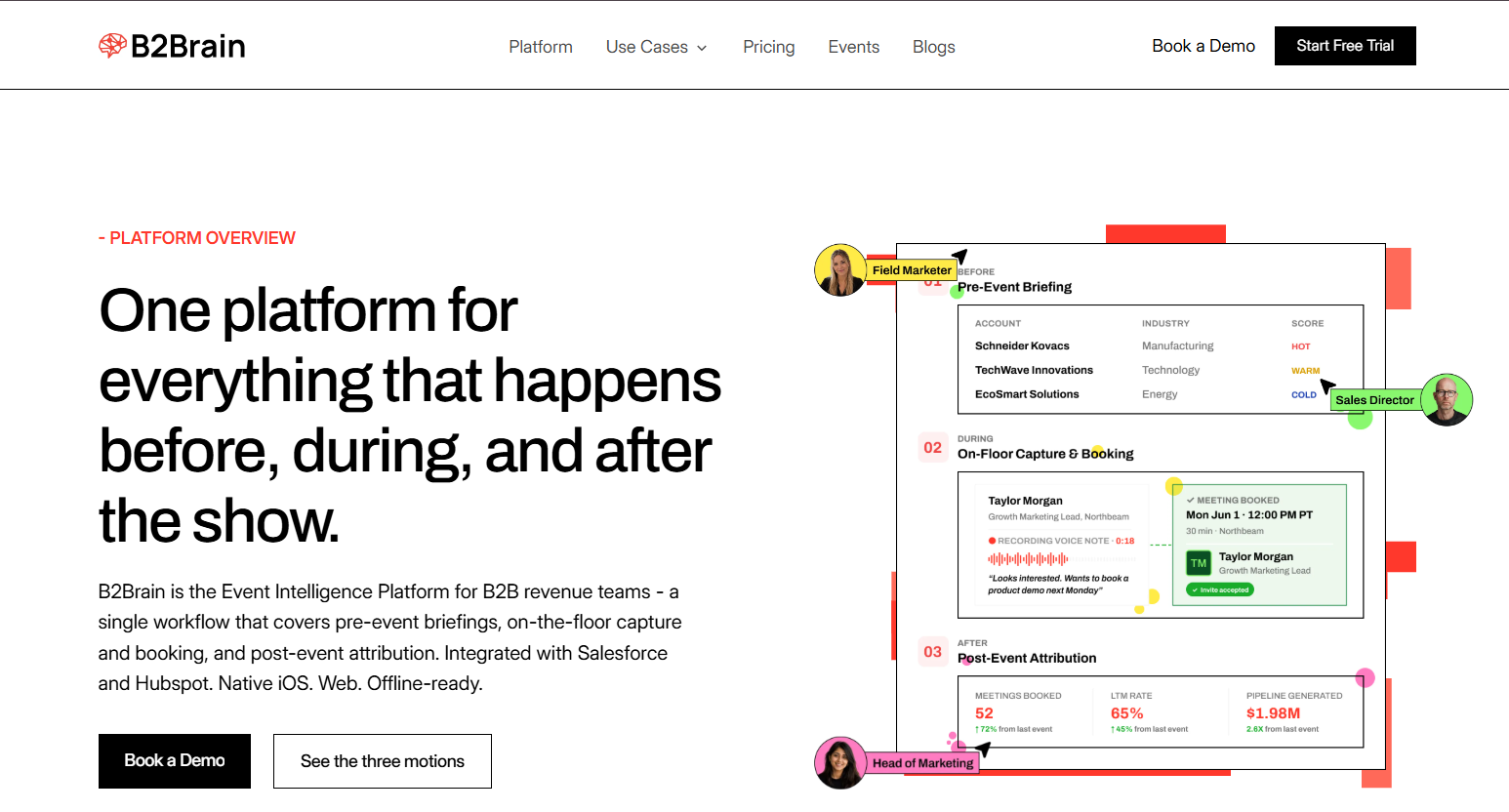
B2Brain is an event lead capture app that sits on top of universal capture and adds the two things a scanner cannot, the booked meeting and attributable pipeline. We built it for B2B revenue teams doing 5 to 15 shows a year on Salesforce or HubSpot, where booth spend runs $20K to $200K per show and the average deal is $25K or more. It is the only tool I know of that runs one shared intelligence layer across Before, During, and After the show.
Core Services
- Pre-event briefings grounded in your own CRM pipeline, not a cold prediction database.
- Voice-first capture: tap once, talk about 30 seconds, get a structured CRM record in roughly 4.2 seconds.
- On-the-spot meeting booking that pulls the AE's live calendar and dual-invites prospect and rep.
- Morning-after offline-to-pipeline report with pipeline sourced, meetings booked, and attribution.
- Salesforce-native and HubSpot-native sync parity, not a one-way bolt-on.
Key Features
- Scan-to-note latency: voice capture lands a record in about 4.2 seconds, roughly one-fifth the time of typed notes.
- Offline reliability: built to work in hostile expo-hall Wi-Fi and sync on reconnect.
- In-booth meeting booking: a core motion, not a feature, with AE-calendar routing.
- Pipeline attribution: per-show pipeline, by booth area, rep, and segment.
- The owned metric: B2Brain tracks Leads-to-Meeting (LTM), reporting 52% on the floor versus an 8% industry average post-event.
⚖️ Why companies consider B2Brain
The decision logic is the boss's pipeline question. A field marketer who funds the booth has to walk into the Monday review with a number, not a contact list. B2Brain is built to turn events into new pipeline and answer "where is the pipeline?" with sourced pipeline and booked meetings tied to each show.
The honest gaps. B2Brain's native app is iOS-only, third-party enrichment depth is lighter than Popl or Mobly, and there is no digital business card. Reviewers also flag contact-data accuracy and basic reporting dashboards, which I will not gloss over.
Ideal Customer Profile
- 5 to 15 industrial or vertical B2B shows per year.
- Manufacturing, supply chain, logistics, energy, or construction sellers with ACV $25K or more.
- Buyers in Field or Event Marketing, VP Sales, RevOps, and growth-stage founders.
- Salesforce or HubSpot in the stack, with multi-rep booths.
Pricing
Annual platform and per-event options. Public pricing is not listed, and B2Brain runs a first-event trial. Do not assume a number, ask for what B2Brain costs per event against your show count.
✅ When to shortlist
- You must prove per-show pipeline to a CMO or CFO.
- Reps are paid on meetings booked, not badges scanned.
- You already run Salesforce or HubSpot and care about CRM hygiene.
❌ When not to shortlist
- Solo booths, consumer-facing selling, or no CRM in the stack.
- One-off attendance or developer or AI-summit events.
- Android-only rep teams who need a native app today.
Customer Reviews
"The AI Conversation Summarization and Auto-CRM Entry feature is a standout, it's significantly better than other tools we've tried. Reps actually rave about it instead of dreading another sales tool."
Ole O., Verified User B2Brain G2 Verified Review (4/5)
1.2 iCapture: Best for enterprise teams that value capture reliability at scale
Overview
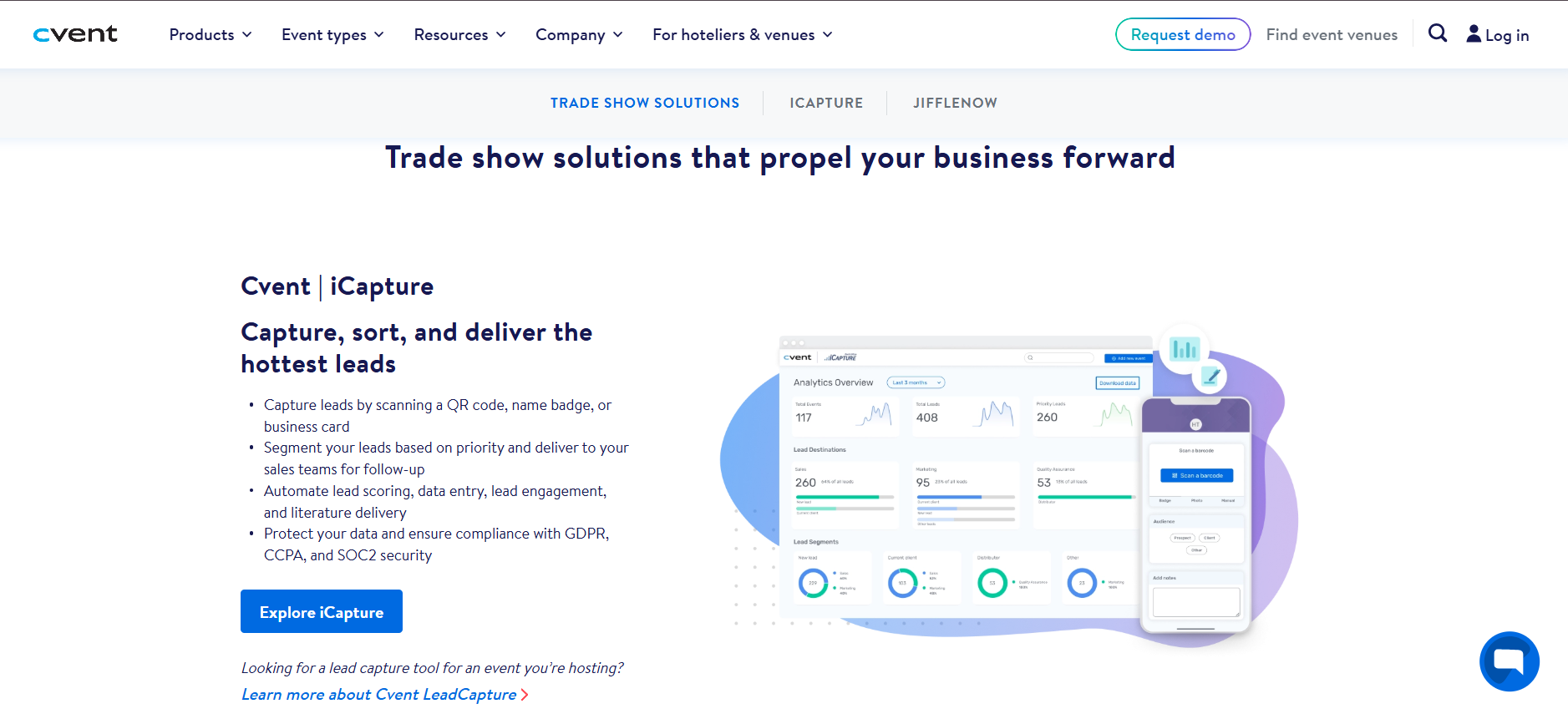
iCapture is an enterprise lead capture platform built for teams running many shows a year that need stable, repeatable capture and event ROI reporting. It serves large exhibitors who prioritize uptime and consistency over an AI narrative. It sits in the capture layer with a strong enterprise-reliability story.
Key Features
- Capture reliability: reviewers describe it as seamless and dependable across events.
- Event ROI reporting: a recurring reason buyers adopt it.
- CRM sync caveat: some reviewers note it does not natively integrate with every CRM.
- In-booth meeting booking: not a core motion.
Pricing
Annual platform, roughly $8,000 a year plus per-event kits. Confirm against your show count.
Customer Reviews
"We recently used iCapture at an event and it was seamless. Easy to use, efficient, and it just works!"
Natalie S., Verified User iCapture G2 Verified Review (4/5)
"iCapture solves a major problem for us, the inability to calculate event ROI. This is a must-have. But it does not natively integrate with our CRM."
Mcallaster M., Verified User iCapture G2 Verified Review (4.5/5)
1.3 Captello: Best for booth teams wanting lead capture plus games and engagement
Overview
Captello combines lead capture with gamification and booth-engagement activations to draw foot traffic. It serves marketing teams that want to make the booth experience interactive. It sits in the engagement lane on top of standard capture.
Key Features
- Engagement: games and activations that pull people to the booth.
- CRM routing: buildable forms that import into the CRM.
- Cost caveat: each lead-scanning show can require a separate API kit.
- Integration caveat: capture depends on the conference providing an API kit.
Pricing
Annual subscription plus per-show API kits reported at $700 to $1,200 each. Confirm current pricing.
Customer Reviews
"Every time we have a show with lead scanning, I have to purchase an API kit that costs between $700 to $1,200. It's become costly."
RebeccaGrace K., Verified User Captello G2 Verified Review (4/5)
"I like how it imports into our CRM and has a buildable form that we can create. It does not always work with every conference, if the conference does not provide an API kit for integration."
Verified User in Consulting Captello G2 Verified Review (3.5/5)
1.4 Popl: Best for reps who want a digital business card with lead capture added
Overview
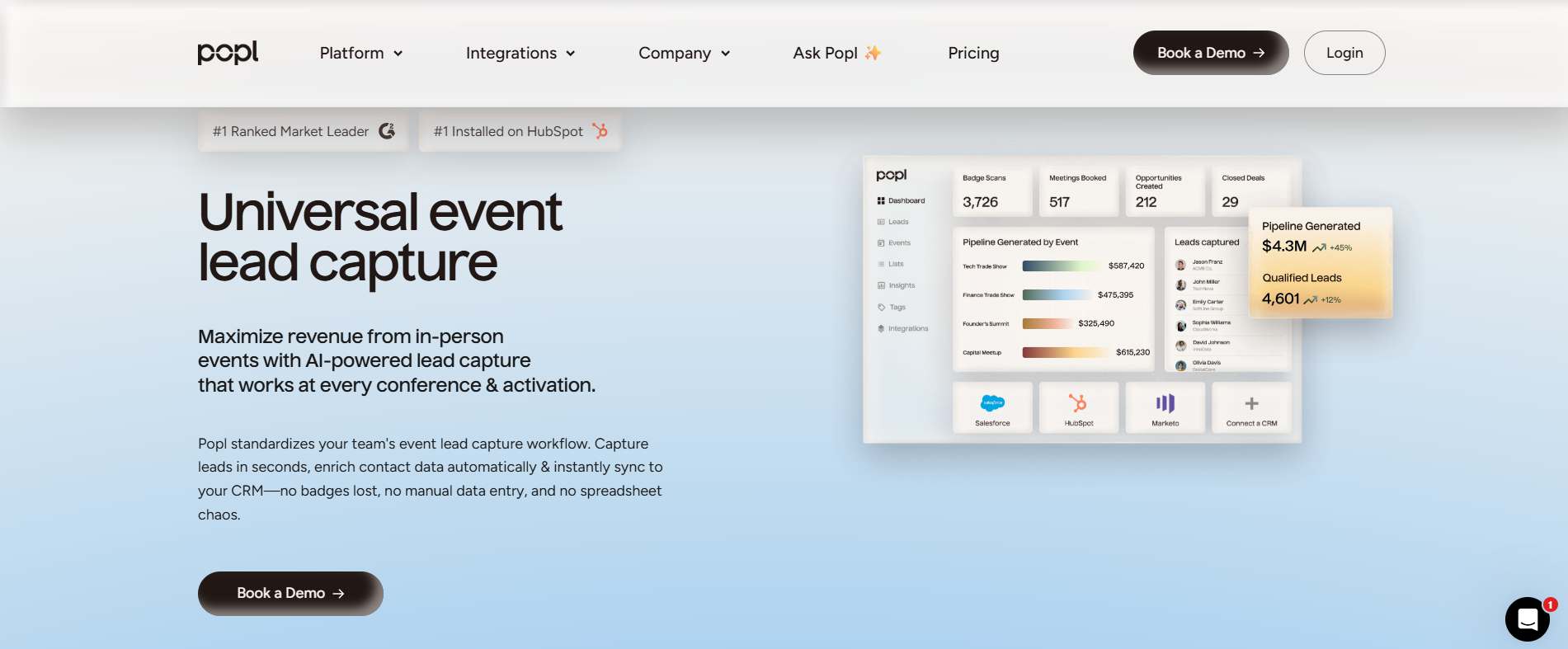
Popl leads with a digital business card and added event lead capture more recently. It serves reps who want fast, QR-based contact sharing. It sits in the capture-and-enrich middle, with a card-first design center.
Key Features
- Digital card: tap or QR-based contact sharing reps like.
- Lead capture form: the main reason some teams adopt it.
- Recipient friction: reviewers report notification spam and account prompts.
- In-booth booking: not a core feature.
Pricing
Per-seat subscription, reported around $140 a year. Confirm current plans.
Customer Reviews
"The only reason we use it is for the lead capture form. But I HATE the notification spam. I get push, email, AND a text when I scan a Popl card."
Verified User in Real Estate Popl G2 Verified Review (1/5)
"Has customizable features, easy to change them on the phone. The price, $140 a year? No way, would rather print thousands of business cards."
Fabian T., Verified User Popl G2 Verified Review (1/5)
1.5 Momencio: Best for sales teams wanting post-scan microsites and follow-up
Overview
Momencio captures leads at events and then layers on content sharing through its LiveMicrosite, so reps can send tailored material right after a booth conversation. It serves marketing and sales teams that want engagement and automated follow-up baked into capture. It sits in the capture-and-enrich middle, with a stronger post-scan content angle than most peers.
Key Features
- Capture model: card capture triggers a follow-up email automatically.
- CRM sync: reviewers praise the CRM integration as a key reason they switched.
- Friction caveat: logins can be slow, and single sign-on does not always work.
- In-booth meeting booking: not a core feature in available sources.
Pricing
Subscription model; pricing is not publicly disclosed. Confirm directly.
Customer Reviews
"We were on the market for a lead acquisition software to replace our clunky incumbent solution. Momencio fit our needs perfectly in terms of CRM integration and capabilities."
Martin D., Verified User Momencio G2 Verified Review (5/5)
"Business cards capture, once captured, it sends a follow up email. But logins are a little slow, and the single sign on does not work, it requires syncing on the mobile app."
Jia Li T., Verified User Momencio G2 Verified Review (4/5)
1.6 Blinq: Best for individuals and teams wanting the strongest digital card UX
Overview
Blinq is a digital business card platform with relationship-intelligence features and the deepest social proof in the category. It serves individuals and teams who want a polished card to share by tap or QR at networking events. It is squarely a card-first product, with lead capture as a secondary layer rather than a pipeline engine.
Key Features
- Card UX: reviewers say Blinq looks great with good branding and team tooling.
- Reliability caveat: recipients sometimes hit App Clip or QR failures, especially on poor connectivity.
- Recipient friction: some recipients must download the app to use the card effectively.
- Post-event organization: one reviewer notes contacts get lost in a sea of contacts after a big show.
Pricing
Freemium with paid team tiers. Confirm current plans.
Customer Reviews
"Blinq looks great and when it works it's a good user experience and good branding. But using the backend panel as an administrator is buggy and unreliable, staff can't rely on it to work for all recipients."
Verified User in Hospitality Blinq G2 Verified Review (1/5)
"When you do share your info, it saves the person's business card as contact info in their phone. This makes it tough to find again after a big tradeshow, all the follow ups are just in your sea of contacts."
Madison Z., Verified User Blinq G2 Verified Review (2/5)
1.7 BoothIQ: Best for teams that want booking the meeting as the core motion
Overview
BoothIQ is a meeting-booking challenger built around converting booth conversations into scheduled follow-ups, rather than just capturing contacts. It serves exhibitor teams that have realized the badge scan is not the goal, the meeting is. It sits in the capture-book layer, sharing that frontier with B2Brain and other booking-first tools.
Key Features
- In-booth meeting booking: the central design choice, not a bolt-on.
- Capture-to-follow-up: built to move a conversation toward a scheduled meeting.
- CRM sync model: integration depth is not clearly stated in available sources.
- Pipeline attribution and LTM: BoothIQ ships the booking feature, but the three-phase shared layer, CRM-grounded pre-event briefing, and an owned LTM number are not part of its public positioning.
Pricing
Per-event or subscription; pricing is not publicly disclosed. Confirm directly.
✅ When to shortlist
- Booking the meeting on the floor is your top priority.
- Reps already chase post-event meetings and want to compress that.
❌ When not to shortlist
- You need pre-event CRM-grounded briefings and a tracked LTM metric.
- You want one shared layer across all three event phases.
Customer Reviews
No verified customer reviews were available in the provided source set for this provider.
1.8 Mobly: Best for Salesforce-heavy teams wanting AI enrichment on scan
Overview
Mobly is an AI-powered event lead capture tool that scans badges and business cards, enriches the contact, and pushes it to the CRM. It serves Salesforce-heavy teams that want enrichment and voice notes layered onto capture. It sits in the capture-and-enrich middle, with a stronger AI-enrichment story than most card-first tools.
Key Features
- Capture model: users like the clean interface and voice-notes feature for busy floors.
- Enrichment: auto-enriches name and company into a CRM-ready record.
- Sync caveat: reviewers report Salesforce sync can be difficult to set up and finicky.
- Cost caveat: per-contact match cost is described as high.
Pricing
Subscription plus per-match enrichment cost. Confirm current pricing.
✅ When to shortlist
- AI enrichment and voice notes are priorities.
- You want a Salesforce-linked alternative to a legacy scanner.
❌ When not to shortlist
- You need rock-solid offline sync at scale.
- You require on-floor booking and pipeline attribution.
Customer Reviews
"We really like the voice notes feature because when you're short on time between talking to people, it's very easy to get information on a lead. But it was challenging to get it to sync with Salesforce. The cost of matches per contact, I think, is kinda high."
Ece K., Verified User Mobly G2 Verified Review (4/5)
"Sometimes Mobly can be finicky, where it doesn't sync all the leads I've scanned, we end up with a lot fewer than we expected."
Verified User in Events Services Mobly G2 Verified Review (3.5/5)
1.9 Cvent LeadCapture: Best for teams already deep in the Cvent event stack
Overview
Cvent LeadCapture is the lead-retrieval layer inside Cvent's larger event-management suite, often offered as the organizer's official capture option at a given show. It serves teams already standardized on Cvent for event management. As a displacement reference, it represents the organizer-tied model, convenient inside the stack, but the workflow tends to end at the contact record.
Key Features
- Native stack fit: strongest when you already run Cvent for registration and event management.
- CRM sync model: routes into CRM, but as part of the suite rather than a native real-time field-level sync.
- In-booth meeting booking: not a core feature.
- Pricing shape: offered on an organizer or per-device rental basis, with a roughly $600/device/show reference for organizer scanners.
Pricing
Organizer or per-device rental (~$600/device/show reference). Confirm per-show.
Customer Reviews
No verified customer reviews were available in the provided source set for this provider.
1.10 CompuLead: Best for one-off exhibitors needing a basic organizer scanner
Overview
CompuLead is a long-standing badge-retrieval provider, typically the organizer's rented scanner at a given show. It serves exhibitors who need a simple way to collect badge contacts for a single booth or a one-off event. It is the clearest example of the displacement target, it saves the lead and ends at the CSV.
Key Features
- Capture model: simple badge retrieval at the show.
- CRM sync model: typically CSV export, not native real-time sync.
- In-booth meeting booking: not offered.
- Pipeline attribution: none; the output is a contact list.
Pricing
Organizer per-device rental. Confirm per-show.
Customer Reviews
No verified customer reviews were available in the provided source set for this provider.
1.11 Validar: Best for enterprise teams needing flexible capture-to-CRM routing
Overview
Validar is an enterprise lead capture and management platform focused on configurable capture and clean routing into the CRM. It serves larger teams that need flexibility in how event data maps to Salesforce or marketing automation. It sits in the capture layer, with strength in data routing rather than on-floor booking.
Key Features
- CRM sync model: built around configurable capture-to-CRM routing.
- Capture flexibility: strong field mapping and validation.
- In-booth meeting booking: not a core feature in available sources.
- Pipeline attribution and LTM: routing is the focus; per-show LTM is not part of its positioning.
Pricing
Custom enterprise quote. Confirm directly.
✅ When to shortlist
- Clean, configurable capture-to-CRM routing is your priority.
- You have complex enterprise data-mapping needs.
❌ When not to shortlist
- You need on-floor booking as the core motion.
- You want per-show pipeline attribution and LTM out of the box.
Customer Reviews
No verified customer reviews were available in the provided source set for this provider.
How We Evaluated These Providers
- Primary sources: provider documentation and positioning, the Space's B2Brain Competitor Reviews file (G2 verified reviews with exact URLs), and category pricing references from published 2026 roundups.
- Criteria selected: on-floor capture speed, offline reliability, in-booth meeting booking, CRM sync model, pipeline attribution, vertical fit, and pricing model, because these are what materially change an exhibitor's purchase decision.
- Criteria de-prioritized: virtual-event and webinar features (Zuddl's core strength) and pure digital-card aesthetics, since they do not predict per-show pipeline for an industrial-booth buyer.
- Data gaps: no verified reviews were available for BoothIQ, Cvent LeadCapture, CompuLead, or Validar in the provided source set, so those sections rely on documented positioning, not reviews.
- B2Brain's own gaps, stated honestly: iOS-only native app, lighter third-party enrichment depth than Popl or Mobly, no digital business card, and far fewer reviews than the card incumbents.
Which Provider Should You Shortlist?
- The field marketer who must prove per-show pipeline to the CMO: shortlist B2Brain for the morning-after offline to pipeline report and the LTM number.
- The VP Sales whose reps get paid on meetings booked: test the booking-first layer, B2Brain or BoothIQ, against your post-event chase.
- The founder taking a 5-rep booth to a first MODEX or IMTS: start with a capture tool built for floor-walking teams, not a rented scanner, so leads do not die in the shoe box.
- The RevOps lead burned by a tool whose CRM sync silently broke: weigh native Salesforce or HubSpot sync (B2Brain, Validar) over bolt-on integrations.
- The Salesforce-heavy team wanting enrichment and voice capture: pilot Mobly, but confirm sync reliability before a big show.
- The team that just needs the cheapest scan for a one-off booth: the organizer scanner (CompuLead, Cvent LeadCapture) is fine, as long as you accept the CSV is where it ends.
If you run 5 to 15 shows a year and need to walk into the Monday review with a pipeline number, the fastest way to see the difference is to Book a Demo against your own show calendar.
Q2: How Should You Evaluate a Trade Show App, and Why Do Most Booth Leads Die Before Pipeline? [toc=2. How to Evaluate]
Score every trade show app on seven criteria: scan-to-note latency, offline reliability, in-booth meeting booking, CRM sync model (native real-time versus CSV), pipeline attribution, vertical-show fit, and pricing model. The reason after-scan criteria matter most: booth-lead conversion falls from roughly 85% within two hours to about 9% after a week, while the average follow-up still takes around 42 hours.
The seven criteria that actually predict pipeline
Most buyers pick a trade show app on scan speed alone. That is the wrong instinct. Scan speed is table stakes; what happens after the scan decides whether you get pipeline.
Here is the rubric I use when I help a team evaluate tools.
- Scan-to-note latency: how long from badge scan to a usable record with context. Slow capture means reps skip the notes.
- Offline reliability: expo-hall Wi-Fi is hostile. If the app drops scans offline, you lose leads you already paid for.
- In-booth meeting booking: can a rep book the follow-up before the prospect walks away? This is the single biggest pipeline lever.
- CRM sync model: native real-time sync versus a CSV import you upload Monday. Native sync protects data and attribution.
- Pipeline attribution: can you report pipeline per show, not just lead counts? This is what the CFO asks about.
- Vertical-show fit: badge formats and buyer qualification differ across shows. What works at IMTS or FABTECH is not what works at MODEX or DISTRIBUTECH.
- Pricing model: per-event versus annual. The right shape depends on your show count over a season.
⚖️ Why vertical fit is a real criterion, not a checkbox
A manufacturing buyer at IMTS qualifies differently than a logistics buyer at ProMat or an energy buyer at RE+. The app should help reps qualify for that vertical, not just dump a generic contact. Some tools, including B2Brain, build pre-show intelligence for booth teams around specific shows so reps walk in knowing who to target.
Why most booth leads die before they reach pipeline
Now the uncomfortable part. The leak is not the scan, it is the gap between the scan and the follow-up.
Booth-lead conversion probability falls from roughly 85% within two hours of the conversation to about 9% after a week. Yet the average follow-up still takes around 42 hours. By the time an SDR calls, the buyer has forgotten the conversation.
💸 The booth-cost leak nobody puts on a slide
One operator told our research team he spent over $35,000 just decorating the booth, before rental, and admitted that money "could have been used so much better." That spend leaks out the back when the leads sit untouched.
There is a qualification problem too. As one field marketer put it, teams "scan every lead and just say here you go sales," handing reps a pile to filter out the garbage. Roughly 60% of lost sales trace back to poor qualification. A scanner that collects without scoring makes that worse.
🎯 The meta-criterion: pick on what it converts, not what it scans
So weight the after-scan criteria heaviest. The number that ties them together is Leads-to-Meeting (LTM), the share of qualified booth leads that become booked meetings. I might be biased, since B2Brain coined the metric, but the logic holds even if you never buy from us: a tool that books the meeting on the floor protects the 85% window. A tool that ends at a CSV bets your booth spend on a follow-up that arrives 42 hours too late.
Q3: Which Trade Show Apps Actually Book Meetings on the Floor (Not Just Collect Contacts)? [toc=3. The Meeting-Booking Layer]
Most apps stop at capture-and-enrich; a smaller set books the follow-up meeting while the buyer is still at the booth. That matters because on-floor booking can reach roughly 52% Leads-to-Meeting versus about 8% when teams rely on post-event SDR chase. BoothIQ, BoothMaven, and Zuddl add booking; B2Brain is architected around it, with AE-calendar routing and a CRM-grounded pre-event briefing.
Capture is solved. Booking is the frontier.
Here is the situation most teams are in. Capture-and-enrich tools scan fast and push a clean contact to the CRM. That is genuinely useful, and it is also now table stakes.
The complication is what happens next. A contact record is not a meeting. As one operator I trust puts it, contact information is not where anything happens; pipeline is where the buyer's world moves.
⏰ Why booking on the floor beats the post-event chase
When you book the meeting at the booth, you lock the commitment while the conversation is fresh. When you wait, you join the queue of vendors emailing a buyer who has flown home and forgotten you.
The numbers are stark. On-floor booking can reach roughly 52% LTM, against about 8% when teams rely on the post-event SDR chase. One operator described the discipline well: within 15 minutes of walking away, the prospect gets an email saying "Hey, I'll be reaching out next week."
Which tools book the meeting, and how
Not all booking is equal. Some tools add booking as a feature; one is built around it.
🎯 The honest difference (and where the others fit)
I expect the obvious objection: "BoothIQ also books meetings, so what is different?" Fair question, and BoothIQ is a real tool for booking-first teams.
The architectural difference is three things a booking feature alone does not give you. B2Brain runs one shared intelligence layer across Before, During, and After: a pre-event briefing grounded in your own CRM pipeline, on-spot booking that pulls the AE's live calendar, and a tracked LTM number. We also let reps score a lead hot, warm, or cold the moment they scan, so qualification happens at the booth, not back at the office.
⭐ What reps actually say about capture-and-book
The voice-capture habit is what makes booking realistic on a busy floor. Reps will not type; they will talk.
"We really like the voice notes feature because when you're short on time between talking to people, it's very easy to get information on a lead so you can refer back to it later."
Ece K., Verified User Mobly G2 Verified Review (4/5)
"The AI Conversation Summarization and Auto-CRM Entry feature is a standout, it's significantly better than other tools we've tried. Reps actually rave about it instead of dreading another sales tool."
Ole O., Verified User B2Brain G2 Verified Review (4/5)
The resolution is simple. If you only need a contact, capture-and-enrich is fine. If your reps get paid on meetings booked, you want the layer that turns booth conversations into pipeline and locks the meeting before they walk away.
Q4: How Do the Capture-and-Enrich Apps Compare, Popl, Mobly, Blinq, Momencio, and Captello? [toc=4. Capture-and-Enrich Apps]
Capture-and-enrich apps, Popl, Mobly, Blinq, Momencio, and Captello, scan fast, enrich contacts, and sync to your CRM, and they are a real upgrade over a rented scanner. Their shared limit is the after-capture work: scoring, on-floor booking, and per-show attribution are thin or bolted on. Popl and Blinq win on speed and UX; Momencio and Captello on enrichment and engagement depth.
The pattern across the mid-stack
These five tools share a design choice. They target the rep and the contact, not the field marketer and the pipeline. That is fine until your boss asks where the pipeline is.
One operator captured the daily reality of stitching these together: she does "a lot of peacemealing," using five different technologies to do her job, and wishes AI would bring them together. That is the tax of the bolt-on stack.
📇 Popl: digital card first
Popl leads with a digital business card and added event lead capture more recently. Reps like the card; recipients often dislike the friction.
"The only reason we use it is for the lead capture form. But I HATE the notification spam. I get push, email, AND a text when I scan a Popl card."
Verified User in Real Estate Popl G2 Verified Review (1/5)
Pricing is a per-seat subscription, reported around $140 a year.
🤖 Mobly: AI enrichment for Salesforce teams
Mobly enriches contacts on scan and offers voice notes, with a Salesforce focus. The recurring complaint is sync reliability.
"Sometimes Mobly can be finicky, where it doesn't sync all the leads I've scanned, we end up with a lot fewer than we expected."
Verified User in Events Services Mobly G2 Verified Review (3.5/5)
Pricing is a subscription plus a per-match enrichment cost that reviewers call high.
🎴 Blinq: the best card UX, the most reviews
Blinq has the strongest digital-card experience and the deepest social proof in the category. Reliability on weak Wi-Fi is the soft spot.
"Blinq looks great and when it works it's a good user experience. But using the backend panel as an administrator is buggy and unreliable, staff can't rely on it to work for all recipients."
Verified User in Hospitality Blinq G2 Verified Review (1/5)
🖥️ Momencio and Captello: engagement and content depth
Momencio adds post-scan microsites and automated follow-up, with CRM integration buyers like. Captello brings gamification, but each lead-scanning show needs an API kit reviewers report at $700 to $1,200.
"Every time we have a show with lead scanning, I have to purchase an API kit that costs between $700 to $1,200. It's become costly."
RebeccaGrace K., Verified User Captello G2 Verified Review (4/5)
⚖️ The honest takeaway
All five are real upgrades over a rented scanner, and for a rep who just needs clean contacts, any of them works. Their common gap is the same: they hand you a contact list and leave the pipeline question open. If on-floor booking and per-show attribution are the priority, the capture-and-book layer that runs capture for floor-walking teams pulls ahead.
Q5: When Is the Organizer's Scanner, iCapture, CompuLead, or Validar Still the Right Call? [toc=5. When Scanners Still Fit]
Organizer-tied and enterprise tools, Cvent LeadCapture, iCapture, CompuLead, and Validar, still fit specific cases: a one-off show, a deep existing Cvent estate, or an enterprise needing one procurement-approved vendor across a huge portfolio. The trade-off is cost shape (iCapture runs roughly $8,000 a year plus per-show kits) and shallower on-floor booking and per-show attribution.
When the organizer-tied path is genuinely the right call
I run B2Brain, so you would expect me to dismiss these tools. I will not, because there are real cases where they win.
- The one-off booth. If you exhibit once a year, renting the organizer's scanner is the cheapest sensible option.
- A deep Cvent estate. If Cvent already runs your registration and event management, Cvent LeadCapture is the path of least resistance.
- Enterprise procurement. A large org sometimes needs one approved vendor across a giant show portfolio, and Validar's configurable routing fits that.
⚖️ The honest per-tool trade-offs
Each of these tools earns its lane, and each has a structural limit.
iCapture buyers value reliability, and the reviews back that up.
"We recently used iCapture at an event and it was seamless. Easy to use, efficient, and it just works!"
Natalie S., Verified User iCapture G2 Verified Review (4/5)
"iCapture solves a major problem for us, the inability to calculate event ROI. This is a must-have. But it does not natively integrate with our CRM."
Mcallaster M., Verified User iCapture G2 Verified Review (4.5/5)
⏰ The structural cost of the organizer-tied model
There is a delay baked into rented scanners. As one operator described it, the lead "might go to a broker, who gives it to someone else," which is why lead lists often get acted on three months later.
That delay is the real cost. If you run 5 to 15 shows a year on Salesforce or HubSpot, the cost-and-attribution math usually favors an owned app that books the meeting with the booth-day workflow and syncs the record live, which is the lane B2Brain sits in.
Q6: How Do You Build the Full Stack and Calculate Cost-Per-Booked-Meeting? [toc=6. Build and Cost the Stack]
The full stack has three layers: a CRM-grounded pre-event briefing, on-floor capture with immediate scoring and on-the-spot booking, and a post-event report tying conversations to per-show pipeline. Pricing splits per-event (often $600 to $1,500 a show), annual platform (iCapture ~$8,000 a year), and freemium, but the number that matters is cost-per-booked-meeting: total cost divided by qualified meetings booked.
Build the stack in three motions
A trade show app is not one moment; it is three. B2Brain is built to run all three on one shared layer before, during, and after the show, but you can assemble the discipline with whatever tool you choose.
1. Before the show: the briefing.
Pull the exhibitor and attendee list, cross-reference your CRM, and hand each rep a ranked target list with one-page briefings. The outcome is a rep who walks the floor knowing who to find, not who hopes to get lucky.
2. During the show: capture, score, book.
Capture every conversation with context, ideally by voice in seconds, and score each lead hot, warm, or cold on the spot. Then book the discovery meeting on the rep's calendar before the prospect walks away.
⏰ The 48-hour and 24-hour rules that protect the work
Capture decays fast, so organize contacts within 48 hours, before you "go out drinking" that night, as one operator bluntly advised. Memory fades, and so does the context that makes a lead worth working.
For follow-up, send the first touch within 24 hours, and send it to your no-shows too. A "sorry we missed you" note keeps the door open for the next show.
3. After the show: the report.
Open the morning-after report and bring per-show pipeline, meetings booked, and Leads-to-Meeting (LTM) to the review. The outcome is a field marketer who answers "where is the pipeline?" with a number, not a contact count.
The pricing models, and the number that matters
Sticker price is the wrong lens. Here are the three pricing shapes you will see.
💰 The cost-per-booked-meeting math
Now reframe price around outcome. Take a season: roughly $80,000 in booth spend plus your app cost, divided by qualified meetings booked.
If a tool that ends at a CSV produces 10 meetings and a booking-first tool produces 40, the "cheaper" tool is far more expensive per meeting. A qualified event meeting tends to cost roughly 60% of an outbound meeting and about 40% of paid acquisition. As one operator's golden rule goes, spend $10K and you should see $30K in closed-won. Cost-per-booked-meeting is the math B2Brain is built around, and you can check what B2Brain costs per event against your show count, because it is the math the CFO actually cares about.
Q7: How Do You Prove Trade Show ROI to Your CMO or CFO After the Show? [toc=7. Prove the ROI]
Proving trade show ROI means reporting per-show pipeline, not lead counts. Replace the "leads captured" slide with a meetings-booked, pipeline, closed-won chain, tracked in your CRM with multi-touch attribution and the Leads-to-Meeting rate per show. That lets you compare show-over-show, defend the budget in a QBR, and decide which shows to drop before next season.
Change the metric, change the conversation
The fastest way to lose the budget argument is to walk into the review with a lead count. A CFO does not buy "we scanned 400 badges." They buy pipeline.
So change the slide. Lead with meetings booked, then pipeline sourced, then closed-won, tracked in the CRM. As the operators say, the money at a trade show is made in the follow-up, not the scan.
📊 The LTM rate and the morning-after report
The backbone of this report is the Leads-to-Meeting (LTM) rate, the share of qualified booth leads that became booked meetings, measured per show. It is the one number that lets you compare MODEX to FABTECH to RE+ on the same footing.
B2Brain delivers this as a morning-after offline to pipeline report: pipeline sourced, meetings booked, and LTM, broken down by show, booth area, rep, and segment. The report exists because the alternative is a mess, where, as one operator put it, "the rental car system didn't talk to the sales system" and the CRM is a tangle of mismatched records.
🎯 The political payoff for the field marketer
Attribution does something quieter, too. It ends the marketing-versus-sales blame loop over cold leads.
When the field marketer can show sourced pipeline per show, they stop being the cost center and become the engine. That is the spirit behind a phrase I use a lot: we are the brain, they are the face. The marketer builds the intelligence; the reps carry it to the floor.
⭐ What this looks like in practice
Reps care about busywork; leadership cares about visibility. The honest reviews show both sides of the reporting question.
"The AI Conversation Summarization and Auto-CRM Entry feature is a standout, it's significantly better than other tools we've tried. Reps actually rave about it instead of dreading another sales tool."
Ole O., Verified User B2Brain G2 Verified Review (4/5)
"Reporting is basic. We can see usage and lead stats, but there are no rep performance dashboards, no clear ROI reporting like time saved or deals influenced."
Ole O., Verified User B2Brain G2 Verified Review (4/5)
I will own that gap. We are early on the deep reporting dashboards, and we are building toward them, because the LTM number only matters if leadership can see it clearly.
So here is the question I am sitting with, and I would genuinely like your answer. If you could walk into your next QBR with one number per show, would it be leads captured, or would it be meetings booked and pipeline sourced? The teams that pick the second number are the ones rewriting how trade show ROI gets proven. If that is the shift you are trying to make, the fastest next step is to Book a Demo against your own show calendar.
FAQ's
What is a trade show app and what should it actually do?
A trade show app helps a booth team capture leads, qualify them, and turn booth conversations into pipeline. We see the category split into three layers.
- Organizer badge scanners that save a contact and end at a CSV.
- Capture-and-enrich tools that scan fast and sync a clean contact to the CRM.
- A capture-and-book layer that books the follow-up meeting at the booth and proves per-show pipeline.
In our view, the contact is not where anything happens; pipeline is where the buyer's world moves. So a strong app should capture with context, book the meeting before the prospect walks away, and write the CRM record live.
We built B2Brain around that idea, running one shared layer across before, during, and after the show. The honest test: does the app help you report meetings booked and pipeline sourced, or just badges scanned?
How do I choose the best trade show app for my booth team?
We score every trade show app on seven criteria, and we weight the after-scan factors heaviest.
- Scan-to-note latency and offline reliability in hostile expo Wi-Fi.
- In-booth meeting booking, the single biggest pipeline lever.
- CRM sync model, native real-time versus a Monday CSV import.
- Pipeline attribution, vertical-show fit, and pricing model.
Here is why after-scan matters most. Booth-lead conversion falls from roughly 85% within two hours to about 9% after a week, yet the average follow-up still takes around 42 hours. A faster scanner cannot fix a slow follow-up.
Vertical fit is real, not a checkbox. A buyer at IMTS qualifies differently than one at MODEX or RE+, so the app should help reps qualify for the show they are working.
If you run several shows a year on Salesforce or HubSpot, weigh an owned app that books meetings. You can compare Show Pass and Pipeline plans against a rented scanner's true cost per meeting.
Which trade show apps actually book meetings on the floor instead of just collecting contacts?
Most apps stop at capture-and-enrich, scanning fast and syncing a contact. A smaller set books the follow-up meeting while the buyer is still at the booth.
This matters because of one comparison. On-floor booking can reach roughly 52% Leads-to-Meeting, against about 8% when teams rely on the post-event SDR chase.
- Booking added as a feature: BoothIQ, BoothMaven, and Zuddl bolt scheduling onto a broader platform.
- Architected around booking: we built B2Brain with AE-calendar routing, a dual-invite, a native CRM write, and a tracked LTM number.
We expect the obvious objection: "BoothIQ also books meetings, so what is different?" Fair question. The difference is architectural, not a feature checkbox.
We run one shared intelligence layer for booth teams: a pre-event briefing grounded in your own CRM, on-spot booking, and a per-show pipeline report. We also let reps score a lead hot, warm, or cold the moment they scan, so qualification happens at the booth, not back at the office.
How much does a trade show app cost, and what is cost-per-booked-meeting?
Trade show app pricing comes in three shapes, and the sticker price is the wrong lens.
- Per-event: often $600 to $1,500 a show, best for a handful of shows.
- Annual platform: iCapture runs roughly $8,000 a year plus per-show kits.
- Freemium or digital card: a free tier plus paid seats, like Popl or Blinq.
The number we care about is cost-per-booked-meeting: total cost divided by qualified meetings booked. Take a season of roughly $80,000 in booth spend plus your app cost.
If a CSV-only tool produces 10 meetings and a booking-first tool produces 40, the "cheaper" tool is far more expensive per meeting. A qualified event meeting tends to cost about 60% of an outbound meeting and roughly 40% of paid acquisition.
That is the math we built around, because it is the math a CFO actually cares about. You can see how a per-event model helps you generate new pipeline from events rather than rent access to your own leads.
How do I prove trade show ROI to my CMO or CFO after the show?
We prove trade show ROI by reporting per-show pipeline, not a lead count. A CFO does not buy "we scanned 400 badges," they buy pipeline.
So we change the slide. Lead with meetings booked, then pipeline sourced, then closed-won, all tracked in the CRM with multi-touch attribution.
- The backbone metric: the Leads-to-Meeting (LTM) rate per show, the share of qualified booth leads that became booked meetings.
- The reporting habit: a morning-after report broken down by show, booth area, rep, and segment.
This lets you compare show-over-show, defend the budget in a QBR, and decide which shows to drop before next season. It also ends the marketing-versus-sales blame loop over cold leads.
When a field marketer can show sourced pipeline per show, they become the engine, not the cost center. If that is the shift you are making, you can Book a Demo to see the offline-to-pipeline report in action.
.png)

.png)
.png)