HiHello Review: What It's Good For, Where It Struggles, Pricing, and Who It's Actually Built For
Written by
Sridhar Ranganathan
Last Updated :
July 25, 2026
Skim in:
12
mins
TL;DR
HiHello is a well-rated digital business card app: 4.6 on G2 (828 reviews), 4.7 on Trustpilot, and 4.8 across app stores.
Its strengths are ease of use, fast QR, NFC, and link sharing, a capable AI card scanner, and polished design with video cards.
Common complaints are limited customization, NFC friction, and QR scanning that misbehaves in dim or busy floor conditions.
Pricing runs from a limited free tier to Business (around $5 per user annually), with CRM sync unlocked only at Business and above.
It is built for solo networkers and reps, not for field marketers who must qualify on the floor, book meetings, and prove per-show pipeline.
The bigger gap is after the scan: a saved contact is not a booked meeting, and follow-up is where most event pipeline is lost.
Q1. What is HiHello, and how do users rate it? [toc=1. What HiHello Is]
A rep walks off the floor at FABTECH with 40 badge scans and a phone full of half-remembered names. She wants one thing: to hit those inboxes before the buyer forgets the booth. That is the job people hope a tool like HiHello does.
📇 What HiHello actually is
HiHello is a digital business card app. You share your contact details through a QR code, an NFC tap, or a link, and you can scan paper cards and event badges into your phone.
It is genuinely well-liked. HiHello holds 4.6 out of 5 on G2 across roughly 828 reviews. It sits at 4.7 on Trustpilot (about 266 reviews) and near 4.8 across the app stores, with close to 10,900 ratings on Google Play.
A quick walkthrough video helps here. Watching the card-creation and share flow tells you in 90 seconds whether the UX fits how you actually network.
🎯 The job the reader really wants done
Most people searching "HiHello review" want to own their lead data in real time, on their own device, so they can reach a prospect while that person is still standing in the aisle. They want to skip the organizer's slow CSV export entirely, which is exactly the problem universal lead capture was built to solve.
Here is where the category line matters. HiHello is a networking and card-sharing tool. It is not an event-pipeline platform that qualifies leads or books meetings at the booth.
That distinction is the whole review. Contact information is not where anything happens; pipeline is where a revenue team's world actually moves. A card app answers who you met. An event-pipeline tool like B2Brain, which turns events offline to pipeline, answers what pipeline that meeting became. Name the category honestly, and you already know half of whether HiHello fits you.
HiHello is a card app that answers who you met, while an event-pipeline platform answers what pipeline the meeting became.
"Card Like Selection which has ease of use. Not Enough Custom Fields and doesn't sync to the CRM." Vontavius H. HiHello G2 Verified Review
Q2. What is HiHello genuinely good for? [toc=2. Where It Shines]
Before I critique anything, I want to be a fair witness. HiHello earns its ratings, and pretending otherwise would just get me roasted on Reddit.
✅ The real strengths
HiHello's biggest asset is that it is easy. "Ease of use" shows up as the single most-cited strength across its G2 reviews, mentioned hundreds of times. Reviewers repeatedly call the setup intuitive.
The core things it does well:
Fast sharing through QR code, NFC tap, or a plain link
A capable AI card scanner, with human verification as a backup for tricky cards, similar to what a dedicated business card scanner app offers
Design polish, including video cards and a deep template library
Clean email-signature blocks that look professional
One reviewer captured the polish angle nicely, even while wanting more:
"I especially like the HiGLV format, as I find it looks nice and professional. Additionally, I find that the setup of HiHello is quite intuitive and easy." Juan G. HiHello G2 Verified Review
👤 Who these strengths delight
If you are a solo professional or an individual rep who wants a clean digital card and quick contact capture without fumbling paper, HiHello is among the best-rated options in its category. That is a real, useful job, and it does it well.
Here is my one honest boundary, and it is a frame, not a knock on the app. These are sharing strengths, not pipeline strengths. Field marketers I talk to often make the same mistake with any capture tool: they scan every lead, then just say "here you go, sales," instead of scoring the person hot, warm, or cold in the moment. A beautiful card share does not close that gap. It was never built to, which is why booth teams need more than a card.
Q3. Where does HiHello struggle in real event conditions? [toc=3. Where It Struggles]
This is why you clicked. You want the honest downsides, not marketing copy dressed as a review.
⚠️ The most-cited complaints
Across HiHello's reviews, three friction points repeat: limited customization and custom fields, NFC tap friction, and QR scanning that misbehaves. The QR failures are the loudest, and they happen at the worst possible moment, on a busy floor.
Two verified reviews say it plainly:
"We tried to use the QR scanner and it would only take us to the download option for Hi Hello. My digital business card would not load. Android users could not even get the QR function to recognize it." Angela C. HiHello G2 Verified Review
"I'm not getting contact information for people that scan the QR." Verified User in Health, Wellness and Fitness HiHello G2 Verified Review
💸 The paywall catch
There is also a pricing catch worth flagging. Third-party reviewers report that HiHello's Professional tier can show ads to the very contacts who receive your card, and that these ads are not removable at that tier. For a rep trying to look credible at a booth, that is a strange trade.
Deeper CRM sync and analytics also sit behind higher tiers, which several users note directly.
🔁 What this means, and the bigger point
For a solo user, these are annoyances. For a booth team, they compound: a flaky QR at 4pm on Day 2 means lost contacts you will never get back.
And here is the structural issue that no card app solves. The money in a trade show is made in the follow-up. A tool that captures a contact but does not qualify it or book the next step just leaves the pipeline question hanging. That is the exact gap where deals go cold. This is where a tool like B2Brain, working before, during, and after the show, differs by design: it captures with context and handles meeting-booking on the trade show floor before the prospect walks away, instead of ending at a saved contact.
Q4. How much does HiHello cost, and is the free plan enough? [toc=4. Pricing & Plans]
Let me walk through the tiers, because pricing is where most buyers actually decide.
💰 The four tiers at a glance
HiHello Pricing Tiers at a Glance
Plan
Monthly
Annual (per mo)
Users
Cards
Scans/mo
Personal
Free
Free
1
4
5
Professional
~$8
~$6
1
16
20
Business
~$6/user
~$5/user
5 to 100
Unlimited
Unlimited
Enterprise
Custom
Custom
101+
Unlimited
Unlimited
Annual billing saves roughly 25%. The important detail for teams: CRM integrations (Salesforce, HubSpot) unlock only at Business and above, so native lead capture into Salesforce is not a free-tier feature.
⏰ Is the free plan enough?
Honestly, no. Five scans a month will not survive a single networking hour, let alone a two-day show. The free Personal plan is a demo, not a working tool, unlike a purpose-built free lead capture app.
For any real booth team, usable life starts at Business, where scans, cards, and CRM sync are unlocked.
📊 The number that actually matters
Here is my read after watching how buyers do this math. The card subscription is the small number. The number that decides your event program is cost-per-booked-meeting.
Think in the buyer's own frame. Cost per head at a show, travel included, tends to land around $300 to $450. A qualified event meeting typically costs about 60% of an outbound meeting and roughly 40% of paid acquisition. So the right question is not "is $5 a user cheap?" It is "how many of these contacts became meetings?"
This is also where the cost shape differs. Card apps price per user, per month. Event-pipeline tools like B2Brain price per event or per season, so it helps to check what B2Brain costs per event, measured against the roughly $600-per-device badge-scanner rental the organizer already charges you. Same booth, very different ROI conversation, because one ends at a contact and the other ends at a meeting on an AE's calendar. If you want to see that workflow live, you can Book a Demo.
Q5. Does HiHello integrate with your CRM and meet security requirements? [toc=5. CRM & Security]
A RevOps lead I worked with once described her post-show routine as "cleaning up after a party nobody planned." Duplicate contacts, missing fields, and a CSV that did not match her Salesforce schema. So the CRM question is not a checkbox. It is the whole job.
🔌 What HiHello syncs, and at which tier
HiHello connects natively with Salesforce, HubSpot, Zapier, Google Workspace, and Outlook. The catch: those CRM integrations unlock only on the Business plan and above.
And here is the important nuance. It syncs contacts, not qualified pipeline. Its analytics track card views and shares, not lead-to-meeting conversion or per-show pipeline, which is why teams that need native lead capture into Salesforce look past card apps.
🔒 Does it clear a security review?
On security, HiHello holds up well. It carries SOC 2 Type II, GDPR alignment, and EU-US Data Privacy Framework compliance. For most procurement teams, that clears the review.
If your only worry was "will security block this," the answer is usually no. That is a genuine strength for a card app operating at this size.
🧩 The gap: synced contact is not attributed pipeline
Here is where I want to be honest about the limit. A contact sitting in Salesforce is not a meeting on an AE's calendar. Getting the record in is the easy 10%, and proving it drove pipeline is the hard part.
A good field marketer already knows this. Every event should live in Salesforce, organized by campaign, with attribution tracked between sourced and influenced pipeline. That is how you actually know if a show worked, and it is the core of how we generate new pipeline from events.
This is the loop HiHello leaves open, and it is exactly where B2Brain lives. We do not just sync a contact; we sync the qualified lead, the booked meeting, and per-show attribution, then hand the field marketer a morning-after offline-to-pipeline report and the owned LTM number (Leads-to-Meeting, the share of booth conversations that become booked meetings). Our customers see roughly 52% LTM on the floor against an 8% industry average post-event. You can see how event lead capture works across the full workflow.
"Card Like Selection which has ease of use. Not Enough Custom Fields and doesn't sync to the CRM." Vontavius H. HiHello G2 Verified Review
Q6. What happens to your leads after HiHello captures them? [toc=6. The After-Scan Gap]
An old buddy of mine told me the truest story in this business. Jimmy works the booth, collects a shoe box of business cards, and brings it home. Monday morning he pulls out three cards, calls them, and forgets the rest. Six months later, somebody finds the shoe box.
📦 The graveyard where leads die
That shoe box is not a joke. It is the default outcome of every capture-only tool, digital or paper. HiHello gets the contact onto your phone in seconds, which is real. But a contact is not a conversation, and a conversation is not a meeting.
The badge scanner has the same disease. As one operator put it bluntly, out of 20 businesses who get a scanned lead list, maybe one acts on it, usually three months later, which is the core problem with the standard conference badge scanner.
⏰ The decay math nobody wants to see
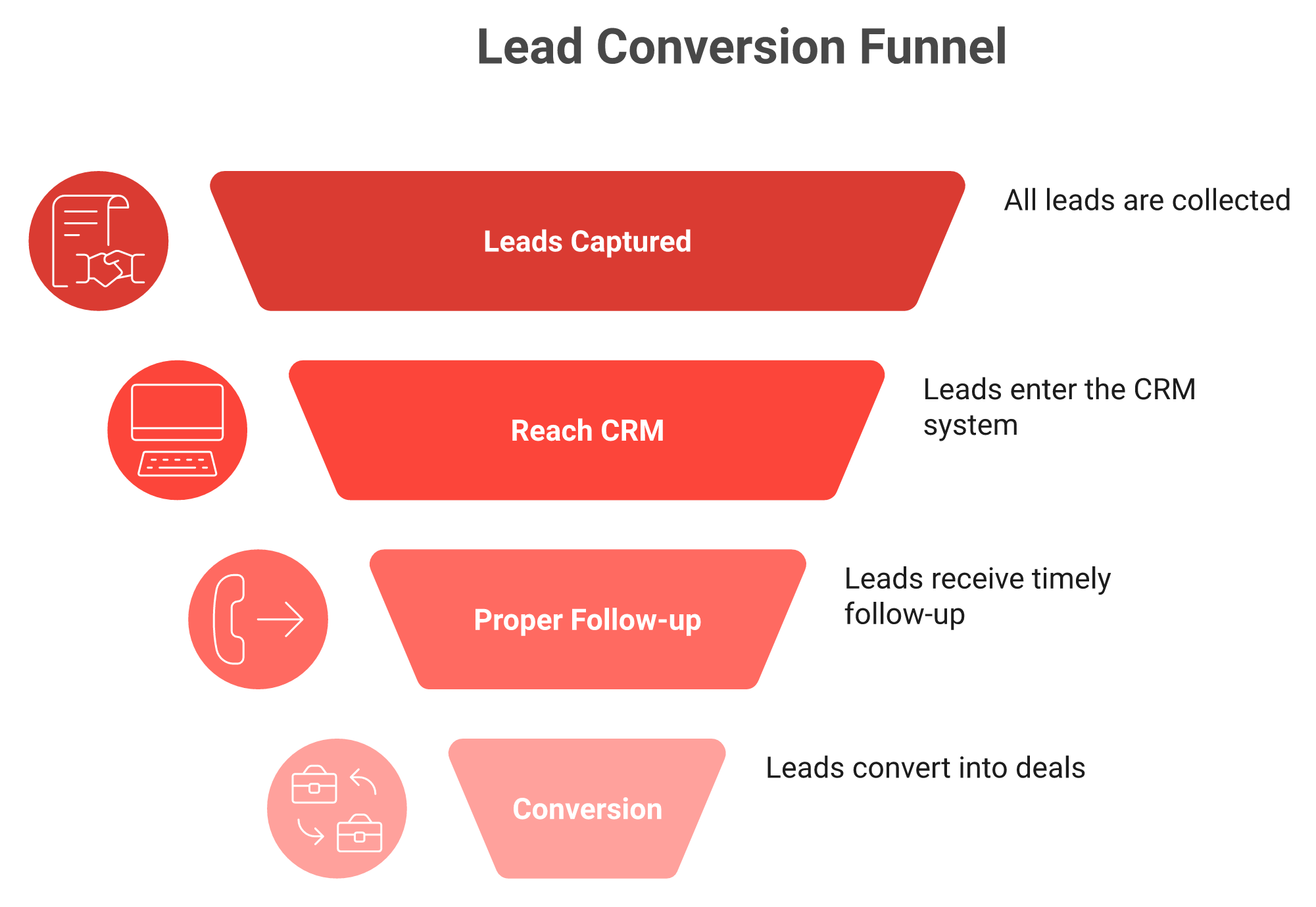
The numbers are brutal and worth citing exactly. Up to 80% of event leads never reach the CRM at all. Roughly 87% are never properly followed up. And conversion probability decays from about 85% within two hours to around 9% after a week.
Most event leads never reach the CRM or get followed up, and conversion probability collapses within days, which is the after-scan gap no card app solves.
That is why the sharp operators run tight windows:
The 15-minute rule: send the "great to meet you" note before you leave the aisle.
The 48-hour rule: organize every contact before the memory fades, ideally the same night.
Miss those windows and you are calling a stranger who forgot you.
🎯 The shift: book it before they walk away
Here is my point of view, and the category mostly avoids saying it. Capture was never the problem. Follow-up is where deals are won or lost, and follow-up is losing.
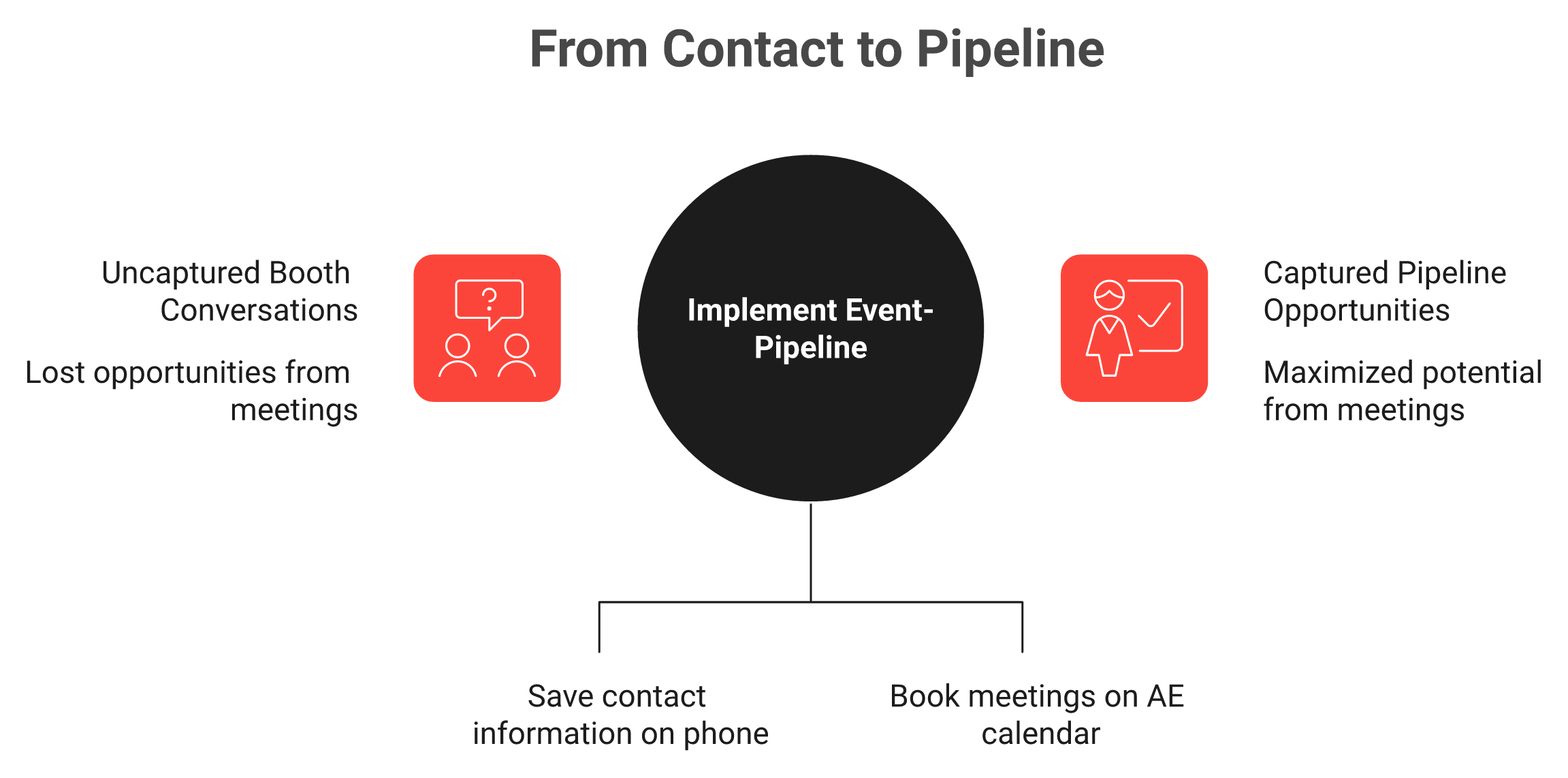
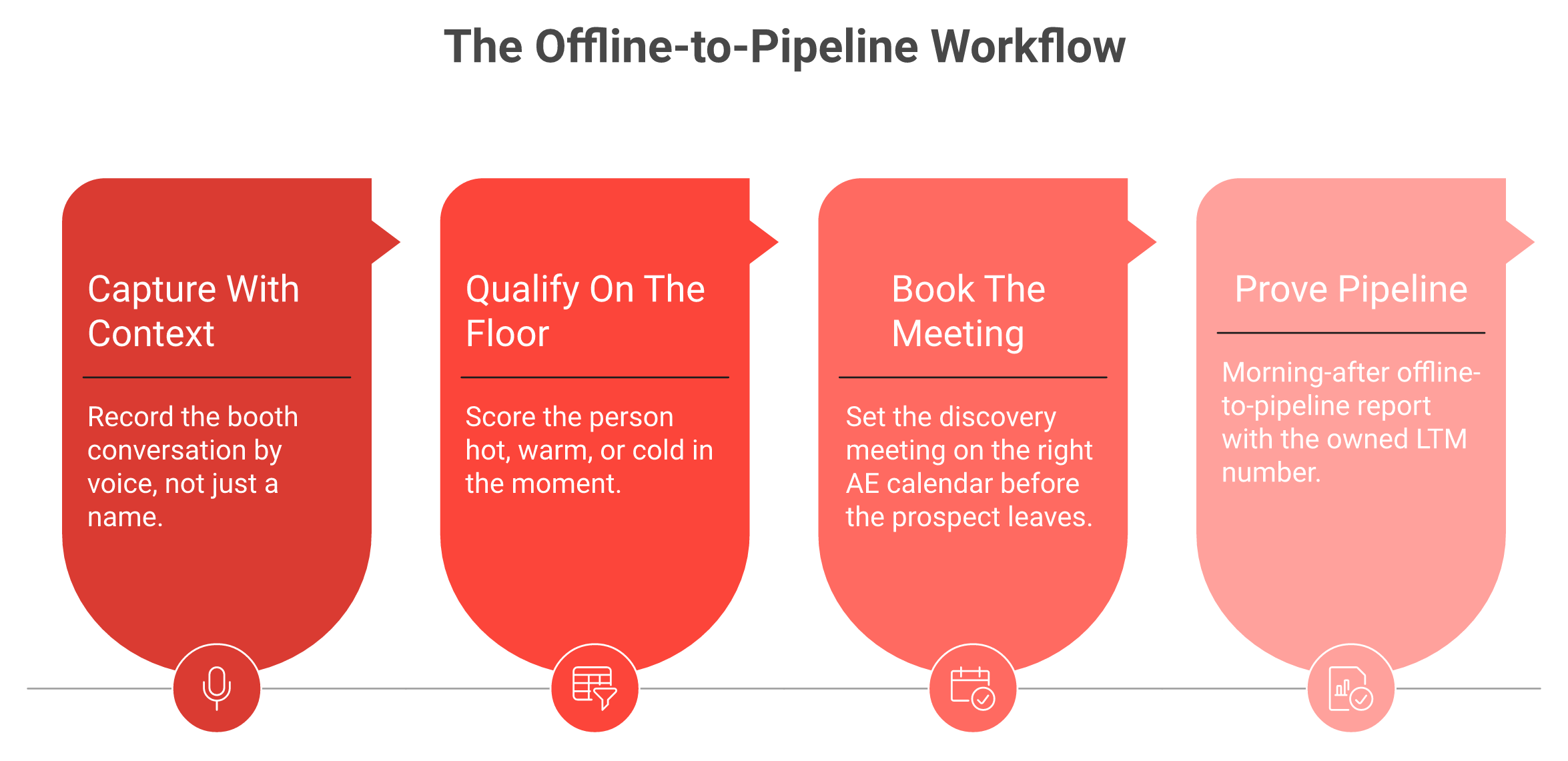
So the fix is not a faster scanner. It is booking the meeting while the buyer is still standing in front of you. That is the entire design of B2Brain: capture the conversation with context by voice, qualify on the floor, and book the discovery meeting on the right AE's calendar before the prospect leaves. It is the only workflow that runs before, during, and after the show on one shared layer, so you walk out with meetings booked and a pipeline number, not a CSV of 400 contacts nobody acts on. This is meeting-booking on the trade show floor built for booth teams.
The offline-to-pipeline workflow books the meeting at the booth and proves it with the Leads-to-Meeting metric, instead of ending at a saved contact.
Q7. How does HiHello compare to Popl, Blinq, and other alternatives? [toc=7. HiHello vs Alternatives]
Let me keep this neutral, because the honest answer helps you shortlist faster than a rigged ranking would.
⚖️ Card app vs card app
Among digital business card tools, HiHello competes well on software features, template depth, and pricing transparency. Popl and Blinq lean harder on NFC hardware and tap-to-share. All three, though, are solving the same job: exchange contact details cleanly. A deeper breakdown lives in our HiHello vs Blinq comparison.
HiHello vs Popl vs Blinq on Card-Tool Dimensions
Dimension
HiHello
Popl
Blinq
Core strength
Software, templates
NFC hardware cards
Relationship intelligence
Pricing transparency
Published upfront
Sales-gated for teams
Published
Recurring complaint
QR/NFC reliability
Forced account, notification spam
QR fails, App Clip issues
G2 social proof
~828 reviews
4,400+ reviews
8,800+ reviews
The competitor complaints are real and sourced:
"I HATE the notification spam. I get push, email, AND a text when I scan a Popl card. Why!?" Verified User in Real Estate Popl G2 Verified Review
"Too many people had issues reading the QR code, either their phone requested a download of the app or the code just didn't register at all." Verified User in Construction Blinq G2 Verified Review
🧭 The comparison that actually matters
Here is the reframe. If your job is rep-led networking, pick the card app you like best and move on. But if your job is booth-floor qualification, in-aisle meeting booking, and per-show pipeline attribution, the real comparison is not Popl versus HiHello. It is a card app versus an event-pipeline platform. If that is your job, compare the field against the best event lead capture software instead.
Many field marketers today survive by peacemealing, stitching five different tools to run one show. That is the gap a consolidated capture-to-pipeline layer closes. B2Brain is not a peer card app in this table; it is the offline-to-pipeline layer that displaces the badge-scan CSV, adding context, the booked meeting, and attributable pipeline the others leave out.
Q8. Who is HiHello actually built for, and who should look elsewhere? [toc=8. Who It's Built For]
The longest deal I have watched a team chase ran 524 days. A slow, contextless start at a show made every later step harder. Who you are decides whether HiHello helps or quietly costs you.
✅ Who HiHello serves well
HiHello is genuinely good for individual professionals and reps who want a polished digital card and frictionless contact exchange. On Professional, or on Business for a small team, it is worth it. The 4.6/5 across roughly 828 G2 reviews is earned.
If you control your own device and your own relationships, that is real value. As one contrarian operator line goes, if you do not control the device, you do not control the relationship.
❌ Who should look elsewhere
It is not built for field marketers, VP Sales, or RevOps who must qualify leads on the floor, book meetings at the booth, and defend six-figure event spend. Roughly 60% of lost sales trace back to poor qualification, and a card app does not qualify anyone.
HiHello fits solo networkers who need a clean card, but pipeline-accountable field marketers who must book meetings and prove per-show pipeline have outgrown a card app.
Use HiHello If, or Skip It If
Use this if
Skip this if
You are a solo networker or rep
You run 5 to 15 shows a year
You want a clean shareable card
You spend $20K to $200K per show
Contact exchange is the goal
You must report per-show pipeline
No CRM attribution needed
Salesforce/HubSpot attribution is the job
🎯 The bottom line by buyer
My read is simple. Buy HiHello for networking. If your scorecard is pipeline, you have outgrown a card app.
That pipeline-accountable buyer is exactly who we built B2Brain for. The field marketer is the brain, the reps are the face, and the offline-to-pipeline report makes that marketer the hero in the Monday review, answering "where is the pipeline?" with a defensible number, not a stack of cards. If that is your scorecard, check what B2Brain costs per event or Book a Demo.
There is no content to convert for this batch. The attached file `step6_AW3.md` confirms the previous step produced no Q9–Q12 sections, because the reaffirmed TOC for this HiHello review caps the article at eight MECE H2s (Q1–Q8), all of which were already generated and CMS-formatted in the two prior CMS passes.
## Nothing to process for convertHeadings = Q9, Q10, Q11, Q12
The `convertHeadings` variable points at sections that do not exist in this article. Since the CMS prompt explicitly forbids going online or inventing content ("ONLY optimize the content exactly as it has been generated previously within this thread"), there is no source HTML to transform. Producing HTML here would mean fabricating body sections, quotes, tables, and reviews, which every rule in this workflow prohibits.
To recap the true state of the build:
- **Q1–Q4:** written, then CMS-formatted into Webflow HTML (CMS pass 1).
- **Q5–Q8:** written, then CMS-formatted into Webflow HTML (CMS pass 2).
- **Q9–Q12:** never existed; the content-flow array was empty and the draft step returned no sections.
### What remains and can be produced now
These were deferred to their own steps and are the legitimate next deliverables, each CMS-ready if you want them:
- FAQ section with FAQPage schema (targeting: is the free plan enough, Salesforce and HubSpot integration, is HiHello worth it, HiHello vs Popl).
- JSON-LD schema markup (Review, Product, VideoObject, Table, BreadcrumbList).
- Meta title and meta description.
- A single stitched Q1–Q8 HTML file, publish-ready, combining both CMS passes.
If your real intent was a longer article than the eight-section TOC we reaffirmed, share the actual Q9–Q12 heading text and draft copy, and I will run the exact same CMS conversion on it.
Which of these should I generate next?
FAQ's
Is the HiHello free plan enough for a networking event?
Honestly, no. The free Personal plan caps you at 4 cards and 5 scans per month, which will not survive a single networking hour, let alone a two-day show.
Here is how we read the free tier:
It works as a demo to test the card-creation and sharing flow.
It does not include CRM sync, so nothing lands in Salesforce or HubSpot.
Real, repeatable use starts at the paid Professional or Business tiers.
For a solo professional testing the app, free is fine. For anyone working a booth, the scan limit alone rules it out. The deeper issue is that even a paid card app stops at the saved contact, and a contact is not a booked meeting.
That is the difference between capturing a name and generating pipeline. If your goal is to walk out of a show with meetings on the calendar, you need a workflow that captures with context and books the meeting on the floor. That is exactly how we generate new pipeline from events, rather than ending at a CSV.
Does HiHello integrate with Salesforce and HubSpot?
Yes, but only on the Business plan and above. HiHello connects natively with Salesforce, HubSpot, Zapier, Google Workspace, and Outlook. Free and Professional tiers do not include CRM integrations.
Two things matter for a RevOps buyer:
HiHello syncs contacts, not qualified pipeline, so the record lands but the deal context does not.
Its analytics track card views and shares, not lead-to-meeting conversion or per-show attribution.
On security, it clears most procurement reviews with SOC 2 Type II, GDPR alignment, and EU-US Data Privacy Framework compliance.
The limit is what the sync means. A contact sitting in Salesforce is the easy part; proving it drove pipeline is the hard part. Every event should live in the CRM, organized by campaign, with sourced and influenced pipeline tracked.
That is the loop a card app leaves open. We close it by syncing the qualified lead, the booked meeting, and per-show attribution, so lead capture into Salesforce becomes a pipeline record, not just a name.
Is HiHello worth it, and who is it actually built for?
HiHello is worth it for individual professionals and reps who want a polished digital card and frictionless contact exchange. On Professional, or Business for a small team, it earns its 4.6 out of 5 rating.
It is a good fit if:
You are a solo networker or rep sharing your own card.
Clean contact exchange is the main goal.
You do not need CRM attribution or per-show reporting.
It is the wrong tool if:
You run 5 to 15 shows a year with real budget on the line.
You must qualify leads on the floor and book meetings at the booth.
Your scorecard is per-show pipeline the CFO can see.
The distinction is simple. A card app answers who you met. A field marketer accountable for six-figure event spend needs to know what pipeline that meeting became. For that buyer, we built the workflow for booth teams to turn conversations into booked meetings and attributable pipeline.
How does HiHello compare to Popl and Blinq?
Among digital business card tools, HiHello competes well on software features, template depth, and pricing transparency. Popl and Blinq lean harder on NFC hardware and tap-to-share. All three solve the same job: exchange contact details cleanly.
The recurring complaints differ:
HiHello: QR and NFC reliability in dim or busy conditions.
Popl: forced accounts and notification spam after a scan.
Blinq: QR failures and App Clip issues for recipients.
On social proof, Blinq leads with more than 8,800 G2 reviews, Popl has over 4,400, and HiHello sits around 828.
Here is the reframe. If your job is rep-led networking, pick the card app you like best. But if your job is booth-floor qualification, in-aisle meeting booking, and per-show attribution, the real comparison is not Popl versus HiHello. It is a card app versus an event-pipeline platform. For a deeper side-by-side, see our HiHello vs Blinq comparison.
What happens to leads after HiHello captures them?
This is the gap most reviews skip. HiHello gets the contact onto your phone in seconds, which is real. But a contact is not a conversation, and a conversation is not a meeting.
The category data is brutal:
Up to 80 percent of event leads never reach the CRM.
Roughly 87 percent are never properly followed up.
Conversion probability decays from about 85 percent within two hours to around 9 percent after a week.
So the money in a trade show is made in the follow-up, not the scan. A capture-only tool leaves qualification and booking to a slower, later process, which is exactly where deals go cold.
Our view is that the fix is not a faster scanner. It is booking the meeting while the buyer is still in front of you, then proving the result with the Leads-to-Meeting metric. You can see how event lead capture works before, during, and after the show on one shared layer.
Enjoyed the read? Join our team for a quick 30-minute chat — no pitch, just a real conversation on how we’re rethinking Event Intelligence in B2b.

.png)

.webp)

.png)