11 Best Captello Alternatives for Event Lead Capture & Engagement (2026)
Written by
Sridhar Ranganathan
Last Updated :
October 7, 2026
Skim in:
13
mins
TL;DR
The 11 strongest Captello alternatives for 2026 are B2Brain, iCapture, Popl, Momencio, Blinq, BoothIQ, Mobly, BoothMaven, Zuddl, Validar, and CompuLead.
They split into three jobs: organizer-tied scanners that end at a CSV, capture-and-enrich rep tools, and platforms that book the meeting at the booth.
The top switch trigger is cost of access, with Captello reviewers reporting per-show badge API kits at $700 to $1,200, sometimes unavailable entirely.
Captello still wins on activation depth, shipping more than 60 games, so stay if foot traffic rather than conversion is your real constraint.
Season cost decides the purchase: per-show access fees add roughly $3,800 to $14,250 across 4 to 15 shows, before activation add-ons.
B2Brain reports 52% Leads-to-Meeting booked on the floor against a category average near 8%, the only published denominator in this comparison.
Q1. What are the 11 best Captello alternatives for event lead capture and engagement in 2026? [toc=1. 11 Best Alternatives]
The 11 strongest Captello alternatives for 2026 are B2Brain, iCapture, Popl, Momencio, Blinq, BoothIQ, Mobly, BoothMaven, Zuddl, Validar, and CompuLead. They split into three groups: organizer-tied scanners that end at a CSV file, capture-and-enrich rep tools, and meeting-booking platforms that write a booked meeting into the CRM at the booth. B2Brain sits in the third group and reports 52% Leads-to-Meeting on the floor against an industry average near 8%.
By the time you search this term, the expensive part is already spent. The booth, the drayage, the flights, and the five people standing on carpet are sunk cost, usually $20,000 to $200,000 for a single show. What is still in play is the 72 hours after the doors close, when a badge-scan export ages into a contact list nobody acts on, and conversion on an untouched lead falls from roughly 85% inside two hours to about 9% after a week. This guide evaluates 11 providers on capture speed, badge-format coverage, on-floor meeting booking, CRM sync depth, pipeline attribution, cost shape, and migration effort. It is written for revenue teams running 5 to 15 shows a year with Salesforce or HubSpot already in place, the same profile covered in our breakdown of the best event lead capture software for 2026.
Our Evaluation Criteria
Badge-format coverage: which encodings each tool actually decodes (Aztec, Data Matrix, QR, Code 128, printed text, and NFC), because a format gap is a total capture failure on the day.
Capture speed and queue behaviour: seconds from scan to a saved record with context attached, measured under peak floor traffic, not in a demo.
On-floor meeting booking: whether a rep can put a 30-minute follow-up on an account executive's live calendar before the prospect walks away.
CRM sync model: native real-time write-back to Salesforce or HubSpot versus a CSV import, plus how duplicates from multiple reps get resolved, which we cover in depth in our guide to lead capture in Salesforce.
Pipeline attribution: whether the tool can produce a per-show pipeline number, not just a lead count.
Cost shape: per-event, annual, per-device rental, or freemium, and whether badge scanning triggers extra per-show fees.
Vertical and stack fit: suitability for industrial B2B sellers (manufacturing, logistics, energy, and construction) with long, multi-threaded cycles.
⭐ How the shortlist was built
Pricing, integrations, and badge support were verified in July 2026 against vendor documentation and public pricing pages. Review evidence came from G2 and Capterra entries with named reviewers and live URLs. Where a vendor does not publish a number, this guide says so rather than estimating it.
Who This Guide Is For
Field and event marketing heads who have to answer "where is the pipeline?" with a number, not a lead count.
VP Sales and CROs running booth ROI math where reps are measured on meetings booked.
Founders taking a vertical B2B company to its first big US show with a small booth team.
RevOps leads who own CRM hygiene, dedup, and event attribution.
Teams currently paying for Captello and questioning the per-show API kit line item.
The 11 Providers at a Glance
1.1 B2Brain: Best for field marketing teams that must book meetings on the floor and prove per-show pipeline.
1.2 iCapture: Best for enterprise event teams wanting reliability and custom qualification forms across many shows.
1.3 Popl: Best for rep-led teams that want digital business cards plus lead capture in one app.
1.4 Momencio: Best for teams whose follow-up depends on sharing content after the conversation.
1.5 Blinq: Best for individual sellers and conference networking rather than booth operations.
1.6 BoothIQ: Best for small teams wanting AI-read printed badges with no barcode dependency.
1.7 Mobly: Best for teams that value voice notes plus enrichment on scanned badges.
1.8 BoothMaven: Best for a single-show pilot on a tight budget.
1.9 Zuddl: Best for teams that also run their own webinars and hosted events.
1.10 Validar: Best for Salesforce-first teams needing deep field mapping.
1.11 CompuLead: Best only for one-off booths on CompuSystems-managed floors.
Master Comparison Table
11 Captello Alternatives Compared (July 2026)
Provider
Best For
Key Strength
Pricing Model
B2Brain
Field marketing directors proving per-show pipeline to the CMO
Voice capture in about 4.2 seconds plus on-spot meeting booking into Salesforce or HubSpot
Per-event (Show Pass) and annual plans; first event free
iCapture
Enterprise event teams standardising capture across 10+ shows
Configurable qualification forms with strong onsite support
Annual subscription; list price not publicly disclosed
Popl
Sales reps who want one app for cards and leads
Digital business card ecosystem with large install base
Seat-based subscription; paid tiers for enrichment and CRM sync
Momencio
Marketers who follow up with content, not just email
LiveMicrosite content sharing tied to each lead
Subscription; pricing not publicly disclosed
Blinq
Individual networkers at conferences
Fast card sharing, highest review volume on G2
Freemium plus paid team plans
BoothIQ
Lean teams at shows with unreadable barcodes
AI reads printed badge text instead of scanning codes
Free tier for individuals; team plan published monthly
Mobly
Reps who talk first and type never
Voice notes plus AI and human-validated enrichment
Subscription with per-contact match costs
BoothMaven
Small exhibitors testing one show
Low-commitment single-event setup
Per-event; pricing not publicly disclosed
Zuddl
Teams running field events and webinars together
Capture inside a broader event platform
Custom enterprise quote
Validar
RevOps teams with heavy Salesforce customisation
Deep Salesforce field mapping and campaign structure
Annual subscription; pricing not publicly disclosed
CompuLead
One-off booths on CompuSystems floors
Direct access to that organizer's registration data
Per-device rental, per show
⚠️ Read the table by job, not by feature count
These 11 tools do three different jobs, which is why most comparison grids feel like apples against oranges. Organizer-tied options save a contact and stop at the export. Capture-and-enrich tools improve the contact record. Only a subset produce a commitment from the buyer before they leave the aisle, which is the distinction we draw in our primer on universal lead capture.
Captello itself is the baseline being replaced here, so it does not appear as a list item. Its own reviewers are clear about the cost trigger.
"Every time we have a show with lead scanning, I have to purchase an API kit that costs between $700-$1200. It's become costly." RebeccaGrace K., Verified User Captello G2 Verified Review
"It does not always work with every conference, if the conference does not provide and API kit for integration." Verified User in Consulting Captello G2 Verified Review
1.1 B2Brain: Best for field marketing teams that must book meetings on the floor and prove per-show pipeline [toc=1.1 B2Brain]
B2Brain reporting meetings booked, conversion rate and cost per pipeline dollar from HITEC 2026, framing events as a measurable revenue channel rather than an engagement activation spend.
🎯 Overview
B2Brain is an event lead capture app built around the offline-to-pipeline workflow, not around badge retrieval. It covers three phases on one shared intelligence layer: pre-event target lists drawn from your own CRM, on-floor voice capture with context, and a morning-after pipeline report. You can see how event lead capture works across all three phases. The buyer is usually a field marketing head at an industrial B2B company running 5 to 15 shows a year.
I built it after watching the same scene too many times. A rep types business cards into Salesforce in the cab back to the hotel, and half the context is already gone.
🧰 Core Services
Pre-event target list built by cross-referencing the show's attendee and exhibitor list against your CRM pipeline.
Per-account briefings for each rep to read before the floor opens.
Voice-first capture on the floor, offline-ready, with structured records written to the CRM.
On-spot meeting booking against the account executive's live calendar, with dual invites.
Post-show pipeline report covering meetings booked, sourced pipeline, and attribution by show, rep, and segment.
⚙️ Key Features Against the Criteria
Badge-format coverage: universal capture across badge codes, printed badges, and business cards, without a per-show API kit purchase.
Capture speed: tap once, talk for about 30 seconds, and a structured CRM record lands in roughly 4.2 seconds, close to one fifth the time typed notes take.
On-floor meeting booking: native, not an add-on. The 30-minute follow-up is confirmed while the prospect is still at the booth.
CRM sync model: Salesforce-native and HubSpot-native at parity, with dedup handled at capture rather than at import.
Pipeline attribution: Leads-to-Meeting (LTM), meaning meetings booked divided by qualified booth leads, reported per show.
Cost shape: per-event Show Pass or annual plan, first event free.
💰 Why Companies Consider B2Brain
The decision logic is almost always the ROI math. On a $70,000 booth where leadership wants 10x pipeline, and discovery-to-close runs near 12%, roughly one in five booth conversations has to become a qualified meeting. Our event ROI calculator walks that chain backwards. A tool that only improves the contact record cannot move that ratio.
B2Brain reports 52% LTM for meetings booked on the floor, against a category average near 8% for post-event chasing. My honest read is that the gap comes from commitment, not speed. A booked meeting is an agreement, while a fast follow-up email is still a request.
👥 Ideal Customer Profile
Company size: growth-stage to mid-market and enterprise, $25K+ average contract value.
Verticals: manufacturing, supply chain and logistics, energy, and construction, with CPG and life sciences secondary.
Buyer role: field or event marketing head as champion, VP Sales as co-signer, and RevOps as implementer.
Shows per year: 5 to 15, with 3 to 8 reps on the floor.
Stack requirement: Salesforce or HubSpot already in production.
🏷️ Pricing
Per-event Show Pass or annual plan, with the first event free. There is no per-show badge API kit fee, and the full breakdown of Show Pass and Pipeline plans is published openly.
✅ When to Shortlist
Reps are compensated on meetings booked, not badges scanned.
You need a per-show pipeline number for a QBR or CFO review.
Booth conversations lose context because nobody can stop to take notes at 4pm on day two, a problem covered in the booth-day workflow.
You want pre-event briefings grounded in your own pipeline rather than a cold prediction database.
❌ When Not to Shortlist
Solo booths and one-off attendance, where a per-event scanner is cheaper.
Teams with no CRM, since the entire model writes into Salesforce or HubSpot.
Android-first booth teams, because the native capture app is iOS.
Teams whose main need is third-party contact enrichment depth, where Popl, Mobly, and Momencio go deeper.
Teams that want a digital business card, which B2Brain does not offer.
🗣️ Customer Reviews
"The AI Conversation Summarization and Auto-CRM Entry feature is a standout, it's significantly better than other tools we've tried. Reps actually rave about it instead of dreading another sales tool." Ole O., Verified User B2Brain G2 Verified Review
"The main thing is the contact data. It's just not very good. The accuracy of emails is hit or miss, around 60-70%." Jorgealfa P., Verified User B2Brain G2 Verified Review
That second review is fair, and it is the gap I mentioned above. Enrichment depth is not where B2Brain competes, and teams that need it usually pair us with a dedicated data tool.
1.2 iCapture: Best for enterprise event teams standardising capture across 10+ shows [toc=1.2 iCapture]
🎯 Overview
iCapture is the reliability lane of this category. It serves enterprise event teams that run many shows a year and need one qualification form, one process, and one reporting view across all of them. It is a mature product with a strong onsite support reputation and no heavy AI narrative attached to it.
🧰 Core Services
Badge and business card capture across multiple devices and users.
Custom qualification forms configured per show or per booth zone.
BackOffice analytics showing scan volume by day, hour, and rep.
Lead routing and assignment to sales reps after capture.
Event ROI reporting at the show level.
⚙️ Key Features Against the Criteria
Badge-format coverage: broad, but dependent on the show providing an API integration. Without it, reps fall back to manual entry.
Capture speed: fast on API-enabled shows. Reviewers flag manual entry as the slow path.
On-floor meeting booking: not a native capability in publicly documented features.
CRM sync model: integrations are supported, though at least one reviewer reports the connection is not native to their CRM.
Pipeline attribution: event-level ROI reporting, without an on-floor conversion metric like LTM. Our guide to measuring event ROI explains why that distinction matters.
Cost shape: annual subscription. List price is not publicly disclosed.
💰 Why Companies Consider iCapture
The buying logic is standardisation and risk reduction. If you run 15 shows across four business units, a single configurable form and a support team who answers on the show floor is worth more than a clever feature. Teams also buy it to get scan-volume data for staffing decisions, which is a genuinely underrated use of the tool.
The structural trade-off is where the workflow stops. iCapture makes the lead record better and the reporting cleaner, but the exit artefact is still a routed lead, not a confirmed meeting. That leaves the conversion step with your SDR team after the show.
👥 Ideal Customer Profile
Company size: mid-market to large enterprise with a central events function.
Verticals: broad, with strong presence in transportation, manufacturing, and industrial services.
Buyer role: director of events or event marketing operations.
Shows per year: 10 or more, often across multiple brands.
Booth profile: multi-rep booths with several capture devices.
🏷️ Pricing
Annual subscription with a custom quote. iCapture does not publish list pricing, so the total depends on device count and show volume.
✅ When to Shortlist
You run 10 or more shows and need one consistent qualification form.
You need staffing analytics by day and hour across a season.
Onsite vendor support during setup is a procurement requirement.
❌ When Not to Shortlist
You need meetings booked at the booth, since that is not the product's design.
You attend shows that use their own proprietary capture software.
Your team cannot absorb manual entry at shows without an API integration.
You want native CRM write-back as a hard requirement, given reviewer feedback on this point.
🗣️ Customer Reviews
"iCapture solves a major problem for us... inability to calculate event ROI... It does not natively integrate with our CRM." Mcallaster M., Verified User iCapture G2 Verified Review
"Scanners complain it takes too long when having to do a manual entry for events that do not have an API Integration." Beverly G., Verified User iCapture G2 Verified Review
"That some events have their own software so we can't use iCapture." Michelle H., Verified User iCapture G2 Verified Review
B2Brain runs the same capture job without the API-kit dependency, then adds the step iCapture leaves to your SDRs: the meeting confirmed on the account executive's calendar before the prospect leaves the booth. If that is the gap in your season, Book a Demo.
1.3 Popl: Best for rep-led teams that want digital business cards plus lead capture in one app [toc=1.3 Popl]
Popl scanning badges, paper cards and QR codes through one mobile app that qualifies, enriches and syncs leads to CRM in seconds — a leaner capture path for lean teams.
🎯 Overview
Popl started as a digital business card product and added event lead capture later. It serves sales reps who want one app for sharing their own details and collecting someone else's. The install base is large, with 4,400+ G2 reviews, which makes it the safest-looking choice on a procurement checklist.
🧰 Core Services
Digital business cards with physical NFC card options.
QR-based lead capture forms for booth traffic.
Contact enrichment on captured leads (paid tiers).
CRM sync to Salesforce and HubSpot (paid tiers).
Team-level card management and branding controls.
⚙️ Key Features Against the Criteria
Badge-format coverage: the weak point. Multiple reviewers report badge barcode scanning failing at conferences, a pattern we also cover in our roundup of Popl alternatives.
Capture speed: fast for card exchange, slower for lead capture, because the recipient often has to act.
On-floor meeting booking: not a core capability in publicly documented features.
CRM sync model: available, but gated behind paid plans rather than included by default.
Pipeline attribution: not positioned as a pipeline reporting tool.
Cost shape: seat-based subscription. Reviewers cite roughly $140 per year per seat as the entry point.
💰 Why Companies Consider Popl
The logic is rep adoption. Reps already carry phones and already hate carrying cards, so a tool that lives in that habit gets used. For a five-person booth at a small show, it is a reasonable, cheap starting point.
The structural trade-off is directional. Popl optimises for the rep pushing their own information out, while a booth team needs the buyer's context pulled in. That is a design choice, not a bug, and it shows up in reviews as friction at the exact moment the conversation matters.
👥 Ideal Customer Profile
Company size: startups to mid-market sales teams.
Verticals: broad, with strong adoption in tech, real estate, and services.
Buyer role: sales leader or individual rep, not usually the events team.
Shows per year: 1 to 5, plus regular networking events.
Seat-based subscription with paid tiers required for enrichment and CRM sync. There is a trial rather than a free forever plan, per reviewer accounts.
✅ When to Shortlist
Reps want one app for card sharing and basic lead collection.
Your shows are small, and badge scanning is not the primary capture method.
Budget is tight, and per-seat cost is the deciding factor.
❌ When Not to Shortlist
Badge scanning at large industrial shows is your main capture path.
You need the buyer to do nothing at the point of capture.
CRM sync must be included, not an upgrade.
You need per-show pipeline reporting for a QBR.
🗣️ Customer Reviews
"I didn't really use Popl because it didn't scan bar codes like I thought it would. Scanning badges should have given the name and contact info, but it didn't work when I tried it." Drew D., Verified User Popl G2 Verified Review
"The only reason we use it is for the lead capture form. The ability for a lead to scan a QR code and then we get their information is huge. I HATE the notification spam." Verified User in Real Estate Popl G2 Verified Review
"It requires immediate action from the other person at the point of contact, which creates a small period of attention away from the client contact." Andrew P., Verified User Popl G2 Verified Review
1.4 Momencio: Best for teams whose follow-up depends on sharing content after the conversation [toc=1.4 Momencio]
momencio's universal capture options — badge scanning, card scanning, manual entry — with instant AI enrichment, avoiding the organizer-restricted lead retrieval limits that slow exhibitor follow-up.
🎯 Overview
Momencio pairs lead capture with content delivery. Its signature feature is a personalised microsite sent to each lead, so the follow-up carries the collateral the buyer asked about. It fits marketing teams whose sales cycle depends on spec sheets, case studies, and product documentation.
🧰 Core Services
Badge and business card capture with automatic follow-up email.
Personalised microsites built per lead from a content library.
Engagement tracking on what each lead actually opened.
CRM integration for captured leads and engagement data.
Interactive presentation and keynote lead collection.
⚙️ Key Features Against the Criteria
Capture speed: business card capture is reported as effortless, with follow-up email triggered on capture.
On-floor meeting booking: not a documented core capability.
CRM sync model: integration is a stated strength, and reviewers cite it as a reason they chose the tool.
Pipeline attribution: engagement scoring rather than pipeline reporting.
Onboarding load: reviewers describe a real learning curve and feature depth they do not fully use.
Cost shape: subscription. Pricing is not publicly disclosed.
💰 Why Companies Consider Momencio
The buying trigger is usually a content-heavy sale. If a prospect at a valve manufacturer's booth wants three datasheets and a certification document, delivering that within minutes is genuinely useful. Engagement tracking then tells the rep what to open the follow-up call with.
The trade-off is what the exit artefact is. Momencio produces an engaged lead, which is better than a raw contact, but engagement is not a commitment. My read is that content follow-up works best as a layer on top of a booked meeting, not as a substitute for one.
👥 Ideal Customer Profile
Company size: mid-market to enterprise marketing teams.
Verticals: technical manufacturing, life sciences, and consultancies.
Buyer role: head of marketing or event marketing manager.
Shows per year: 4 to 12, plus hosted events and keynotes.
Booth profile: booths where product documentation drives the conversation.
🏷️ Pricing
Subscription pricing is not publicly disclosed. Expect a custom quote based on users and events.
✅ When to Shortlist
Your follow-up needs collateral attached, not just an email.
You want to know which assets each lead opened before the sales call.
You run hosted events and keynotes alongside trade shows.
Your team cannot absorb an onboarding curve before the next show.
You need a per-show pipeline number rather than engagement scores.
🗣️ Customer Reviews
"There is so much value to be had using the tool, I feel like we're only utilising 60% of it right now." Martin D., Verified User Momencio G2 Verified Review
"Logins are a little slow, and the single sign on does not work, it requires syncing on the mobile app." Jia Li T., Verified User Momencio G2 Verified Review
1.5 Blinq: Best for individual sellers and conference networking rather than booth operations [toc=1.5 Blinq]
🎯 Overview
Blinq is a digital business card platform with the largest social-proof wall in this category, holding the #1 G2 position with 8,800+ reviews. It is excellent at what it was built for, which is handing over your details fast. It is not designed as a booth capture system.
🧰 Core Services
Digital business cards shared by QR, link, or text.
Team card management with branding controls.
Contact saving into the recipient's phone.
Basic lead capture forms.
Integrations for exporting collected contacts.
⚙️ Key Features Against the Criteria
Badge-format coverage: not a badge scanning product, unlike the tools covered in our guide to conference badge scanners.
Offline reliability: reviewers report QR scanning problems in poor connectivity, which is normal at expo halls.
On-floor meeting booking: not offered.
CRM sync model: available on paid tiers, but not the product's centre of gravity.
Post-show organisation: a documented weakness. Contacts land in the phone address book, not a show list.
Cost shape: freemium with paid team plans.
💰 Why Companies Consider Blinq
Blinq gets adopted because it is free to start and genuinely pleasant to use. Individual reps often bring it into a company from the bottom up, before the events team has a say.
Then the first big show happens. One reviewer described the exact failure mode a field marketer should worry about, which is losing the ability to group and prioritise leads after the event.
👥 Ideal Customer Profile
Company size: individuals through small teams.
Verticals: broad and largely non-industrial.
Buyer role: individual seller, founder, or consultant.
Shows per year: attendance rather than exhibiting.
Booth profile: no booth, or a tabletop with one person.
🏷️ Pricing
Freemium with paid team plans. The free tier covers card sharing.
✅ When to Shortlist
You are attending conferences, not exhibiting at them.
Card sharing is the main job, and lead capture is incidental.
You want a zero-cost starting point for a small team.
❌ When Not to Shortlist
You are running a multi-rep booth at an industrial show.
You need leads grouped by show for structured follow-up.
Recipients cannot be asked to download anything or fill a form.
🗣️ Customer Reviews
"When you do share your info, it saves the person's business card as contact info in their phone. This makes it tough to find again after a big tradeshow, event, etc." Madison Z., Verified User Blinq G2 Verified Review
"It doesn't always work reliably when scanning the barcode, especially in places with poor internet connectivity. This has made it necessary for me to consider purchasing printed business cards as a backup." Kasha A., Verified User Blinq G2 Verified Review
"Using the backend panel as an administrator is buggy and unreliable." Verified User in Hospitality Blinq G2 Verified Review
1.6 BoothIQ: Best for lean teams at shows with unreadable barcodes [toc=1.6 BoothIQ]
🎯 Overview
BoothIQ takes a deliberate architectural bet. It does not scan barcodes at all, and instead uses AI to read the printed text on a badge. That removes the per-show API kit dependency that frustrates Captello users, at the cost of depending on badge print quality.
🧰 Core Services
AI reading of printed badge text and business cards.
Voice-to-text notes attached to each lead.
Contact enrichment on captured records.
AI-drafted follow-up emails from the booth.
CRM sync to Salesforce and HubSpot.
⚙️ Key Features Against the Criteria
Badge-format coverage: printed text and cards only. No QR or barcode decoding by design.
Capture speed: fast, since there is no format negotiation with the organizer.
On-floor meeting booking: part of its positioning, though not the metric it reports against.
CRM sync model: documented Salesforce and HubSpot support.
Pipeline attribution: lead and follow-up reporting rather than a per-show pipeline number.
Cost shape: free tier for individuals, published monthly team plan.
💰 Why Companies Consider BoothIQ
The appeal is escaping the toll booth. If your last three shows each cost an extra four figures just to unlock scanning, a tool that ignores badge codes entirely reads like relief.
I think the bet is smart and incomplete. Printed-text reading solves format lock-in, but it inherits a new failure mode, which is badges where the name is in six-point type or the print is smudged. My read is that universal lead capture should cover both paths, not pick one.
👥 Ideal Customer Profile
Company size: startups through mid-market.
Verticals: broad, with tech and services well represented.
Buyer role: founder, sales leader, or a one-person marketing function.
Shows per year: 2 to 8.
Booth profile: 1 to 4 reps, often without a dedicated events team.
🏷️ Pricing
Free tier for individuals, with a published monthly team plan covering multiple seats and events.
✅ When to Shortlist
Your shows do not provide badge API access, or charge heavily for it.
You want a free-tier test before committing budget, similar to reviewing free lead capture app options.
A small team needs follow-up drafted before they leave the hall.
❌ When Not to Shortlist
Your shows use badges where the printed text is small or low-contrast.
You need QR or barcode decoding as a hard requirement.
You need three-phase coverage, including pre-event target lists.
No verified customer reviews were available in the provided source set for this provider.
1.7 Mobly: Best for reps who talk first and type never [toc=1.7 Mobly]
🎯 Overview
Mobly is a capture-and-enrich tool built around badge photos plus voice notes. Reps snap the badge, speak the context, and Mobly enriches the record before pushing it to the CRM. It is a genuine improvement on rented scanners, and its own reviewers say so plainly.
🧰 Core Services
Badge photo capture with AI and human-validated enrichment.
Voice notes attached to each lead.
Event tagging so you can see where you met someone before.
Salesforce and CRM sync for captured records.
Custom fields configured per market or persona.
⚙️ Key Features Against the Criteria
Badge-format coverage: photo-based. Reviewers have asked for QR functionality, noting most badges now carry codes.
Capture speed: fast at the point of capture. Enrichment latency is the friction, with reviewers reporting waits before leads populate.
Offline reliability: a reported weak spot. One reviewer describes scans not syncing over event Wi-Fi.
CRM sync model: available, though one reviewer describes the Salesforce integration as difficult and slow to set up. Our Mobly review goes deeper on that setup path.
Cost shape: subscription with per-contact match costs, which reviewers call high.
💰 Why Companies Consider Mobly
The voice notes feature is the real draw, and it solves a genuine problem. When you have 40 seconds between conversations at 4pm on day two, speaking is the only realistic input method.
The structural gap is what happens next. Mobly hands back an enriched, well-annotated contact, then leaves the conversion to the follow-up sequence. That is where the decay curve does its damage, since untouched leads fall from roughly 85% conversion inside two hours to around 9% after a week.
👥 Ideal Customer Profile
Company size: mid-market to enterprise sales and events teams.
Verticals: technology, consumer goods, and professional services.
Buyer role: demand gen or event marketing manager, with RevOps involvement.
Shows per year: 5 to 15.
Booth profile: multi-rep booths where reps capture on their own phones.
🏷️ Pricing
Subscription with additional per-contact enrichment match costs. Reviewers describe the per-match cost as expensive.
✅ When to Shortlist
Voice-based context capture is the deciding feature for rep adoption.
You want enrichment depth on every captured record.
Your floors have unreliable Wi-Fi, and you need dependable offline sync.
Badge QR decoding is a firm requirement.
You need meetings booked on the floor as the primary outcome.
Your RevOps team has no capacity for a long integration setup.
🗣️ Customer Reviews
"We really like the voice notes feature because when you're short on time between talking to people, it's very easy to get information on a lead. It was challenging to get it to sync with Salesforce." Ece K., Verified User Mobly G2 Verified Review
"Sometimes Mobly can be finicky, where it doesn't sync all the leads I've scanned... we end up with a lot fewer than we expected." Verified User in Events Services Mobly G2 Verified Review
"It takes quite a while for the app to populate captured leads within the conference list... it would be great to have QR code functionality." Kevin M., Verified User Mobly G2 Verified Review
1.8 BoothMaven: Best for a single-show pilot on a tight budget [toc=1.8 BoothMaven]
🎯 Overview
BoothMaven is a lightweight entrant aimed at small exhibitors testing whether a purpose-built capture app beats the rental scanner. It is a low-commitment option rather than a season-long system. Public documentation is thinner than the established players.
🧰 Core Services
Mobile badge and card capture for booth staff.
Lead notes and basic qualification fields.
Export and integration paths for captured leads.
Meeting-booking functionality within its stated positioning.
⚙️ Key Features Against the Criteria
Badge-format coverage: not clearly stated in available sources.
On-floor meeting booking: part of the product positioning.
CRM sync model: not clearly documented publicly. Verify in a demo before signing.
Pipeline attribution: not publicly disclosed.
Cost shape: per-event orientation. Pricing is not publicly disclosed, unlike the published Show Pass and Pipeline plans.
💰 Why Companies Consider BoothMaven
The decision is almost always a budget test. A founder taking a 10-by-10 booth to one show wants to prove the concept before asking for annual software budget.
That is a legitimate use case, and I would not talk anyone out of it. The caution is that a single-show tool rarely produces the show-over-show comparison a marketing budget conversation eventually requires.
👥 Ideal Customer Profile
Company size: small business and early-stage companies.
Verticals: broad.
Buyer role: founder or the one person who owns marketing.
Shows per year: 1 to 3.
Booth profile: 1 to 3 reps on a small stand.
🏷️ Pricing
Pricing is not publicly disclosed. Ask for per-event terms directly.
✅ When to Shortlist
You are testing one show before committing to annual software.
Budget approval depends on proving value at minimal cost.
❌ When Not to Shortlist
You need documented native Salesforce or HubSpot write-back.
You require show-over-show reporting across a full season.
Procurement demands verified pricing and security documentation.
No verified customer reviews were available in the provided source set for this provider.
1.9 Zuddl: Best for teams that also run their own webinars and hosted events [toc=1.9 Zuddl]
🎯 Overview
Zuddl is a broader event platform covering registration, webinars, and field events, with capture as one module inside it. Buyers choose it to consolidate several tools rather than to win the booth floor. Its review base skews toward registration and virtual event use.
🧰 Core Services
Event registration pages with branching logic and custom fields.
Webinar and virtual event hosting.
Onsite check-in and badge printing for hosted events.
Field event and roadshow management.
Analytics across registration and attendance.
⚙️ Key Features Against the Criteria
Trade-show badge capture: secondary to hosted-event functionality in its documented strengths.
CRM sync model: marketing automation and CRM integrations are supported.
Setup load: reviewers cite many steps to configure an event and occasional glitches.
Pipeline attribution: registration and attendance reporting rather than per-show pipeline.
Cost shape: custom enterprise quote.
💰 Why Companies Consider Zuddl
The logic is consolidation, and it is a real argument. If you run 20 webinars, 6 roadshows, and 8 trade shows, one platform and one contract is administratively cheaper than five.
The counter-argument comes from operators themselves. A consolidated suite optimises for the phases it was born in, and Zuddl was born in registration and virtual events, not on a convention floor at peak traffic.
👥 Ideal Customer Profile
Company size: mid-market to enterprise with a formal events function.
Verticals: technology, higher education, and financial services.
Buyer role: director of events or demand generation.
Shows per year: mixed portfolio of hosted and third-party events.
Booth profile: teams whose booth work is one part of a larger calendar.
🏷️ Pricing
Custom enterprise quote based on event volume and modules.
✅ When to Shortlist
You are consolidating webinar, registration, and field event tools.
Hosted events outnumber trade shows on your calendar.
Your team needs a tool live before the next show without long setup.
You need on-floor meeting booking tied to rep calendars.
🗣️ Customer Reviews
"We find there are sometimes too many steps to set up an event, and the landing page builds could use some additional simplification." Verified User in Information Technology and Services Zuddl G2 Verified Review
"It can sometimes be a bit glitchy and work in unexpected ways... particularly when demo-ing the system to stakeholders." Verified User in Automotive Zuddl G2 Verified Review
1.10 Validar: Best for Salesforce-first teams needing deep field mapping [toc=1.10 Validar]
🎯 Overview
Validar sits at the RevOps end of this category. Its appeal is control over how event data lands in Salesforce, including campaign structure, field mapping, and lead lifecycle handling. It is chosen by the person who has to clean up the data, not the person standing at the booth.
🧰 Core Services
Event lead capture with configurable qualification questions.
Salesforce campaign and lead object mapping.
Duplicate handling for multi-rep capture.
Event attribution reporting inside Salesforce.
Onsite check-in for company-hosted events.
⚙️ Key Features Against the Criteria
Badge-format coverage: dependent on organizer data access, similar to other lead-retrieval-lineage tools.
CRM sync model: the core strength, with deep Salesforce object and campaign mapping, the same territory covered in our guide to lead capture in Salesforce.
Multi-rep dedup: explicitly addressed, which matters on a six-person booth.
On-floor meeting booking: not a documented core capability.
Pipeline attribution: reporting happens in Salesforce rather than in a vendor dashboard.
Cost shape: annual subscription. Pricing is not publicly disclosed.
💰 Why Companies Consider Validar
RevOps buys Validar after an event blows up their database. If two reps scanned the same buyer and created three records, attribution for that show is already unreliable.
The trade-off is scope. Validar makes the data trustworthy, which is genuinely valuable, but trustworthy data about conversations that never converted is still a reporting problem. Clean records and booked meetings are different wins.
👥 Ideal Customer Profile
Company size: mid-market to enterprise with mature Salesforce usage.
Verticals: technology, manufacturing, and financial services.
Buyer role: RevOps or marketing operations lead as primary decision maker.
Shows per year: 6 to 20 across teams.
Booth profile: multi-rep booths with strict data governance.
🏷️ Pricing
Annual subscription with pricing not publicly disclosed.
✅ When to Shortlist
Salesforce data integrity is the top evaluation criterion.
Duplicate leads from multiple reps have broken past attribution.
You need event data structured as campaigns, not imports.
❌ When Not to Shortlist
You run on HubSpot rather than Salesforce.
You need booked meetings, not better-structured lead records.
You want a fast, low-configuration rollout before the next show.
No verified customer reviews were available in the provided source set for this provider.
1.11 CompuLead: Best only for one-off booths on CompuSystems-managed floors [toc=1.11 CompuLead]
🎯 Overview
CompuLead is the lead retrieval service tied to CompuSystems, a major show registration provider. It works where CompuSystems runs registration and does not travel with you to other shows. It appears here as the displacement reference, not as a season-long software choice.
🧰 Core Services
Badge scanning on CompuSystems-registered shows.
Rented handheld devices or an app licence per show.
Attendee data delivery after the event.
Basic qualifier fields on the scan.
⚙️ Key Features Against the Criteria
Badge-format coverage: complete on its own floors, unusable elsewhere.
On-floor meeting booking: not offered.
CRM sync model: the workflow ends at a file, which the team imports later.
Pipeline attribution: none. It reports scan counts.
Cost shape: per-device rental per show, with roughly $600 per device per show as the category reference point.
💰 Why Companies Consider CompuLead
Because it is the default in the exhibitor kit. Ordering it takes four minutes, and nobody has to get software approved.
That convenience is the trap the reader is already trying to escape. Operators are blunt about it, and one long-time exhibitor put it as plainly as anyone: roughly one in twenty businesses that receive the lead list ever act on it, and usually months late.
⚠️ What the ecosystem lock-in actually costs
Two of the organizer-tied options are per-show rentals in disguise. CompuLead reads badges only on CompuSystems floors, and the organizer's own Cvent LeadCapture reads badges only where Cvent runs registration.
Neither travels across a 10-show calendar. That means a new setup, new training, and a new export format every time your show mix changes.
👥 Ideal Customer Profile
Company size: any, for a single show.
Verticals: broad.
Buyer role: whoever fills the exhibitor kit order form.
Shows per year: 1, on a CompuSystems floor.
Booth profile: small booth with no CRM requirement.
🏷️ Pricing
Per-device rental, charged per show. The category reference point is around $600 per device per show.
✅ When to Shortlist
You are exhibiting once, on a CompuSystems-registered show.
You have no CRM and no follow-up process to protect.
❌ When Not to Shortlist
You exhibit across multiple organizers in a season.
You need real-time CRM records rather than a post-show file.
You are accountable for a pipeline number, since scan counts cannot produce one.
How We Evaluated These Providers
Sources consulted: vendor documentation and public pricing pages, verified G2 and Capterra reviews with live URLs, plus CEIR exhibitor research on lead tracking and decay.
Criteria selected: badge-format coverage, capture speed, on-floor meeting booking, CRM sync depth, pipeline attribution, and cost shape, because these are the six factors that change the outcome of a show rather than the demo.
Criteria de-prioritised: gamification depth and digital business card design, since neither affects whether a booth conversation becomes pipeline for an industrial B2B seller.
Data gaps stated openly: BoothIQ, BoothMaven, Validar, and CompuLead had no verified reviews in the source set, and several vendors do not publish pricing. Those cells say so rather than guessing.
B2Brain's own gaps: the native capture app is iOS-only, third-party enrichment depth is lighter than Popl, Mobly, or Momencio, there is no digital business card, and the G2 review base is 17 reviews against Blinq's 8,800+.
Which Provider Should You Shortlist?
The field marketer who must prove per-show pipeline to the CMO: shortlist B2Brain, and ask any other vendor to show you a per-show pipeline report before you sign.
The events director standardising capture across 12 shows: shortlist iCapture for process consistency, and confirm CRM write-back depth in writing.
The founder taking a five-rep booth to a first big US show: shortlist BoothIQ's free tier or BoothMaven for a low-cost first test.
The RevOps lead cleaning up duplicate event leads: shortlist Validar if you are Salesforce-first, and test dedup live with two reps scanning the same contact.
The marketer whose sale runs on datasheets and certifications: shortlist Momencio for content-led follow-up.
The sales team that wants voice capture above all else: shortlist Mobly, and stress-test offline sync before the show.
The team exhibiting once on a CompuSystems floor with no CRM: rent CompuLead, and skip the software evaluation entirely.
B2Brain publishes the one number this comparison keeps circling: Leads-to-Meeting, or meetings booked divided by qualified booth leads, at 52% on the floor against roughly 8% for post-event chasing. Every tool above captures a lead. Ask each one what happens to it before the prospect reaches the next aisle, or Book a Demo and we will walk your last show through the same math.
Q2. Why are exhibitors leaving Captello, and what does it still do better than everything on this list? [toc=2. Switch Triggers vs Strengths]
Exhibitors leave Captello for a small set of documented reasons: badge scanning at many shows requires buying a separate API kit reviewers price at $700 to $1,200 per show, that kit is unavailable at some conferences entirely, pricing is quote-only, and onboarding carries a real learning curve. They stay for one thing that no alternative on this list matches: a deep library of booth activations and games that reliably pull foot traffic at very large shows.
The trigger nobody budgets for
💸 You pay a toll to reach your own leads
The first switch trigger is not a software complaint. It is an access fee that appears after you have already paid for the booth.
"Every time we have a show with lead scanning, I have to purchase an API kit that costs between $700-$1200. It's become costly." RebeccaGrace K., Verified User Captello G2 Verified Review
Notice this reviewer likes the product. She rates it four stars and says it captures leads faster. The cost is structural, not a service failure.
⚠️ The kit is not always available at all
The second trigger is worse than cost, because money can be budgeted and availability cannot. If the show does not sell API access, the integration does not exist that week.
"It does not always work with every conference, if the conference does not provide and API kit for integration." Verified User in Consulting Captello G2 Verified Review
B2Brain removes that dependency deliberately, since capture runs on the rep's own iOS device and does not require a per-show badge API purchase. That is the design principle behind universal lead capture. My honest view is that this is the least glamorous part of the product and the one that saves the most weekends.
The five triggers you can paste into an internal email
📋 Write them as costs, not complaints
Procurement responds to numbers, not frustration. Here is the list in the language a CFO reads.
Per-show badge API kits, reported at $700 to $1,200 each, on top of licence cost.
No guaranteed badge access when the organizer does not sell an API kit.
Quote-only pricing, which makes season budgeting an estimate rather than a plan, unlike the published Show Pass and Pipeline plans.
An admin backend that requires trained staff, not just booth staff.
Activation setup time competing with pre-show sales preparation.
⏰ The delay is where the money leaks
Trade-show lead lists routinely get acted on months after the show, sometimes passed through a broker before anyone calls. That delay is the whole problem, since conversion on an untouched lead runs around 85% within two hours and falls to roughly 9% after a week.
Convention economics make this feel familiar. Exhibitors already pay marked-up rates for basics like power, cleaning, and handwashing stations, and paying to rent access to your own scanned leads follows the same pattern.
The concession: what Captello genuinely does better
✅ Activation depth is real, and nobody here matches it
Captello ships more than 60 games and activation experiences, which is more than any tool on this shortlist. Per-event licences also avoid device and user caps, so a 12-person booth does not multiply cost.
If your constraint is attention, that library is a legitimate asset. Engagement tooling solves attention. Pipeline tooling solves conversion. Both problems are real, and they are not the same purchase.
⭐ Stay with Captello if both of these are true
Foot traffic is your actual constraint, meaning people walk past your booth rather than into it.
You actively run activations at more than half your shows and have staff to operate them.
If neither is true, you are paying for an activation engine to do badge scanning. A $25,000-plus contract-value industrial seller at a targeted vertical show usually does not have an attention problem.
Activations raise booth stops at very large shows. That much is well documented. What no vendor publishes, including everyone on this list, is how many activation-sourced leads become qualified meetings.
The practitioner critique is blunt about the risk: the person who queues for the free iPad is often the non-decision-making employee. Yet engineered engagement clearly can work, since one operator ran a giveaway paired with a video sales letter and closed 85 paying customers from a three-day show. The variable is whether the mechanic qualifies or just attracts.
🧪 Run this test at your next show
Tag activation-sourced leads separately in your CRM. Tag conversation-sourced leads separately too. Then compare the meeting rate between the two groups.
B2Brain measures itself on Leads-to-Meeting per show, meaning meetings booked divided by qualified booth leads, which is exactly the number this test produces. Our guide to measuring event ROI shows how to set that comparison up. I could be wrong about which source wins at your shows, and that is the point of running it rather than arguing about it.
B2Brain skips activations on purpose and spends its product surface on the qualification and booking step instead, capturing by voice on the rep's own device, offline-ready, with no per-show access fee. You can see how event lead capture works across before, during, and after the show. The trade-off is honest: if you need a prize wheel, this is the wrong tool.
Q3. Which capture criteria actually separate these tools, badge formats, capture speed, and enrichment latency? [toc=3. Capture & Compatibility Criteria]
Four criteria separate these tools, and two do not. Badge-format coverage (Aztec, Data Matrix, QR, Code 128, printed-text reading, and NFC), seconds per capture under queue conditions, minutes to a usable enriched record, and whether the tool depends on a specific organizer's registration system all vary sharply. Offline mode and Salesforce or HubSpot connectors do not vary much, so treat those as disqualifier checks rather than differentiators.
Badge-format coverage, the criterion that fails hardest
🔍 A format gap is a total capture failure
Every other weakness degrades performance. A format gap stops capture entirely, at the booth, on the day, with no workaround.
Badge codes are not standardised across shows. A logistics show may print Data Matrix, an energy show may print QR, and older floors still use Code 128 barcodes, which is why conference badge scanner coverage varies so widely.
📊 Coverage matrix as verified in July 2026
Badge-Format Coverage Matrix (July 2026)
Tool
Badge codes (QR, barcode, 2D)
Printed-text reading
Business card
NFC
B2Brain
Yes, universal capture
Yes
Yes
Not publicly disclosed
iCapture
Yes, where the show provides API access
Unverified
Yes
Unverified
Captello
Yes, with a per-show API kit
Unverified
Yes
Unverified
Popl
Reported unreliable by reviewers
Unverified
Yes
Yes
Mobly
Reviewers request QR support
Yes, badge photo
Yes
Unverified
Momencio
Yes
Unverified
Yes
Unverified
Blinq
QR sharing, not badge retrieval
No
Unverified
Yes
BoothIQ
No, by design
Yes, AI reads printed text
Yes
Unverified
Zuddl
Yes, mainly hosted events
Unverified
Unverified
Yes
Validar
Yes, organizer-dependent
Unverified
Yes
Unverified
CompuLead
Yes, CompuSystems floors only
No
Unverified
Unverified
Unverified means the vendor does not publish it clearly. It does not mean absent, and I would rather mark a gap than guess.
Throughput and latency, the two axes vendors skip
⏰ Seconds per capture matters only under queue pressure
Any tool looks fast in a demo with one person. The test is 4pm on day two, when three prospects are waiting and your rep has no free hand, which is exactly the booth-day workflow we built for.
B2Brain records a structured CRM entry in about 4.2 seconds from a roughly 30-second spoken note, which is close to one fifth of the time typed notes take. That gap only shows up when there is a queue, which is precisely when leads get lost.
⚠️ Minutes-to-usable-record is published nowhere
Match rate percentages appear on every vendor site. Delivery time appears on almost none, and delivery time is what determines whether the rep can act at the booth.
"I noticed it takes quite a while for the app to populate captured leads within the conference list." Kevin M., Verified User Mobly G2 Verified Review
An enriched record that arrives overnight is a follow-up asset. A record that arrives at the booth is a qualification tool. Those are different products.
Ecosystem lock-in as a shortlist disqualifier
🔒 Some tools are per-show rentals in disguise
Two options here only read badges on their own turf. Cvent LeadCapture depends on Cvent running the show's registration, and CompuLead depends on CompuSystems running it.
Neither travels across a mixed 10-show calendar. That means new setup, new training, and a new export format whenever your show mix changes. iCapture users hit a version of this too.
"That some events have their own software so we can't use iCapture." Michelle H., Verified User iCapture G2 Verified Review
🎯 Score the tool against your pipeline chain
Work backwards the way a field marketer already does. A $70,000 show with a 10x pipeline mandate, at roughly 40% discovery-to-opportunity and 35% opportunity-to-close, means about one in five booth conversations must become a qualified meeting. Our event ROI calculator runs that chain for your own numbers.
Any tool you cannot score against that chain is unscoreable. Scan counts do not enter the equation anywhere.
The two anti-criteria
❌ Do not let a vendor sell you offline mode or a CRM connector
Nearly every tool here claims both. What actually varies is sync behaviour on reconnect, and whether duplicate scans from multiple reps get resolved on the way in.
"Sometimes Mobly can be finicky, where it doesn't sync all the leads I've scanned... we end up with a lot fewer than we expected." Verified User in Events Services Mobly G2 Verified Review
Ask two harder questions instead. How long does reconnect sync take, and what happens when two reps scan the same buyer?
✅ The qualification step is the real separator
Most booth teams scan everything and hand the pile to sales unsorted. Experienced field marketers score each lead hot, warm, or cold at the booth so that work is already done.
That matters because poor qualification is widely cited as the cause of around 60% of lost sales. B2Brain handles multi-rep deduplication at the moment of capture rather than at import, which is what keeps that scoring trustworthy later, and it is the same discipline we describe in our guide to lead capture in Salesforce.
B2Brain is an event lead capture app rather than a badge scanner, which is why its own scoring focuses on what happens after the decode: the context attached, the meeting booked, and the CRM record written. Named users include Zetwerk, Adobe, FourKites, and Auditoria.
Q4. What do Captello and these alternatives actually cost across a full 8-to-15-show season? [toc=4. Season Cost Math]
Season cost, not licence price, is the number that decides this purchase. A quote-only licence plus per-show badge API kits reported at $700 to $1,200 can add $3,800 to $14,250 across 4 to 15 shows, before any activation add-ons. Flat-fee and per-event annual models carry no per-show access fee, and B2Brain reports cost per booked meeting rather than cost per scan.
Stated assumptions
📐 Model inputs, verified July 2026
API kit modelled at the $950 mid-point of the $700 to $1,200 range reported by a Captello reviewer.
One licence, two booth reps, no add-on activations or automations.
Organizer scanner rental referenced at roughly $600 per device per show.
Vendors that do not publish pricing are marked as such, not estimated.
Every number below is directional. Get your own quote before you take it to finance.
The pattern is simple. Models with per-show access fees scale with your calendar, while flat and per-event annual models do not.
B2Brain prices per event on an annual commitment specifically so that a 5-to-15-show season carries no per-show access charge. First event is free, which is how we would rather be judged than on a quote.
The only number that actually matters
🧮 Divide season cost by meetings booked
Cost per scan flatters every vendor. Cost per booked meeting is where a $6,000 tool can turn out more expensive than an $8,000 one.
Take a full season cost and divide it by the meetings your team actually booked from those shows. Then compare that figure to your other channels.
💸 Benchmark against the channel, not the invoice
B2Brain's published benchmarks put a qualified event meeting at roughly 60% of the cost of an outbound meeting and about 40% of paid acquisition. My read is that this is the argument that wins the budget conversation, because it moves events out of the marketing-expense column and into the column where you generate new pipeline from events.
The reason it works is that events are already expensive elsewhere. One operator spent $35,000 to $40,000 on booth decoration, then replicated the same presence at the next show for $950, and concluded that the extra spend could have been used far better.
⭐ Software is the cheapest line in the show budget
Cost per attendee at a show, including travel, typically lands between $300 and $450 per head. Against flights, freight, carpet, and staff time, the capture tool is a rounding error, a point we make again in our roundup of the best event lead capture software for 2026.
Which makes saving $2,000 on software the worst available trade if it costs you meetings. That is the one piece of advice in this article I hold without hedging.
⚠️ What this model does not include
Activation and game add-ons, which are quoted separately by the vendors that offer them.
Enrichment match fees, which Mobly reviewers describe as high per contact.
Internal time for admin setup and rep training, which is real but not invoiced.
Ask every vendor to quote these three lines explicitly. Silence on any of them usually means it is billable.
Reviewer receipts on cost
"Love how easy it is to use across multiple devices and various levels of tech-savvy employees. Easily allows for ROI calculation on every event. It does not natively integrate with our CRM." Mcallaster M., Verified User iCapture G2 Verified Review
"The price, $140 a year? No way, would rather print thousands of business cards." Fabian T., Verified User Popl G2 Verified Review
"I just wish that it was less expensive to get matches on individual contacts." Ece K., Verified User Mobly G2 Verified Review
B2Brain reports Leads-to-Meeting per show, at 52% on the floor against roughly 8% for post-event follow-up, which is what turns a cost table into a cost-per-meeting table. Ask any vendor on this list for the same denominator before you sign an annual contract, or Book a Demo and we will run your last season through it.
Q5. Which alternative fits your show volume, vertical, and CRM stack? [toc=5. Fit by Buyer Profile]
Match the tool to your season, not to a feature grid. Under three shows a year: BoothMaven or a free tier. Five to fifteen industrial shows on Salesforce or HubSpot with a pipeline mandate: B2Brain or iCapture. Rep-led teams wanting cards plus enrichment: Popl or Mobly. Cvent-registration calendars: iCapture or Validar. CompuSystems floors: CompuLead, per show.
Five profiles, two finalists each
🎪 Profile 1: solo or sub-three-show exhibitor
Finalists: BoothMaven for a per-event test, or BoothIQ's free tier.
Not recommended: any annual enterprise contract. If you set up your own booth alone, and plenty of founders do spend seven straight hours doing it, software is not your bottleneck. A free lead capture app covers that situation adequately.
🚀 Profile 2: growth-stage founder building a first events machine
Finalists: BoothIQ for low-cost speed, or B2Brain if a CRM is already live and the goal is booked meetings.
Not recommended: Zuddl or Captello. Both are strong platforms that assume an events team you do not have yet.
🏭 Profile 3: the 5-to-15-show industrial field marketing team
Finalists: B2Brain or iCapture.
B2Brain serves manufacturing, supply chain and logistics, energy and utilities, and construction as primary verticals, with CPG, retail, and life sciences secondary. You can see the booth-day workflow that profile runs on. Pick iCapture instead if standardised qualification forms across many shows matter more than on-floor booking.
Not recommended: Blinq or Popl as the primary system. Digital card tools are built around the rep pushing information out, not the buyer's context coming in.
🏢 Profile 4: enterprise team locked to a Cvent or CompuSystems calendar
Finalists: iCapture or Validar.
Not recommended: BoothIQ. Its printed-text-only approach is deliberate and clever, but it does not decode the badge codes these registration systems rely on, which our guide to badge scanning apps breaks down format by format.
💼 Profile 5: rep-led, sales-first team with no events function
Finalists: Popl or Mobly.
Not recommended: Momencio or Validar. Both reward configuration effort that a rep-led team will not invest.
Which motion are you actually running?
⭐ The motion decides more than the vertical
Three event motions exist, and they buy differently. A full booth with four or five staff and a meeting room, a tabletop or pop-up with one or two people, or simply walking the floor on a ticket with no marketing spend, which is what gets captured on the floor for teams without a stand.
Most tools serve only one phase of one motion. B2Brain covers pre-event, on-floor, and post-event on one shared layer, which only pays off if you run more than a couple of shows a year. That is the three-motion workflow in practice.
❌ Who should not buy any of this
Be honest with yourself before you take a demo. Solo booths, consumer-facing sellers, teams with no CRM, one-off attendance, and developer or AI-summit events do not need an enterprise capture platform.
I would rather lose that deal than watch a founder pay for a season-long system to work one show. It is also the fastest way to get a tool blamed for a problem it was never bought to solve.
Floor reality on industrial shows
⚠️ Get two answers in writing before you sign
MODEX, IMTS, FABTECH, PACK EXPO, and DISTRIBUTECH floors differ in badge encoding and in how bad the Wi-Fi gets. Ask each vendor which formats they decode on your specific shows, and what happens when connectivity drops.
One more thing the spec sheets ignore: the last hour matters. At one Adobe Summit, a team collected some of its best leads and demos in the final 40 minutes, after every other exhibitor had packed up. That argues for offline reliability and battery life, not a bigger booth.
B2Brain is built for the 5-to-15-show field marketing team in manufacturing, supply chain, energy, or construction, with a $25,000-plus average contract value and Salesforce or HubSpot already in production. Outside that profile, a lighter tool above will genuinely serve you better.
Q6. How do you migrate off Captello without losing a show? [toc=6. Migration Playbook]
Run a parallel pilot, not a cutover. Export historical Captello leads and activation data before the licence lapses, map fields to your existing event campaign structure, then run the new tool at one mid-size show alongside your current process. Score both on meetings booked per 100 qualified conversations, and switch fully only after a show the new tool wins on that number.
The seven-step switch
📤 Steps 1 to 3: protect the data, then build the structure
Export everything before renewal. Pull lead history and activation data while your licence is still active. Ask in writing who owns the data if you do not renew.
Audit your duplicates. Count how many records exist for the same buyer because three reps scanned the same badge. That number is your real data-quality baseline.
Define the campaign structure first. Every event should live in the CRM as a campaign, with each lead and conversation tracked against it, the structure we lay out in our guide to lead capture in Salesforce.
That third step is the one teams skip, and skipping it is why attribution stays broken. Retrofit attribution later and it will be unreliable for the rest of the season.
⚠️ Steps 4 to 7: test the thing that actually breaks
Fix one success metric before the pilot. Meetings booked per 100 qualified conversations. Not scan volume.
Test dedup live in the demo. Have two people scan the same contact while the vendor watches. Ask what the CRM shows afterwards.
Run one mid-size show in parallel. Old process on one side of the booth, new tool on the other.
Decide on the number, not the vibe. Compare the two on the single metric you fixed in step 4.
B2Brain handles multi-rep deduplication and CRM hygiene at the moment of capture rather than at import, which is exactly what step 5 is designed to expose. Make every vendor on your list fail or pass that test in front of you.
The failure mode to design against
🔌 Disconnected systems, not bad software
The classic event-tech disaster is not a broken app. It is a stack where the capture tool, the CRM nurture, and the sales process were each configured correctly in isolation and never spoke to each other.
Reviewers describe this friction in day-to-day terms too, which is a useful early warning.
"Logins are a little slow, and the single sign on does not work, it requires syncing on the mobile app." Jia Li T., Verified User Momencio G2 Verified Review
❓ Three questions to send every vendor in writing
Which badge formats do you decode, named show by named show?
What exactly happens when the floor Wi-Fi drops mid-conversation, and how long does reconnect sync take?
Who owns the captured data if we do not renew, and how do we export it?
Email these before the demo. The speed and specificity of the reply tells you more than the demo will.
B2Brain runs its first-event pilot on exactly this structure: one show, Leads-to-Meeting as the single metric, and the campaign mapped in Salesforce or HubSpot before any rep scans a badge. The first event is free, which makes the parallel test cheap to run, and what B2Brain costs per event is published openly.
Q7. How do you prove per-show pipeline once you have switched? [toc=7. Proving Per-Show Pipeline]
Report one metric per show: Leads-to-Meeting, meaning meetings booked divided by qualified booth leads. Booked-on-the-floor programmes run near 52%, against a category average around 8% that depends on post-event chasing. Speed explains the gap, since conversion sits near 85% within two hours and falls to roughly 9% after a week, against an average response time of about 42 hours.
Why the number has to be a ratio
🎯 "We scanned 400 badges" is not an answer
The Monday pipeline review asks one question. Where is the pipeline?
Contact information is not where anything happens. Pipeline is where the buyer's world moves, which is why B2Brain measures Leads-to-Meeting rather than scan counts, and why we frame the whole product around offline to pipeline.
⏰ Speed, then commitment
The follow-up collapse is well documented across the category. Roughly 87% of event leads are never properly followed up, about 79% get no follow-up at all, and up to 80% never reach the CRM.
Here is where I think the standard advice gets it backwards. Everyone optimises for a faster follow-up email, but an email is a request while a booked meeting is a commitment. Those are not the same object.
The three pillars behind the ratio
💰 Pillar one: the money is made in the follow-up
Operators say it plainly, and they are right. The trade show does not make money. The follow-up does.
The practical rule is 48 hours or less, done at the hotel before the night out, because your memory of the conversation degrades faster than your notes suggest. Our walkthrough of how to collect leads at a trade show covers that same discipline. The "give them a few days to get settled" instinct is the single most expensive habit in booth work.
⚡ Pillar two: the 15-minute window is real
Some teams send a verification email within 15 minutes of the conversation. The buyer still remembers your face, so the email lands as continuity rather than as cold outreach.
B2Brain captures the context by voice in about 4.2 seconds and writes it straight to the CRM, which is what makes a 15-minute touch operationally possible at a busy booth. Whether that window beats a same-evening touch at every show, I honestly do not know yet.
📈 Pillar three: early momentum compounds
Enterprise buying cycles routinely run past 500 days, with Gartner-cited figures around 524 days. Losing three weeks at the front of that cycle is not a small delay.
That is the real cost of a CSV that sits until the following month. The deal does not die, it just never starts.
The per-show report that survives a CFO review
📊 Six rows, and last show's numbers beside them
Per-Show Pipeline Report Template
Line
This show
Last comparable show
Qualified conversations
-
-
Meetings booked
-
-
Leads-to-Meeting (%)
-
-
Pipeline created
-
-
Cost per booked meeting
-
-
Sourced vs influenced split
-
-
Fill it the morning after, not the following month. B2Brain publishes this as an unbranded morning-after report with multi-touch attribution, so the marketer who funded the booth presents the number as their own work. Our guide to measuring event ROI shows how each row is sourced.
⭐ Where I think this goes next
My read is that differentiation in this category is moving up the stack, away from capture speed and toward pipeline activation. Capture will be commodity within about 18 months, and the booking-and-attribution layer will be the whole argument.
Do not take that as gospel. It is what B2Brain is seeing this season, and I would genuinely like to know what your last show actually returned, meetings and pipeline, not scans.
B2Brain coined Leads-to-Meeting and reports it per show at 52% booked on the floor against a roughly 8% category average, with attribution broken out by show, booth area, rep, and segment. No other tool on this list publishes the same denominator. Ask yours to, or Book a Demo and we will build the report against your own last show.
FAQ's
What is the best Captello alternative for event lead capture in 2026?
There is no single best Captello alternative, because these tools do three different jobs. The right answer depends on which job you are actually buying.
If you need meetings booked at the booth and a per-show pipeline number: B2Brain, which reports 52% Leads-to-Meeting on the floor against a category average near 8%.
If you need standardised qualification forms across 10 or more shows: iCapture.
If your reps want digital cards plus basic capture in one app: Popl or Mobly.
If your follow-up runs on datasheets and certifications: Momencio.
If you are testing one show on a tight budget: BoothIQ's free tier or BoothMaven.
We would score every finalist against your pipeline chain rather than a feature grid. On a $70,000 booth with a 10x pipeline mandate, roughly one in five booth conversations has to become a qualified meeting, and a tool that only improves the contact record cannot move that ratio. B2Brain publishes Leads-to-Meeting per show for exactly this reason, and you can see how event lead capture works across before, during, and after the show before you shortlist anything.
Why do exhibitors switch away from Captello?
Exhibitors leave Captello for a small set of documented, structural reasons rather than because the software is bad. Its own reviewers rate it well while describing the same friction.
Per-show badge API kits that one reviewer prices at $700 to $1,200 each, charged on top of the licence.
No guaranteed badge access when the organizer does not sell an API kit for that conference.
Quote-only pricing, which makes season budgeting an estimate rather than a plan.
An admin backend that needs trained staff, not just booth staff.
Activation setup time competing with pre-show sales preparation.
The cost trigger is the one that gets escalated, because it arrives after the booth, drayage, and flights are already sunk. Across a 15-show season, kits modelled at the $950 mid-point add roughly $14,250 before any activation add-ons. B2Brain removes that dependency deliberately: capture runs on the rep's own device with no per-show badge API purchase, which is the whole point of universal lead capture. It is the least glamorous part of the product and the one that saves the most weekends.
Is Captello still worth keeping for booth engagement and games?
Sometimes, and it is worth saying plainly. Captello ships more than 60 games and activation experiences, which is more than any alternative on this list, and its per-event licences avoid device and user caps so a 12-person booth does not multiply cost.
Keep Captello if both of these are true:
Foot traffic is your actual constraint, meaning people walk past your booth rather than into it.
You run activations at more than half your shows and have staff to operate them.
If neither is true, you are paying for an activation engine to do badge scanning. A $25,000-plus contract-value industrial seller at a targeted vertical show usually does not have an attention problem.
The open question nobody in the category publishes, including every vendor on this list, is how many activation-sourced leads become qualified meetings. Tag activation-sourced and conversation-sourced leads separately in your CRM at the next show, then compare meeting rates. B2Brain measures itself on Leads-to-Meeting per show, which is exactly the number that test produces, and our guide to measuring event ROI shows how to set the comparison up.
How much do Captello alternatives cost across a full trade-show season?
Season cost, not licence price, decides this purchase. The variable that compounds is per-show access fees, not the subscription line.
Licence plus per-show API kits at a $950 mid-point: roughly $3,800 at 4 shows, $7,600 at 8, and $14,250 at 15.
Organizer scanner rental at about $600 per device per show with two devices: roughly $4,800, $9,600, and $18,000 across the same calendars.
Flat annual and per-event annual models: no per-show access fee, so cost does not scale with your show count.
Then divide season cost by meetings booked, not scans. Cost per scan flatters every vendor, and it is where a $6,000 tool turns out more expensive than an $8,000 one. B2Brain's published benchmarks put a qualified event meeting at roughly 60% of an outbound meeting and about 40% of paid acquisition, which is the argument that moves events out of the marketing-expense column. B2Brain prices per event on an annual commitment with the first event free, and what B2Brain costs per event is published rather than quoted.
How do you migrate off Captello without losing a show?
Run a parallel pilot, not a cutover. Nobody should switch capture tools three weeks before their biggest show of the year.
Export everything before renewal, including lead history and activation data, and ask in writing who owns the data if you do not renew.
Audit your duplicates to establish a real data-quality baseline.
Define the campaign structure first, so every event lives in the CRM as a campaign before any rep scans a badge.
Fix one success metric: meetings booked per 100 qualified conversations.
Test dedup live in the demo by having two people scan the same contact while the vendor watches.
Run one mid-size show in parallel, old process on one side of the booth and the new tool on the other.
Decide on the number, not the vibe.
Step three is the one teams skip, and skipping it is why attribution stays broken for the rest of the season. B2Brain handles multi-rep deduplication at the moment of capture rather than at import, which is what step five is designed to expose, and it runs its first-event pilot on this exact structure. When you are ready to test it against your current process, Book a Demo.
Enjoyed the read? Join our team for a quick 30-minute chat — no pitch, just a real conversation on how we’re rethinking Event Intelligence in B2b.


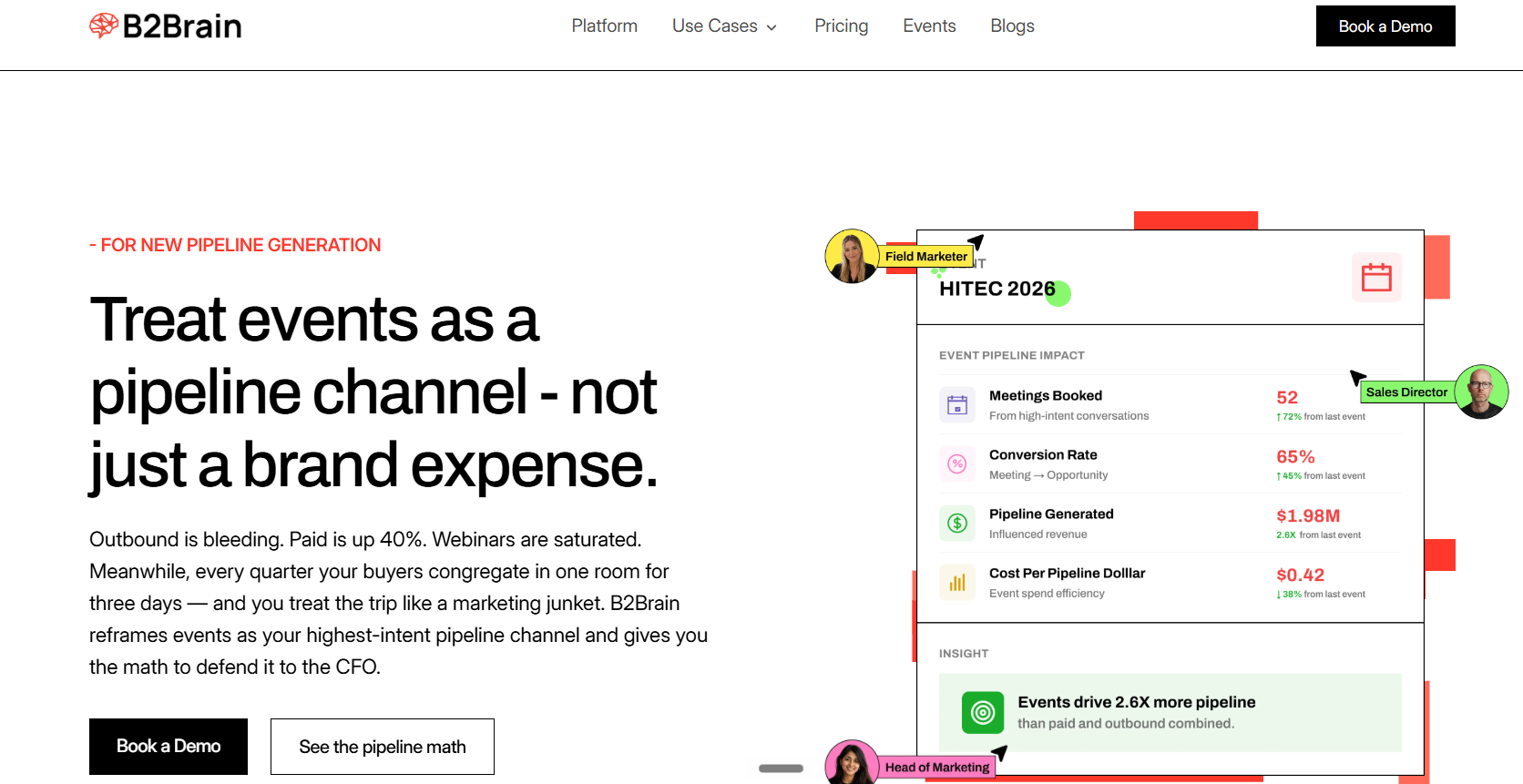
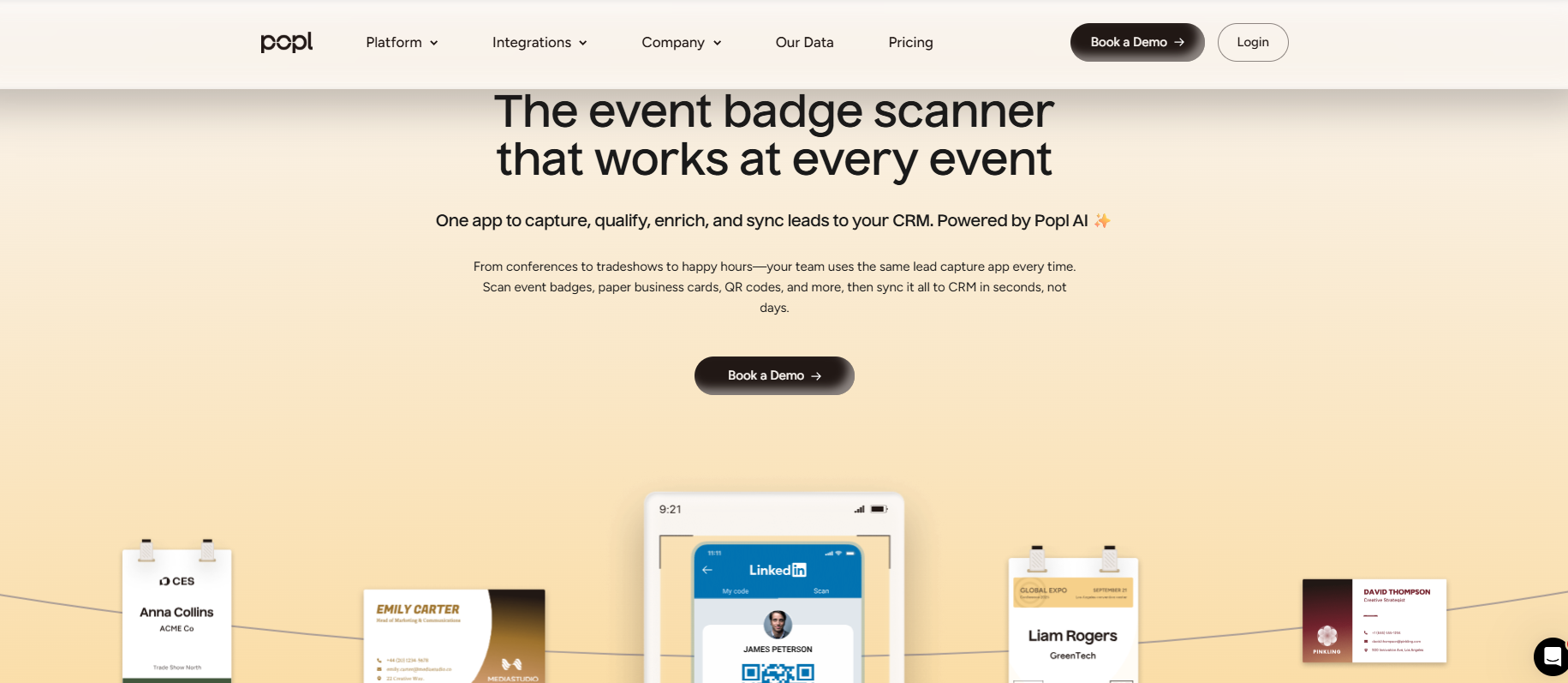

.png)

.png)
.png)