12 Best Momencio Alternatives for Event Lead Capture and Follow-Up (2026)
Written by
Sridhar Ranganathan
Last Updated :
August 6, 2026
Skim in:
13
mins
TL;DR
Twelve credible Momencio alternatives split into three buckets: meeting-booking tools, enterprise capture and qualification tools, and rep-led capture and enrich tools.
Most switches start with seat math. A three-rep team on a reported five-seat minimum and twelve-month term pays roughly $6,000 to $10,200 a year regardless of show count.
Badge-API kit fees are the hidden season cost, reported between $700 and $1,200 per show, and one Captello reviewer named that range directly on G2.
Momencio still genuinely wins on LiveMicrosite post-scan content analytics and enterprise configurability, so teams measured on content engagement should not switch.
B2Brain publishes 52% Leads-to-Meeting on the floor against an 8% post-event average, which moves cost per meeting further than any subscription price gap.
Migration breaks at the campaign structure, not the app. Build event campaigns and backfill last season before you switch tools, then run one show in parallel.
Q1. How do the 12 best Momencio alternatives compare, and which category does each one belong to? [toc=1. Compare All 12]
A Momencio alternative is an exhibitor-owned event lead capture app that replaces Momencio's per-seat annual model. The 12 credible options are B2Brain, BoothIQ, BoothMaven, Zuddl, iCapture, Captello, Validar, CompuLead, Popl, Mobly, Blinq, and snapAddy. They split into three buckets: meeting-booking tools, enterprise capture-and-qualification tools, and rep-led capture-and-enrich tools. B2Brain operates across all three event phases on one shared layer, with pre-event briefings built from the customer's own CRM pipeline.
Choosing wrong here is expensive because the money is already gone. A booth runs $20K to $200K per show before a single badge is scanned. The lead file lands, nobody works it, and the pipeline question arrives anyway. Lead value decays fast, from roughly 85% conversion inside two hours to about 9% after a week. I evaluated 12 providers against the criteria a switcher actually cares about: capture speed on the floor, offline reliability, in-booth meeting booking, CRM sync model, same-day follow-up feasibility, pipeline attribution, cost shape across a season, and migration effort. Written for Field Marketing heads, VP Sales, RevOps, and founders, this guide follows the same evaluation frame as our breakdown of the best event lead capture software for 2026.
Our Evaluation Criteria
On-floor capture latency: How many seconds from conversation to a structured record. Reps abandon anything slower than a notebook.
Offline reliability: Whether capture survives dead expo-hall Wi-Fi. Metal halls kill connections at peak hours.
In-booth meeting booking: Can a rep hold a real calendar slot before the prospect walks away.
CRM sync model: Native real-time write to Salesforce or HubSpot, versus a CSV import someone does later. Our guide to event lead capture into Salesforce covers the field-mapping detail.
Same-day follow-up feasibility: Whether enriched data arrives fast enough to send while the show is live.
Pipeline attribution: Whether the tool reports sourced pipeline per show, not just scan counts.
Migration effort: Export cleanliness, field mapping, and whether engagement history transfers.
Who This Guide Is For
Field and Event Marketing heads who must answer "where is the pipeline?" with a number.
VP Sales or CRO teams running booth ROI math against a 10x pipeline mandate, often using an event ROI calculator before the season starts.
RevOps owners fixing dedup, field completeness, and per-show attribution.
Founders taking a vertical B2B company to a first big US show.
Teams mid-contract on Momencio and testing whether the seat minimum still fits.
💰 Why the seat math triggers most switches
Momencio prices per seat, per month, with a reported five-seat minimum and a 12-month term (G2 vendor-provided pricing, 2026). A three-rep team pays for five seats anyway. That gap shows up whether you exhibit twice or twelve times, which is why Show Pass and Pipeline plans are structured per event instead.
Provider List
1.1 B2Brain: Best for field marketing heads proving per-show pipeline and booking meetings at the booth
1.2 BoothIQ: Best for small teams wanting flat, unlimited-seat pricing without a contract
1.3 BoothMaven: Best for booking-first teams with a narrow scope
1.4 Zuddl: Best for teams needing event management plus capture in one suite
1.5 iCapture: Best for enterprise exhibitors standardizing capture across many shows
1.6 Captello: Best for booth engagement and gamification programs
1.7 Validar: Best for Salesforce and Marketo-native lead governance
1.8 CompuLead: Best for straightforward badge retrieval reliability
1.9 Popl: Best for rep-led card exchange with light lead capture
1.10 Mobly: Best for Salesforce-heavy teams wanting enrichment on scan
1.11 Blinq: Best for teams prioritizing digital card adoption and social proof
1.12 snapAddy: Best for DACH-region teams needing card and badge data cleanup
Master Comparison Table
Momencio Alternatives Compared: Best For, Key Strength, and Pricing Model
Provider Name
Best For
Key Strength
Pricing Model
B2Brain
Field marketing heads proving per-show pipeline to the CMO
Books the meeting on the floor and writes it to the CRM
Per-event Show Pass or annual Pipeline plan; first event free
BoothIQ
Small booth teams avoiding annual contracts
Flat unlimited-seat pricing, free individual tier
Flat monthly, no contract
BoothMaven
Teams wanting booking without a full platform
Narrow booking-first workflow
Not publicly disclosed
Zuddl
Teams running events and capture in one suite
Registration plus onsite capture in one system
Custom enterprise quote
iCapture
Enterprise exhibitors standardizing across many shows
Configurable qualification forms and multi-show reporting
Annual subscription plus per-event API kits
Captello
Marketing teams running booth engagement games
Engagement and gamification depth
Per-event pricing plus API kit fees
Validar
RevOps teams in Salesforce and Marketo
Native lead governance and field mapping
Annual subscription
CompuLead
One-off or low-volume exhibitors
Reliable organizer-side badge retrieval
Per-device, per-show rental
Popl
Individual reps exchanging contacts
Digital business card adoption
Per-seat annual subscription
Mobly
Salesforce-heavy teams wanting enrichment on scan
Contact enrichment plus voice notes
Subscription plus per-contact match fees
Blinq
Teams prioritizing card adoption
Largest review base in the category
Freemium plus usage-based tiers
snapAddy
DACH-region B2B teams
Card and badge data cleanup into CRM
Per-seat subscription
The Three Buckets, and Why Mixing Them Wastes Your Time
Most shortlists fail because they compare tools that were never built for the same job. Here is the honest split.
🧭 Bucket 1: meeting-booking tools
These treat the booked meeting as the output, not the contact. B2Brain, BoothIQ, BoothMaven, and Zuddl sit here. Judge them on calendar handling and CRM writes.
🏛️ Bucket 2: enterprise capture and qualification
iCapture, Captello, Validar, and CompuLead optimize for form logic, governance, and multi-rep control. They assume a RevOps owner exists. One iCapture reviewer flagged the setup dependency plainly.
"It's essential to ensure that the fields are mapped properly from the registration form all the way to badge creation and onsite capture. If any information is missing at any stage, it won't carry over as expected." Natalie S., Verified Reviewer iCapture G2 Verified Review
📱 Bucket 3: rep-led capture and enrich
Popl, Mobly, Blinq, and snapAddy serve the individual rep. Adoption is easy. Attribution stays thin, and reliability complaints cluster around sync, a pattern we broke down in our Mobly review.
"Sometimes Mobly can be finicky, where it doesn't sync all the leads I've scanned... we end up with a lot fewer than we expected." Verified User in Events Services Mobly G2 Verified Review
⚠️ The displacement baseline nobody lists honestly
The organizer's rented scanner is not a peer product. It is the thing most of this spend replaces, at roughly $600 per device per show. It saves the contact and loses the conversation, which is the core argument in our guide to lead retrieval apps for trade shows.
❌ Wrongly listed as Momencio alternatives
Review aggregators muddy this badly. G2's alternatives module surfaces vFairs, Apollo.io, ZoomInfo, and Seamless.AI. GetApp adds MailerFind, HubSpot Marketing Hub, and Dripify. None of them scan a badge or stand in a booth. Sales-intelligence and marketing-automation tools sit upstream of capture, so they cannot replace it. Filter them out before your shortlist gets polluted.
1.1 B2Brain: Best for field marketing heads proving per-show pipeline [toc=1.1 B2Brain]
B2Brain connects badge capture and conversation context with ICP scoring, meeting outcomes and attributed pipeline, offering revenue teams a measurable alternative to Momencio’s engagement-led workflow.
Overview
B2Brain is an event lead capture app built around the offline-to-pipeline problem, not around badge hardware. It covers three motions on one shared layer: pre-event briefings, on-floor capture with booking, and a post-event pipeline report. It serves mid-market and enterprise B2B exhibitors with Salesforce or HubSpot in the stack. Named customers include Zetwerk, Adobe, FourKites, Increff, and Atomicwork.
Core Services
Pre-event target list built by cross-referencing the show list against your own CRM pipeline.
Voice-first booth capture that turns about 30 seconds of talking into a structured CRM record.
On-spot meeting booking against the AE's live calendar, with dual invites.
Morning-after offline-to-pipeline report with multi-touch attribution.
CRM hygiene work: dedup, field completeness, and event-campaign tagging.
Key Features
Capture latency: Roughly 4.2 seconds to a structured record, about one-fifth the time of typed notes.
Offline reliability: Capture works without connectivity and syncs on reconnect.
In-booth booking: Yes, native, with the meeting written into Salesforce or HubSpot.
CRM sync model: Salesforce-native and HubSpot-native at parity, not a CSV import.
Attribution: Per-show pipeline sourced, meetings booked, and Leads-to-Meeting by rep, show, and segment.
Enrichment depth: Lighter than Popl, Mobly, or Momencio. This is a real gap, not a positioning choice.
⭐ Why Companies Consider B2Brain
The decision logic is arithmetic, not features. A $70K booth carrying a 10x pipeline mandate needs $700K in pipeline. Work backward through discovery-to-close rates and roughly one in five booth conversations must become a qualified meeting.
That ratio is what a contact list cannot deliver. B2Brain's published benchmark is 52% Leads-to-Meeting on the floor against an 8% post-event average. My read is that the number holds because booking happens inside the conversation, not four days later in a sequence. I could be reading it too strongly, though the gap is wide enough to survive some skepticism. The mechanics sit in our write-up on how to go from offline to pipeline.
Ideal Customer Profile
Company size: mid-market to enterprise B2B
Verticals: manufacturing, supply chain and logistics, energy, construction, vertical SaaS
Buyer role: Field or Event Marketing head, with VP Sales and RevOps as co-signers
Shows per year: 5 to 15
Booth team: two or more reps
ACV: $25K and above
Pricing
Per-event Show Pass or annual Pipeline plan. The first event is free. Pricing is deliberately not per-seat monthly, because event calendars are lumpy while annual pipeline goals are not.
✅ When to Shortlist
You must present per-show pipeline in a QBR, not a scan count.
Your reps skip notes because typing at the booth is too slow.
Your show calendar spans multiple badge vendors.
You want a free-event test before committing budget. Book a Demo to scope the first show.
❌ When Not to Shortlist
Solo booths or one-off show attendance, where the workflow overhead is not worth it.
Teams with no CRM, since the pipeline reporting depends on it.
Consumer-facing sellers, where meeting booking is not the goal.
Teams needing a digital business card, which B2Brain does not ship.
Android-first booth teams, since the native app is iOS.
Customer Reviews
"The AI Conversation Summarization and Auto-CRM Entry feature is a standout... Reps actually rave about it instead of dreading another sales tool." Ole O., Verified Reviewer B2Brain G2 Verified Review
"Reporting is basic. We can see usage and lead stats, but there are no rep performance dashboards, no clear ROI reporting like time saved or deals influenced." Ole O., Verified Reviewer B2Brain G2 Verified Review
"The main thing is the contact data. It's just not very good. The accuracy of emails is hit or miss, around 60-70%." Jorgealfa P., Verified Reviewer B2Brain G2 Verified Review
Worth stating plainly: B2Brain holds 17 G2 reviews against Blinq's 8,800-plus and Popl's 4,400-plus. That is a thin base. We counter on the Leads-to-Meeting outcome, not the review wall.
1.2 BoothIQ: Best for small teams avoiding annual contracts [toc=1.2 BoothIQ]
BoothIQ converts lead notes and voice memos into buyer intent, competitor mentions, rep performance and pipeline insights, supporting faster personalized follow-up after trade shows and conferences.
Overview
BoothIQ is an exhibitor-owned capture app aimed at teams that want AI scanning without a seat-based commitment. It sells a flat monthly price with unlimited seats and no contract. It fits smaller booth teams and first-time exhibitors testing the category, a group we cover in our guide to lead capture apps for trade shows.
Core Services
Business card and badge capture with AI reading
Contact enrichment after capture
Lead notes and basic qualification fields
CSV export and CRM handoff
Free individual plan for solo users
Key Features
Capture latency: Fast for card capture; scan-to-record timing is not publicly disclosed.
Offline reliability: Not clearly stated in available sources.
In-booth booking: Present as a booking feature, without a three-phase layer around it.
CRM sync model: Export and integration based, lighter than native two-way sync.
Badge formats: Reads no QR and no NFC, which is a hard limit on many floors.
Platform: Natively iOS only.
💸 Why Companies Consider BoothIQ
The pull is cost shape. A flat monthly fee with unlimited seats removes the seat-minimum math that pushes teams off Momencio in the first place. For a five-rep booth doing three shows, that arithmetic is genuinely favorable.
The trade-off is structural, not a bug. No QR and no NFC reading means the badge format on the floor decides whether the tool works that day. B2Brain's read is that badge-format dependency is the quiet failure mode in this category, and it does not show up in a demo. That is the case for universal lead capture over format-specific scanning.
Ideal Customer Profile
Company size: startup to lower mid-market
Verticals: broad, not vertical-specific
Buyer role: founder or marketing generalist
Shows per year: 1 to 5
Booth team: 1 to 5 reps
Decision maker: founder or single marketing owner
Pricing
Flat monthly subscription with unlimited seats and no contract, plus a free individual plan. Verify the current rate directly, since flat-price tiers move.
✅ When to Shortlist
You want unlimited seats without a 12-month term.
Your shows use printed badges or business cards.
You need a free tier to test before any spend.
❌ When Not to Shortlist
Your floors use QR or NFC badges, which the app does not read.
Your booth team runs Android devices.
You need per-show pipeline attribution in the CRM, not a lead export.
You need pre-event target lists built from your own pipeline.
Customer Reviews
No verified customer reviews were available in the provided source set for this provider.
B2Brain's own gap is worth naming next to BoothIQ's: both are iOS-native, so an Android-heavy booth team should test that constraint before anything else. Where the two separate is after the show, when the report built for booth teams puts sourced pipeline and Leads-to-Meeting in front of the CMO by 9am.
1.3 BoothMaven: Best for booking-first teams with a narrow scope [toc=1.3 BoothMaven]
BoothMaven centralizes event readiness, staff assignments, task checklists and CRM sync testing, helping exhibitors compare planning and operational control alongside Momencio’s capture and follow-up capabilities.
Overview
BoothMaven is a booking-first exhibitor tool built around getting a follow-up meeting on the calendar at the show. Its scope is deliberately narrow, which keeps rep training light. It suits small to mid-sized B2B teams whose main gap is scheduling, not capture volume.
Core Services
Badge and card capture with basic lead fields
Meeting scheduling against rep availability
Lead export for CRM handoff
Simple per-show lead lists
Key Features
In-booth booking: Core function, the reason the tool exists.
CRM sync model: Integration and export based; native two-way depth is not clearly stated in available sources.
Offline reliability: Not publicly disclosed.
Attribution: Meeting counts, not sourced pipeline by show.
Pre-event motion: None documented.
⏰ Why Companies Consider BoothMaven
The logic is narrow and honest. If your only broken step is scheduling, a scheduling tool is cheaper than a platform. Teams doing three or four shows a year often need nothing more.
The limit is what happens next. Booking a meeting is one step, and proving that the meeting became pipeline is a different job. Booking is the most common next-best-action, not the whole workflow, which is why measuring event ROI starts after the calendar invite goes out.
Ideal Customer Profile
Company size: startup to mid-market
Buyer role: founder or sales lead
Shows per year: 2 to 6
Booth team: 2 to 4 reps
Pricing
Pricing is not publicly disclosed. Request a per-show quote before committing to a season.
✅ When to Shortlist
Scheduling is your single biggest booth failure.
You want minimal rep training before day one.
You do not need pre-event target lists.
❌ When Not to Shortlist
You must report per-show pipeline, not meeting counts.
You need native Salesforce or HubSpot writes as the record.
Your floors have unreliable Wi-Fi and offline capture is non-negotiable.
1.4 Zuddl: Best for teams needing event management plus capture [toc=1.4 Zuddl]
Overview
Zuddl is an event platform covering registration, webinars, and onsite check-in, with lead capture as part of the suite. It serves teams running their own conferences alongside trade show booths. Buyers pick it to consolidate vendors, not to optimize booth capture.
Core Services
Event registration and landing pages
Onsite check-in and badge printing
Webinar and virtual session hosting
Onsite lead capture and reporting
Marketing automation integrations
Key Features
Capture speed: Adequate for check-in flows; booth-specific latency is not publicly disclosed.
Offline reliability: Not clearly stated in available sources.
In-booth booking: Available inside the broader platform.
CRM sync model: Integrations with marketing automation and CRM tools.
Attribution: Registration and attendance reporting, strong on owned events.
Setup effort: Heavier, since the platform covers many functions.
🏛️ Why Companies Consider Zuddl
Vendor consolidation is a real budget argument. One contract covering your user conference and your booth is easier to defend than three. Reviewers praise the customization depth and the support team.
The trade-off is that a suite optimizes for the whole event, not the 60 seconds at a booth. Setup steps multiply. My read is that suites win when you host events and exhibit at them, and lose when you only exhibit, where a dedicated trade show app carries the floor better.
Ideal Customer Profile
Company size: mid-market to enterprise
Buyer role: Event Marketing head or events program owner
Shows per year: mixed calendar of owned events and third-party shows
Decision maker: marketing leadership with procurement involvement
Pricing
Custom enterprise quote. Pricing scales with event volume and modules.
✅ When to Shortlist
You host your own conferences and also exhibit.
You want fewer vendors under one contract.
Registration and check-in matter as much as booth capture.
❌ When Not to Shortlist
Booth capture is your only need, since the suite is heavier than required.
You need setup done in a week before a near-term show.
Your priority is on-floor speed above platform breadth.
Customer Reviews
"The customization elements are incredible. We love the calendar and scene saving features... Their customer service is top-notch." Verified User in IT and Services Zuddl G2 Verified Review
"It can sometimes be a bit glitchy and work in unexpected ways... particularly when demo-ing the system to stakeholders." Verified User in Automotive Zuddl G2 Verified Review
1.5 iCapture: Best for enterprise exhibitors standardizing across many shows [toc=1.5 iCapture]
Overview
iCapture is an enterprise lead capture platform built for companies exhibiting at many shows a year. Its strength is standardizing one qualification form across a whole calendar. It serves large marketing organizations with a RevOps owner attached.
Core Services
Configurable qualification forms per show or per audience
Badge scanning via per-event API kits
Business card capture
Back-office analytics on rep and show performance
Multi-show ROI reporting
Key Features
Qualification depth: Strongest in this comparison for form logic.
CRM sync model: Integration based, and one reviewer reports no native CRM integration for their stack.
Badge dependency: Requires an API kit per event, and some shows block third-party apps entirely.
Rep analytics: Reports who scanned, when, and who did not use the app.
Setup effort: High. Field mapping must be correct end to end or data drops.
⚠️ Why Companies Consider iCapture
Consistency is the buying reason. When 20 shows produce 20 different lead formats, a standard form fixes a real reporting mess. Reviewers using it across 10-plus events a year cite ROI calculation as the payoff.
The structural cost is dependency and setup. If the organizer does not supply an API kit, reps fall back to manual entry, and speed collapses. That failure mode never appears in a demo, which is the argument for universal lead capture instead of kit-gated scanning.
Ideal Customer Profile
Company size: enterprise and upper mid-market
Verticals: transportation, industrial, healthcare, large manufacturing
Buyer role: Event Marketing director with RevOps support
Shows per year: 10 or more
Decision maker: marketing leadership plus procurement
Pricing
Annual subscription reported from roughly $8,000 per year, plus per-event badge API kit fees. Confirm kit costs per show, since they are the variable line item.
✅ When to Shortlist
You exhibit at 10-plus shows and need one standard form.
You want rep-level performance analytics.
You have a RevOps owner to run field mapping.
❌ When Not to Shortlist
You need native Salesforce or HubSpot writes as the system of record. Our guide to lead capture into Salesforce covers what native means in practice.
You lack an owner for setup, since implementation will stall.
Your shows frequently do not offer API access.
Customer Reviews
"iCapture solves a major problem for us... inability to calculate event ROI... allows us to keep our events sales teams accountable." Mcallaster M. iCapture G2 Verified Review
"Scanners complain it takes too long when having to do a manual entry for events that do not have an API Integration." Beverly G. iCapture G2 Verified Review
1.6 Captello: Best for booth engagement and gamification programs [toc=1.6 Captello]
Overview
Captello combines lead capture with booth engagement mechanics such as games and activations. It serves marketing teams whose brief includes booth traffic, not only lead volume. Forms are buildable and push into the CRM.
Core Services
Lead capture forms with custom fields
Gamification and booth activation templates
Badge scanning through per-event API kits
CRM and marketing automation imports
Multi-event lead consolidation
Key Features
Engagement depth: Strongest in this group for games and activations.
CRM sync model: Import based into CRM, praised by reviewers for consolidation.
Badge dependency: API kit purchase required per show, reported at roughly $700 to $1,200 each.
Attribution: Lead counts and engagement metrics, not sourced pipeline.
Support: Reviewers consistently rate onboarding and training highly.
💸 Why Companies Consider Captello
Traffic is a legitimate problem, and activations solve it. Teams with a large booth and a brand mandate get real use from the engagement library. Consolidating leads from many conferences into one place is the second draw.
The cost shape is where buyers get surprised. API kits are per show, so a 10-show season adds thousands beyond subscription. One reviewer named the number directly.
🎁 The gamification caution nobody prints
Prize-driven activations attract the wrong people. The person who signs up for every iPad giveaway is rarely the person with budget. Filling the funnel with unqualified scans makes the qualification problem worse, not better.
My read after watching booths at 4pm on day two is simple. Traffic without qualification just moves the sorting work to an SDR who will never do it, which is the whole reason how you collect leads at a trade show matters more than how many you collect.
Ideal Customer Profile
Company size: mid-market to enterprise
Buyer role: Field or Brand Marketing manager
Shows per year: 4 to 15
Booth size: mid to large with staffed activations
Pricing
Per-event pricing reported from roughly $500 per event, plus badge API kits at roughly $700 to $1,200 per show. Verify kit fees for each show on your calendar.
✅ When to Shortlist
Booth traffic is a stated goal alongside lead capture.
You need one place for leads from many conferences.
You value hands-on onboarding support.
❌ When Not to Shortlist
Your shows rarely provide API kits, since scanning then breaks.
Per-show kit fees will blow a fixed season budget.
You need qualified meetings rather than engagement volume.
Customer Reviews
"Every time we have a show with lead scanning, I have to purchase an API kit that costs between $700-$1,200. It's become costly." RebeccaGrace K. Captello G2 Verified Review
"It does not always work with every conference, if the conference does not provide an API kit for integration." Verified User in Consulting Captello G2 Verified Review
1.7 Validar: Best for Salesforce and Marketo-native lead governance [toc=1.7 Validar]
Overview
Validar is a capture and lead-governance tool built tightly around Salesforce and Marketo. It focuses on clean records, dedup, and campaign membership rather than booth experience. RevOps teams tend to be the champion here.
Core Services
Onsite badge and card capture
Salesforce and Marketo campaign attribution
Lead dedup and field validation
Event data governance and audit trails
Key Features
CRM depth: Built around Salesforce and Marketo objects rather than generic connectors.
Dedup and hygiene: A primary design goal, not an afterthought.
In-booth booking: Not a documented core feature.
Attribution: Campaign membership per event, which supports show-level reporting.
Rep experience: Functional rather than polished.
🧮 Why Companies Consider Validar
The buyer here has already been burned. A tool synced, the fields did not map, and the pipeline report was wrong for a quarter. Validar sells against that memory.
The trade-off is that governance tools rarely delight reps. Adoption depends on a mandate from RevOps. Clean data with low rep usage still produces a thin pipeline number, which is why the booth-day workflow has to be lighter than a notebook.
Ideal Customer Profile
Company size: mid-market to enterprise
Stack: Salesforce plus Marketo
Buyer role: RevOps or Marketing Operations lead
Shows per year: 5 or more
Pricing
Annual subscription. Specific pricing is not publicly disclosed.
✅ When to Shortlist
CRM hygiene and dedup are your stated pain.
You run Salesforce with Marketo and want native object handling.
You need per-event campaign attribution to survive an audit.
❌ When Not to Shortlist
You need on-floor meeting booking as a core motion.
Your team runs HubSpot as the primary system.
Rep adoption is your bottleneck rather than data quality.
1.8 CompuLead: Best for straightforward badge retrieval reliability [toc=1.8 CompuLead]
Overview
CompuLead is a long-running lead retrieval provider working through show organizers. It supplies devices and apps that read the badges issued at that specific event. It serves exhibitors who want capture to simply work for one show.
Core Services
Badge scanning hardware rental
Organizer-issued lead retrieval apps
Basic qualifier fields on scan
Post-show lead file delivery
Key Features
Badge compatibility: Highest, since it is the official system at supported shows.
CRM sync model: File delivery, not native sync. The workflow ends at the export.
Offline reliability: Device-based capture is generally dependable on the floor.
Attribution: Scan counts per show, nothing further.
Cost shape: Per device, per show, referenced at roughly $600 per device.
📄 Why Companies Consider CompuLead
Simplicity, mostly. For a single booth at a single show, renting the official scanner removes every compatibility question. Nobody has to test anything beforehand.
This is the displacement baseline, not a peer platform. It saves the contact and loses the conversation, a limit we unpack in our breakdown of the conference badge scanner model. Practitioners on Reddit segment it plainly: organizer-provided scanners are usually fine if you exhibit once or twice a year.
Ideal Customer Profile
Company size: any, weighted to small
Buyer role: founder or single event owner
Shows per year: 1 to 2
Booth team: 1 to 3 reps
Pricing
Organizer per-device rental, referenced at roughly $600 per device per show. Costs scale with device count and rise across a multi-show season.
✅ When to Shortlist
You exhibit once or twice a year.
You want zero setup and zero badge-format risk.
A lead file is genuinely enough for your process.
❌ When Not to Shortlist
You exhibit at five or more shows, where rentals get expensive fast. Compare it against Show Pass and Pipeline plans before the season starts.
You need context on why each conversation mattered.
You must report sourced pipeline per show to leadership.
1.9 Popl: Best for rep-led card exchange with light lead capture [toc=1.9 Popl]
Overview
Popl started as a digital business card company and added event lead capture later. It serves individual reps and teams who network heavily. Adoption is easy because the core action is sharing your own details.
Core Services
Digital business cards and NFC cards
QR-based lead capture forms
Contact enrichment
Team card management
CRM integrations
Key Features
Capture speed: Fast for card sharing; badge scanning draws reliability complaints.
Recipient friction: Multiple reviewers report the receiver being pushed toward an account or app.
CRM sync model: Integration based, lighter than native two-way writes.
Attribution: Contact counts, not per-show pipeline.
Cost shape: Per-seat annual, reported near $140 per year at entry.
📱 Why Companies Consider Popl
The pull is rep adoption. Reps like it because it makes them look modern and requires no training. For conference networking, that is a fair fit.
The structural gap is who it serves. Card tools solve the rep's contact list. They do not answer the field marketer's pipeline question, and lead capture arrived as a later addition rather than the foundation, a pattern covered in our roundup of Popl alternatives.
Ideal Customer Profile
Company size: any, weighted to small teams
Buyer role: individual rep, sales manager, or founder
Shows per year: variable, often networking-led
Booth team: 1 to 5 reps
Pricing
Per-seat annual subscription, reported from roughly $140 per year and scaling with team size. No permanent free tier is reported by reviewers.
✅ When to Shortlist
Card exchange and networking are the main use case.
You want adoption without any training.
You are not reporting per-show pipeline.
❌ When Not to Shortlist
You need reliable badge scanning at industrial shows.
Recipient friction would hurt your brand at the booth.
You need meetings booked and attributed, not contacts collected.
Customer Reviews
"I didn't really use Popl because it didn't scan bar codes like I thought it would... It really didn't work for me." Drew D. Popl G2 Verified Review
"Lead capture is likely the most positive element of Popl. However, it's far too cumbersome when all someone wants is your contact information." Vadim E. Popl G2 Verified Review
"The only reason we use it is for the lead capture form. The ability for a lead to scan a QR code and then we get their information is huge." Verified User in Real Estate Popl G2 Verified Review
1.10 Mobly: Best for Salesforce-heavy teams wanting enrichment on scan [toc=1.10 Mobly]
Overview
Mobly is a rep-facing event capture app that enriches scanned contacts and pushes them to the CRM. It leans Salesforce-heavy and includes voice notes. It serves sales teams who want better data than an organizer scanner delivers.
Core Services
Badge and business card scanning
Contact enrichment with appended data
Voice notes on captured leads
Event tagging across shows
Salesforce sync
Key Features
Enrichment yield: Claims 90%-plus valid emails, while its own FAQ concedes enrichment can take until end of day.
Voice notes: Reviewers name this as a genuine time-saver at busy booths.
CRM sync model: Salesforce-oriented, though reviewers report a difficult setup.
Offline reliability: Sync failures without Wi-Fi are a repeated complaint.
Cost shape: Subscription plus per-contact match fees, which reviewers call high.
⏰ Why Companies Consider Mobly
Data quality is the reason. Organizer scanners return whatever the badge holds, which is often a job title and nothing else. Mobly fills the gaps and tags the event, and our full Mobly review walks through the trade-offs.
Latency is the mechanic to understand. A 90% valid-email claim and an end-of-day delivery window can both be true. If enrichment lands at 6pm, your same-day follow-up window has already closed, and lead value decays sharply inside the first hours.
Ideal Customer Profile
Company size: mid-market to enterprise
Stack: Salesforce primary
Buyer role: sales operations or field marketing manager
Shows per year: 5 to 15
Pricing
Subscription plus per-contact enrichment match fees. Exact rates are not publicly disclosed, and reviewers flag match costs as a budget factor.
✅ When to Shortlist
Badge data quality is your main complaint.
Reps will actually use voice notes.
You run Salesforce and can staff the integration work.
❌ When Not to Shortlist
You need same-day sends and cannot wait for enrichment.
Your halls have poor connectivity and sync failures are unacceptable.
You need per-show pipeline attribution, not enriched contact counts.
Customer Reviews
"We really like the voice notes feature because when you're short on time between talking to people, it's very easy to get information on a lead." Ece K. Mobly G2 Verified Review
"It was challenging to get it to sync with Salesforce... The integration process was difficult for my team to accomplish and took a long time." Ece K. Mobly G2 Verified Review
"It takes quite a while for the app to populate captured leads within the conference list." Kevin M. Mobly G2 Verified Review
1.11 Blinq: Best for teams prioritizing digital card adoption [toc=1.11 Blinq]
Overview
Blinq is a digital business card platform with the largest review base in this category, above 8,800 on G2. It adds contact capture and team management around card sharing. It serves teams whose priority is networking, not booth pipeline.
Core Services
Digital business cards with branding
QR and link-based sharing
Contact capture forms
Team card administration
CRM integrations on higher tiers
Key Features
Adoption: Easiest in this group, with the deepest social proof.
Connectivity dependence: Reviewers report QR failures and slow loads in poor signal areas.
Recipient friction: App Clip and download prompts block some recipients.
Contact organization: Cards save into the phone contact list, which reviewers say makes post-show follow-up harder.
Attribution: Not designed for per-show pipeline reporting.
⭐ Why Companies Consider Blinq
Social proof is genuinely persuasive here. When 8,800 reviewers rate a tool highly, procurement stops arguing. Setup is fast and reps need no instruction.
The honest read is that review volume measures a different job. Blinq wins at card exchange, as our Blinq vs Popl comparison shows. It was never built to answer where the pipeline came from, and expo-hall connectivity is exactly where reviewers report it struggling.
Ideal Customer Profile
Company size: any
Buyer role: individual professional or sales manager
Shows per year: variable, networking-led
Booth team: 1 to 5 reps
Pricing
Freemium with paid usage-based tiers, reported from roughly $2,400 per year at team scale. Confirm which tier includes CRM integration.
✅ When to Shortlist
Card sharing and personal branding are the goal.
You want a proven tool with heavy review validation.
Booth pipeline reporting is not your responsibility.
❌ When Not to Shortlist
Your halls have weak connectivity, since QR reliability suffers.
You need leads grouped by show for follow-up.
You must attribute pipeline to a specific booth.
Customer Reviews
"Blinq looks great and when it works it's a good user experience... have a good depth of tools on the backend to manage a team of users." Verified User in Hospitality Blinq G2 Verified Review
"It doesn't always work reliably when scanning the barcode, especially in places with poor internet connectivity." Kasha A. Blinq G2 Verified Review
"This makes it tough to find again after a big tradeshow... all the follow ups are just in your sea of contacts you have to try and remember." Madison Z. Blinq G2 Verified Review
1.12 snapAddy: Best for DACH-region teams needing card and badge cleanup [toc=1.12 snapAddy]
Overview
snapAddy is a German data-quality tool that captures business cards and badges and cleans the records before CRM entry. Its strength is European data handling and address accuracy. It serves DACH-region B2B teams with GDPR obligations front of mind.
Core Services
Business card and badge scanning
Address and contact data correction
Custom capture forms per event
CRM integrations including Salesforce and SAP
GDPR-oriented data handling
Key Features
Data cleanup: Core strength, especially European company and address data.
Regional fit: Strongest option here for DACH-region shows and language handling.
In-booth booking: Not a documented core feature.
Attribution: Lead and form data, not per-show sourced pipeline.
Cost shape: Per-seat subscription.
🇪🇺 Why Companies Consider snapAddy
Regional data quality is the reason. European contact records break North American tools in ways that only show up after import. Compliance posture matters to buyers with German legal review.
The scope is narrower than the platforms above. It fixes the record, much like a standalone OCR business card reader. It does not book the meeting or build the pipeline report your CFO wants.
Ideal Customer Profile
Company size: mid-market to enterprise
Region: DACH and wider Europe
Buyer role: Sales Operations or Marketing Operations
Shows per year: 3 to 12
Pricing
Per-seat subscription. Specific pricing is not publicly disclosed for all tiers.
✅ When to Shortlist
Your calendar is weighted to European shows.
GDPR handling is a procurement requirement.
Dirty imported records are your recurring pain.
❌ When Not to Shortlist
Your calendar is US-heavy with API-gated badges.
You need on-floor meeting booking.
You need LTM or per-show pipeline reporting.
How We Evaluated These Providers
Sources consulted: Provider documentation and pricing pages, the B2Brain Competitor Reviews file, G2 and Capterra verified reviews, and practitioner threads on r/tradeshows and r/b2bmarketing.
Criteria selected: Capture latency, offline reliability, in-booth booking, CRM sync model, enrichment latency, attribution depth, and cost shape across a season, because these decide whether a booth produces meetings.
Criteria de-prioritized: Booth aesthetics, gamification breadth, and virtual event features, since they do not change whether a lead becomes a meeting.
Data gaps: Pricing is undisclosed for BoothMaven, Validar, and some snapAddy tiers. No verified reviews were available in the source set for BoothMaven, Validar, CompuLead, or snapAddy.
Our own gaps, stated: B2Brain runs an iOS-native app, carries lighter third-party enrichment depth than Popl, Mobly, or Momencio, and ships no digital business card.
Which Provider Should You Shortlist?
The field marketer who must prove per-show pipeline: Test a tool that writes booked meetings into the CRM and reports sourced pipeline, and run the free first event before you commit budget.
The VP Sales whose reps get paid on meetings booked: Prioritize on-floor booking and offline capture, then check that the meeting lands on the correct AE's calendar. Our page on generating new pipeline from events covers the handoff.
The founder taking a first five-rep booth to a US industrial show: BoothIQ's flat unlimited-seat model or a per-event pass beats a 12-month seat minimum.
The RevOps lead burned by a silent sync failure: Validar or iCapture reward governance rigor, provided you own the field mapping.
The enterprise team standardizing 15 shows: iCapture for form consistency, with per-event API kit costs priced in upfront.
The team exhibiting once this year: Rent the organizer's scanner from CompuLead and spend the saved money on follow-up discipline.
The European-calendar team: snapAddy for data cleanup, paired with something that handles the booking step.
B2Brain publishes a 52% Leads-to-Meeting rate on the floor against an 8% post-event average, and that gap is the only number in this comparison tied to pipeline rather than scans. We built the morning-after report so the field marketer walks into Monday with a number, not a lead file. The first event is free, which is the cheapest way to test whether the claim holds on your floor. Book a Demo to scope it against your next show.
Q2. Why are field marketing teams leaving Momencio in 2026, and what does Momencio still do better? [toc=2. Why Teams Leave Momencio]
Teams leave over four things: seat math (a five-seat minimum on a twelve-month non-cancellable term when you staff three reps), add-on sprawl where AI, CRM sync, and gamification bill separately, badge-API dependency that breaks across a multi-vendor show calendar, and follow-up that tracks content opens instead of booking the meeting at the booth. Momencio still wins on microsite analytics and enterprise configurability.
💰 The seat math nobody models before signing
Run it for a real team. Three reps, six shows, twelve months. At the reported $100 to $170 per seat per month with a five-seat minimum, you pay for five seats regardless.
That lands between $6,000 and $10,200 for the year. Two of those seats never open the app. B2Brain prices per event with a Show Pass, or annually with a Pipeline plan, because event calendars are lumpy while pipeline goals are not. You can check what B2Brain costs per event before modelling a season.
⚠️ Why an API kit that works at one show fails at the next
Badge vendors are not standardized. MODEX, FABTECH, PACK EXPO, and DISTRIBUTECH do not share one system. An integration kit purchased for one floor becomes a fresh line item on the next, which is the case for universal lead capture across a mixed calendar.
Exhibitors feel this as an unpredictable cost, not a feature gap. One Captello reviewer named the same pattern in her own stack.
"Every time we have a show with lead scanning, I have to purchase an API kit that costs between $700-$1,200. It's become costly." RebeccaGrace K. Captello G2 Verified Review
❌ The five switch triggers, as symptoms
You pay for five seats and staff three reps.
Your calendar spans badge vendors the API does not cover.
AI, CRM sync, and gamification each bill as separate add-ons.
Reps need training before their first scan on the floor.
You need follow-up drafted or booked at the booth, not open-rate tracking after it.
✅ What Momencio genuinely does better
Credit where it is due. The money at a trade show is made in the follow-up, and Momencio was built around that belief. Its LiveMicrosite sends a personalized content page minutes after a scan, then reports what the prospect actually opened.
Real-time booth analytics and deep enterprise configurability are also genuine strengths. One reviewer describes the capture-to-email motion working exactly as sold, with a point-of-use complaint attached.
"Business cards capture, once captured, it sends a follow up email... logins are a little slow, and the single sign on does not work, it requires syncing on the mobile app." Jia Li T. Momencio G2 Verified Review
⏰ Do not switch if
Post-scan content engagement is your core measured motion.
Your enterprise team already uses the microsite reporting in QBRs.
You have more than six months left on a non-cancellable term and no budget to double up.
🧭 The LiveMicrosite parity map
This is the switcher's real fear, and no comparison page answers it. Here is the honest split.
Which Momencio Alternatives Replicate the LiveMicrosite Follow-Up Motion
Follow-up motion
Which alternatives do it
Replicates post-scan content pages and open tracking
B2Brain (books the meeting during the conversation and writes it to the CRM), Mobly (enriched contact plus voice note for rep-drafted outreach)
Does not compete there
Popl, Blinq, snapAddy, CompuLead, Validar
📊 The distinction that decides the argument
Microsite analytics answer "did they read it." A booked meeting answers "did they commit." Both are legitimate, but only one writes a dated record your CFO can attribute pipeline to, which is the whole premise of measuring event ROI properly.
There is a fair counterview worth naming. Consolidation advocates argue for one platform feeding your CRM and automation, and for teams hosting their own events that logic holds. My read is that it stops holding once you exhibit at floors you do not control.
B2Brain measures this as Leads-to-Meeting, meetings booked divided by qualified booth leads, and publishes 52% on the floor against an 8% post-event average. We chose per-event and annual pricing rather than monthly seats because that is how event budgets actually get approved.
Q3. Which Momencio alternatives book the meeting on the floor instead of chasing it afterwards? [toc=3. Meeting-Booking Alternatives]
Four alternatives are built to convert at the booth rather than nurture afterwards: B2Brain (3.1), BoothIQ (3.2), BoothMaven (3.3), and Zuddl (3.4). B2Brain captures voice-first context in about 4.2 seconds, works offline, books the meeting on the spot, and writes it into Salesforce or HubSpot, publishing a 52% leads-to-meeting rate against an 8% post-event average. The others trade breadth for that focus.
This bucket treats a calendar hold as the output, not a contact record. The internal champion is almost always the person who funded the booth and must report on it.
3.1 B2Brain [toc=3.1 B2Brain]
⏰ The sixty seconds that decide the show
Picture a rep at an industrial floor on day two, 4pm, booth slammed. A plant director asks two sharp questions about throughput. The conversation ends in one of two ways: a scan, or a calendar hold.
B2Brain exists for that fork. The scan path feels productive and costs you the deal.
❌ What the scan path actually does
The lead enters a list. Someone exports it. An SDR sequence starts on day four with no memory of the conversation.
By then the buying window has moved. Response rates decay steeply, from roughly 85% conversion inside two hours to about 9% after a week. Field marketers know the failure well: every scan gets dumped on sales, who then filter the garbage themselves.
✅ The three motions on one layer
Before: B2Brain builds a ranked target list by cross-referencing the show list against your own CRM pipeline, then hands each AE one-page briefings. See how event lead capture works across the three motions.
During: Tap once, talk for about 30 seconds, and get a structured CRM record in roughly 4.2 seconds, offline-ready when hall Wi-Fi dies.
During: The app pulls the AE's live calendar and books the 30-minute follow-up before the prospect walks away, with dual invites.
After: The morning-after report lands by 9am with pipeline sourced, meetings booked, LTM, and attribution by show, rep, and segment.
Reps also score the lead hot, warm, or cold at the booth, so the filtering work is already done before handoff.
⚠️ Where B2Brain does not fit
Honest limits matter more than feature lists here.
Requires Salesforce or HubSpot, ACV around $25K and above, and roughly 5 to 15 shows a year.
Wrong for solo booths, one-off attendance, no-CRM teams, and consumer-facing sellers.
Native app is iOS, so Android-heavy booth teams should test first.
Third-party enrichment depth is lighter than Popl, Mobly, or Momencio.
Ships no digital business card, deliberately.
📱 Why the report is unbranded
We are the brain, the field marketer is the face. B2Brain delivers the per-show pipeline report without our logo on it, so the champion presents it as their own work in the Monday review. That is the core of the booth-day workflow.
That design choice names the buyer. It is the person answering "where is the pipeline," not the rep who wants a nicer card.
"The AI Conversation Summarization and Auto-CRM Entry feature is a standout... Reps actually rave about it instead of dreading another sales tool." Ole O. B2Brain G2 Verified Review
"Reporting is basic. We can see usage and lead stats, but there are no rep performance dashboards, no clear ROI reporting like time saved or deals influenced." Ole O. B2Brain G2 Verified Review
Pricing: Per-event Show Pass or annual Pipeline plan, with the first event free.
3.2 BoothIQ [toc=3.2 BoothIQ]
Better than Momencio at: Cost shape. Flat monthly pricing near $499 with unlimited seats, no contract, plus a free individual tier.
The ceiling: Reads no QR and no NFC, and the app is natively iOS only. Badge format on the floor decides whether it works that day, a limit worth reading alongside our guide to the conference badge scanner model.
Cost shape: Flat monthly, no term commitment.
Choose this if: Your shows use printed badges or cards and you refuse a seat minimum.
3.3 BoothMaven [toc=3.3 BoothMaven]
Better than Momencio at: Simplicity. Booking is the product, so training is close to zero.
The ceiling: Narrow by design. No documented pre-event motion, and reporting stops at meeting counts rather than sourced pipeline.
Cost shape: Not publicly disclosed. Request a per-show quote.
Choose this if: Scheduling is your only broken step and you do not owe anyone a pipeline number.
3.4 Zuddl [toc=3.4 Zuddl]
Better than Momencio at: Breadth. Registration, check-in, webinars, and capture sit under one contract.
The ceiling: You buy event management you may not need, and setup steps multiply before your first show. A focused lead capture app for trade shows deploys faster when exhibiting is the only job.
Cost shape: Custom enterprise quote scaling with modules and volume.
Choose this if: You host your own conferences and also exhibit at third-party shows.
"It can sometimes be a bit glitchy and work in unexpected ways... particularly when demo-ing the system to stakeholders." Verified User in Automotive Zuddl G2 Verified Review
🔁 The objection I expect
"BoothIQ books meetings too, so what is different?" Fair question, and the answer is never the booking button.
B2Brain configures the next-best-action per customer, so booking, a pre-meeting email, or a champion intro can each be the trigger depending on your sales process. Booking is simply today's most common one. That mirroring is what makes the workflow survive past year one.
B2Brain publishes Leads-to-Meeting as its core metric, 52% on the floor against 8% post-event, and no competitor in this bucket tracks LTM at all. We give the first event free so you can test the number on your own floor rather than trusting ours. Book a Demo to line it up against your next show.
Q4. Which alternatives handle enterprise capture, qualification, and governance at scale? [toc=4. Enterprise Capture & Governance]
iCapture (4.1), Captello (4.2), Validar (4.3), and CompuLead (4.4) are the enterprise-grade Momencio alternatives. iCapture wins on configurable qualification forms and multi-show governance, Captello on booth engagement mechanics with per-event pricing flexibility, Validar on Salesforce and Marketo-native lead governance, CompuLead on straight retrieval reliability. All four cost more setup time than Momencio and assume a RevOps owner.
"Enterprise" here buys consistency, not speed. It means one form, one field map, and one report across twenty shows.
📋 The comparison that matters to RevOps
Enterprise Capture and Governance Alternatives: Trade-Offs and Cost Shape
Provider
Replaces about Momencio
Structural trade-off
Cost shape
iCapture
Standardized qualification across many shows
No native CRM integration for some stacks
From roughly $8,000/yr plus per-event API kits
Captello
Booth engagement plus lead consolidation
Breaks when a show provides no API kit
From roughly $500/event plus kits at $700 to $1,200
Validar
Salesforce and Marketo lead governance
No documented on-floor booking motion
Annual subscription, not publicly disclosed
CompuLead
Badge-format certainty at one show
Workflow ends at the lead file
Per device, per show, referenced near $600
B2Brain
Context capture without a long form
Requires Salesforce or HubSpot, iOS-native app
Per-event Show Pass or annual plan
4.1 iCapture [toc=4.1 iCapture]
Strongest form logic in this comparison, and the reason large teams standardize on it. The cost is setup rigor and badge dependency, and our notes on event lead capture into Salesforce explain why the field map decides the outcome.
"iCapture solves a major problem for us... inability to calculate event ROI... allows us to keep our events sales teams accountable." Mcallaster M. iCapture G2 Verified Review
"Scanners complain it takes too long when having to do a manual entry for events that do not have an API Integration." Beverly G. iCapture G2 Verified Review
Not recommended for: Teams without a RevOps owner, since implementation stalls and the tool takes blame for a staffing decision.
4.2 Captello [toc=4.2 Captello]
Deepest engagement and activation library, with genuinely praised onboarding. Per-show API kit fees are the budget surprise.
Not recommended for: Fixed-budget seasons where kit fees compound, or calendars where shows rarely offer API access.
🎁 The raffle problem gamification creates
Prize activations attract the wrong badge. The person collecting every free iPad entry is rarely the person with budget, and the actual buyer ignores the table entirely.
Roughly 60% of lost sales trace back to poor qualification. Filling a funnel faster with unqualified scans makes that worse, not better, which is why how you collect leads at a trade show matters more than how many you collect.
4.3 Validar [toc=4.3 Validar]
Built around Salesforce and Marketo objects, with dedup and campaign membership as design goals rather than afterthoughts. The buyer here has already survived a silent sync failure.
Not recommended for: HubSpot-primary teams, or teams whose real bottleneck is rep adoption rather than data quality.
4.4 CompuLead [toc=4.4 CompuLead]
Highest badge compatibility, because it is the official system at supported shows. It saves the contact and loses the conversation, the same ceiling we describe in our guide to the lead retrieval app for trade shows category.
Not recommended for: Anyone exhibiting five or more times a year, where per-device rentals stop being cheap.
⚠️ The form-length trap
Judge a form builder by completion rate under floor conditions, not field count in a demo. Twelve fields look like governance on a slide.
At 4pm on day two, with a queue forming, twelve fields become an abandoned record. B2Brain captures context by voice in about 4.2 seconds instead of through a multi-field booth form, which is a different bet on what reps will actually finish.
B2Brain sits deliberately outside this bucket. Rather than a longer qualification form, the booked meeting itself acts as the qualification signal, and the CRM write carries the rep's spoken context, the motion behind generating new pipeline from events. That is the trade we made, and it suits teams whose constraint is speed rather than governance.
Q5. Which alternatives are built for rep-led capture and enrichment speed? [toc=5. Rep-Led Capture & Enrich]
Popl (5.1), Mobly (5.2), Blinq (5.3), and snapAddy (5.4) are the rep-first Momencio alternatives: fast capture, contact enrichment, and card exchange with almost no training. The trade-off is ownership. These tools optimize for the individual rep's contact list, so enrichment can lag until end of day, and per-show pipeline attribution stays thinner than a field marketer needs.
⭐ Who actually champions this bucket
The champion here is a rep or a sales manager, not the person who signed the booth invoice. That distinction explains every design choice in the bucket. Adoption is easy because the rep gets an immediate personal benefit.
B2Brain deliberately ships no digital business card, because the field marketer funding the booth is measured on meetings booked and pipeline attributed, not contacts exchanged. That is a positioning choice, not an oversight, and it shapes what gets captured on the floor.
5.1 Popl
Capture speed: Fast for card sharing, weaker on badge scanning per reviewers.
Enrichment: Available, though recipients report friction and account prompts.
CRM sync: Integration based, lighter than native two-way writes.
Cost shape: Per-seat annual, from roughly $140/yr, scaling toward $6,000/yr at team scale.
Better than Momencio at: Zero-training rep adoption. Our roundup of Popl alternatives covers where that ceiling sits.
"Lead capture is likely the most positive element of Popl. However, it's far too cumbersome when all someone wants is your contact information." Vadim E. Popl G2 Verified Review
5.2 Mobly
Capture speed: Quick scan plus voice notes, which reviewers name as the real time-saver.
Enrichment: Claims 90%-plus valid emails, with an end-of-day window conceded in its own FAQ.
CRM sync: Salesforce-oriented, though setup is reported as difficult.
Cost shape: Subscription plus per-contact match fees.
Better than Momencio at: Data quality on thin badge records, a trade-off we unpack in our full Mobly review.
"We really like the voice notes feature because when you're short on time between talking to people, it's very easy to get information on a lead." Ece K. Mobly G2 Verified Review
"Sometimes Mobly can be finicky, where it doesn't sync all the leads I've scanned... this can really affect the overall success of our event." Verified User in Events Services Mobly G2 Verified Review
5.3 Blinq
Capture speed: Fastest sharing, dependent on connectivity.
Enrichment: Contact-level, not account-level intelligence.
CRM sync: Available on higher tiers.
Cost shape: Freemium, usage-based from roughly $2,400/yr at team scale.
Better than Momencio at: Social proof and adoption, with 8,800-plus G2 reviews and a $25M Series A including HubSpot Ventures. See how it stacks up in Blinq vs Popl.
"This makes it tough to find again after a big tradeshow... all the follow ups are just in your sea of contacts you have to try and remember." Madison Z. Blinq G2 Verified Review
5.4 snapAddy
Capture speed: Solid on cards and badges, built for cleanup rather than speed.
Enrichment: Strongest European address and company data correction.
CRM sync: Salesforce and SAP integrations, GDPR-oriented handling.
Cost shape: Per-seat subscription, not fully disclosed.
Better than Momencio at: DACH-region data accuracy.
⏰ Enrichment latency, explained plainly
Two claims can both be true at once. A vendor can deliver 90%-plus valid emails and still deliver them at 6pm.
Here is the concept. Enrichment means the tool takes a thin badge record and looks up the missing fields from outside databases. That lookup queues behind everyone else's scans at a busy show.
The example: you scan a plant manager at 10am on day one. The valid email arrives at end of day. Your same-day send is now a next-day send.
The application matters because response rates collapse fast, from roughly 85% conversion inside two hours to about 9% after a week. B2Brain writes the captured context and the booked meeting into Salesforce or HubSpot at capture time, which removes the wait entirely, and our notes on event lead capture into Salesforce explain the write path.
✅ The tool-agnostic workaround
Not everyone trusts card OCR, and that debate is genuinely unsettled. Some practitioners find photographing the card faster and more accurate than any scanner app, a claim we test in our look at the OCR business card reader category.
Do this regardless of your tool. Photograph the person holding their card, obviously and intentionally, even as they walk away. Then organize every contact inside 48 hours, at the hotel, before you go out that night, because your memory of the conversation is the asset that decays first.
💰 Choose this bucket if
Rep-led adoption matters more to you than per-show attribution.
Networking, not booth pipeline, is the primary use case.
Nobody is asking you for a sourced-pipeline number on Monday.
B2Brain targets the field or event marketing head who funds the booth rather than the individual rep, which is why the product skips digital cards. Watch the language across this bucket, though. When a rep-first vendor starts writing "qualified pipeline" on its homepage, the market is conceding that better business cards were never the job.
Q6. What does each alternative really cost across a season, and what do verified reviews reveal that vendor pages don't? [toc=6. Season Cost & Review Evidence]
Compare seasons, not sticker prices. Momencio at $100 to $170 per seat per month with a five-seat minimum on a twelve-month term costs the same whether you exhibit twice or twelve times. Flat models near $499 a month, per-event models from around $200 a show, and enterprise annuals near $8,000 diverge sharply once divided by shows, and again once divided by meetings booked.
🧮 The methodology, so you can audit it
The model below assumes three booth reps, eight shows, and twelve months. It includes subscription, seat minimums, and badge-API kit fees where those are documented.
It excludes travel, booth build, and shipping, since those are constant across tools. Where a vendor does not publish pricing, the cell says so rather than guessing.
💸 Season cost across the pool
Season Cost by Tool: Three Reps, Eight Shows, Twelve Months
Tool
Season cost shape (3 reps, 8 shows)
Approx. cost per show
Momencio
$6,000 to $10,200 (5-seat minimum, 12-mo term)
$750 to $1,275
BoothIQ
~$5,988 flat, unlimited seats
~$749
iCapture
~$8,000 annual plus per-event kits
$1,000-plus
Captello
~$500/event plus kits at $700 to $1,200
$1,200 to $1,700
Popl
~$420 to $6,000 per-seat annual
$53 to $750
Blinq
from ~$2,400 usage-based
~$300
Mobly
subscription plus per-contact match fees
not publicly disclosed
Validar
annual subscription
not publicly disclosed
snapAddy
per-seat subscription
not publicly disclosed
Zuddl
custom enterprise quote
not publicly disclosed
CompuLead
~$600/device/show, 3 devices
~$1,800
B2Brain
per-event Show Pass from ~$200, or annual Pipeline plan
~$200-plus
⭐ The division nobody else performs
Cost per show is halfway. Divide by meetings booked and the ranking rearranges.
Take 200 qualified booth leads. At an 8% post-event conversion, that is 16 meetings. At a 52% on-floor rate, it is 104.
An $8,000 season over 16 meetings is $500 each. The same $8,000 over 104 meetings is $77. B2Brain publishes that 52% Leads-to-Meeting figure against the 8% post-event average, and no subscription-price gap in the table above moves the number that far. Compare it against Show Pass and Pipeline plans before you renew.
📄 The baseline this spend replaces
Most of this budget displaces the organizer's rental scanner at roughly $600 per device per show. Three devices, eight shows, and you are at $14,400 for a workflow that ends at a lead file, which is the ceiling of every lead retrieval app for trade shows.
Convention economics explain the pricing. Venues profit by charging for basics, down to handwashing stations and trash service, and renting you access to your own leads follows the same logic.
💰 The real benchmark is the other channel
A qualified event meeting costs roughly 60% of an outbound meeting and about 40% of paid acquisition, per B2Brain's published benchmark. So the renewal question is not whether a seat price is fair.
The question is whether this is the cheapest qualified meeting you can buy this quarter. Practitioners set the floor around 3x return in closed-won, with cost per attendee landing near $300 to $450 including travel, and our guide to measuring event ROI shows the working.
There is a booth-spend lesson attached. One founder spent over $35,000 decorating a booth, then ran the next show for $950 and did not lose ground. Audit the line items before you audit the software.
⚠️ Rating integrity: score and sample size
Review Signal Quality by Tool
Tool
Signal quality
Blinq
8,800-plus G2 reviews, deepest sample in the category
Popl
4,400-plus reviews
Cvent LeadCapture
2,100-plus lead-capture reviews
Momencio
high average on a moderate base, with a 4.9 rating reported on an 18-review basis
iCapture, Captello, Mobly, Zuddl
moderate bases, useful for pattern reading
B2Brain
17 G2 reviews, a stated velocity campaign
BoothMaven, Validar, CompuLead, snapAddy
thin or absent public review evidence
A 4.9 from 18 reviews and a 4.5 from 900 are not the same signal. The first is a sample, the second is a distribution. We state B2Brain's own 17 openly, because a test applied to everyone has to survive being applied to us.
❌ The complaint taxonomy
Read the one-star cluster like a pipeline. In this category it sits at the handoff, not the capture, which tells you the buying criterion should be the CRM write.
CRM sync reliability
"It was challenging to get it to sync with Salesforce... The integration process was difficult for my team." Ece K. Mobly G2 Verified Review
Offline and connectivity failure
"It doesn't always work reliably when scanning the barcode, especially in places with poor internet connectivity." Kasha A. Blinq G2 Verified Review
Login and access friction
"Logins are a little slow, and the single sign on does not work, it requires syncing on the mobile app." Jia Li T. Momencio G2 Verified Review
Attribution gaps
"Reporting is basic... no clear ROI reporting like time saved or deals influenced." Ole O. B2Brain G2 Verified Review
Forum posts and single reviews are unaudited individual accounts. Operators in r/b2bmarketing report roughly $18K across three shows against $40K deals with near-zero return three years running, and the mechanism is always the same. The leads go in a box, someone gets invited to lunch, and the box surfaces six months later.
B2Brain sells a per-event Show Pass from around $200 because cost should scale with shows exhibited, not with headcount on a twelve-month term. The first event is free, which is the cheapest audit of the LTM claim available.
Q7. How should you choose by show count and vertical, and how do you migrate off Momencio without breaking attribution? [toc=7. Choose & Migrate]
Choose by annual show count. One or two shows: rent the organizer's scanner. Three to five: a flat or per-event tool without seat minimums. Five to fifteen with $25K-plus ACVs: B2Brain, which is Salesforce-native and HubSpot-native across iOS, web, and a Chrome extension, offline-ready, with a stated 100% attribution coverage claim. Fifteen-plus with governance mandates: iCapture or Validar.
📋 The volume tiers
Shortlist by Annual Show Count
Shows per year
Shortlist
Not recommended for you
1 to 2
Organizer scanner, CompuLead
Annual seat contracts of any kind
3 to 5
BoothIQ, BoothMaven, per-event passes
Five-seat minimums on 12-month terms
5 to 15
B2Brain, Momencio, Mobly
Card-first tools with no attribution layer
15-plus
iCapture, Validar, Captello
Tools without multi-rep governance
Practitioners in r/tradeshows put the floor bluntly: organizer-provided scanners are usually fine if you only exhibit once or twice a year.
⚠️ Vertical fit changes the answer
Industrial and manufacturing (MODEX, FABTECH, PACK EXPO): Badge-API coverage and offline reliability decide everything. Confirm both per show, and see universal lead capture for why format coverage matters.
Supply chain and logistics (CSCMP, ProMat): Long cycles reward context capture over contact volume.
Energy and construction (RE+, POWERGEN, DISTRIBUTECH): Multi-rep dedup matters, since the same account gets scanned three times.
Dev and AI summits: Honestly, B2Brain is the wrong fit here, and so is most of this category. Community motion beats booth motion.
✅ The six-step migration runbook
Treat this like debugging. You find the exact place the data goes wrong, then fix that place.
Map your current fields first. Export one past show from Momencio and list every field, including custom qualifiers. Expected outcome: a field dictionary you can hand to RevOps.
Create the campaign structure before the tool. Every event lives in Salesforce or HubSpot as its own campaign. Expected outcome: sourced and influenced pipeline become separable.
Backfill last season's shows into those campaigns. Do not skip this. Expected outcome: show-over-show comparison survives the switch.
Configure the write path, then test with ten fake leads. Check dedup behavior against existing contacts. Expected outcome: zero orphaned records on show day.
Run one show in parallel. Keep the old tool live for that show only. Expected outcome: a real accuracy comparison instead of a vendor promise.
Set the next-best-action before day one. B2Brain writes the booked meeting and its captured context straight into the CRM record, so multi-touch attribution is configured during migration rather than reconstructed after the show. See how event lead capture works across before, during, and after the show.
⏰ Where teams break attribution
Two mistakes, both common. Teams migrate the app and leave the campaign structure behind, then wonder why quarter-over-quarter comparison is gone.
The second is delaying follow-up on purpose. Some field marketers give buyers a few days to settle in at home. Do not. Within 15 minutes, a short note saying you enjoyed the conversation and will reach out next week costs nothing and changes how the buyer remembers you.
💰 The math that should drive the tier choice
Run your own numbers before any demo. A $70K booth, a 10x pipeline target, and a 20% close rate implies roughly 2x revenue ROI.
Work backward: a $1M pipeline target needs about 50 opportunities and roughly 180 discovery calls. That means about one in five booth visitors has to become a qualified meeting. If you do not know this math, no tool comparison will save you, and our event ROI calculator runs the tiers for you.
B2Brain is built for the 5-to-15-show tier with $25K-plus ACVs and Salesforce or HubSpot already in the stack, and it is honestly wrong for solo booths, one-off attendance, and no-CRM teams. Our own gaps stay on the table: iOS-native app, lighter enrichment depth, no digital card. If that profile matches yours, Book a Demo and scope the first event free.
🔮 Where I think this goes next
My read is that capture becomes a commodity within 18 months. Everyone will scan a badge and transcribe a voice note competently, and nobody will pay a premium for it.
Differentiation moves up the stack, to pipeline activation and to configuring the next-best-action per sales process. I could be wrong on the timeline. What is the next-best-action your process actually needs, if it is not booking a meeting?
FAQ's
What are the best Momencio alternatives for event lead capture in 2026?
A Momencio alternative is an exhibitor-owned event lead capture app that replaces Momencio's per-seat annual model. We evaluated twelve credible options and they sort cleanly into three buckets rather than one flat list.
Meeting-booking tools: B2Brain, BoothIQ, BoothMaven, and Zuddl, judged on calendar handling and CRM writes.
Enterprise capture and qualification: iCapture, Captello, Validar, and CompuLead, which optimize for form logic, governance, and multi-rep control.
Rep-led capture and enrich: Popl, Mobly, Blinq, and snapAddy, easy to adopt but thin on per-show attribution.
Most shortlists fail because they compare tools that were never built for the same job. B2Brain operates across all three event phases on one shared layer, with pre-event briefings built from the customer's own CRM pipeline, on-floor capture with booking, and a morning-after pipeline report. See how event lead capture works across before, during, and after the show.
Filter aggressively before shortlisting. G2's alternatives module surfaces vFairs, Apollo.io, ZoomInfo, and Seamless.AI, and GetApp adds HubSpot Marketing Hub and Dripify. None of them scan a badge or stand in a booth, so they sit upstream of capture and cannot replace it.
Why are field marketing teams leaving Momencio, and what does Momencio still do better?
Teams leave over four recurring things, and the first is arithmetic rather than features.
Seat math: A reported five-seat minimum on a twelve-month non-cancellable term when you staff three reps, landing between $6,000 and $10,200 a year at $100 to $170 per seat per month.
Add-on sprawl: AI, CRM sync, and gamification billing separately.
Badge-API dependency: A kit bought for one floor becomes a fresh line item at the next show, because MODEX, FABTECH, PACK EXPO, and DISTRIBUTECH do not share one system.
Follow-up shape: Content opens tracked after the show rather than a meeting booked at the booth.
Credit where it is due. Momencio's LiveMicrosite sends a personalized content page minutes after a scan and reports what the prospect actually opened, and its real-time booth analytics and enterprise configurability are genuine strengths. Do not switch if post-scan content engagement is your core measured motion or your team already presents microsite reporting in QBRs.
B2Brain prices per event with a Show Pass or annually with a Pipeline plan, because event calendars are lumpy while pipeline goals are not. Compare Show Pass and Pipeline plans against your own show count before renewal.
Which Momencio alternatives book the meeting at the booth instead of chasing it afterwards?
Four alternatives treat a calendar hold as the output rather than a contact record: B2Brain, BoothIQ, BoothMaven, and Zuddl. The champion for this bucket is almost always the person who funded the booth and must report on it.
B2Brain captures voice-first context in roughly 4.2 seconds, works offline when hall Wi-Fi dies, pulls the account executive's live calendar to book the thirty-minute follow-up before the prospect walks away, and writes that meeting into Salesforce or HubSpot as a native record. B2Brain publishes a 52% Leads-to-Meeting rate on the floor against an 8% post-event average.
BoothIQ: Flat monthly pricing near $499 with unlimited seats and no contract, but it reads no QR and no NFC.
BoothMaven: Booking is the whole product, so training is close to zero, though reporting stops at meeting counts.
Zuddl: Registration, check-in, webinars, and capture under one contract, with setup steps that multiply.
The scan path is the alternative, and it feels productive while costing the deal. A lead enters a list, someone exports it, and a sequence starts on day four with no memory of the conversation, by which point response rates have decayed from roughly 85% inside two hours to about 9% after a week. That is the gap generating new pipeline from events is built to close.
What do Momencio alternatives actually cost across a full trade show season?
Compare seasons, not sticker prices. Modelled on three booth reps, eight shows, and twelve months, including subscription, seat minimums, and documented badge-API kit fees, the spread is wide.
Momencio: $6,000 to $10,200 with a five-seat minimum, roughly $750 to $1,275 per show.
BoothIQ: about $5,988 flat with unlimited seats, near $749 per show.
iCapture: about $8,000 annually plus per-event kits, over $1,000 per show.
Captello: about $500 per event plus kits at $700 to $1,200, so $1,200 to $1,700 per show.
CompuLead: about $600 per device per show, roughly $1,800 across three devices.
B2Brain: per-event Show Pass from around $200, or an annual Pipeline plan.
Cost per show is only halfway. Take 200 qualified booth leads: at 8% post-event conversion that is 16 meetings, and at a 52% on-floor rate it is 104. An $8,000 season over 16 meetings costs $500 per meeting, and the same $8,000 over 104 meetings costs $77. No subscription gap in that table moves the number that far. Our guide to measuring event ROI shows the working.
How do you migrate off Momencio without breaking per-show attribution?
Treat this like debugging. Find the exact place the data goes wrong, then fix that place, because teams almost always migrate the app and leave the campaign structure behind.
Map your current fields first. Export one past show and list every field, including custom qualifiers, to produce a field dictionary for RevOps.
Create the campaign structure before the tool. Every event lives in Salesforce or HubSpot as its own campaign, so sourced and influenced pipeline stay separable.
Backfill last season's shows into those campaigns. Skip this and show-over-show comparison dies at the switch.
Configure the write path, then test with ten fake leads. Check dedup behaviour against existing contacts so no records are orphaned on show day.
Run one show in parallel. Keep the old tool live for that show only, which buys a real accuracy comparison instead of a vendor promise.
Set the next-best-action before day one. B2Brain writes the booked meeting and its captured context straight into the CRM record, so multi-touch attribution is configured during migration rather than reconstructed afterwards.
One more discipline matters more than the tooling. Send a short note within fifteen minutes of the conversation rather than giving buyers a few days to settle in at home. Our notes on event lead capture into Salesforce cover the write path in detail.
Enjoyed the read? Join our team for a quick 30-minute chat — no pitch, just a real conversation on how we’re rethinking Event Intelligence in B2b.

.png)

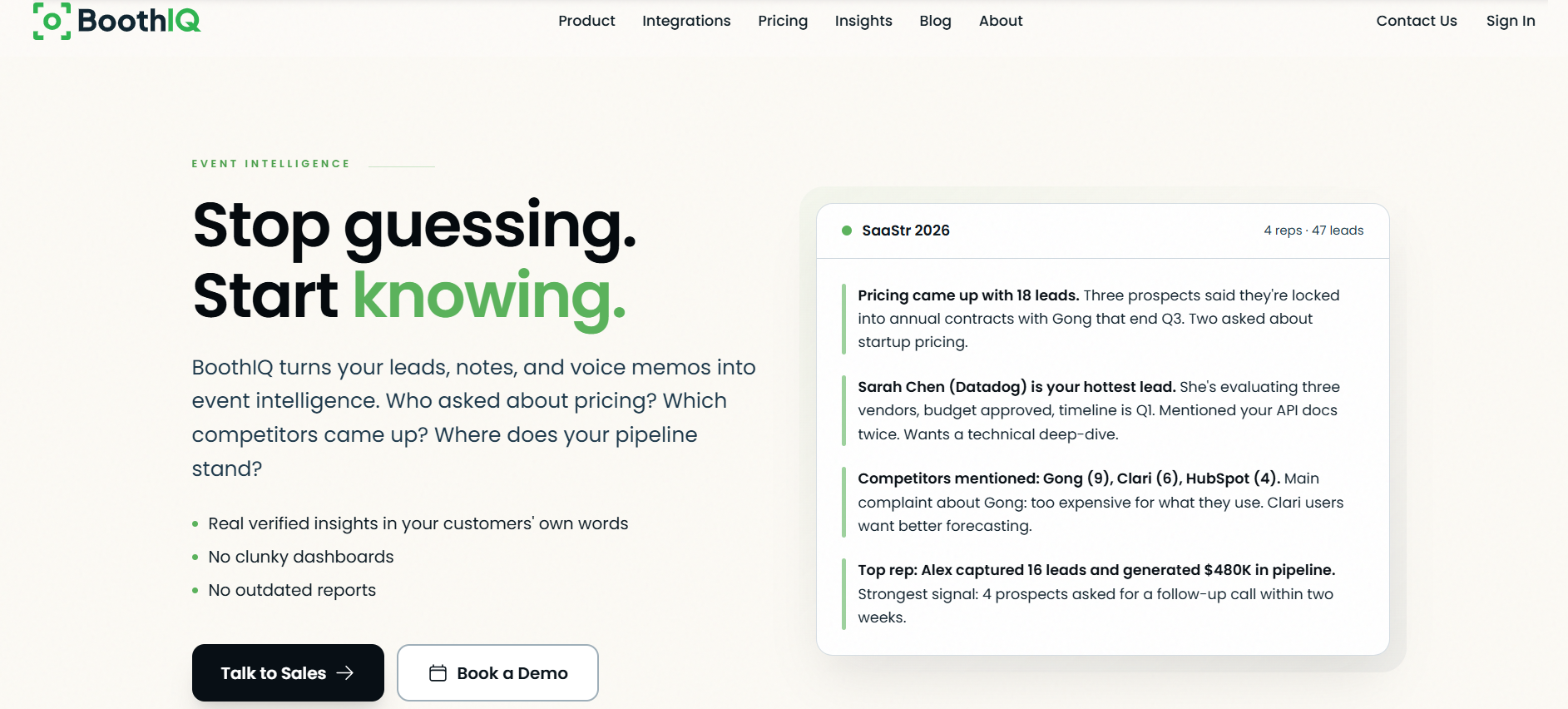
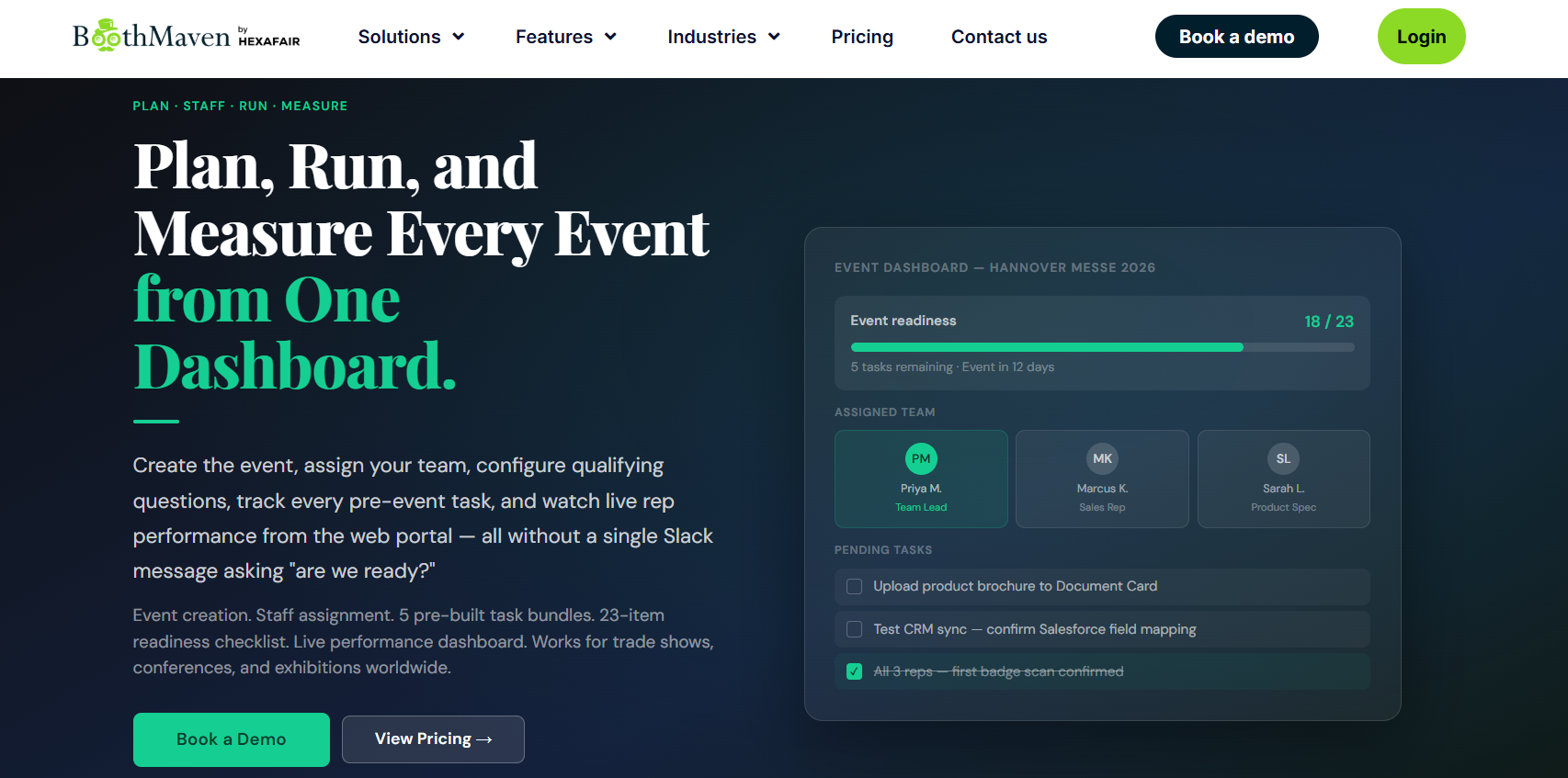
.png)

.png)
.png)