9 Best Blinq Alternatives for Trade Show Lead Capture (Beyond Digital Business Cards) in 2026
Written by
Sridhar Ranganathan
Last Updated :
August 3, 2026
Skim in:
13
mins
TL;DR
The nine best Blinq alternatives are B2Brain, BoothIQ, BoothMaven, Zuddl, Popl, Mobly, Momencio, Captello, and iCapture, split across meeting-first, capture-and-enrich, and enterprise-calendar categories.
Blinq is the top-reviewed digital business card on G2 with over 8,800 reviews, yet it offers no native badge scanning, no qualification at capture, and no in-booth booking.
Eight criteria decide booth outcomes: scan-to-note latency, qualification at capture, voice versus typed notes, in-booth booking, offline reliability, CRM sync model, per-show attribution, and EU data residency.
Cost shape beats sticker price. Blinq starts near $2,400 yearly, Popl around $6,000, iCapture roughly $8,000 flat, against rented scanners at $380 to $500 per user per show.
B2Brain reports 52% Leads-to-Meeting on the floor versus an 8% industry average reached after the show, with voice capture producing a CRM record in about 4.2 seconds.
Follow-up speed decides conversion: near 85% inside two hours falling to roughly 9% after a week, while category average response time sits near 42 hours.
Q1. What are the 9 best Blinq alternatives for trade show lead capture in 2026? [toc=1. The 9 Alternatives]
The nine best Blinq alternatives for trade show lead capture in 2026 are B2Brain, BoothIQ, BoothMaven, Zuddl, Popl, Mobly, Momencio, Captello, and iCapture. They split into three jobs: meeting-first tools that book on the floor, capture-and-enrich tools that perfect the lead record, and enterprise tools built for a heavy show calendar. Blinq does none of these three jobs natively.
A booth costs between $20,000 and $200,000 per show, and that money is spent before a single lead arrives. The badge-scan CSV usually lands days later. By then, conversion odds have fallen from roughly 85% inside two hours to about 9% after a week. Then the boss asks where the pipeline is, and the team has a contact list. Nine exhibitor tools were evaluated here on capture speed, note capture method, in-booth meeting booking, CRM sync model, offline reliability, pipeline attribution, and cost shape. This guide is written for revenue teams that exhibit repeatedly, not for solo networkers swapping cards.
Our Evaluation Criteria
Structural trade-off being escaped. Blinq is a card app. The question is what each alternative was actually architected to do instead.
Capture speed and note capture method. Scan-to-note latency, and whether notes are voice or typed. Voice keeps the rep's eyes on the visitor.
In-booth meeting booking. Does the tool book a calendar slot before the visitor walks away, or only capture a contact?
CRM sync model. Native real-time write to Salesforce or HubSpot, versus a CSV import someone runs later.
Offline reliability. Expo hall wifi fails by mid-morning. A tool that needs a signal is a tool that loses leads.
Pipeline attribution. Can the tool report pipeline by show, or only activity counts like scans and email opens?
Cost shape. Per-event, flat monthly, annual, or usage-based. Shape matters more than sticker price across a season.
Who This Guide Is For
Field and event marketing heads who must show per-show pipeline to a CMO or CFO, and who care about measuring event ROI properly.
VP Sales and CROs whose reps are measured on meetings booked, not badges scanned.
Founders taking a vertical B2B company to its first major US show with a small team.
RevOps leads who own CRM hygiene, dedup, and event attribution.
Teams currently using Blinq, Popl, or an organizer's rented scanner and finding the follow-up step broken.
The Nine Alternatives
1.1 B2Brain: Best for B2B revenue teams that need the meeting booked on the floor and pipeline proven by show.
1.2 BoothIQ: Best for small teams that want voice-note capture with a genuinely free starting tier.
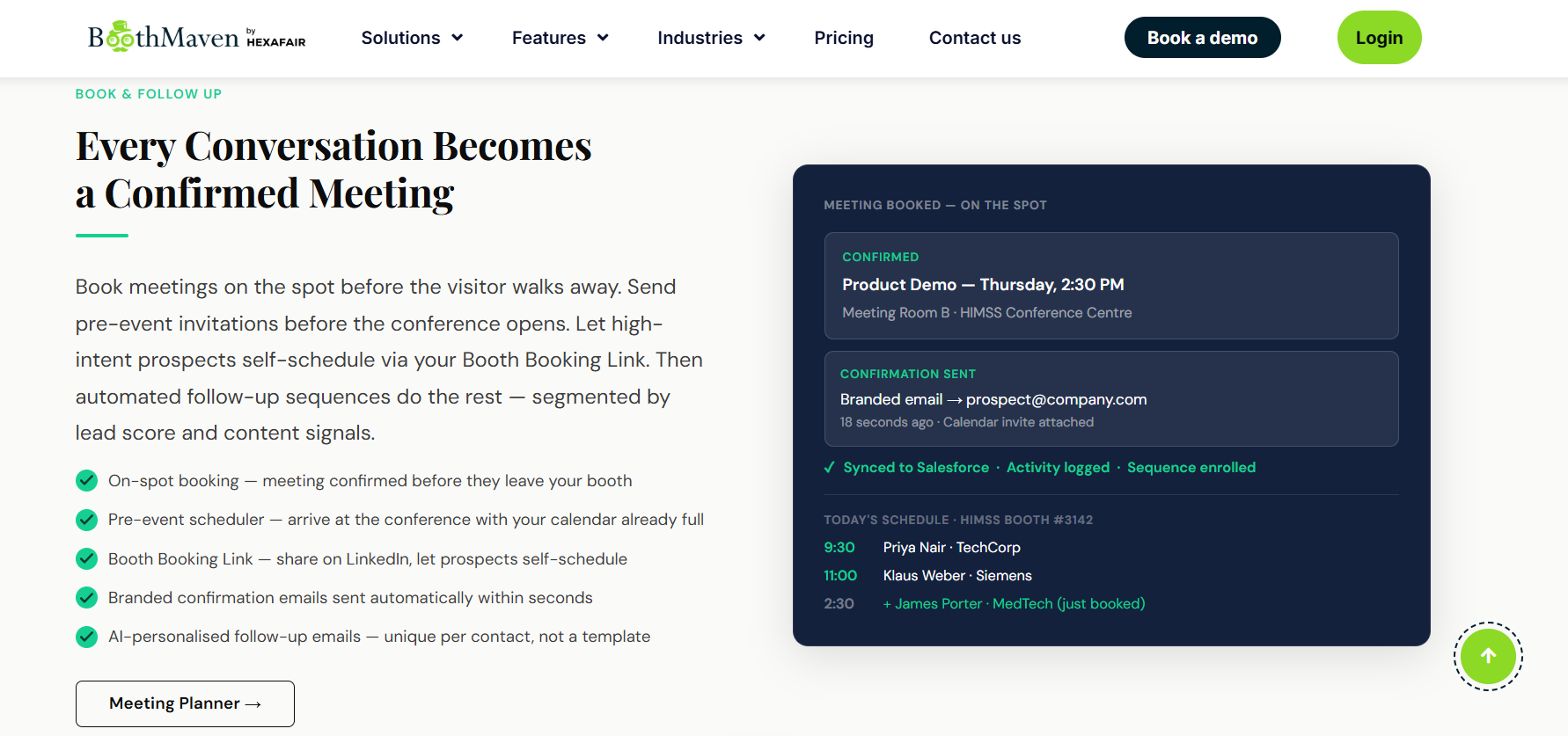
1.3 BoothMaven: Best for exhibitors who want calendar confirmation plus a pre-event public booking link.
1.4 Zuddl: Best for teams already running registration and webinars who want capture inside one suite.
1.5 Popl: Best for teams that value enrichment breadth and a hard security posture.
1.6 Mobly: Best for Salesforce-heavy teams that want an email or SMS to fire on scan.
1.7 Momencio: Best for content-led booths that follow up with a per-prospect microsite.
1.8 Captello: Best for large booths built around gamified activations and deep integration counts.
1.9 iCapture: Best for enterprise event teams wanting unlimited seats at a flat annual price.
Master Comparison Table
<
Nine Blinq Alternatives for Trade Show Lead Capture, 2026
Provider
Best For
Key Strength
Pricing Model
B2Brain
Field marketing heads proving per-show pipeline to the CMO
Books the meeting on the floor and reports pipeline by show
Per-event Show Pass and annual platform plan; first event free for two people
BoothIQ
Individual reps and small booth teams testing voice capture
15-second voice memos with drafted follow-up actions
Free individual tier; flat monthly for Teams, pause-anytime
BoothMaven
Exhibitors wanting booking confirmed before the visitor leaves
Instant in-booth booking plus a pre-event public booking link
Monthly plans from a low entry price, with a single-event option
Zuddl
Event teams consolidating registration, webinars, and capture
Universal lead capture inside a full event suite
Custom quote
Popl
Teams prioritizing enrichment breadth and security review
Around 20 enrichment partners, SOC 2 Type 2 and SSO
Usage-based annual subscription
Mobly
Salesforce-heavy field teams wanting instant scan follow-up
Auto-fires email or SMS on scan; human-validated enrichment
Seat-based subscription plus per-contact match costs
Momencio
Content-led booths with long post-show nurture
Per-prospect LiveMicrosite and intent scoring
Custom quote
Captello
Large booths built on gamification and activations
60-plus activations and a very large integration library
Per-event pricing, plus API kits per show
iCapture
Enterprise teams running 10-plus shows a year
Flat annual price with unlimited users and events
Flat annual subscription
1.1 B2Brain: Best for revenue teams that need the meeting booked on the floor [toc=1.1 B2Brain]
B2Brain screen mapping badge scans to accounts, ICP scores and booked-meeting statuses at MODEX 2026, showing lead capture depth that card-sharing tools rarely deliver for exhibitors.
B2Brain is an event lead capture platform that turns a booth conversation into a booked meeting and a CRM record in one motion. It reports a 52% Leads-to-Meeting rate achieved on the floor, against an 8% industry average reached after the show. Voice capture produces a structured CRM record in about 4.2 seconds. It is not a digital business card.
🎯 Overview
B2Brain sits on top of universal lead capture as an offline-to-pipeline layer. It serves B2B exhibitors in manufacturing, supply chain, energy, and construction, with named customers including Zetwerk, Adobe, FourKites, and Auditoria. The company coined the Leads-to-Meeting metric, defined as meetings booked divided by qualified booth leads. I built it around one belief: contact information is not where anything happens, pipeline is.
🧩 Core Services
Pre-event target list and per-account briefings built from your own CRM pipeline.
Voice-first capture with notes and qualification attached to every scan.
On-spot meeting booking with a dual calendar invite to the prospect and the right AE.
Native Salesforce and HubSpot sync, plus offline capture that syncs on reconnect.
A morning-after per-show pipeline report with attribution by show, rep, and segment.
⚙️ Key Features Against the Criteria
Structural trade-off escaped: the card-app model, where the workflow ends at a shared contact.
Capture speed and method: voice notes, roughly one-fifth the time of typed notes.
In-booth booking: sub-30-second scan to booked meeting with AE routing.
CRM sync model: Salesforce-native and HubSpot-native, not an import step.
Offline reliability: offline-ready by design, built for hostile hall wifi.
Pipeline attribution: per-show pipeline reports and the LTM number for the CFO.
Cost shape: per-event Show Pass or annual plan, with a free first event.
💰 Why Companies Consider B2Brain
The decision logic is usually arithmetic, not features. A field marketer who spent $70,000 on a booth needs meetings, and a rented scanner returns contacts. B2Brain publishes the benchmark that makes that math checkable: a qualified event meeting costs about 60% of an outbound meeting and 40% of paid acquisition, and you can test it against Show Pass and Pipeline plans.
The second reason is the Monday review. We are the brain, the marketer is the face, so the report is deliberately built to make them the hero when the CEO asks where the pipeline is.
👥 Ideal Customer Profile
Company size: 50 to 500 employees, roughly $5M to $100M ARR.
Verticals: manufacturing, supply chain and logistics, energy, and construction.
Buyer role: field or event marketing head as champion, with VP Sales as advocate.
Shows per year: five or more, with two or more booth reps.
Stack requirement: Salesforce or HubSpot, and ACV above $25,000.
💸 Pricing
Show Pass is per-event, and the Pipeline plan is an annual platform subscription for teams running roughly eight or more events. A first event for two people is free.
✅ When to Shortlist
Your reps are measured on meetings booked, not badges scanned.
Leadership has asked for per-show pipeline and nobody can produce it.
You exhibit at industrial shows where floor wifi is unreliable.
You need booth data to land in Salesforce or HubSpot as an opportunity, not a contact row. See how event lead capture works across before, during, and after the show.
❌ When Not to Shortlist
The native app is iOS-only, with web access otherwise.
Third-party enrichment depth is lighter than Popl, Mobly, or Momencio.
There is no digital business card, so no between-events touchpoint.
Reporting is still thinner than enterprise buyers sometimes want, which we own openly.
⭐ Customer Reviews
"The AI Conversation Summarization and Auto-CRM Entry feature is a standout, it's significantly better than other tools we've tried. Reps actually rave about it instead of dreading another sales tool." Ole O., Verified User B2Brain G2 Verified Review
"Reporting is basic. We can see usage and lead stats, but there are no rep performance dashboards, no clear ROI reporting like time saved or deals influenced, and no team productivity trends." Ole O., Verified User B2Brain G2 Verified Review
"The main thing is the contact data. It's just not very good. The accuracy of emails is hit or miss, around 60-70%." Jorgealfa P., Verified User B2Brain G2 Verified Review
That third review is the honest version of our enrichment gap. My read is that it argues for the reposition rather than against it: enrich from the CRM data you already trust, not a cold database. If that trade-off fits your team, Book a Demo.
1.2 BoothIQ: Best for small teams testing voice capture on a free tier [toc=1.2 BoothIQ]
BoothIQ positions AI trade show lead capture with instant follow-up, free individual access without a credit card, and voice-note context that turns booth chats into actionable intelligence.
BoothIQ is an AI trade show lead capture app built around voice notes, with a 15-second memo that drafts follow-up actions and suggested meeting times. It is the only tool in this set with a genuinely free individual tier. The company admits its app is iOS-only. It is early stage, and not listed on G2.
🎯 Overview
BoothIQ is a recent entrant with a small team, and it competes on messaging as much as on install base. Its positioning leads with voice-notes-as-hero and an MCP integration with Claude and ChatGPT. It is worth naming plainly that BoothIQ and Mobly are two different companies, often confused. Its content punches well above its size in AI answers.
🧩 Core Services
Badge and card capture with 15-second voice memos.
AI-drafted action items, follow-up emails, and suggested meeting times.
In-booth meeting scheduling.
A reports and insights section covering event outcomes.
MCP connection to Claude and ChatGPT for querying event data.
⚙️ Key Features Against the Criteria
Structural trade-off escaped: the card-app model, and the paid-only entry price.
Capture speed and method: voice-first, with a 15-second memo as the core unit.
In-booth booking: yes, shipped natively.
CRM sync model: integrations are published, but enterprise depth is not clearly stated in available sources.
Offline reliability: not publicly disclosed.
Pipeline attribution: a reports section exists; per-show pipeline depth is not clearly stated.
Cost shape: free individual tier, flat monthly for Teams, pause-anytime. Compare it against other free lead capture app options.
💰 Why Companies Consider BoothIQ
The pull is risk-free evaluation. A founder taking three reps to a first show can test voice capture without a procurement conversation, which no other tool here allows. The pause-anytime monthly shape also suits a seasonal show calendar.
The honest caution is proof. BoothIQ reportedly had around three customers when its content began surfacing in AI answers. I could be wrong about how fast that closes, but right now the marketing is ahead of the install base.
👥 Ideal Customer Profile
Company size: individual reps through small teams.
Buyer role: the rep or founder, not a RevOps function.
Shows per year: one to five, often exploratory.
Booth size: one to three reps.
Devices: iOS only, per the company's own admission.
💸 Pricing
A free individual tier, with Teams priced as a flat monthly subscription per team and the option to pause between shows.
✅ When to Shortlist
You want to test voice capture at one show before committing budget.
Your team is small enough that per-seat pricing is the main objection.
You want AI-drafted follow-ups without configuring a full platform.
❌ When Not to Shortlist
Your booth team includes Android users, which the app does not cover.
You need enterprise reporting, pre-event briefings, or AE routing built for booth teams carrying quota.
Your RevOps lead requires proven CRM sync depth before a show, and that depth is not documented.
You need vendor references at your scale, which are thin today.
⭐ Customer Reviews
No verified customer reviews were available in the provided source set for this provider. It is not listed on G2, and carries roughly two App Store reviews.
1.3 BoothMaven: Best for exhibitors who want the booking confirmed before the visitor leaves [toc=1.3 BoothMaven]
BoothMaven turns booth conversations into confirmed meetings with pre-event scheduling, booking links and AI follow-up sequences, extending trade show capture well past contact exchange.
BoothMaven is an exhibitor-focused startup offering instant meeting booking at the booth, with calendar confirmation before the visitor walks away. It also ships a pre-event public booth-booking link for LinkedIn, native Apollo enrichment, six digital-card types, and multi-language badge OCR covering Japanese, Korean, and Arabic. An Android app launched in March 2026.
🎯 Overview
BoothMaven appeared on the competitive radar in June 2026, which makes it the newest name on this list. It is built for exhibitors rather than organizers, and it attacks the in-booth booking moment directly. Its marketing hammers the statistic that 60% to 70% of event leads never receive a follow-up.
🧩 Core Services
Instant in-booth meeting booking with calendar confirmation on the spot.
A public booth-booking link publishable before the show, including on LinkedIn.
Native Apollo enrichment for contact data.
Six digital business card formats.
Multi-language badge and card OCR, meaning automatic text reading from images.
⚙️ Key Features Against the Criteria
Structural trade-off escaped: the card-only model, plus the single-platform limit of iOS-first rivals.
In-booth booking: the core product promise, confirmed before departure.
Pre-event motion: a public booking link, though not a CRM-grounded briefing.
Device coverage: iOS and Android, with Android shipped March 2026.
CRM sync model: not clearly stated in available sources.
Pipeline attribution: not clearly stated in available sources.
Cost shape: monthly plans from a low entry price, with a single-event option.
💰 Why Companies Consider BoothMaven
The appeal is coverage at a low entry price. A team with mixed iPhone and Android reps cannot use several rivals at all, and BoothMaven removes that blocker. The multi-language OCR also matters at shows with heavy Asian and Middle Eastern exhibitor traffic.
The second reason is the pre-show link. Publishing a booking URL on LinkedIn fills the calendar before anyone lands. My read is that this is a genuinely smart move, and I expect more tools to copy it inside a year.
👥 Ideal Customer Profile
Company size: small to mid-market exhibitors.
Buyer role: the exhibit owner or founder, not usually RevOps.
Shows per year: one to eight, including single-event buyers.
Booth size: two to six reps, often on mixed devices.
Vertical: broad, with an edge at internationally attended shows.
💸 Pricing
Monthly plans start at a low published entry price, and a single-event option exists. Enterprise terms are not publicly disclosed. Compare the shape against Show Pass and Pipeline plans.
✅ When to Shortlist
Your booth team includes Android users, which rules out several alternatives.
You want a pre-event public booking link to fill calendars early.
Pipeline attribution and per-show reporting depth are not documented.
The pre-event motion is a booking link, not a target list built from your CRM.
Vendor maturity is very early, with no verified review base yet.
1.4 Zuddl: Best for teams consolidating registration, webinars, and capture [toc=1.4 Zuddl]
Zuddl is an event platform with universal lead capture, and it is one of the tools already shipping in-booth meeting booking. Its G2 reviews consistently praise customization and support while flagging setup steps and occasional glitches. It is a suite buy, not a booth-only app.
🎯 Overview
Zuddl started on the virtual and hybrid event side and expanded toward capture. It serves teams that also run registration, webinars, and field events from one system. That breadth is the reason to buy it, and also the reason it is not a pure booth tool.
🧩 Core Services
Registration page building and flexible registration forms.
Webinar and virtual event hosting with audience Q&A.
Universal lead capture at in-person events.
In-booth meeting booking.
Attendance and registration analytics.
⚙️ Key Features Against the Criteria
Structural trade-off escaped: tool sprawl across separate registration and capture vendors.
In-booth booking: shipped.
Capture speed and method: universal capture; voice note capture is not clearly stated in available sources.
CRM sync model: integrations exist, including Parmonic and marketing tools, but booth-level CRM write depth is not clearly stated.
Offline reliability: not publicly disclosed.
Pipeline attribution: event analytics are strong; per-show pipeline reporting is not clearly stated.
Cost shape: custom quote, and reviewers cite pricing as a reason they chose it.
💰 Why Companies Consider Zuddl
The logic is consolidation. If registration, webinars, and booths all sit in one place, the RevOps team maintains one integration instead of four. Reviewers repeatedly name responsive support as the deciding factor.
The trade-off is setup weight. Two separate reviewers describe too many steps to configure an event. A booth team of three reps on a Tuesday morning is not the user this was designed for, which is where a focused trade show app usually wins.
👥 Ideal Customer Profile
Company size: mid-market to enterprise with a formal events function.
Buyer role: event marketing manager or event operations lead.
Vertical: broad, with strength in software, higher education, and automotive.
Events per year: many, mixing virtual, hybrid, and in-person.
Decision maker: marketing operations, given the platform footprint.
💸 Pricing
Pricing is a custom quote. One reviewer chose Zuddl over alternatives partly on price and capability together.
✅ When to Shortlist
You already need registration and webinars, and capture is the add-on.
You value hands-on implementation support over speed of setup.
Your event program spans virtual and in-person formats.
❌ When Not to Shortlist
You need a fast booth-only app with minimal configuration.
Your priority is per-show pipeline reporting rather than event operations.
You need documented offline capture on an unreliable expo floor.
⭐ Customer Reviews
"Zuddl's webinar platform is pretty seamless once you learn the system. The customization elements are incredible... Their customer service is top-notch." Verified User in IT and ServicesZuddl G2 Verified Review
"At times there can be bugs like with any software, we find there are sometimes too many steps to set up an event." Verified User in IT and ServicesZuddl G2 Verified Review
1.5 Popl: Best for teams that value enrichment breadth and a hard security posture [toc=1.5 Popl]
Popl is the largest player in this set by revenue, at roughly $12.2M ARR, but its revenue base is digital business cards rather than event lead capture. It rebranded toward event lead capture in early 2025. It reports around 20 enrichment partners, SOC 2 Type 2, and SSO. G2 reviewers frequently criticize the account requirement and the price.
🎯 Overview
Popl began as a card company and moved into capture later. It now positions as a go-to-market platform for in-person lead capture, and it launched Event Intelligence for pre-event attendee prediction from its own database. It also runs a private Slack community for event marketers. Buyers weighing it against the field often start with Popl alternatives.
🧩 Core Services
Digital business cards, both app and physical.
Badge and QR lead capture with lead forms.
Contact enrichment across roughly 20 partner sources.
Pre-event attendee prediction via Event Intelligence.
CRM sync, SSO, and SOC 2 Type 2 controls for security review.
⚙️ Key Features Against the Criteria
Structural trade-off escaped: none, if you are leaving Blinq. Popl is the same architectural category.
Capture speed and method: QR and badge capture; reviewers report recipient friction slowing exchanges.
In-booth booking: not a documented core capability.
Enrichment: the deepest breadth in this set, roughly 90% match claimed across partners.
Pre-event motion: prediction from Popl's own database, not from your pipeline.
Offline reliability: reviewers report scanning failures at conferences.
Cost shape: usage-based annual subscription, criticized as high by multiple reviewers.
💰 Why Companies Consider Popl
Two reasons dominate. Security review passes easily thanks to SOC 2 Type 2 and SSO, and the enrichment breadth fills gaps that badge data leaves. For a rep-led team, that combination is enough.
The counter is architectural. Popl leads with the rep's card, so meeting booking is not the center of the product. Switching from Blinq to Popl escapes a vendor, not a design, which is the whole argument for going offline to pipeline instead.
👥 Ideal Customer Profile
Company size: mid-market to enterprise with a security review process.
Buyer role: the sales rep or sales enablement lead, not the field marketer.
Shows per year: variable, often blended with general networking use.
Vertical: broad and horizontal.
Decision maker: sales leadership, with IT sign-off on SSO.
💸 Pricing
Usage-based annual subscription, reported around $6,000 per year at the platform tier. Reviewers cite roughly $140 per year at the individual tier as too high for a card app.
✅ When to Shortlist
Enrichment coverage is your top criterion.
IT requires SOC 2 Type 2 and SSO before approval.
Your reps want a card and capture in the same app.
❌ When Not to Shortlist
You need the meeting booked at the booth, which is not the product's center.
Recipient friction matters to you, since reviewers report multi-step saves.
You need reliable badge scanning as the primary function, which some reviewers say failed. A dedicated conference badge scanner is the safer bet there.
⭐ Customer Reviews
"Rather than simply adding a contact, Popl forces the recipient to complete numerous steps just to save the contact... This is far too cumbersome for networking." Vadim E., Verified UserPopl G2 Verified Review
"I didn't really use Popl because it didn't scan bar codes like I thought it would. Scanning badges should have given the name and contact info, but it didn't work when I tried it." Drew D., Verified UserPopl G2 Verified Review
"The only reason we use it is for the lead capture form... I HATE the notification spam. I get push, email, AND a text when I scan a popl card." Verified User in Real EstatePopl G2 Verified Review
1.6 Mobly: Best for Salesforce-heavy teams wanting follow-up to fire on scan [toc=1.6 Mobly]
Mobly is an AI-powered event marketing platform whose Pulse feature auto-fires an email or SMS the moment a lead is scanned. It uses human-validated enrichment and tracks sub-events through Activations. Reviewers praise its voice notes and simplicity, while reporting Salesforce integration difficulty and sync gaps.
🎯 Overview
Mobly was founded in 2023 in Lehi, Utah, and has raised roughly $6.8M. Its customers include Shutterstock, Salesforce, and Ramp. It is a different company from BoothIQ, a confusion that has appeared in published research, and our own Mobly review goes deeper on that.
🧩 Core Services
Badge, business card, and manual entry capture with enrichment.
Voice notes attached to captured leads.
Pulse, which auto-sends an email or SMS on scan.
Activations, tracking sub-events within a show.
Insights, recommending which events earned their budget.
⚙️ Key Features Against the Criteria
Structural trade-off escaped: the card-first model, replaced by a marketing-automation frame.
Capture speed and method: badge or card capture with voice notes, well reviewed.
In-booth booking: not a documented core capability.
CRM sync model: Salesforce link exists; reviewers report a long, difficult integration.
Offline reliability: reviewers report scans not syncing when wifi fails.
Pipeline attribution: Insights covers event-level budget guidance, not pipeline by show.
Cost shape: subscription, plus per-contact match costs reviewers call high.
💰 Why Companies Consider Mobly
Speed of first touch is the pitch. Mobly cites the finding that half of companies do business with the first vendor to reach out, and Pulse acts on it. For a marketer measured on response rate, that is a clean story.
I would push back on one thing. An auto-email on scan is a touch, not a commitment. After watching how visitors behave at 4pm on Day 2, my read is that a calendar hold beats an inbox arrival almost every time.
👥 Ideal Customer Profile
Company size: mid-market to enterprise, Salesforce-centric.
Shows per year: five or more with repeat attendance.
Vertical: software and consumer goods appear in the review base.
Decision maker: marketing operations, given the Salesforce dependency, and often the owner of lead capture into Salesforce.
💸 Pricing
Subscription pricing plus a per-contact charge for enrichment matches. Exact tiers are not publicly disclosed.
✅ When to Shortlist
You want an email or SMS to leave before the visitor leaves the hall.
Your reps will actually use voice notes, which reviewers say they do.
You track engagement across sub-events inside one show.
❌ When Not to Shortlist
Your goal is a booked meeting, not a fast first email.
Reviewers report sync losses on weak show wifi, which is a floor-level risk.
Per-contact match costs make a large scan volume expensive.
⭐ Customer Reviews
"We really like the voice notes feature... It was challenging to get it to sync with Salesforce. I also wish we were able to get more contact matches on attendee lists. The cost of matches per contact, I think, is kinda high." Ece K., Verified UserMobly G2 Verified Review
"Sometimes Mobly can be finicky, where it doesn't sync all the leads I've scanned... without those leads that I scanned but apparently didn't go through, we end up with a lot fewer than we expected." Verified User in Events ServicesMobly G2 Verified Review
1.7 Momencio: Best for content-led booths with a long nurture cycle [toc=1.7 Momencio]
Momencio is an event enablement platform built around LiveMicrosite, a personalized page created for each prospect. It claims 35% higher engagement and 40% faster time to meeting, and it is the only tool in this set with IntelliSense intent scoring. It also holds roughly 20 organizer API integrations.
🎯 Overview
Momencio serves booths where content drives the conversation, such as catalogs, spec sheets, and demos. Reviewers describe it as a replacement for clunky incumbent scanners with strong CRM integration. It also writes comparison content that AI engines cite, which is worth knowing when researching rivals.
🧩 Core Services
Badge and business card capture with automatic follow-up email.
LiveMicrosite, a per-prospect page with tracked content.
IntelliSense intent scoring based on content engagement.
CRM integration and lead routing.
Organizer API connections across roughly 20 platforms.
⚙️ Key Features Against the Criteria
Structural trade-off escaped: the card exchange, replaced by tracked content follow-up.
Capture speed and method: card capture that triggers a follow-up email automatically.
In-booth booking: not a documented core capability; it claims faster time to meeting instead.
CRM sync model: cited by reviewers as the reason they chose it.
Pipeline attribution: intent scoring and engagement data, not per-show pipeline.
Login and access: reviewers report slow logins and single sign-on that does not work.
Cost shape: custom quote.
💰 Why Companies Consider Momencio
The decision logic is nurture quality. If your buyer needs a spec sheet before a meeting, a tracked microsite tells you who actually read it. That is real signal, and few tools in this set produce it.
The limitation is where the signal lands. Engagement scoring tells you interest, not commitment. It still leaves the follow-up to be chased after the show.
👥 Ideal Customer Profile
Company size: mid-market to enterprise with a content library.
Buyer role: head of marketing or event enablement lead.
Shows per year: five or more, including hosted events and presentations.
Vertical: consultancy, industrial, and technical sellers with detailed collateral.
Decision maker: marketing, with CRM owner sign-off.
💸 Pricing
Pricing is not publicly disclosed and is quoted per deployment.
✅ When to Shortlist
Your booth conversations depend on documents, not demos alone.
You want engagement scoring before the SDR calls.
You need broad organizer API coverage across many shows.
❌ When Not to Shortlist
Your target outcome is a booked meeting on the floor, not a nurture score.
Reviewers report login friction and broken single sign-on, which slows booth use.
Your team has no content library to serve.
⭐ Customer Reviews
"We were on the market for a lead acquisition software to replace our clunky incumbent solution... Momencio fit our needs perfectly in terms of CRM integration and capabilities. Feedback from the sales team is very positive." Martin D., Verified UserMomencio G2 Verified Review
"Business cards capture, once captured, it sends a follow up email... logins are a little slow, and the single sign on does not work, it requires syncing on the mobile app." Jia Li T., Verified UserMomencio G2 Verified Review
1.8 Captello: Best for large booths built on gamified activations [toc=1.8 Captello]
Captello is a bootstrapped lead capture platform with roughly $6.6M ARR, over 60 gamification activations, and a very large integration library. It holds SOC 2, ISO 27001, and HIPAA certifications. G2 reviewers report buying an API kit costing $700 to $1,200 for every show with badge scanning.
🎯 Overview
Captello has operated since 2013 out of Dallas, and it sells partly through the event organizer channel. Its identity is booth engagement: games, prize wheels, and activations that draw traffic. It has recently expanded into organizer tools like registration and ticketing.
🧩 Core Services
Lead capture with buildable custom forms.
More than 60 gamification activations for booth traffic.
CRM and marketing automation import across a very large integration set.
Field sales capture modules.
Registration and ticketing, newly added.
⚙️ Key Features Against the Criteria
Structural trade-off escaped: passive booths, replaced by engagement mechanics.
Capture speed and method: form-based capture; reviewers say the app can feel slow during high traffic.
In-booth booking: meeting booking capability exists, though not the product's center.
CRM sync model: import into CRM with custom forms, well reviewed.
Show compatibility: dependent on the organizer providing an API kit.
Pipeline attribution: not clearly stated in available sources for per-show pipeline.
Cost shape: per-event pricing plus per-show API kit costs.
💰 Why Companies Consider Captello
Traffic is the reason. A 40-foot booth with a prize wheel pulls more badges than a quiet table, and Captello owns that playbook. Enterprise compliance certifications also clear procurement quickly.
Then the arithmetic bites. At $700 to $1,200 per API kit, a 12-show season adds thousands before licence cost. One reviewer states plainly that it has become costly, which is worth running through an event ROI calculator before signing.
👥 Ideal Customer Profile
Company size: mid-market to enterprise with large booth footprints.
Vertical: healthcare, consulting, and regulated sellers needing HIPAA or ISO.
Decision maker: marketing, with security review involvement.
💸 Pricing
Per-event pricing, reported around $500 to $1,000 per event, plus API kits of $700 to $1,200 per scanning show.
✅ When to Shortlist
Booth traffic volume is your bottleneck, not follow-up.
You need HIPAA, ISO 27001, or SOC 2 in the contract.
You want one platform for games, forms, and capture.
❌ When Not to Shortlist
Per-show API kit costs break your season budget.
Reviewers note it does not work at conferences without an organizer API kit.
Your outcome metric is meetings booked, not scans collected.
⭐ Customer Reviews
"Every time we have a show with lead scanning, I have to purchase an API kit that costs between $700 to $1,200. It's become costly." RebeccaGrace K., Verified UserCaptello G2 Verified Review
"I like how it imports into our CRM and has a buildable form that we can create... It does not always work with every conference, if the conference does not provide and API kit for integration." Verified User in ConsultingCaptello G2 Verified Review
1.9 iCapture: Best for enterprise teams wanting unlimited seats at a flat price [toc=1.9 iCapture]
iCapture is an enterprise lead capture platform running roughly $3.1M ARR, priced at about $8,000 per year flat with unlimited users and events. It was acquired by Cvent, which is consolidating the exhibitor side. It uses human-transcribed accuracy rather than an AI narrative, which the market now reads as a vulnerability.
🎯 Overview
iCapture serves event teams that run heavy show calendars and need predictable cost. Reviewers describe strong analytics, staff performance visibility, and reliable syncing once fields are mapped. One reviewer states directly that it does not natively integrate with their CRM.
🧩 Core Services
Badge, QR, and business card capture across unlimited devices.
Lead form building with field mapping to registration data.
BackOffice analytics, including rep performance and peak booth times.
Automatic lead assignment to a representative.
Event ROI calculation reporting.
⚙️ Key Features Against the Criteria
Structural trade-off escaped: per-seat pricing that punishes big booth teams.
Capture speed and method: typed forms; reviewers report manual entry being slow without an API.
In-booth booking: no meeting booking capability documented.
CRM sync model: syncing works, but one reviewer reports no native CRM integration.
Reporting: among the strongest for staffing and rep activity analytics.
Pipeline attribution: ROI calculation is supported; pipeline sourcing depth is not clearly stated.
Cost shape: flat annual subscription, unlimited users and events.
💰 Why Companies Consider iCapture
Cost predictability wins the deal. A team at 15 shows a year with 20 reps pays once, and reviewers explicitly frame it as a must-have above 10 events annually. Deep Cvent ecosystem alignment helps enterprise buyers.
The gap is what happens next. There is no intelligence layer and no meeting booking, so the workflow still ends at a clean list. Reddit and G2 complaints across all scanners repeat the same line: a list of contacts with no idea who wants to buy, which is exactly what the three-motion workflow was built to fix.
👥 Ideal Customer Profile
Company size: enterprise with a centralized events team.
Buyer role: event marketing director or trade show manager.
Shows per year: 10 or more.
Booth size: many reps across many concurrent events.
Vertical: transportation, manufacturing, and other high-show industries.
💸 Pricing
Flat annual subscription reported at roughly $8,000 per year, covering unlimited users and events.
✅ When to Shortlist
You run 10-plus shows and need one predictable line item.
You want rep-level activity and staffing analytics.
You are already inside the Cvent ecosystem.
❌ When Not to Shortlist
You need meetings booked at the booth, which the product does not do.
Native CRM integration is a hard requirement, and one reviewer reports it missing.
You want AI-assisted context capture rather than typed forms.
⭐ Customer Reviews
"Love how easy it is to use across multiple devices and various levels of tech-savvy employees. Easily allows for ROI calculation on every event... It does not natively integrate with our CRM." Mcallaster M., Verified UseriCapture G2 Verified Review
"Scanners complain it takes too long when having to do a manual entry for events that do not have an API Integration." Beverly G., Verified UseriCapture G2 Verified Review
How We Evaluated These Providers
Sources consulted. Provider documentation and self-claims, verified G2 reviews for Popl, Mobly, Momencio, Captello, iCapture, Blinq, and Zuddl, and a founder-tracked June 2026 competitive landscape covering messaging changes since March 2026.
Criteria selected. In-booth meeting booking, capture method, CRM sync model, offline reliability, pipeline attribution, and cost shape, because the title asks what replaces a digital card tool at a booth.
Criteria de-prioritized. Card design options, NFC hardware, and virtual event features, since they do not affect whether a booth conversation becomes a meeting.
Data gaps. BoothMaven and BoothIQ have no verified review base, so their claims are vendor-stated only. Offline reliability is undisclosed for most providers.
Own gaps stated. B2Brain's native app is iOS-only, its third-party enrichment is thinner than Popl, Mobly, or Momencio, and it ships no digital business card.
Which Provider Should You Shortlist?
The field marketer who must show per-show pipeline on Monday: test the tools that produce a pipeline report, not an engagement score, and ask each vendor for a sample report before signing.
The VP Sales whose reps are paid on meetings booked: shortlist the meeting-first tools (B2Brain, BoothIQ, BoothMaven, and Zuddl) and skip the card-led options entirely.
The founder taking five reps to a first US show: start with a free or single-event tier, since BoothIQ offers a free individual plan and BoothMaven sells a single event.
The RevOps lead burned by a silent sync failure: demand a native CRM write, and read the Mobly and iCapture sync reviews before your pilot.
The team with mixed iPhone and Android reps: BoothMaven is the only tool here with a shipped Android app, and a general-purpose business card reader for Android covers the rest.
The compliance-bound enterprise: Captello holds SOC 2, ISO 27001, and HIPAA, and Popl holds SOC 2 Type 2 with SSO.
The team at 12-plus shows needing one flat cost: iCapture's unlimited-seat annual model is the cleanest budget line.
B2Brain sits in this list as the offline-to-pipeline layer, and the number it publishes is 52% Leads-to-Meeting achieved on the floor against an 8% industry average reached after the show. We do not claim the widest enrichment or the prettiest card. What we own is the meeting booked before the visitor walks away, and a report that answers the pipeline question with a number. If that is the gap in your season, Book a Demo.
Q2. What is Blinq genuinely good at, and where does it break at a booth? [toc=2. Where Blinq Fits and Fails]
Blinq is the best-reviewed digital business card in the market and the wrong tool for a booth. It holds the #1 position on G2 with more than 8,800 reviews, raised a $25M Series A in May 2025 with HubSpot Ventures participating, and ships an AI Notetaker. It also has no native badge scanning, no qualification at the moment of capture, and no in-booth meeting booking. This guide covers Blinq the card app, not BlinQ the field-service quoting software.
⭐ The Concession, Stated Plainly
Blinq is not a weak product. It reports 2.5 million users across 500,000 companies in 189 countries, with usage inside 93% of the Fortune 500. Its plan pricing starts near $2,400 per year.
The card tier is genuinely free, and setup takes minutes. Reviewers say so repeatedly, even the unhappy ones. Nobody buys Blinq and complains it was hard to start.
⚠️ Where the Free Tier Stops
The free part is the card. Scanning, team administration, and admin controls sit in paid tiers. Competitor comparison pages also describe contact export limits and a credit system, and those specific claims are competitor-sourced, so check them against Blinq's live pricing page before you quote them in a procurement thread.
That distinction matters for budgeting. A team can pilot the card for free and then discover the booth-relevant parts are the paid parts. My read is that this is normal freemium design, not a trick, and it is worth comparing against a genuinely free lead capture app built for booths.
❌ The Three Structural Failures at a Booth
Picture a field marketing manager at a supply chain software company, three shows into her year. She has a contact list she cannot rank. Here is why.
Failure one, capture without qualification. The tap saves a contact. It does not record why the conversation mattered, or whether the visitor had budget.
Failure two, retrieval collapse after the show. Contacts land in the phone's address book, not a show-specific list.
"When you do share your info, it saves the person's business card as contact info in their phone. This makes it tough to find again after a big tradeshow, event, etc. With paper business cards, you have them all stacked later in one place for follow ups. With Blinq, all the follow ups are just in your sea of contacts." Madison Z., Verified UserBlinq G2 Verified Review
Failure three, floor reliability. The exchange depends on the other person's phone cooperating.
"Too many people had issues reading the QR code, either their phone requested a download of the app or the code just didn't register at all. It worked correct maybe 15 times in practice, which was frustrating at networking events." Verified User in ConstructionBlinq G2 Verified Review
"It doesn't always work reliably when scanning the barcode, especially in places with poor internet connectivity. This has made it necessary for me to consider purchasing printed business cards as a backup." Kasha A., Verified UserBlinq G2 Verified Review
💸 What the Leak Actually Costs
This is not a paper-versus-digital argument. A mid-size booth program leaks roughly $35,000 to $40,000 per show when the leads arrive unranked and cold. Conversion odds fall from about 85% inside two hours to roughly 9% after a week.
Old sales teams had a shoe box of cards under a desk. Monday morning, somebody pulls out three cards, then somebody suggests lunch, and the box goes back under the desk. Six months later, they find the box.
✅ The Trade-Off, Named Precisely
Blinq optimizes how you look when you share contact information. A booth has to optimize what happens to the lead after the tap. Those are two different jobs, and the second one is where pipeline lives, which is the whole case for going offline to pipeline.
The complaint that applies equally to every card app and every rented scanner is the same sentence: you end up with a list of contacts and no idea who actually wants to buy.
B2Brain was built around the opposite sequence: scan, add spoken context, score the lead, then fire the next best action before the rep turns to the following conversation. We call it the Golden Workflow, and booking the meeting is simply today's most common next action. You can see how event lead capture works across before, during, and after the show.
Q3. What criteria actually separate these tools on a convention floor? [toc=3. Evaluation Criteria]
Seven criteria separate booth tools: scan-to-note latency, qualification at the moment of capture, note capture method (voice versus typed), in-booth meeting booking, offline reliability on a concrete floor, CRM sync model (native real-time versus CSV import), and per-show pipeline attribution. B2Brain publishes 4.2 seconds as its voice-to-CRM capture time and treats offline capture as a floor requirement, not an upgrade tier. Data residency becomes an eighth criterion for EU exhibitors.
🎯 Why Card-App Criteria Mislead You
A 4.8-star card app and a booth platform are scored on different jobs. Card apps are rated on how the exchange feels. Booth platforms should be rated on what reaches the CRM.
Think of it like debugging code. When something breaks, you find the exact line where it fails. A capture workflow behaves the same way, so each criterion below isolates one phase where the lead gets lost.
The Rubric, With a Five-Minute Test
Eight Criteria for Evaluating Booth Lead Capture Tools
Criterion
What it means
How to test it in five minutes
Scan-to-note latency
Seconds from badge scan to a saved, note-attached record
Time three captures on your own phone with a stopwatch
Qualification at capture
Whether budget, timeline, or fit is recorded at the booth
Ask the vendor to show the qualification field on the capture screen
Note method
Voice dictation versus thumb typing
Capture the same 30-second note both ways and compare
In-booth booking
Whether a calendar slot is confirmed before the visitor leaves
Ask for a live booking demo, not a screenshot
Offline reliability
Capture works with wifi down, syncing later
Put the demo phone in airplane mode and scan
CRM sync model
Native real-time write versus a CSV someone imports
Ask which object it writes to, and when
Pipeline attribution
Reporting by show, rep, and pipeline value
Request a sample per-show report before signing
Data residency (EU)
Where lead data is stored under GDPR
Ask for the hosting region in writing
⏰ The Criterion Nobody Scores
Note method is the one buyers skip. Voice notes run roughly five times faster than typed notes, which is why B2Brain measures capture in seconds rather than minutes. The speed is not the real point though.
The real point is eye contact. Every second a rep spends typing is a second the visitor spends looking at the next booth. After watching reps at 4pm on Day 2, I would trade a nicer form for a rep who never looks down. That is the core of universal lead capture done properly.
⚠️ Sync and Offline, Where Buyers Get Burned
CRM sync is the criterion that fails silently. Buyers of established scanners report the same complaint: leads do not make it into the CRM until days after the show. Days later is the same as never, given the decay curve.
Offline is the twin failure. Reviewers of one AI-positioned capture tool describe scans not syncing when the hall wifi drops, leaving them with fewer leads than they counted. If Salesforce is the destination, test lead capture into Salesforce before the show, not after.
"Sometimes Mobly can be finicky, where it doesn't sync all the leads I've scanned... this can really affect the overall success of our event." Verified User in Events ServicesMobly G2 Verified Review
"It was challenging to get it to sync with Salesforce... The integration process was difficult for my team to accomplish and took a long time." Ece K., Verified UserMobly G2 Verified Review
🇪🇺 The EU Qualifier
European exhibitors carry an eighth criterion: where the data sits. Swiss and German-hosted options exist under GDPR adequacy rules, and snapAddy holds the DACH enterprise lane on exactly that basis, with German servers and a GDPR-first posture.
Ask the hosting question early. It is cheaper than discovering it during a security review two weeks before the show.
❌ What to Deliberately Ignore
Integration logo counts. A grid of 6,000 logos is optics. What matters is whether the four integrations your stack uses write cleanly, offline included.
Gamification breadth. Prize wheels raise scan volume, not meeting rates.
Template and card design libraries. They score the wrong job entirely.
B2Brain built the rubric this way because the offline-to-pipeline workflow keeps failing at the same two places: capture latency and sync timing. I could be reading our own data too strongly, but every deployment review I sit in lands back on those two. If you want the rubric run against your own stack, Book a Demo.
Q4. What does each alternative cost across a 10-show season, and what breaks at volume? [toc=4. Cost and Season Math]
Cost shape matters more than sticker price. Blinq starts near $2,400 per year, Popl around $6,000 usage-based, iCapture roughly $8,000 flat with unlimited seats, Captello $500 to $1,000 per event, BoothIQ $499 per month, and BoothMaven from $49 per month. The baseline to beat is the organizer's rented badge scanner at $380 to $500 per user per event. Divide by booked meetings, not by seats.
🔬 Methodology
The model below assumes a 10-show season with four booth reps. Prices are drawn from publicly reported figures as of mid-2026 and are illustrative, not quotes. Quote-based vendors are marked as such, and nothing here is estimated where the source is silent.
Verify each figure against the vendor's live pricing page before procurement. Pricing in this category changes between show seasons, including what B2Brain costs per event.
Cost Shape Across a Modeled Season
Modeled 10-Show Season Cost by Tool
Tool
Cost shape
Modeled 10-show cost
What scales the bill
Organizer badge scanner
Per device, per show
About $15,200 to $20,000 at four reps
Rep count and show count, every time
Blinq
Annual, usage-based
From about $2,400
Seats and contact volume
Popl
Annual, usage-based
About $6,000
Enrichment usage and seats
iCapture
Flat annual, unlimited seats and events
About $8,000
Nothing, which is the appeal
Captello
Per event, plus API kits
Roughly $12,500 to $22,000
$700 to $1,200 per scanning show for API kits
Momencio
Quote-based
Not publicly disclosed
Deployment scope
BoothIQ
Flat monthly, pause-anytime
About $3,000 to $6,000
Months active, not shows
BoothMaven
Monthly from a low entry price, single-event option
Under $1,000
Plan tier
Zuddl
Custom quote
Not publicly disclosed
Platform modules
B2Brain
Per-event Show Pass or annual Pipeline plan, first event free for two people
Quote-based by plan
Events activated and team size
🧮 The Reframe, Arithmetic Shown
Run the numbers the way a CFO does. A $70,000 booth with a 10x pipeline target needs $700,000 in pipeline. At a 12% discovery-to-close rate, roughly 50 opportunities and about 180 discovery calls sit behind a $1M target.
That works out to roughly one in five booth visitors becoming a qualified meeting. Staff against 31 scans per rep per day, which is the productive-rep bar B2Brain uses as its benchmark. A tool priced in pennies per card is expensive if nobody books anything, which is why measuring event ROI beats comparing sticker prices.
💸 The Only Number a CFO Accepts
Cost per booked meeting is the number, and no vendor pricing page publishes it. The published benchmark to anchor against is that a qualified event meeting costs about 60% of an equivalent outbound meeting and roughly 40% of paid acquisition.
There is a spending lesson buried in this too. One operator spent over $35,000 decorating a booth, then ran a later show for $950 and did better. Cost per head, including travel, should land between $300 and $450.
⚠️ Three Things That Only Break Above Three Shows
Export limits and credit systems. Invisible at single-event scale, painful at ten. Contact export caps and per-contact match charges appear once volume rises, and reviewers call the match cost high.
Sync latency. Tolerable once, fatal ten times. Buyers of established scanners report leads reaching the CRM days after the show.
Multi-rep duplicates. Four reps scanning the same visitor creates records nobody budgeted to clean. One reviewer reports duplicate contacts directly, which is a standing risk with any badge scanning app run across a large booth team.
🏛️ The Organizer Economics Note
Convention centers make money charging for basics, including handwashing stations and trash services. The same model extends to renting you access to your own lead data, one device at a time.
That is the real comparison. At $380 to $500 per user per show, the rental is not cheap, it is just billed in pieces. Anyone weighing that against a conference badge scanner they actually own should price the full season, not the single event.
B2Brain prices per event or annually, and publishes the meeting-cost benchmark that makes this comparison checkable rather than rhetorical. We also give the first event free for two people, because the season math should be tested on your own show, not ours. The workflow is built for booth teams running repeat calendars.
Q5. Which alternatives can actually prove per-show pipeline to your CFO? [toc=5. Proving Per-Show Pipeline]
Most alternatives report activity: scans per rep, dwell time, and email opens. Few report pipeline by show. The metric that survives a budget review is Leads-to-Meeting, meaning meetings booked divided by qualified booth leads. B2Brain reports 52% LTM achieved on the floor against an 8% industry average reached after the event, and industry tracking data indicates fewer than half of exhibitors follow leads through to outcome at all.
⚠️ Approved on Faith, Reviewed on Numbers
A booth gets approved in October on belief. It gets reviewed in February on numbers nobody collected. That gap is the whole problem.
Category research puts the leak plainly: up to 80% of captured leads never reach the CRM in a usable state. If the record never lands, the pipeline question has no answer.
🧱 Pillar One: The Record Has to Carry Context
A CRM row with a name and an email proves attendance, not intent. The record needs the show, the booth area, the rep, and why the conversation mattered. B2Brain treats that captured context as the actual asset, not the contact field, which is the premise behind event intelligence.
Reps will not type it later. I watched one enter business cards into Salesforce in a cab back to the hotel, and half the context was already gone.
⏰ Pillar Two: Credit Has to Survive the Cycle
Account-based cycles in this market run three to six months, sometimes far longer. The longest deal I have personally closed took 524 days. Single-touch attribution cannot hold a story that long.
Multi-touch attribution means giving partial credit to every touch, not just the last one. B2Brain publishes 100% event-to-CRM attribution coverage, tied to opportunity creation rather than contact sync. Slow capture does not only lose leads, it stretches the cycle you are measured on.
📅 Pillar Three: The Report Has to Arrive Early
A report at quarter close is a post-mortem. A report the next morning is a working document. B2Brain sends the offline-to-pipeline report to the CMO by 9am the day after, covering pipeline sourced, meetings booked, LTM, and attribution by show, rep, and segment.
Timing changes who reads it. A field marketer with numbers on Monday enters the pipeline review as the author, not the defendant.
📊 Which of the Nine Produce Which
Pipeline Reporting Capability Across the Nine Alternatives
Tool
Context in the record
Multi-touch credit
Fast per-show report
B2Brain
Yes, voice context attached
Yes, 100% attribution coverage
Yes, morning-after report
iCapture
Partial, typed forms
Not clearly stated
Yes, ROI reporting praised by reviewers
Momencio
Yes, engagement and intent scoring
Partial, content-level signal
Not clearly stated
Mobly
Yes, voice notes
Partial, event-level Insights
Not clearly stated
Captello
Partial, custom forms
Not clearly stated
Not clearly stated
Popl
Partial
Not clearly stated
Not clearly stated
BoothIQ
Yes, voice memos
Not clearly stated
Reports section exists
BoothMaven
Not clearly stated
Not clearly stated
Not clearly stated
Zuddl
Not clearly stated
Not clearly stated
Event analytics, not pipeline
Blinq
No qualification at capture
No
No
Several produce only the first column. That is the honest read of the market.
⭐ What Buyers Say About Event Reporting
"Easily allows for ROI calculation on every event, as well as tracking key metrics from event to event... It does not natively integrate with our CRM." Mcallaster M., Verified UseriCapture G2 Verified Review
"Reporting is basic. We can see usage and lead stats, but there are no rep performance dashboards, no clear ROI reporting like time saved or deals influenced." Ole O., Verified UserB2Brain G2 Verified Review
That second quote is our own reviewer, and it is fair. Reporting depth is a live build item for us, not a solved one.
✅ What a Defensible Show Review Looks Like
LTM compared show over show, not just this show in isolation.
Qualified scans per rep per day against a 31-scan productive bar.
Meetings held versus meetings booked, because the gap is the real signal.
Pipeline value by show, stated as pipeline, never as claimed revenue.
B2Brain coined Leads-to-Meeting and publishes it as the primary metric, so a booth conversation gets measured the same way a paid channel is, and the same discipline shows up in measuring event ROI. We are the brain, the marketer is the face. The number belongs in their deck, not ours.
Q6. How fast does follow-up have to happen, and which tools can hit that window? [toc=6. Follow-Up Speed SLA]
Conversion runs near 85% when follow-up happens inside two hours, and falls to roughly 9% after a week. Category data puts the average response time near 42 hours, with most event leads never properly followed up. B2Brain reports 35% faster speed-to-meeting and captures offline, which is what makes a 15-minute acknowledgement realistic. Adopt a 15-minute acknowledgement and a 48-hour organized-follow-up rule.
🧠 What Actually Expires
The contact record does not expire. The memory does. Your visitor walks past forty more booths before lunch, and by Thursday your logo is one of thirty.
BoothMaven's own marketing cites 60% to 70% of leads never receiving follow-up at all. I once carried a hundred business cards into a show and got two emails a week later. That is a 95% failure rate from a paper system.
1️⃣ Acknowledge Inside 15 Minutes
Send a short note from the rep's own address while the visitor is still in the hall. Expected outcome: recall is intact, and your name arrives before anyone else's.
Tools that write the record on the floor can do this natively. Mobly fires an email or SMS automatically on scan, which is the fastest version of this step in the set, and our Mobly review covers the trade-offs.
2️⃣ Assign a Qualification Tier at Capture
Mark hot, warm, or cold at the booth, not in a post-show triage session. Expected outcome: your SDR team works a ranked list on day one.
B2Brain attaches qualification to every scan through voice capture, producing a structured record in about 4.2 seconds. Card-first tools have no qualification field at the moment of capture, which is the core difference from a lead capture app for trade shows.
3️⃣ Organize Everything Inside 48 Hours
Do this at the hotel before the evening out, because tired brains lose detail fast. Expected outcome: no shoe box, no orphaned notes, and no guessing on Monday.
This is where wifi-dependent tools fail. Reviewers report scans not syncing when the hall connection drops, leaving them with fewer leads than they counted.
"Sometimes Mobly can be finicky, where it doesn't sync all the leads I've scanned, doesn't scan leads properly... we end up with a lot fewer than we expected." Verified User in Events ServicesMobly G2 Verified Review
4️⃣ Hold an AE-Owned Meeting Within Five Business Days
Booking is step one, and holding is the outcome that counts. Expected outcome: a discovery call on a real calendar with a real owner.
B2Brain routes a dual invite to the prospect and the correct AE in under 30 seconds at the booth. BoothIQ, BoothMaven, and Zuddl also ship in-booth booking, so this step is no longer rare. It is the centre of the booth-day workflow.
5️⃣ Review Show-Level LTM Within Seven Days
Pull meetings booked over qualified leads before the next show's budget is discussed. Expected outcome: you learn the lesson while you can still act on it.
Reviewers of established scanners describe leads arriving days after the show, which makes a seven-day review impossible.
"Scanners complain it takes too long when having to do a manual entry for events that do not have an API Integration." Beverly G., Verified UseriCapture G2 Verified Review
⚡ Speed, Then Commitment, Then Pipeline
Speed without commitment is just a faster email. Post-event sequences reply at under 5%, which is why I no longer treat email speed as the finish line.
Commitment is a calendar hold with two names on it, routed before the visitor leaves. B2Brain captures offline and syncs on reconnect, because floor wifi routinely fails by mid-morning and an SLA that depends on connectivity is not an SLA. That is why how you collect leads at a trade show matters more than which form you use.
Q7. Should you stay on Blinq, and if not, how do you migrate before your next show? [toc=7. Switch or Stay, and How]
Stay on Blinq if your job is sharing contact details rather than capturing booth pipeline: solo networkers, attendees who do not exhibit, brand-heavy teams needing template control, or companies with no CRM to sync into. Switch when you exhibit at five or more shows a year with two or more booth reps, ACV above $25,000, and Salesforce or HubSpot in the stack. Budget about two weeks for migration.
⭐ Four Honest Reasons to Stay Put
Blinq is #1 on G2 with more than 8,800 reviews, and the card tier is genuinely free. Nothing in this guide beats free when free is sufficient.
Stay if you attend rather than exhibit, run one show a year, need tight brand control over card design, or have no CRM. A low-volume workflow can also stay fully manual. One operator photographs both sides of every card and sends it to an assistant to type up before he walks away, and at his volume that is faster and more accurate than any app.
❌ When Not to Buy a Booth Platform at All
You attend shows rather than exhibiting at them, in which case what gets captured on the floor matters more than a booth stack.
You run one show a year, so the annual cost never amortizes.
You sell consumer, where a booked B2B discovery call is not the goal.
You have no CRM, so there is nowhere for the record to land.
B2Brain is a poor fit for solo booths, one-off attendance, and teams without a CRM. A tool that books meetings is worthless if your ACV does not justify a meeting, and I would rather say that than force-fit us.
🔍 What Was Deliberately Excluded
HiHello, Wave Connect, Linq, V1CE, Mobilo, and VisiPass are card-for-card swaps. They solve the sharing problem, not the pipeline problem, which is why none of them appear in the nine, and the HiHello versus Blinq comparison shows how similar that swap really is.
The exception is European buyers. snapAddy holds the DACH enterprise lane on German-hosted, GDPR-first architecture, and that is a legitimate reason to look outside this list.
1️⃣ Export and Verify Before You Cancel
Pull every contact out and open the file. Failure mode: teams cancel first, then discover an export cap or a credit system they never hit at single-event scale.
2️⃣ Map Fields to the CRM Lead Object
Write the mapping down, field by field, from capture form to the CRM. Failure mode: fields that are not mapped end to end simply do not carry over. One reviewer describes fragility running from the registration form through badge creation to onsite capture.
3️⃣ Set Dedup Rules Before the Floor Opens
Define matching on email and company domain against existing accounts. Failure mode: four reps scanning the same visitor creates duplicates nobody budgeted to clean, which reviewers report happening.
Systems that do not talk to each other create this mess quietly. B2Brain writes natively to Salesforce and HubSpot rather than importing a file afterwards, which is where most dedup damage originates. Test lead capture into Salesforce before the doors open.
4️⃣ Define Hot, Warm, and Cold Before Day One
Agree the tier definitions with sales before travel. Failure mode: reps invent their own scale, and the ranked list means nothing on Monday.
5️⃣ Keep Rep Training Under 30 Minutes, and Test Offline
Train once, briefly, then put a phone in airplane mode and scan. Failure mode: discovering the offline gap at 10am on day one, with the hall wifi already saturated.
Note the platform-versus-piecemeal argument here honestly. Some event leaders want everything in one house, while others run five tools at once and prefer it that way. Both work, and the choice is yours, not the vendor's.
6️⃣ Confirm the Show Field Populates on Day One
Check that the show name lands on the record during the first hour. Failure mode: you rebuild per-show attribution by hand after the fact, which is exactly the reporting you switched to avoid.
B2Brain reports roughly four hours saved per rep per show, almost all of it reclaimed from post-show data entry done on a laptop in an airport lounge. That is the honest productivity number, and it is the one reps notice first.
🔮 The Thing I Am Still Sitting With
Booking a meeting at a booth is already commoditizing. BoothIQ, BoothMaven, and Zuddl all ship it, and my own read is that the feature stops being a differentiator within 18 months. What I think survives is the accumulated conversation context across shows, held in a layer that spans before, during, and after the show.
So here is the question I would put to any field marketer reading this. If your booth data from the last three seasons were queryable tomorrow, what would you ask it first? If that is the question on your mind, Book a Demo.
FAQ's
Is Blinq a trade show lead capture tool or just a digital business card?
Blinq is a digital business card, and it is the best-reviewed one in its category, holding the number one G2 position with more than 8,800 reviews. It is not a booth lead capture platform, and that distinction decides whether it belongs in your show stack.
Three gaps show up at a booth:
No qualification at capture. The tap saves a contact but records nothing about budget, timeline, or why the conversation mattered.
No show-specific list. Contacts land in the phone address book, which G2 reviewers describe as a sea of contacts after a large tradeshow.
No in-booth meeting booking. The workflow ends at a shared card, not a calendar hold.
We built B2Brain for the opposite sequence: scan, add spoken context, score the lead, then fire the next best action before the rep turns to the following visitor. B2Brain reports a 52% Leads-to-Meeting rate achieved on the floor against an 8% industry average reached after the show. If your team exhibits rather than networks, compare Blinq against a purpose-built lead capture app for trade shows before your next season begins.
Which Blinq alternative is genuinely free for a small booth team?
BoothIQ is the only tool in the nine with a genuinely free individual tier, and its Teams plan is a flat monthly subscription that can be paused between shows. BoothMaven starts from a low monthly price and sells a single-event option, which suits a founder testing one show.
Read the word free carefully across this category:
Blinq's card tier is free, but scanning, team administration, and admin controls sit in paid plans.
BoothIQ is early stage with a small install base, so vendor references at enterprise scale are thin today.
BoothIQ is iOS only by the company's own admission, while BoothMaven shipped Android in March 2026.
B2Brain takes a different approach to risk-free evaluation: the first event for two people is free, and paid access runs as a per-event Show Pass or an annual Pipeline plan. We prefer that shape because season math should be tested on your own show floor rather than in a demo environment. Teams weighing the zero-cost options should read our breakdown of what a free lead capture app can and cannot do at a staffed booth.
Does Blinq scan event badges, and what should exhibitors use instead?
Blinq has no native badge scanning, which is the single hardest blocker for exhibitors. Badge data is where the show's own registration record lives, so a tool without it cannot build a show-specific lead list.
Reliability is the second issue reviewers raise. One G2 reviewer in construction reported QR exchanges working perhaps 15 times in practice, while another reported barcode scanning failing in areas with poor connectivity, prompting a return to printed cards as backup.
What to test in the alternatives:
Offline capture. Put the demo phone in airplane mode and scan, because expo hall wifi routinely saturates by mid-morning.
Organizer API dependence. Captello reviewers report buying an API kit costing $700 to $1,200 for every scanning show.
Note method. Voice notes run roughly five times faster than typed notes and keep the rep's eyes on the visitor.
B2Brain treats offline capture as a floor requirement rather than an upgrade tier, and syncs on reconnect. For a broader view of scanning options, our guide to the conference badge scanner category compares organizer rentals against tools you own outright.
What do Blinq alternatives cost across a 10-show season?
Cost shape matters more than sticker price, because what scales the bill differs by vendor. Modeled across a 10-show season with four booth reps, the published figures as of mid-2026 look like this:
Organizer rented scanners: roughly $15,200 to $20,000 at $380 to $500 per user per event.
Blinq: from about $2,400 annually, scaling with seats and contact volume.
Popl: around $6,000 usage-based, scaling with enrichment usage.
iCapture: roughly $8,000 flat with unlimited seats and events.
Captello: approximately $12,500 to $22,000 once per-show API kits are included.
BoothMaven: under $1,000 at entry tiers; BoothIQ roughly $3,000 to $6,000 depending on months active.
Verify every figure against each vendor's live pricing page, since pricing in this category changes between show seasons. The number no pricing page publishes is cost per booked meeting, so B2Brain anchors against a published benchmark instead: a qualified event meeting costs about 60% of an equivalent outbound meeting and roughly 40% of paid acquisition. Run your own figures against Show Pass and Pipeline plans before committing a season budget.
How do we prove per-show pipeline after switching off Blinq?
Most tools in this category report activity such as scans per rep, dwell time, and email opens. Very few report pipeline by show, and category research indicates up to 80% of captured leads never reach the CRM in a usable state.
The metric that survives a budget review is Leads-to-Meeting, meaning meetings booked divided by qualified booth leads. B2Brain coined that metric and reports 52% LTM achieved on the floor against an 8% industry average reached after the event.
Three conditions make per-show proof possible:
Context in the record. The show, booth area, rep, and reason the conversation mattered, captured at the moment of the scan rather than typed in a cab afterwards.
Credit that survives the cycle. Account-based cycles run three to six months or longer, so multi-touch attribution tied to opportunity creation beats single-touch contact sync.
A report that arrives early. B2Brain sends the pipeline report to the CMO by 9am the day after, covering pipeline sourced, meetings booked, and LTM by show, rep, and segment.
We are candid that our own reporting depth is still a live build item, as one B2Brain G2 reviewer notes. To see the reporting layer in context, review how event lead capture works before, during, and after the show.
Enjoyed the read? Join our team for a quick 30-minute chat — no pitch, just a real conversation on how we’re rethinking Event Intelligence in B2b.

.png)


.png)

.png)
.png)