B2Brain vs Mobly: Compared on Enrichment, Meeting Booking, and CRM Sync
Written by
Sridhar Ranganathan
Last Updated :
August 22, 2026
Skim in:
13
mins
TL;DR
Mobly is a capture-and-enrich app. B2Brain is a capture-to-meeting layer. Both scan badges, but only one books the discovery meeting before the visitor leaves the booth.
Mobly enriches deeper through routed data providers with human validation. B2Brain enriches from your own CRM pipeline, which reps trust because they already own the data.
Both sync natively to Salesforce and HubSpot. Mobly writes contacts, leads, and campaign members. B2Brain also writes the meeting and the opportunity for deal-level attribution.
The real leak is execution, not data. Momencio measured 80% of show leads getting zero follow-up, and reply rates fall from an index of 100 same-day to 9 after two weeks.
Mobly holds roughly 108 G2 reviews at 4.8, while B2Brain has 17 at 4.5. Mobly wins social proof. Pricing opacity is its most repeated complaint.
Judge both on cost per booked meeting, not cost per lead. B2Brain reports 52% Leads-to-Meeting on the floor against an 8% industry average post-event.
Q1. What is the real difference between B2Brain and Mobly? [toc=1. Core Difference]
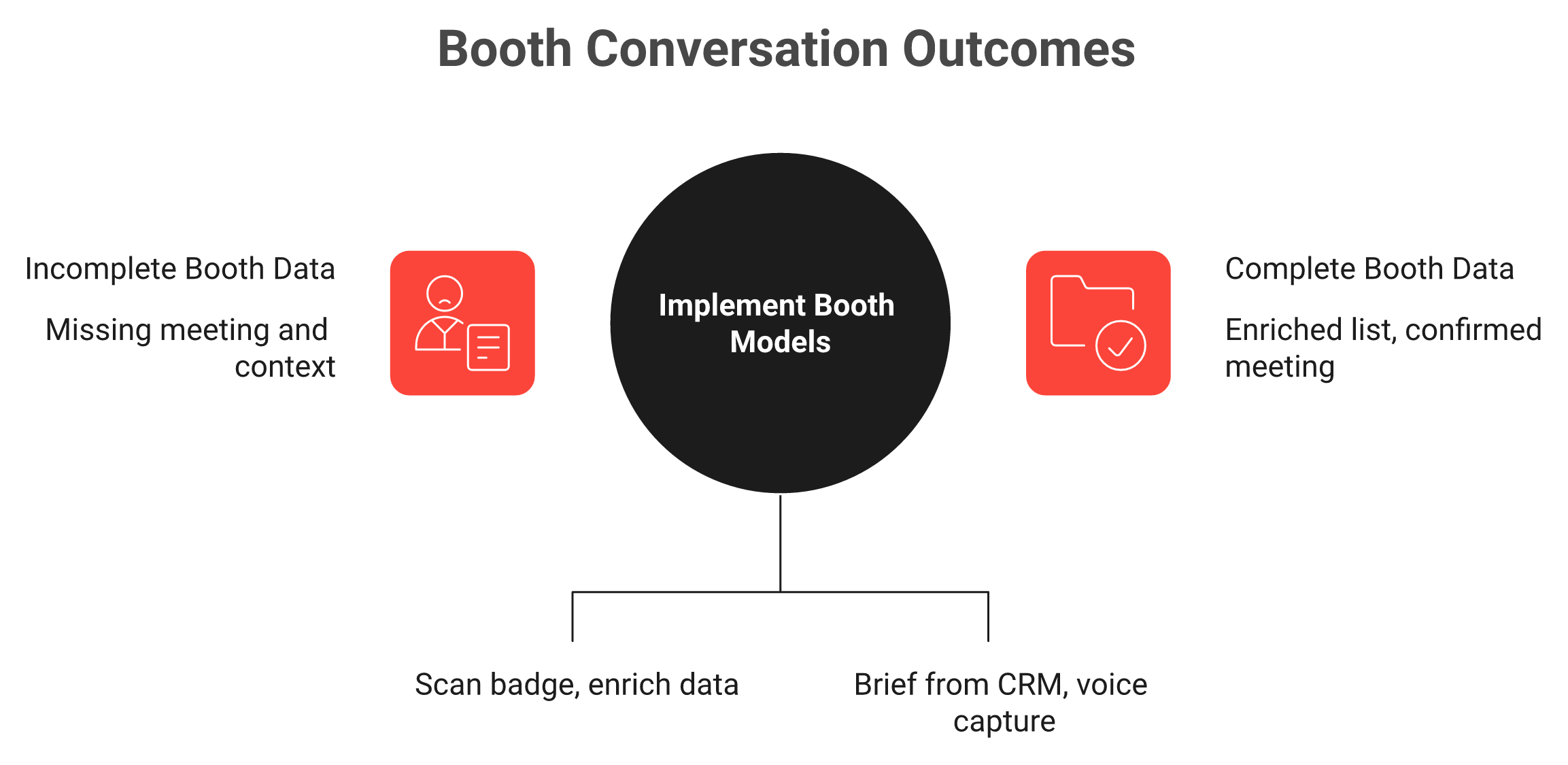
Mobly is a capture-and-enrich app: it scans badges, cards, and QR codes, enriches contacts through routed data providers, and syncs them to Salesforce or HubSpot. B2Brain is a capture-to-meeting layer: it briefs reps from your own CRM, books the meeting at the booth, and reports per-show Leads-to-Meeting pipeline. Both capture. Only one closes the loop on the floor.
📦 The shoe box problem never actually went away
An old friend in industrial sales described the classic version to me. All the business cards go in a shoe box, Jimmy carries the box home, and on Monday he pulls out three. Six months later, somebody finds the box.
Software digitized the box. It did not empty it. Contact information is not where anything happens, and pipeline is where your world moves.
🔀 Two product categories, not two feature lists
Mobly's own positioning is an AI-powered event marketing platform built around capture, enrichment, and automated outreach on scan. That is a real category, and Mobly does it well, as our own teardown of what Mobly captures reliably lays out in detail.
B2Brain sits one layer up. B2Brain measures Leads-to-Meeting (LTM), the share of qualified booth conversations that become booked meetings, and reports 52% booked on the floor against an 8% industry average for post-event follow-up.
The split is architectural, not featural: one path ends with an enriched contact, the other ends with a booked meeting and an opportunity record.
⭐ How the three real options compare
Most shortlists have three options, not two. The organizer's rented badge scanner is the incumbent you are actually displacing, which is the displacement story behind universal lead capture.
Badge Scanner vs Mobly vs B2Brain: Core Differences
Criterion
Organizer badge scanner
Mobly
B2Brain
Primary output
Contact list, often a CSV
Enriched contact in CRM
Booked meeting plus CRM record
Enrichment
None
Provider-routed, human-validated
From your own CRM pipeline
Books meeting on floor
❌ No
❌ Not natively
✅ Under 30 seconds
Pipeline reporting
❌ None
Event dashboards
Per-show pipeline plus LTM
Where Mobly wins
Nothing
Enrichment depth, Android, 100+ G2 reviews
Review base is only 17
💬 What buyers actually report
"I like that the interface is very user friendly, streamlined, clear and only includes the buttons/features that you'd need, especially during a busy event." — Verified User in Events Services, 3.5 stars, Mobly G2 Verified Review
"It was challenging to get it to sync with Salesforce. I also wish we were able to get more contact matches on attendee lists." — Ece K., 4 stars, Mobly G2 Verified Review
🧠 My read on why the category argues about the wrong thing
B2Brain's read is that the standard advice gets this backwards. Teams compare capture features because features are easy to tabulate. Outcomes are not.
I could be wrong about how fast this shifts. My honest expectation is that booking becomes table stakes within 18 months, since BoothIQ, BoothMaven, and Zuddl already ship a version of it.
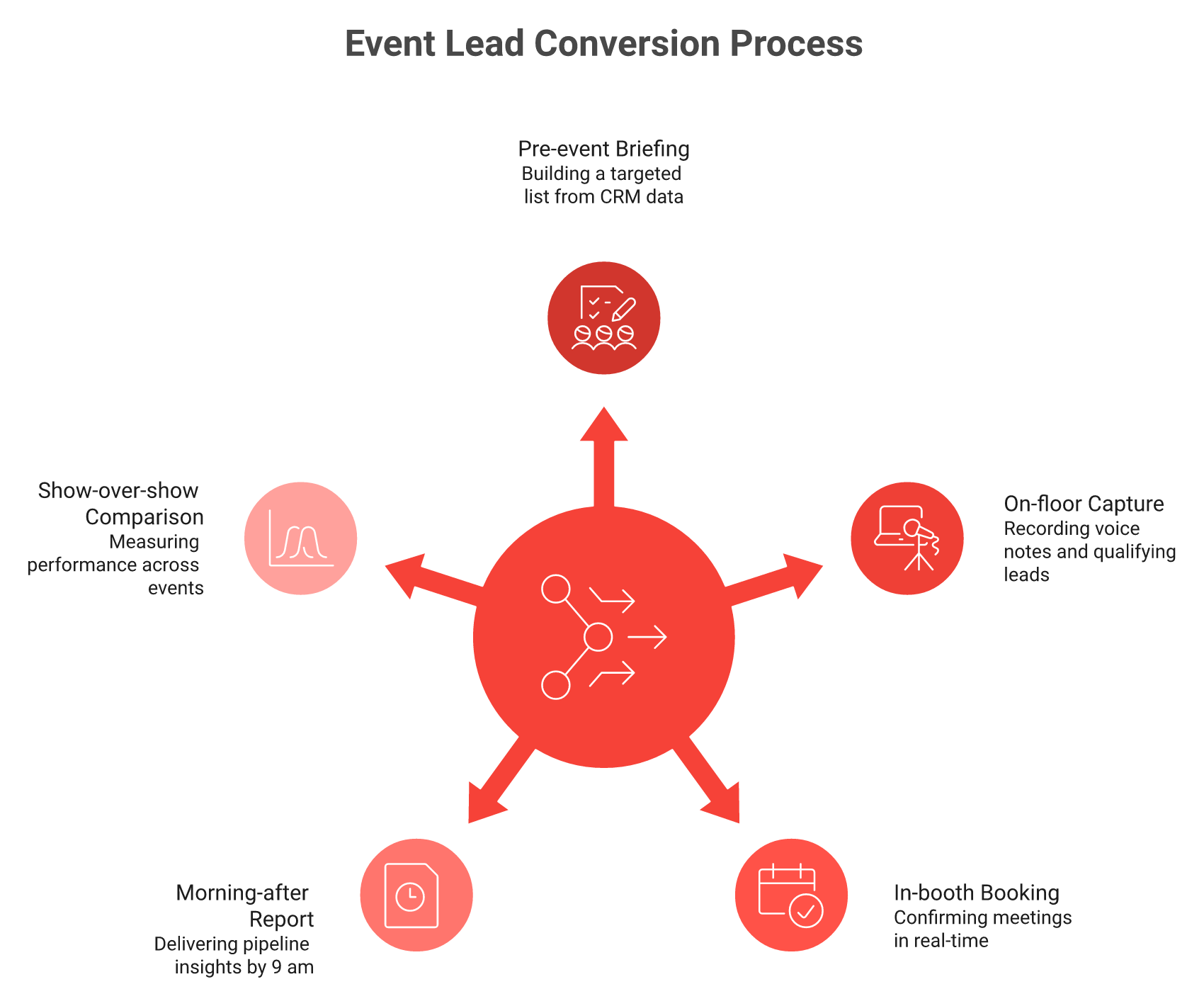
B2Brain covers Before, During, and After on one shared intelligence layer, which is the part rivals have not replicated: a CRM-grounded pre-event briefing, on-floor booking, and a morning-after pipeline report tied to the same records. That is how event lead capture works when the three motions sit on one data layer.
Q2. Where does event lead follow-up actually break, bad data or unexecuted follow-up? [toc=2. Where Follow-Up Breaks]
Follow-up breaks at execution, not data completeness. Momencio's 2026 report measured 80% of trade show leads receiving zero follow-up across 20 major US shows. Average B2B response time runs 42 hours. BoothMaven platform data shows reply rates falling from an index of 100 same-day to 47 at 48 to 72 hours, and 9 after two weeks.
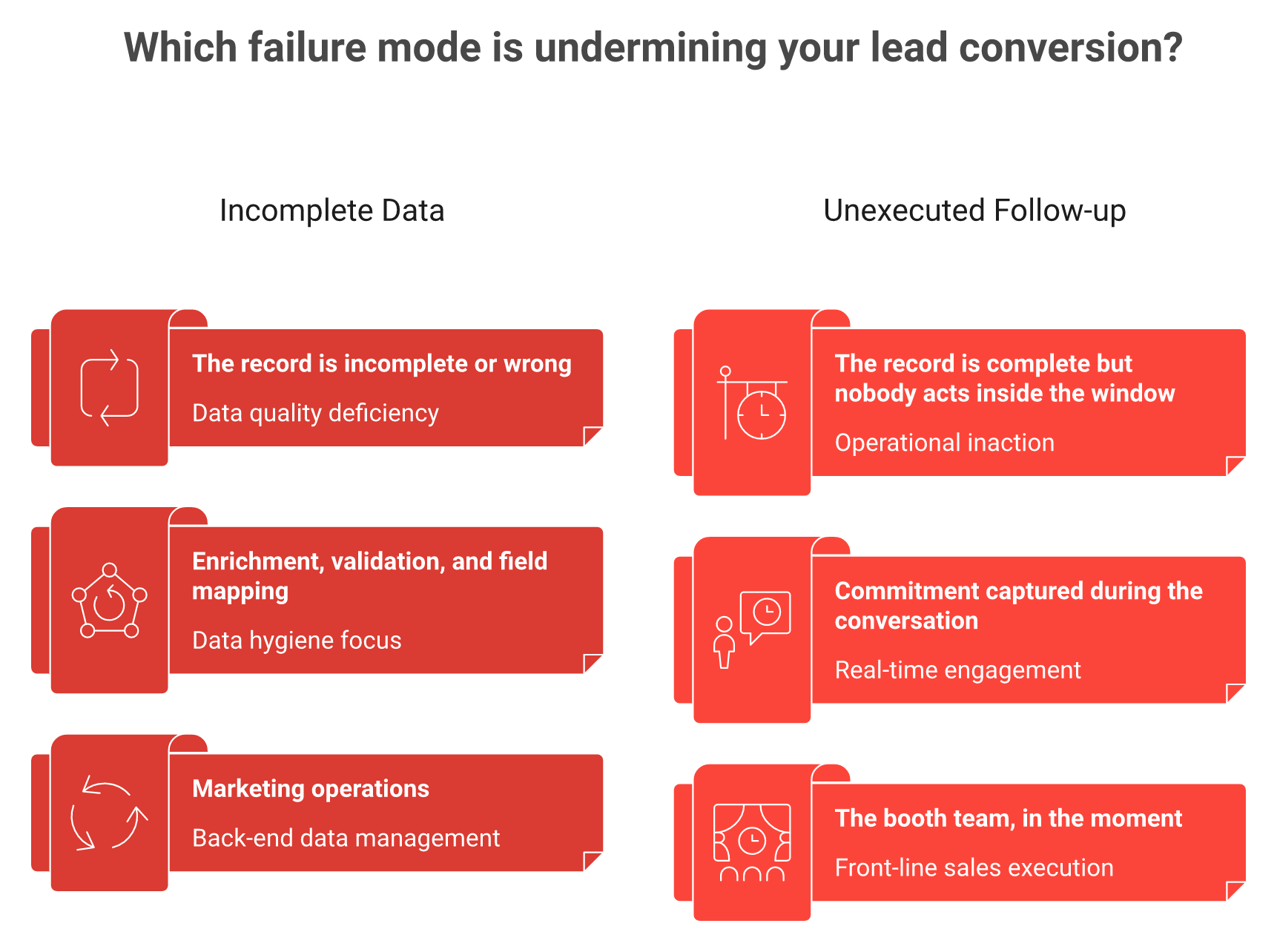
🔍 Two failure modes that look identical in a spreadsheet
Mode one is incomplete data: a badge scan with no email, no title, no company size. Enrichment fixes this.
Mode two is unexecuted follow-up: perfect data that nobody acts on inside the window when the buyer still remembers you. Enrichment does nothing for this, and mode two is where the money goes.
Most exhibitors buy enrichment to fix a problem that lives on the execution side of this diagram.
📉 The receipts on mode two
A 2026 Momencio study across 20 major US shows found 80% of trade show leads receive no follow-up at all. CEIR benchmark research found only 47% of exhibitors track leads through the sales cycle.
An operator at a Chicago print expo ran the cleanest test I have seen. He handed out 100 business cards, got two follow-ups inside a week, and five or six across the next 30 days. The structural fix is the one described in how to collect leads at a trade show.
⏰ The decay curve, in numbers
Reply rates do not decline gently. They fall off a cliff, and the cliff arrives before most teams are home from the airport.
Trade Show Reply-Rate Decay by Follow-Up Delay
Time since booth conversation
Reply-rate index
Same day
100
Within 24 hours
92
48 to 72 hours
47
4 to 7 days
31
15+ days
9
Source: BoothMaven platform data, 2,400+ North American exhibitors, 2024 to 2026.
💸 What this means for tool selection
There is a popular workaround: wait a few days so the prospect gets settled, then send a nurture sequence. That advice is expensive. By day four you are working with an index of 31.
B2Brain was built against mode two specifically. Ask B2Brain to book the discovery slot while the prospect is still at the booth, and the 42-hour window disappears because there is nothing left to chase.
🧭 The uncomfortable part of the math
Run your own numbers before you evaluate any vendor. A $70K booth with a 10x pipeline target and a 12% discovery-to-close rate means roughly 1 in 5 booth visitors must become a qualified meeting. The event ROI calculator runs that chain for you.
If you do not know that ratio, no amount of enrichment will save the show. Honestly, I think this is the single most useful hour a Field Marketer can spend before signing anything.
B2Brain reports LTM at 52% on the floor against an 8% post-event industry average, which is the ratio that math actually depends on. We publish it because no competitor tracks the metric at all, and it is the number behind going from offline to pipeline.
Q3. How do capture methods and on-floor reliability compare? [toc=3. Capture & Offline]
Mobly offers four capture methods including badge scan, card OCR, QR, and manual entry with voice-to-text notes. B2Brain captures with context attached, producing a structured CRM record in about 4.2 seconds per scan. Popl's 2026 grid disputes Mobly on universal capture while Mobly's own page claims on-device OCR, so test both against your show's badge format before signing.
📱 What each tool captures
Mobly publishes four capture paths: badge scan, business card OCR, QR, and manual entry, with voice-to-text notes layered on top. Reviewers confirm the voice notes work well under time pressure.
B2Brain's Golden Workflow is Scan, Add Context, Execute Next-Best-Action. Voice is just the vehicle. The captured context is the asset, and it takes roughly a fifth the time of typed notes.
⚠️ Adjudicating the claim conflict
Popl's 2026 comparison grid marks Mobly as absent on universal capture and real-time CRM sync. Mobly's own product page claims both. Vendor grids are marketing, so go to reviews instead.
"Sometimes Mobly can be finicky, where it doesn't sync all the leads I've scanned, doesn't scan leads properly, whether it was a blurry picture or the service made it delayed." — Verified User in Events Services, 3.5 stars, Mobly G2 Verified Review
"Feels a bit clunky. Never sure if details are saved. Would prefer free fields accessible from opening the app." — Thor C., 3.5 stars, Mobly G2 Verified Review
📶 Offline behavior is the row nobody tests
Expo hall Wi-Fi fails on Day 2 at 2pm, every time. That reviewer complaint about leads not syncing is the sound of a connectivity assumption breaking.
B2Brain is offline-ready and syncs on reconnect, so the scan queue survives dead Wi-Fi. Ask any vendor to demo airplane mode, not just a clean booth Wi-Fi scan, and check it against how a conference badge scanner app behaves at scale.
⭐ The rush-hour problem, and one workaround
At 4pm on Day 2 nobody can stop to take notes. Operators improvise: photograph the person holding their card so you can reconstruct who was who later.
B2Brain ships "Recent Leads" for exactly that moment, letting a rep clear a rush and add context minutes later without losing the thread. Reps open the app roughly 500 times across a four-day show, so this is where usability actually gets decided.
✅ What to test on your floor
Run a 20-scan pilot before you commit. Bring three badge types and one deliberately blurry card, and treat it the way you would test any lead capture app for trade shows.
Test the show's badge format directly. MODEX, FABTECH, and PACK EXPO do not print the same badge.
Time scan to structured record, not scan to photo saved.
Turn Wi-Fi off mid-scan, then reconnect and count what survived.
Have two reps scan the same buyer and check for duplicates.
B2Brain logs scan to structured CRM record in about 4.2 seconds, and that number is measured on the floor rather than in a demo environment.
Q4. Which tool enriches a scanned lead better, data waterfall or CRM-grounded context? [toc=4. Enrichment Compared]
Mobly enriches deeper, routing each scan through multiple providers with human validation, which reviewers praise most. B2Brain enriches from your own CRM: pipeline stage, open opportunities, and account history, so reps trust data they already own. Deeper firmographics do not create urgency, and only 8% of B2B companies respond to a lead within five minutes.
🔎 How Mobly's enrichment actually works
Mobly routes a scanned badge through a waterfall of data providers, with human validation on top. You buy contact matches, so enrichment has a per-contact cost.
This is a genuine strength and I will not pretend otherwise. If your gap is thin contact records, Mobly is the better buy on this row.
💬 What reviewers say about the trade-off
"I find Mobly very user-friendly and seamless. We really like the voice notes feature, because when you're short on time between talking to people, it's very easy to get information on a lead. The cost of matches per contact, I think, is kinda high." — Ece K., 4 stars, Mobly G2 Verified Review
"The benefits of having a place to store contacts that also has expedited enhancements is very helpful. The app is a little buggy. I think the contacts made a few duplicates." — Verified User in Consumer Goods, 3.5 stars, Mobly G2 Verified Review
🧩 Why CRM-grounded context beats a firmographic append
A firmographic append tells a rep the company has 800 employees. It does not tell her there is an open $240K opportunity, stalled at proposal, owned by a colleague.
B2Brain's pre-event briefing is built from the customer's own CRM pipeline rather than a vendor prediction database, and teams using it book 2.4x more booth meetings than cold floor-walking. Reps trust it because they already own the data, which is the point of lead capture that writes straight into Salesforce.
⚡ Enrichment does not create urgency
One field marketer put the real problem plainly: teams scan everything, hand it to sales, and let sales filter the garbage. Scoring the lead at the moment of the conversation removes that entire step.
Only 8% of B2B companies respond to an inbound lead within five minutes, and the average sits at 42 hours. A perfectly enriched record that sits for 42 hours is still a dead record.
❌ Where B2Brain is honestly weaker
B2Brain's third-party enrichment depth is lighter than Mobly's, Popl's, or Momencio's. Our own reviewers say so.
"The main thing is the contact data. It's just not very good. The accuracy of emails is hit or miss, around 60 to 70%." — Jorgealfa P., 3.5 stars, B2Brain G2 Verified Review
There are two other gaps worth knowing: the native app is iOS-only (web app otherwise), and there is no digital business card. If enrichment breadth is your top criterion, buy Mobly.
B2Brain's position is narrower and deliberate: enrich from data you already trust, then convert the conversation into a booked meeting and a CRM record the same minute. That is the row we compete on, and the fastest way to test it is the booth-day workflow for booth teams or a Book a Demo walkthrough.
Q5. Does Mobly book the meeting at the booth, or route it for later? [toc=5. In-Booth Booking]
No. Mobly captures, scores, and can auto-fire email or SMS on scan, but the meeting itself is booked afterwards by your follow-up engine. B2Brain books it on the floor: voice note, qualification, then a dual calendar invite to the prospect and the right AE in under 30 seconds, while the conversation is still fresh.
📲 What a Mobly scan actually triggers
Mobly's model is capture, enrich, score, then activate outreach. Its Pulse feature can fire an email or SMS the moment a badge is scanned.
That is a real improvement on a rented scanner. The visitor gets a touch while they are still in the hall, which is faster than most exhibitors manage.
⏰ What still has to happen after the scan
An automated email is a touch, not a commitment. Somebody still has to reply, agree on a time, and land on a calendar.
That work moves to your SDR queue or your marketing automation sequence. One field marketer put the standard fix well: within 15 minutes the prospect gets a note saying you will reach out next week. It works, but it buys attention, not a slot.
✅ The 30-second version, timestamped
B2Brain compresses that into the conversation itself, with the invite routed to the correct AE's calendar before the rep moves to the next badge. Here is the sequence we measure on the floor, and it is the core of the three-motion workflow.
Scan to Booked Meeting: The 30-Second Booth Sequence
Elapsed time
What happens
0:00
Rep scans the badge, one tap
0:03
Prior CRM context surfaces: open opportunity, owner, stage
0:05
Rep talks for about 20 seconds, voice capture running
0:12
Structured CRM record written, qualification tagged
0:20
Live AE calendar pulled, 30-minute slot offered
0:28
Dual invite accepted by prospect and AE, synced to CRM
⚠️ Booking alone is not a moat, and I will say so
BoothIQ, BoothMaven, and Zuddl all ship some version of in-booth booking now. I fully expect the fair objection: "BoothIQ does this too, so what is different?"
The answer is never the feature. It is the layer underneath: one shared intelligence layer across Before, During, and After, a briefing grounded in your own CRM, and per-customer Next-Best-Action configurability. Ask any vendor which of those three they actually own.
🧠 Why booking is only today's default action
The workflow B2Brain runs is Scan, Add Context, Execute Next-Best-Action. Booking is simply the most common action in 2026, not the definition of the product.
For some customers the right action is a sample shipment, a spec-sheet handoff, or a partner intro. My read right now is that this configurability, not the calendar widget, is what keeps a team on one platform for three seasons instead of one.
💸 The economics of a slot versus a touch
Compare two outcomes from the same booth conversation. One produces an email in an inbox, and one produces a 30-minute discovery call on Thursday at 2pm.
The second is worth roughly ten times the first, because discovery-to-close runs near 12% while inbox-touch-to-discovery runs far lower. Captello's own comparison page scores Mobly's meeting management as partial rather than native, which matches what buyers describe in our Mobly review.
B2Brain treats the booked meeting as the unit of work, not the scan. That is why the platform reports Leads-to-Meeting at 52% on the floor against an 8% post-event industry average, and why the number is published per show rather than per quarter.
Q6. How does CRM sync work in each, contact sync or opportunity attribution? [toc=6. CRM Sync Depth]
Both push natively to Salesforce and HubSpot with no CSV step, which already beats a rented badge scanner. The difference is what lands: Mobly syncs enriched contacts and leads with campaign mapping, while B2Brain writes the meeting and the opportunity, making the show attributable at deal level rather than contact level.
🔌 Sync model and latency
Mobly writes leads and contacts to Salesforce or HubSpot, with matching credits consumed per enriched contact. Sync happens on connectivity, which matters more than vendors admit.
B2Brain is Salesforce-native and HubSpot-native at parity, and queues offline then syncs on reconnect. Rented scanners still hand you a CSV days later, which is the workflow both tools replace, as covered in lead retrieval apps for trade shows.
Contact or Lead record, with enrichment fields populated
Campaign member, mapped to the show campaign
Activity or Task, holding the booth conversation notes
Event or Meeting record, with the confirmed time
Opportunity, created or linked to the existing deal
Contact sync tells you the record arrived. Only the last two objects answer where the pipeline is.
Mobly reliably covers the first three. B2Brain writes all five, which is why the platform reports 100% event-to-CRM attribution at opportunity level rather than contact level.
💬 What buyers report about sync
"It was challenging to get it to sync with Salesforce. The integration process was difficult for my team to accomplish and took a long time." — Ece K., 4 stars, Mobly G2 Verified Review
"The app is a little buggy. I think the contacts made a few duplicates." — Verified User in Consumer Goods, 3.5 stars, Mobly G2 Verified Review
"Had issues with integration with the current tracking system. Had to call for support on interface integration. The support too wasn't very responsive." — Sachin A., 4.5 stars, B2Brain G2 Verified Review
⚠️ Dedup when six reps scan the same buyer
At a large industrial show, one buyer walks your booth three times in two days. Three reps scan the badge, and your CRM now holds three records.
Duplicate contacts break attribution before anybody notices. B2Brain merges repeat scans against the same account record and keeps each conversation as a separate activity, so context survives without record bloat.
❌ The trap: "did the data arrive" is the wrong question
Contact sync answers a logistics question. It tells you the record landed.
Attribution answers the business question your CEO asks on Monday. A RevOps lead I worked with described inheriting a stack where the rental system did not talk to the sales system, so nurture emails went out with mismatched sender names and missing images.
🧾 What to demand in the demo
Bring your own sandbox and run a live write. Do not accept a slide, and if you want it walked through live, Book a Demo.
Scan one badge, then watch the record appear and note the exact latency.
Ask which five objects were written, and confirm in the CRM yourself.
Turn off Wi-Fi, scan three badges, reconnect, and count survivors.
Scan the same badge from two devices and inspect for duplicates.
B2Brain supports four native integrations deliberately, and builds a new one in roughly a day, which is a different bet than a 6,000-logo directory. Field mapping usually finishes inside one RevOps working session.
Q7. Can either tool give you a per-show pipeline number you can defend to finance? [toc=7. Proving Pipeline]
Mobly reports lead volume, engagement, and which events earned budget. B2Brain reports a rate, Leads-to-Meeting, meaning meetings booked divided by qualified conversations captured, plus a per-show pipeline report by 9am the next morning. CEIR benchmark research finds only 47% of exhibitors track leads through the sales cycle, so either beats a spreadsheet.
📊 What each dashboard shows
Mobly's Insights view reports lead counts, engagement, and which events earned their budget. For a team currently working from a CSV, that is a genuine upgrade.
B2Brain delivers a different artifact: the morning-after offline-to-pipeline report, in the CMO's inbox by 9am, broken out by show, booth area, rep, and segment. The Field Marketer walks into the Monday review with a number, not a narrative.
🧮 Defining LTM in one line
Leads-to-Meeting (LTM) is the share of qualified booth conversations that became booked meetings. The formula is meetings booked divided by qualified conversations captured.
LTM is to events what cost-per-click is to advertising. B2Brain measures it per show, on the floor, and reports 52% against an 8% industry average for post-event follow-up, which is the spine of generating new pipeline from events.
The number finance accepts is produced upstream: briefing, capture, booking, then the morning-after report.
💰 The math your CFO is actually running
Work backwards from spend, not forwards from scans. Here is the chain on a $70K booth with a 10x pipeline target, and the same chain sits inside measuring event ROI.
Booth Spend to Required Qualified Scans: The CFO Chain
Step
Number
Booth cost
$70,000
Pipeline target at 10x
$700,000
Average deal size
$25,000
Opportunities needed
28
Discovery calls needed at 12% close
~180
Qualified scans needed at 52% LTM
~350
Rep-days needed at 31 scans per rep-day
~11
That last row is the honest constraint. Three reps across four days gets you there, and two reps does not.
⏰ Why slow capture kills the number
One seller told me his longest enterprise deal took 524 days to close. Velocity problems compound from the very first touch.
CEIR research found only 47% of exhibitors track leads through the sales cycle, and 79% of trade show leads receive no follow-up at all. You cannot defend a pipeline number built on a process nobody measures.
❌ What neither tool can prove
Be careful with the word revenue. Neither platform can promise it, because enterprise and ABM cycles run three to six months at the fast end, and a year at the slow end.
What both can prove is pipeline sourced and influenced. B2Brain deliberately claims revenue pipeline rather than revenue, since a revenue claim sets an expectation the sales cycle cannot honor.
🧭 The reporting gap our own reviewers flag
I will not pretend this is finished work. One B2Brain reviewer wanted deeper leadership reporting than the platform shipped at the time.
"Reporting is basic. We can see usage and lead stats, but there are no rep performance dashboards, no clear ROI reporting like time saved or deals influenced." — Ole O., 4 stars, B2Brain G2 Verified Review
B2Brain built the per-show pipeline report because of feedback exactly like that, and LTM is stated per show so two events sit on the same axis. The Field Marketer funds the booth, so we made the report the thing that makes her the hero in the review.
Q8. What do verified reviewers say, and where do vendor claims contradict them? [toc=8. Verified Reviews]
Mobly holds 4.8 out of 5 across roughly 108 G2 reviews and 4.8 on the App Store, praised for setup speed, voice-to-text, and enrichment accuracy. B2Brain holds 4.5 across 17 reviews, cited for CRM fit and account intelligence. Mobly wins social-proof volume, and pricing opacity is its most repeated criticism.
⭐ The social-proof scoreboard, stated honestly
Mobly has roughly 108 G2 reviews and a 4.8 App Store rating. B2Brain has 17 G2 reviews at 4.5.
The wider category is more lopsided still: Blinq sits at 8,800+ reviews, Popl at 4,400+, and Cvent at 2,100+ for lead capture. B2Brain is running a review-velocity campaign, and until it lands, that gap is a real evaluation risk you should weigh, the same way you would weigh what Popl reviewers report.
✅ What Mobly reviewers praise
The praise clusters tightly around speed and simplicity under booth pressure.
"We really like the voice notes feature, because when you're short on time between talking to people, it's very easy to get information on a lead so you can refer back to it later." — Ece K., 4 stars, Mobly G2 Verified Review
"It provides customers' contact details from name badges, and I can use it with my mobile phone." — Thor C., 3.5 stars, Mobly G2 Verified Review
⚠️ The complaint patterns that repeat
Three themes recur across Mobly's mid-star reviews: sync reliability, per-contact match cost, and uncertainty about whether a scan saved.
"Sometimes Mobly can be finicky, where it doesn't sync all the leads I've scanned. Without those leads that I scanned but apparently didn't go through, we end up with a lot fewer than we expected." — Verified User in Events Services, 3.5 stars, Mobly G2 Verified Review
Thor C. adds the version I hear most at booths: "never sure if details are saved." B2Brain ships the Recent Leads queue for that exact anxiety, showing the rep what captured and what still needs context.
❌ Where vendor grids contradict the reviews
Popl's 2026 comparison grid marks Mobly as absent on real-time CRM sync, while Mobly's own pages claim multi-object mapping and attribution. Both are marketing artifacts.
Reviews split the difference: sync exists, and it is finicky under load. Operators in exhibitor threads are blunter about rented scanners generally, one describing lead lists that get acted on three months later, if at all, in this r/EventProduction Reddit Thread.
💬 What B2Brain reviewers actually say
The pattern in our thin review base is consistent, and it is about research and CRM fit rather than booth hardware.
"What I appreciate most about B2Brain is its ability to deliver real-time, actionable insights that have a direct impact on the quality of outreach. The integrations work seamlessly." — Verified User in Accounting, 5 stars, B2Brain G2 Verified Review
🧠 How I would read a review wall in your position
Review count measures distribution and age, not fit. A 4.8 average across 108 reviews tells you the app rarely fails, and it says nothing about whether meetings got booked.
B2Brain's read is that the standard buying advice gets this backwards: sort by outcome first, then check reviews for reliability risk. Ask both vendors for one number, the share of booth conversations that became booked meetings, and see who can answer, then pressure-test it against the best event lead capture software in 2026.
Q9. What does each cost across an 8-to-15-show season? [toc=9. Pricing & Cost Shape]
Mobly prices as a quote-based flat subscription with unlimited events and users, plus a free single-user tier. The cost is identical at ten leads or a hundred, with no public per-event entry point. B2Brain is demo-priced with a first-event-free trial for two users. Judge both on cost per booked meeting, not cost per lead.
💰 What each vendor actually publishes
Mobly's own comparison table sells the flat-subscription shape against pay-per-event pricing, and it lists unlimited events and users as the benefit. There is a free single-user tier with limited monthly credits, which is the same trade-off covered in free lead capture app options.
The number Mobly does not publish is the price. Blinq's 2026 roundup flags exactly that opacity, and buyers repeat it in reviews.
💸 Where the enrichment meter runs
Flat does not mean unmetered. Contact matches are bought per contact, so a busy show adds cost outside the subscription line.
"I also wish we were able to get more contact matches on attendee lists. The cost of matches per contact, I think, is kinda high." — Ece K., 4 stars, Mobly G2 Verified Review
⭐ The season model, three ways
Here is how the three real options behave across a season. Assume 8 shows for a mid-market team and 15 for a heavy exhibitor, then check the numbers against Show Pass and Pipeline plans.
Season Cost Shape: Badge Scanner vs Mobly vs B2Brain
Cost driver
Organizer badge scanner
Mobly
B2Brain
Pricing shape
Per device, per show rental
Flat annual quote
Annual, demo-priced
Typical scanner rental
~$600 per device per show
Not applicable
Not applicable
8-show cost driver
Rentals multiply by device
Flat, plus match credits
Flat, no match meter
15-show cost driver
Rentals multiply again
Flat, credits rise with volume
Flat
Entry risk
Sunk per show
Free single-user tier
First event free, 2 users
B2Brain offers the first event free for two users, which turns the decision into one show of real floor data instead of a procurement argument.
❌ Why the software line is the wrong place to hunt savings
One consumer-goods founder told me she spent over $35,000 decorating a booth, before rental. At her second Expo West, she spent $950 and did better.
Software is rarely where the leak lives. The leak is the 400 scans that never became meetings, and the booth spend that produced them.
⏰ Switch the metric to cost per booked meeting
Mobly's own content cites roughly $811 as the cost per in-person lead, the highest of any B2B channel. That number only stings if leads are your unit of work.
Change the denominator. At 52% Leads-to-Meeting, B2Brain's benchmark data puts a qualified event meeting at about 60% of an equivalent outbound meeting and about 40% of paid acquisition, which is the whole point of moving from offline to pipeline.
🧮 The arithmetic worth doing before any demo
Take your last show and run four numbers. It takes ten minutes and it changes the conversation with your CFO, and the event ROI calculator runs the same chain.
Total show cost, including travel, booth, and drayage.
Qualified conversations captured, not badges scanned.
Meetings actually booked from those conversations.
Divide cost by meetings. That is your real price per meeting.
Most teams land somewhere between $2,000 and $6,000 per booked meeting on their first honest pass. Reps clear roughly 31 productive scans per day, so staffing changes that number faster than software does.
B2Brain prices annually and makes the first event free because the number that matters is only visible after one real show. My read is that any vendor unwilling to be measured on cost per booked meeting is asking you to buy on volume instead.
Q10. Which team should pick which, and how hard is the switch? [toc=10. Fit & Migration]
Pick Mobly if enrichment completeness is your gap, your follow-up engine already runs in HubSpot or Salesforce, and you need Android plus a free tier. Pick B2Brain if reps book meetings live on industrial floors and finance wants a per-show pipeline number. Neither suits solo booths, consumer sellers, or teams without a CRM.
🏭 The Field Marketing head running 12 industrial shows
She funds the booth and owes the pipeline answer. Her gap is almost never contact data. It is the gap between conversation and calendar.
B2Brain is built for this profile: exhibitors running 5 to 15 shows a year, $20K to $200K per show, ACVs above $25K, on Salesforce or HubSpot. Verdict for her: B2Brain, with Mobly as the pick if enrichment breadth outranks booking, and the booth-day workflow is where that decision plays out.
📈 The VP Sales running booth-ROI math
He wants meetings on AE calendars and a rate he can forecast against. Volume reports do not help him staff a booth.
Ask for one number from each vendor: the share of booth conversations that became booked meetings. Verdict: B2Brain if the answer matters, Mobly if his SDR team already converts reliably.
🧹 The RevOps lead inheriting dirty event data
His problem is duplicates, missing campaign members, and orphaned contacts from three seasons of scanners. Reviewers name this pain directly.
"The app is a little buggy. I think the contacts made a few duplicates." — Verified User in Consumer Goods, 3.5 stars, Mobly G2 Verified Review
B2Brain writes to four native integrations by design, and builds a new one in about a day, so mapping usually closes in one working session. Verdict: either tool beats a CSV, and dedup behavior should decide it.
🚀 The founder building a first events machine
Think of the India-headquartered team flying into a US show for the first time. Cash is finite and the booth is already booked.
"Mobly is easy to understand and navigate, so it was a snap to learn. I love the ability to customize certain fields within the app that makes it relevant to our market." — Kevin M., 4 stars, Mobly G2 Verified Review
Verdict: start with whichever offers a real trial, and measure one show honestly before signing an annual deal.
✅ Five things to configure before doors open
Setup takes days, not quarters. One B2Brain reviewer reported being production-ready in under 30 minutes, and the sequence follows how event lead capture works before, during, and after the show.
Create the show campaign in the CRM, before any scanning.
Set lead-owner routing rules by territory or segment.
Turn on dedup matching against account records.
Load the pre-event target list, cross-referenced with open pipeline.
Test offline capture with Wi-Fi disabled, then reconnect.
Reps open the app roughly 500 times across a four-day show, while dashboards get opened about four times. Train on the app, not the dashboard, and the same rule holds for any lead capture app for trade shows.
❌ Where B2Brain is the wrong buy
The native app is iOS-only, so mixed-device teams need the web app. There is no digital business card, and third-party enrichment depth is lighter than Mobly's.
B2Brain is also exhibitor-only, so attendees, organizers, solo booths, consumer sellers, and teams without a CRM should look elsewhere. Naming the misfit early saves everyone a quarter, and floor-walking teams are covered separately in what gets captured on the floor.
🧭 Where I think this goes next
Booking will be commodity within 18 months, since three challengers already ship it. Differentiation moves up the stack, to pipeline activation and per-customer Next-Best-Action configuration.
The open question I am sitting with: will finance start asking for LTM by name, the way it now asks for CPC? If your CFO already does, I would genuinely like to hear how that conversation started, so Book a Demo and bring the number with you.
FAQ's
What is the main difference between B2Brain and Mobly?
The difference is category, not feature count. Mobly is a capture-and-enrich app: it scans badges, business cards, and QR codes, enriches contacts through routed data providers, then pushes them into Salesforce or HubSpot with campaign mapping.
B2Brain is a capture-to-meeting layer. It briefs reps from your own CRM before the show, captures the conversation with context, books the discovery meeting at the booth, and reports per-show pipeline afterwards.
Practically, that changes what you hold when the show ends:
With Mobly: an enriched contact list in the CRM, plus an automated email or SMS fired on scan.
With B2Brain: a booked 30-minute meeting on the right AE's calendar, plus the opportunity record behind it.
B2Brain reports Leads-to-Meeting at 52% on the floor against an 8% industry average for post-event follow-up, which is the number we publish per show rather than per quarter. Mobly, to be fair, enriches deeper than we do and holds a far larger review base.
If your gap is thin contact data, Mobly is the stronger buy. If your gap is the space between a conversation and a calendar, see how event lead capture works across before, during, and after the show.
Does Mobly book meetings at the booth?
No. Mobly captures, enriches, scores, and can auto-fire an email or SMS the moment a badge is scanned. The meeting itself is booked afterwards by your follow-up engine, whether that is an SDR queue or a marketing automation sequence.
That distinction matters because of when attention decays. An automated email is a touch, not a commitment. Somebody still has to reply, agree on a time, and land on a calendar.
Platform data from North American exhibitors shows reply rates falling sharply as delay grows:
Same day: index of 100
48 to 72 hours: index of 47
15 or more days: index of 9
B2Brain compresses that into the conversation itself, pulling the AE's live calendar and sending a dual invite to the prospect and the correct AE in under 30 seconds. The record and the meeting land in the CRM together.
Booking is not a permanent moat, and I will say so plainly. BoothIQ, BoothMaven, and Zuddl all ship a version of it now. The durable difference is the shared data layer underneath, which you can inspect in the booth-day workflow for exhibitor teams.
How much does Mobly cost, and how does that compare across a full show season?
Mobly prices as a quote-based flat subscription with unlimited events and users, plus a free single-user tier carrying limited monthly credits. No public price or per-event entry point is listed, which is the most repeated criticism buyers raise about it.
Two things to model before signing anything:
The flat line: you pay the same whether a show produces ten leads or a hundred, so light shows subsidize heavy ones.
The metered line: contact matches are purchased per contact, so enrichment cost rises with volume outside the subscription.
Compare both against the incumbent you are actually displacing. Organizer scanner rentals run roughly $600 per device per show, which multiplies across an 8-to-15-show season.
Then change the denominator. Mobly's own content cites about $811 as the cost per in-person lead, the highest of any B2B channel. That figure only stings if leads are your unit of work.
B2Brain's benchmark data puts a qualified event meeting at about 60% of an equivalent outbound meeting and about 40% of paid acquisition. Run your own numbers with the event ROI calculator, then compare Show Pass and Pipeline plans.
Which tool syncs better with Salesforce and HubSpot?
Both push natively without a CSV step, which already beats a rented badge scanner that hands you a spreadsheet days later. The honest difference is what objects land.
Mobly reliably writes the contact or lead record with enrichment fields, the campaign member mapped to the show, and the activity holding your notes. Verified reviewers do flag friction, including one who described the Salesforce integration as challenging and slow for the team to complete.
B2Brain writes two more: the meeting record with the confirmed time, and the opportunity, created or linked to an existing deal. That is why per-show attribution lands at deal level rather than contact level.
Four things worth testing in your own sandbox rather than accepting on a slide:
Scan one badge and time how long the record takes to appear.
Confirm which objects were written by checking the CRM yourself.
Disable Wi-Fi, scan three badges, reconnect, then count survivors.
Scan the same badge from two devices and inspect for duplicates.
B2Brain supports four native integrations deliberately and builds a new one in roughly a day, so field mapping usually closes inside one RevOps session. The detail sits in event lead capture that writes into Salesforce.
What is a Leads-to-Meeting (LTM) rate, and why does it matter for trade show ROI?
Leads-to-Meeting is the share of qualified booth conversations that became booked meetings. The formula is meetings booked divided by qualified conversations captured, measured per show.
LTM is to events what cost-per-click is to advertising: one rate that lets you compare two shows on the same axis instead of arguing about scan volume.
It matters because the alternative is unmeasurable. CEIR benchmark research found only 47% of exhibitors track leads through the sales cycle, and 79% of trade show leads receive no follow-up at all.
Here is the chain finance actually runs on a $70,000 booth with a 10x pipeline target:
$700,000 pipeline target at a $25,000 average deal size means 28 opportunities.
At a 12% discovery-to-close rate, that means roughly 180 discovery calls.
At 52% LTM, that means roughly 350 qualified scans.
At 31 productive scans per rep-day, that means roughly 11 rep-days on the floor.
B2Brain measures LTM on the floor and reports 52% against an 8% post-event industry average, delivered inside the morning-after pipeline report. Ask every vendor on your shortlist for that one number, then read how the metric fits generating new pipeline from events.
Enjoyed the read? Join our team for a quick 30-minute chat — no pitch, just a real conversation on how we’re rethinking Event Intelligence in B2b.

.png)


.png)
.png)