B2Brain vs Captello: Compared on Booth Engagement, Meeting Booking, and Pricing Model
Written by
Sridhar Ranganathan
Last Updated :
August 20, 2026
Skim in:
13
mins
TL;DR
Captello is built for engineered booth traffic, with 60-plus activations and engagement scoring. B2Brain is built for meetings booked on the floor and per-show pipeline proof.
Captello's G2 entry price is $500 per event license, but reviewers report $700 to $1,200 API kits per lead-scanning show, so model 12 shows, not one.
Only about 47% of exhibitors track leads through the sales cycle, which is why inflated scan volume from prize draws rarely gets audited.
B2Brain books the discovery meeting into the AE's live calendar during the booth conversation, then reports leads-to-meeting at 52% on the floor against a roughly 8% post-event norm.
Captello carries roughly 4.8 across 178 G2 reviews; B2Brain carries 17 reviews, is iOS-first, and has lighter enrichment depth. Both facts belong in your evaluation.
Cheapest way to decide: pilot one show, compare meetings booked and pipeline attributed 90 days later against last year's same show.
Q1. B2Brain vs Captello: which one fits your show program? [toc=1. Verdict at a Glance]
A field marketing head I spoke with last season came home from a $70,000 booth with 412 scans in a CSV. Her CEO asked one question on Monday: where is the pipeline? She had a contact list, not an answer.
That gap is the whole reason this comparison exists.
Choose Captello if your booth plan runs on interactive activations and enterprise engagement scoring across a large portfolio. Choose B2Brain if the KPI is meetings booked on the floor and a per-show pipeline number you can defend. Captello optimizes booth traffic and attribution reporting. B2Brain optimizes context capture through to the booked meeting.
🎯 The real question buyers are actually asking
Most searches for this comparison are not about feature counts. The question underneath is simpler: can I score a lead and hit their inbox while they are still standing in my aisle?
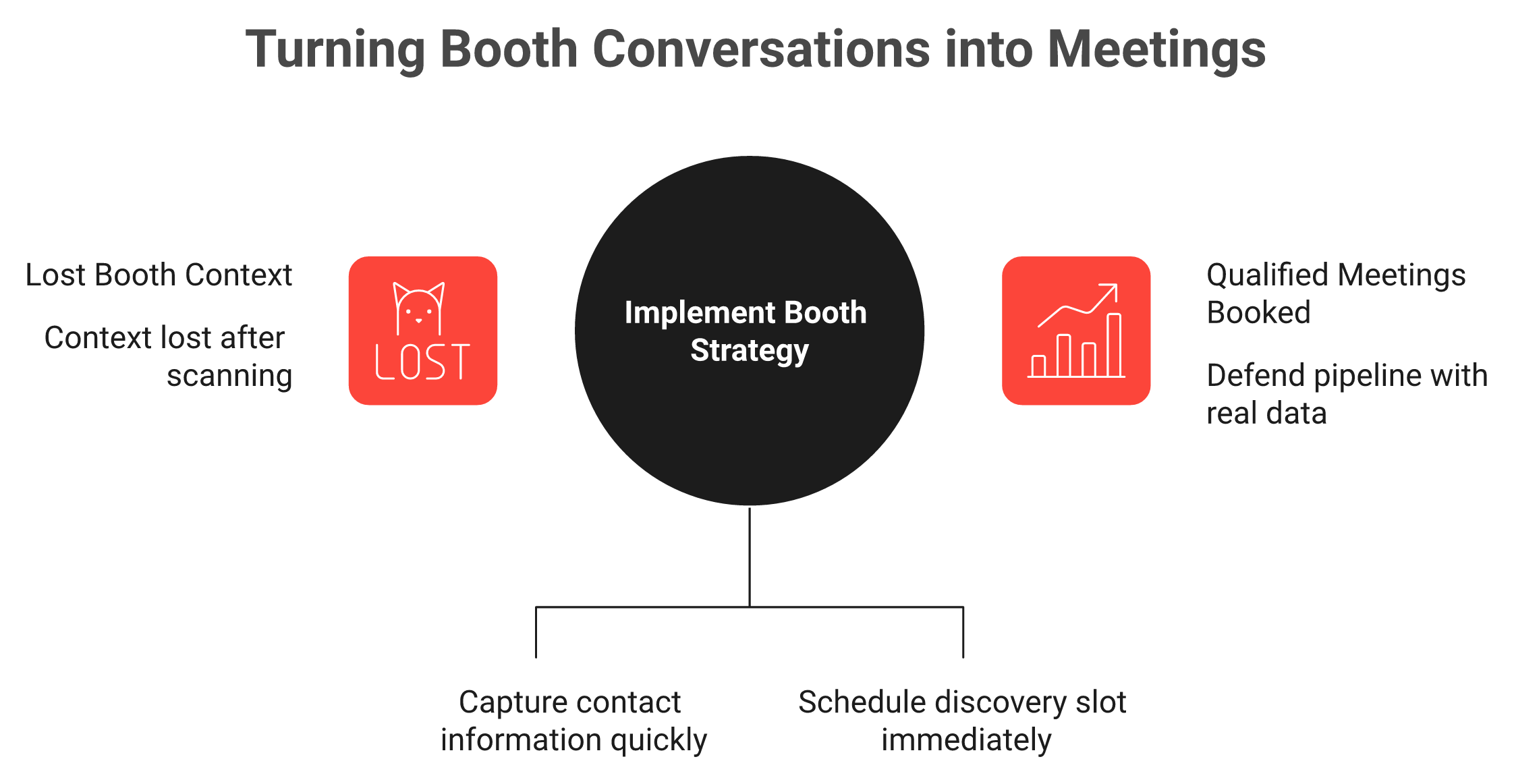
The same 90-second booth conversation has two possible endings, and the platform you pick decides which one your team gets.
Captello answers that with engagement. Its own site leads with activations, enrichment, and validated revenue attribution for enterprise event teams.
B2Brain answers it with commitment. B2Brain books the discovery meeting into the AE's live calendar during the booth conversation, then writes the record to Salesforce or HubSpot, which is how event lead capture reaches the CRM without a manual import.
⏰ Why the outcome, not the feature list, decides this
Trade show ROI complaints rarely trace back to a missing feature. They trace back to what happened in the ten minutes after the scan.
One r/b2bmarketing thread this year put it plainly:
The most-upvoted replies did not recommend a better scanner. They reframed shows as meeting accelerators rather than lead sources.
That reframe is the fault line between these two tools.
✅ The two-line decision rule
Here is the math I keep coming back to with buyers. A $70,000 booth with a 10x pipeline target needs roughly 50 opportunities. At a 12% discovery-to-close rate, that is about 180 discovery calls.
Work backwards and roughly one in five booth visitors has to become a qualified meeting. If you do not know that number, no software choice will save the show, and measuring event ROI stays guesswork.
So the rule is short:
Booth traffic is your bottleneck, and you have budget for branded games? Captello.
Meetings booked and a defensible per-show pipeline number are your bottleneck? B2Brain.
You run 15-plus shows with a committed activation budget already signed? Weight Captello's rows higher in the grid that follows.
⚠️ What I am not claiming
Captello is a strong platform with real review depth, holding roughly 4.8 out of 5 across 178 G2 reviews. B2Brain's public review footprint is far thinner, and I will show that honestly later in this piece.
I could be wrong about how fast the category converges here. Meeting booking is copyable, and BoothIQ, BoothMaven, and Zuddl already ship a version of it.
What is harder to copy is the layer underneath it.
B2Brain positions on one number, meetings booked per show, because that is the only event metric traceable to pipeline without waiting six months for a deal to close. Everything else in this comparison is a means to that number, and you can see how event lead capture works before, during, and after the show.
Q2. How do B2Brain and Captello compare across the eight buying criteria? [toc=2. Feature Comparison Table]
Across eight criteria, Captello leads on activation library, enrichment breadth, and review depth. B2Brain leads on in-booth meeting booking, leads-to-meeting reporting, and free-first-event trialability. Both handle badge and business-card capture with CRM sync. The divergence starts at what the platform does with the lead in the next ten minutes.
📊 Why these eight criteria
Procurement teams do not score 40 features. They score the handful that change the pipeline number.
These eight came from the questions field marketers and RevOps leads actually ask in demos: what does it escape, how deep does the CRM go, does it book meetings, what does it report, what does a season cost, does it survive rush hour, how hard is migration, and does it fit my vertical.
I added the organizer's rented badge scanner as a third column. That is the incumbent both tools are displacing, and leaving it out flatters everyone. If you are still on that default, the conference badge scanner workflow is the baseline to beat.
B2Brain vs Captello vs Organizer Badge Scanner: Eight Buying Criteria
Criterion
Captello
B2Brain
Organizer badge scanner
Structural trade-off escaped
Flat booth traffic, weak engagement data
Contact list with no booked meeting
Nothing; it is the default
Booth activations
60-plus games and activations
None shipped
None
In-booth meeting booking
Meeting management as a platform module
Books to the AE's live calendar during the conversation
No
CRM depth
Imports to CRM with buildable forms, per reviewers
Salesforce-native and HubSpot-native parity
CSV export after the show
Pipeline reporting
Revenue attribution on a 90-day window
Leads-to-meeting rate plus per-show pipeline report
None
Cost shape
From $500 per event license, custom quote above it
Per-event Show Pass, first event free for two users
Roughly $600 per device per show rental
Offline reliability
Enterprise capture app
Offline-ready, syncs on reconnect
Device-dependent
Review depth
About 4.8 across 178 G2 reviews
Thin third-party footprint
Not applicable
Row sources: each vendor's own site for its own claims, G2 for ratings and entry pricing, and verified reviews for anything a vendor would not publish itself.
🔁 How to reweight the grid
This grid is not a verdict. It is a rubric you should reweight against your own season.
The consolidation debate matters here. Accelevents' Jon Kazarian argues for one platform integrated with your CRM, while practitioners like Kayla Drake admit to running five technologies at once to get the job done.
If your activation budget is already contracted for the year, drop the activation row's weight to zero and rescore. If your CFO has asked twice for per-show pipeline, the reporting row should carry double weight.
⚠️ Where each column is genuinely weak
Captello's soft spot is cost predictability, not capability. Reviewers report per-show API kit purchases on top of the license, which is worth reading next to the full Captello pricing breakdown.
B2Brain's soft spots are real and worth stating: the native app is iOS-first, third-party enrichment depth is lighter than Popl, Mobly, or Momencio, and there is no digital business card.
The badge scanner's weakness needs no elaboration. It saves the lead and loses the conversation.
B2Brain owns the meeting-booking and leads-to-meeting rows in this grid, and nothing else. Readers with committed activation budgets should weight those two rows lower and score Captello higher without guilt.
Q3. What does Captello genuinely do best on the booth floor? [toc=3. Captello Booth Engagement]
Captello's strength is engineered booth traffic. The platform ships 60-plus interactive activations and games, engagement scoring, and enterprise capture with enrichment across 125-plus providers. It fits large exhibitors that need branded experiences across many booths and one platform spanning capture, activation, and attribution reporting.
⭐ Who actually buys Captello, and why they are right to
Picture a 40-by-60 booth at a large industry show with six product zones and twelve staff. The problem is not the scanner. The problem is that nobody stops walking.
Captello solves that specific problem well. Its activation library covers spin-to-win, scavenger hunts, leaderboards, and branded games, all wired to capture and scoring.
Enterprise event teams also buy it as a consolidation play. One vendor covers registration, check-in, activations, capture, and attribution reporting on a 90-day window.
✅ What reviewers consistently praise
Support and onboarding come up repeatedly in verified reviews, not just in case studies.
"We have had some issues getting up and running and their service has been excellent. They are very good with follow up, even during the holidays. Their training has been very proactive." — Jennifer H., Captello G2 Verified Review, 4 stars
Captello's own numbers, which are vendor claims and should be read as such, put activation-driven capture lift at 400% and engagement at 3x. I have not seen an independent audit of either figure.
⚠️ Where the strength stops
Here is the honest limit. Engagement is an input. A booked meeting is a commitment.
The same G2 reviewer above flagged the dependency that decides whether the app works at all:
"It does not always work with every conference, if the conference does not provide an API kit for integration." — Verified User in Consulting, Captello G2 Verified Review, 3.5 stars
That is the middleman problem showing up in a five-word clause. Your capture depends on what the organizer sells you, which is the case for universal lead capture that works at any show.
🎯 The layer where I think differentiation now sits
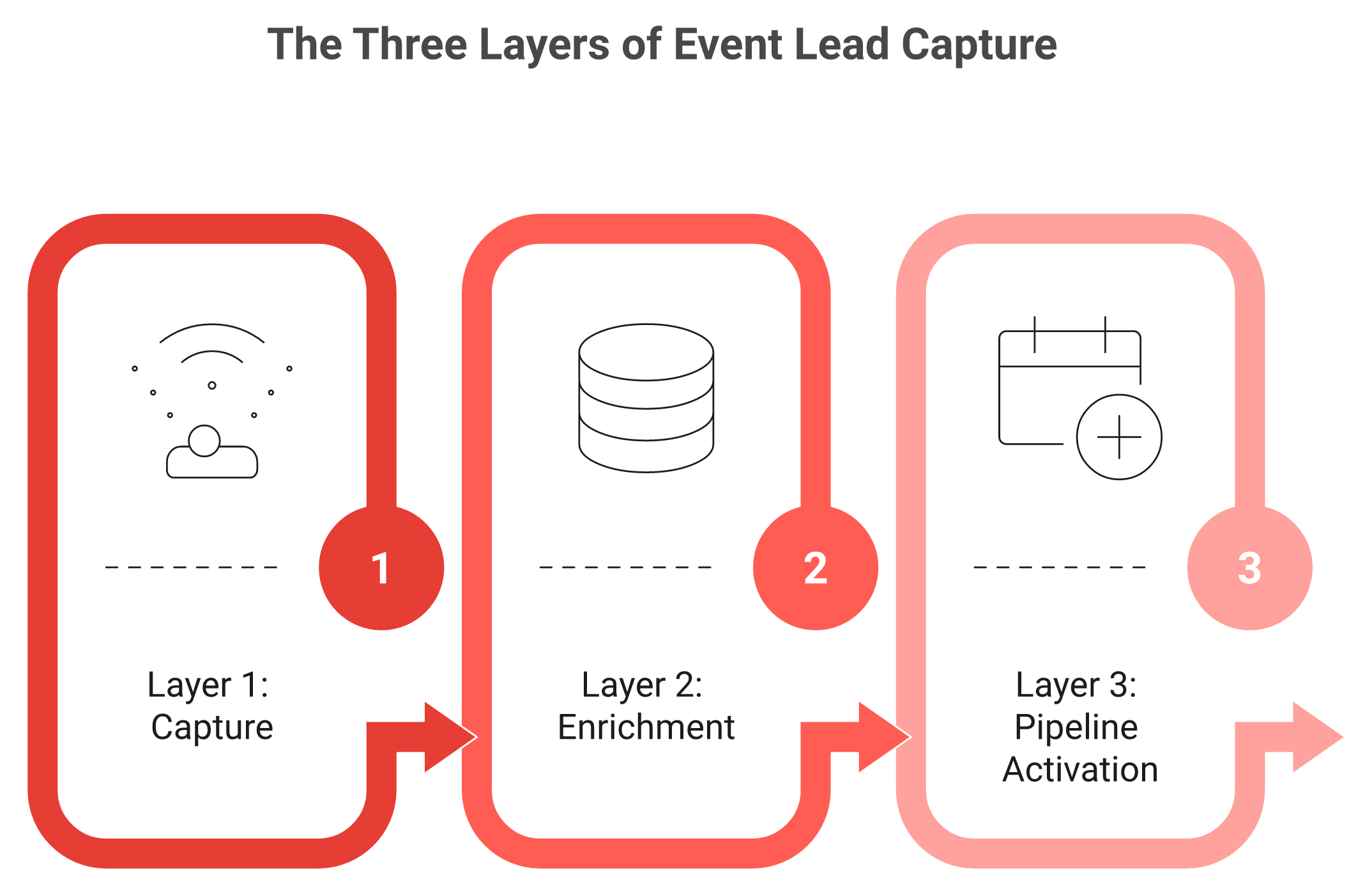
Capture and enrichment are now table stakes; the layer that decides shortlists is pipeline activation.
The category has three layers: capture, enrichment, and pipeline activation. Captello owns the first two convincingly.
My read is that differentiation has moved up to the third layer, and the next 18 months will be fought there. Don't take that as gospel, it is what B2Brain's data shows this season across industrial shows.
Field marketers I trust already work this way. One told me she scores every conversation hot, warm, or cold in the aisle rather than handing sales an unfiltered pile to sort through.
B2Brain ships no games library. It ships the workflow after the conversation, scan, add context by voice in roughly four seconds, then execute the next best action, which is usually the booked meeting, and that is the booth-day workflow in practice.
Q4. Do gamified activations produce buyers or lead garbage? [toc=4. Activation Lead Quality]
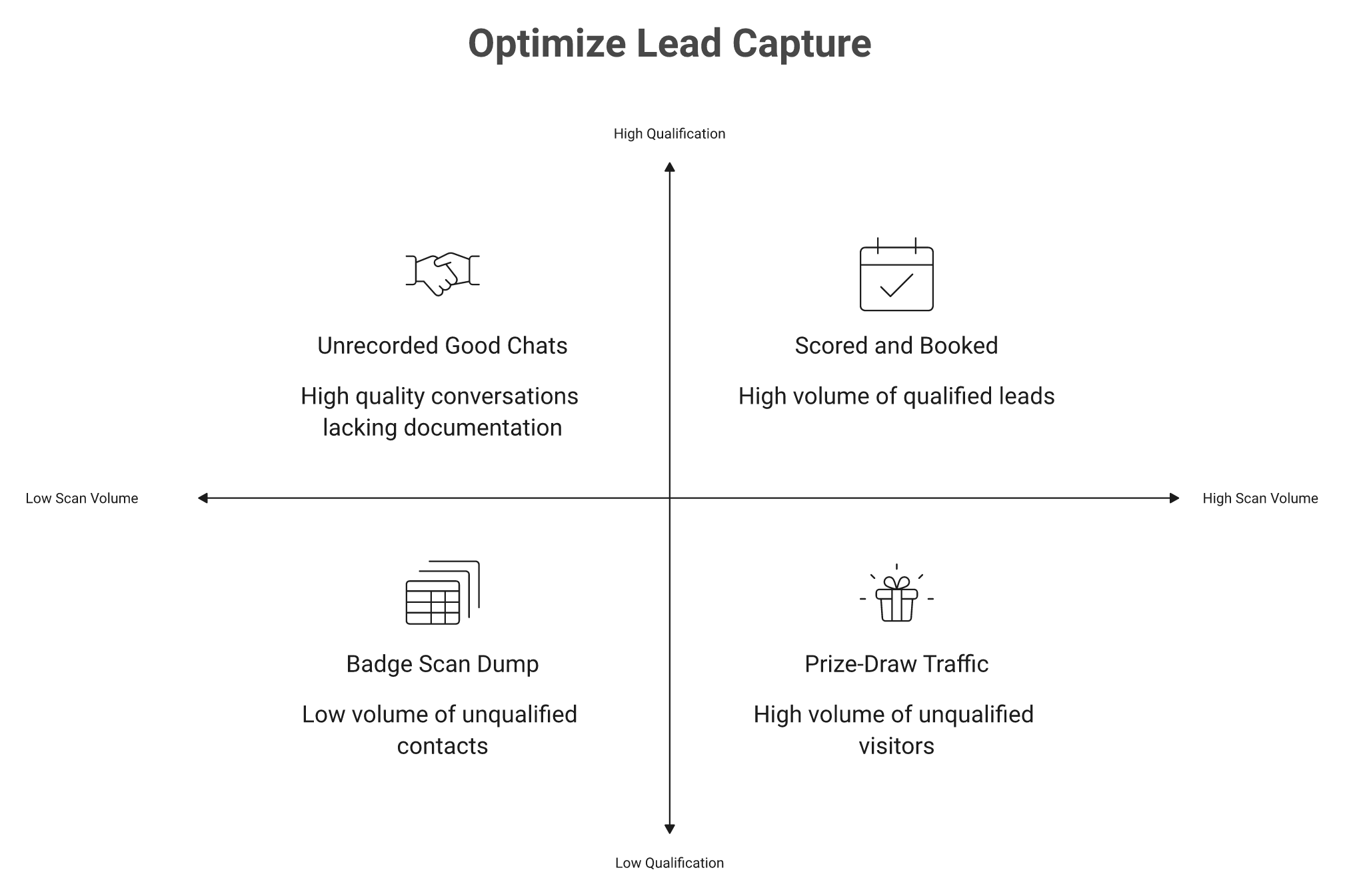
Activations reliably raise scan counts, but prize-driven traffic skews toward non-buyers. Only about 47% of exhibitors track leads through the sales cycle, so inflated volume rarely gets audited. Score in the aisle and count qualified conversations, not entries, before judging an activation's return.
❌ The popular view, and why it survives
The common playbook says booth traffic is the leading indicator. Draw a crowd, scan the crowd, hand the list to sales.
That playbook survives because almost nobody checks it. A 2025 CEIR analysis found only 47% of exhibitors track leads through the sales cycle, and fewer than 70% have a formal follow-up plan.
If you never trace the scan to a closed deal, a raffle looks exactly as good as a qualified conversation.
🎁 What the free iPad actually attracts
Here is the part the category avoids saying. The person who signs up for every prize draw is usually not the person who signs the purchase order.
A field marketer put it bluntly to me last year: the only people chasing the free iPad are non-decision-making staff walking the floor signing up for everything. The buyer with budget does not care about the giveaway.
The cost of that skew is not the prize. It is the follow-up hours your AEs burn sorting entries from buyers, which is exactly what a disciplined process for how to collect leads at a trade show prevents.
📉 What the qualification data says
Volume and qualification are different axes; only the top-right quadrant turns booth traffic into pipeline.
Poor qualification is where the money leaks. Industry sales research puts roughly 60% of lost sales down to failure to properly qualify the prospect.
Pair that with the decay curve. Response within two hours converts near 85%, dropping to about 9% after a week.
So a bigger pile, handled slower, is worse than a smaller pile handled in the aisle. That is the whole argument in two sentences.
💬 What buyers say when volume is the goal
Reviewers who love the capture speed still hit the volume trap.
"That it has helped us capture leads faster." And on the downside: "Every time we have a show with lead scanning, I have to purchase an API kit that costs between $700 and $1200. It's become costly." — RebeccaGrace K., Captello G2 Verified Review, 4 stars
The replies in that thread landed on pre-event targeting and meetings, not on scan volume.
✅ The better view, and the Monday version of it
A scan is only a lead when it carries context and a next action. Everything else is a contact record.
Three things to change before your next show:
Set a qualified-conversation target per rep, not a scan target.
Score every conversation in the aisle, hot, warm, or cold, before the badge leaves your hand.
Book the meeting on the spot for anything hot, then measure the ratio.
B2Brain scores each conversation at the point of capture, so rep judgement rather than a prize entry decides which leads reach the CRM. In B2Brain's own data, 52% of qualified booth conversations convert to booked meetings on the floor, against roughly 8% for post-event follow-up. If you want to test that ratio on your own floor, Book a Demo and run one show against last year's numbers.
Q5. Which tool books the meeting while the buyer is still at the booth? [toc=5. On-Floor Meeting Booking]
B2Brain books the meeting inside the booth conversation, routing it to the AE's live calendar before the buyer walks away. Captello handles meeting management as a platform module alongside capture, activations, and attribution. If commitment at the booth is your conversion event, that single difference decides the evaluation.
⏰ The aisle moment nobody designs for
Day 2, around 4pm. A VP of operations from a target account stops at your booth and says the sentence you flew 8,000 miles for: "Can someone walk my team through this?"
Your rep has about 90 seconds. What happens in those 90 seconds is the entire ROI of the show.
Most tools scan the badge and move on. The commitment evaporates in the aisle, which is why a lead capture app for trade shows has to do more than store a contact.
❌ What the post-show chase actually costs
The default plan is a follow-up sequence next week. That plan fights physics.
Response inside two hours converts near 85%, falling to roughly 9% after a week. Average exhibitor response time sits around 42 hours.
One field marketer described the reverse experience to me. She got an email 15 minutes after leaving a booth, and it changed her read of the whole company.
✅ What AE-calendar routing changes
Booking on the floor removes three failure points at once: the memory gap, the routing delay, and the "who owns this lead" argument on Monday.
B2Brain pulls the AE's live calendar in the booth, books the 30-minute discovery slot, and sends a dual invite to the prospect and the right AE. That record then syncs to Salesforce or HubSpot, which is how offline conversations turn into pipeline.
The rep does not become a scheduler. The buyer does not become a task in someone's queue.
Where the Meeting Gets Booked: Captello vs B2Brain vs Organizer Badge Scanner
Capability
Captello
B2Brain
Organizer badge scanner
Meeting booking location
Platform module for meeting management
Inside the booth conversation, on the AE's calendar
Not offered
Who holds the calendar
Event team configures scheduling
The assigned AE, live
Nobody
What the CRM receives
Lead record plus engagement data
Lead, context, and a booked meeting
CSV after the show
Reporting starting point
Engagement and attribution
Meetings booked, then pipeline
Scan count
⚠️ The objection I expect, and my honest answer
"BoothIQ also books meetings, so what is different?" I hear this constantly, and it is a fair hit.
Booking is a feature, and features get copied within two quarters. My read is that the booking button will be table stakes by next show season.
What is harder to copy is what the booking is grounded in: a shared record across pre-event, on-floor, and post-event, plus a briefing pulled from your own pipeline. Don't take that as gospel, it is what B2Brain is seeing across industrial shows this year.
🎯 The one demo question that settles it
Ask both vendors the same thing. "Show me a rep booking a meeting during a live booth conversation, on the AE's real calendar, with no laptop."
Then ask what lands in the CRM ten seconds later. The answers separate fast.
B2Brain treats the booked meeting as the capture event itself, which is why its reporting starts at meetings rather than scans. Contact information is not where anything happens. Pipeline is.
Q6. Which platform covers the show before, during, and after it? [toc=6. Pre-Event Intelligence Coverage]
Captello covers pre-event promotion and meeting scheduling, on-floor capture and activations, then post-event attribution as connected modules. B2Brain runs one shared intelligence layer across all three phases, with pre-event briefings built from your own CRM pipeline rather than a generic prediction database. Ask any vendor which phases share a single data record.
📅 The three phases, defined plainly
Every show has three jobs. Before: decide who you must meet. During: capture the conversation and get a commitment. After: prove what it produced.
Most stacks handle each job in a different tool. The seams are where leads die.
Captello does run all three phases, and its pre-event promotion and scheduling material is real. The question is whether the phases share one record or three, which is the point of the three-motion workflow.
🔌 Why stitched modules leak
A marketer once described her stack to me in one line. The rental system did not talk to the sales system, so the nurture emails went out with mismatched sender names and missing images.
That is not a vendor failure story. That is what happens when phases are integrations rather than one record.
B2Brain keeps the same record moving through all three phases, which is why the post-show report can name the booth conversation that created the meeting. That single-record design is what event intelligence actually requires.
✅ A worked example from one show
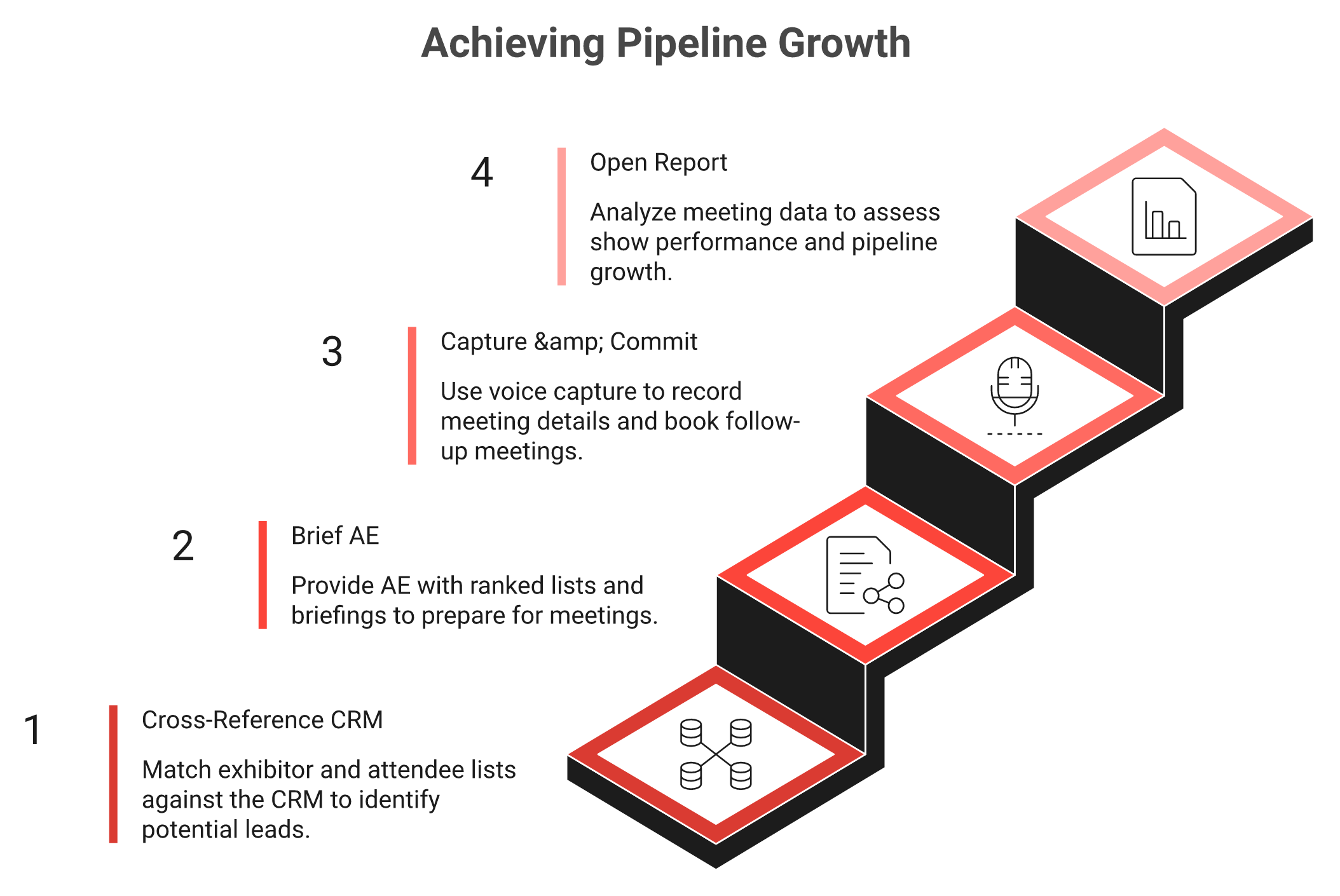
The four moves that turn one show into a defensible pipeline number, run on a single shared record.
Here is the sequence I would run for a 5,000-attendee industrial show.
Two weeks out, pull the exhibitor and attendee list, then cross-reference your CRM for open pipeline and stalled accounts.
Hand each AE a ranked list of 25 accounts plus one-page briefings to read on the plane.
On the floor, capture context by voice and book the meeting for anything qualified.
The next morning, open the per-show report before the 9am standup.
Step 2 is where most programs stop pretending. Generic prediction databases tell you who might be interested. Your CRM already knows who owes you a renewal conversation.
⚠️ Where each approach is genuinely stronger
Captello's advantage is breadth inside the event operations lane, including registration, check-in, and organizer-side workflows. If your team runs owned conferences as well as booths, that breadth matters.
B2Brain's advantage is depth in one lane, from CRM-grounded briefing to booked meeting to attributed pipeline, and nothing outside it. Honest limits apply too: the native app is iOS-first, enrichment depth is lighter than Popl or Momencio, and there is no digital business card.
Pick the one whose strength matches your actual bottleneck this season.
🎯 The question that exposes the seams
In the demo, ask to see one lead's full history in a single view: pre-show briefing, booth conversation, booked meeting, CRM campaign, and pipeline stage.
If the answer requires three screens and an export, you have your answer.
B2Brain briefs each rep from your live CRM pipeline before the doors open, so the booth conversation starts where the deal already is. That is the part I have never seen a badge scanning app attempt.
Q7. How deep is each CRM integration, and what happens at rush hour? [toc=7. CRM Sync and Reliability]
Both platforms sync to Salesforce and HubSpot, but depth differs. Campaign mapping, dedup across multiple reps, and offline queueing decide data quality. Captello reviewers report per-conference API kit dependencies and setup friction. Test offline capture, scan-to-note latency, and dedup in a sandbox with your own badge formats before signing either contract.
🔥 Rush hour is the real product test
The demo happens in a quiet conference room. The product gets judged at 2pm on Day 1 when four buyers arrive at once.
What breaks is predictable. Wi-Fi drops, a required field blocks the next scan, and three reps capture the same person.
Nothing in a feature matrix predicts this. Only a pilot does.
💬 What reviewers say when sync fails
Sync reliability complaints follow the same pattern across the category, not just one vendor.
"Sometimes Mobly can be finicky, where it doesn't sync all the leads I've scanned, doesn't scan leads properly, whether it was a blurry picture or the service made it delayed, or it's not syncing with the wifi." — Verified User in Events Services, Mobly G2 Verified Review, 3.5 stars
"It's essential to ensure that the fields are mapped properly from the registration form all the way to badge creation and onsite capture. If any information is missing at any stage, it won't carry over as expected." — Natalie S., iCapture G2 Verified Review, 4 stars
Captello's own reviewers flag the upstream dependency: the app works cleanly when the conference supplies an API kit, and less cleanly when it does not.
✅ The five checks to run in a pilot booth
Run these in one afternoon with two reps and your real badge formats.
Offline queue. Turn airplane mode on, capture ten leads, reconnect, and count what lands.
Scan-to-record latency. Time one full capture with context, not just the badge scan.
Dedup logic. Have three reps scan the same badge, then check the CRM for one record or three.
Badge format coverage. Test the actual show's badge, not a sample QR code.
Training time. Measure how long a new rep needs before they stop asking questions.
B2Brain records a structured CRM entry from about 30 seconds of speech in roughly 4.2 seconds, which is close to one fifth of the time typed notes take. Teams that already run lead capture into Salesforce should test that latency against their current process.
⚠️ The blocking-field trap
Here is the design mistake that quietly kills data quality. If the app forces a note before the next scan, reps skip notes entirely during a surge.
One reviewer of a rival tool praised exactly the opposite behaviour:
"The AI Conversation Summarization and Auto-CRM Entry feature is a standout. Reps actually rave about it instead of dreading another sales tool." — Ole O., B2Brain G2 Verified Review, 4 stars
That same reviewer also called B2Brain's reporting basic, with no rep performance dashboards. Both things are true, and buyers should weigh both.
🎯 Ask these three questions in the demo
"Show me a capture with the Wi-Fi off." "Show me what happens when two reps scan the same badge." "Show me the Salesforce campaign this lead lands in, live."
Vague answers here become dirty data in November.
B2Brain lets a rep capture fast and add context afterwards from a recent-leads queue, because a blocking note field produces a note nobody writes. Rush hour was the design brief, not an edge case, and it shapes the booth-day workflow end to end.
Q8. What does each cost across a full 12-show season? [toc=8. Pricing and Season Cost]
Captello starts near $500 per event license with a custom quote layered on top, and G2 reviewers report API kits of $700 to $1,200 per lead-scanning show. B2Brain sells a per-event Show Pass, with the first event free for two users. Model both against your full show count rather than a single event.
💰 Two different cost shapes
Captello's published entry point on G2 is $500 for one event license per year, with enterprise pricing quoted per portfolio. The fuller breakdown sits in the Captello pricing analysis.
B2Brain prices per event through a Show Pass, plus an annual plan for teams running a full season. You can compare Show Pass and Pipeline plans line by line.
Neither number is the number you will pay. The add-ons decide that.
💸 The add-on stack reviewers actually report
This is the cost line that never appears on a pricing page.
"That it has helped us capture leads faster." On the downside: "Every time we have a show with lead scanning, I have to purchase an API kit that costs between $700 and $1200. It's become costly." — RebeccaGrace K., Captello G2 Verified Review, 4 stars
"It does not always work with every conference, if the conference does not provide an API kit for integration." — Verified User in Consulting, Captello G2 Verified Review, 3.5 stars
Price sensitivity in this category is sharp, and reviewers say so bluntly across vendors:
"The price, $140 a year? No way, would rather print thousands of business cards." — Fabian T., Popl G2 Verified Review, 1 star
📐 A 12-show model, with the assumptions stated
Assume 12 shows, 8 with organizer badge scanning, and 4 reps per booth. These are illustrative assumptions, not quotes.
Modelled 12-Show Season Cost: Captello vs B2Brain vs Organizer Scanner Rental
Cost line
Captello (modelled)
B2Brain (modelled)
Organizer scanner rental
Platform or license
12 event licenses from $500 each
Per-event Show Pass, first event free
Not applicable
Per-show add-ons
8 API kits at $700 to $1,200
None reported
Roughly $600 per device per show
Activations
Quoted per event
Not offered
Not offered
Season floor
Roughly $11,600 and up
Show Pass count minus the free event
Roughly $14,400 for 3 devices
Verify each line against your own quote. Any vendor should be willing to write the add-ons into the contract.
⏰ The only cost metric that matters
Sticker price is the wrong denominator. Cost per booked meeting is the right one.
Take a $70,000 booth and a $1,000,000 pipeline target. At a 12% discovery-to-close rate, you need roughly 50 opportunities and about 180 discovery calls.
That means roughly one in five booth visitors must become a qualified meeting. Software costing $1,000 more that lifts that ratio pays for itself in one show, and an event ROI calculator makes that arithmetic explicit.
✅ How to keep the finance conversation honest
A qualified event meeting costs about 60% of an outbound meeting and around 40% of paid acquisition in B2Brain's own customer data. Put that comparison in the QBR deck instead of a licence total.
One founder I know spent $35,000 decorating her first booth, then ran her second for $950 and did better. The line item is rarely the problem. The workflow is.
B2Brain prices per event with the first event free for two users, so the season cost is testable before a contract rather than after. Run one show, measure the meeting count, then decide, or Book a Demo and walk the math through with us first.
Q9. What do verified reviews say about each platform? [toc=9. Verified Review Patterns]
Captello holds roughly 4.8 out of 5 across 178 G2 reviews, praised for support, training, and CRM import, with recurring friction on setup, per-conference API kit dependencies, and lead-management complexity. B2Brain's third-party footprint is far smaller and mostly describes its account-intelligence product, so weigh Captello's review depth against B2Brain's narrower, outcome-specific evidence.
⭐ The volumes, stated plainly
Captello sits near 4.8 out of 5 across 178 G2 reviews, with an entry price listed at $500 for one event license per year. The season-level view sits in the Captello pricing breakdown.
The social-proof reality in this category is lopsided. Blinq carries more than 8,800 G2 reviews, Popl more than 4,400, while B2Brain carries 17. The pattern behind those volumes is unpacked in the Blinq reviews analysis.
I am not going to argue that away. Review count is a real signal, and buyers should treat it as one.
✅ What Captello reviewers consistently praise
Two themes repeat: the humans and the CRM handoff.
"We have had some issues getting up and running and their service has been excellent. They are very good with follow up, even during the holidays." — Jennifer H., Captello G2 Verified Review, 4 stars
Cost creep per show. The $700 to $1,200 kit purchase repeated across the season.
None of these are dealbreakers for a well-staffed enterprise event team. All of them are budget lines nobody mentions in a demo.
❌ The honest disclosure about B2Brain's reviews
Here is the vulnerable part. B2Brain's public G2 reviews mostly evaluate the account-intelligence product, not the event capture app, and one reviewer was blunt about the gaps.
"The main thing is the contact data. It's just not very good. The accuracy of emails is hit or miss, around 60-70%." — Jorgealfa P., B2Brain G2 Verified Review, 3.5 stars
I would rather you read that than find it later. Enrichment depth is genuinely lighter than Popl, Mobly, or Momencio, and the native app is iOS-first.
🎯 What to ask in a reference call
Review counts do not answer the question you actually have. Ask the reference these four things instead.
How many booth conversations turned into booked meetings at your last show?
What percentage of scans reached the CRM with usable context?
What did the platform cost you across the full season, add-ons included?
What broke on Day 1, and how fast was it fixed?
Any vendor confident in its numbers will connect you to someone who can answer all four.
B2Brain has fewer public reviews than Captello, so ask for a reference on your own show circuit and check their leads-to-meeting rate rather than their star rating. That is the number the review sites do not collect, and it is the number the three-motion workflow is built to move.
Q10. Which reporting survives a CFO conversation, engagement scores or LTM? [toc=10. Proving Pipeline to Finance]
Captello reports revenue attribution on a 90-day window, with engagement scoring and cost-per-lead views. B2Brain reports leads-to-meeting, meetings booked divided by qualified conversations, so a show is judged on commitments obtained. Bring both a sourced and an influenced number to finance, because most CFO disputes turn out to be window disputes.
📐 Leads-to-Meeting, defined once
Leads-to-Meeting (LTM) is one ratio. Meetings booked divided by qualified booth conversations.
That is it. No modelling, no attribution philosophy, no six-month wait.
LTM is to events what cost-per-click is to advertising. It gives the category a unit that finance already knows how to argue about, and it is the spine of measuring event ROI.
💰 What Captello's model reports, and what it assumes
Captello anchors revenue attribution on a 90-day window and shows cost per lead alongside forecast figures.
That model works when your deals close inside the window. Industrial and ABM cycles usually do not.
The longest enterprise deal I have personally closed took 524 days. No 90-day window would have credited the show that started it.
⏰ Why the window is where CFO arguments happen
Field marketing measurement practice generally splits into 90-day sourced pipeline and 180-day influenced pipeline, and many marketing automation platforms default to a 14-day attribution window.
A 14-day default on a nine-month cycle credits almost nothing to the show. Your budget dies in that gap, not in the spreadsheet.
So bring two numbers, not one, and say which window each uses.
Reporting Comparison: Captello vs B2Brain vs Organizer Badge Scanner
Reporting question
Captello
B2Brain
Organizer badge scanner
Primary metric
Engagement score, cost per lead
Leads-to-meeting rate, then pipeline
Scan count
Attribution window
90 days
Sourced at 90 days, influenced at 180
None
Available Monday morning
Post-show reporting
Per-show report by 9am next day
CSV, when the organizer sends it
Auditable formula published
Not published
Meetings divided by qualified conversations
Not applicable
✅ The report template I would bring to the QBR
Five lines, one page. Nothing a CFO has to interpret.
Booth cost, all in, including travel and drayage.
Qualified conversations captured.
Meetings booked, with the LTM percentage.
Pipeline sourced at 90 days and influenced at 180 days.
Ratio against the 3:1 to 5:1 pipeline-to-cost benchmark most field programs target.
B2Brain measures LTM as meetings booked divided by qualified booth conversations, and reports 52% on the floor against a roughly 8% industry norm for post-event follow-up. An event ROI calculator turns those two numbers into the pipeline line finance wants.
⚠️ Where I could be reading this wrong
Every event team should tie shows to CRM campaigns, sourced and influenced, or the attribution argument is unwinnable. That part I am certain about.
The 52% figure is a different matter. It comes from B2Brain's own customer base of industrial and mid-market ABM sellers, which is a specific slice of the market.
My read is that the number holds in that slice and softens in high-volume consumer-adjacent shows. Don't take it as gospel, it is what we are seeing this season.
B2Brain publishes the LTM formula so finance can audit it, which matters more than the percentage itself. A metric nobody can recompute is a claim, not a measurement, and that is why offline to pipeline is written as a chain of records.
Q11. Which should you pick for your show profile, and how hard is switching? [toc=11. Fit and Migration]
Teams running 15-plus shows with branded activations and enterprise procurement should stay with Captello. Teams running 5 to 15 industrial shows where the KPI is meetings booked should pilot B2Brain on one show. B2Brain offers a free first event for two users, and migration typically costs a week of setup work.
📦 The before state, in one image
A sales director once described his post-show ritual to me. The box of cards comes home, he pulls three out on Monday, someone asks him to lunch, and the box goes under the desk.
Six months later, someone finds the box. That is the baseline both platforms are competing against, and it is why how to collect leads at a trade show starts with the workflow, not the device.
Field or Event Marketing head. You fund the booth and owe the pipeline number. If activations already drive your floor plan, keep Captello. If the Monday question is "how many meetings," pilot the meeting-first tool.
VP Sales or CRO. You want AE calendars full before the flight home. Score in-booth booking and AE routing above everything else, which is the core of the booth-day workflow.
Founder at a growth-stage vertical company. You are building a first events machine on real cash. Start with per-event pricing and one show, not an annual contract, so compare Show Pass and Pipeline plans before you commit.
RevOps or Marketing Ops. You own dedup and campaign mapping. Score CRM depth and offline queueing first, since you will inherit whatever mess ships.
⏰ What migration actually takes
Plan a week, not a quarter. The work is unglamorous and mostly one-time.
Map shows to Salesforce or HubSpot campaigns, one per event.
Set dedup rules for multiple reps scanning the same badge.
Export historical event leads for continuity.
Run one 45-minute rep training session, then a dry run at the booth.
Reviewers across this category consistently name field mapping as the step that decides data quality:
"It's essential to ensure that the fields are mapped properly from the registration form all the way to badge creation and onsite capture." — Natalie S., iCapture G2 Verified Review, 4 stars
"The AI Conversation Summarization and Auto-CRM Entry feature is a standout. Reps actually rave about it instead of dreading another sales tool." — Ole O., B2Brain G2 Verified Review, 4 stars
❌ Who should buy neither
Say the quiet part. Some teams should not buy either platform.
Solo founders at a single table, consumer-facing sellers, teams with no CRM, one-off attendees, and developer or AI-summit exhibitors will not recover the cost. A notebook and a same-day email works better at that scale.
B2Brain deliberately does not chase those buyers, and I would tell you the same on a call.
✅ The cheapest way to settle this
Run one show. Same booth, same reps, same badge scanner as last year, and one new capture workflow.
Compare two numbers only: meetings booked, and pipeline attributed 90 days later. B2Brain's free first event for two users exists precisely so that test costs you nothing but attention.
Where I think this category goes next: the booking button becomes table stakes within 18 months, and the fight moves to whose pre-event briefing is actually grounded in your pipeline. I could be wrong. If you run industrial shows and are seeing something different this season, I would genuinely like to hear it, so Book a Demo and bring your last show's numbers.
FAQ's
Does Captello book meetings at the booth, or only capture leads?
Captello handles meeting management as a platform module that sits alongside capture, activations, and attribution reporting. It is configured by the event team rather than executed by a rep mid-conversation, so the booking usually happens around the show rather than inside the aisle exchange.
That distinction matters more than it sounds. The commitment window at a booth is about 90 seconds, and response inside two hours converts near 85%, dropping to roughly 9% after a week.
Captello: meeting scheduling as a module, engagement scoring as the primary on-floor signal.
B2Brain: pulls the AE's live calendar in the booth, books the 30-minute discovery slot, and sends a dual invite before the buyer walks away.
Organizer badge scanner: no booking at all, just a contact record and a CSV.
B2Brain treats the booked meeting as the capture event itself, which is why its reporting starts at meetings rather than scans. If you want to see that sequence end to end, we walk through how event lead capture works before, during, and after the show. One demo question settles it for most buyers: ask each vendor to show a rep booking on a real AE calendar, with no laptop.
How much does Captello cost per event, and how does B2Brain price against it?
Captello's published G2 entry point is $500 for one event license per year, with enterprise pricing quoted per portfolio. The sticker price is rarely the final number, because verified reviewers report buying an API kit for each lead-scanning show at $700 to $1,200, plus activation add-ons quoted per event.
B2Brain prices per event through a Show Pass, with an annual plan for teams running a full season and a free first event for two users.
Model a realistic season rather than a single show:
12 event licenses from $500 each on the Captello side.
8 API kits at $700 to $1,200 for the shows with organizer badge scanning.
Activations quoted separately, per event.
Organizer scanner rental as your baseline, roughly $600 per device per show.
The denominator that actually matters is cost per booked meeting, not licence total. A $70,000 booth chasing $1,000,000 in pipeline needs roughly 50 opportunities and about 180 discovery calls, which means roughly one in five booth visitors must become a qualified meeting. Compare Show Pass and Pipeline plans against your own show count, and insist any vendor writes per-show add-ons into the contract before you sign.
What is Leads-to-Meeting (LTM), and how do I calculate it for my last show?
Leads-to-Meeting (LTM) is a single ratio: meetings booked divided by qualified booth conversations. No modelling, no attribution philosophy, and no six-month wait for a deal to close.
LTM is to events what cost-per-click is to advertising. It gives finance a unit they already know how to argue about, which is why it survives a QBR better than an engagement score.
To calculate it for your last show:
Count qualified conversations, not badge scans. A prize entry is not a conversation.
Count meetings actually booked into an AE calendar, not leads marked interested.
Divide the second number by the first, then compare it to the same show last year.
B2Brain measures LTM this way and reports 52% on the floor against a roughly 8% industry norm for post-event follow-up, drawn from its own base of industrial and mid-market ABM sellers. That slice matters, and the number softens at high-volume consumer-adjacent shows. Pair LTM with pipeline sourced at 90 days and influenced at 180 days, because most CFO disputes turn out to be window disputes. Our guide to measuring event ROI lays out the five-line report we bring to the QBR.
Do gamified booth activations actually produce qualified leads?
Activations reliably raise scan counts. Whether they raise pipeline is a separate question, and the honest answer is that most exhibitors never check.
A 2025 CEIR analysis found only about 47% of exhibitors track leads through the sales cycle, and fewer than 70% have a formal follow-up plan. If nobody traces the scan to a closed deal, a raffle looks exactly as good as a qualified conversation.
The skew is predictable. The person who signs up for every prize draw is usually not the person who signs the purchase order, and industry sales research puts roughly 60% of lost sales down to failure to qualify properly.
Three changes to make before your next show:
Set a qualified-conversation target per rep, not a scan target.
Score every conversation hot, warm, or cold in the aisle, before the badge leaves your hand.
Book the meeting on the spot for anything hot, then measure the ratio.
B2Brain scores each conversation at the point of capture, so rep judgement rather than a prize entry decides which leads reach the CRM. Captello's activation library is genuinely strong at drawing a crowd; the discipline that converts that crowd is described in our guide to how to collect leads at a trade show.
How hard is it to switch event lead capture tools in the middle of a show season?
Plan a week of setup work, not a quarter. The migration tasks are unglamorous and mostly one-time, which is why a mid-season switch is realistic if your next show is at least three weeks out.
Map shows to Salesforce or HubSpot campaigns, one campaign per event.
Set dedup rules for multiple reps scanning the same badge.
Export historical event leads so year-over-year comparisons survive.
Run one 45-minute rep training session, then a dry run at the booth.
Field mapping is the step that decides data quality. Reviewers across this category consistently report that when a field is missing at registration or badge creation, it never carries through to onsite capture.
B2Brain offers a free first event for two users, which makes the test cheap: same booth, same reps, same badge scanner as last year, one new capture workflow. Compare two numbers only, meetings booked and pipeline attributed 90 days later.
Some teams should switch to neither platform. Solo founders at a single table, consumer-facing sellers, teams with no CRM, and one-off attendees will not recover the cost. If you do run 5 to 15 industrial shows, the booth-day workflow is where to start, then Book a Demo with your last show's numbers.
Enjoyed the read? Join our team for a quick 30-minute chat — no pitch, just a real conversation on how we’re rethinking Event Intelligence in B2b.

.png)

.png)