B2Brain vs HiHello: Compared on Card Capture, CRM Sync, and Pipeline Attribution
Written by
Sridhar Ranganathan
Last Updated :
August 18, 2026
Skim in:
13
mins
TL;DR
HiHello is a digital business card platform. B2Brain is an event lead capture app. The tools answer different questions: who am I, versus where is the pipeline.
HiHello caps scanning at 5 a month on Free and 20 on Professional. A productive booth rep logs about 31 scans in a single show day.
HiHello syncs contacts and leads to Salesforce, HubSpot, Dynamics 365, and Marketo on paid plans. B2Brain also writes opportunities, meetings, and notes tagged to the show.
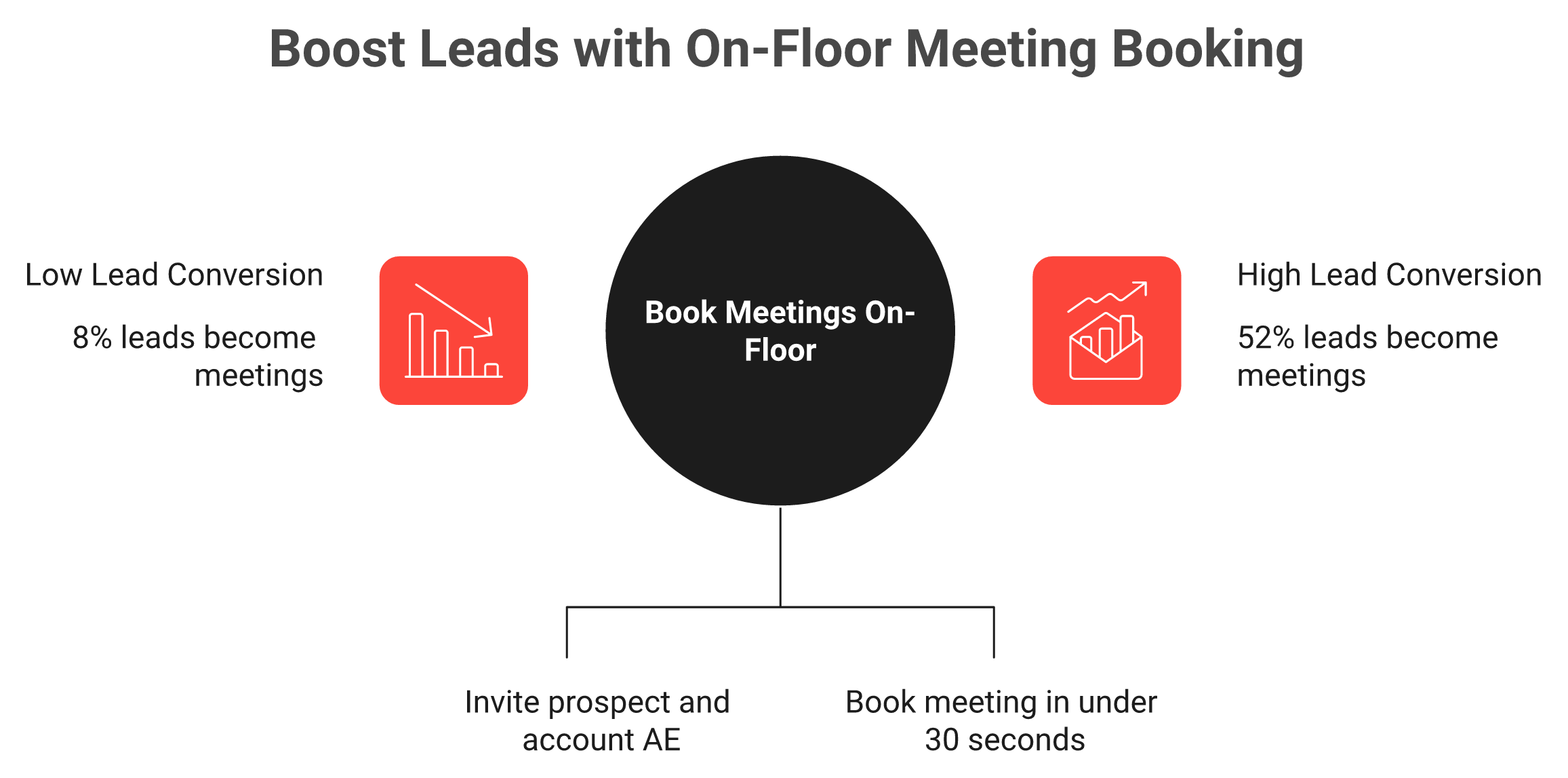
B2Brain books the discovery meeting at the booth in under 30 seconds, holding a 52% leads-to-meeting rate against an 8% industry average post-event.
Compare cost per booked meeting, not cost per seat. Rented scanners run $200 to $500 per device per event, roughly $30,000 to $40,000 a year for five reps at twenty shows.
Honest gaps: B2Brain ships no digital business card, has no Android app today, and holds 17 G2 reviews against HiHello's 919. Many teams run both tools.
Q1. B2Brain vs HiHello: What Is the Real Difference in One Table? [toc=1. Verdict And Comparison Table]
HiHello is a digital business card platform whose card and badge scanner is capped at 20 scans a month below its Business plan. B2Brain is an event lead capture app that scans badges, cards, and LinkedIn profiles offline, books the meeting at the booth, and writes event-attributed deals to Salesforce or HubSpot. Different jobs, not different price points.
The Procurement Question Nobody Asks Out Loud
A field marketing head at a logistics platform asked me this last September, six weeks out from her show. Her reps already had HiHello cards in their email signatures. Her CFO wanted to know why the booth needed another app.
Fair question. Wrong comparison. One tool answers "who am I," and the other answers "where is the pipeline."
⚠️ Two Tools, Two Different Jobs
A digital business card is an identity layer. Your reps use it every day, at coffee meetings and airport lounges. Lead capture is a pipeline layer, used maybe fifteen days a year, under pressure, with a revenue number attached.
I have watched teams try to stretch the identity tool across the booth. It holds for the first hour of Day 1. Then a queue forms.
The Eight Criteria That Actually Decide This
Here is the comparison as a buyer would build it, with the organizer's rented scanner included, because that is the real incumbent on most floors. If you want the wider field, the best event lead capture software for 2026 breakdown covers the rest of the category.
B2Brain vs HiHello vs the Organizer's Badge Scanner
Criterion
HiHello
B2Brain
Organizer badge scanner
Capture surfaces
Paper cards, QR codes
Badge QR and barcode, cards, LinkedIn profiles
Event badge only
Scan volume
5/month Free, 20/month Professional, unlimited on Business
Unlimited
Unlimited during the show
Offline capture
Needs a live connection
Offline including airplane mode, syncs on reconnect
Device dependent
In-booth meeting booking
No
Yes, dual invite to prospect and AE
No
CRM objects written
Contacts and leads (paid plans)
Leads, contacts, opportunities, meetings, notes
CSV export
Per-show pipeline reporting
Card views, shares, scan counts
Per-show pipeline, LTM, show comparison
None
Event arc covered
During and after the handshake
Before, during, after on one layer
During only
Pricing shape
$0 Free, $8/mo Professional, about $5 to $6/user/mo Business
From $200/user/event or $1,500/user/year
$200 to $500 per device per event
💰 Read the Pricing Row Twice
Per-seat monthly pricing and per-event pricing are not the same animal. Five reps at twenty shows on rented scanners runs $30,000 to $40,000 a year for contextless scans. B2Brain prices per show, from $200 per user per event, because a tool used fifteen days a year should not carry a daily seat charge, as the Show Pass and Pipeline plans set out.
The money in a trade show is made in the follow-up, not the scan.
Which Column Decides It for You
If you exhibit twice a year with no CRM behind you, the cheap identity tool is defensible. If you run five to fifteen shows with Salesforce or HubSpot and owe someone a pipeline number, look at rows four through seven. Those rows are where the two tools stop overlapping.
⭐ My Honest Hedge on This Table
B2Brain's own data points to the meeting-booking row as the decider, though I might be reading it too strongly. Some teams genuinely just need faster contact capture this season, and that is a legitimate place to start.
B2Brain offers a first event free for two users, which is the only honest way to price a tool you should judge on one show's pipeline rather than on a feature grid.
Q2. What Can Each Tool Capture at a Booth, and What Happens When the Plan Cap or the Wi-Fi Runs Out? [toc=2. Capture Surfaces And Limits]
HiHello scans paper cards and QR codes, limited to 5 scans a month on Free and 20 on Professional, and reviewers report the QR flow failing without a live connection. B2Brain captures badge QR and barcode formats, business cards, and LinkedIn profile screenshots offline, including airplane mode, then syncs when the network returns.
The 4pm Day Two Problem
Picture a booth at a mid-size industrial show. Forty people come through in ninety minutes after a keynote lets out. Two reps, one demo station, nobody free to type notes.
That is the moment every capture tool gets tested. Not the demo. Not the pricing page.
⏰ Three Surfaces, Not One
Booth capture happens on three surfaces. There is the event badge, printed as a QR code or a 1D barcode depending on the organizer's registration vendor. There is the paper business card, still alive at manufacturing shows. And there is the person with no badge at all, met at the coffee cart.
Badge formats change show to show. A tool tied to one format fails silently at the next event, which is the whole argument for universal lead capture.
⚠️ Run the Cap Math Before You Buy
A productive rep in B2Brain's data logs about 31 scans in a single show day. HiHello's Professional plan allows 20 scans a month. That budget is gone before the morning coffee break on Day 1.
Unlimited scanning starts on HiHello's Business plan, which is also where CRM sync unlocks. So the entry tiers are not really booth tiers at all.
What Buyers Report When the Scan Fails
The complaint pattern on HiHello's scanner is not about speed. It is about the scan producing nothing usable, a pattern the wider HiHello review tracks across plans.
"We tried to use the QR scanner and it would only take us to the download option for Hi Hello. My digital business card would not load. Android users could not even get the QR function to recognize it." — Angela C., Verified Reviewer HiHello - G2 Verified Review
"I'm not getting contact information for people that scan the QR." — Verified User in Health, Wellness and Fitness HiHello - G2 Verified Review
📶 The Back Hall Dead Zone
Expo halls are hostile networks. Thirty thousand phones share the same ceiling, and back halls are worse than aisle one. Ask B2Brain to capture in airplane mode and the record queues locally, then writes to the CRM on reconnect.
I still tell teams to test connectivity at their actual booth number during move-in. Two minutes of testing beats a lost afternoon.
Capture Without Context Is Not Capture
A scan gives you a name. It does not tell you the person was replacing a competitor's system in Q1. The category runs on badge scan dumps, 400 contacts nobody acts on, because context died at the booth.
The old operator advice still holds. Organize contacts within 48 hours, before the hotel bar, because your brain loses the detail fast. The booth-day workflow exists to make that automatic rather than heroic.
✅ Photo-Verify While They Walk Away
One habit from a field marketer who runs close to 100 shows a year. Hold the card up and photograph it as the person leaves, so you never ask "which card was that." B2Brain's voice note attached to the same record does the same job in about four seconds.
B2Brain captures badge, card, and LinkedIn profile in one offline flow, so the floor-walker with no badge is still a logged lead with context attached.
Q3. Does HiHello's CRM Sync Give You Contacts or Actual Pipeline Records? [toc=3. CRM Sync Depth]
HiHello syncs to Salesforce, HubSpot, Microsoft Dynamics 365, and Marketo on paid plans, creating contacts and leads. B2Brain writes leads, contacts, opportunities, meetings, and notes in real time, each tagged to the event and sub-activity, so per-show reporting works without a RevOps rebuild.
Sync Is a Verb With Very Different Depths
Every vendor in this category says "syncs with Salesforce." That phrase covers everything from a nightly CSV to native object writes. The difference shows up in your QBR, not in the integration grid, and the Salesforce lead capture setup is where you can see it.
Up to 80% of event leads never properly reach the CRM. That is a workflow failure, not a data failure.
⚠️ A Contact With No Campaign Is Invisible
Think about what a bare contact record can support. No campaign membership, so no sourced pipeline. No opportunity, so no dollar value. No note, so the AE calling next week has nothing to open with.
A field marketing leader put the standard plainly to me. Every event lives in Salesforce as a campaign, every lead and conversation tracked, sourced and influenced pipeline separated.
🔁 Object-by-Object, Side by Side
CRM Objects Written by HiHello and B2Brain
CRM behaviour
HiHello
B2Brain
Contact or lead creation
Yes, on paid plans
Yes
Opportunity or deal creation
No
Yes
Meeting written to calendar and CRM
No
Yes
Conversation notes on the record
Limited
Voice note transcribed to the record
Event and sub-activity tagging
No
Yes, every capture
B2Brain measures attribution by stamping each record with the show, the booth area, the rep, and the segment. That is what makes a per-show report possible on Monday instead of never.
What Users Say About the Sync Layer
The most useful HiHello review on this point is a middling one, not a one-star rant.
"Not Enough Custom Fields and doesn't sync to the CRM." — Vontavius H., Verified Reviewer HiHello - G2 Verified Review
And here is a critique of my own product, because pretending it does not exist would be worse.
"The main thing is the contact data. It's just not very good. The accuracy of emails is hit or miss, around 60-70%." — Jorgealfa P., Verified Reviewer B2Brain G2 - Verified Review
✅ The Monday CRM Audit
Run this in twenty minutes. Pull last show's records and check four fields: campaign, opportunity, note length, and owner. If campaign is blank on more than a quarter of them, your sync is cosmetic.
B2Brain's read is that the standard advice gets this backwards. Teams shop integration logos when the buying criterion is which objects get written.
💸 Enrichment Is Not the Same as Attribution
Popl and Mobly go deeper on third-party enrichment than B2Brain does, and I will not pretend otherwise. Our stance is to enrich from your own CRM, the data you already trust. Cold database appends do not fix a missing campaign field, and the measuring event ROI guide shows why the campaign field matters more.
B2Brain creates the opportunity, not just the contact, and stamps every record with the show it came from, which is what turns a scan into something a CFO can audit.
Q4. Which Tool Books the Meeting Before the Prospect Leaves the Aisle? [toc=4. On-Floor Meeting Booking]
HiHello shares a card and routes a contact; it does not book a discovery meeting on the floor. B2Brain books the meeting during the conversation with a dual calendar invite to the prospect and the right AE, which is why its lead-to-meeting rate holds at 52% on the floor against an 8% industry average post-event.
The Shoe Box Is Still Undefeated
An old operator described the pattern to me years ago, and I have never found a better image. Everyone drops business cards in a box. Jimmy carries the box home.
Monday morning he pulls out three cards. Six months later somebody finds the box.
⏰ Decay Is the Whole Argument
The same booth conversation produces two very different outcomes, depending on whether the meeting gets booked before the prospect walks away.
Conversion probability sits near 85% within two hours of the conversation. After a week, it falls to roughly 9%. Meanwhile, 79% of trade show leads never receive any follow-up at all.
One operator ran a clean experiment on this. He handed out 100 cards at a show, and exactly two people reached out within a week.
❌ Why the Post-Show Email Sequence Fails
Post-event blasts reply below 5%. The prospect met nine vendors and remembers two. Your email lands as noise from a name they cannot place.
Speed to lead is the only lever that still works. Within fifteen minutes, a message referencing the actual conversation still feels like continuity rather than a sales attempt.
What "Booking on the Floor" Actually Involves
Booking a meeting at a booth is four steps, and three of them are where tools break. The full sequence sits inside how event lead capture works, before, during, and after the show.
Capture the person with context, fast, offline if needed.
Decide who owns the account, not who happened to scan it.
Pull that AE's live calendar and find a real slot.
Send one invite that lands on both calendars and in the CRM.
⭐ The Sub-30-Second Sequence
In B2Brain's deployments, that whole chain runs in under 30 seconds, before the badge is back under the lanyard. Voice capture takes about a fifth of the time typed notes take. The invite routes to the right AE, not to the rep who happened to be standing there.
Meeting booking as a feature is not durable, and I say that openly. BoothIQ, BoothMaven, and Zuddl all ship a version of it now.
📈 Set the LTM Target Before the Show
LTM means Leads to Meeting, meetings booked divided by qualified booth leads. It is for events what CPC is for advertising. B2Brain tracks it in real time per rep and per show, which is the number no competitor in this category publishes.
Do the math backwards from your booth. A $70,000 booth with a 10x pipeline expectation means roughly one in five qualified visitors must become a meeting. If you do not know that number, the tool choice is guesswork, so start with the event ROI calculator and work back to required meetings.
B2Brain books the discovery meeting at the booth in under 30 seconds and reports the resulting LTM by rep and by show, so the follow-up conversation starts scheduled instead of hoped for. If you would rather test it than read about it, Book a Demo and bring your last show's numbers.
Q5. Which Tool Covers the Whole Show, From Pre-Event Target List to Post-Show Handoff? [toc=5. Before During After Coverage]
HiHello operates during and after the conversation: share a card, scan one, sync the contact. B2Brain runs a Before, During, and After layer on shared data, including a pre-event briefing grounded in your own Salesforce or HubSpot pipeline, so reps walk the floor knowing which accounts already have open opportunities.
The Rep Who Arrives With Only a Booth Number
Most reps land at a show with two facts. The booth number, and the hotel address. No target list, no idea which attending accounts already sit in the pipeline.
That is not laziness. Nobody gave them the list, because the list lives in three disconnected places.
⏰ Three Phases, One Data Layer
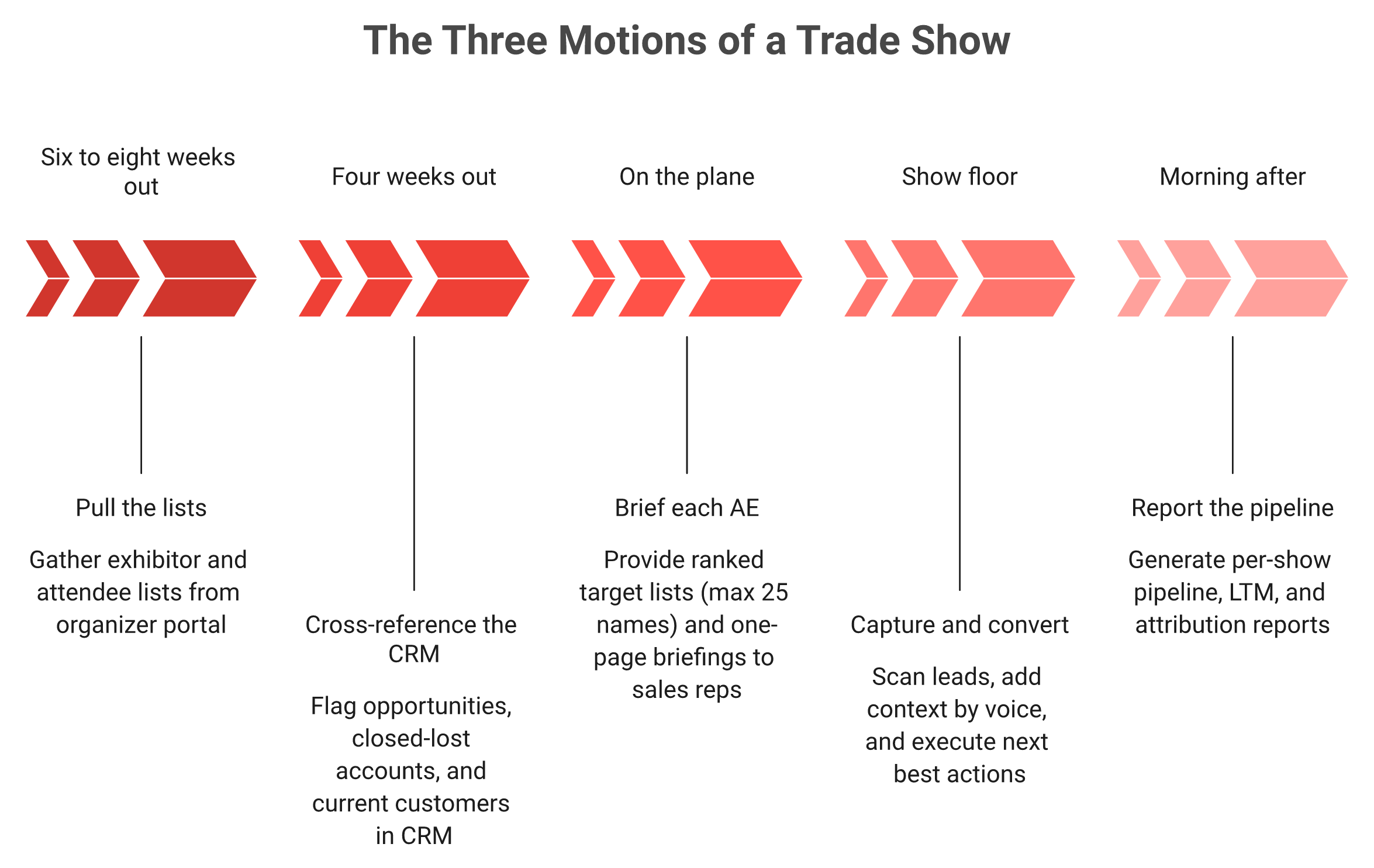
Event work splits into three motions. When they sit in separate tools, context dies at every handoff.
Event work splits into three phases. Before is target selection and briefing. During is capture and conversion. After is follow-up, reporting, and CRM hygiene, which means keeping records clean and deduplicated.
When those phases sit in separate tools, context dies at each handoff. The pre-show spreadsheet never reaches the booth app, which is why the three-motion workflow sits on one record.
⚠️ What "Peacemealing" Actually Costs
One field marketer described her stack plainly. She uses about five different technologies at any given time to do her job, and wants them brought together.
The event platform founders argue for consolidation, and they are half right. The real fix is not one vendor, it is one shared record that all three phases write to.
The Pre-Event Briefing, Done Two Ways
This is where the tools separate most sharply. A digital business card platform has nothing to say before the doors open, because its job starts at the handshake.
Ask B2Brain to build the pre-show list and it cross-references the attending or exhibiting companies against your own CRM pipeline. Open opportunities surface first. Dormant accounts and current customers get flagged separately, the same logic behind event intelligence before the show.
✅ Your CRM Beats a Prediction Database
Some tools in this category predict which attendees matter using a proprietary database. That is useful when you have no pipeline of your own. Most teams running eight to fifteen shows a year do have one.
I would rather brief an AE on the deal that stalled in April than on a cold intent score. My read is that the second one gets ignored on the plane.
🔁 During and After, Same Record
The Golden Workflow inside B2Brain runs Scan, Add Context, Execute Next Best Action. Booking a meeting is simply today's most common next action. Some teams configure it to create a deal instead, or to fire a champion-introduction email.
That configurability matters more than the booking button. Every sales process is shaped slightly differently, which is why the booth-day workflow is configured per team.
The Six-Week Checklist
Build this before your next show, whichever tool you use.
Pull the exhibitor and attendee lists from the organizer portal.
Cross-reference against open opportunities, closed-lost accounts, and current customers.
Rank the list per AE, no more than 25 names each.
Write one-page briefings, readable on a flight.
Set the qualification questions the booth team will actually ask.
Agree who owns follow-up before anyone lands.
⭐ Where I Think This Goes Next
Meeting booking is being shipped by BoothIQ, BoothMaven, and Zuddl now, and I expect that objection from every buyer. B2Brain's answer is not the button, it is the three-phase shared layer underneath it. Differentiation in this category is moving up the stack toward pipeline activation.
B2Brain briefs reps from your own CRM pipeline before the doors open, so the target list is made of accounts your revenue team already cares about rather than names bought from a database.
Q6. What Does Each One Cost Across an 8-to-15-Show Season, Per Booked Meeting? [toc=6. Season Cost Per Meeting]
HiHello runs $0 Free, $8 a month Professional, and roughly $5 to $6 per user per month on Business with unlimited scanning and CRM sync. B2Brain runs from $200 per user per event or $1,500 per user annually for unlimited shows. The baseline both replace is the organizer's scanner at $200 to $500 per device per event.
Start With the Rental Bill You Already Pay
Rented lead retrieval devices cost $200 to $500 per event. Five reps across twenty shows lands between $30,000 and $40,000 a year. What you get back is contextless scans, exported as a CSV, which is the case for a lead retrieval app for trade shows you actually own.
Convention centers make money by charging for basics. Lead data is one of those basics.
💰 Three Season Scenarios
Season Cost by Show Count: HiHello, B2Brain, and Rented Scanners
Scenario
HiHello Business (5 users)
B2Brain
Rented scanners (5 devices)
2 shows a year
about $360/year
about $2,000 per event pass usage
$2,000 to $5,000
8 shows a year
about $360/year
$7,500 on the annual plan
$8,000 to $20,000
15 shows a year
about $360/year
$7,500 on the annual plan
$15,000 to $37,500
Read that first column honestly. On raw seat cost, HiHello wins every scenario, and it is not close.
⚠️ Raw Seat Cost Is the Wrong Denominator
Seat cost tells you what the software bills. It says nothing about what a meeting costs you. Cost per qualified lead at events runs $300 to $600, and cost per opportunity $800 to $2,000.
One founder I follow spent over $35,000 decorating a booth, then ran her second show for $950. The tool line item was never the problem.
Convert to Cost Per Booked Meeting
Here is the math that survives a CFO conversation. Take total show cost, divide by meetings booked, and compare it to your other channels.
B2Brain's published benchmark puts a qualified event meeting at about 60% of the cost of an outbound meeting and about 40% of paid acquisition. That comparison, not the seat price, is what wins the budget, and the Show Pass and Pipeline plans are built to be read that way.
💸 Run Your Own Booth Math
Try it with real numbers. A $70,000 booth with a 10x pipeline expectation needs roughly $700,000 in pipeline. At a 20% close rate, that is about 2x revenue return.
Work backwards. Fifty opportunities, roughly 180 discovery calls, so about one in five qualified booth visitors must become a meeting. If you do not know that ratio, no pricing table helps you.
⏰ The Per-Head Sanity Check
Experienced event operators budget $300 to $450 per attendee reached, travel included. Compare your software line to that number and it disappears. Compare it to your booth spend and it disappears twice.
Cash is real, though. If the season budget is already committed to drayage and flights, per-event pricing is easier to absorb than an annual contract.
✅ What to Take Into the Budget Meeting
Bring three numbers, not a feature list.
Total show cost, including booth, travel, and capture tooling.
Meetings booked at the show, not leads scanned.
Cost per booked meeting versus your outbound and paid benchmarks.
B2Brain offers the first event free for two users, which is the only honest way to price a tool you should judge on one show's booked meetings rather than on a monthly seat comparison.
Q7. Can Either Tool Answer the CFO's Question About Per-Show Pipeline? [toc=7. Pipeline Attribution Reporting]
HiHello reports card views, shares, and scan counts; it does not report per-show pipeline. B2Brain reports leads-to-meeting rate, per-show pipeline value, and show-over-show comparison, delivered the morning after the show. Only 47% of exhibitors track leads through the sales cycle at all, which is the gap this closes.
The Monday Question Nobody Prepares For
I have sat in this meeting more than once. The CEO asks where the pipeline from the show is. The team opens a contact list with 400 rows.
Contact information is not where anything happens. Pipeline is where their world moves, which is the whole point of moving offline to pipeline.
📊 What "Reporting" Means in Each Tool
Card analytics tell you how often a card was viewed and shared. That is a useful engagement signal for a daily identity tool. It is not an answer to a budget question.
Event reporting has to name dollars. Meetings booked, opportunities created, pipeline sourced, and pipeline influenced.
⚠️ The Chain That Has to Hold
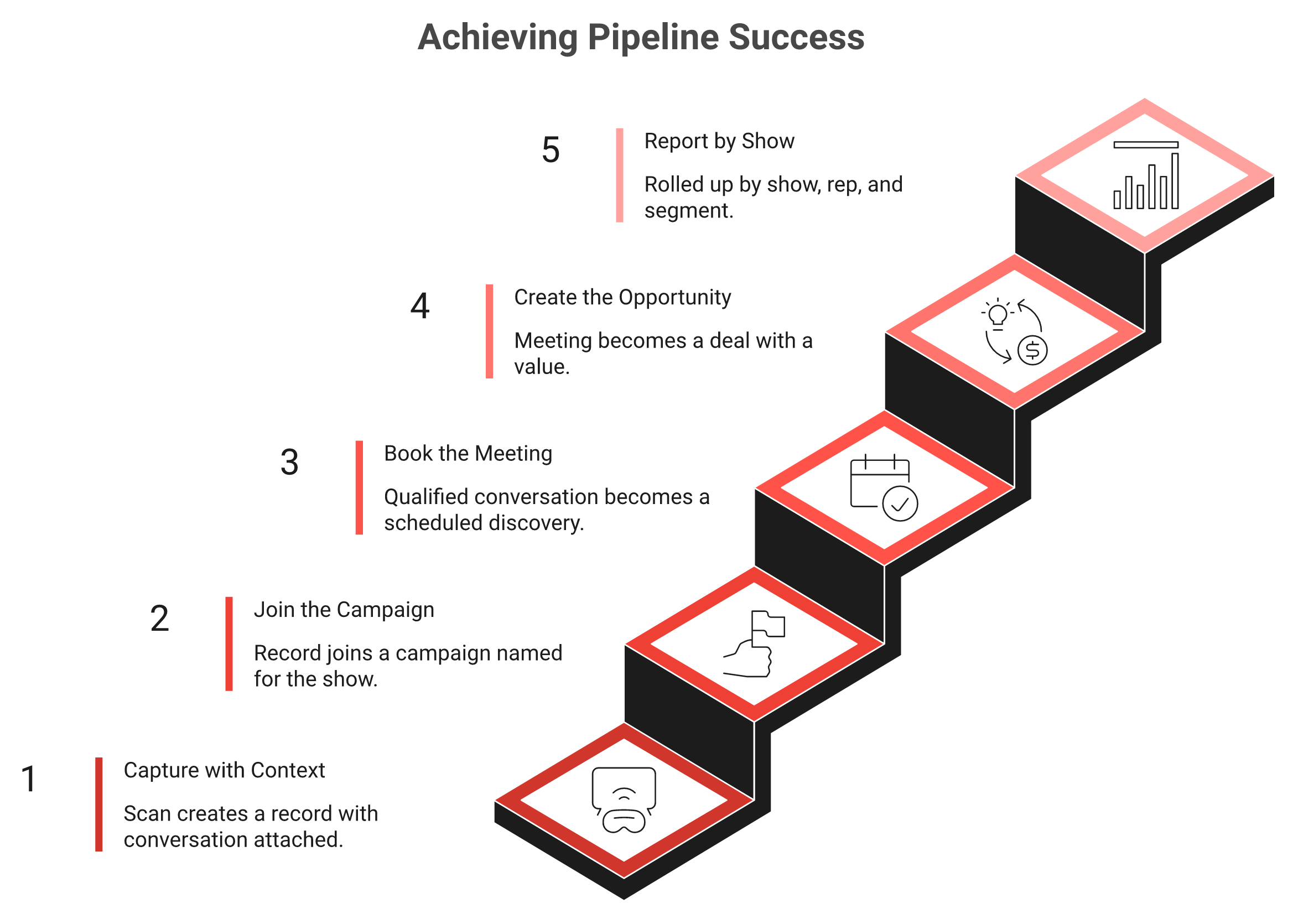
Attribution is a chain. Skip the campaign link and nothing above it can be counted.
Attribution is a chain, and it breaks at whichever link is missing.
Scan creates a record with context attached.
Record joins a campaign named for the show.
Qualified conversation becomes a booked meeting.
Meeting becomes an opportunity with a value.
Reporting rolls those up by show, rep, and segment.
Skip link two, and nothing after it can be counted. That is why 47% of exhibitors cannot track leads through the cycle.
The Metric to Report On
LTM means Leads to Meeting: meetings booked divided by qualified booth leads. B2Brain measures it in real time per rep and per show, which is the only place I have seen the number reported at all.
A useful frame from advertising. LTM is to events what cost per click is to paid media, a single ratio that makes spend comparable across shows, and the measuring event ROI guide walks the full calculation.
⏰ Speed Is Part of the Report
Momencio's 2026 report on US B2B events, which is vendor research, measured 80% of trade show leads receiving zero follow-up across 20 major shows. Slow capture also stretches cycles.
One seller described his longest enterprise deal running 524 days. Deals that start with a scheduled discovery start months ahead of that.
✅ Score at the Booth, Not in the Inbox
A field marketing leader named the real miss. Teams scan everything, hand it all to sales, and let sales filter the garbage.
Her fix was to score at the moment of conversation, hot, warm, or cold. Ask B2Brain to attach that qualification during capture and the filtering work is already finished.
⭐ The One-Page Monday Report
Send five lines by 9am the day after the show.
Qualified leads captured, by rep.
Meetings booked on the floor, with LTM percentage.
Opportunities created and total pipeline value.
Follow-ups still open, with owners named.
Pipeline compared against the previous show.
We built the offline-to-pipeline report at B2Brain to make the field marketer the person holding the answer in that meeting. They fund the booth, so they should own the number.
B2Brain delivers that report by 9am the morning after the show, with pipeline dollars traced back to a specific booth conversation, rep, and show.
Q8. What Do Verified Reviews on G2, Trustpilot, and Reddit Actually Say About Each? [toc=8. Review Evidence Patterns]
HiHello holds 4.6 out of 5 across 919 G2 reviews and 4.7 across 264 Trustpilot reviews, with praise concentrated on card design and sharing speed. B2Brain has 17 G2 reviews. The recurring category complaint on event capture is that leads reach the CRM days after the show ends.
What HiHello Users Genuinely Love
The positive reviews are consistent and credible. Setup takes minutes, the cards look professional, and sharing works without friction.
"I made it to a conference without business cards. Thankfully, another attendee showed me this app. I was able to easily connect and network. Such a great user experience!" — Verified Reviewer HiHello - TrustPilot Verified Review
⭐ Read the Praise Carefully
Notice what the praise is about. Card creation, email signatures, running out of paper cards, sharing at a networking event.
Almost none of it is about booth throughput, CRM records, or pipeline. The product is loved for the job it was built to do, and the fuller HiHello review separates those jobs plan by plan.
What Reviewers Flag
The critical reviews cluster around scanning and sync, which is exactly the booth-relevant part.
"It seems to me that HiHello is not very useful for me because in Latin America we use WhatsApp a lot to share contacts... I also think that HiHello should improve its functionality to offer more than just scanning QR codes and saving contacts." — Juan G., Verified Reviewer HiHello - G2 Verified Review
"I paid for the Professional tier of service only to find out that anyone that chooses to share their contact details with me is then forced to view an advertisement... Nowhere in their documentation do they provide notice of this forced advertisement." — Verified Reviewer HiHello - TrustPilot Verified Review
⚠️ The Category-Wide Complaint Pattern
Across event capture tools, three complaints repeat in buyer reviews. Leads arriving in the CRM days after the show. Notes impossible to add during a booth rush. Lists of contacts with no signal about who wants to buy.
Those are workflow failures, not app bugs. They happen when capture and pipeline live in different systems, which is what a lead capture app for trade shows has to solve end to end.
The Social Proof Gap, Stated Plainly
Here is the uncomfortable part of writing this comparison. Blinq holds the top G2 position with more than 8,800 reviews. Popl has over 4,400, and Cvent more than 2,100 in lead capture.
B2Brain has 17. A review-velocity campaign is running, and it will take a year.
✅ What to Ask For Instead
Review count measures adoption age, not booth performance. When the review wall is thin, ask for different evidence.
A named reference running your show type and CRM.
LTM numbers from two recent shows, per rep.
A live look at the morning-after report from a real event.
One free show before any contract.
I would apply that same test to any vendor here, including mine.
B2Brain has 17 G2 reviews against HiHello's 919, so the fair way to judge it is one free show with your own reps and your own CRM, measured on meetings booked. Bring last season's numbers and Book a Demo if you want that comparison run against your own pipeline.
Q9. When Is HiHello the Right Choice, and When Is It the Wrong One? [toc=9. Which Fits Your Team]
Choose HiHello if the priority is a branded digital business card every employee uses daily, you need Android parity, or your team attends rather than exhibits. Choose B2Brain if you run 5 to 15 shows a year with Salesforce or HubSpot and owe someone a pipeline number. Many teams run both.
Three Cases Where HiHello Wins Outright
The first is the daily identity job. Every employee needs a shareable card, a photo, and a clean email signature. Setup takes minutes and costs nothing on the free tier.
"Total time I spent downloading app + creating my business card: 3-5 min. Total money spent: $0.00" — Verified Reviewer HiHello - TrustPilot Verified Review
✅ Attending, Not Exhibiting
The second case is attendance. If your team walks shows without a booth, you are networking, not capturing. A card app is the correct tool for that, though what gets captured on the floor still needs a home in the CRM.
The third case is Android. B2Brain has no native Android app today, and reviewers have flagged Android friction on HiHello's QR flow as well.
"We tried to use the QR scanner and it would only take us to the download option for Hi Hello... Android users could not even get the QR function to recognize it." — Angela C., Verified Reviewer HiHello - G2 Verified Review
Three Cases Where It Structurally Cannot Deliver
Booth throughput is the first. Twenty scans a month on Professional does not survive a busy morning, which is the practical case for a purpose-built badge scanning app.
Attribution is the second. Contact records without campaign membership or opportunity values cannot answer a budget question.
⚠️ CRM Hygiene Is the Third
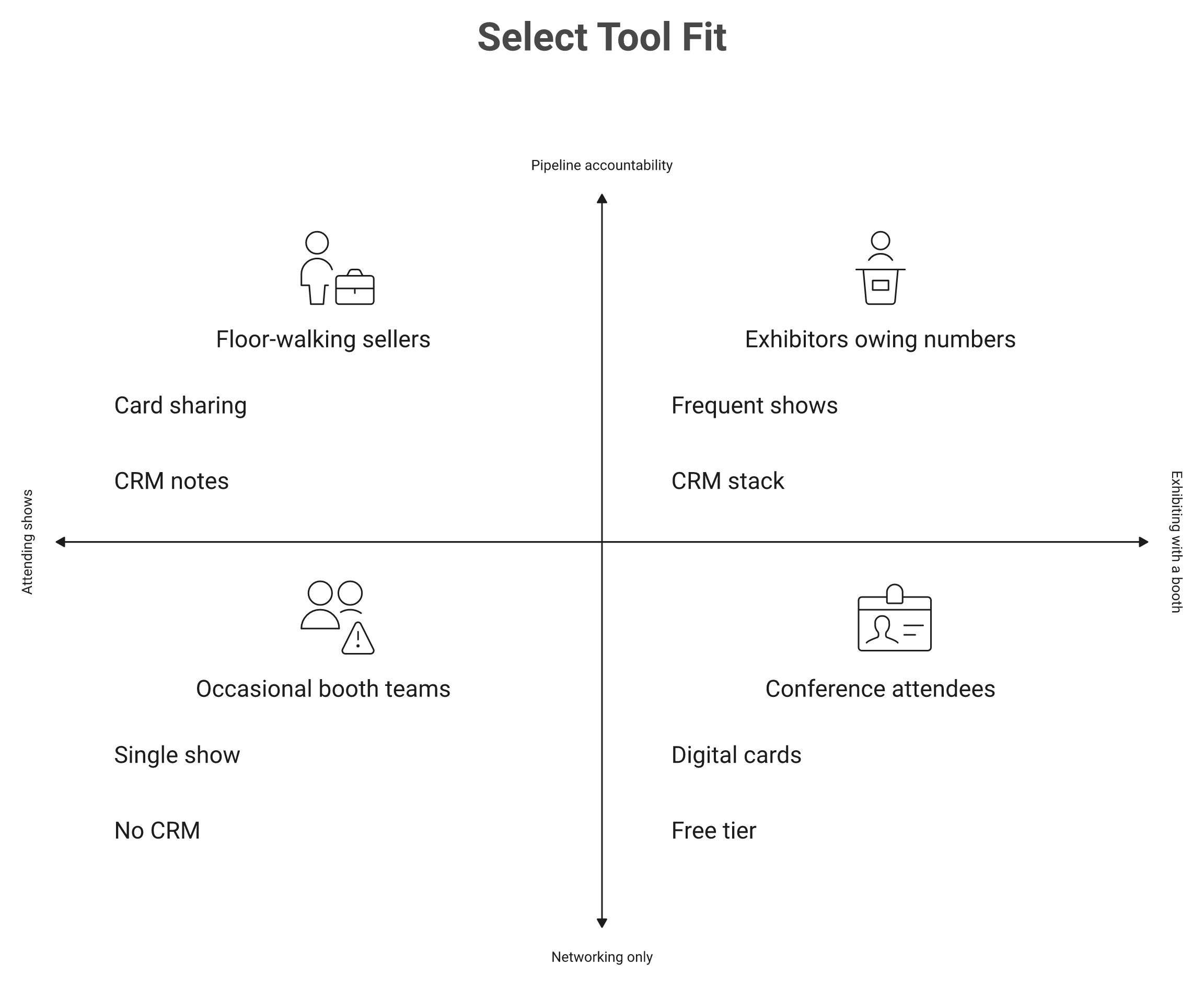
Find your team in one of the four quadrants. The right tool follows from the quadrant, not the feature list.
Duplicate contacts are a real cost. RevOps spends hours cleaning them, and dedup errors show up in reporting.
"Only thing I didn't like is that Hi Hello doubled all the contacts I selected to send..." — Verified Reviewer HiHello - TrustPilot Verified Review
Where B2Brain Loses, Stated Plainly
I would rather you hear these from me than find them in month two.
B2Brain's Stated Gaps and How They Are Handled
Gap
Reality
What we do instead
Digital business card
B2Brain ships none
Reps keep their existing card tool
Android native app
iOS-native today, web app otherwise
Roadmap item, no date promised
Third-party enrichment depth
Lighter than Popl, Mobly, and Momencio
Enrichment from your own CRM data
Public review volume
17 G2 reviews
One free show as the proof instead
⭐ Why the Enrichment Gap Is a Choice
Cold database appends look impressive in a demo. They also introduce records nobody in your team recognizes. B2Brain enriches from your own CRM, the data your reps already trust, which is how Salesforce lead capture stays clean.
I could be wrong on this for high-volume SMB motions. For $25,000-plus deal sizes, trusted context beats more fields.
💰 The Run-Both Split Most Teams Land On
Here is the pattern I see most often. Keep the card app for daily identity, priced at a few dollars a seat. Add the show tool for the fifteen days that carry the pipeline number, priced through the Show Pass and Pipeline plans.
One field marketer told me the real risk is retraining herself and the sales group every time a tool changes. Splitting by job avoids that.
Also worth saying: if you exhibit once a year with no CRM behind you, neither of these is your problem. Fix the follow-up process first.
B2Brain ships no digital business card and no Android app today, and says so openly, because a tool used fifteen days a year should not pretend to be a daily habit.
Q10. How Do You Roll Either One Out Before Your Next Show? [toc=10. Rollout Before Next Show]
Plan four weeks. Week one: map CRM fields and campaign objects. Week two: dedup rules and AE routing. Week three: a 20-minute rep walkthrough and a dry-run scan on a real badge. Week four: qualification questions locked and an LTM target set. Both apps install in minutes; CRM configuration is the real work.
The Six-Week Scramble Is Self-Inflicted
Field marketers hit the exhibitor portal about six to eight weeks out. Those portals are painful to navigate, and the lead retrieval order form usually sits three clicks deep.
That is the moment to decide your capture stack. Not the week before move-in, and how to collect leads at a trade show covers the full pre-show sequence.
⏰ Week One: Map the CRM First
Software installs in minutes. Configuration is where shows are won or lost. Start by naming the campaign object for this show inside Salesforce or HubSpot.
Then map every field the booth team will fill. Name, company, title, qualification, notes, next step, and owner.
🔁 Week Two: Dedup and Routing
These two settings cause most of the post-show mess. Dedup means the rule that stops one company appearing four times because four reps scanned it.
Routing decides who owns the lead. Set it by territory or account ownership, never by who happened to hold the phone. B2Brain routes the booked meeting to the account's AE, with a dual invite to the prospect.
Week Three: The Dry Run Nobody Does
Debugging code works by finding the exact line where things break. A capture workflow is no different, and a dry run tells you which step fails.
Print a test badge, scan it, and follow the record all the way to the CRM. Check the campaign, the note, and the owner field, exactly as how event lead capture works lays out the chain.
✅ Train in Twenty Minutes, Not Two Hours
Reps will not read documentation before a show. B2Brain onboards a booth team in a walkthrough under twenty minutes, because a tool nobody opens is just a line item.
Keep the training to three moves. Scan, add context by voice, and execute the next best action.
⚠️ Week Four: Lock the Questions and the Target
Write the four qualification questions the team will actually ask. Fewer questions get asked; more questions get skipped.
Then set the target. If your booth cost $70,000 and needs $700,000 in pipeline, work backwards to the meetings required, using the event ROI calculator. Roughly one in five qualified visitors becoming a meeting is the ratio I would hold the team to.
What to Measure at the First Show
Judge the rollout on four numbers, checked the morning after.
Qualified leads captured per rep per day.
Meetings booked on the floor, expressed as LTM percentage.
Percentage of records with a note and a campaign attached.
Hours from booth conversation to CRM record.
📈 Where I Think This Category Goes Next
Meeting booking is becoming table stakes, and I expect it in every competitor's release notes within eighteen months. The interesting work moves up the stack, into pipeline activation and per-customer next best actions, which is the shift behind generate new pipeline from events.
B2Brain's read is that the winning tool will be the one your sales process shapes, not the one with the longest feature list. Reps do not adopt features. They adopt whatever is less work than a notebook.
If you are picking a stack before your fall shows, I would rather hear your booth math than send you a demo link. Tell me your show count, your CRM, and last season's LTM, and I will tell you honestly whether this is a tooling problem or a process one.
B2Brain onboards a booth team in a walkthrough of under twenty minutes and offers a first event free for two users, which is enough to test the whole chain from scan to pipeline report on one real show. When you are ready to compare against your own numbers, Book a Demo.
FAQ's
Does HiHello scan event badges, and is it enough for a trade show booth?
Yes, HiHello includes a card and QR scanner, but the plan limits decide whether it survives a booth day.
Free plan: 5 scans a month.
Professional plan at $8 a month: 20 scans a month.
Business plan from about $5 to $6 per user per month: unlimited scanning, and this is also where CRM sync unlocks.
The math matters more than the feature. A productive booth rep logs around 31 scans in one show day, so a 20-scan monthly allowance is gone before the first coffee break.
Badge formats also change from show to show, printed as QR codes or 1D barcodes depending on the organizer's registration vendor. B2Brain reads badge QR and barcode formats, business cards, and LinkedIn profile screenshots without depending on the organizer's system, which is the difference between a card tool and universal lead capture.
Our honest read: if your team attends shows and networks, HiHello's scanner is fine. If you exhibit, staff a booth, and owe someone a pipeline number, plan for unlimited scanning, offline capture, and event-tagged CRM records instead.
Does HiHello sync leads to Salesforce and HubSpot, and is that the same as pipeline attribution?
HiHello integrates with Salesforce, HubSpot, Microsoft Dynamics 365, and Marketo on its paid plans, and it creates contacts and leads. That is real sync, but it is not attribution.
Attribution needs a chain that holds end to end:
The record joins a campaign named for the show.
The qualified conversation becomes a booked meeting.
The meeting becomes an opportunity with a dollar value.
Reporting rolls those up by show, rep, and segment.
Skip the campaign link and nothing after it can be counted. That is why only 47% of exhibitors track leads through the sales cycle, and why up to 80% of event leads never properly reach the CRM.
B2Brain writes leads, contacts, opportunities, meetings, and notes in real time, each stamped with the show, booth area, rep, and segment, which is what makes Salesforce lead capture reportable rather than cosmetic.
A quick audit you can run on Monday: pull last show's records and check four fields, campaign, opportunity, note length, and owner. If campaign is blank on more than a quarter of them, the sync is writing contacts, not revenue pipeline.
What does each tool actually cost across an eight to fifteen show season?
The two tools price on different axes, so raw seat cost misleads.
HiHello: $0 Free, $8 a month Professional, and roughly $5 to $6 per user per month on Business.
B2Brain: from $200 per user per event, or $1,500 per user annually for unlimited shows.
The organizer's rented scanner: $200 to $500 per device per event, which for five reps across twenty shows lands between $30,000 and $40,000 a year.
On seat cost alone, HiHello wins every scenario, and it is not close. On cost per booked meeting, the comparison inverts, because cost per qualified event lead runs $300 to $600 and cost per opportunity runs $800 to $2,000.
B2Brain's published benchmark puts a qualified event meeting at about 60% of the cost of an outbound meeting and about 40% of paid acquisition, and the Show Pass and Pipeline plans are built to be read that way.
Cash timing is real. If your season budget is already committed to booth build, drayage, and flights, per-event pricing is easier to absorb than an annual contract, and the first event is free for two users.
Can either tool answer the CFO's question about pipeline from the show?
HiHello reports card views, shares, and scan counts. Those are useful engagement signals for a daily identity tool, and they are not an answer to a budget question.
Event reporting has to name dollars:
Qualified leads captured, by rep.
Meetings booked on the floor, expressed as a leads-to-meeting rate.
Opportunities created and total pipeline value.
Pipeline compared against the previous show.
LTM means Leads to Meeting, meetings booked divided by qualified booth leads. It is to events what cost per click is to paid media, a single ratio that makes spend comparable across shows. B2Brain measures LTM in real time per rep and per show, and delivers the offline-to-pipeline report the morning after the show.
We built that report to make the field marketer the person holding the answer in the Monday review, because they fund the booth and carry the number. If you want the underlying calculation, the measuring event ROI guide walks it through step by step.
Work the math backwards too. A $70,000 booth expected to return $700,000 in pipeline means roughly one in five qualified visitors must become a meeting.
When is HiHello the better choice, and where does B2Brain fall short?
HiHello is the better choice in three situations:
The priority is a branded digital business card every employee uses daily.
Your team attends shows rather than exhibiting at them.
You need Android parity across the whole company.
B2Brain has real gaps, and pretending otherwise would be worse than naming them. B2Brain ships no digital business card, runs an iOS-native app with no Android release today, carries lighter third-party enrichment depth than Popl, Mobly, or Momencio, and holds 17 G2 reviews against HiHello's 919.
Our enrichment stance is deliberate: we enrich from your own CRM, the data your reps already trust, rather than appending records nobody recognizes. For deal sizes above $25,000, trusted context tends to beat more fields.
The split most teams land on is simple. Keep the card app for daily identity at a few dollars a seat. Add the show tool for the fifteen days a year that carry the pipeline number, which is what the booth-day workflow is built around.
If you exhibit once a year with no CRM behind you, neither tool is your problem. Fix the follow-up process first.
Enjoyed the read? Join our team for a quick 30-minute chat — no pitch, just a real conversation on how we’re rethinking Event Intelligence in B2b.


.png)
.png)