Captello Pricing Breakdown: Plans, Licenses, and Cost Structure
Written by
Last Updated :
August 10, 2026
Skim in:
13
mins
TL;DR
Captello publishes only two numbers: a Premium Lead Capture license from $500 per event per year with unlimited users, and a free single-event engagement package.
Verified G2 reviewers report buying an API or developer kit at $700 to $1,200 per show, which is why realistic all-in spend runs $1,200 to $1,700 per event.
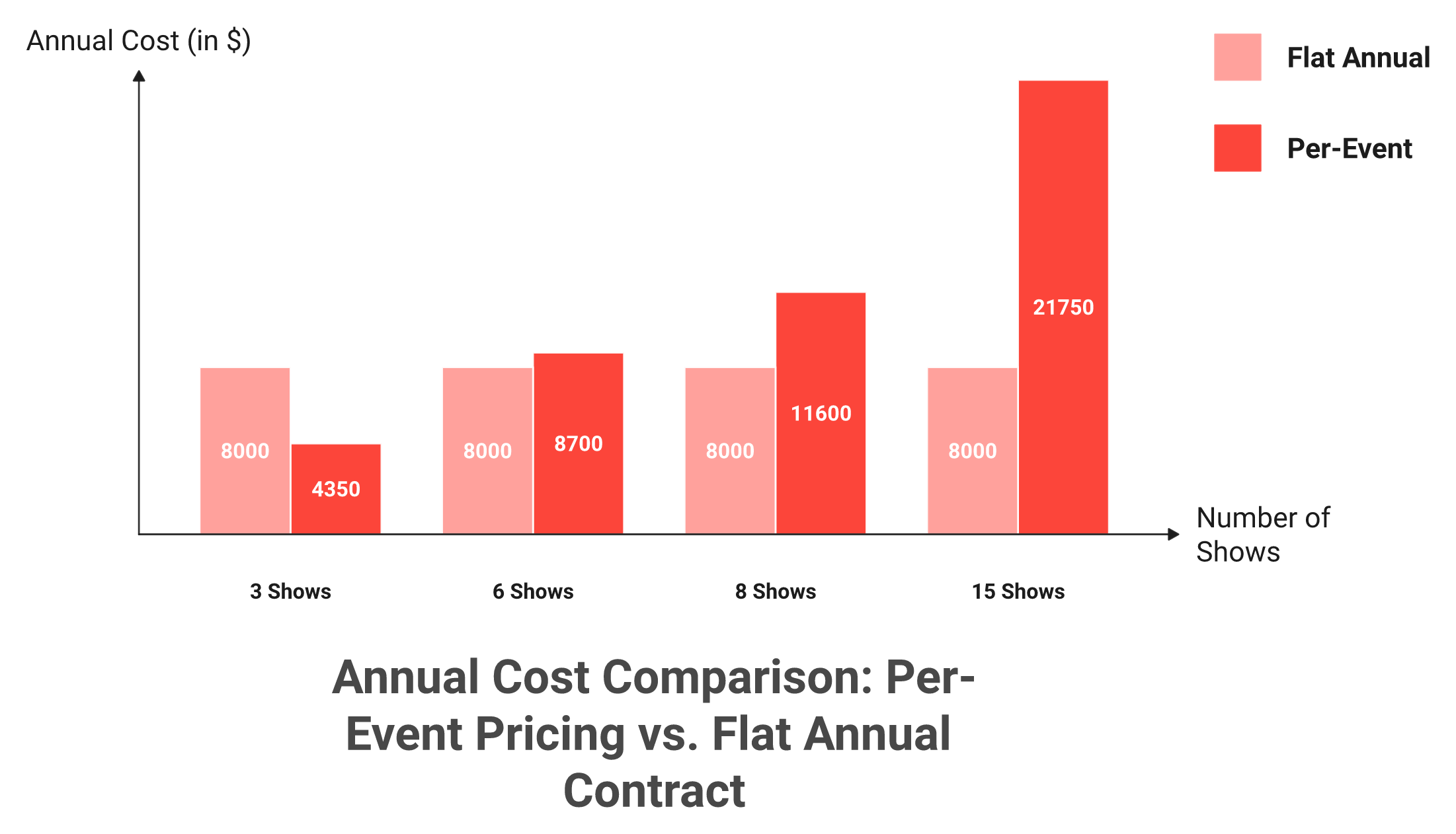
Across a season the model is linear: roughly $3,600 to $5,100 at three shows, $9,600 to $13,600 at eight, and $18,000 to $25,500 at fifteen before gamification.
Per-event pricing wins below about six shows a year; flat annual pricing such as iCapture at around $8,000 usually wins above that threshold.
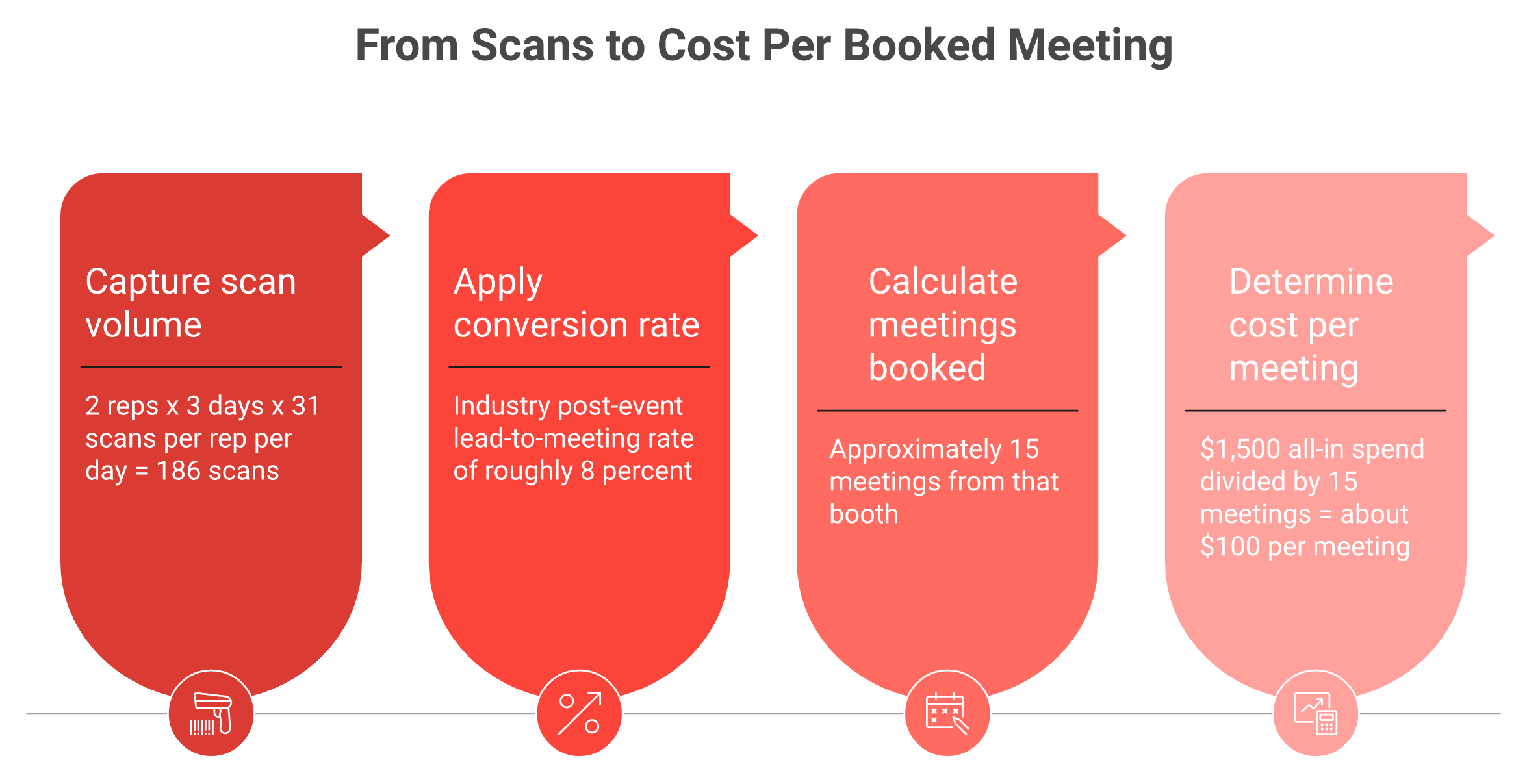
The better metric is cost per booked meeting, not cost per event. At 31 scans a day and an 8 percent lead-to-meeting rate, $1,500 buys about 15 meetings.
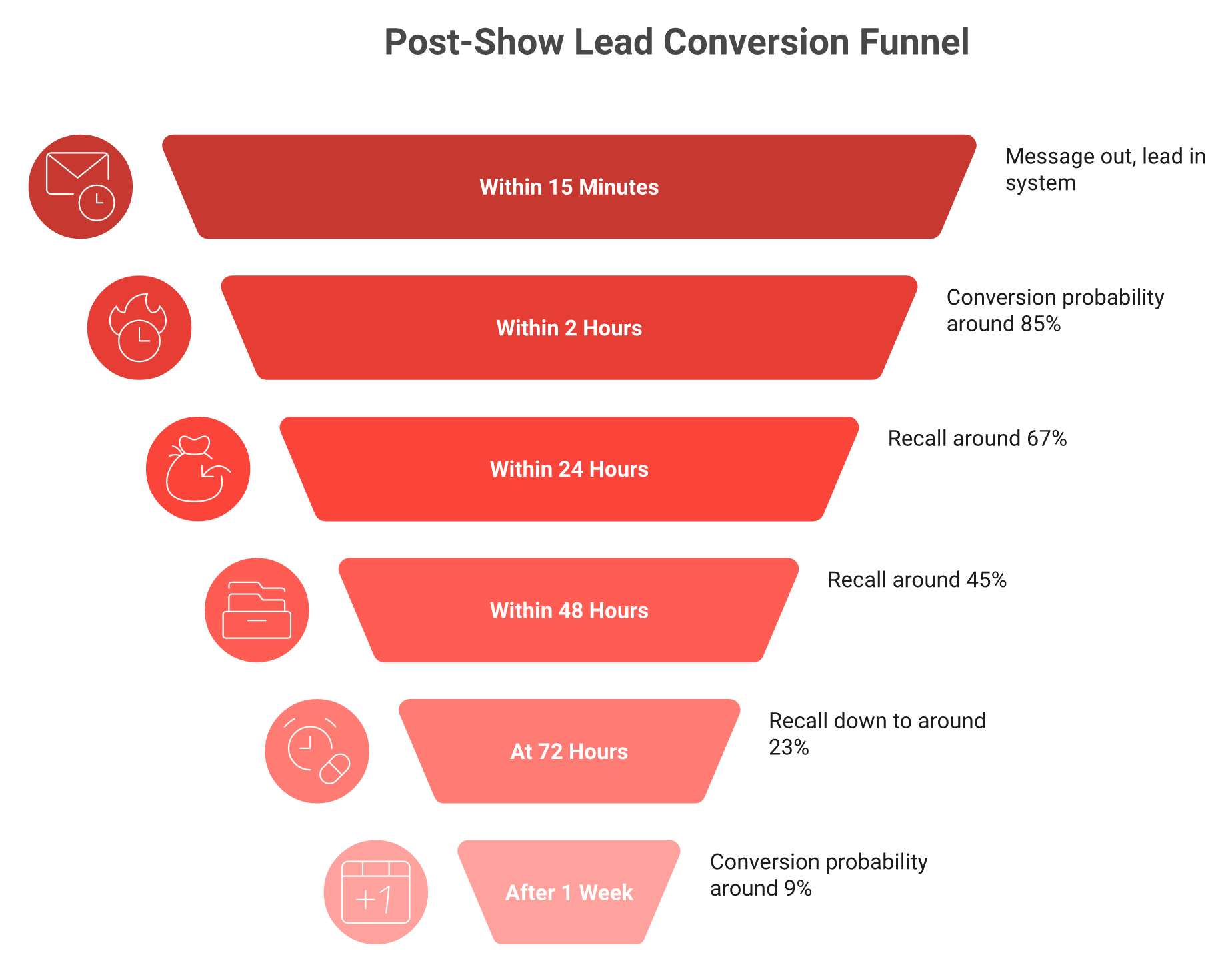
Most of the loss happens after the license is paid: 87 percent of leads never get proper follow up, and conversion falls from 85 percent inside two hours to 9 percent after a week.
Q1. How Much Does Captello Cost in 2026? [toc=1. Published Pricing]
A Field Marketing head I spoke with last fall had the exhibitor kit for a fall industrial show open on one screen and a Captello quote request on the other. Booth space was already signed. She had one number in her budget line for lead capture, and it was wrong by about triple.
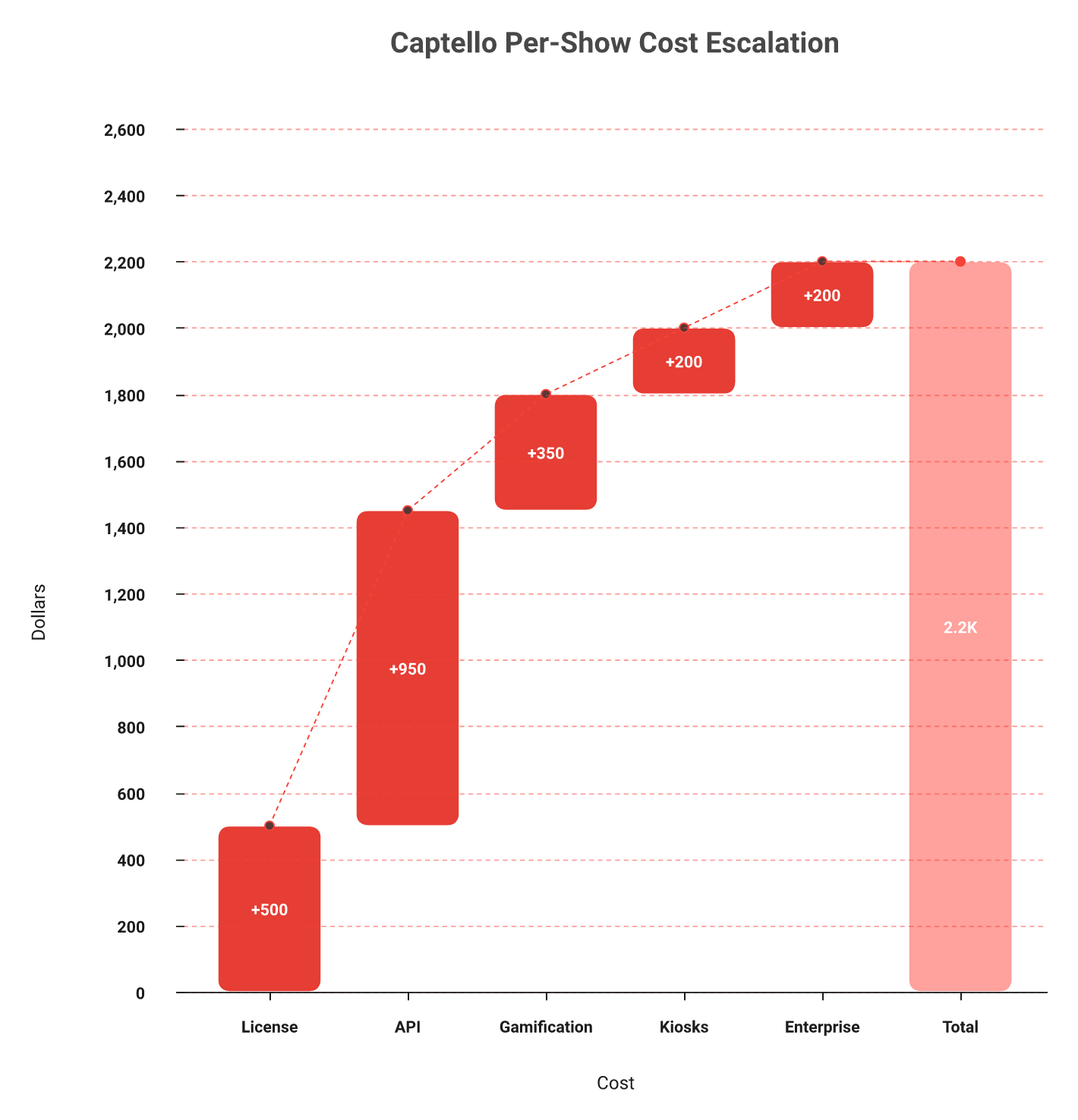
Captello's Premium Lead Capture license starts at $500 for one event license per year, with unlimited users and devices. A Free Event Engagement Package covers one single-event activation. Everything above that is quote based. Once the per-show API kit is added, realistic all-in spend runs roughly $1,200 to $1,700 per show, not $500.
💰 The only two numbers Captello publishes
Captello Published Pricing Editions
Edition
Published price
What it covers
Free Event Engagement Package
Contact sales
One single event license, one time
Premium Lead Capture
$500
One event license per year, unlimited users
Enterprise / custom
Custom quote
Multi event, SSO, modules, premium support
Captello's own licensing page sells the model, not the rate card. It advertises per event, a la carte licensing and routes you to sales for anything specific. If you want a like-for-like reference point, what B2Brain costs per event is published in full.
⚠️ Where the $500 stops covering you
The $500 buys the software license for one show. It does not buy badge data access at that show. It also does not buy gamification activations, kiosk hardware, or enterprise modules, all of which are quoted case by case.
The published $500 license is roughly a third of what a single show actually costs once badge data access and add-ons are added.
Buyers report that most contracts land as recurring annual agreements rather than month to month, and that mid four figure to five figure annual totals are common once seats, events, and modules are counted.
⭐ Put the license next to the booth invoice
Here is the comparison that matters more than the sticker price. One operator running a mid size industrial show described the full cost this way: the booth itself was around $3,000 to $4,000, and all in it ran $10,000 to $15,000 for that single show.
Against that, a $1,500 all in capture spend is roughly ten percent of the show. Cutting it to save $700 is the expensive decision, not the frugal one. The full arithmetic sits in our guide to measuring event ROI.
✅ The number to walk into the budget meeting with
Budget $1,200 to $1,700 per show, then treat anything lower as upside from negotiation. Ask for the quote in writing per named show, not as an annual blended figure.
If your team runs five to fifteen shows a year, model the season, not the event. Linear per event costs behave very differently at three shows and at thirty.
I will hedge one thing here. The $500 anchor is confirmed, but the add on layer is not published anywhere, so every total in this article is a model built from buyer reports rather than a price list.
B2Brain publishes its trial terms for the same reason buyers keep asking about Captello's: a first event free for two users, so the cost question can be answered after a real show rather than during a quote cycle. If you would rather talk it through with your own numbers, Book a Demo.
Q2. What Does One Event License Actually Cover? [toc=2. License Scope]
The most common misread I see in procurement sheets is treating a Captello license like a seat. It is not a seat. It is an event.
One Premium Lead Capture license covers a single event for one year with unlimited users and unlimited devices, badge and business card scanning, custom qualification forms, offline capture, and Captello's integration library. Directory listings showing a per user model contradict Captello's own a la carte event licensing page. Excluded: API kits, gamification, kiosks, and organizer side modules.
📋 The licensing unit, defined plainly
A seat license charges per person who logs in. An event license charges per show, then lets everyone in your booth scan under it.
Captello sits firmly in the second camp. Directory listings put the entry point at $500 with unlimited users, and Captello's platform documentation repeats no user restrictions across its lead capture module.
✅ What six reps under one license looks like
Take a six person booth at a three day manufacturing show. Under Captello's model, all six scan under the single $500 license, on their own phones, with the same qualification form.
Under a seat based tool at, say, $200 per user, the same booth pays $1,200 before any badge data fee. That difference is real, and it is a genuine strength of Captello's model. The same seat math applies to any lead capture app for trade shows you shortlist.
⚠️ Why unlimited seats is not a nice to have
Lead abandonment is a licensing problem before it is a software problem. When only one or two people are authorized to capture, the booth queue backs up and conversations walk away uncaptured.
I think about a story a buyer told me about a dealership where exactly one person in the whole state was authorized to close his deal type. The deal did not die on price. It died in the queue.
❌ The boundary line, itemised
Not included: API or developer kits for badge decryption at organizer run shows
Not included: gamification activations and interactive content packages
Not included: kiosk hardware and rewards fulfillment logistics
Not included: enterprise SSO, premium support tiers, and organizer side registration or ticketing modules
Included but time costly: onboarding and training, where the learning curve is the dominant complaint across G2 reviews
💸 Read the module list before you read the price
Captello's modules span lead capture, engagement, meeting management, corporate event management, and digital business cards. Each is licensed on its own terms.
Ask the rep for the module list first, then the price. A quote without a module list cannot be compared against anything, which is why the category is drifting toward universal lead capture as the unit of comparison.
B2Brain licenses on the same unlimited principle for the same operational reason: every person in the booth needs to capture, because the conversation nobody logged is the one that never reaches the CRM. That is the booth-day workflow in one sentence.
Q3. Why Does Every Show Cost More Than the License? [toc=3. Per-Show API Kits]
This is the part buyers find out in month four, usually in an invoice review.
Badge data access is billed per show. A verified G2 reviewer reports buying an API kit at $700 to $1,200 every time they run lead scanning, calling it costly. Another notes Captello does not always work with every conference if the conference does not provide an API kit. Part of that fee originates with the organizer, which has charged exhibitors up to $1,500 for developer kits.
🔁 The receipts, in the buyers' own words
"Every time we have a show with lead scanning, I have to purchase an API kit that costs between $700 - $1200. It's become costly." — RebeccaGrace K., Event Marketing Captello - G2 Verified Review (4 stars)
"It does not always work with every conference, if the conference does not provide and API kit for integration." — Verified User in Consulting Captello - G2 Verified Review (3.5 stars)
Both reviewers rate the product positively overall. That is what makes the cost pattern credible rather than a complaint from a churned account.
⏰ Why the fee comes back every single show
The badge on the attendee's lanyard is encrypted by the show organizer, not by Captello. Reading it requires that organizer's kit, purchased for that specific show.
So the fee recurs per event, and it scales with your calendar rather than your headcount. Ten shows means ten kits, which is the hidden tax behind every conference badge scanner quote.
❌ The failure case nobody quotes for
At shows that supply no kit at all, badge scanning simply is not available through Captello. You fall back to business card capture or manual entry, having already paid the license.
That is not a Captello defect. It is a structural feature of the organizer controlled badge economy, and it is worth naming out loud during the demo.
⚖️ Splitting the vendor fee from the organizer toll
Captello has itself documented shows pressuring exhibitors with developer kit charges as high as $1,500. The company is partly reselling a toll it did not set.
Blaming the vendor for the whole number is unfair. Failing to budget for the number is your problem either way.
I hold this view strongly, and it predates any tooling conversation: the organizer's badge apparatus is built to serve the organizer. It collects the lead for them. What you get back is a contact, not a conversation.
✅ The action before you sign
List every show on your 2026 calendar by name
Ask Captello in writing which of those shows require an API kit and at what cost
Ask which of those shows supply no kit, so badge scanning is unavailable
Add the kit total to the license total before comparing against any alternative
B2Brain's capture works from the badge, the business card, or a voice note in about four seconds, which keeps the three-motion workflow running at shows where the organizer's kit is unavailable or late.
Q4. What Do the Add-Ons Cost, Gamification, Kiosks and Enterprise Modules? [toc=4. Add-On Layer]
Captello's gamification library, kiosk hardware, premium integrations, SSO, and enterprise support are all quoted separately, with third party cost models placing gamification activations around $200 to $500 per event. Two exhibitors on the same plan can therefore pay very different totals, which is why Captello's public page advertises a la carte licensing rather than a rate card.
🎮 The inventory of quoted items
Captello Add-On Layers and What They Buy
Add-on layer
Reported shape
What it is for
Gamification activations
Around $200 to $500 per event (third party model)
Booth traffic, dwell time, prize draws
Kiosk and rewards fulfillment
Quoted
Unattended capture, on site prize delivery
Premium integrations
Quoted
Deeper CRM and marketing automation workflows
Enterprise SSO and support
Quoted
Security review, IT sign off, response SLAs
Organizer side modules
Quoted
Registration, ticketing, event management
Captello runs 55+ digital activations, 72 language translation, and reports a median support response of 19 minutes, alongside SOC 2 Type II and ISO 27001 certification. That is a genuinely deep platform. Depth is exactly what makes the invoice unpredictable.
🎯 Which layer your ICP actually needs
Gamification buys booth traffic. It does not buy qualified pipeline, and those are different line items on different scorecards.
If your booth problem is footfall at a crowded hall, the activation spend is defensible. If your problem is that reps captured 400 badges and booked four meetings, it is not. That gap is the whole reason we track offline to pipeline as a single number.
❌ The activation that costs you twice
The free iPad draw is the clearest example. It fills the scan list with people who wanted the iPad.
Those are typically non decision making attendees with no interest in the product. You pay for the activation, then you pay again in SDR hours chasing contacts who were never buyers. Our notes on how to collect leads at a trade show cover the qualification alternative.
💸 Sticker price versus final invoice
Because none of this layer is published, the quoted number and the final invoice can drift apart. Cost transparency shows up repeatedly as a theme in Captello's review base, alongside a setup learning curve that carries a real training cost even though no onboarding fee is published.
My read, and I could be reading it too strongly, is that opacity here is a segmentation strategy rather than an oversight. Enterprise buyers with procurement teams do fine. Five person field marketing teams do not.
✅ The quote request to send this week
Itemise every module by name, with the per event or annual basis for each
Confirm which activations are included in the license and which are billed separately
Ask for the total at your actual show count, not a per event figure
Ask what changes at renewal if your show count grows from eight to fifteen
B2Brain prices around the outcome the CFO asks about rather than the activation menu, and reports 52 percent of leads converted to meetings on the floor against roughly 8 percent booked after the show. The method behind that number sits in our event ROI calculator.
Q5. What Does Captello Cost Across a Full Show Season? [toc=5. Season Cost Model]
Every pricing page in this category answers the wrong question. The exhibitor does not buy one show. They buy a season.
Budget roughly $1,200 to $1,700 per show once license and API kit are combined: about $3,600 to $5,100 for three shows, $9,600 to $13,600 for eight, and $18,000 to $25,500 for fifteen before gamification. Independent cost models put ten events near $5,000 to $7,000 in base licensing and thirty events above $15,000 to $20,000. Multi event bundles are negotiated and usually beat the modelled figure.
📐 The assumptions, stated up front
Three inputs drive everything below. Change any one of them and the table changes.
Base license at $500 per event license per year, the only confirmed public number
API or developer kit at $700 to $1,200 per show, from buyer reports
No gamification, kiosk, or enterprise modules included
I am publishing the assumptions because you will re run this math with your own quote. A number you cannot audit is useless in a budget meeting. The same discipline applies when you compare Show Pass and Pipeline plans against any per event quote.
💰 The season table
Modelled Captello Cost by Shows Per Year
Shows per year
License subtotal
API kits
Modelled all-in
3
$1,500
$2,100 to $3,600
$3,600 to $5,100
8
$4,000
$5,600 to $9,600
$9,600 to $13,600
15
$7,500
$10,500 to $18,000
$18,000 to $25,500
30
$15,000
$21,000 to $36,000
$36,000 to $51,000
Costs scale linearly with event volume, which is exactly what makes the model easy to forecast and painful to grow into.
⚠️ Where the ICP feels it
Five to fifteen shows a year is the account shape that buys this category. It is also the shape where per event stacking stops being cheap.
At three shows, per event pricing is genuinely the efficient choice. At fifteen, you are paying a subscription without subscription protections. Teams at that volume usually end up rebuilding measuring event ROI from scratch.
🤝 What negotiation actually moves
Bundling multiple shows into one contract moves the license line. Buyers report mid four figure to five figure annual agreements once seats, events, and modules are combined, which suggests real volume discounting exists.
What negotiation does not move is the organizer's kit fee. That toll belongs to the show, not the vendor, and no amount of procurement pressure changes it.
✅ Build the model before the demo
List your 2026 shows by name, with headcount per booth
Ask for a bundled quote at that exact show count
Keep kit fees in a separate column so you can see the fixed floor
Recheck the model if your show count moves by more than three
I will flag my own uncertainty here. These ranges are built from buyer reports and third party models, not a published rate card, so treat them as a planning envelope rather than a quote.
B2Brain models cost the same way internally, and its published benchmark for the alternative is blunt: a five rep team at twenty shows spends $30,000 to $40,000 a year on organizer rentals alone, for scans that never leave the organizer's portal.
Q6. Is Captello Cheaper Than the Organizer's Badge Scanner? [toc=6. Vs Organizer Rental]
Usually yes, past two scanning reps. Organizer lead retrieval rentals run roughly $200 to $600 per device per show, so a five rep booth pays $1,000 to $3,000 for contact data that stays in the organizer's portal. Captello's own research claimed $866 per event versus $2,346 for organizer provided capture at six staff. That gap narrows once per show API kits are added back in.
🧮 The rental math, per rep
Organizer scanners are priced per device. Your cost rises with every person you want scanning.
Captello's license is priced per event with unlimited users. Past two or three reps, the software wins on arithmetic alone, which is the same reason exhibitors move off a rented badge scanning app in the first place.
❌ What the rental never buys
The rented scanner saves the badge. It does not save the conversation.
You cannot add custom qualification questions, and the record lands in the organizer's portal rather than your CRM. One operator put the consequence plainly: companies that skip custom questions lose their ticket to personalized follow up.
"I like how it imports into our CRM and has a buildable form that we can create." — Verified User in Consulting Captello - G2 Verified Review (3.5 stars)
"Having all our leads from events go into one place which makes it easier for the reps. It's saving time on manually uploading leads." — RebeccaGrace K., Event Marketing Captello - G2 Verified Review (4 stars)
Both reviewers name the same win, and it is not scanning. It is the form and the CRM route. If Salesforce is your system of record, our notes on lead capture into Salesforce cover the field mapping side.
⚖️ Auditing Captello's own savings claim
Captello published a comparison putting its cost at $866 per event against $2,346 for organizer provided capture at six staff. That research is from 2020, and it is the vendor's own.
Rerun it with today's stack. A $500 license plus a $900 kit lands near $1,400, so the saving is real but thinner than the original claim suggests.
⚠️ Where the rental still wins
Two people, one show, one year. At that shape, a couple of rented devices cost less than a license plus a kit.
Be honest about this in your own evaluation. If your event program is one booth a year, this whole category is optional.
💸 The bigger cost is not the device
Rentals feel cheap because they are billed per show and never annualized. A five rep team at twenty shows can spend $30,000 to $40,000 a year without anyone modelling it once.
My view, and I have held it since long before building tooling, is that the organizer's badge apparatus exists to serve the organizer. It collects the lead for them. You rent the device and hand over the insight.
B2Brain's displacement math is published for exactly this reason, and it is not flattering to the default: $30,000 to $40,000 a year in rental spend, returning contextless scans that stay locked in someone else's portal. That is the gap the booth-day workflow is built to close.
Q7. How Does Captello's Cost Shape Compare to Other Event Lead Capture Platforms? [toc=7. Cost Shape Comparison]
Captello prices per event from $500. iCapture Essentials starts near $8,000 a year flat for unlimited users, events, and scans. Popl sits around $6,000 a year usage based, Blinq from roughly $2,400 a year, and BoothIQ runs a free individual tier with about $499 a month for teams. Per event wins below roughly six shows. Flat annual wins above it.
📊 Cost shape across the shortlist
Event Lead Capture Platforms Compared on Cost Shape
Platform
Cost shape
CRM sync model
Books meetings in booth
Per-show pipeline reporting
B2Brain
Per event, first event free for two users
Salesforce and HubSpot native
Yes, sub 30 seconds with dual invite to prospect and AE
Yes, morning after report
Captello
Per event from $500, add-ons quoted
Broad integration library
Meeting management module
Analytics, engagement led
iCapture
Around $8,000 per year flat, unlimited
Native CRM sync
No
Reporting, no LTM metric
Popl
Around $6,000 per year usage based
Integrations plus enrichment
Bolt-on
Basic
Momencio
Quoted
Integrations
Scheduling
Engagement scoring
Blinq
From around $2,400 per year
Integrations
Limited
Basic
BoothIQ
Free tier, around $499 per month for teams
Integrations
Yes
Early stage
⭐ The break-even, plainly
Six shows is the hinge. Below it, per event pricing means you pay only for the shows you run.
Above it, flat annual pricing usually costs less and removes the per show kit surprise. Frequent exhibitors get punished by stacking, and occasional exhibitors get punished by annual floors. Our roundup of the best event lead capture software in 2026 runs the same rows on features.
Per-event licensing wins below roughly six shows a year. Above that, flat annual pricing usually costs less.
⚠️ What the sticker price hides
Captello's 2026 relaunch positions it as a lead capture system of record for enterprise event programs. That shift pushes more value into quoted enterprise modules rather than the $500 line.
Cheap entry, quoted middle. That is a coherent enterprise strategy, and it makes side by side comparison harder for a five person team.
❌ Price complaints are real across the pool
"The price, $140 a year? No way, would rather print thousands of business cards." — Fabian T., Verified User Popl - G2 Verified Review (1 star)
"Sometimes Mobly can be finicky, where it doesn't sync all the leads I've scanned... we end up with a lot fewer than we expected." — Verified User in Events Services Mobly - G2 Verified Review (3.5 stars)
Reliability is a cost too. A missed sync is a lead you paid for twice, a pattern we unpack further in our Mobly review.
✅ The column that decides the price
Scans are an activity metric. Meetings are the outcome the CFO funds.
Judge every row above on whether it books the meeting before the prospect walks away. On that column, a $500 license and an $8,000 contract can produce identical results, which is the uncomfortable part.
I should concede our own gaps honestly here. B2Brain's native app is iOS first, its third party enrichment is lighter than Popl or Momencio, and it ships no digital business card.
B2Brain sits in the table as the meeting booking option: scan to booked meeting in under 30 seconds, dual calendar invites to the prospect and the right AE, and a first event free for two users. You can see how event lead capture works end to end before you commit budget.
Q8. What Is the Real Cost Per Booked Meeting? [toc=8. Cost Per Meeting]
Divide all in event software cost by meetings booked, not by scans. A productive rep captures around 31 scans a day, a benchmark B2Brain publishes from its own deployments. At the industry's roughly 8 percent post event lead to meeting rate, a three day two rep booth yields about 15 meetings, putting $1,500 of all in spend near $100 per meeting. Lift the conversion rate and the license price stops being the variable that matters.
🧾 The formula
Cost per meeting equals all in event software cost divided by meetings booked from that show. That is the whole thing.
Lead to Meeting, or LTM, is the percentage of captured leads that become a booked meeting. It is the denominator that decides everything downstream.
Cost per booked meeting, not cost per event, is the number worth defending in a budget review.
🔢 The worked example
Two reps, three days, 31 scans per rep per day. That is 186 scans.
At an 8 percent LTM, you book roughly 15 meetings. Divide $1,500 of license and kit spend by 15, and you are at $100 per meeting. The event ROI calculator runs this with your own inputs.
⏰ Sensitivity is where the money is
Hold the spend flat and move only the conversion rate. At 8 percent you get 15 meetings. At 52 percent you get 97.
Same booth, same license, same three days. Cost per meeting drops from $100 to about $15.
B2Brain measures this directly as LTM and reports 52 percent of leads converted to meetings on the floor against roughly 8 percent booked after the show.
💰 Why speed does the work
The lead decay curve explains the gap. Conversion probability sits near 85 percent inside two hours and falls to roughly 9 percent after a week.
A meeting booked at the booth is captured at the top of that curve. A post show email sequence competes at the bottom of it, where reply rates run under 5 percent.
❌ The metric that fools people
Cost per attendee is not cost per meeting. One operator described paying about $52 per head for an event experience, then noted the obvious: somebody getting on a boat with you is not somebody getting on a demo.
That is not pipeline. Contact information is not where anything happens. Pipeline is where the buyer's world moves, which is the whole argument behind offline to pipeline.
⭐ The ladder behind the number
Work it backwards from the show budget. A $70,000 booth with a 10x pipeline target needs $700,000 in pipeline.
At roughly 12 percent discovery to close, you need about 180 discovery calls. Which means roughly one in five booth visitors has to become a qualified meeting.
If you do not know this math, the license price is not your problem.
✅ Do this before your next show
Add a cost per meeting cell to the event budget sheet
Track meetings booked on the floor separately from meetings booked after
Report LTM per show, per rep, and per booth area
Bring that number to the QBR instead of a scan count
My read, and I could be reading our own data too strongly, is that most teams overspend on capture and underspend on conversion. Only about 47 percent of exhibitors track leads through the sales cycle at all, so the baseline is low.
B2Brain built the morning after offline to pipeline report around this single number, so the Field Marketer can answer "where is the pipeline?" with meetings booked, LTM, and attribution by show, rep, and segment. If you want that run against your own show list, Book a Demo.
Q9. Where Does the Money Leak After the License Is Paid? [toc=9. Post-Show Leakage]
In the 48 hours after the show. Roughly 87 percent of trade show leads never receive proper follow up, 79 percent receive none at all, up to 80 percent never reach the CRM, and average response time runs about 42 hours. Conversion probability sits near 85 percent inside two hours and falls to roughly 9 percent after a week. CEIR finds only 47 percent of exhibitors track leads through the sales cycle.
📉 The decay table
Post-Show Follow-Up and Lead Decay Benchmarks
What happens
Rate
Leads that never get proper follow up
Around 87 percent
Leads that get no follow up at all
Around 79 percent
Event leads that never reach the CRM
Up to 80 percent
Average response time after a show
Around 42 hours
Conversion inside 2 hours vs after a week
Around 85 percent falling to around 9 percent
None of these numbers are about capture. Every one of them happens after the license has already been paid.
📦 The shoebox, which is a real thing
An operator described the pattern to me almost exactly as it plays out. Jimmy comes back from the show with a box of leads, pulls out three cards, and calls three people.
Then someone asks him to lunch. The box goes under the desk. Six months later, somebody finds it. That is the failure our guide to how to collect leads at a trade show is written to prevent.
⚠️ Software does not fix this on its own
Reviewers across the category describe the same failure in different words.
"When you do share your info, it saves the persons business card as contact info in their phone. This makes it tough to find again after a big tradeshow... all the follow ups are just in your sea of contacts you have to try and remember." — Madison Z., Verified User Blinq - G2 Verified Review (2 stars)
"I hoped Popl would scan badges for contact info at a conference, but it didn't work and I couldn't figure out how to use it." — Drew D., Verified User Popl - G2 Verified Review (0.5 stars)
A tool that captures but does not route is a more expensive shoebox. We break down the routing gap across the category in our list of Popl alternatives.
⏰ The rules that actually stop the leak
Two operator rules beat any feature list. Get the lead into a system and a message out within 15 minutes of the conversation ending.
Then organize everything within 48 hours, at the hotel, before you go out. Memory of a booth conversation decays fast, and by 72 hours retention is down near 23 percent.
Almost none of this loss happens during capture. It happens in the 48 hours after the license has already been paid.
💸 Where the budget usually goes instead
One exhibitor told me he spent over $35,000 decorating a booth, then looking back, wished that money had gone somewhere useful. The capture and follow up workflow is where "useful" lives.
Only about one in twenty companies act on the lead list at all. The price of software is really the price of joining that small group.
✅ The four things the spend must buy
Same day write to the CRM, not a post show CSV import
A score on every lead, set at the moment of the conversation
A follow up sequence written before you fly out
A per show pipeline number the CFO can read without a translator
B2Brain closes this gap with a morning after offline to pipeline report in the CMO's inbox by 9am, and 100 percent event to CRM attribution at the opportunity level rather than contact sync alone. That is what generate new pipeline from events means in practice.
Q10. Who Should Buy Captello at This Price, and Who Should Not? [toc=10. Buy Or Skip]
Captello fits exhibitors running one to six shows a year who want gamification led booth engagement, broad integration coverage, and unlimited users per event with no annual commitment. It fits less well above eight shows, where licenses plus API kits exceed flat annual alternatives. It also fits less well for teams whose measure of success is meetings booked on the floor rather than booth traffic.
✅ Strong fit profiles
One to six shows a year, where per event pricing means paying only for shows you run
Booths that genuinely benefit from games, activations, and interactive capture
Enterprise buyers who need SOC 2 Type II, ISO 27001, SSO, and a long integration list
Large booths with rotating staff, since unlimited users cost nothing extra per show
Captello also scores well on service. That shows up consistently in reviews.
"We have had some issues getting up and running and their service has been excellent. They are very good with follow up, even during the holidays." — Jennifer H., Verified User Captello - G2 Verified Review (4 stars)
❌ Weak fit profiles
Eight or more shows a year, where the license and kit stack passes flat annual pricing
Small teams with no dedicated ops person, given the setup learning curve
Programs judged on meetings booked and sourced pipeline rather than booth traffic
Teams that need a hard budget number before a demo, since pricing is quote gated
"Every time we have a show with lead scanning, I have to purchase an API kit that costs between $700 - $1200. It's become costly." — RebeccaGrace K., Event Marketing Captello - G2 Verified Review (4 stars)
Ask for one bundled quote at your real show count, not a per event rate
Get API kit fees in writing, show by show, by name
Confirm which shows supply no kit, where badge scanning will not work
Ask what happens at renewal if your show count grows
Negotiate the attendee email list into your sponsorship package, separately from software
That last one is the most underused lever in event procurement. Exhibitors argue over a $500 license and leave the list on the table. For a like for like reference on transparent terms, see what B2Brain costs per event.
⭐ The question behind the question
Booth traffic and booked meetings are two different products. Captello is very good at the first one.
If your CEO asks about traffic, buy on activations. If your CEO asks where the pipeline is, buy on meetings and attribution, which is the job for booth teams that own a number.
Here is where I think this goes over the next 18 months. Capture becomes a commodity, meeting booking becomes table stakes, and the only durable difference is whether the tool can prove pipeline across the whole event program.
I am genuinely unsure how fast that shift lands. My read right now is that the first vendor to publish an audited Leads to Meeting benchmark by industry changes the buying conversation for everyone.
B2Brain is worth evaluating alongside Captello above eight shows a year, where the Before, During, and After layer is what you are buying: CRM grounded pre event briefings, on floor booking, and per show pipeline reporting. You can see before, during, and after the show mapped end to end.
If you are modelling your own season right now, I would rather see your numbers than send you a demo link. Send me your show list and your target pipeline, and I will tell you where the math breaks, or Book a Demo and we will do it together.
FAQ's
How much does Captello actually cost per event in 2026?
Captello publishes one confirmed number. The Premium Lead Capture license starts at $500 for one event license per year, with unlimited users and unlimited devices. A Free Event Engagement Package covers one single-event activation, and enterprise terms are quoted individually.
The published price is not the invoice. Once badge data access is added, the realistic per-show range looks like this:
Base license: $500 per event
API or developer kit: $700 to $1,200 per show, from verified buyer reports
Gamification activations: around $200 to $500 per event in third-party cost models
Kiosks, premium integrations, SSO, and enterprise support: quoted case by case
We tell field marketers to budget $1,200 to $1,700 per show and treat anything lower as negotiation upside. Set that against the $10,000 to $15,000 it costs to exhibit at a mid-size industrial show, and capture software is roughly ten percent of the spend.
B2Brain publishes its own terms rather than quote-gating them, including a first event free for two users, which is one way to answer the cost question after a real show instead of during a sales cycle. You can see what B2Brain costs per event before you book anything.
Is Captello priced per user or per event?
Captello licenses per event, not per seat. One Premium Lead Capture license covers a single show for a year, and every person in your booth can scan under it on their own device at no extra cost.
Some software directories list Captello with a per-user pricing model, which contradicts Captello's own a-la-carte event licensing page. Treat the event license as the true unit when you build a comparison sheet.
The practical difference shows up fast:
Six reps under one event license: $500 in license cost
Six reps under a seat-based tool at $200 each: $1,200 before any badge fee
Six rented organizer scanners at $200 to $600 per device: $1,200 to $3,600
Unlimited seats matter more than the arithmetic suggests. When only one or two people are licensed to capture, the booth queue backs up at peak hours and conversations walk away unrecorded. Lead abandonment is a licensing decision before it is a software problem.
B2Brain applies the same principle for the same operational reason, because a conversation nobody logged never reaches the CRM. That thinking runs through the booth-day workflow we built for exhibiting teams.
Why do Captello buyers say they pay API kit fees at every show?
Because badge data access is billed per show, not per year. The badge on an attendee's lanyard is encrypted by the show organizer, and reading it requires that organizer's API or developer kit, purchased for that specific event.
Verified reviewers describe the pattern plainly. One G2 reviewer reports buying a kit at $700 to $1,200 every time they run lead scanning at a show, calling it costly. Another notes that Captello does not always work at every conference when the conference supplies no kit at all.
Two things follow from that:
The fee scales with your event calendar, not your headcount. Ten shows means ten kits.
Part of the charge originates with the organizer, which has historically billed exhibitors up to $1,500 for badge-decryption kits.
Before signing, list every show on your calendar by name and ask in writing which ones require a kit, at what price, and which ones supply none.
B2Brain's capture works from the badge, the business card, or a voice note in about four seconds, so the workflow keeps running at shows where the organizer's kit is late or unavailable. That resilience is part of how event lead capture works across the three motions.
At how many shows a year does Captello's per-event pricing stop being cheap?
Around six shows. Below that, per-event licensing is genuinely efficient because you pay only for the shows you actually run, with no annual floor.
Above it, the stack starts to beat flat annual alternatives. Here is the modelled arithmetic at $500 per license plus $700 to $1,200 per kit:
3 shows: roughly $3,600 to $5,100 a year
8 shows: roughly $9,600 to $13,600 a year
15 shows: roughly $18,000 to $25,500 a year
30 shows: roughly $36,000 to $51,000 a year
Compare that with iCapture Essentials at around $8,000 a year flat for unlimited users, events, and scans. At eight or more shows, a frequent exhibitor is paying subscription-level money without subscription protections.
Multi-event bundles are negotiable and usually beat the modelled figure, so ask for one quote at your real show count rather than a per-event rate. What negotiation will not move is the organizer's kit fee.
B2Brain models the alternative from the other side and publishes the number: a five-rep team at twenty shows spends $30,000 to $40,000 a year on organizer rentals alone. Our guide to measuring event ROI shows how to run the same math on your own season.
How should we judge whether Captello's price is worth it?
Judge it on cost per booked meeting, not cost per event. Scans are an activity metric. Meetings are what the CFO funds.
The formula is simple. Divide all-in event software spend by meetings booked from that show.
Two reps, three days, at 31 scans per rep per day gives 186 scans
At the industry's roughly 8 percent lead-to-meeting rate, that is about 15 meetings
$1,500 of license and kit spend lands near $100 per meeting
At a 52 percent on-floor conversion rate, the same spend lands near $15 per meeting
The license price is the smallest variable in that chain. Speed is the largest one, because conversion probability sits near 85 percent inside two hours and falls to roughly 9 percent after a week.
Most of the money leaks after the license is paid. Roughly 87 percent of trade-show leads never receive proper follow up, and CEIR finds only 47 percent of exhibitors track leads through the sales cycle at all.
B2Brain measures this directly as Leads to Meeting and reports 52 percent conversion on the floor against roughly 8 percent booked after the show. If you want that run against your own show list and pipeline target, Book a Demo.
Enjoyed the read? Join our team for a quick 30-minute chat — no pitch, just a real conversation on how we’re rethinking Event Intelligence in B2b.



.png)

.png)
.png)