Momencio Pricing 2026: Plans, Per-Event Costs, Real Numbers
Written by
Sridhar Ranganathan
Last Updated :
August 8, 2026
Skim in:
13
mins
TL;DR
Momencio costs $100, $130, or $170 per seat per month, billed annually, with a five-seat minimum. Capture starts near $6,000 per year; ten Amaze seats reach about $20,400.
AI EdgeCapture, CRM or marketing automation integrations, gamification, and onboarding are add-ons. Badge scanning also needs an event API bought from each show organizer.
There is no free trial, no single-event license, and no mid-cycle cancellation, downgrade, or refund. All plans carry a twelve-month commitment with reassignable seats.
Directories still publish $45, $300, and $50 figures that no longer exist. Screenshot the dated vendor page before taking any number into procurement.
Across eight shows, event API kits at $700 to $1,200 each can push a five-seat Capture team past $15,000 loaded, well above the $100 seat rate.
Judge the spend on cost per booked meeting, not cost per scan. B2Brain measures 52% leads-to-meeting booked on the floor against an 8% industry average post-event.
Q1. How much does Momencio cost in 2026? [toc=1. Momencio Pricing 2026]
A field marketer at a logistics company sent me her budget sheet in July. Line one was the booth at $47,000. Line two said "lead capture software: TBD," and she needed the number before Friday.
Momencio costs $100, $130, or $170 per seat per month, billed annually, with a five-seat minimum. Capture starts at $6,000 per year, Engage at roughly $7,800, and Amaze at roughly $10,200 for five seats. Ten Amaze seats reach about $20,400. All tiers cover unlimited events, but AI EdgeCapture, CRM integrations, gamification, and onboarding are priced separately.
⭐ The three published tiers
Momencio publishes its pricing openly, which is rarer in this category than it should be. The figures below come from momencio.com/pricing, accessed August 2026.
Momencio plan pricing at 5, 10, and 20 seats
Plan
Per seat, per month
5 seats / year
10 seats / year
20 seats / year
Capture
$100
$6,000
$12,000
$24,000
Engage
$130
$7,800
$15,600
$31,200
Amaze
$170
$10,200
$20,400
$40,800
B2Brain
Per-event Show Pass or annual
First event free for two people
Quoted by show count
Quoted by show count
All Momencio pricing is billed annually. There is no monthly option.
💰 The five-seat floor is the real entry price
You cannot buy one seat, or three. The floor is five reassignable seats, so $6,000 is the smallest cheque, not $100.
That matters for teams doing two or three shows a season. Wave Connect's comparison arrives at the same 5-seat and 10-seat annual figures from the vendor's published rates.
⚠️ Three costs the sticker does not include
The seat rate is line one of four. On the Capture plan, AI EdgeCapture (Momencio's AI lead capture and enrichment service), CRM or marketing automation integrations, and gamification are all listed as paid add-ons.
Badge scanning also needs an event API, which you buy from each show organizer, not from Momencio. I break that math down in the next two sections, because it is where season budgets go wrong. The same trap shows up when teams price a rented conference badge scanner as if the rental were the whole cost.
✅ Price the seat in pipeline units
Here is the frame I use with every field marketer who asks. Against a $30,000 booth, plus flights, plus the overpriced hotel room, a $6,000 license is a marginal expense.
That does not mean you should ignore it. It means the question is not "is $6,000 a lot." The question is what the seat produces.
My read is that most teams argue the wrong number. They negotiate 10% off the license and leave the follow-up workflow untouched. B2Brain's benchmark data points one way here, and I might be reading it too strongly, but the spread between a meeting booked on the floor and a lead chased two weeks later dwarfs any discount you will win. That spread is the whole argument for treating events as an offline to pipeline motion.
B2Brain prices per event as well as annually, because event budgets get approved show by show, not twelve months at a time. That structure exists for the team that says yes to FABTECH in August and does not know yet about spring. You can see what B2Brain costs per event before you model anything.
Q2. What is included in Capture, Engage, and Amaze, and what costs extra? [toc=2. Plans and Add-Ons]
Capture includes booth and kiosk mode, badge scanning via event API, business card OCR, surveys, smart notes, simple follow-up, basic lead management, and IntelliStream Basic. Engage adds LiveMicrosite, presentations, and a content library. Amaze adds email campaigns, website lead activity tracking, and form integration. AI EdgeCapture, CRM or marketing automation integrations, gamification, and extra onboarding are add-ons, not bundled.
⭐ The tier logic in one line each
Capture is capture. Engage is follow-up and engagement visibility. Amaze is tracking what the lead does after the show.
Each tier is cumulative. Amaze includes everything in Capture and Engage.
What each Momencio plan includes, and what is billed as an add-on
What you get
Capture $100
Engage $130
Amaze $170
Booth and kiosk mode
✅
✅
✅
Badge scan (needs event API)
✅
✅
✅
Business card OCR, surveys, smart notes
✅
✅
✅
LiveMicrosite, presentations, content library
❌
✅
✅
Email campaigns, website lead tracking
❌
❌
✅
CRM or marketing automation integration
💸 add-on
💸 add-on
💸 add-on
AI EdgeCapture enrichment
💸 add-on
💸 add-on
💸 add-on
Gamification
💸 add-on
💸 add-on
💸 add-on
⚠️ Buying Capture without the CRM add-on buys you a CSV
This is the trap I see most often. A Salesforce or HubSpot team buys the entry tier, then discovers the connector is a separate line.
Without it, the workflow ends at an export. That is the shoebox problem in software form: the box comes back from the show, three cards get pulled out on Monday, someone suggests lunch, and the box goes under the desk until Q3.
B2Brain includes Salesforce and HubSpot sync in every plan, because a booth conversation that never reaches the CRM was never a lead. That is the difference between an export and lead capture that writes to Salesforce on the floor.
✅ What buyers actually say about the tiers
Reviewers rate the capture experience well and flag setup friction, which tracks with a tool that has this much surface area.
"business cards capture, once captured, it sends a follow up email... logins are a little slow, and the single sign on does not work, it requires syncing on the mobile app" Jia Li T., 4 stars, momencio - G2 Verified Review
"After reviewing the market we found that Momencio fit our needs perfectly in terms of CRM integration and capabilities... There is so much value to be had using the tool I feel like we're only utilising 60% of it right now." Martin D., 5 stars, momencio - G2 Verified Review
That last line is the honest cost of a wide feature set. You pay for Amaze and use Capture.
💸 The event API is the line nobody quotes
Badge scanning depends on an API kit sold by the show organizer. Exhibitors on comparable platforms report real numbers.
"Every time we have a show with lead scanning, I have to purchase an API kit that costs between $700 -$1200. It's become costly." RebeccaGrace K., 4 stars, Captello - G2 Verified Review
⭐ My read on add-on pricing
CRM integration sold as an add-on is a category tell. Tools built for the organizer channel treat CRM as optional, because the organizer never needed it.
Revenue teams treat CRM as the product. B2Brain's read is that the standard advice gets this backwards when it tells buyers to compare feature counts, because the only feature that determines pipeline is whether the record lands in Salesforce with context attached. If you are shortlisting, compare the best event lead capture software for 2026 on that single criterion first.
B2Brain ships Salesforce-native and HubSpot-native sync, iOS and web apps, and a Chrome extension, with offline capture that syncs when the expo hall Wi-Fi comes back. No add-on line, because the sync is the point. That is how event lead capture works when the CRM record is treated as the deliverable.
Q3. Why do other sites still list Momencio at $45, $300, or $50? [toc=3. Stale Price Audit]
Because those listings are out of date. FitGap and SoftwareWorld still show a $300 single-event plan and a $45 monthly rate. HubSpot's marketplace listing shows Capture at $50 per month. SoftwareAdvice restates seats annually at $1,200 to $2,040. The live vendor page shows $100 to $170 per seat per month with a five-seat minimum. Quote the vendor page in procurement, not the directory.
⚠️ A budget built on the wrong number dies in the approval meeting
I watched this happen in June. A marketing ops lead built a season budget on a $300 per-event figure, took it to finance, then came back with a quote that was twenty times higher.
She had not made a mistake. She had read a page that Google ranked on the first screen.
⭐ The discrepancy table
Momencio pricing shown across sources, August 2026
Source
Figure shown
Reality check
momencio.com/pricing (accessed Aug 2026)
$100 / $130 / $170 per seat per month, 5-seat minimum, from $6,000 per year
Live vendor page
FitGap (2026 listing)
Single Event $300, Capture from $45 per month
No single-event plan exists today
SoftwareWorld (2025 listing)
$300 one-time, $45 per month
Superseded
HubSpot App Marketplace (updated Aug 2025)
Capture $50 per month
Superseded, and the page says display purposes only
SoftwareAdvice (profile)
$1,200 / $1,560 / $2,040 per user per year
Correct math, different unit, easy to misread as total
G2 pricing tab
$100 to $170, three editions
Directionally right, no seat minimum stated
✅ The one rule that fixes this
Screenshot the vendor's own pricing page, with the date visible, and attach it to the purchase request. Directory pages are secondary sources that nobody refreshes when a vendor reprices.
Do this for every tool on the shortlist, not just this one. The lag is category-wide, and it distorts even simple questions like what a lead retrieval app for trade shows actually costs per show.
💸 Why this also breaks AI answers
Ask an AI assistant what Momencio costs and it will often average the directories. That is how a buyer ends up quoting $45 to a rep who has never sold at that price.
Retrieval systems weight domain authority heavily. A high-authority directory with a 2025 snapshot outranks a vendor's own current page more often than it should.
My honest hedge here: I cannot prove which specific pages any given model pulls. What I can say is that the figures circulating publicly disagree with the vendor by a factor of six, and that gap has to land somewhere.
B2Brain publishes and dates its full price list on its own Show Pass and Pipeline plans page, so a buyer can screenshot one URL and walk it straight into procurement without reconciling five sources first.
Q4. Is there a single-event license, a free trial, or a way out mid-contract? [toc=4. Contract and Trial Terms]
No on all three. Momencio offers a guided demo, not a free trial. There is no single-event or per-show license, and teams attending fewer than ten events a year are asked to contact sales. Every plan carries a twelve-month minimum, cannot be cancelled mid-cycle, cannot be downgraded mid-term, and is non-refundable. B2Brain, by contrast, gives new teams their first event free for two people.
⏰ The four hard terms
Straight from the vendor's own pricing FAQ, accessed August 2026.
Minimum contract length. All three plans require a twelve-month commitment.
Cancellation. Annual plans cannot be cancelled mid-cycle. Access runs to the end of the term.
Refunds and downgrades. Neither is available mid-term.
Trial. There is none. You get a demo, and you can buy online without talking to sales.
Seats can be added mid-cycle, and seats are reassignable between reps.
You will not get a trial, but each locked term has a counter-move worth asking for before signature.
⚠️ Why the twelve-month lock stings a spring-only team
Say your season is MODEX in March and one regional show in May. You sign in February and pay through a dead summer and a dead autumn.
The vendor's stated reason for the five-seat floor is worth quoting, because it is unusually direct. It says teams below three to five actively capturing reps probably do not need an intelligence platform, and that a $49 card scanner will do.
I respect that. It is a vendor telling a segment not to buy, which almost nobody does in this category.
✅ Seat reassignability is the clause to read twice
Booth rosters change. The rep who worked PACK EXPO in September may be gone by February.
Reassignable seats mean the license follows the role, not the person. A non-reassignable seat is a stranded asset by March, and I have seen teams lose two of five that way. Check how the seat maps to the booth-day workflow before you sign for a full year.
💰 What to negotiate instead
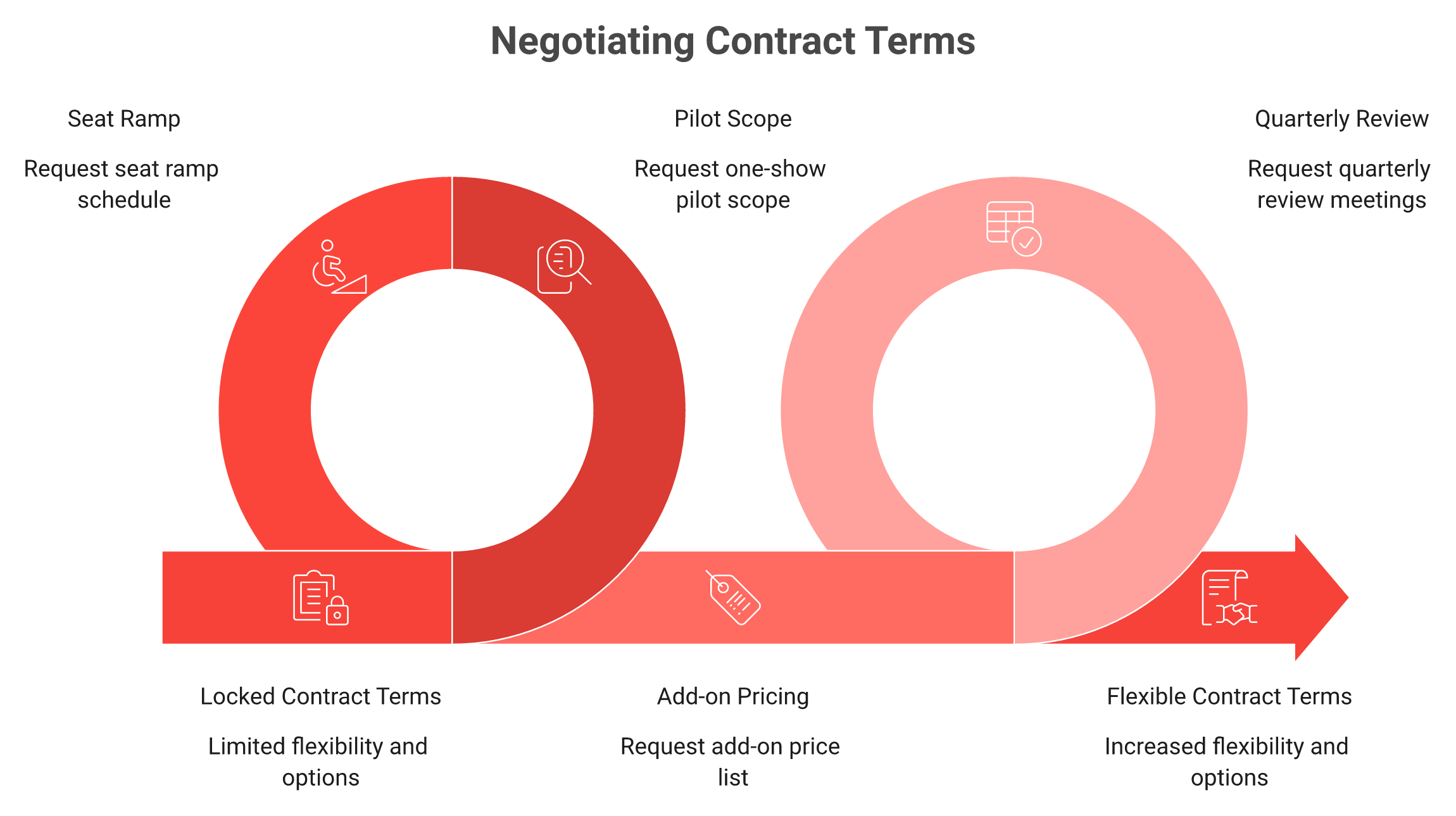
You will not get a trial. You can still de-risk the first year with four asks, all reasonable, all sendable on Monday.
Ask for a one-show pilot scope, even if it sits inside the annual term.
Ask for a seat ramp: five seats at signature, more only after show two.
Ask for the add-on price list in writing before you sign, not after.
Ask for a quarterly review tied to meetings booked, not scans captured.
⭐ The test the contract should let you run
An operator I follow puts it simply. For every event, he wants three times return on investment and one closed deal.
A twelve-month lock removes your ability to test that rule on a single show before committing a year of budget. That is the real cost of "no trial," and it is not on the price page. If you want to run the numbers first, the event ROI calculator gets you there in a few minutes.
B2Brain gives new teams their first event free for two people, which lets a field marketer run the whole workflow on one floor, count the meetings booked, and then decide what to sign. If you would rather see it run against your own show calendar first, Book a Demo.
Q5. What does Momencio cost across a full 8-to-15-show season? [toc=5. Full Season Cost]
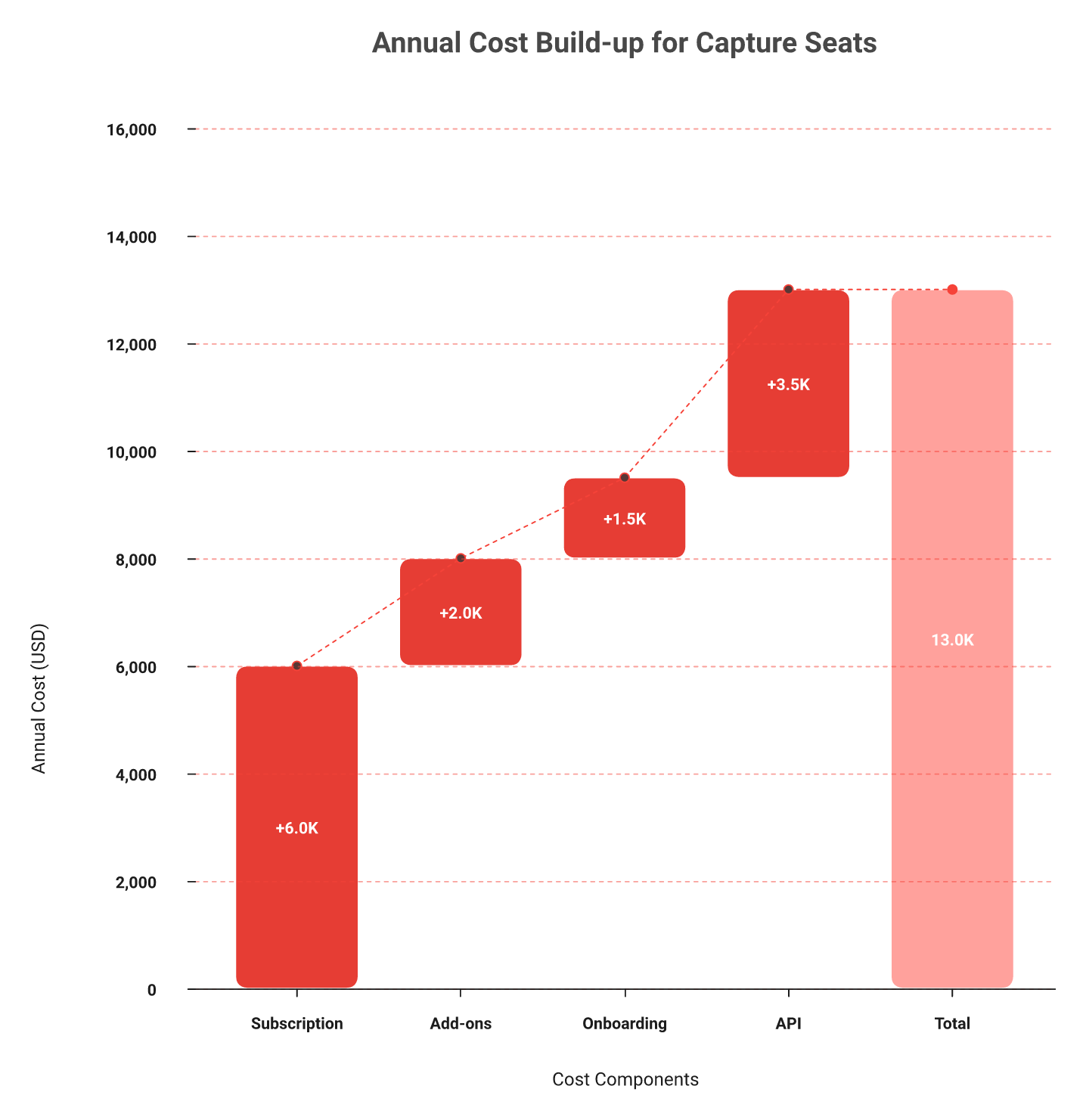
Software is only the first line. Add the CRM integration, AI EdgeCapture, gamification, and onboarding, then add an event API kit for every show on the calendar. Exhibitors report $700 to $1,200 per show for API access on comparable platforms. Across twelve shows, API fees alone can exceed a five-seat Capture subscription. Model all four lines before you request budget.
💰 The four lines every season budget needs
Most budget sheets carry one line for lead capture. That is the mistake. There are four.
Seats. Five minimum, at $100, $130, or $170 per seat per month, billed annually.
Add-ons. CRM or marketing automation integration, AI EdgeCapture, and gamification are priced separately on Capture.
Onboarding and support hours. Ask for this in writing before signature.
Event API kits. One per show, bought from the organizer, not the vendor.
The subscription is line one of four. Event API kits scale with show count while the seat cost does not.
⭐ Two worked scenarios
Here is the arithmetic for a mid-market industrial team. Use your own show count and seat count.
Loaded season cost by team size and show count
Scenario
Seats and tier
Subscription
Event API at 8 shows
Event API at 15 shows
Regional team
5 x Capture
$6,000
$5,600 to $9,600
$10,500 to $18,000
National team
10 x Engage
$15,600
$5,600 to $9,600
$10,500 to $18,000
B2Brain comparison
Per-event Show Pass
Priced by show count
Included in the show scope
Included in the show scope
The API column does not shrink when you buy fewer seats. It scales with shows.
💸 The API fee is the line nobody quotes you
This is the hidden tax in the category. It is charged per event, by the organizer, and it lands after you have already signed the software.
"Every time we have a show with lead scanning, I have to purchase an API kit that costs between $700 -$1200. It's become costly." RebeccaGrace K., 4 stars, Captello - G2 Verified Review
"It does not always work with every conference, if the conference does not provide and API kit for integration." Verified User in Consulting, 3.5 stars, Captello - G2 Verified Review
That second review matters as much as the first. Some shows do not sell an API at all, which is one reason teams end up comparing a rented badge scanning app against a licensed platform mid-season.
⚠️ Where teams actually overspend
I keep meeting field marketers who spent thirty-five thousand dollars dressing the booth and left the capture workflow on the organizer's rental. One told me later that the extra plywood money could have funded the entire follow-up motion.
B2Brain's four ways to invest in a show (booth, floor walking, sidebar events, and digital) exist to force that comparison before the money is committed. My read is that the booth line is almost always over-funded relative to what happens after the conversation. If you want the arithmetic first, the event ROI calculator runs it in a few minutes.
✅ The one number to put in the budget request
Add all four lines, then divide by show count. That gives you a defensible cost per show.
For a five-seat Capture team at eight shows, the loaded range lands roughly between $11,600 and $15,600, before onboarding and add-ons. That is the number finance will ask for, not the $100 seat rate.
Buyers who model this early tend to be happier with the tool afterwards.
"After reviewing the market we found that Momencio fit our needs perfectly in terms of CRM integration and capabilities... Really easy to set up and use at each event we have." Martin D., 5 stars, momencio - G2 Verified Review
B2Brain offers a per-event Show Pass alongside annual plans, so an eight-show team can match spend to the show calendar instead of pre-buying twelve months of seats in February. The full breakdown sits on the Show Pass and Pipeline plans page.
Q6. Is Momencio worth paying for when the organizer hands you a scanner? [toc=6. Versus Badge Scanner]
The organizer's scanner is not free. Rentals commonly run $200 to $500 per device per show, so five reps across twenty shows can reach $30,000 to $40,000 a year for contextless scans that live in the organizer's portal. B2Brain measures 52% of qualified booth leads converting to a booked meeting on the floor, against an 8% industry average post-event. The comparison is conversion, not device price.
💸 Run the rental math first
Nobody calls the rental "free" once they add it up. Two devices at $400, across twelve shows, is $9,600 with no software at all.
Scale that to a five-rep booth team across a full national calendar. You are inside the same budget band as a licensed platform, with none of the workflow.
⚠️ What the scan actually gives you
A badge scan captures a contact record. It does not capture why you talked to that person.
The organizer built that system for their own attendee analytics. The exhibitor gets the contact list, the organizer keeps the traffic insight. That gap is the whole reason exhibitors start looking at a conference badge scanner replacement rather than a renewal.
Reps feel this before finance does. A scanner that half-works at the booth is worse than a notebook.
"I didn't really use Popl because it didn't scan bar codes like I thought it would. Scanning badges should have given the name and contact info, but it didn't work when I tried it." Drew D., 0.5 stars, Popl - G2 Verified Review
⏰ The follow-through numbers that decide this
This is where the argument stops being about price. A 2025 CEIR benchmark found only 47% of exhibitors track leads through the sales cycle at all.
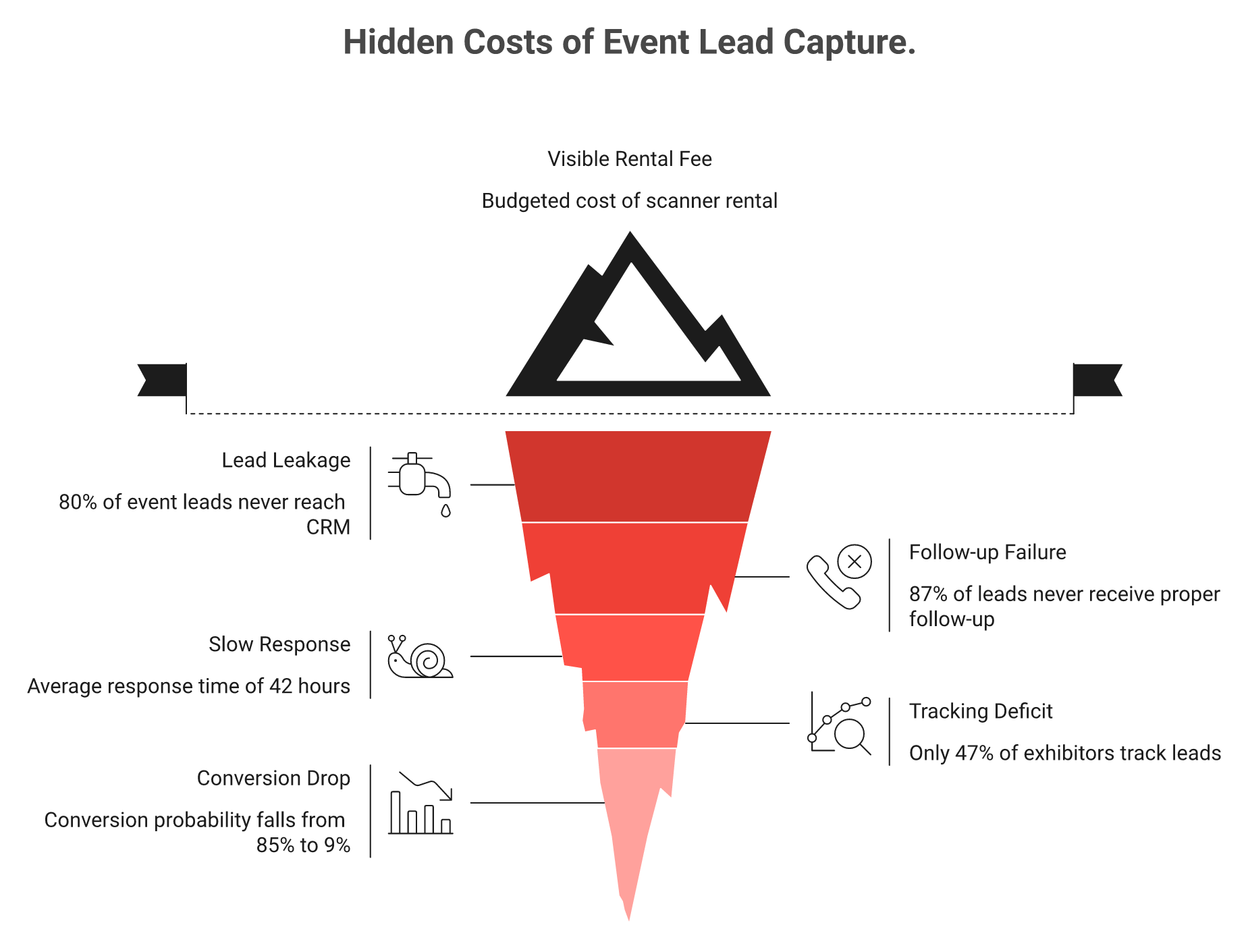
The category research is worse than most teams expect. Up to 80% of event leads never reach the CRM, 87% never receive proper follow-up, and the average response time is 42 hours.
Conversion probability sits near 85% within two hours of the conversation. After a week it drops to roughly 9%.
The rental fee is visible. The leads that never reach the CRM, and the meetings that never happen, are not.
❌ Where sync failures cost real money
You pay for every scan whether or not it lands. When sync breaks, you paid for a lead that does not exist.
"Sometimes Mobly can be finicky, where it doesn't sync all the leads I've scanned... this can really affect the overall success of our event because without those leads that I scanned but apparently didnt go through, we end up with a lot fewer than we expected." Verified User in Events Services, 3.5 stars, Mobly - G2 Verified Review
✅ The honest verdict on the displacement question
Momencio is worth paying for if your reps will use it and your CRM is connected. It is not worth paying for if you buy the entry tier without the integration add-on.
B2Brain books the meeting on the floor in under thirty seconds, with a dual calendar invite to the prospect and the right AE. That is the outcome a rental scanner structurally cannot produce, whatever it costs per device. It is the middle motion in how event lead capture works before, during, and after the show.
I will hedge one thing. For a single show a year with two reps, the rental probably still wins on cash, and I would tell you that before selling you anything.
B2Brain captures offline when the expo hall Wi-Fi dies, and its Recent Leads view exists for the 4pm rush when nobody can stop to type notes. That is the gap between saving a contact and keeping the conversation, and it is built for booth teams specifically.
Q7. What does a Momencio seat cost per booked meeting? [toc=7. Cost Per Meeting]
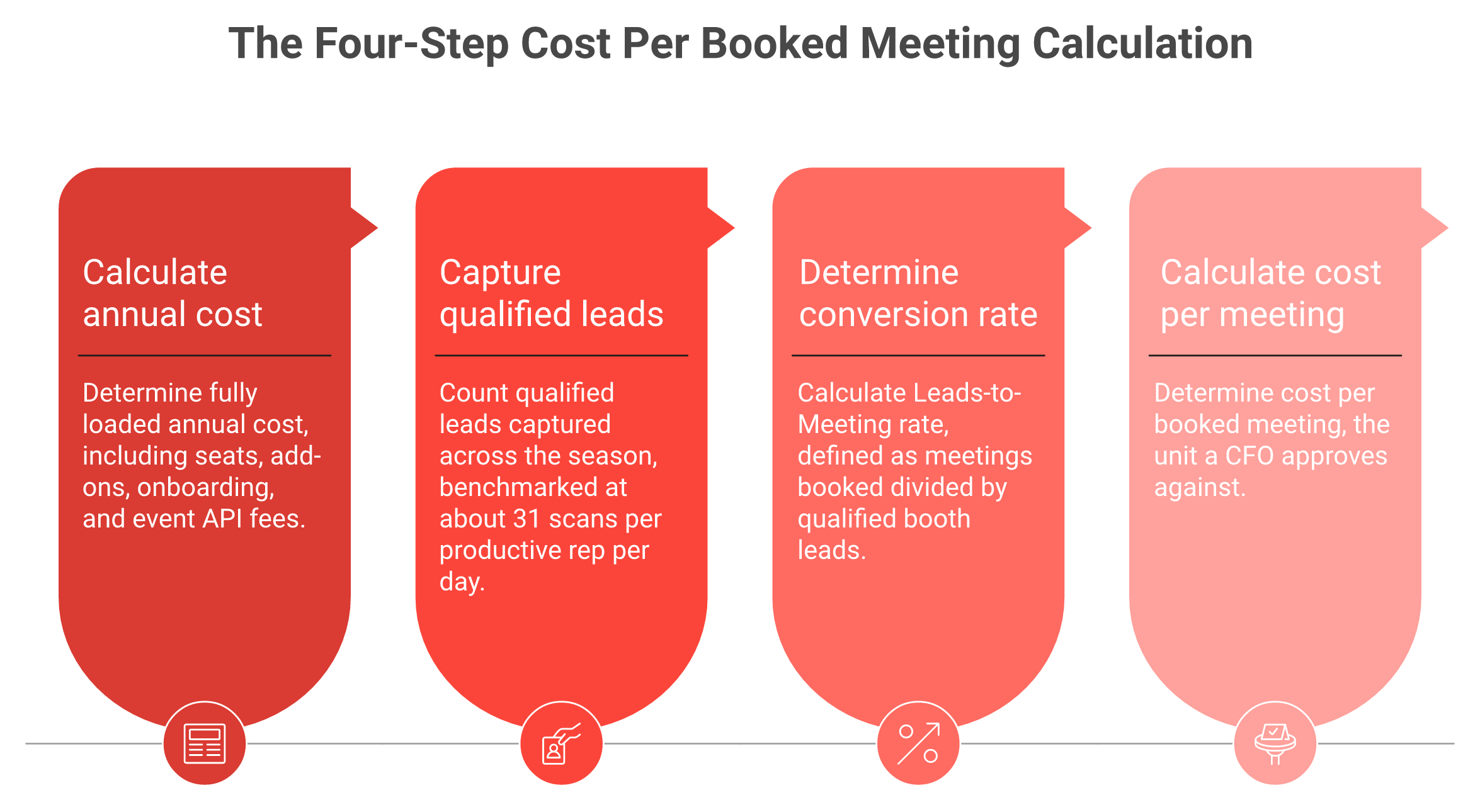
Divide fully loaded annual cost by meetings booked, not by badges scanned. A productive rep scans about 31 badges a day. At an 8% post-event leads-to-meeting rate, the same $6,000 license produces a very different cost per meeting than a floor-booked motion. B2Brain measures 52% leads-to-meeting on the floor against that 8% industry baseline, and delivers the pipeline report to the CMO by 9am the next day.
📊 The formula, written out
Leads-to-Meeting, or LTM, is meetings booked divided by qualified booth leads. It is the only ratio that turns a software price into a pipeline price.
Divide loaded cost by meetings booked, not badges scanned. The same license produces very different numbers.
⭐ The inputs, sourced
B2Brain's benchmark for a productive rep is 31 scans per day. Across a three-day show with five reps, that is roughly 465 scans, of which a portion are genuinely qualified.
The conversion side comes from two numbers. Industry post-event LTM sits near 8%, while floor-booked motions in B2Brain's deployments run at 52%.
The decay curve explains the spread. Conversion probability is roughly 85% within two hours and about 9% after a week.
💰 Two scenarios, same license fee
Take a five-seat Capture team at eight shows, loaded cost near $13,000. Assume 1,200 qualified leads across the season.
Cost per booked meeting at two conversion rates
Motion
LTM rate
Meetings booked
Cost per booked meeting
Post-event follow-up
8%
96
about $135
Booked on the floor
52%
624
about $21
The license did not change. The moment of the ask did.
✅ Benchmark it against your other channels
A qualified event meeting costs roughly 60% of an outbound meeting and about 40% of paid acquisition, on B2Brain's published benchmark. That is the comparison a CFO actually recognises, and it is the core of how teams generate new pipeline from events.
Contact information is not where anything happens. Pipeline is where their world moves, and cost per scan hides that completely.
⚠️ The reporting you need to defend the number
A cost-per-meeting claim is only as good as the attribution behind it. You need per-show pipeline, show-over-show comparison, and multi-touch attribution by rep and segment. The mechanics of measuring event ROI matter more here than the license line.
B2Brain's morning-after offline-to-pipeline report is built for that Monday review, so the field marketer answers "where is the pipeline?" with a figure rather than a scan count. We built it deliberately to make the marketer the hero in that meeting.
My honest caveat: LTM is a metric B2Brain coined, and no competitor currently reports it. Treat the 52% as our measured deployments, not an industry-audited average, and ask any vendor on your shortlist for their own equivalent.
B2Brain ties every booked meeting to an opportunity record in Salesforce or HubSpot, which is what makes cost per meeting auditable rather than anecdotal. That is the same plumbing behind lead capture that writes to Salesforce from the floor.
Q8. How does Momencio's price compare to the alternatives? [toc=8. Alternatives Cost Compare]
Momencio sits mid-market on price and high on commitment: per-seat annual only, five-seat floor, no trial. B2Brain and Captello offer per-event entry points, Popl runs usage-based near $6,000 a year, iCapture sells a flat unlimited-user annual license near $8,000, and Blinq starts near $2,400 a year. Cost shape and whether CRM sync is bundled matter more than the headline rate.
⭐ The cost-shape table
Price alone will mislead you here. Compare the shape of the commitment.
Event lead capture platforms compared on cost shape
Platform
Cost shape
Entry commitment
CRM sync bundled
On-floor meeting booking
Per-show fee exposure
B2Brain
Per-event Show Pass or annual
First event free, two people
✅ Salesforce and HubSpot native
✅ Under 30 seconds, dual invite
Low
Captello
Per event or annual
Per-event licences available
✅
Partial
High (API kits $700 to $1,200)
iCapture
Flat annual, unlimited users
Annual
✅
❌
Moderate
Popl
Usage-based annual
Annual
✅
Bolt-on
Moderate
Blinq
Per-seat annual
Annual
✅
Bolt-on
Low
Momencio
Per-seat annual only
12 months, 5 seats
💸 Add-on
❌
High (event API per show)
💸 What buyers say about paying for the wrong shape
Cost complaints in this category are rarely about the number. They are about paying annually for something used a few days a year.
"The price, $140 a year? No way, would rather print thousands of business cards." Fabian T., 1 star, Popl - G2 Verified Review
"The cost is very high considering it's mostly a digital Buisness card sharing app it's not much different then adding a QR code to my Buisness card." Brooke N., 1 star, Popl - G2 Verified Review
If Popl is on your shortlist for cost reasons, the wider set of Popl alternatives is worth reading before you commit to an annual seat model.
✅ Five buying scenarios
Match the shape to your calendar, not to the feature grid.
Two shows a year. Per-event pricing wins. An annual five-seat floor is dead money through the off-season.
Twelve or more shows. Annual unlimited-event pricing wins, and iCapture's flat model is worth a quote.
Salesforce or HubSpot native requirement. Rule out any plan where the connector is an add-on line.
Multi-region teams. Check Android support and offline behaviour before price. B2Brain's native app is iOS only today, with web access elsewhere, and that is a real constraint we do not hide.
Enterprise with procurement review. Ask for SOC 2 documentation, data export rights, and the renewal notice period in the first call.
Blinq holds the largest review wall in the segment with 8,800-plus G2 reviews. Popl carries 4,400-plus, Cvent over 2,100 for lead capture.
B2Brain has 17. I am not going to pretend that is equivalent, and buyers should weigh it. Our argument is the LTM outcome, not the review count, and our own reviewers name gaps too.
"Reporting is basic. We can see usage and lead stats, but there are no rep performance dashboards, no clear ROI reporting." Ole O., 4 stars, B2Brain G2 - Verified Review
B2Brain leads this table as the per-event option with native CRM sync, on-floor booking, and per-show pipeline reporting included rather than added. That is a structural difference in cost shape, not a discount. If you want it priced against your own show calendar, Book a Demo.
Q9. Who should buy Momencio, and what should you ask before signing? [toc=9. Fit and Contract Asks]
Momencio fits teams with three to five reps actively capturing, plus marketing ops and a manager reviewing the dashboard, running ten or more events a year. The vendor says so itself: below that headcount, a $49 card scanner will do. Skip it if you run two shows a year, cannot commit twelve months, need Android parity, or need CRM sync without a separate add-on.
✅ The good-fit profile, in the vendor's own words
Momencio's pricing page states its floor plainly. It says event programs are team activities, and that teams getting real return have at least three to five reps capturing, plus marketing ops, plus a sales manager reviewing the dashboard.
It then says the quiet part out loud. Below that headcount, an exhibitor probably does not need an intelligence platform.
I respect vendors who publish a disqualifier. Almost nobody in this category does, which is why most shortlists of a lead capture app for trade shows read as if every tool fits every booth.
❌ The four disqualifiers
Each one traces back to a contract term, not an opinion.
Two or three shows a year. A twelve-month lock means paying through a dead off-season.
No budget certainty. There is no trial, no mid-cycle cancellation, and no refund.
Android-first field teams. Check device support before price, always.
CRM sync as a must-have. On Capture, the integration is a paid add-on, not bundled.
For very low show counts, the money may not belong in capture software at all. A sidebar dinner for 25 to 30 named prospects, at $300 to $450 per head, often beats a second booth.
⚠️ The honest middle at six to eight shows
This is where the answer is genuinely unclear. You are above the vendor's stated floor but below the ten-event mark it prices for.
My read is that the deciding factor is CRM requirement, not show count. If Salesforce or HubSpot hygiene is the reason you are buying, the add-on cost moves the whole calculation, and lead capture that writes to Salesforce stops being a nice-to-have.
Feature breadth cuts both ways here, and buyers say so.
"It takes some time to get used to it, and there are infinite possibilities that one can feel quite overwhelmed initially. But I do value that the Momencio team replied and addressed initial issues promptly." Silia V., 4.5 stars, momencio - G2 Verified Review
B2Brain fits a narrower profile on purpose: five or more shows a year, two or more booth reps, ACV above $25,000, and Salesforce or HubSpot already in the stack. The workflow that profile buys is documented for booth teams.
💰 The ten questions to send before signature
Send these as one email to the rep. Answers in writing, before the contract, not after.
The full add-on price list, itemised.
Event API cost for every show on our calendar.
Seat reassignment terms between reps.
CRM integration scope and sync frequency.
Data export rights if we cancel.
Onboarding and support hours included.
Android support status and roadmap date.
Renewal notice period.
A one-show pilot scope inside the annual term.
A reference customer's leads-to-meeting rate.
That last one is the tell. Vendors who cannot produce it are selling scans, not pipeline, and the whole point of an offline to pipeline motion is that the number exists.
⭐ Two things to test live, not on a slide
Make the rep demo follow-up latency in real time. If the prospect does not get an email within roughly fifteen minutes of the scan, the workflow is theatre. Ask to see how event lead capture works end to end, not just the scan screen.
Then ask about enrichment honestly. B2Brain's own reviewers flag that our contact data is not the strongest in the segment, and I would rather you hear it from them.
"The main thing is the contact data. It's just not very good. The accuracy of emails is hit or miss, around 60-70%." Jorgealfa P., 3.5 stars, B2Brain G2 - Verified Review
B2Brain answers all ten of these in writing before a contract, including a reference customer's leads-to-meeting rate. That number is the one we ask other vendors for too, and it sits alongside what B2Brain costs per event.
⏰ Where I think this goes next
My prediction for the next eighteen months is that per-seat annual pricing starts breaking in this category. Show calendars are volatile, and finance teams increasingly want spend tied to the event, not the year.
I could be wrong. If you have run a per-event model against an annual one across a full season, I would genuinely like to see your numbers. If you would rather test it on one floor first, take the first event free for two people or Book a Demo against your own show calendar.
FAQ's
How much does Momencio cost in 2026, and what is the real entry price?
Momencio publishes three tiers on its own pricing page, all billed annually with a five-seat minimum.
Capture: $100 per seat per month, from about $6,000 per year at five seats.
Engage: $130 per seat per month, roughly $7,800 per year at five seats.
Amaze: $170 per seat per month, roughly $10,200 per year at five seats.
Ten Amaze seats land near $20,400 per year, and twenty near $40,800. Every tier covers unlimited events, so show count does not change the subscription line.
The five-seat floor matters more than the seat rate. You cannot buy one seat or three, which means $6,000 is the smallest cheque, not $100. For a team running two or three shows a season, that floor is the whole decision.
Three costs sit outside the sticker: AI EdgeCapture, CRM or marketing automation integrations, and gamification, all listed as paid add-ons on Capture. Badge scanning additionally requires an event API purchased from each show organizer.
We price differently on purpose. B2Brain offers a per-event Show Pass alongside annual plans, because event budgets get approved show by show rather than twelve months at a time. You can see what B2Brain costs per event and model it against your own calendar.
Does Momencio offer a free trial or a single-event license?
No on both counts, and the terms around them are firm.
Free trial: none. Momencio offers a guided demo instead, citing setup requirements such as CRM integration and content configuration.
Single-event or per-show license: not currently offered. Teams attending fewer than ten events a year are directed to contact sales for a tailored plan.
Contract length: a twelve-month minimum on all three plans.
Cancellation, downgrade, refund: none mid-cycle. Access runs to the end of the term.
Seats: can be added mid-cycle, and are reassignable between reps.
Third-party directories still list a $300 single-event plan. That option no longer exists, so do not build a budget on it.
Seat reassignability is the clause worth reading twice. Booth rosters change between spring and autumn shows, and a non-reassignable seat becomes a stranded asset.
If you cannot commit twelve months unvalidated, negotiate a one-show pilot scope inside the term, a seat ramp after show two, and the add-on price list in writing. B2Brain gives new teams their first event free for two people, which lets a field marketer test how event lead capture works on one floor before signing anything annual.
What does Momencio actually cost across a full trade show season?
The subscription is one of four lines. Model all four before you request budget.
Seats: five minimum at $100, $130, or $170 per seat per month, billed annually.
Add-ons: CRM or marketing automation integration, AI EdgeCapture, and gamification, priced separately on Capture.
Onboarding and support hours: get the inclusion in writing before signature.
Event API kits: one per show, bought from the organizer rather than the vendor.
That last line is the hidden tax. Exhibitors on comparable platforms report paying $700 to $1,200 per show for API access, and the cost scales with show count while the subscription does not.
A five-seat Capture team at eight shows lands roughly between $11,600 and $15,600 loaded, before onboarding and add-ons. At fifteen shows, API fees alone can exceed the subscription.
Divide the loaded total by show count. That gives you the defensible cost per show that finance will actually ask for.
Our per-event Show Pass exists for exactly this reason: B2Brain lets an eight-show team match spend to the calendar instead of pre-buying twelve months in February. If you want the arithmetic first, run it through our event ROI calculator.
Is Momencio worth paying for when the organizer already gives us a badge scanner?
The organizer's scanner is not free. Rentals commonly run $200 to $500 per device per show, so five reps across twenty shows can reach $30,000 to $40,000 a year.
The better comparison is not device price. It is what share of captured leads reaches your CRM with context attached, and how many become booked meetings.
The category data is blunt on this point:
Up to 80% of event leads never reach the CRM.
87% never receive proper follow-up.
The average response time is 42 hours.
A 2025 CEIR benchmark found only 47% of exhibitors track leads through the sales cycle.
Conversion probability sits near 85% within two hours and falls to roughly 9% after a week.
A badge scan saves a contact record. It does not capture why you talked to that person, and the organizer built the system for their own attendee analytics.
Momencio is worth paying for if your reps will use it and the CRM connector is in scope. It is not worth paying for on the entry tier without that add-on.
B2Brain books the meeting on the floor in under thirty seconds with a dual calendar invite to the prospect and the right AE, which is how teams generate new pipeline from events rather than a contact list.
How does Momencio's pricing compare to Captello, iCapture, Popl, and Blinq?
Momencio sits mid-market on price and high on commitment: per-seat annual only, a five-seat floor, and no trial. Cost shape matters more than the headline rate.
Captello: per-event or annual, with high per-show API kit exposure at $700 to $1,200.
iCapture: flat annual, unlimited users and events, near $8,000 per year.
Popl: usage-based annual, near $6,000 per year, with meeting booking as a bolt-on.
Blinq: per-seat annual from around $2,400 per year.
Momencio: per-seat annual only, CRM integration billed as an add-on.
Match the shape to your calendar. Two shows a year favours per-event pricing. Twelve or more favours flat annual unlimited-event models. A Salesforce or HubSpot requirement should rule out any plan where the connector is a separate line.
Be honest about social proof too. Blinq holds the largest G2 review wall in the segment with 8,800-plus reviews, Popl over 4,400, and we have 17.
B2Brain competes on the leads-to-meeting outcome instead, measuring 52% of qualified booth leads booked into meetings on the floor against an 8% industry average post-event. The full workflow behind that number is documented for booth teams.
Enjoyed the read? Join our team for a quick 30-minute chat — no pitch, just a real conversation on how we’re rethinking Event Intelligence in B2b.

.png)
.png)

.png)
.png)