Popl vs HiHello: How They Compare on Digital Cards, Team Plans, CRM Integration, and Pricing
Written by
Sridhar Ranganathan
Last Updated :
July 28, 2026
Skim in:
12
mins
TL;DR
Popl and HiHello are both digital business card platforms, so they capture contacts, not booked meetings or attributable trade-show pipeline.
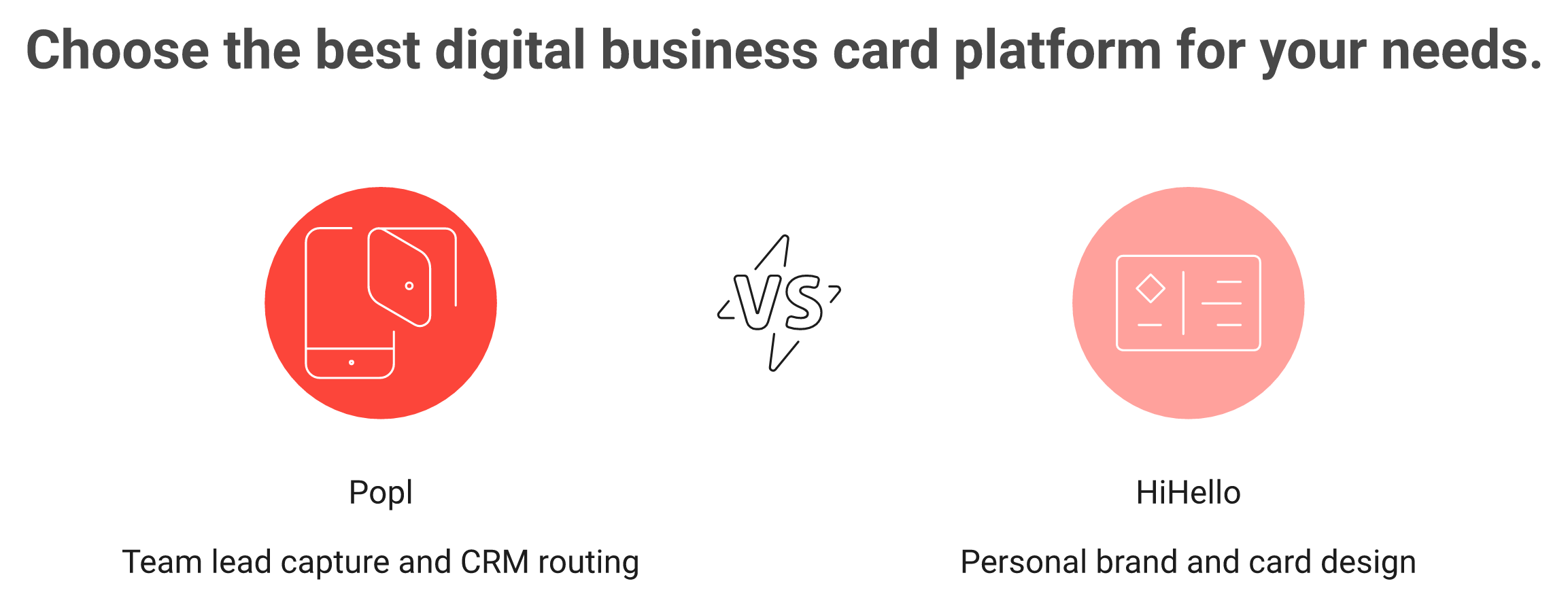
Popl fits sales teams with lead capture, badge scanning, and CRM routing; HiHello fits professionals who value card design and compliance.
Both list Salesforce and HubSpot logos, but neither treats event attribution as native, so test real-time sync and dedupe before signing.
Seat price is the wrong denominator for a revenue team; cost per qualified meeting booked is the number a field marketer can defend.
On G2 both score near 4.6 of 5, but Popl carries far more reviews (~5,300 vs ~725), reflecting scale, not superiority.
For booth teams measured on pipeline, evaluate an event-capture platform on meetings booked on the floor, not cards tapped.
Q1. Popl vs HiHello: Which Digital Business Card Platform Should You Choose? [toc=1. Quick Verdict]
Choose Popl if your priority is lead capture, event scanning, and CRM automation for a sales team. Choose HiHello if your priority is polished card design, brand consistency, and compliance for professionals. Both are digital business card platforms, not event-pipeline systems. So if your real goal is booked meetings and attributable trade-show pipeline, neither indexes on that axis.
🏆 The short answer, before you scroll
Popl leans toward sales teams. It bundles lead capture, an app-based badge scanner, and CRM sync into one place. HiHello leans toward the individual professional. It pioneered the digital card category in 2018 and still wins on design, custom fields, and email signatures.
I have watched this decision play out from the operator's seat for fifteen years. The choice usually comes down to one question. Are you collecting contacts, or are you trying to move pipeline? If your booth team needs to generate new pipeline from events, that distinction decides everything.
🔑 What each one actually owns
Popl and HiHello are both digital cards, but they optimize for different jobs, team capture versus personal brand.
Popl's strongest card is capture. Reps tap, scan, and route a contact into Salesforce or HubSpot without much fuss. HiHello's strongest card is presentation. Your card looks sharp, your signature is on-brand, and IT can manage it cleanly.
Here is the reframe I keep pushing on field teams. A digital card is a capture mechanism. It is not a pipeline mechanism. The real question is not "whose card is prettier." It is "which one gets a scored, context-rich lead into my CRM before the prospect leaves the aisle." That is exactly what universal lead capture is built to solve.
One operator put the deeper job plainly. They wanted to "own my lead data in real-time on my own device, bypassing the event organizer's gatekeeping, so I can hit a prospect's inbox while they are still standing in the aisle."
⚠️ The axis neither one reports
Here is the open loop I will close later in this article. Both tools capture a contact. Neither tells you what happened next. Neither reports meetings booked, and neither reports pipeline your CFO can see.
That gap is exactly where an event-capture platform like B2Brain lives. We do not compete with Popl or HiHello on card design. We work one axis they do not track, the meeting booked at the booth, and the pipeline tied to it. Our before, during, and after the show workflow returns in Q8 and Q9.
For now, hold the simple verdict. Popl for team capture. HiHello for personal brand. If your boss is going to ask "where is the pipeline?" on Monday, keep reading, because a card alone will not answer that.
"The user experience was confusing and I still do not know where the information or the person I connected with is." Liliana P. Popl G2 Verified Review
"We tried to use the QR scanner and it would only take us to the download option for HiHello. My digital business card would not load." Angela C. HiHello G2 Verified Review
Both are real tools with real fans. Just be honest about the job you are hiring them for.
Q2. What Exactly Are Popl and HiHello, and Who Is Each Built For? [toc=2. What They Are]
Popl is a digital business card and lead-capture platform aimed at teams and enterprises. It offers NFC products, an app-based badge scanner, and CRM integrations. HiHello is a digital business card platform that pioneered the category in 2018. It emphasizes customizable design, virtual backgrounds, email signatures, and compliance. Popl skews toward sales and event use. HiHello skews toward professional identity.
📇 What Popl is, in plain terms
Think of a digital business card as your contact details behind a QR code or an NFC tap. NFC means "near-field communication," the same tap-to-pay chip in your phone. Popl builds on that base and adds lead capture, so a rep can pull a prospect's info into a shared team view.
Popl positions itself as a lead-capture and digital card platform, and claims over two million users on its own site. Its best fit is a sales or field team that wants capture, scanning, and CRM routing in one app. That is a real use case, and Popl serves it better than a plain card app. If you want a wider view of that category, our roundup of Popl alternatives covers the field.
🎨 What HiHello is, in plain terms
HiHello came first. It launched the modern digital card category in 2018 and still leads on presentation. You get custom fields, clean card templates, virtual backgrounds, and branded email signatures.
Its best fit is the individual professional or a brand-conscious team. If you want your card to look sharp and your signature to stay on-brand across the company, HiHello is built for that. It is less about pipeline and more about identity.
🧠 The distinction most comparisons miss
Here is where I will grant the reader the dignity of the full picture. Both tools are digital business card platforms first. A card platform optimizes for the swap. An event-pipeline platform optimizes for what the swap becomes.
I keep coming back to a line from an operator I trust. Software is getting commoditized, so "it goes back to the data piece, the data whatever it is for you is your biggest asset." That is the real question here. Not card features. Data ownership, and what you can do with the data after the tap.
There is an adjacent category worth naming, event lead capture. It is distinct from both Popl and HiHello. It starts where a card ends, at capturing the conversation and turning it into a booked meeting. B2Brain sits in that category, and our work for booth teams keeps out of the next two feature sections so you can compare the card tools cleanly.
So, quick fit summary. Popl for team lead capture. HiHello for personal and brand identity. Now let us test them on the features you actually pay for.
Q3. How Do Popl and HiHello Compare on Digital Cards, NFC, and Sharing? [toc=3. Cards, NFC and Sharing]
Both offer digital cards shareable via QR code, link, and NFC, with no app required for recipients to view. HiHello wins on design customization, templates, virtual backgrounds, and email signatures. Popl wins on NFC product range and built-in lead capture, including an app-based badge scanner. For networking aesthetics, HiHello edges ahead. For turning a tap into an actionable lead, Popl is stronger.
📊 The feature comparison at a glance
Popl vs HiHello: Digital Cards, NFC, and Sharing
Capability
Popl
HiHello
Card design and customization
Solid, template-based
Stronger, more custom fields
NFC hardware range
Broad (cards, tags, accessories)
Available, narrower range
QR and link sharing
Yes
Yes
Digital wallet support
Yes
Yes
Built-in lead capture / scanner
Yes, a core feature
Limited, contact-focused
Email signatures
Available
A standout strength
😖 Where each one frustrates real users
Here is the operator problem. On a busy floor, the differentiator is not card beauty. It is whether capture survives rush hour and patchy convention-center Wi-Fi. A card swap is one tap. A follow-up that lands within 15 minutes is what the prospect remembers, which is why a dedicated lead capture app for trade shows is built differently.
Popl's capture works, but users flag friction. Several reviewers describe the recipient flow as heavy, with account prompts getting in the way of a simple exchange.
"Lead capture is likely the most positive element of Popl. However, it's far too cumbersome when all someone wants is your contact information." Vadim E. Popl G2 Verified Review
HiHello's design is loved, but its scanning and QR reliability draw complaints, especially across devices.
"I'm not getting contact information for people that scan the QR." Verified User in Health, Wellness and Fitness HiHello G2 Verified Review
If you are handing out a card at a conference dinner, HiHello's polish wins. If a rep is capturing thirty leads an hour at a booth, Popl's scanner and team view matter more.
One tactical note from the floor. The instant you get a contact, act on it. As one operator described their habit, "within 15 minutes they get an email, they think that I enjoyed our conversation so much." Speed is the whole game, and a pretty card does not create speed by itself.
This is where design goals diverge. Card platforms optimize the tap and the look. Event-capture platforms like B2Brain optimize scan-to-note latency and offline reliability on the floor, because the target is not a saved contact but a captured conversation that survives bad Wi-Fi. For the mechanics of that, see how our badge scanning app handles the booth-day workflow. Different job, different build.
Q4. How Do Team, Enterprise, and Compliance Options Differ Between Popl and HiHello? [toc=4. Team and Enterprise]
Both offer team and enterprise tiers with centralized admin, brand templates, and analytics. HiHello Business adds SSO, SCIM, HR-directory integrations (Workday, Okta), and strong compliance for identity-managed rollouts. Popl Teams emphasizes shared lead capture, leaderboards, and CRM routing across reps. For IT-governed brand deployments, HiHello fits. For sales-team lead capture at scale, Popl fits. Neither reports pipeline generated per team.
🏢 The team and enterprise breakdown
Let me define two acronyms first. SSO ("single sign-on") lets staff log in with one company identity. SCIM ("system for cross-domain identity management") auto-provisions and removes users as people join or leave.
Popl vs HiHello: Team, Enterprise, and Compliance
Criteria
Popl Teams / Enterprise
HiHello Business / Enterprise
User / seat model
Per-seat, team dashboard
Per-seat, tiered by users
Admin console
Yes, capture-focused
Yes, identity-focused
Brand templates
Yes
Yes, strong
SSO / SAML / SCIM
On higher tiers
Yes, a core strength
HR / directory sync
Limited
Workday, Okta supported
Compliance posture
Standard
Strong, enterprise-ready
Analytics
Lead and scan leaderboards
Card and engagement analytics
🔐 Which team should pick which
HiHello is the pick when IT owns the rollout. If you need identity management, auto-provisioning, and clean compliance across hundreds of employees, that is HiHello's lane. It treats the card as a governed brand asset.
Popl is the pick when sales owns the rollout. Shared lead capture, rep leaderboards, and CRM routing are built for a team that scans leads and wants them in the pipeline. It treats the card as a capture tool, and if that is your need, our guide to lead capture into Salesforce is worth a read.
📈 What team plans measure, and what they don't
Here is my honest read, and I might be pushing on the category a bit. Team plans price seats and count taps. They tell you who tapped, who scanned the most, and whose card got the most views.
But the boss does not ask "how many taps." She asks "how much pipeline." Team-plan ROI is not the same as team-plan price. This is exactly where a card platform's KPI and a revenue team's KPI drift apart.
The fix is discipline you can apply on Monday. As one operator put it, "all of your events should be living in Salesforce, every single event is organized by campaign and you are tracking every single lead," because "tracking that attribution between both sourced and influenced pipeline is how you know if that event was successful." Our event ROI calculator turns that discipline into a number.
That is the gap worth naming. A team plan tells you who tapped. An event-pipeline platform like B2Brain, with per-show pipeline reports and an offline to pipeline report, tells the CFO what the team actually booked. Same event, very different question answered.
Q5. How Deep Is CRM Integration in Popl vs HiHello, and Does the Sync Actually Hold? [toc=5. CRM Integration and Sync]
Popl offers native CRM integrations (Salesforce, HubSpot, Microsoft Dynamics) plus Zapier and built-in lead routing. HiHello supports CRM export and integrations but leans toward contact management over pipeline sync. Both list the logos. But buyers should test what few comparisons cover: real-time sync reliability, deduplication when multiple reps scan the same person, and whether event attribution survives into the CRM record.
🔌 What each one connects to
Popl vs HiHello: CRM Integration Depth
Criteria
Popl
HiHello
Salesforce / HubSpot
Native
Supported, lighter
Microsoft Dynamics
Yes
Limited
Zapier
Yes
Yes
Real-time vs batch
Near real-time
Often export-based
Deduplication
Basic
Basic
Event attribution field
Not native
Not native
Popl is the stronger CRM story of the two. HiHello treats the CRM as a place to push a contact, not a pipeline to feed. If Salesforce is your system of record, our guide to lead capture into Salesforce shows what clean routing looks like.
😤 The checkbox trap nobody warns you about
Here is the part that bites teams after they sign. A logo on an integrations page is not a working sync. "Integrates with Salesforce" says nothing about dedupe, or whether attribution survives.
I have seen this failure mode up close. One operator described inheriting a system where "the rental car system didn't talk to the sales system," and "none of it was set up correctly, from name would not match, images missing, there's CRMs a mess." That mess is what a bad sync leaves behind.
The other cost is time. When capture routes through a broker or a batch export, teams end up acting on lists "3 months later," long after the buyer forgot the conversation. That is the exact gap a true universal lead capture workflow removes. Real users feel the friction too.
"I get push, email, AND a text when I scan a Popl card. Why!? It's also quite difficult to narrow it down." Verified User in Real Estate Popl G2 Verified Review
Is the sync real-time, or a batch export I trigger later?
What happens when two reps scan the same person? Do I get one record or two?
Does the show name land in the CRM as an attribution field, or do I add it by hand?
Does a booked meeting write back to the CRM, or just the contact?
If a tool cannot answer all four cleanly, you are buying a contact exporter, not a pipeline system.
This is the exact failure mode we built B2Brain to close. We sync native to Salesforce and HubSpot in real time, dedupe the record, and keep show attribution intact, so a card app's contact export is not the ceiling. If you want to see how event lead capture works, the lead, the note, and the meeting all land as one clean, attributed record.
Q6. What Do Popl and HiHello Cost, and Which Is Better Value for Teams? [toc=6. Pricing and Value]
Both offer free tiers. Popl Pro runs about $7.99 per month (cheaper annually), with Teams and Enterprise by seat and custom quote. HiHello Professional starts around $6 per month, Business from roughly $25 per month for five users, and Enterprise custom. HiHello is competitive for small teams needing design and compliance. Popl's value grows when lead capture and CRM routing replace separate tools.
💰 The reconciled pricing table
Vendor pages conflict and hide the team math, so here is the clean version.
Popl vs HiHello: Pricing Tiers
Tier
Popl
HiHello
Free
Yes, basic card
Yes, basic card
Pro / Professional
~$7.99/mo (less annually)
~$6/mo
Business / Teams
Per seat, custom
From ~$25/mo (5 users)
Enterprise
Custom quote
Custom quote
NFC hardware
Sold separately
Sold separately
Both are cheap per seat. That is the point, and also the trap.
📐 Why seat price is the wrong number
Here is where I will be blunt, because the math matters. Seat price is the wrong denominator for a revenue team. The right one is cost per qualified meeting booked. That is the figure a field marketer can actually defend in a budget review, and our event ROI calculator works it out for you.
Think about the full picture. A booth can run $70,000 or more, and the boss wants pipeline that dwarfs it. An $8-per-seat card app and a $600-per-device organizer scanner are both priced on the wrong axis. Neither tells you what a meeting costs.
One operator I trust runs a simple rule. "For every event I want to see three times a return on investment and closed one," they said, so "if you spend 10K on a happy hour I want to see 30K in closed one." Another benchmark from the same brief: your cost per attendee, even with travel, "should come in somewhere between 300 to $450."
Hold those numbers next to a card subscription and the point lands. The card app is not the expensive line item. The booth, the flights, and the wasted follow-up time are. So the real value question is not "what is the seat price." It is "what does one booked meeting cost me, and how many did I get?"
That reframe is the whole reason event-pipeline platforms price against pipeline, not seats. At B2Brain, we anchor value on cost-per-booked-meeting and the pipeline tied to it, because that is the number your CFO recognizes. You can see what B2Brain costs per event, since a per-seat card fee never answers "was the show worth it?"
Q7. What Do Real Users Say About Popl and HiHello on G2 and Reddit? [toc=7. Real User Reviews]
Both score about 4.6 out of 5 on G2, but Popl carries far more reviews (~5,300 versus ~725), reflecting scale. Popl praise clusters on ease of sharing and lead capture. Complaints cite add-on and hardware costs and occasional QR or sync glitches. HiHello praise centers on clean design and customization, while complaints note fewer sales-automation features.
📊 The ratings, in context
The star averages look nearly identical. The gap is volume, and volume is a signal, not a verdict. More reviews usually means more adoption, but it also surfaces more edge-case failures.
Here is how I read reviews after fifteen years of doing it. Separate "love the design" sentiment from "the sync broke and I lost three days of leads." The first is a preference. The second is a pipeline risk, and it should carry far more weight.
👍 Popl: what praise and pain look like
Popl fans like the concept and the capture. Critics flag friction, cost, and pushy notifications. For a wider view, our roundup of Popl alternatives compares the field.
Notice the pattern across both tools. The recurring complaint is not "the card looks bad." It is "I could not act on what I captured." That maps to a hard truth from the floor: "there's one out of 20 businesses who get this lead list and then they act on it 3 months later." A purpose-built lead capture app for trade shows is designed to break that pattern.
That follow-up gap is a category-wide problem, not a brand-specific one. Roughly "60% of lost sales are a result of not properly qualifying your potential customers," per the same operator brief. A star rating will not tell you whether a tool fixes that. Only the complaint patterns will, so read those first.
Q8. Popl vs HiHello for a Sales or Field Team: Which Actually Moves Pipeline? [toc=8. Which Moves Pipeline]
For a field or sales team, Popl is the stronger of the two, thanks to lead capture, CRM routing, and analytics. HiHello fits individual brand identity better than pipeline generation. But both are digital business card platforms, so they capture contacts, not commitments. If your goal is meetings booked at the booth and pipeline your CFO can see, evaluate a purpose-built event-capture platform against them on that axis.
📦 The shoe-box graveyard
Let me tell you a story I think about often. A rep named Jimmy brings the lead box back from a show. "Monday morning he pulls out three business cards," then a coworker asks him to lunch, "and he shoves the shoe box under the desk, and six months later they find the shoe box."
Swap the shoe box for a CSV of 400 contacts and nothing changes. The graveyard just went digital. As the same operator put it, "the money in a trade show is made in the follow-up," and slow capture kills it. This is the whole reason we exist to help teams generate new pipeline from events.
⏰ Contacts versus commitments
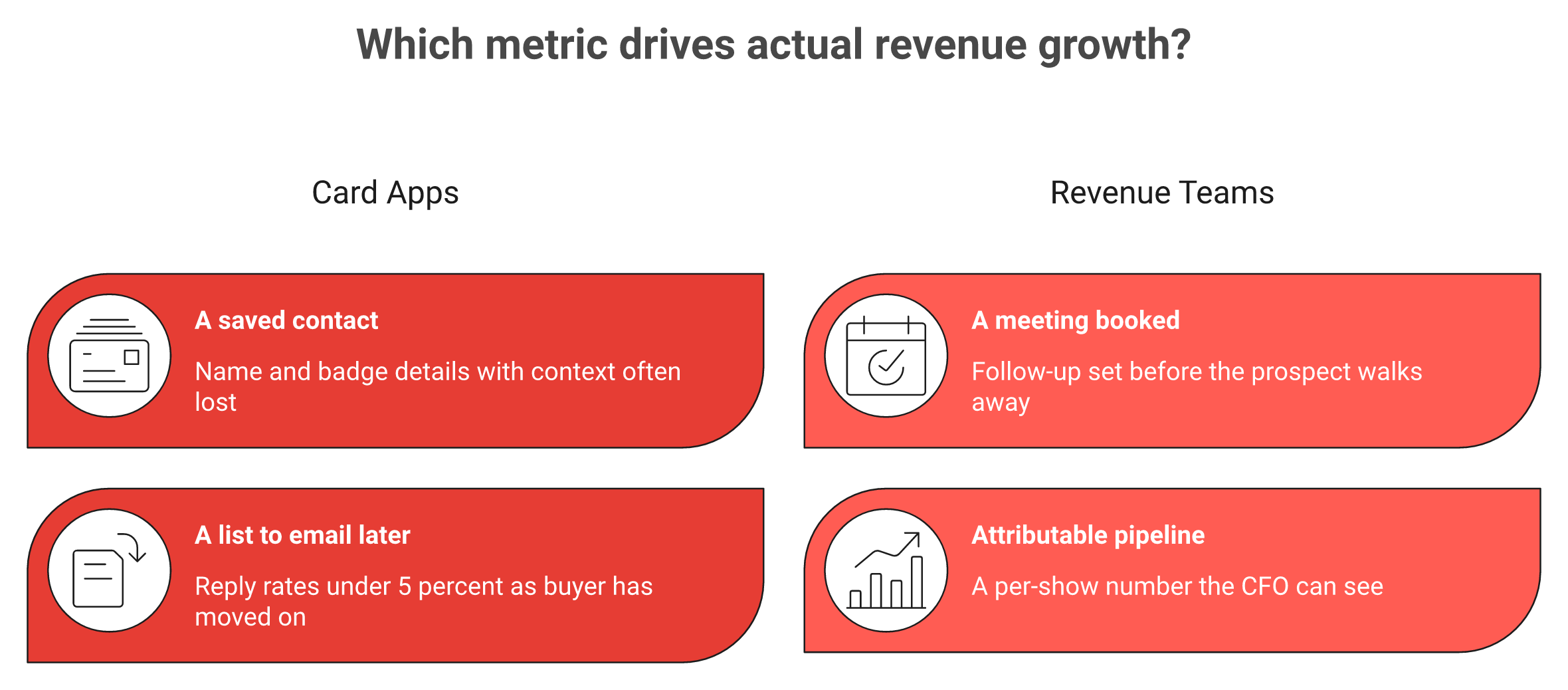
The axis neither card app reports: a saved contact is not a booked meeting or a pipeline number.
Here is the distinction that decides the whole thing. A card platform captures a contact. A revenue team is measured on pipeline. Those are not the same job.
I have watched a rep type business cards into Salesforce in the cab back to the hotel, with half the context already gone. By the time a post-event email goes out, the buyer has moved on. Reply rates on those sequences sit under 5%, which is why the "just send a follow-up email" playbook quietly fails.
Popl users see this even when the capture works well.
"It requires immediate action from the other person at the point of contact, which creates a small period of attention away from the client." Andrew P. Popl G2 Verified Review
🎯 The axis to actually evaluate
The owned metric: 52% of leads booked as meetings on the floor versus an 8% post-event average.
So if you run a booth, add one criterion the card comparison never includes: does the tool book the meeting before the prospect walks away? Contact information is not where anything happens. Pipeline is where your world moves. Our work for booth teams is built around that single question.
The dream outcome is simple. You leave the show with meetings booked and a pipeline number you can defend, not a list nobody acts on. To get there, evaluate three things a card app does not touch: in-the-moment meeting booking, per-show pipeline reporting, and coverage before, during, and after the show.
This is the lane we built B2Brain for, and I will be honest about the fit. We are the offline-to-pipeline layer: a CRM-grounded briefing before, voice capture plus on-floor meeting booking during, and a morning-after pipeline report after. Our customers see 52% of leads become a booked meeting on the floor, against an 8% industry average post-event. We are not for solo booths, consumer sellers, or no-CRM teams, and we have no digital business card, so if that is your need, Popl or HiHello is the right buy.
Q9. When Should You Skip Both, and What Should You Choose Instead? [toc=9. Who Should Choose What]
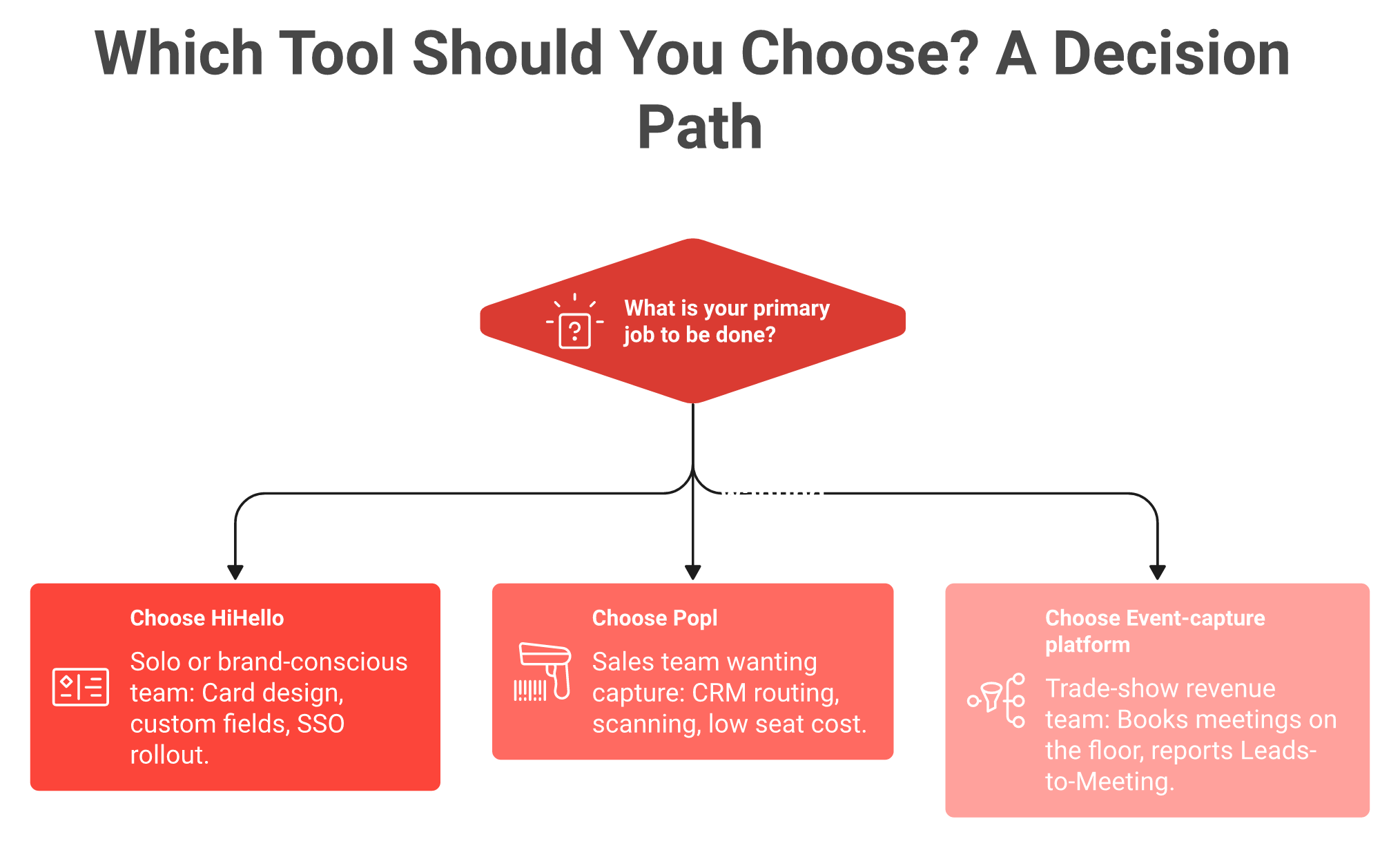
Pick HiHello if you're an individual or team that values card design, brand consistency, and identity-managed rollout. Pick Popl if you're a sales team wanting lead capture and CRM routing in a card platform. Skip both if your primary channel is trade shows and your boss wants pipeline attribution. Then you need an event-capture platform that books meetings on the floor and reports Leads-to-Meeting, not a networking card.
🧭 The three-way routing rubric
Most comparisons end with a winner. That is the wrong shape for this decision. The honest answer depends on who you are and what your boss measures.
Route yourself: the right tool depends on whether you value card design, team capture, or booked pipeline.
Which Tool Fits Which Team
If you are...
Choose
Because
A solo professional or brand-conscious team
HiHello
Best card design, custom fields, and IT-governed rollout with SSO
A sales team wanting capture inside a card app
Popl
Native CRM routing, scanning, and shared lead views at low seat cost
A revenue team exhibiting at trade shows
An event-capture platform
Books the meeting on the floor and reports pipeline, not just contacts
✅ Why the honesty matters
Let me be plain about the first two rows. For many readers, a card app is exactly the right buy. If you network more than you exhibit, HiHello or Popl will serve you well, and spending more would be waste.
I have no interest in force-fitting a heavier tool onto a lighter need. That candor is the whole point. The tool should match the job, and for solo booths, consumer selling, or no-CRM teams, a card app wins, full stop. Our roundup of Popl alternatives is honest about that too.
⚠️ The third row is a different animal
The trade-show team is where the card category runs out of road. You are not trying to swap a card. You are trying to answer "where is the pipeline?" on Monday with a number, which is the whole promise of moving offline to pipeline.
This is the old debate between stacking tools and consolidating them. One practitioner admitted, "we do a lot of peacemealing, I use like five different technologies at any given time," and wished "AI would bring those things together." Another argued to "bring everything in one house, integrate it with your marketing automation platform or CRM." For an events motion, the consolidated view usually wins, because a stack of card apps leaves the pipeline question unanswered. That is why teams look at the best event lead capture software for 2026.
That is the row B2Brain is built for, and I will keep it to one line. We are the offline-to-pipeline layer: a CRM-grounded briefing before the show, voice capture and on-floor meeting booking during, and a pipeline report after, with 52% of leads booked as meetings on the floor against an 8% industry average. You can see how our workflow runs before, during, and after the show, but we are iOS-only today and carry no digital card, so if that is your need, route back to row one or two.
🔮 The question I am sitting with
Here is where I think this category moves in the next 18 months. Card design is commoditizing fast, and differentiation is shifting up the stack toward pipeline activation. The winning tool will not be the one with the prettiest card. It will be the one that proves what the conversation became, which is exactly the job for booth teams.
So before you sign anything, ask every vendor one question: how many meetings did your tool book, not how many cards it tapped? If a vendor cannot answer in a number, you are buying a contact list, not a pipeline. If you want to test that question against our numbers, you can Book a Demo, and I would genuinely like to hear how that question lands in your next demo.
FAQ's
What is the main difference between Popl and HiHello?
The short version is this. Popl leans toward sales teams, and HiHello leans toward the individual professional.
Popl: bundles digital cards, an app-based badge scanner, lead capture, and CRM routing into one place.
HiHello: pioneered the digital card category in 2018 and still wins on design, custom fields, virtual backgrounds, and email signatures.
Here is the reframe we keep pushing on field teams. Both are digital business card platforms first. A card platform optimizes the swap and the look. It does not optimize what the conversation becomes after the tap.
So the real question is not whose card is prettier. It is whether the tool gets a scored, context-rich lead into your CRM before the prospect leaves the aisle, and whether it books the follow-up meeting. That is a different job, and it is the one we built how event lead capture works around. Popl for team capture, HiHello for personal brand, and an event-capture platform when your boss asks where the pipeline is.
Is Popl or HiHello better for a sales or field marketing team?
For a sales or field team, Popl is the stronger of the two. It offers lead capture, CRM routing, shared lead views, and rep leaderboards that HiHello does not center on.
HiHello fits individual brand identity and IT-governed rollouts better than pipeline generation. If your priority is a polished, compliant card across hundreds of employees, HiHello is the pick.
Popl: capture-first, built for reps scanning many leads per hour.
HiHello: identity-first, built for brand consistency and SSO.
Here is the honest catch. Both capture contacts, not commitments. A revenue team is measured on pipeline, and a card platform reports taps and views, not meetings booked.
That is the axis to add to your evaluation. Does the tool book the meeting on the floor before the prospect walks away, and does it prove per-show pipeline? Our work offline to pipeline exists to answer exactly that, because a contact list is not the same as a defensible pipeline number the CFO can see.
How much do Popl and HiHello cost?
Both offer free tiers, so you can start without spend. Paid pricing is close at the entry level.
Popl Pro: about $7.99 per month, cheaper annually, with Teams and Enterprise priced by seat and custom quote.
HiHello Professional: around $6 per month, Business from roughly $25 per month for five users, and Enterprise custom.
NFC hardware: sold separately on both.
HiHello is competitive for small teams needing design and compliance. Popl's value grows when its lead capture and CRM routing replace separate tools.
Here is where we will be blunt. Seat price is the wrong denominator for a revenue team. A booth can run $70,000 or more, so an $8-per-seat card app is not the expensive line item, the wasted follow-up time is.
The right number is cost per qualified meeting booked, the figure a field marketer can defend. You can work that out with our event ROI calculator, because a per-seat fee never answers whether the show was worth it.
Does Popl or HiHello integrate better with Salesforce and HubSpot?
Popl is the stronger CRM story of the two. It offers native Salesforce, HubSpot, and Microsoft Dynamics integrations, plus Zapier and built-in lead routing.
HiHello supports CRM export and integrations, but it leans toward contact management over pipeline sync. It treats the CRM as a place to push a contact, not a pipeline to feed.
Here is the checkbox trap that bites teams after they sign. A logo on an integrations page is not a working sync.
Is the sync real-time, or a batch export you trigger later?
What happens when two reps scan the same person, one record or two?
Does the show name land in the CRM as an attribution field?
Does a booked meeting write back, or just the contact?
If a tool cannot answer all four cleanly, you are buying a contact exporter, not a pipeline system. This is the exact failure mode we close with real-time, native lead capture into Salesforce, dedupe, and show attribution kept intact.
What do real users say about Popl and HiHello on G2?
Both score about 4.6 out of 5 on G2. The gap is volume, not rating, since Popl carries far more reviews (~5,300) than HiHello (~725), reflecting scale.
Popl praise: ease of sharing and lead capture.
Popl complaints: add-on and hardware costs, plus occasional QR or sync glitches.
HiHello praise: clean design and customization.
HiHello complaints: fewer sales-automation features and CRM sync gaps.
Here is how we read reviews after years of doing it. Separate love-the-design sentiment from the sync broke and I lost three days of leads. The first is a preference, the second is a pipeline risk, so weight complaints by cost to revenue, not frequency.
Notice the recurring pattern across both tools. The complaint is rarely the card looks bad, it is I could not act on what I captured. That follow-up gap is category-wide, which is why we anchor on the meeting booked, not the contact saved, across the best event lead capture software for 2026.
Enjoyed the read? Join our team for a quick 30-minute chat — no pitch, just a real conversation on how we’re rethinking Event Intelligence in B2b.

.png)

.webp)

.png)