



IEC SPARK 2026 planning facts
- IEC SPARK runs October 21 to 24 in Columbus, with project-management training starting October 19.
- The public Expo Hall runs Thursday, October 22 and Friday, October 23 rather than all four programme days.
- Thursday combines a noon expo opening, Archie Griffin's 2:45 p.m. keynote and a 4:30 p.m. tailgate.
- The full-conference programme uses Greater Columbus Convention Center and Hilton Columbus Downtown, while early training uses IEC Central Ohio.
- The organizer describes annual attendance above 1,000 industry leaders and publishes a title mix led by presidents at 51%.
- The 2026 exhibitor manual confirms devices and mobile licences ordered through the portal but does not name the product or publish complete prices.
Why IEC SPARK 2026 matters to electrical contractors
IEC SPARK 2026 is Independent Electrical Contractors' annual flagship event for electrical contracting, combining education, an exhibition, leadership activity and the Apprentice of the Year competition in Columbus, Ohio, October 21 to 24. Pre-conference training begins earlier, and the public expo operates on Thursday and Friday rather than throughout the entire conference.
The programme connects business ownership, field supervision, estimating, workforce development and safety. A contractor can compare tools while also discussing crew management or training, but those are distinct reasons to participate. The event's positioning as the Electrician's Expo does not make every attendee a purchaser of the same product.
IEC describes annual attendance of more than a thousand industry leaders. That is an organizer scale statement, not a verified final 2026 count. The 2025 recap belongs to the earlier Phoenix edition; Columbus logistics must come from the current SPARK site. No separate co-located trade show needs to be invented to explain the programme.
Which contractor and supplier roles belong at SPARK 2026
Electrical contractors, business owners, project managers, estimators, safety professionals, foremen, electricians and IEC chapter staff are the main SPARK audiences. The education filters and pre-conference courses make those roles explicit, while manufacturers, suppliers and service companies exhibit to discuss products and operating problems relevant to electrical contracting.
A business owner may be considering growth or a new supplier. A project manager may need better coordination, and a safety professional may be focused on training or compliance practice. Chapter staff and apprentices bring valuable perspectives without necessarily holding a contractor's purchasing budget.
Attending supports learning and peer exchange. Exhibiting provides a product demonstration and a formal meeting point, with staffing and logistics obligations. Current full-conference access, exhibitor-only badges and pre-conference training have different inclusions.
B2Brain's account briefings support specific contractor discussions around new business, customer expansion or channel development. A general product with no electrical-construction use case is less likely to justify the investment than a product connected to a real jobsite, workforce or business-management problem.
IEC SPARK 2026 dates, expo hours and early training days
IEC SPARK runs Wednesday, October 21 through Saturday, October 24, 2026 in Eastern daylight time, with earlier project-management and foreman training and a two-day public exhibition. Thursday's general expo session and evening tailgate are separate blocks, while Friday's published opening differs between the live agenda and the exhibitor manual.
- Day: Monday, October 19; Confirmed planning points: Project-management training starts at IEC Central Ohio
- Day: Wednesday, October 21; Confirmed planning points: Pre-conference, committee and apprentice activity
- Day: Thursday, October 22; Confirmed planning points: Registration 7 a.m. to 6:30 p.m.; expo noon to 2:30 p.m.; tailgate 4:30 to 6:30 p.m.
- Day: Friday, October 23; Confirmed planning points: Expo closes at 1 p.m.; live agenda opens at 8 a.m., manual at 8:30 a.m.
- Day: Saturday, October 24; Confirmed planning points: Emerging Leaders breakfast, Great Idea Swap and governance
The live agenda gives Friday registration as 7:30 a.m. to 4:30 p.m. Until IEC resolves the half-hour floor discrepancy, an early Friday appointment needs direct confirmation. Saturday programming does not imply another exhibit day.
A four-day operating plan for the Columbus programme
Plan SPARK around the role-specific training and governance activities first, then use Thursday and Friday for exhibitor conversations and Saturday for leadership exchange. The limited public floor schedule, Archie Griffin's Thursday keynote and the separate Hilton and convention-center rooms make location and access more important than filling every calendar gap.
Wednesday includes the Safety Pre-Conference and the Apprentice of the Year written exam. Thursday combines education, the noon exhibition opening, a 2:45 to 4:15 p.m. keynote and the 4:30 p.m. tailgate. Friday adds exhibition activity, the Future Electricians Showcase and awards-related programming.
Saturday's Emerging Leaders breakfast runs 8 to 9 a.m., followed by the Great Idea Swap from 9 to 10:30 a.m. A contractor staying for that exchange needs different departure plans from an exhibitor leaving after Friday teardown.
For a booth team, protect qualified coverage during the keynote and relevant education. The competition and social events can create introductions, but do not guarantee purchase intent. Actual conversations should inform the team's targets rather than an unsupported prediction of peak visitor traffic.
How SPARK uses the convention center, Hilton and IEC Central Ohio
SPARK's exhibition is at Greater Columbus Convention Center, 400 North High Street, Columbus, Ohio 43215, United States, while many conference sessions use named Hilton Columbus Downtown rooms and pre-conference training uses IEC Central Ohio. These locations are part of one programme but should not be treated as interchangeable meeting addresses.
Registration on the main expo days is listed in the Exhibit Hall A foyer. The keynote is in the Hilton's Robinson Ballroom, and Saturday's leadership sessions use Pheoris West. The official floor map supplies current booth positions.
The Hilton hotel address is 402 North High Street. Freight uses a different convention-center delivery address specified in the exhibitor manual. A visitor entrance, hotel check-in and shipping dock serve different functions.
Meals included with the full-conference pass follow the actual programme. Private meetings, dietary arrangements, accessible routes and security accommodations should be coordinated with IEC and the venue. The existence of an expo badge does not establish access to every committee meeting, apprentice activity or restricted training session.
Moving between the Expo Hall and the Hilton programme
Navigate SPARK by room and activity, not just the convention-center name: the expo and registration use Greater Columbus Convention Center, while education and leadership sessions also appear at Hilton Columbus Downtown. Pre-conference training at IEC Central Ohio requires a separate route, so consecutive entries in the agenda may not be physically adjacent.
Save the booth map and the room names for confirmed meetings. A contractor moving from an expo conversation to the Robinson Ballroom keynote needs time to walk and find the room. Grouping Hilton sessions together can reduce unnecessary backtracking.
The public event pages examined do not establish a complete airport-transfer guide, parking tariff, rideshare entrance, public-transit entitlement or event shuttle schedule. Those remain travel checks rather than figures to borrow from another Columbus event. The same applies to Wi-Fi performance and public charging points.
Practical footwear and a charging bank suit a day moving between venues. October weather needs a current forecast before departure, not a guaranteed temperature in an advance guide. Demonstrations and pre-conference training may also have their own safety or equipment requirements beyond ordinary conference clothing.
SPARK pass prices and the access included with each tier
Register through the official SPARK Showcare page using the surname and email that match the IEC membership record, choosing the appropriate individual, chapter-staff or group category. The full-conference pass includes the main education, expo, keynote, national awards and provided meals, while pre-conference training is explicitly separate.
- Individual category: IEC member employee; Early, through July 20: $1,230; Regular, July 21 to September 21: $1,480; Late, September 22 to October 24: $1,750
- Individual category: Chapter staff or instructor; Early, through July 20: $1,025; Regular, July 21 to September 21: $1,285; Late, September 22 to October 24: $1,540
- Individual category: Non-member; Early, through July 20: $1,440; Regular, July 21 to September 21: $1,700; Late, September 22 to October 24: $1,900
- Individual category: Non-industry guest; Early, through July 20: $515; Regular, July 21 to September 21: $770; Late, September 22 to October 24: $1,025
Groups of five or more receive 15% off individual rates without combining other discounts. The organizer publishes the resulting per-person amounts as follows.
- Group category: IEC member employee; Early, through July 20: $1,045.50; Regular, July 21 to September 21: $1,258; Late, September 22 to October 24: $1,487.50
- Group category: Chapter staff or instructor; Early, through July 20: $871.25; Regular, July 21 to September 21: $1,092.25; Late, September 22 to October 24: $1,309
- Group category: Non-member; Early, through July 20: $1,224; Regular, July 21 to September 21: $1,445; Late, September 22 to October 24: $1,615
Pre-conference prices are $250 for Safety Summit, $950 for two-day foreman training and $1,500 for three-day project-management training. Exhibitor staff use a separate invitation, not the attendee links. Current press and student concessions are not listed in the public registration table.
Badge, guest, refund and restricted-session rules
SPARK exhibitors receive two expo-only registrations per ten-by-ten-foot booth, with additional badges or full-conference upgrades available, and all booth staff must be registered. Attendee accounts must match IEC membership details, while guest registration is intended for non-industry partners or spouses rather than additional electrical-industry staff.
The 2026 exhibitor checklist sets October 7 for conference-pass arrangements. The public resource page names October 21 as a cancellation deadline but follows it with inconsistent fee and no-refund wording. That passage does not support a reliable general refund calculation; the purchased registration's terms and IEC support must resolve it.
Current lost-badge charges, transfer conditions and advance pickup rules are not established by the public summary. They should not be copied from the 2025 MCI manual. Registration assistance and exhibitor upgrades can be requested through partners@ieci.org.
Member-only governance and apprentice-competitor sessions have role restrictions. A full-conference badge does not eliminate every invitation or eligibility requirement. Pre-conference training remains a separate purchase even when the main pass describes broad access to education.
The Hilton room block and housing cutoff for SPARK
IEC has a SPARK room block at Hilton Columbus Downtown, 402 North High Street, with a September 18 housing cutoff and booking access through registration. The hotel hosts named conference rooms as well as accommodation, making it convenient for attendees whose agenda includes the keynote, committee meetings or Saturday leadership sessions.
The official about page directs attendees to the booking link provided during registration. Exhibitors receive a personalized portal that combines housing with staff registration and lead-retrieval ordering. Those verified routes are preferable to an unsolicited reservation seller.
A current room price and universal cancellation condition are not published in the general overview. The actual booking establishes dates, availability, taxes and terms; the cutoff does not guarantee a room until September 18 or a refundable stay afterward.
Pre-conference training at IEC Central Ohio requires a separate trip from the convention hotels. No shuttle entitlement or list of alternative official properties is established here. Compare the actual route and cancellation terms before booking an independent hotel.
Arrival windows for trainees, attendees and exhibitors
Arrive before the first SPARK activity booked, which may be Monday's project-management training rather than Wednesday's conference start, and plan departure around either Friday exhibition teardown or Saturday leadership sessions. The training location, Hilton rooms and convention-center exhibition require a more specific itinerary than one hotel address and the event's date range.
Project-management training runs three days and foreman training two days, both at IEC Central Ohio according to the programme. Saturday includes an 8 a.m. breakfast and later governance, so a Friday departure cannot preserve those activities. International entry requirements remain independent of an event registration.
Exhibit freight has confirmed windows: advance warehouse shipments run September 21 to October 13, with direct-to-show acceptance beginning October 20. The manual's warehouse address is SAIA/Freeman, 1717 Krieger Street, while show-site freight uses 3 Convention Center Drive. Neither is the hotel's room address.
Keep passenger travel, training attendance and customer meetings separate from freight delivery instructions. Allow for local transfers and airport procedures when booking appointments. The collected public information does not establish a conference airport-shuttle timetable.
Electrical products, sponsors and expo-floor formats
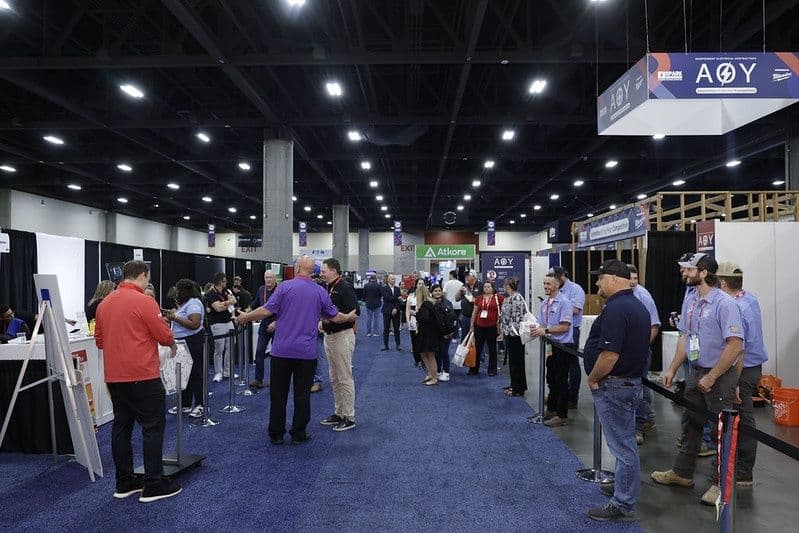
SPARK's current expo page lists electrical-industry manufacturers, suppliers and service providers, including The Home Depot as Premier Sponsor and Eaton and Federated Insurance as Strategic Partners. The PowerUp Product Showcase and Bright Ideas Theater add product-focused formats, while current booth locations are maintained in the linked conference floor map.
Relevant categories include jobsite tools, electrical products, safety, insurance, workforce support and business technology. A sponsor relationship and a booth position are different facts; the current profile and map should establish the location for a meeting.
The expo page provides a live exhibitor list rather than a closed historical roster. Emerging companies need the same current-edition verification as familiar names. An image of a previous stand in a manual is not proof that the company occupies that space again in Columbus.
IEC also offers paid presentation and sponsorship opportunities. Their existence does not make every product a recommended purchase or every speaker a sponsor. A buyer can use the programme to identify topics, then compare the relevant suppliers against actual jobsite or contractor-business requirements.
Turning the SPARK floor map into a contractor account list
Research SPARK's current exhibitor map around the contractor's specific requirement, such as safety equipment, project coordination, insurance or a tool demonstration, then build a short list with current booth locations. The public expo list and role-filtered agenda provide context, while sponsor visibility alone is not a ranking of product suitability.
Record the company, offering, confirmed location, proposed question and the person responsible for the meeting. A foreman's field-practicality questions differ from the commercial terms a business owner discusses at the same booth.
Separate competitor research, channel partnerships and potential customers. Any login-dependent contact data, saved-list feature or export option must follow the current system's access rules. A floor map does not establish a right to download private attendee records.
Revisit the shortlist before travel and account for the short Thursday opening block and Friday close. The research handoff should explain the decision the team is trying to make. A collection of logos without an electrical-contracting use case creates more walking than useful meetings.
Sessions and speakers across six education themes
SPARK's 2026 education covers business development, workforce, emerging technology, safety, Women in Power and chapter leadership, with Archie Griffin giving the keynote and a new Safety Pre-Conference on Wednesday. The expo adds product showcases and the Apprentice of the Year competition, creating different learning and commercial settings across the programme.
Featured speakers include Susan Frew on an AI playbook, Brian Brinkmann on growth leadership, Danielle Rose on simulation-based electrical training, Elisa Pratt on volunteer retention and Robert Albrecht on risk management. The education page links the full course catalogue and selected credit information.
The Safety Pre-Conference includes code updates, OSHA practice, hazard prevention and lockout/tagout topics. These are session subjects, not a substitute for the applicable safety standard or site-specific training. Pre-conference programmes require separate registration.
The Bright Ideas Theater, PowerUp Product Showcase, tailgate and awards provide additional formats. Apprentice competition access and governance have role conditions. Guest tours are described as forthcoming rather than a confirmed universal inclusion; no hosted-buyer entitlement is established by the general networking page.
Where meetings fit around the keynote, expo and tailgate
Build the SPARK agenda from the attendee's role and paid registrations, then place exhibitor appointments within the short public floor windows rather than assume the expo runs all day. The programme's filters include persona, session type and topic, helping an owner, foreman or safety professional choose different sessions without losing the same meeting time twice.
Thursday's noon-to-2:30 p.m. exhibition block ends before the keynote, and the tailgate resumes hall activity later. Friday's exact opening needs confirmation because the live agenda and manual differ by thirty minutes. Saturday's breakfast and Great Idea Swap are separate reasons to extend the trip.
IEC is piloting continuing-education credits, with Ohio identified as the host-state offering and chapter resources for other approvals. That is not universal credit for every attendee or session. Recorded access is also not established as a replacement for attendance.
Full conference includes specified meals and awards; pre-conference courses do not. Exhibitors can assign staff education before fixing booth shifts, leaving enough subject-matter coverage for demonstrations. An entry on a personal calendar is not a confirmed seat or appointment unless the relevant booking system says so.
What the published SPARK audience mix says about fit
SPARK attracts electrical-contractor owners, project managers, estimators, foremen, safety managers, electricians and IEC chapter staff, with apprentice and leadership activity adding further reasons to attend. Those roles have different buying authority, so a company selling jobsite tools, insurance or business software should qualify the actual responsibility rather than treat every badge as an equivalent prospect.
IEC describes annual attendance above a thousand industry leaders. That statement does not establish a final 2026 headcount, company-size distribution or share of purchasing decision-makers. The role filters and current exhibitor list provide more concrete evidence of professional relevance than an unsupported conversion forecast.
For a tool supplier, the end user's assessment and the owner's purchasing decision may both matter. A software company might need a project manager and business owner together. A chapter contact can be important for training partnerships without being a contractor customer.
Account fit at SPARK is defined by electrical-construction work, geography, company scale and the operating problem under discussion. A relevant badge starts qualification; it does not prove budget, authority or an implementation project.
Using sponsor access and current relationships to tier accounts
SPARK target-account research can combine existing CRM relationships, current exhibitor and speaker information, confirmed appointments and any opt-in attendee access included in the actual sponsorship tier. The 2026 manual explicitly provides limited list benefits to qualifying sponsors, so a blanket claim that no attendee information is available would be inaccurate.
Strategic Partners receive opt-in pre-event registration data two weeks before the event. Post-event opt-in data is listed for Strategic Partners, Power Sponsors and Circuit Sponsors two weeks after the event. Those benefits do not grant every exhibitor the same access or authorize unrestricted reuse outside the applicable terms.
Start the account plan with open contractor opportunities and existing customers needing a product or operational discussion. Add suitable channel or training partners separately. A named owner can then prepare outreach tied to a relevant electrical-contracting problem and a realistic meeting window.
An unsolicited list seller is not equivalent to IEC's authorized opt-in distribution. Speaker affiliation also does not prove a buying intention. Tiering accounts by fit, relationship and active need makes the list useful without inflating every contact into a sales opportunity.
What the agenda, floor map and registration portal each handle
SPARK provides a current web agenda with persona, track, session-type and topic filters, plus a linked exhibition floor map and a separate registration portal. These verified resources support planning the Columbus event, but the public 2026 material examined does not establish a complete event-app feature list or an unrestricted attendee-networking service.
The agenda identifies role-specific sessions, venues and times. The map supplies booth positions. Showcare's registration route manages attendee enrollment, while exhibitors receive personalized access for staff badges, housing and lead-retrieval purchases. Those are different functions, even where a portal brings several transactions together.
Current mobile download links, private messaging, meeting booking, digital tickets, schedule alerts and cross-device synchronization remain unconfirmed here. An older IEC app listing is not sufficient to promise those features for SPARK 2026.
For practical planning, retain the confirmed room, booth and appointment information in a reliable format. A personal agenda entry is not a reservation, and a platform's general capabilities do not prove that a particular feature is enabled for this event or pass.
The boundary between programme planning and conversation capture
The SPARK agenda and floor map help an attendee reach education, the keynote or an exhibitor, while lead capture records a specific contractor conversation and its agreed next action. The registration portal's ability to sell a lead-retrieval product does not mean every attendee-planning interaction becomes a qualified CRM lead.
A foreman attending a safety session may be improving practice rather than buying a product. An apprentice watching a demonstration may be learning a technique. The commercial record needs the actual account, role, operating problem and permission to follow up rather than assumptions based on programme attendance.
IEC's opt-in list benefits are limited by sponsorship tier and timing. They are distinct from a booth conversation and should remain subject to the applicable data terms. Offline behavior and venue connectivity also require a test of the chosen capture tool rather than an inference from the web planner.
The agenda remains a navigation tool, while the commercial record holds account context, qualification, ownership and a meeting commitment. Those records serve different jobs and should not be presented as one combined organizer feature.
Known booth inclusions, deadlines and unpriced costs
SPARK booth pricing requires a current space quotation, but the 2026 manual establishes several package inclusions and operational costs to plan around, including two expo-only staff registrations per ten-by-ten-foot booth. Freeman is the official exhibitor-services partner, with an early-order deadline of September 22 and separate freight and specialty-service requirements.
The standard-space description includes an identification sign, back and side drape, a draped table, two chairs and a wastebasket. The hall and booths are not carpeted. Furniture additions, branding, flooring, labor, freight and other services therefore need their own budget rather than being assumed included.
The current exhibitor resources link Freeman's kit and the 2026 manual. Catering, internet, electricity and rigging are venue specialty services reached through the kit. Outside contractors require the relevant form and certificate of insurance; vehicles on display require approval and scheduled movement.
The complete investment combines the space contract, ordered services, equipment movement, staff time, travel, lodging and capture tools. Verified line items can remain in the budget even when the public sources do not support an ACV or a calculated ROI.
Staffing the two public expo days without losing subject expertise
SPARK exhibitors need a compact operating plan for Thursday's public expo block and tailgate and Friday's short exhibition day, with product expertise available while colleagues attend the keynote or education. Two included expo-only registrations per ten-by-ten booth are a badge allowance, not proof that two people are sufficient for every demonstration or meeting schedule.
Divide greeting, technical discussion and account follow-up according to the actual team. A safety-product enquiry and a software implementation question may need different specialists. The booth message can state a specific contractor problem rather than list every possible capability.
IEC provides an exhibitor-engagement education series covering audience, promotion, onsite interaction and team preparation. Current move-in is Tuesday and Wednesday from 8 a.m. to 5 p.m. and Thursday from 8 to 11 a.m.; Friday move-out runs 1 to 6 p.m. Those windows should anchor setup and teardown staffing.
Passport to Prizes and other promotions have separate participation conditions. Test the capture fallback, define conversation and meeting targets as internal assumptions, and review unassigned next steps daily. The post-show account routing should be ready before the first visitor arrives.
What IEC confirms about its 2026 lead-capture order
IEC's current SPARK manual confirms lead-retrieval devices and mobile licenses available for purchase through the personalized exhibitor registration portal, with early pricing through September 24 and a checklist order deadline of September 30. The public manual does not name the underlying product or publish a complete price and technical specification.
The primary exhibitor contact receives the portal invitation, which also manages staff registration, housing and payments. That verifies the ordering route. It does not establish that the general attendee-registration brand is the scanner product, or that the old 2025 supplier remains appointed.
The 2026 manual describes devices and mobile licenses as purchasable options. A mandatory-purchase requirement, exact device count, supported operating systems, training, onsite support and retention terms remain to be confirmed in the order.
Those unknowns should not be replaced with a competitor's generic feature list. The current offer is established; the exact product capabilities and fees are not. A named comparison becomes appropriate once the actual portal order supplies those missing details.
Which official scanner capabilities remain unpublished
SPARK's 2026 manual says the purchased devices or mobile licenses track attendee leads and booth visits, but it does not publish the detailed qualification, export or CRM feature set. The confirmed order dates and portal access support a real lead-retrieval offer without proving every capability an exhibitor may need after a contractor conversation.
- Capability: Identity and enrichment; Detail to establish from the current product: Contact fields, company data and permitted use
- Capability: Qualification; Detail to establish from the current product: Custom questions, notes, voice, ratings, photos and cards
- Capability: Rep action; Detail to establish from the current product: Assignment, meeting booking and CRM connections
- Capability: Reliability; Detail to establish from the current product: Offline operation, synchronization and duplicates
- Capability: Team access; Detail to establish from the current product: Export formats and timing, reporting and retention
For example, a project-management software discussion may depend on the contractor's current process and rollout constraints. A tool demonstration may need a promised field trial. The practical question is whether that context travels with the identity record. Unpublished features are not proven absences and should not be represented as competitor weaknesses.
How B2Brain differs from an unnamed badge scanner at SPARK
B2Brain can sit beside IEC's authorized badge workflow when an exhibitor needs richer commercial context. The manual confirms devices and mobile licences but not their product name or complete feature set, so the comparison is limited to documented B2Brain claims and the work each record must support.
B2Brain reports booth capture in under 30 seconds per conversation, preserving the process, blocker, buying role and agreed next step alongside the contact. The official order may still be required where the exhibitor depends on access to IEC badge data.
B2Brain reports 52% Leads-to-Meeting on the floor, against an 8% industry average for post-event follow-up. Leads-to-Meeting means meetings booked divided by qualified booth leads; the comparison does not grant access to restricted registration data or replace IEC's data terms.
B2Brain reports 100% event-to-CRM attribution: deal and opportunity creation, not contact sync alone. No claim about lower price, organizer endorsement or superiority over the unnamed SPARK product is supported by the available current-edition evidence.
When one capture workflow is enough and when two serve distinct jobs
Use the official SPARK order where authorized badge identity is required. Add B2Brain when the booth team needs conversation context, on-floor meeting booking and event-to-CRM attribution. Use a single workflow when it covers the whole job; combining tools only makes sense when each has a distinct, documented role.
A combined setup can keep permitted badge identity in the contracted product while B2Brain records qualification and the agreed meeting. A common company and contact key prevents an expo visit and a tailgate conversation from becoming unrelated records.
The CRM remains authoritative for contractor accounts and opportunities. Sponsor opt-in lists arrive under tier-specific terms and timing; they do not justify duplicate contacts or consent assumptions for every campaign.
The manual publishes order deadlines but no complete package price, so a savings comparison would be invented. The supported decision is operational: one product when it completes the job, two only when the additional capture and attribution work is real.
The contractor context every useful booth record needs
Capture the company, contact, electrical-contracting role, stated problem and agreed next step in each relevant SPARK conversation, distinguishing an owner purchase from a foreman's practical assessment or a chapter partnership. The audience's mix of business leaders, field professionals and apprentices makes role qualification essential before a booth interaction becomes a sales opportunity.
Useful detail includes the current tool or process, jobsite or business constraint, urgency, approval path and intended use. A contractor considering software may need project coordination; a tool buyer may need a field demonstration. Neither should be reduced to a generic “interested” tag.
B2Brain reports booth capture in under 30 seconds per conversation. A requested quote, technical review or meeting still needs a subject, owner, participants and timing so the speed claim produces an actionable record.
Keep consent appropriate to the follow-up and avoid unnecessary confidential project information. An opt-in list entry, prize visit or apprentice interaction is not proof of an active buying project. The record should explain what the person actually requested and what the rep committed to deliver.
Quality controls for the Expo Hall, showcases and tailgate
SPARK lead quality depends on a consistent qualification record and prompt reconciliation across the expo, tailgate and product demonstrations, rather than treating every visit as a new purchase prospect. The short public floor windows make missing ownership or repeated data entry especially costly when the team has limited time for follow-up conversations onsite.
Keep identity, company, need, owner and next step required for commercial records. Optional technical notes can explain a field constraint or implementation issue. Classify chapter, partner, apprentice and direct-buyer contacts accurately rather than force them into one opportunity type.
B2Brain reports booth capture in under 30 seconds per conversation. The phone workflow and any backup process still need an onsite test; the current SPARK sources do not establish hall connectivity or the unnamed scanner's offline behavior.
Managers can sample records during the day and resolve urgent meetings immediately. The daily debrief should reconcile duplicate visits, missing contact details and outstanding promises. A lead-retrieval device count is not a quality metric; the useful measure is whether the next responsible person has enough context to act.
Routing SPARK follow-up by account, role and promised action
Route SPARK leads by existing account ownership, contractor role and the action promised, giving a qualified project discussion a different response from a chapter partnership or general product enquiry. The expo, Bright Ideas Theater and tailgate can all start relationships, but the commercial handoff needs the actual conversation rather than a generic event label.
An existing customer returns to the account owner. A field-trial request may need a technical specialist or local distributor. Chapter and training discussions may belong with a partnership team. A sponsor list entry should not automatically trigger the same sequence as a directly agreed sales meeting.
B2Brain delivers the morning-after offline-to-pipeline report to the CMO by 9am and reports 100% event-to-CRM attribution: deal and opportunity creation, not contact sync alone. The receiving owner can then act on the specific electrical-contracting problem captured at the booth.
After the event, review promised actions, accepted meetings and unresolved questions. Create opportunities under the company's qualification rules and distinguish new pipeline from influence on an existing account. The receiving sales and marketing teams should share context without sending inconsistent messages.
A return decision based on verified cost and attributable outcomes
Measure SPARK against the complete exhibition investment and the contractor, partner or customer outcomes it produces, separating scans, qualified conversations, meetings and opportunities. The two-day public expo, paid pre-conference options and sponsorship-specific benefits create different participation models, so a single event-wide return assumption would be misleading.
Total cost includes space, services, freight, staff time, travel, hotel and capture tools. Cost per qualified conversation and cost per opportunity divide that total by the respective outcomes; a zero denominator does not yield a meaningful unit cost. Targets should be declared before the event and compared with actual results.
The attribution record separates a newly created opportunity from influence on an existing contractor account. Open pipeline remains a forecast until the company's normal sales process advances it, even when the booth conversation and its owner are fully traced in the CRM.
Realized ROI uses attributable gross profit minus total event cost, divided by total event cost. Open pipeline remains a forecast. The decision to return can then consider account fit, meeting quality, educational value and operational burden, with a larger booth justified by evidence rather than a large scan total.