




What to know before Gulf Coast Energy Forum 2026
- LDC Gas Forums holds its 8th annual Gulf Coast Energy Forum on October 14 to 16, 2026 at The Westin New Orleans at Canal Place.
- Programme hours run on Central Time: 7:15 AM to 6 PM Wednesday, 7:15 AM to 6:30 PM Thursday, and a 7:45 AM start Friday.
- Standard registration is $1,795 and government registration is $850, while qualifying regulated utility and end-user gas buyers attend at no charge, three per company.
- Optional networking is generally $245, and the Westin room block is $271 a night until September 21.
- Panels track Gulf Coast fundamentals, midstream and storage, LNG demand, permitting with gas-electric coordination, and AI in energy.
- LDC Gas Forums states that it does not phone attendees to sell hotel rooms or attendee lists.
- No reviewed 2026 page names a badge-scanning vendor, so the capture comparison stays neutral until an exhibitor order form is published.
What is Gulf Coast Energy Forum 2026, and why does it matter to gas sellers?
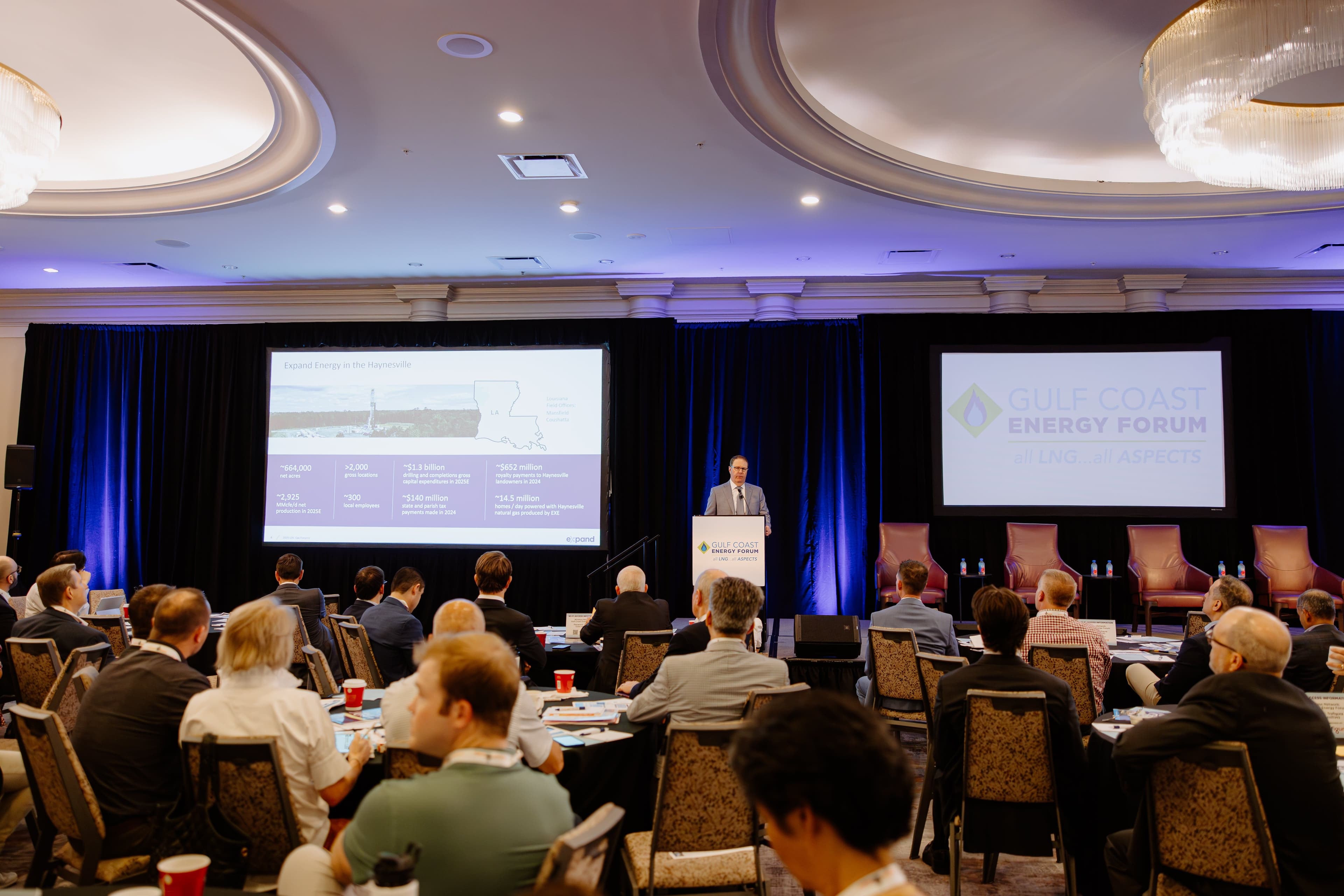
Gulf Coast Energy Forum 2026 is the 8th annual gas-market summit run by LDC Gas Forums, held over three days at The Westin New Orleans at Canal Place. It gathers gas buyers, producers, marketers, pipeline and storage operators, LNG teams, regulators and analysts in one room, which is what makes the New Orleans dates worth a booth.
The draw is concentration rather than sheer size. Supply and demand fundamentals, LNG export offtake, storage and midstream capacity, power demand and permitting sit on a single agenda, and current LDC Gas Forums pages carry the live 2026 detail while older recap video is labelled by its edition.
Who should attend or exhibit at Gulf Coast Energy Forum 2026?
The forum rewards vendors with a real buyer in gas and power: natural-gas and LNG operators, midstream and storage firms, and the analytics, infrastructure, software and professional-service companies that sell into them. A team with no credible gas account has a thin reason to take floor space unless named customers or open deals are already booked into New Orleans, and account expansion can justify a lighter presence when existing customers will be in the room.
What are the Gulf Coast Energy Forum 2026 dates and daily hours?
Gulf Coast Energy Forum 2026 runs Wednesday October 14 through Friday October 16 on Central Time. Breakfast opens the floor at 7:15 AM on October 14 and 15, with programming to 6 PM Wednesday and 6:30 PM Thursday, and Friday starts later at 7:45 AM.
Three published day blocks anchor the schedule. Travel and staffing work from the 7:15 AM openings and the Thursday 6:30 PM close, since registration desks and evening functions can keep their own clocks.
How should a team plan each day of Gulf Coast Energy Forum 2026?
Each day builds out from the live agenda, not a generic booth routine. October 14 opens with a 7:15 AM networking breakfast and an 8:30 AM market fundamentals panel; October 15 leads with the Gulf Coast value-chain panel at 8:30 AM and closes at a 4:30 PM cocktail reception; October 16 begins with breakfast at 7:45 AM and a 9:00 AM gas buyers panel.
Around those fixed points, two or three account meetings belong outside the busiest floor windows, and the breakfasts and reception are the natural slots for pre-booked conversations that would otherwise clash with a panel bearing on a live deal.
Where is Gulf Coast Energy Forum 2026 held, and how does the Westin lay out?
The single venue is The Westin New Orleans at Canal Place, 100 Iberville Street, New Orleans, LA 70130. Panels run in the forum room while the breakfasts and reception sit in the hotel's own spaces, so almost everything stays under one roof.
That compact footprint is part of the sales math: when sessions, meals and meeting points share a building, walking time shrinks and a rep can hold more account slots across the three days.
How do attendees get around the Westin and New Orleans during the forum?
Because the whole forum sits inside The Westin at Canal Place, movement is short-range, and the real risk is losing a booked slot between the forum room, the breakfast space and the reception rather than crossing a large campus. A single team meeting corner, a saved copy of the venue layout, and a look at local October weather and hotel connectivity before travel cover most of what a New Orleans trip needs.
How does registration work, and which Gulf Coast Energy Forum 2026 pass fits?
Registration runs through the LDC Gas Forums 2026 path, and the pass matters more by access than by name. Standard registration at $1,795 covers sessions and networking breaks; government attendees pay $850 with qualification; and regulated utility and end-user gas buyers who qualify pay nothing, capped at three per company.
Optional networking is generally $245, with qualification-specific exceptions, so a paid social add-on and the base pass stay separate lines. Buyer classification decides eligibility for the no-charge seats, where most of the useful floor time is concentrated.
What badge, cancellation and access rules apply at the 2026 forum?
Badge and access terms follow the registration category. The rule that catches exhibitors is that a paid or complimentary badge does not automatically open every session, private function or invitation-only reception, and the no-charge gas-buyer seats carry their own qualification and the three-per-company cap. Identification, pickup windows and transfer terms belong to the registration category rather than a single blanket policy, and cancellation terms are worth reading while travel spend is still refundable.
Where should attendees stay for Gulf Coast Energy Forum 2026?
The forum's own room block is at The Westin New Orleans at Canal Place, listed at $271 per night and closing September 21 subject to availability. Staying in the event hotel removes travel time between the floor, evening functions and morning debriefs, which is worth more to a selling team than a marginally cheaper room several blocks away.
LDC Gas Forums has said plainly that it does not call to sell hotel rooms or attendee lists, so any such approach is a housing-poacher signal, and reservations belong on the organizer's own link with its deadline and change terms recorded.
What travel plan protects the most useful time in New Orleans?
A travel plan works backward from the 7:15 AM Wednesday breakfast and forward to the last booked meeting on October 16, not merely the published hours. Arriving the evening before badge pickup protects the first panel, and a later Friday flight leaves room for the 9:00 AM gas buyers session and any closing conversations.
Exhibitors carry freight and booth-material deadlines in the same plan, and international attendees rely on the organizer's visa-letter instructions where offered. One shared travel brief holds the official links, contacts and last-check dates.
Which sectors, exhibitors and products show up at the 2026 forum?
The floor maps to the gas value chain: pipeline and storage operators, producers and marketers, LNG export desks, and the analytics, infrastructure and software firms that serve them. The current LDC Gas Forums directory separates confirmed 2026 participants from prior-edition names, since a brand present last year has not necessarily rebooked.
The agenda itself signals the mix, weighting LNG exports, supply and demand fundamentals, and storage and midstream capacity. Sponsors, pavilions and product zones hint at where account clusters sit, but they are leads to check against the live list, not proof that a company will be there.
How should a team work the Gulf Coast Energy Forum 2026 directory?
The directory works best as a changing account map, not a one-time export. Filtering the live list by the gas and power categories that match the ICP, noting booth positions and commercial roles, and cross-checking against CRM accounts turns a roster into a call sheet before the team reaches New Orleans. Some fields stay behind a login or unpublished, and that gap is worth recording rather than guessing; what reaches sales is a reason to meet, an account tier and a named owner.
Which panels, speakers and floor formats carry the most weight?
Programme value comes from tying a session to a live account question. October 15 carries the market, infrastructure, policy and AI content across the day before the 4:30 PM reception, and the tracks run from Gulf Coast fundamentals through midstream and storage, LNG demand, permitting with gas-electric coordination, and AI in energy.
The two gas-focused panels bracket the forum: market fundamentals at 8:30 AM on October 14 and the gas buyers panel at 9:00 AM on October 16. Open time around those high-traffic sessions keeps a rep free when relevant attendees drift back toward the floor.
How should attendees build a Gulf Coast Energy Forum 2026 agenda around meetings?
The working agenda starts from confirmed account conversations, then adds the panels that make those conversations sharper. The 7:15 AM breakfasts and the Thursday 4:30 PM reception are ready-made meeting windows, while the 8:30 AM and 9:00 AM panels pull traffic off the floor and are better spent learning than staffing. Coverage is staggered so a booth is never dark during peak periods, with travel time to any off-site meeting built in.
Who attends Gulf Coast Energy Forum 2026, and does it match the ICP?
Audience fit is an account-level question, not a headcount. The roles skew across gas buying, production and marketing, pipeline and storage operation, LNG teams and regulators, and the forum matches an exhibitor's ICP only where those published roles and sectors overlap with named accounts already in the CRM. The scale markers are specific and modest: an 8th annual edition across three days, with a $1,795 standard pass, so purchasing influence in the room counts for more than raw attendance, and any cited percentage is used only with its stated year and basis.
How can exhibitors pin down target accounts for the 2026 forum?
Target accounts come together without buying a list. The base is existing CRM customers and open opportunities; on top sit companies and speakers tied to the 2026 agenda and directory, each ranked by ICP fit and a concrete reason to meet in New Orleans. Any offer to sell an attendee roster is treated as unsanctioned, matching the organizer's stated stance, and once tiers and owners are set, outreach names a credible gas topic and proposes a slot tied to the published October schedule.
What can the official Gulf Coast Energy Forum 2026 planner actually do?
The public planning layer is the LDC Gas Forums agenda, attendee and registration pages, built to publish schedule, exhibitor and navigation information. The live agenda is worth rereading close to travel because sessions move, and it does not, on its own, run a private qualification or CRM workflow. A public schedule tool and a private conversation-note process are different things, and an offline copy of the plan covers the weak connectivity a hotel meeting floor can have.
Where does the forum planner stop and private lead capture begin?
The organizer's planner ends where a private sales conversation starts. It can organize published programme and navigation detail, but consent, account qualification, conversation notes, ownership, offline resilience and the CRM handoff after a floor discussion at the Westin all live in the exhibitor's own workflow.
B2Brain fills that second role, holding the private target-account and conversation process while the public planner handles public information. A printed schedule covers an app outage, and offline-ready capture protects qualification and ownership when venue signal is weak.
What does it really cost to exhibit at Gulf Coast Energy Forum 2026?
Exhibiting costs more than the booth line. A defensible budget adds Westin services, travel to New Orleans, staffing across three days, connectivity, material handling and enough follow-up capacity to work the leads afterward. The published attendee rates give the floor for context: $1,795 standard, $850 government, and no charge for qualifying regulated gas buyers, three per company.
Move-in and contractor deadlines can shift the real cost faster than the base rate, so the service calendar sits beside the booth quote, and the current 2026 organizer materials govern those dates rather than a prior-edition figure. Optional networking at $245 is its own line.
How should exhibitors staff and run a booth at the 2026 forum?
A booth runs on named shifts, a shared qualification standard and meeting targets rather than improvisation. With a 7:15 AM start on the first two days and a 7:45 AM Friday open, coverage is set so pre-booked breakfast and reception conversations stay staffed while panels are running and floor traffic thins.
B2Brain sizes the team against a benchmark of 31 productive scans per rep-day, with a consistent opener, a small set of required qualification fields and a clear handoff owner. Each evening closes with hot leads reviewed, duplicates cleared and the next day's meetings confirmed before the team leaves the Westin.
Does Gulf Coast Energy Forum 2026 name an official lead-retrieval tool?
The reviewed public 2026 pages name no lead-retrieval product. A registration portal and a published agenda are not evidence of a badge-scanning contract, so this guide names no vendor and the comparison stays neutral. As of the September 2026 review, the current exhibitor order form is where that detail would appear.
That order form is where a product name, provider, ordering path, deadlines, prices, licences, devices, badge method and privacy terms would appear. Until any of those surface in 2026 material, the New Orleans copy cannot borrow a scanner from an older edition.
What could an official scanner capture at the 2026 forum, and what are its limits?
Because no 2026 lead-retrieval product is documented, its features and limits are an open purchasing question rather than a claim either way. A current order form would set out the exact data fields, notes, ratings, device and offline behaviour, export formats and support, none of which a public badge-access page usually covers. Attendee fields, custom questions, free-text notes, duplicate handling, CRM integrations and manager reporting are the specifics that decide whether an organizer scanner fits, and anything the 2026 documentation leaves unstated stays an unknown, not a mark against a product no one has named.
Is B2Brain an alternative to an official scanner at Gulf Coast Energy Forum 2026?
B2Brain can stand in as the capture workflow or run alongside an organizer scanner when the jobs that matter are account briefing, conversation context, on-floor meeting booking and event-to-CRM attribution. The comparison stays job by job, and it invents no capability for a tool the organizer has not named.
B2Brain runs three motions: pre-event targeting, on-floor capture and booking, and post-event conversion with attribution. LTM, or Leads-to-Meeting, is meetings booked divided by qualified booth leads. B2Brain reports booth capture in under 30 seconds per conversation and 52 percent Leads-to-Meeting on the floor against an 8 percent industry average for post-event follow-up.
Should exhibitors run B2Brain, an official scanner, or both in New Orleans?
The right setup follows the required commercial jobs. If the only job is organizer-approved badge data and its documented export, an official scanner may cover it; where account briefing, contextual qualification, in-conversation meeting booking and opportunity attribution matter, B2Brain adds them.
Running both preserves official badge data alongside B2Brain qualification, provided consent, deduplication, ownership and the CRM system of record are settled before the doors open. Since the forum names no scanner yet, that choice sits between B2Brain and whatever the order form later reveals.
What should reps capture in every Gulf Coast Energy Forum 2026 conversation?
A useful conversation keeps the account, contact, buying role, business problem, current process, blocker, urgency and agreed next step, not just a scanned badge. B2Brain holds that context beside the lead so a gas or LNG discussion becomes an owned commercial action after the team leaves New Orleans.
Each record is structured around identity, buying role, use case, current process, blocker, urgency, qualification, consent and the next step. B2Brain lets the rep book the next meeting while the detail is fresh and assign an owner, which gives follow-up a reason to exist beyond a generic event email.
How can a team hold lead quality on the 2026 show floor?
Lead quality holds when every rep works one fast, repeatable capture standard rather than a personal shorthand. The required fields stay small but useful, an offline fallback is always available, and each record carries a visible owner and a duplicate check so two reps never log the same account twice. Managers inspect hot leads and half-finished records at the daily debrief, then reconcile offline entries before the next morning's 7:15 AM open.
How should Gulf Coast Energy Forum 2026 leads be routed and worked afterward?
Routing happens while the gas or LNG context is still precise. Each qualified booth record gets an owner, a priority, an agreed next step and a meeting status, with the buyer's problem attached so sales receives a reason to call rather than an anonymous contact, and booked meetings are confirmed first.
B2Brain delivers a morning-after offline-to-pipeline report to the CMO by 9am and reports 100 percent event-to-CRM attribution through deal and opportunity creation, not contact sync alone. The urgency is in the math: conversation-to-conversion probability runs about 85 percent within two hours and about 9 percent after one week.
How should exhibitors measure forum pipeline, ROI and the decision to return?
The return decision rests on full event cost against qualified conversations, meetings booked, opportunities created and attributable revenue pipeline. Badge scans are an activity count on their own; a sound call to rebook depends on measurable commercial movement inside an agreed follow-up window, not on how many badges were read.
B2Brain treats 31 scans per productive rep-day as its benchmark, yet the return still turns on qualification, conversion, contract value and the measurement window. Cost per qualified conversation and per opportunity is tracked beside accepted meetings and attributed pipeline.