




Connect the New York building programme with the right project conversations
- Greenbuild's conference runs October 20 to 23, 2026, at Javits Center; the expo runs October 21 and 22.
- Advance conference pricing is $1,399 for USGBC members and $1,599 for nonmembers, with an October 18 rate-increase cutoff.
- Expo Hall, Expo plus Evening Events, Conference and Student passes have different education and networking entitlements.
- The 2026 programme adds a Sustainable Finance and Investing Forum and a Tech Pavilion.
- Informa names Lead Insights for event engagement management, scoring and tracking; that is not a verified handheld-scanner model.
- The official site contains conflicting entrance guidance and some 2025 FAQ text. Current ticket instructions take precedence over an assumed entrance or reused cancellation policy.
What is Greenbuild 2026 in New York?
Greenbuild International Conference & Expo 2026 runs October 20 through 23 at Javits Center in New York. Informa presents the event with the U.S. Green Building Council, combining technical education with a two-day product expo focused on decarbonization, resilience, materials, sustainable finance and building performance.
The organizer promotes more than 250 exhibitors, 100 sessions and 300 speakers for this edition. These are programme-scale claims, not an audited final count of people who attended.
The four-day conference contains a two-day expo on October 21 and 22. Tours and other activities can extend beyond ordinary exhibition hours. The new Sustainable Finance and Investing Forum and Tech Pavilion add current-edition subjects to the established green-building programme.
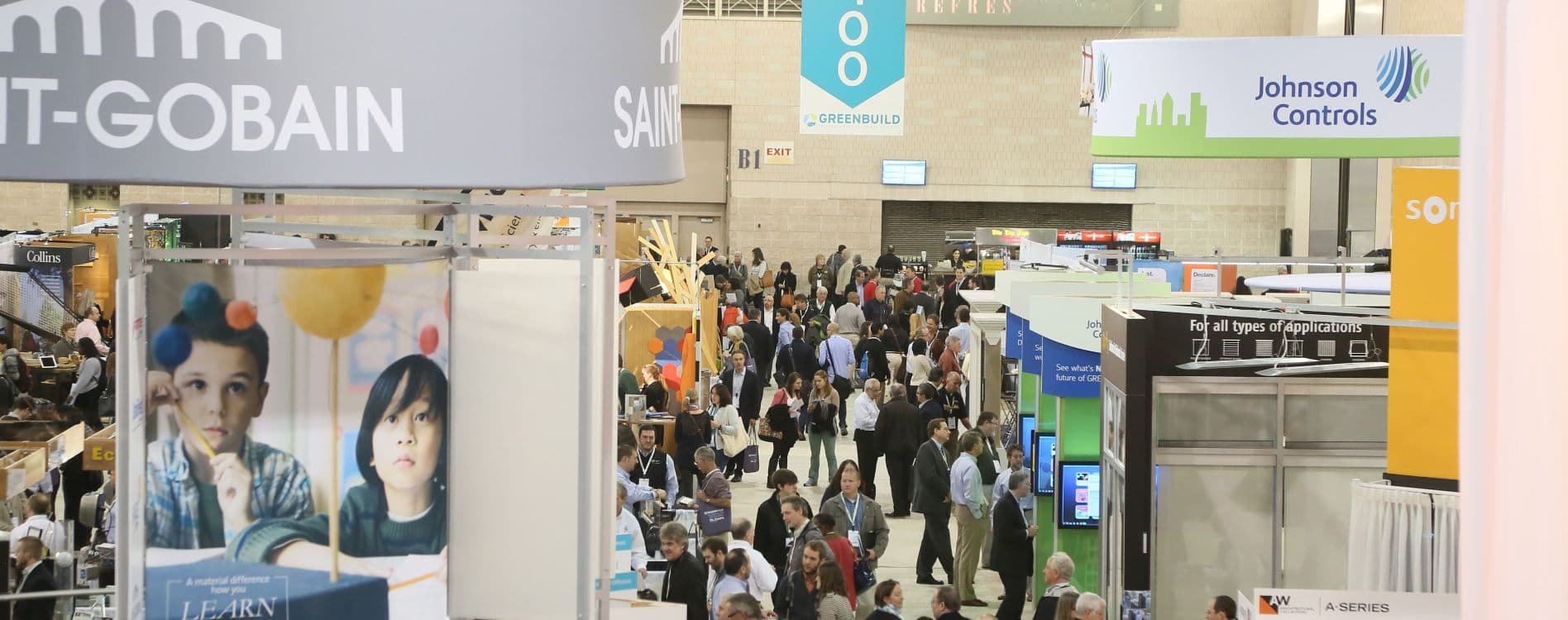
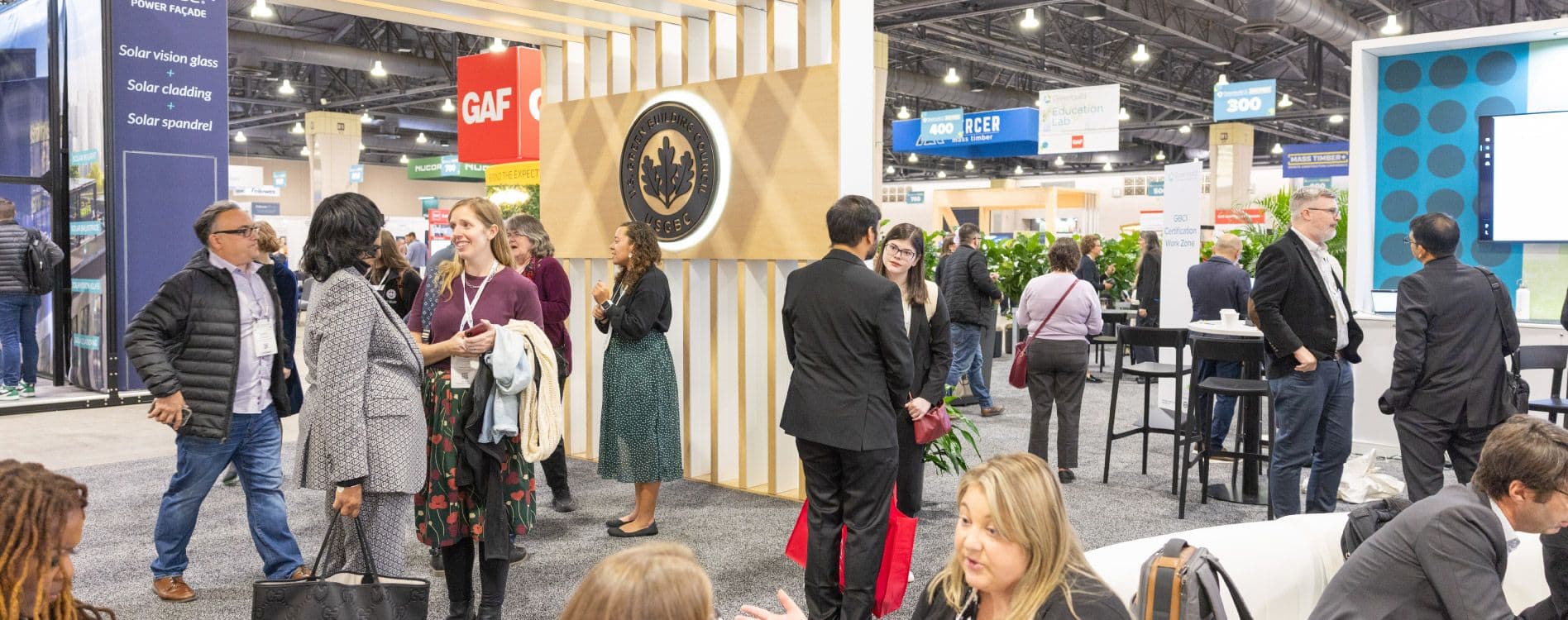
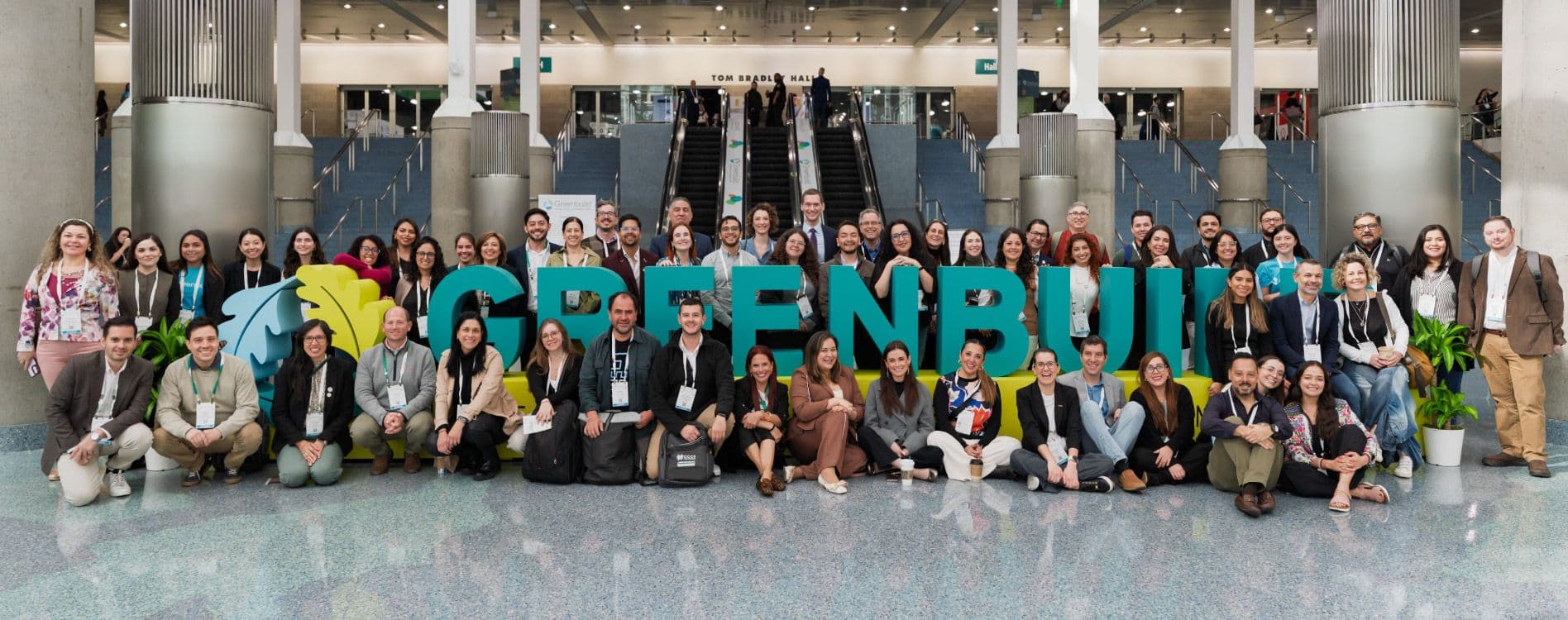
The official Greenbuild site is the source for this New York edition. Los Angeles archive footage and earlier conference photographs illustrate the event, not the forthcoming Javits show.
Who should attend or exhibit at Greenbuild 2026?
The New York programme is built for architects, engineers, sustainability specialists, building owners, developers, operators and suppliers serving the built environment. AIA and GBCI education sits beside product research and investment discussion, so attendance is most relevant when a team has a real design, construction, retrofit or portfolio decision to advance.
A conference attendee can compare approaches to a building problem; an exhibitor needs a product or service relevant to those approaches. Carbon reporting, healthy materials, energy systems, water management and construction technology represent different buying situations, not a single generic sustainability audience.
New-account conversations may begin with a project requirement or certification objective. Customer expansion may concern a larger portfolio, retrofit programme or new specification. The relevant contact can be a specifier, technical adviser or budget owner, and those roles are not interchangeable.
A consumer-only offering without a building application is less aligned. A supplier should choose participation according to the projects and relationships it can serve, not merely the advertised number of speakers.
What are the Greenbuild 2026 dates and Expo Hall hours?
Conference programming runs Tuesday, October 20, through Friday, October 23, in Eastern Time. Expo Hall opens Wednesday from 9 a.m. to 5 p.m. and Thursday from 9 a.m. to 4 p.m., providing 15 public exhibition hours while workshops, keynotes and tours occupy separate programme windows.
- Day: Tuesday, October 20; Main published schedule: Agenda lists registration 7 a.m. to 5 p.m.; summits start between 8 and 9 a.m.; afternoon workshops end at 5 p.m.; welcome reception 5 to 6 p.m.
- Day: Wednesday, October 21; Main published schedule: Fareed Zakaria keynote 8 to 9 a.m.; expo 9 a.m. to 5 p.m.; technical sessions through 3:15 p.m., with stage presentations later
- Day: Thursday, October 22; Main published schedule: Opening remarks and data-center keynote 8 to 9 a.m.; expo 9 a.m. to 4 p.m.; technical sessions through 3:30 p.m.
- Day: Friday, October 23; Main published schedule: Technical sessions 9 a.m. to 12:30 p.m.; tours leave at 1 p.m. and finish between 3 and 5 p.m., depending on the route
Some tours run Monday, October 19, and yoga runs 6:30 to 7:30 a.m. on Wednesday and Thursday. These activities do not extend general expo admission. The current show-information page lists Tuesday registration until 5:30 p.m. and the welcome reception until 6:30 p.m.; this draft uses those current published times.
How should a team divide Greenbuild's four-day programme?
Tuesday is reserved for summits, workshops and the welcome reception before Expo Hall opens for eight hours on Wednesday and seven on Thursday. Friday closes with technical sessions and ticketed tours. Fareed Zakaria's Wednesday keynote and Thursday's Women in Green luncheon create specific scheduling conflicts for project teams.
Tuesday's AI summit runs 8 a.m. to 4 p.m.; the strategic decarbonization summit starts at 8:45 a.m. and ends at 4:45 p.m. Morning workshops include LEED v5 Building Design + Construction from 8 a.m. to noon. Afternoon choices include LEED v5 operations and PERFORM from 1 to 5 p.m. These are overlapping alternatives, not a sequence one attendee can complete.
On Wednesday, a supplier of reclaimed building products can connect material-focused education with appropriate booth meetings. The salvaged-steel case study runs 2:15 to 3:15 p.m., followed by the hall happy hour from 3:15 to 5 p.m. Allow time for the session-to-booth walk.
Thursday's Women in Green luncheon runs 11:45 a.m. to 1:15 p.m., overlapping the expo. The 7 to 10 p.m. signature gathering at TAO Downtown requires travel and the appropriate pass or add-on.
Friday's three morning session slots start at 9, 10:15 and 11:30 a.m. The 1 p.m. tours have different return times: Rubin Hall ends at 3 p.m., the Alloy Block route at 3:30 p.m., the Javits roof tour at 4 p.m., and the NYU Langone campus visit at 5 p.m. A tour ticket is therefore a specific departure commitment, not an interchangeable afternoon activity.
Where is Greenbuild 2026 inside Javits Center?
Greenbuild 2026 uses Javits Center's South Entrance at 655 West 34th Street for its event space. Education rooms, Expo Hall and tour meeting points are separate, while the Thursday After Hours Party takes place at TAO Downtown. The a2z floor plan is the current source for booth locations inside Javits.
The South Entrance is the organiser's current event-space instruction. Tour departures and individual classes can still use their own meeting details, so the general venue address should not be treated as a room assignment.
The official a2z floor plan locates exhibits; the Tech Pavilion and other directory categories help organize product visits. TAO Downtown is the Thursday-night gathering venue, not part of the Javits expo floor.
Javits provides accessibility support including ramps, elevators and accessible facilities. Specific mobility requirements can be addressed through the venue's access team. Meeting rooms, catering entitlements and activity restrictions depend on the actual programme and pass.
Which transit, parking and airport options serve Greenbuild 2026?
The 7 train stops at 34th Street-Hudson Yards, which the organiser describes as a five-minute walk from Javits Center. M34, M42, M50, M12 and M11 buses also serve the area, and paid parking is listed at 700 West 34th Street. Airport transfer times remain route and traffic dependent.
The listed bus options include M34 SBS, M42, M50, M12 and M11. The relevant stop and walking route depend on the entrance used. Do not equate arrival at Hudson Yards with being seated in a session at that same minute.
JFK, LaGuardia and Newark are regional airport options; transfer time varies with airport, route and traffic. A fixed airport-to-keynote guarantee would be misleading.
Save the confirmed floor plan and session rooms, wear shoes suitable for repeated hall crossings, and allow for October outdoor transfers. Public event information does not establish a universal Wi-Fi allowance, charging map or guaranteed rideshare pickup position. Those details remain venue-specific rather than assumed app features.
What do Greenbuild 2026 passes cost and include?
Advance registration separates Conference, Expo plus Evening Events, Expo Hall and Student access. The published prices are $1,399 for a USGBC member Conference pass, $1,599 for a nonmember Conference pass, $599 for Expo plus Evening Events, $169 for ordinary Expo Hall entry and $499 for students.
- Pass: Conference, USGBC member; Advance price: $1,399; Important distinction: Four-day education, Tuesday summit/workshop choice and included evening events
- Pass: Conference, nonmember; Advance price: $1,599; Important distinction: Same listed programme scope without member rate
- Pass: Expo plus Evening Events; Advance price: $599; Important distinction: Expo, keynotes and included evening activities; not the full conference education
- Pass: Expo Hall; Advance price: $169; Important distinction: Expo and keynotes; $525 for non-exhibiting suppliers
- Pass: Student; Advance price: $499; Important distinction: Education and expo; no evening-event access
Eligible public-sector and education professionals receive 25 percent off Conference passes under the stated registration conditions. Groups of five to nine save 10 percent on Conference passes; ten to nineteen save 15 percent. Five or more Expo Hall registrants receive 50 percent off.
Group registration must be one transaction and cannot be applied retroactively. Use the 2026 registration portal; student passes and add-ons are excluded from those group reductions.
Which Greenbuild badge, add-on and cancellation rules matter?
Badge access follows the selected pass rather than one universal entitlement. Conference registration includes the stated education and evening programme, an Expo Hall pass excludes conference credits, and the $499 Student pass excludes evening events. Women in Green, project tours and Streamly remain separately priced additions.
The pricing page permits existing registrants to add eligible activities through their registration account. Women in Green costs $149; half-day and full-day tours cost $150 and $200. Those add-ons require an underlying pass.
The current FAQ includes older 2025 rollover and cancellation wording. This guide does not apply those previous-edition terms to a 2026 purchase. The current checkout agreement and registration support are the relevant routes for refunds, substitutions and badge corrections.
Conference sessions are described as first-come rather than individually reserved in the current FAQ. A saved app entry does not establish a seat guarantee. Lost-badge fees, guest entitlements and every advance-pickup detail are not established by the reviewed pricing information.
How does the official Greenbuild 2026 hotel block work?
Greenbuild directs its 2026 New York hotel inventory through onPeak. Javits hosts the daytime programme, TAO Downtown hosts Thursday's evening party and tours can use separate meeting arrangements. A useful hotel choice therefore depends on the attendee's actual pass and programme rather than the convention-center address alone.
Use the official hotel and travel page to reach the event's booking inventory. Rates and available room types can change; a hotel marketed for the event does not automatically guarantee a complimentary shuttle or a particular cancellation condition.
A location near the subway or a practical walking route may suit repeated Javits visits. An offsite evening event still requires its own transfer. The appropriate neighborhood depends on programme choices and individual access needs.
No universal current nightly rate, housing cutoff or deposit policy is asserted here. The selected booking provides those terms. Unsolicited housing sellers should not be treated as appointed providers merely because they use Greenbuild's name or advertise discounted inventory.
When should Greenbuild travellers arrive and leave New York?
Travel dates should follow the selected programme. Monday tours precede the October 20 conference opening, the Expo Hall operates October 21 and 22, and Friday tours can continue until 5 p.m. A two-day sourcing visit and a full conference itinerary therefore require different arrival and departure windows.
Allow time to reach the correct Javits entrance before a reserved workshop or tour. Thursday's TAO Downtown event ends at 10 p.m., making a very early Friday commitment a deliberate trade-off rather than a free calendar gap.
The organizer publishes eligible airline arrangements, including United, Southwest and Air Canada offers with separate date windows and fare conditions. These are not guarantees that every route or fare is discounted.
International travel documentation and exhibitor freight follow different procedures from attendee registration. The public conference address is not an approved receiving dock. Use the contracted shipping instructions for booth materials and keep those deadlines separate from passenger flights, hotel cancellation and the tour itinerary.
Which companies and product categories appear in the Greenbuild 2026 directory?
The current public directory spans building materials, energy, indoor environmental quality, software and related services. Autodesk, ASSA ABLOY, ArcelorMittal, Armstrong World Industries and BrainBox AI have visible booth listings, while Tech Pavilion and mindful MATERIALS filters separate technology and material research from the wider roster.
- Current directory example: Autodesk; Listed booth: 1137
- Current directory example: ASSA ABLOY; Listed booth: 1527
- Current directory example: ArcelorMittal; Listed booth: 1325
- Current directory example: Armstrong World Industries; Listed booth: 1360
- Current directory example: BrainBox AI; Listed booth: 1046
These are a selected sample from the current public roster, not the whole directory or a list of attending executives. Apollo Energies is also named in the keynote sponsorship context; that role is distinct from an unsupported product-performance claim.
Directory categories span roofing, windows, renewable energy, research, waste management and more. The organizer's 250-plus exhibitor promotion should not be replaced with a count of one paginated directory screen. Current profiles and floor-plan links control product and location detail.
How should exhibitors turn Greenbuild directory filters into a booth route?
A useful Greenbuild booth route begins with one building requirement and the directory filters that fit it. Product, pavilion and sponsor views provide company and booth detail for a shortlist, but a directory listing does not prove that a named purchasing executive will attend or that every profile remains unchanged through opening day.
Start with the project issue: envelope performance, healthy materials, energy controls or another defined need. A designer researching a specification needs different evidence from an owner planning a portfolio retrofit. Keep that difference in the meeting brief.
Record the current company, product relevance, booth and existing account relationship. Separate competitors, implementation partners and prospective buyers. A listed company is not proof that a named purchasing executive will attend.
The roster is paginated. A first-page extraction must not be described as the full catalogue. Export rights, saved-list behavior and login-only information depend on the actual interface; the public profile does not authorize unrestricted contact collection. Refresh priority entries before sending invitations or fixing a floor route.
Which Greenbuild keynotes, summits and technical sessions matter?
Greenbuild mixes keynotes, summits, workshops, tours, technical sessions and Expo Hall presentations. Fareed Zakaria opens Wednesday's programme at 8 a.m.; Thursday begins with Doreen Harris and a data-center panel. The programme also adds a Sustainable Finance and Investing Forum alongside resilience, decarbonization, materials and technology subjects.
Thursday's opening separates Doreen Harris's 8 to 8:10 a.m. remarks from the 8:10 to 9 a.m. data-center panel. The panel lists Katie Bachman of STACK Infrastructure, Noah Goldstein of Google, Beth Lowry of Holder Construction and Cyre Mercedes Quiñones of Infrastructure Masons, moderated by Lauren Kiel of Bloomberg Media. The topic connects energy, construction, resource use and community impact; participation is not an endorsement of an exhibitor's product.
Technical sessions give a more precise reason to attend than a broad sustainability theme. Wednesday's 2:15 p.m. choices include salvaged structural steel, building-performance analytics and a Brooklyn Passive House case. Thursday's 2:30 p.m. choices cover green leases, heat recovery, campus electrification and MEP embodied-carbon study results. A team comparing these subjects must split attendance or choose one; they run concurrently.
Innovation and Technology Stage presentations have their own schedules. Wednesday's Mitrex presentation runs 3:20 to 3:40 p.m., and UpCodes' plan-review session runs 3:30 to 4 p.m. These sponsored formats are not interchangeable with a full conference class. Women in Green also overlaps Thursday's expo, from 11:45 a.m. to 1:15 p.m.
Use the 2026 session catalogue for actual speakers, rooms and learning objectives. A promotional total of 100-plus sessions and 300-plus speakers is not a substitute for the selected session's details or proof of a separate hosted-buyer entitlement.
Where are the practical meeting windows during Greenbuild 2026?
Meeting windows must account for pass access and programme overlap. The Expo Hall runs 9 a.m. to 5 p.m. Wednesday and 9 a.m. to 4 p.m. Thursday, while keynotes occupy both mornings, Women in Green overlaps Thursday from 11:45 a.m. to 1:15 p.m. and hall happy hours occupy each afternoon close.
The public catalogue filters by topic, learning level, continuing-education credit, rating system, pass type and track. Select the relevant pass before choosing a learning route: a visible session is not necessarily included in that ticket. Credit filters include AIA HSW, GBCI and AIA LU Elective; eligibility and attendance conditions belong to the individual activity.
A technical question can precede the corresponding supplier meeting. Wednesday's reclaimed-steel case study can shape discussion during the hall happy hour, while a data-center supplier can use Thursday's keynote before a floor conversation after 9 a.m. These are separate buyer routes, not one generic agenda.
Workshop listings display availability separately, while ordinary conference seating is described as first-come in the FAQ. Check the selected activity's booking and ticket requirements rather than interpreting a saved app entry as a reserved seat.
Streamly costs $200 with Conference or Student registration and $500 with an Expo Hall pass. It offers twelve-month access to anticipated track recordings; individual recordings are not guaranteed, and summit and workshop recordings are excluded.
That distinction matters when choosing between a live session and a customer meeting. A recording purchase does not guarantee that every missed activity will be available later. Continuing-education requirements also remain tied to the eligible activity and attendance process.
Does Greenbuild's 2026 audience match a building-sector ICP?
Greenbuild serves design, engineering, development, ownership, operations, sustainability and building-product roles. That mix can match a supplier selling into active specifications, retrofits or property portfolios, but the organiser's 250-plus exhibitor and 300-plus speaker claims do not establish purchasing authority or guaranteed demand for any one product.
An ideal customer profile can use building type, project stage, portfolio responsibility and specification influence. An architect's material decision differs from an owner's capital approval or a facility team's operating requirement, even when all three attend the same keynote.
The current event promotes 250-plus exhibitors and hundreds of speakers. Those programme counts do not establish a final attendee census, a purchasing-authority percentage or a guaranteed pool of qualified prospects for one supplier.
Use known accounts and relevant project evidence to test fit. Public-sector and education discounts indicate eligible registration categories, not the share of attendees from those sectors. Any historical demographic data needs its original edition label rather than being repackaged as a 2026 New York forecast.
How can Greenbuild exhibitors identify target accounts before Javits?
Target-account work can start with active specifications, retrofit programmes and portfolio decisions already present in CRM, then use the directory and programme to find relevant companies and subjects. Lead Insights adds permitted engagement information for contracted clients, while the organiser explicitly warns against outside sellers claiming to provide attendee or exhibitor lists.
Begin with active specifications, retrofit programmes or portfolio decisions. Separate an existing customer's expansion from a new design practice or property owner. Directory research can identify a collaborator; it does not establish that a listed supplier is a buyer.
A useful pre-show brief names the building application because a healthy-materials discussion needs different evidence from an energy-controls evaluation. Each account therefore needs a priority tier, one responsible rep and an invitation tied to a legitimate project reason.
Speaker research can reveal expertise without proving a person's colleagues will attend. Access to Lead Insights follows the client arrangement and permitted engagement data; it is not unrestricted ownership of the entire registration database. Avoid unverified attendee-list offers.
What can the Greenbuild app, directory and floor plan do?
Three Greenbuild planning surfaces serve different jobs. The mobile app supports appointments and networking for the listed main pass types, the public directory supports company research and the a2z floor plan supports Javits navigation. None of those facts proves unrestricted messaging, attendee-list export or a native CRM connector.
The app guidance links a Greenbuild-branded mobile application through the organizer. Its meeting and networking functions should not be confused with the commercial Lead Insights dashboard, which ranks and tracks permitted engagement for clients.
Use the current signed-in event selection for the actual session timetable and eligible participants. The event app's existence does not prove unrestricted messaging, downloadable attendee lists or direct CRM export.
Specific offline behavior, alert delivery, digital-badge use and synchronization between every web and mobile function are not fully established by the public pass matrix. A saved itinerary and verified booth numbers provide a practical fallback without inventing capabilities for the official app.
Where do Greenbuild planning tools stop and conversation capture begin?
The Greenbuild app helps participants plan meetings, while Informa Lead Insights combines permitted signals from badge scans, app activity, content engagement and session participation. Those signals can indicate interest, but a usable sales record still needs the building requirement, buying role and agreed next action captured in the conversation.
A visitor looking at a material specification, a developer evaluating finance and an owner researching controls can generate similar activity counts while having different needs. Engagement is not identical to procurement authority or an accepted meeting.
Lead Insights documents a shared client dashboard, enrichment and account ranking. Public information does not establish the underlying scanning device, universal offline behavior or a complete native CRM connector list.
Keep participant planning data, event engagement and the CRM record distinct according to permission. Retain only appropriate project information. A badge interaction does not justify collecting confidential building details or interpreting every session visit as a purchase commitment.
Which costs belong in a Greenbuild 2026 exhibit budget?
A Greenbuild exhibit budget needs the contracted space package plus construction, furniture, labour, power, internet, freight, handling, insurance, staff travel and optional sponsorship. The organiser's public route provides an exhibitor enquiry and prospectus request, but attendee ticket prices do not reveal a current per-square-foot booth rate or complete service schedule.
Separate booth rent from design, furniture, labor, electricity, internet, freight, handling, insurance, staff travel and optional sponsorship. A Conference pass's education entitlement does not establish how many staff badges a booth package includes.
The prospectus download requires an enquiry step in the public route reviewed here. No current universal price per square foot, corner premium, contractor identity or freight deadline is asserted without the current exhibitor agreement and service manual.
The two-day expo creates a concentrated selling period, while a team staying for all four conference days incurs different travel and registration costs. The cost model should reflect that actual participation choice, not an invented standard budget or unsupported return projection.
How many booth reps does Greenbuild's 15-hour expo require?
Greenbuild provides 15 Expo Hall hours: eight on Wednesday and seven on Thursday. At B2Brain's benchmark of 31 scans per productive rep-day, two reps can cover 62 conversations per day, or 124 across two expo days, before demonstration length, breaks and education commitments reduce practical capacity.
Divide roles around the buying conversation: application expertise, qualification, demonstration and the next appointment. A rep cannot give an uninterrupted technical explanation while also managing a queue and entering every contact record.
Use the visitor's project stage in the opening question. A specification under review, a portfolio retrofit and an early research exercise require different follow-up. Set conversation targets around the number of staffed demonstrations and their duration; projected attendance does not guarantee a full appointment calendar.
At shift handover, review missing application notes and promised materials. The contracted exhibitor rules determine sampling, displays and utilities. Permission to demonstrate a product does not establish permission to circulate confidential drawings collected during a discussion.
What does Informa Lead Insights provide at Greenbuild 2026?
Informa's Greenbuild-specific page presents Lead Insights as a client platform for lead and account scoring, rating, tracking and campaign monitoring. It combines badge, app, content and session signals and gives teams access before the event, but the public page does not identify a handheld scanner model, licence quantity or order deadline.
The Greenbuild Lead Insights page states that clients receive access before arriving onsite. A shared client account can include the team, and the organizer identifies leadinsights@informa.com as the access-email sender.
This proves the analytics and management offering for Greenbuild, not every registration, badge-decoding or mobile-app role. Hardware, mandatory-use rules, activation quantities, operating-system requirements, order deadlines and published prices are not established by that marketing page.
The appropriate commercial confirmation is the current client package and resource center. No specific device model or cheaper alternative price is inferred from another Informa event or a previous Greenbuild edition.
Which Lead Insights capabilities are documented, and which are not?
Lead Insights documents near-real-time engagement updates, third-party enrichment, lead and account ranking, campaign tracking and shared team access. Public Greenbuild material does not fully specify custom qualification fields, offline capture, duplicate handling, retention periods, device requirements or every CRM destination, so those items remain commercial configuration questions.
The activity record can help distinguish which topic or content drew interest. That is valuable for prioritization, but a high engagement score is not proof of a funded building project or authority to select a supplier.
The current public page does not fully describe custom qualification fields, voice notes, business-card capture, duplicate resolution, offline collection, retention periods or native CRM destinations. Those are specification questions, not confirmed limitations.
The comparison should therefore recognize the stated ranking and enrichment features while distinguishing them from a captured conversation and accepted next meeting. The client package determines actual access and configuration rather than a claim that every feature is included for every exhibitor.
How does B2Brain differ from Lead Insights at Greenbuild?
Lead Insights aggregates and ranks event engagement; B2Brain records the sales conversation and its next commitment. For a Greenbuild exhibitor, that distinction means retaining the building application, buying role, process, blocker and accepted meeting instead of treating a badge or session signal as a complete opportunity record.
A badge or session signal can indicate interest in a building topic. B2Brain supports retaining the process, buying role, blocker and agreed next action behind that signal, making the next specialist conversation more specific.
- Job: Event engagement; Lead Insights, as published: Aggregates app, badge, content and session signals; B2Brain focus: Retains conversation context
- Job: Prioritization; Lead Insights, as published: Ranks leads and accounts with enriched data; B2Brain focus: Prepares relevant target accounts
- Job: Team activity; Lead Insights, as published: Shared client dashboard and campaign tracker; B2Brain focus: Capture and meeting progression
- Job: Commercial handoff; Lead Insights, as published: CRM configuration not fully described publicly; B2Brain focus: Event-to-CRM opportunity workflow
This is not an assertion of organizer endorsement or unrestricted access to Informa registration data. Replacing or combining products depends on the actual client entitlements and tested sales process.
When should an exhibitor use Lead Insights, B2Brain or both?
Lead Insights can remain the source for permitted Greenbuild engagement intelligence while B2Brain handles account preparation, conversation context, meeting booking and opportunity attribution. One product is sufficient when its tested configuration covers the complete workflow; both are useful only when the handoff avoids duplicate entry and preserves organiser permissions.
Use one system if its documented configuration meets the full requirement. A combined process can make sense when an engagement signal needs an application-specific conversation and a CRM opportunity. Reject extra entry steps that make reps repeat the same record at Javits.
A realistic building scenario exposes whether the handoff works. A retrofit buyer's next meeting differs from a specifier's request for material evidence, and the chosen systems need one account identity and one responsible rep.
Official Lead Insights pricing is not published in the reviewed Greenbuild page, so no numerical savings comparison is justified. Privacy, retention, organizer permissions and staff adoption belong in the decision alongside cost.
Which fields belong in a Greenbuild booth conversation record?
A Greenbuild conversation record should name the account, building or portfolio context, project stage, contact role, current process, stated obstacle, timing and accepted next step. Decarbonization, resilience, materials and finance conversations need different qualification detail, so a general interest in sustainability is not enough to establish a sales-ready lead.
Record the account, relevant project stage, current process and stated obstacle. Clarify whether the visitor specifies products, advises a client, manages operations or controls investment. Do not assume all four roles from a senior-looking job title.
Keep the promised evidence specific: a product declaration, technical review, application example or accepted meeting. Retain timing, other participants and the rep responsible for delivery. Qualification should explain why that next action matters.
Collect information with permission and restrict confidential building or commercial details appropriately. A Lead Insights engagement score can provide context but cannot replace the visitor's actual statement of need or consent to a particular follow-up.
How can a Greenbuild team protect lead quality during two expo days?
Lead quality depends on linking each visitor's building requirement to a permitted event signal and a specific commitment. Greenbuild has two expo days, Lead Insights updates engagement near real time and education competes with floor time, making short, application-specific records more useful than a uniform scan count or an assumed purchasing role.
B2Brain reports conversation capture in under thirty seconds, supporting a short handoff while the project details are fresh. Speed should not remove consent, responsible ownership or the distinction between an active specification and general research.
Preserve different stakeholders from the same organization while reconciling duplicate contacts. Route an urgent technical request to the relevant specialist; a high engagement score alone does not establish urgency.
Use the selected product's tested connectivity behavior, not an assumed offline capability in the event app. Inspect incomplete records between shifts and reconcile any permitted offline notes. The end-of-day review can catch a promised document before an attendee leaves New York.
How should Greenbuild leads be routed after the New York show?
Post-show routing should combine the project need, account owner and promised action. A materials specification, energy retrofit and sustainable-finance discussion require different specialists and evidence, while Lead Insights activity can inform priority without proving a commercial commitment. Existing customers should return to the current account team before a duplicate opportunity is created.
Confirm accepted meetings with the necessary technical participants and preparation. Existing customers and open projects should return to their current account team before a duplicate opportunity is created. General learning interest belongs in a suitable permission-based content path.
B2Brain supports connecting captured event context with CRM deal and opportunity work. Keep the building application, blocker and agreed next step attached to that handoff rather than sending only a generic Greenbuild contact list.
Set response deadlines according to the visitor's urgency and the company's service commitment. Review outstanding promises after the expo and track progression on the project's actual decision cycle. Badge activity, marketing engagement and a qualified sales opportunity remain separate measures.
Which Greenbuild metrics support a return decision without invented ROI?
A Greenbuild return decision should compare total New York spend with qualified project conversations, meetings and attributable opportunities. Expo-only, four-day conference and tour itineraries have different costs, while Lead Insights reports activity rather than realised financial return. Without a published booth rate and company-specific ACV, this draft does not invent an ROI percentage.
Separate scans, qualified conversations, meetings, new opportunities and influenced existing projects. Evidence for influence can include a new specifier relationship, resolved product requirement or accepted portfolio review. Do not attribute an entire existing deal merely because someone attended Greenbuild.
B2Brain defines Leads-to-Meeting as meetings booked divided by qualified leads. That measure needs consistent qualification before a team compares events or editions.
Calculate cost per qualified conversation and cost per opportunity from total spend. Financial ROI uses attributable realized return minus total cost, divided by cost; open pipeline is not realized return. Review results over a window suited to design, construction or retrofit cycles, then decide whether the account relevance and progression justify returning.