


Build Show LIVE 2026 exhibitor takeaways
- Build Show LIVE 2026 runs September 10 through September 12 at the Henry B. González Convention Center in San Antonio.
- Informa's June 2026 announcement says more than 3,000 construction professionals are expected and more than 50 education sessions are planned.
- The organiser's 2025 post-show report recorded 2,365 registered industry professionals, 155 exhibitors and 74 education sessions.
- The organiser's 2026 exhibitor FAQ prices inline space at $44.80 per square foot and island space at $41.80 per square foot.
- The strongest exhibitor fit is a supplier whose target accounts include quality-focused residential builders, contractors, remodelers, architects or specialty trades.
- A defensible floor plan captures project context, buying role, blocker and next step while the conversation is still current.
Is Build Show LIVE 2026 worth exhibiting at?
Build Show LIVE 2026 is defensible for exhibitors that sell into quality-focused residential construction. The current evidence supports audience relevance, but it does not guarantee pipeline. The decision should rest on named-account fit, public booth economics and a measurable meeting target rather than the organiser's attendance forecast alone.
The current edition has a useful scale signal. Informa's June 2026 announcement says more than 3,000 construction professionals are expected in San Antonio. The same 2026 announcement says the programme will include more than 50 education sessions. Those figures indicate a focused gathering rather than a small workshop, but both remain forward-looking organiser statements until the show closes.
The prior edition provides firmer evidence. The organiser's 2025 post-show report recorded 2,365 registered industry professionals, 155 exhibitors and 74 education sessions in Dallas. That report also describes custom builders and other construction leaders as the core audience. Prior-edition results do not prove the 2026 outcome, but they establish that this series has already operated at a meaningful professional scale.
Buyer authority matters more than total footfall. The organiser's prior audience material says 90 percent of 2025 attendees recommended or approved purchasing decisions. It also says 62 percent of 2025 attendees represented companies with at least $1 million in sales. Those figures are organiser-reported and belong to the 2025 audience. They should be treated as a qualification signal, not as a forecast for every 2026 conversation.
The exhibitor sentiment is encouraging but mixed enough to be credible. The 2026 prospectus reports that 70 percent of prior exhibitors were satisfied with the event. It also says 67 percent considered the event important to their business, while 83 percent were most likely to exhibit again. Each figure reflects organiser research from the prior edition. None reveals how many meetings, opportunities or deals those exhibitors created.
That missing outcome data creates the central decision rule. An exhibitor should proceed only when the official audience overlaps with a defined target-account list. The company should also know which technical question will start a useful conversation. If the target market is merely "construction," the definition is too broad to support a booth decision.
The strongest fit includes building-product manufacturers, field-service firms and technical suppliers serving custom home builders. It also includes companies selling to remodelers, architects, engineers and specialty contractors. The official 2026 materials repeatedly center building science, craftsmanship, efficient homes and practical field methods. A product that improves an assembly, workflow, schedule, margin or building outcome has a clear path into that conversation.
The weaker fit includes companies that depend on civil infrastructure, large commercial projects or consumer decorating traffic. The published programme does not center those buyers. A company can still meet relevant people in San Antonio, but it would be buying access to a neighboring audience. That distinction should lower the expected qualified-conversation count before the budget is approved.
The final test is operational. The booth team should be able to name the accounts it wants, the project signals it must capture and the meetings it wants booked. It should also assign a revenue-pipeline owner before travel begins. Without those decisions, even a well-matched audience can become a pile of business cards and incomplete notes.
Who is actually in the room?
Build Show LIVE 2026 is built around residential construction professionals rather than a general consumer home-show crowd. The official audience language names custom builders, general contractors, specialty contractors, remodelers, architects and engineers. Exhibitors should plan for technical and business conversations with people responsible for how homes are designed, specified and built.
The audience is broad inside that professional frame. A custom builder may care about building-envelope risk, schedule control and client expectations. A remodeler may focus on existing conditions, sequencing and trade coordination. An architect may examine performance, detailing and specification confidence. A specialty contractor may evaluate installation time, serviceability or callbacks.
That mix changes how an exhibitor should define an ideal visitor. A useful target description combines role, project type and active constraint. "Custom builder working on high-performance homes in a hot-humid climate" is actionable. "Construction professional" is not. The tighter description gives a rep a reason to ask about the project before presenting a product.
The organiser's 2025 buying-authority claim adds weight. According to the official prior-edition material, 90 percent of 2025 attendees recommended or approved purchasing decisions. That does not mean every visitor controlled a budget. It suggests the floor included people who could influence specifications, trials and vendor selection.
The company-size signal is also relevant. The organiser says 62 percent of the 2025 audience came from companies with at least $1 million in annual sales. That threshold does not establish enterprise buying power. It does indicate that much of the prior audience operated real businesses with active projects, crews, suppliers and financial constraints.
The 2026 sponsor list reveals the product context. The official site highlights Bosch, Highspire, Huber, Isokern, Pella, Polyguard and Prosoco as stage or underwriting sponsors. It names Guido as the official material supplier. Digs, Trainual and SharkBite also appear as partners or sponsors. The names span building systems, materials, operations and trade workflows.
Those names should shape positioning. A supplier does not need to imitate a sponsor, but it should understand the comparison set around it. Claims about speed, durability, moisture, energy, installation quality or business execution will be tested against other products and expert teaching on the same floor. A generic product pitch will struggle beside a live demonstration or a detailed technical session.
The official 2026 directory is live through MapYourShow. That directory should become the account-planning source, not a last-minute browsing tool. A field marketer can tag exhibitors as partners, competitors, channel candidates or target accounts. A sales leader can add customers and open opportunities that may send attendees. The same preparation prevents two reps from spending Friday with the same low-priority visitor.
The published data has limits. No current source provides a role mix whose percentages total 100. The event site also does not disclose the share of attendees who are builders, architects, contractors or homeowners. An exhibitor should not turn audience labels into invented percentages. The missing mix is a reason to use named-account planning, not a reason to manufacture precision.
There is another useful exclusion. Build Show LIVE 2026 is not the strongest choice for a company seeking only very large commercial owners or public-sector infrastructure buyers. Its educational spine is residential building science and craft. The show may still create partnerships, but the official audience evidence does not justify assuming a commercial-project pipeline.
Audience quality becomes visible only in the conversations. The booth team should record project type, geography, business model, buying role and active problem. Those fields separate a curious attendee from a potential customer. They also make the post-show review more honest than a single scan count.
What does a Build Show LIVE booth really cost?
Build Show LIVE 2026 publishes a clear space rate but not a complete exhibitor budget. The official 2026 FAQ lists inline booths below 400 square feet at $44.80 per square foot. It lists island booths of at least 400 square feet at $41.80 per square foot, plus mandatory and optional charges.
The smallest common inline example shows the baseline. A 10-foot by 10-foot booth contains 100 square feet. At the organiser's 2026 inline rate of $44.80 per square foot, the space costs $4,480. The mandatory 2026 online company listing adds $400, which brings that sourced minimum to $4,880 before services, travel or build costs.
An inline corner changes that figure. The organiser's 2026 FAQ lists a $150 fee for each inline corner. A 10-foot by 10-foot inline booth with one charged corner therefore reaches $5,030 when the $4,480 space, $400 listing and $150 corner fee are combined. That calculation uses only public organiser prices retrieved in August 2026.
An island commitment starts much higher because of size. The official 2026 island rate applies at 400 square feet or more. At exactly 400 square feet and $41.80 per square foot, the space calculation is $16,720. Adding the mandatory 2026 online listing produces a sourced floor of $17,120 before the island build and show services.
The word "floor" is important. The organiser says a standard booth typically includes an eight-foot black back drape, three-foot black side dividers and one identification sign. The FAQ says additional furnishings can be ordered through the exhibitor resource center. It does not say that furniture, electrical service, internet, material handling, labor, cleaning or storage are included in the public rate.
Freight and material handling can change the total. The organiser's 2026 FAQ says Freeman handles items that require flat-bed carts, four-wheel dollies, pallet jacks or forklifts. It also says empty-container storage is included when items are shipped and handled by Freeman. The public page does not list those service prices, so they should remain a budget line marked "quote required."
Insurance is another boundary. The 2026 FAQ says exhibitors must carry the coverage listed in the booth contract. It also points to a show-specific insurance option. The public page does not state a universal premium. A planning sheet should record the requirement and obtain the actual price rather than treating insurance as free.
Travel is outside the booth rate. A complete internal budget should include staff transport, hotel, meals and local movement. It should also include product shipment, installation time, graphics and any demo equipment. Those amounts vary by company, so they should never be copied from a generic trade-show benchmark and presented as Build Show LIVE facts.
The most useful budget has three layers. The first layer is organizer-published commitment, including space, listing and any corner fee. The second layer is vendor-quoted delivery, including build, freight and services. The third layer is internal execution, including people, content and follow-up. Keeping the layers separate makes later variance analysis possible.
Pass pricing may affect staffing. The official 2026 ticket page lists an advance Non-Exhibiting Manufacturer pass at $495. Exhibitor personnel rules may differ from attendee rules, and the public booth FAQ does not give a complete badge allotment. The booth contract should confirm how many staff badges are included before extra passes are budgeted.
The public economics are unusually useful because they support a real starting calculation. They are still incomplete. An approval request should present the sourced minimum, the quoted service total and a contingency separately. A single rounded number hides which portion is known and which portion remains an estimate.
What outcome would make the spend rational?
Build Show LIVE 2026 should be judged on qualified conversations that become scheduled meetings and attributable opportunities. Raw visitors are not an adequate success metric. A rational plan begins with the target-account universe, the two published expo windows and the smallest number of meetings needed to support the approved spend.
The 2026 expo provides eight hours on Friday and five hours on Saturday, according to the official schedule. That creates 13 published floor hours across the two expo days. The team should not divide an attendance forecast by those hours. It should estimate how many relevant conversations each rep can handle without losing context or missing agreed next steps.
Start with accounts, not scans. Tag the official directory, current customers, open opportunities and regional prospects. Then assign each account to an owner. The owner should know the desired meeting, likely stakeholder and strongest reason for a conversation. This method turns the show plan into a finite work queue.
The next layer is a qualified-conversation definition. For this event, qualification should include residential construction relevance, a real project or business need, a plausible buying role and an agreed follow-up. A conversation that lacks those elements can still be useful for market learning. It should not be counted as a qualified pipeline interaction.
Leads-to-Meeting, or LTM, means meetings booked divided by qualified booth leads. The definition matters because it measures commitment rather than contact collection. B2Brain reports 52 percent LTM on the floor against an 8 percent industry average for post-event follow-up. That approved comparison is a benchmark, not a promise for Build Show LIVE 2026.
The decision model should use scenarios. A conservative case can lower the number of qualified conversations and the expected meeting rate. A base case can reflect the account list and staffing plan. An upside case can test what happens if sponsor traffic or session alignment increases demand. Each case should use the same cost base so the team can see which assumption changes the result.
The model should also distinguish meetings from opportunities. A meeting is a scheduled next step with an owner and date. An opportunity requires commercial relevance and CRM acceptance. Combining the two inflates the apparent result. The show review should report qualified conversations, meetings booked, meetings held, opportunities created and revenue pipeline influenced as separate stages.
Prior attendance can help with capacity planning, not outcome prediction. The organiser's 2025 report recorded 2,365 registered industry professionals. That figure supports the need for routing and staffing. It does not justify multiplying 2,365 by an assumed conversion rate and calling the result pipeline.
The organiser's prior buying-authority figure should be used with the same restraint. The official material says 90 percent of 2025 attendees recommended or approved purchasing decisions. That makes decision-influence questions worth asking. It does not establish that 90 percent of a particular exhibitor's visitors will have buying power.
The clean approval question is simple. Can the company name enough relevant accounts and projects to justify the sourced show commitment? Can the team state the meeting target and expected opportunity path? Can RevOps trace the result after the show? If any answer is no, the plan needs more work before budget approval.
Which 2026 sessions should exhibitors use?
Build Show LIVE 2026 sessions are useful as account intelligence, not just staff education. The organiser has announced more than 50 sessions for the 2026 edition. Exhibitors should select sessions that reveal buyer priorities, language and project constraints, then turn those insights into better booth questions.
Thursday is especially valuable because education begins before the expo hall opens. The official 2026 schedule starts classroom programming at 7:00 AM and lists sessions through the afternoon. The VIP Welcome Party is scheduled for 5:00 PM. A small exhibitor team can use Thursday to learn, confirm account presence and refine Friday prompts.
Several Thursday sessions point to business pressure. The 2026 schedule lists "AI, Automations, and VAs: Top 5 Profit Boosters for the 2026 Builder" at 9:00 AM. It lists "Builder Finance 101: 3 ways to control your cash flow and predict your profit" at 12:45 PM. It also lists "Managing $30M+ Projects: Challenges, Risk, Opportunity" at 3:30 PM.
Those titles indicate operational themes: margin protection, cash-flow control, project complexity and administrative load. An exhibitor selling software or services can listen for the language builders use around those pressures. A product manufacturer can connect installation choices to schedule risk, callbacks or rework without forcing a generic efficiency claim.
Friday combines classroom content with the first expo day. The organiser's 2026 schedule lists "AI for Home Builders: Real Tool & Examples That Save Time, Reduce Rework & Protect Margins" at 12:30 PM. It also lists "Building Science Basics: Understanding the Four Control Layers" at 2:30 PM. These sessions create different conversation streams around business systems and technical assemblies.
The technical session matters to envelope and material suppliers. A booth prompt can ask which control layer creates the most field risk on the attendee's current project. The answer is more useful than asking whether the attendee wants a brochure. It creates context about climate, assembly, trade coordination and failure prevention.
Saturday continues that pattern. The 2026 schedule lists "Build HD Standard: Designing to High-Performance" at 9:00 AM. It lists "What's Hot, What's Not: Top Custom-Home Design Trends" at 10:30 AM. It also lists "The $10MM Builder: Mastering Contractor Growth Phases" at 1:00 PM.
The Saturday design session may attract architects, designers and builders making specification choices. The growth session may attract owners dealing with process and organizational change. Those audiences can overlap on the floor, but their questions differ. The booth team should route technical specification conversations and business workflow conversations to different owners when possible.
Speaker selection can improve preparation. The official expert roster includes Matt Risinger, Brent Hull, Jake Bruton, Stephanie Dailey, Danny Kerr and Eric Aune. Their published roles span building, design, contracting, plumbing and business education. An exhibitor should review the relevant speaker's current work before using a session as a conversation hook.
Session notes should follow a fixed structure. Record the problem stated, the phrase attendees repeated, the product or method discussed and the unresolved question. Add the target accounts seen in the room. That structure turns education into usable market evidence without attributing a claim to a speaker who did not make it.
The team should avoid session hijacking. Education time is not a substitute sales floor. The goal is to learn how the audience frames its work and to identify legitimate follow-up. A rep who dominates a session with a product pitch can damage the same trust the booth is meant to build.
Finally, keep current and prior content separate. The verified YouTube home-tour and masterclass videos come from the 2025 edition. They are useful for understanding format and teaching style. They should not be presented as the 2026 agenda, speaker list or venue experience.
How should a booth team work the San Antonio floor?
Build Show LIVE 2026 gives exhibitors one long Friday and one compressed Saturday on the expo floor. The official schedule provides eight Friday hours and five Saturday hours. The team should use Friday for discovery and meeting conversion, then use Saturday for priority accounts, unresolved conversations and clean handoff.
Preparation begins with the official 2026 MapYourShow directory. Mark customers, open opportunities, target accounts, partners and competitors. Add a reason for each planned conversation. A rep should enter San Antonio knowing which accounts matter and which technical question can earn attention.
B2Brain reports 2.4 times more booth meetings than cold floor-walking when reps work a pre-event briefing. The approved claim compares briefed reps with cold floor-walking, not with every other event method. For Build Show LIVE 2026, the briefing should include project type, likely trade role, relevant session and desired next step.
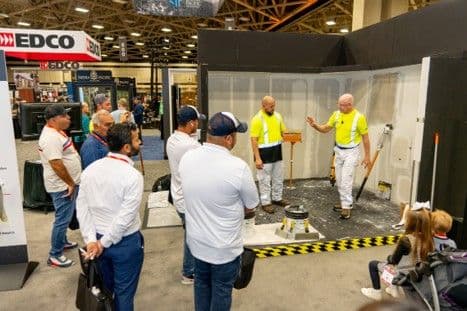
The booth should make technical context easy to discuss. A demonstration can be organized around a field decision, failure mode or installation step. A sign can state the problem in builder language. The opening question can ask about the assembly, climate, schedule or callback risk rather than the attendee's job title alone.
Capture should preserve the conversation, not just contact data. Useful fields include project type, construction stage, climate zone, role, current method, blocker, buying process and agreed next action. That context gives the next owner enough information to continue without asking the attendee to repeat the entire conversation.
B2Brain reports booth capture in under 30 seconds per conversation. The approved claim concerns capture time and should be evaluated against the quality of context preserved. Speed matters only if the record still contains the project, blocker, role and next step needed for follow-up.
Meeting conversion should happen while interest is specific. A rep can offer a technical review, project consultation or stakeholder meeting only when it matches the conversation. The calendar invitation should name the purpose. A vague "follow-up call" creates less commitment and gives both sides an easy reason to cancel.
B2Brain reports 52 percent Leads-to-Meeting on the floor against an 8 percent industry average for post-event follow-up. The comparison supports on-floor booking, but it does not guarantee the same result for every booth. The team still needs audience fit, a clear next step and available calendars.
Friday should favor range and learning. The 2026 expo runs from 10:00 AM to 6:00 PM, and the Show Floor Welcome Party begins at 4:30 PM. Use the early hours for planned accounts. Use the middle of the day for session-driven traffic. Protect the final period for conversations that can become meetings.
Saturday should favor precision. The 2026 expo runs from 10:00 AM to 3:00 PM. Reps should start with missed target accounts, decision makers who requested a return visit and qualified conversations without a booked meeting. The shorter window leaves little room for broad floor wandering.
The booth manager needs live checks. Review qualified conversations, meetings booked, missing context and account coverage at fixed points. Do not rank reps by raw contacts during the show. That incentive encourages shallow capture and makes the later list harder to use.
The public exhibitor FAQ does not name a standard 2026 badge scanner or lead-capture product. That absence should be treated as an operational requirement. Each exhibitor must confirm its own capture method, test it before travel and define the CRM path. A product name should not be invented from another Informa event.
The floor plan should also protect expert time. Technical staff should handle assembly, performance and integration questions. Sales staff should handle qualification, stakeholder mapping and next steps. When one person must do both, the capture form should prompt a clean transition between technical finding and commercial action.
What should happen before the team leaves San Antonio?
Build Show LIVE 2026 closes its expo floor at 3:00 PM on Saturday, September 12. Every qualified conversation should have an owner, status and next action before the team leaves San Antonio. Waiting for a Monday list export creates delay, context loss and unclear responsibility.
The first closeout step is record quality. Check that each qualified record names the account, person, project or business context, buying role, blocker and agreed next step. Add the promised asset or introduction. If the conversation is not qualified, mark why rather than forcing it into a meeting queue.
The second step is ownership. Every next meeting needs an internal owner and calendar date. Every technical question needs a named responder. Every partner introduction needs both sides identified. A shared queue without personal ownership is only a delay mechanism.
Speed matters because conversation context decays. B2Brain reports that conversation-to-conversion probability is about 85 percent within two hours and about 9 percent after one week. The approved comparison explains why same-day action is structurally different from a generic email sent several days later.
That comparison should shape Saturday operations. High-priority records should be routed during the show, not after travel. A meeting request can be accepted before the attendee reaches the airport. A technical answer can be assigned while the rep still remembers the detail that made it important.
The third step is CRM separation. A contact record is not automatically an opportunity. RevOps should define when a qualified event conversation creates or updates an account, contact, campaign member and opportunity. The rule should be consistent across all three show motions: pre-event targets, on-floor capture and post-event attribution.
B2Brain reports 100 percent event-to-CRM attribution through deal and opportunity creation, not contact sync alone. The distinction is essential. Attribution should connect the event conversation to commercial movement, while preserving the original event source and the meeting that followed.
The fourth step is management reporting. A useful morning-after view includes target-account coverage, qualified conversations, meetings booked, owner assignment, opportunity movement and unresolved risks. It also separates current results from forecasts. Raw booth traffic belongs in supporting detail, not the headline.
B2Brain reports delivery of the morning-after offline-to-pipeline report to the CMO by 9am. That approved claim describes report timing and audience. For Build Show LIVE 2026, the report should explain which residential-construction accounts moved, why they moved and what action is due next.
The fifth step is evidence review. Compare the actual floor with the assumptions used for approval. Did the audience match the official labels? Did sponsor and session traffic create useful conversations? Were the public booth-rate assumptions accurate after services? Which session themes produced qualified interest?
The team should also record gaps. The public 2026 pages did not disclose a role-percentage mix or a named badge scanner. After the show, the company can replace those unknowns with its own observed mix and operating data. That creates a better decision base for a future edition.
The final go or no-go rule stays concrete. Build Show LIVE 2026 is a strong candidate when relevant builders, contractors, remodelers, architects and trades appear on the account list. It becomes defensible when the company can support the sourced booth commitment and define the meeting-to-opportunity path. It becomes measurable only when every conversation carries context, ownership and attribution.
The event itself supplies a concentrated audience, technical programming and product floor. The exhibitor supplies the commercial system. When those two parts fit, San Antonio can create durable revenue pipeline. When they do not, a larger scan count only makes the failure harder to diagnose.