




What is Florida Restaurant Show 2026, and why does it matter?
Florida Restaurant Show 2026 is a three-day business event for restaurant, foodservice, pizzeria, lodging, and hospitality operators. It runs October 25 through October 27 at the Orange County Convention Center in Orlando. The show is co-located with The Pizza Tomorrow Summit, so one badge opens both exhibition floors and the included education program. Its 2026 format combines product sourcing, three education theaters, culinary demonstrations, competitions, and operator workshops in one visit.
Who should attend or exhibit at Florida Restaurant Show 2026?
The attendee mix includes independent restaurant owners, multi-unit operators, chefs, managers, purchasing teams, caterers, hotels, hospitals, campuses, clubs, bars, bakeries, distributors, and other commercial foodservice organizations. Exhibitors fit when they sell food, beverages, equipment, technology, or business services to those operators. The event is industry-only, although accompanied children may enter under the organizer's published family-business policy. Consumer campaigns do not match the qualification or sourcing purpose of the floor.
When is Florida Restaurant Show 2026, and what are the show hours?
The exhibition runs Sunday, October 25 from 10:00 AM to 4:00 PM, Monday, October 26 from 10:00 AM to 4:00 PM, and Tuesday, October 27 from 10:00 AM to 2:30 PM. That creates 14.5 published floor hours. Badge pickup starts at 8:30 AM on all three days and closes with the floor. Several culinary competitions and paid workshops begin before the exhibition opens, so session holders should use the program schedule rather than floor hours alone.
How should teams plan each day at Florida Restaurant Show 2026?
Sunday offers six floor hours plus an ACF Pork Challenge from 9:00 AM to noon and Restaurant Management 201 from 12:30 PM to 4:00 PM. Monday has another six floor hours, an ACF Seafood Challenge in the morning, and Restaurant Management 301 in the afternoon. Tuesday closes at 2:30 PM, with the ACF Beef Challenge and The Wizard Behind the Curtain workshop starting at 9:00 AM. The shorter final day is best reserved for comparisons and agreed follow-ups.
Where is Florida Restaurant Show 2026, and how is the venue organised?
The show is in North Hall B on Level 1 of the North and South Complex at the Orange County Convention Center in Orlando, Florida. The education program uses Theaters 1119, 1145, and 115, while the Sunshine Plate Arena is listed at booth 879. Paid workshops use room N230B. The organizer also links a current 2026 floor plan and exhibitor directory, which should remain the final source for booth locations because assignments can change before opening day.
How should attendees navigate the Orlando venue and surrounding area?
North Hall B is the primary destination, with workshop room N230B and the Sunshine Plate Arena as separate schedule anchors. The venue is surrounded by State Road 528, Interstate 4, International Drive, Westwood Boulevard, and Convention Way. The Orange County Convention Center operates three first-come, first-served parking lots. The organizer currently lists $20 for passenger vehicles and $30 for oversized vehicles, while taxi pickup location varies by show and should be checked on arrival.
How do attendees register, and which Florida Restaurant Show pass fits?
The Exhibits and Education badge includes the exhibit hall, show-floor sessions, demonstrations, competitions, and access to The Pizza Tomorrow Summit. The Full Experience Pass adds Restaurant Management 201 and 301 workshops. A Team Bundle covers up to six people from one organization, while workshops can be bought separately. Current advance prices are $80, $179, and $195 respectively, with a $149 workshop add-on. Florida Restaurant and Lodging Association members receive separate prices, including a $0 Exhibits and Education badge.
What admission, student, and badge rules apply?
Florida Restaurant Show is an industry-only event and is not open to the general public. Children under 18 may enter during official hours only while continuously accompanied by a parent, guardian, or chaperone aged 21 or older. Student registration is $30 per person, with one faculty member or chaperone required for every five students and a limit of ten students per educational institution. An unaccompanied minor can be removed from the floor and have the badge voided without a refund.
Where should attendees stay for Florida Restaurant Show 2026?
Connections Housing is the only housing company the organizer identifies as official for the 2026 show. Its booking portal contains live hotel options and rates, so this draft does not freeze a nightly price that may change with inventory. The organizer states that Connections Housing will not request a deposit or prepayment and warns that outside housing solicitations are unaffiliated. Travelers should read the selected hotel's cancellation terms before reserving and keep the organizer-linked portal as the source of record.
What travel plan protects useful floor and education time?
Badge pickup opens at 8:30 AM each morning, while competitions begin at 9:00 AM and the exhibition opens at 10:00 AM. A team using Sunday morning programming should arrive in Orlando by Saturday evening. Tuesday's floor closes at 2:30 PM, but departure planning still needs time for final conversations, convention-center exit, hotel baggage, and airport or rail transfer. Brightline serves Orlando International Airport's Terminal C, and driving routes converge on the convention district through State Road 528 and Interstate 4.
Which exhibitors, sectors, and products appear at the show?
The organizer cites more than 325 exhibiting companies across the co-located event. Published sourcing categories include food products, beverages such as coffee, tea, and nonalcoholic drinks, equipment, technology, and business services. The show-info page adds suppliers serving restaurant design, decor, operations, and menu development. The current 2026 exhibitor list and floor plan are live through the organizer's directory. Those live resources are safer for named booth planning than a static shortlist copied weeks before the event.
How should teams research the 2026 exhibitor directory?
Begin with the official exhibitor list, record the booth number and product category, then cross-check each target on the 2026 floor plan. The co-location means a restaurant supplier may appear among Florida Restaurant Show companies or within The Pizza Tomorrow Summit footprint. Separate targets by food, beverage, equipment, technology, and business service, then add buyer fit and an owner for each conversation. Recheck every booth assignment before October 25 because the directory and map can change as exhibitors complete their profiles.
Which sessions, speakers, and floor formats deserve attention?
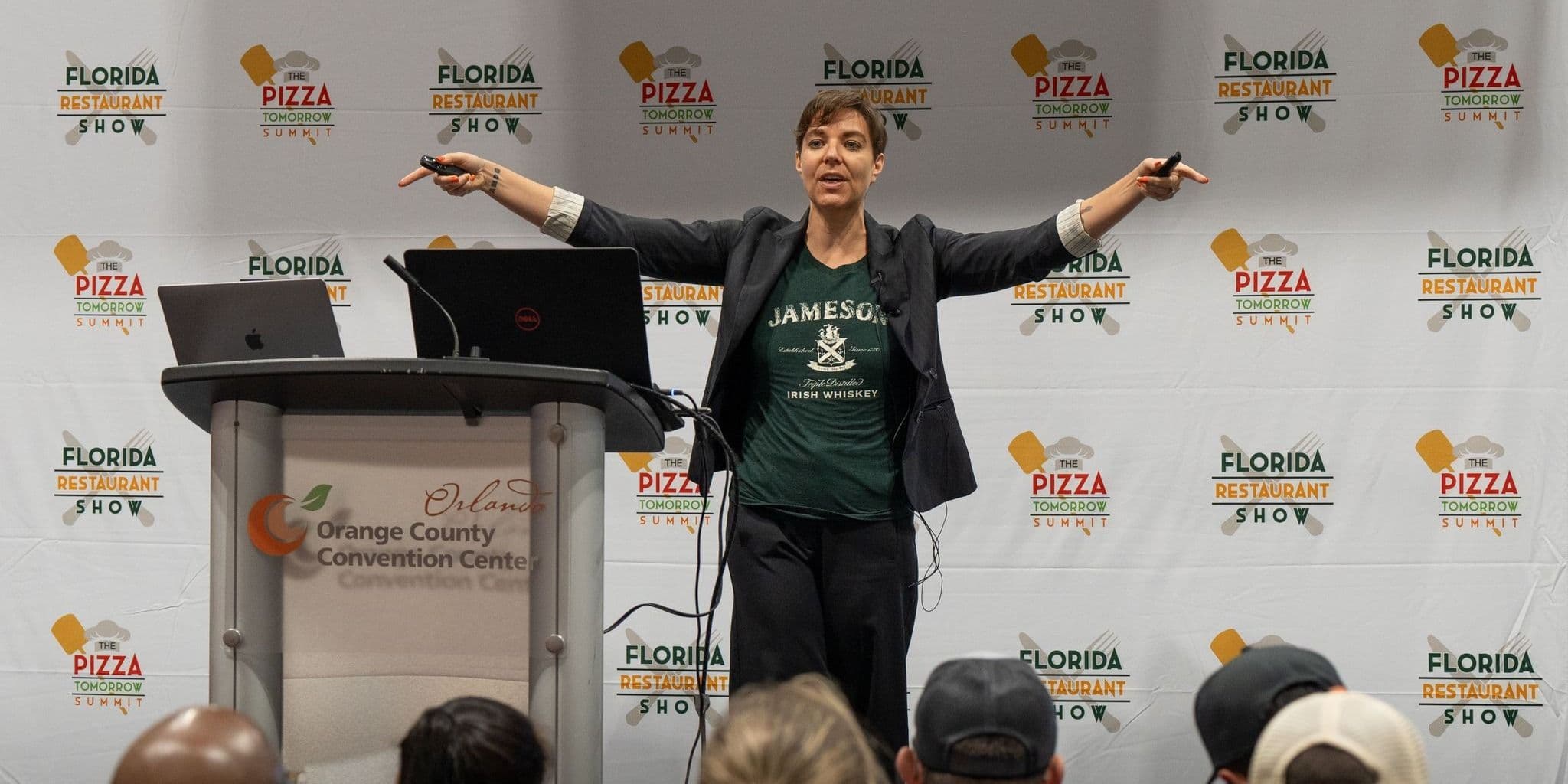
The current program lists forty sessions, demonstrations, competitions, and workshops across October 25 through October 27. Formats include 45-minute education sessions in three theaters, ACF culinary challenges in the Sunshine Plate Arena, a live restaurant podcast taping, and three paid workshops. Speakers include Alison Anne on leadership, Roman Basi on tax structure, Brooke Adams on demand generation, Darren Denington on restaurant management, Rick Rosenfield on restaurant ownership, and Sean Finter on hospitality operating practices.
How should attendees build an agenda around meetings?
The floor supplies 14.5 hours, while the program runs across five named locations. Teams should first reserve any paid workshop because the 3.5-hour Sunday and Monday sessions overlap the floor. Next, protect the education blocks tied to current operating problems, then place supplier meetings in the remaining windows by hall location. On Tuesday, the 9:00 AM competition and workshop begin before the floor, but the 2:30 PM close leaves less recovery time for missed appointments or unplanned comparisons.
Who attends, and does the audience match the ideal customer profile?
The organizer describes an audience of more than 5,000 restaurant, pizzeria, and hospitality professionals and says 84% have purchasing authority. Its segment breakdown is 60% independent operators, 30% foodservice organizations, and 10% multi-unit businesses. Published titles include owner, manager, chef, supervisor, food and beverage operations, executive chef, and purchasing manager. Suppliers selling to commercial kitchens or hospitality operations have a clearer fit than companies seeking a broad consumer audience.
How can exhibitors identify target accounts before October 25?
The organizer's audience taxonomy provides a useful first filter: independent restaurants, multi-unit groups, pizzerias, hotels, hospitals, campuses, caterers, clubs, bars, and other commercial foodservice operators. Match each segment to the product category and buying problem the booth can address, then assign a named account owner. Use the exhibitor directory to spot partners and adjacent suppliers, but do not treat public exhibitor records as an attendee list. Private registration data is not established by the reviewed sources.
What can the official planner and exhibitor tools do?
The official site links a 2026 exhibitor directory, floor plan, Exhibitor Hub, and Shepard service portal. The directory and map support company research and booth navigation. The Exhibitor Hub is limited to recognized primary and logistics contacts, with additional access handled through exhibitor services. Shepard's portal requires an account and covers booth planning and service orders. The reviewed public pages do not establish attendee messaging, appointment scheduling, or a dedicated mobile-app feature list, so those functions are not assumed.
Where do planning tools stop and conversation capture begin?
The public directory, floor plan, Exhibitor Hub, and Shepard portal solve different tasks: discovery, location, company administration, and service ordering. None of the reviewed current pages names an edition-specific badge-scanning product or publishes its fields, export format, user limits, price, or deadline. An exhibitor therefore needs a separate documented method for conversation notes and next steps. The absence of public product documentation is an evidence gap, not proof that the organizer offers no badge service.
What does it cost to exhibit at Florida Restaurant Show 2026?
The organizer publishes a 2026 booth rate of $39.95 per square foot plus $350 per corner, with space sold in 100-square-foot increments. A standard 10-by-10 booth therefore starts at $3,995 before any corner fee. Furniture, freight, labor, internet, catering, travel, and other service charges are separate. The organizer also offers customer-invitation credits toward 2027 booth costs, but those conditional credits should not be subtracted from a 2026 budget until earned. No ROI result is calculated without verified commercial outcomes.
How should exhibitors staff and operate the booth?
The exhibit floor is open for 14.5 hours across three days: six hours Sunday, six Monday, and two and a half Tuesday. Using B2Brain's productive-rep benchmark of 31 scans per day, one rep across three days represents a 93-scan capacity benchmark before breaks, workshops, and qualification depth. Staffing should protect the 10:00 AM opening, lunch coverage, and the compressed Tuesday close. Exhibitors also need their Shepard service orders and Orange County Convention Center venue services confirmed before move-in.
What official lead-capture tool is offered for the 2026 show?
As of October 3, 2026, the reviewed official home, exhibitor-resource, registration, floor-plan, directory, and Shepard access pages do not publicly name a Florida Restaurant Show 2026 lead-capture vendor. They also do not publish a device rate, order deadline, returned badge fields, or export method. This draft leaves the comparison column as On your own rather than assigning an unsupported product. A current service-kit order form is required before any vendor-specific claim can be made.
What could the official badge tool capture, and what remains unknown?
No current public product specification was found for badge scanning at Florida Restaurant Show 2026. Without a verified package, this page cannot state whether the service returns email or phone fields, supports notes and qualifiers, accepts multiple users, runs on personal devices, or exports into a CRM. Those details remain procurement questions for exhibitor services. Directory access and Exhibitor Hub credentials do not prove conversation capture, because both resources can exist without returning attendee badge data.
Is B2Brain an alternative to an organizer badge scanner?
A feature-by-feature alternative claim is premature because the organizer's 2026 scanner package is not publicly identified. B2Brain can still be assessed as a distinct booth-conversation workflow. B2Brain reports capture in under 30 seconds, preserves buying role and next step with the contact, and supports meeting booking on the floor. Those are B2Brain claims, not descriptions of the unnamed organizer service. The official order form is needed to compare price, badge access, fields, exports, and user limits.
Should exhibitors use B2Brain, the official tool, or both?
The choice depends on the missing official package. If organizer-controlled badge access is required, the official product may be necessary for the base contact record. B2Brain can add conversation context, an agreed next action, meeting booking, and event-to-CRM opportunity attribution. A combined workflow should define consent, duplicate handling, device ownership, and export timing before the floor opens. This draft does not quote a B2Brain price and does not assign a capability or limitation to an unnamed show tool.
What should reps capture in each restaurant-operator conversation?
Each record should identify the operator type, number of locations, kitchen or front-of-house problem, current supplier, decision role, budget condition, implementation window, blocker, and agreed next step. Food and beverage vendors should also record menu fit, volume, and distribution constraints. Equipment and technology suppliers need installation, integration, and rollout details. The organizer's segments, including independents, foodservice organizations, and multi-unit groups, make operator type a useful routing field rather than a generic badge note.
How can teams maintain lead quality during 14.5 floor hours?
A qualified attendee is not automatically a qualified opportunity. Use the three show days to require a complete operator profile and next action before a record leaves the booth. The short Tuesday window makes same-day repair especially important. B2Brain's 31 scans per productive rep-day is a capacity benchmark, not a quota that replaces qualification. Review incomplete conversations at midday and before each floor close, with product specialists correcting technical or commercial gaps while the attendee is still on site.
How should Florida Restaurant Show leads be routed after the event?
The floor closes Tuesday, October 27 at 2:30 PM. Assign ownership and send promised material while the discussion remains current, with an initial routing deadline of 4:30 PM that day. B2Brain reports conversation-to-conversion probability of about 85% within two hours and about 9% after one week, so November 3 is the one-week exception review. Segment follow-up by operator type, product need, timing, and next step instead of sending one recap to every scanned contact.
How should exhibitors measure pipeline, cost, and a return decision?
Verified booth economics begin at $3,995 for 100 square feet, plus $350 for each corner and all service, labor, freight, travel, and staffing costs. The show spans three days and 14.5 floor hours. Those inputs support a complete cost ledger, but not a return forecast without qualified conversations, meetings, conversion rate, and average contract value. Define LTM as meetings booked divided by qualified booth leads, then compare cost per qualified conversation, cost per meeting, sourced and influenced revenue pipeline, and event-to-CRM attribution.