



ABA Annual Convention 2026 at a glance
- The convention runs October 25 through October 27 at Salt Palace Convention Center in Salt Lake City.
- ABA lists 1,200+ banking professionals, 50+ experts, 100+ industry partners, and 35 sessions.
- Registration includes the Innovation Forum, 20 Knowledge Sessions, three receptions, two breakfasts, and two lunches.
- Current member pricing ranges from $1,595 before August 3 to $1,995 after August 3.
- The attendee app supports schedules, exhibitor browsing, materials, profiles, and session surveys.
- No public 2026 source reviewed on October 3 identifies a contracted exhibitor lead-capture vendor.
What is ABA Annual Convention 2026, and why does it matter to banking teams?
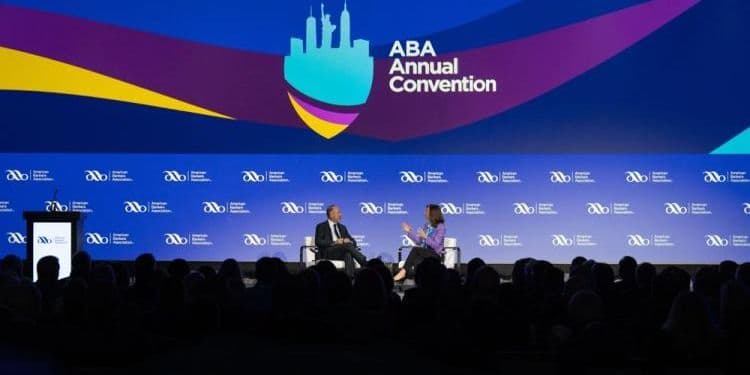
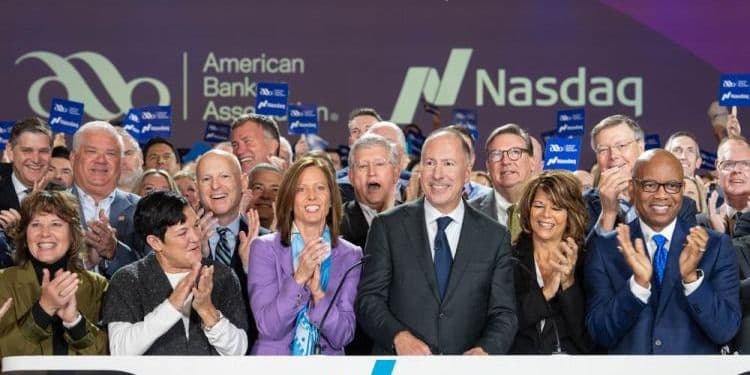
ABA Annual Convention 2026 is the American Bankers Association's three-day national meeting for bank executives, emerging leaders, subject experts, and financial-services partners. It runs October 25 through October 27 at the Salt Palace Convention Center in Salt Lake City. The organizer lists 1,200+ banking professionals, 50+ experts, 100+ industry partners, and 35 sessions. That mix makes the event relevant to banking strategy, regulation, technology, risk, customer experience, and operating decisions rather than a general business audience.
Who should attend or exhibit at the 2026 ABA Annual Convention?
The program is built for C-suite bank leaders, emerging leaders, functional executives, and specialists working across policy, compliance, payments, deposits, lending, risk, fraud, cybersecurity, customer experience, and workforce management. The Hub gives current sponsors and exhibitors a route to banking decision-makers from institutions of different sizes. Companies without a defined banking use case are a weak fit because the sessions and partner roster are specific to bank operations and financial-services policy.
When is ABA Annual Convention 2026, and what hours are published?
ABA Annual Convention 2026 runs Sunday, October 25 through Tuesday, October 27 in Mountain Time. Registration is open Sunday from 7:00 AM to 7:00 PM, Monday from 7:00 AM to 5:00 PM, and Tuesday from 7:00 AM to 1:30 PM. Program activity begins Sunday at 2:00 PM with the Innovation Forum and ends Tuesday with a closing reception from 2:30 PM to 3:30 PM. Those published windows create 32 hours of registration access across the three days.
How does the three-day ABA Annual Convention schedule unfold?
Sunday concentrates on the 2:00 PM Innovation Forum and the 6:00 PM Salt Lake City Social. Monday opens with hot-topic breakfast sessions at 7:30 AM, followed by general sessions, knowledge sessions, Emerging Leaders programming, Hub breaks, and the 5:00 PM Monday Mixer. Tuesday combines breakfast, general sessions, knowledge tracks, the Workforce Excellence Forum, Partner Game Changers, Olympic leadership speakers, and the 2:30 PM closing reception.
Where is ABA Annual Convention 2026, and what happens inside the venue?
The convention is at Salt Palace Convention Center, 100 South West Temple Street, Salt Lake City, Utah 84101. Registration and badge pickup are on level 1. Breakfast and lunch connected to Industry Hot Topics sessions are on level 2. The Hub adds the Solutions Stage and Meet the Experts Lounge to the partner area, while the agenda uses general sessions, concurrent knowledge sessions, the Innovation Forum, and leadership programs. The organizer has not published a public 2026 room-by-room floor plan on the pages reviewed for this draft.
How should attendees navigate Salt Palace and the surrounding area?
The official checklist places registration on level 1 and Industry Hot Topics meal sessions on level 2, so those two floors are the clearest fixed navigation points. The Hub is scheduled during Monday and Tuesday breaks. Hyatt Regency Salt Lake City is at 170 South West Temple Street, while Salt Lake Marriott Downtown at City Creek is at 75 South West Temple Street. Both listed hotels and the convention center are on or near the same downtown corridor, which reduces cross-city travel between rooms and sessions.
What does ABA Annual Convention registration cost in 2026?
Before August 3, ABA member registration is $1,595 and the member team rate from the second person onward is $1,395. After August 3, those prices rise to $1,995 and $1,795. Nonmember registration remains $3,495, while spouse or guest registration is $495. Registration includes the Sunday Innovation Forum, three networking receptions, 20 Knowledge Sessions, Hub access, two breakfasts, and two lunches. These amounts are attendee fees and do not establish exhibitor-space pricing.
Which badge, guest, and event-access rules apply?
Attendees collect badges and conference booklets at level 1. The organizer says every attendee must show identification at check-in and at convention events serving alcohol because Utah requires 100 percent ID checking in those settings. The $495 guest category is for spouses or guests who are not in financial services or banking-related fields. ABA points registrants to its Conference and School Policies for cancellation and transfer terms; the event pages reviewed here do not reproduce a complete edition-specific cancellation table.
Which hotels does ABA list for Annual Convention 2026?
ABA lists Hyatt Regency Salt Lake City at 170 South West Temple Street and Salt Lake Marriott Downtown at City Creek at 75 South West Temple Street. SPARGO is the exclusive housing vendor for the 2026 convention. The published preferred-rate deadline is Wednesday, September 30 at 3:00 PM Eastern. The organizer warns that ABA Events and its official partner hotels do not contact attendees directly to request payment, so unsolicited room offers are not part of the approved housing channel.
What travel timing protects the most useful convention hours?
The first program begins Sunday at 2:00 PM, while the opening reception runs from 6:00 PM to 7:30 PM. Tuesday concludes with the 2:30 PM to 3:30 PM closing reception. A schedule that includes all three days therefore spans 49.5 hours from the Innovation Forum opening to the final reception close. ABA publishes rental-car discounts of up to 20 percent with Dollar, up to 25 percent with Hertz, and up to 20 percent with Thrifty, but it does not publish a single event shuttle timetable.
Which sponsors, exhibitors, and banking categories are represented?
The current sponsor and exhibitor page names more than 100 industry partners. Platinum participants include Abrigo, Discover Debit, FIS, Fiserv, IntraFi, Nasdaq Verafin, nCino, Ncontracts, Visa, and other banking suppliers. Gold names include CSI, Kasasa, Orsnn, Primax, and The Clearing House. The broader roster covers fraud, compliance, core technology, lending, payments, deposits, analytics, security, governance, and professional services. The official directory remains the source for current participation and sponsor tier changes.
How can a team research the 2026 sponsor and exhibitor roster?
The official Sponsors and Exhibitors page is a current text roster organized by sponsorship level, while the 2026 mobile app lets registered users view exhibitors and sponsors. The public list supports an account sheet built around company name, banking category, relationship owner, and relevant session topic. It does not expose private attendee data or booked meetings. Because the organizer can change the roster, the public page and the app should be treated as the two current records rather than copied prior-edition lists.
Which ABA Annual Convention sessions and speakers stand out in 2026?
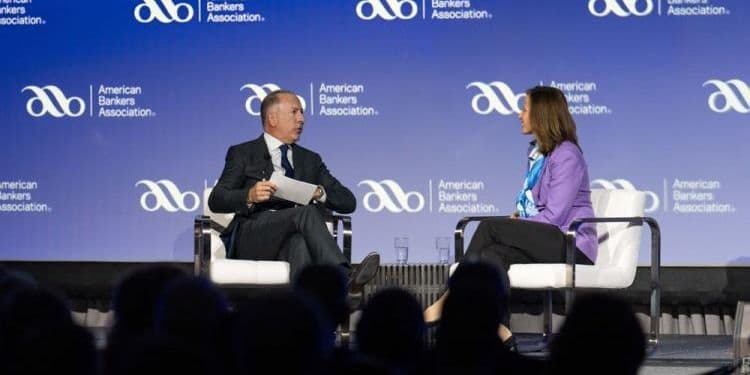
The 35-session program spans AI, tokenization, payments, interest rates, fraud, cybersecurity, profitability, mortgage lending, customer experience, leadership, and workforce integration. Monday includes Fraser Bullock on Utah's 2034 Olympic effort, Jonathan Martin on the 2026 election, and Olivia Giaccio on elite performance. Tuesday closes with Elana Meyers Taylor and Mike Eruzione on leadership across generations. The home page also features Velera Wilson, while program pages identify additional banking specialists across the concurrent tracks.
Where do meetings fit around the ABA Annual Convention agenda?
The organizer creates specific partner windows in the Hub from 9:30 AM to 10:30 AM and 2:30 PM to 3:30 PM Monday, followed by the 5:00 PM Monday Mixer. Tuesday adds a 9:30 AM Hub break before the 10:30 AM knowledge blocks. Those published windows separate partner conversations from the 8:00 AM general sessions and the 10:30 AM or 11:30 AM knowledge sessions. The mobile app can hold the session schedule, which helps prevent a meeting from replacing a priority program block.
Who attends ABA Annual Convention, and how broad is the bank mix?
ABA describes an audience of 1,200+ banking professionals from all 50 states. Based on 2023 through 2025 attendance, the organizer reports 38 percent from the South, 28 percent from the Northeast, 21 percent from the Midwest, and 13 percent from the West. Bank asset sizes range from under $100 million to over $50 billion. The largest reported band is $1 billion to $9 billion at 34 percent, followed by $500 million to $1 billion at 23 percent.
How can exhibitors identify priority bank accounts before Salt Lake City?
The attendee profile provides useful filters without exposing a private attendee list. A target-account model can combine bank asset band, region, line of business, and the 2026 session themes. For example, a fraud supplier can focus on banks whose roles align with cybersecurity, first-party fraud, or payment scams; a deposit provider can map the sessions on funding, margins, and customer primacy. The public source does not identify individual registrants, so named-account research must come from lawful company and relationship data.
What can the 2026 ABA Annual Convention mobile app do?
ABA says registered attendees receive app access instructions by email on October 21. The app supports profile updates, personal schedule building, sponsor and exhibitor browsing, presentation-material downloads when available, and session surveys. Survey links appear only for sessions added to the user's app schedule. Those functions make the app a program and event-navigation tool. The public checklist does not state that the attendee app exports booth conversations, records badge scans, or supplies exhibitor-side lead files.
Where does the ABA mobile app stop and exhibitor lead capture begin?
The verified app functions cover attendee profiles, schedules, exhibitor discovery, session materials, and feedback. None of the current public pages reviewed on October 3 names a 2026 exhibitor lead-capture vendor or documents a connection between the attendee app and a badge-scanning product. The planner therefore supports finding companies and sessions, while an exhibitor's conversation record remains a separate workflow unless an edition-specific service order establishes otherwise.
What verified costs are available for ABA Annual Convention 2026?
Verified public prices cover attendee admission: $1,595 or $1,995 for an ABA member depending on timing, $1,395 or $1,795 for a member team registrant, $3,495 for a nonmember, and $495 for a spouse or guest. The current public sponsor page invites companies to contact business development but does not publish booth rent, sponsorship-package totals, labor, freight, or service charges. Those admission fees remain useful budget inputs, but they cannot be converted into a complete exhibitor cost or ROI estimate.
How should exhibitors staff The Hub across the three days?
The program provides three concentrated partner windows: two Hub breaks and a one-hour mixer on Monday, plus a one-hour Hub break Tuesday. Registration is open for 12 hours Sunday, 10 hours Monday, and 6.5 hours Tuesday, but those are not continuous exhibit hours. Staffing should therefore follow the published Hub and partner-program windows rather than multiplying three calendar days by a generic shift. The organizer has not published a current exhibitor badge allotment or booth staffing limit in the public sources reviewed.
Which official lead-capture product is offered to ABA exhibitors?
As of October 3, the official 2026 convention home page, program, attendee checklist, Hub page, sponsor roster, registration page, and travel page do not identify a contracted exhibitor lead-capture product. The public material also does not list a device fee, order deadline, badge-data specification, or export format. This is an evidence gap, not proof that the event offers no service. The draft therefore leaves the comparison column as On your own and does not name a vendor.
What badge data and export limits does the official capture tool have?
No current product specification was found in the reviewed ABA sources by October 3. Without a named product or service order, the draft cannot state which badge fields are returned, whether notes and qualifiers are supported, how many devices or users are included, or when data exports become available. The attendee app's documented schedule, profile, exhibitor, materials, and survey functions do not establish exhibitor lead-capture capabilities.
Can B2Brain complement an ABA Annual Convention booth workflow?
A feature-by-feature comparison is not possible while ABA's official exhibitor product remains unpublished. B2Brain can be evaluated independently through approved claims: B2Brain reports booth capture in under 30 seconds per conversation and records process, blocker, buying role, and next step alongside the contact. Those functions apply to conversations in The Hub, but they do not replace convention registration, provide private attendee data, or imply a weakness in an unnamed organizer service.
When would an exhibitor use B2Brain and an official ABA tool together?
The combined case depends on edition-specific badge access. If ABA later names a required scanner, that product can supply the organizer-authorized contact record while B2Brain records conversation context and the agreed next meeting. B2Brain reports 52 percent Leads-to-Meeting on the floor, against an 8 percent industry average for post-event follow-up. That comparison is a B2Brain claim, not an ABA event forecast. No official-tool price or feature is assumed in this draft.
What should a rep capture in an ABA Annual Convention conversation?
The record should connect the bank's context to the 2026 themes. Useful fields include institution, asset band, region, operating issue, relevant line of business, current process, decision role, project timing, blocker, and agreed next step. A payments conversation may require rail and deposit context, while a fraud discussion needs the loss or control problem. Capturing the session or Hub topic that prompted the conversation makes the follow-up specific without claiming access to ABA's private attendee data.
How can teams protect lead quality during busy Hub windows?
Monday places Hub activity between dense session blocks, and Tuesday adds another hour before concurrent knowledge sessions. A concise required-field set reduces incomplete records during those bursts. B2Brain uses 31 scans per day as its productive-rep benchmark, but the figure is a capacity benchmark rather than a promise for ABA Annual Convention. Each completed record still needs an institution, banking issue, buying role, timing, blocker, and next action before it is counted as a qualified booth lead.
How should ABA Annual Convention conversations be routed after October 27?
The closing reception ends Tuesday, October 27 at 3:30 PM Mountain Time. B2Brain reports that conversation-to-conversion probability is about 85 percent within two hours and about 9 percent after one week. Those benchmarks make 5:30 PM Mountain Time the first same-day routing checkpoint and November 3 the one-week exception review. The owner, promised material, meeting date, and opportunity status should remain attached to the original conversation so the event record can be reconciled with CRM activity.
How should exhibitors calculate pipeline and ROI for ABA Annual Convention?
A defensible return calculation needs booth or sponsorship spend, travel, staffing, service costs, qualified conversations, meetings booked, opportunity value, and attributable outcomes. The current sources verify attendee fees and hotel channels but not the full exhibitor investment, average contract value, or event conversion rate. For that reason, this draft retains the verified prices without inventing an ROI result. LTM means meetings booked divided by qualified booth leads, and it can be calculated only after the event supplies both counts.