Popl vs Blinq: Which Wins for Event Lead Capture?
Last Updated :
July 14, 2026
Skim in:
12
mins
.png)
Q1: Popl vs Blinq: Which Actually Wins for Event Lead Capture? [toc=1. The Verdict]
For event lead capture, Popl edges Blinq. Popl built an AI badge-scanning, event-mode workflow, while Blinq is a design-first digital business card that bolts capture on. But here is the uncomfortable truth. Neither one books the meeting at the booth. Both hand you a contact list to chase later. If your KPI is pipeline, not contacts, you may be comparing the wrong two tools.
🎯 The question behind the question
I watched a founder walk back from MODEX with 380 scanned badges and a grin. Three weeks later, that grin was gone. His SDR had emailed the whole list once. Two people replied.
That is the real fear under "Popl vs Blinq." You are not picking a card app. You are trying to avoid the shoe box. An old operator buddy described it to me once. Jimmy brings the box of cards back, pulls out three on Monday, and the rest gets found six months later under a desk.
So the question is not which tool looks nicer. It is which tool gets you a meeting before the badge cools, which is the heart of the offline to pipeline problem.
⚖️ The honest verdict
If you must choose between these two for a booth, Popl wins on capture intent. It has an event mode, AI badge scanning, enrichment, and analytics. Blinq is a beautiful digital business card with an email-signature builder and HRIS integrations. It is built for one-to-one networking, not a slammed booth at 4pm on Day 2.
Interestingly, the review data muddies even that. G2 reviewers report that Blinq sometimes outperforms Popl on lead retrieval, despite Popl's louder event-capture marketing. Worth noting too, Popl's event-lead-capture push only dates to its late 2025 repositioning. Its revenue base is still digital cards. Neither tool was born for booth-scale pipeline, the way a workflow built for booth teams is.
"The user experience was confusing and I still do not know where the information or the person I connected with is."
Liliana P. Popl G2 Verified Review
"Easy to share, hard to find contact info later. All the follow ups are just in your sea of contacts you have to try and remember."
Madison Z. Blinq G2 Verified Review
💡 Why the comparison is framed wrong
Here is my read right now, and I could be wrong on this. The money in a trade show is made in the follow-up, and both these tools end at the contact record. That is the start of a decay clock, not the finish line.
Contact information is not where anything happens. Pipeline is where your world actually moves. A captured email is a promise to do work later, when the buyer has already forgotten your booth.
This is exactly why a third category has started pulling the Popl vs Blinq question apart, tools like B2Brain that book the meeting on the floor and report pipeline per show. We will get to that. First, let us be fair to both tools and look at what each actually does well, because the differences are real and they matter for your specific booth.
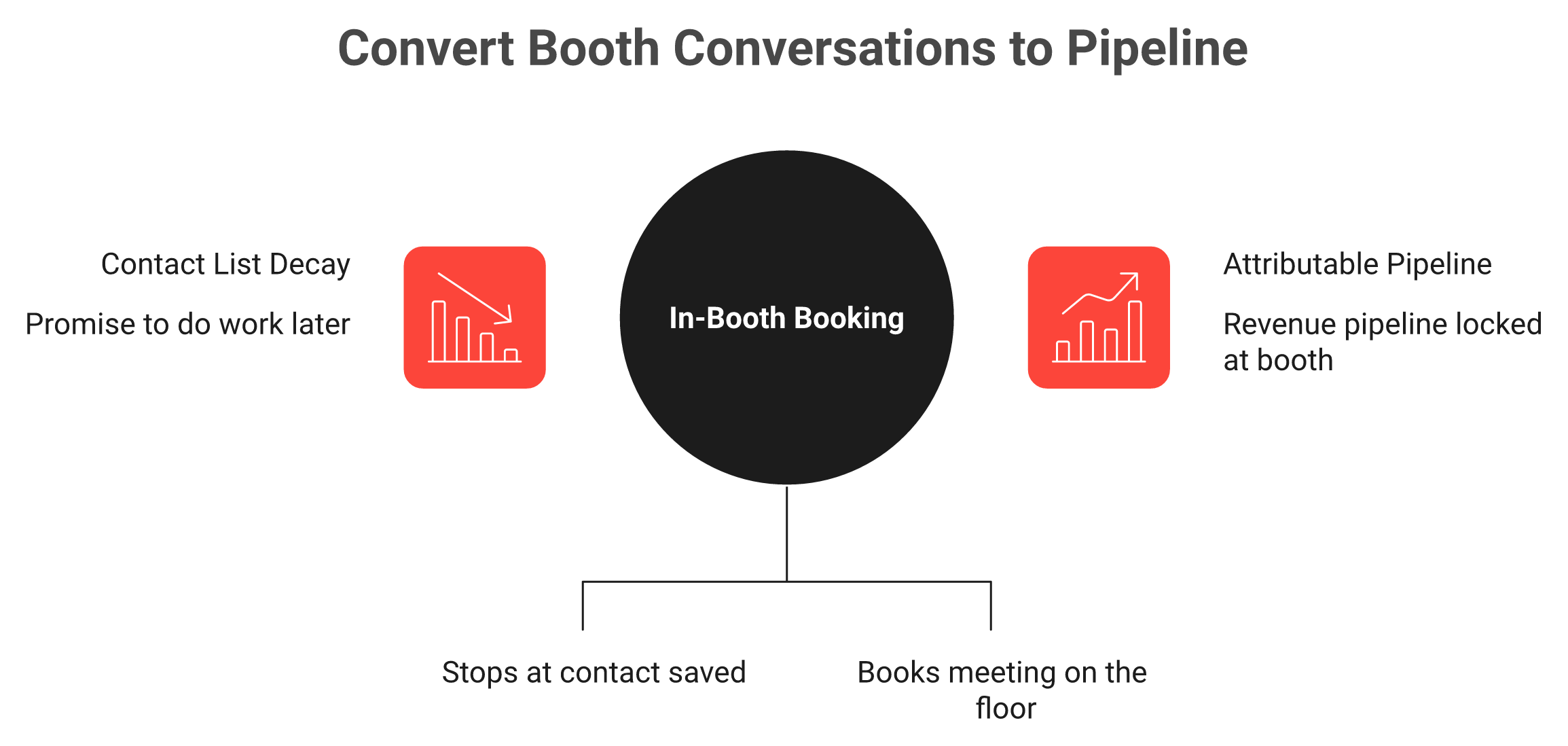
The rest of this guide breaks down the core difference, a feature-by-feature table, real user reviews, the true season cost, and the pipeline question neither tool answers.
Q2: What Is the Real Difference Between Popl and Blinq? [toc=2. Core Difference]
Blinq is a design-first digital business card platform: polished cards, an email-signature builder, HRIS integrations, and brand control. Popl is a lead-capture-first platform: AI badge scanning, event mode, contact enrichment, CRM sync, and analytics. Said plainly, Blinq optimizes how you look when you share contact info. Popl optimizes what happens to the lead after the tap. That gap decides which one fits a trade-show booth.
🧩 Two tools, two different jobs
Think of it like this. A digital business card answers one question: "How do I share my info without paper?" An event lead capture app answers a harder one: "How do I qualify, score, and route this person before they leave the aisle?"
Those are different jobs. Blinq is very good at the first. Popl reaches toward the second, the way a true floor-walking teams workflow has to.
📱 Walk a single booth tap through each
Picture one conversation at your booth. A buyer stops, you talk for two minutes, you exchange details.
With Blinq, you tap or show a QR code, and your card lands on their phone. It looks great. The brand is consistent. But the data flow is built around you sharing outward, not you capturing them inward.
With Popl, you can scan their badge, the app tries to enrich the contact, and it pushes to your CRM. The orientation flips toward the lead. That is the meaningful difference for a booth team.
🎛️ Capture is about control, not convenience
One operator framed digital cards in a way that stuck with me. The point is not convenience. It is control. You are getting their phone, their email, a text conversation going right then, even a photo so you remember who they were three years later. That is you owning the relationship.
By that standard, neither tool fully captures. Both stop at "contact saved." Neither writes down why the conversation mattered, and neither books the next step. That gap is where the pipeline question lives, and we will get to it.
✅ Which orientation does your use case need?
Choose based on the job you are hiring the tool for.
- If your team mostly networks one-to-one and brand polish matters, Blinq's orientation fits.
- If reps are scanning badges all day and the lead needs to reach the CRM fast, Popl's orientation fits better.
- If your KPI is booked meetings and per-show pipeline, you have outgrown both.
At B2Brain, we sit in that third orientation. We treat the booth conversation, not the contact record, as the unit of work. Anything a badge scanner captures, we capture with context, then book the meeting and write the CRM record, a flow you can see in the three-motion workflow. Different job, different tool. The next section puts all three on one table so you can see exactly where each line lands.
Q3: How Do Popl and Blinq Compare Feature by Feature for the Booth Floor? [toc=3. Feature Comparison]
Head to head: Popl wins on AI badge scanning, event mode, contact enrichment, and lead analytics. Blinq wins on card design, email signatures, HRIS integrations, and admin polish. Both offer CRM sync and offline-ish capture, but reviewers flag reliability gaps on both. Choose Popl if reps scan badges all day. Choose Blinq if the priority is brand-consistent cards. Neither offers in-booth meeting booking or per-show pipeline reporting.
📊 The booth-floor comparison table
I scored these on the criteria that actually decide a booth season, not the ones that look good in a feature grid. I have added B2Brain to the table because the last two rows are exactly where the Popl vs Blinq question runs out of road.
| Criterion | Popl | Blinq | B2Brain |
|---|---|---|---|
| AI badge scanning | Strong, event-mode | Basic, QR/scan | Universal capture |
| Capture model | Scan and enrich | Card share | Voice-first, ~4.2s record |
| Offline reliability | Reviewers report misses | QR fails on weak WiFi | Offline-ready, syncs on reconnect |
| In-booth meeting booking | ❌ None | ❌ None | ✅ Books on AE's live calendar |
| CRM sync model | Sync to CRM | Sync, credit-gated | Salesforce/HubSpot-native |
| Pipeline attribution / LTM | ❌ Analytics only | ❌ None | ✅ Per-show pipeline plus LTM |
| Pricing shape | Per-seat tiers | Per-seat plus credits | Flat per-event |
💸 What the table is really telling you
Look at the CRM and cost rows together. Operator testing found that at a 100-badge show, Blinq's credit system can add roughly $1,000 in scan and CRM fees, while Popl gates scanning behind paid tiers. Sticker price is not season price, which is why it helps to know what B2Brain costs per event.
Now look at scoring. A good booth rep marks every scan hot, warm, or cold on the spot, so qualification is already done by the time they walk away. Neither Popl nor Blinq makes that the default motion. You bolt it on with notes, if reps remember.
That is the precision problem. Winning a booth is not about more taps. As one operator put it, account-based selling is a sniper rifle, not a shotgun. Volume capture without context just fills the shoe box faster.
🎯 Choose Popl if, choose Blinq if
Let me make this decision easy.
- ✅ Choose Popl if your reps scan badges all day, you want enrichment, and you can live with per-seat pricing.
- ✅ Choose Blinq if brand-consistent cards and email signatures matter more than booth capture.
- ❌ Choose neither if your CFO measures you on pipeline, because both stop at the contact list.
"Lead capture is likely the most positive element of Popl. However, it's far too cumbersome when all someone wants is your contact information."
Vadim E. Popl G2 Verified Review
"It doesn't always work reliably when scanning the barcode, especially in places with poor internet connectivity. This has made it necessary for me to consider purchasing printed business cards as a backup."
Kasha A. Blinq G2 Verified Review
The two empty columns, in-booth booking and per-show pipeline, are the whole reason B2Brain exists. We book the 30-minute follow-up before the prospect leaves, route it to the right AE, and report the pipeline by show. Our customers run about 52% leads-to-meeting on the floor against an 8% industry average post-event. That is the line no card-versus-card table fills, and it is the core of how we generate new pipeline from events.
Q4: What Do Real Users Say About Popl and Blinq? [toc=4. User Reviews]
Blinq's recurring complaints: App Clips and QR codes failing for recipients, unreliable scans in low-connectivity halls ("had to buy printed cards as backup"), and lost contacts when a phone is lost. Popl's recurring complaints: "didn't scan badges at the conference," forced account creation, and notification spam. The shared theme reviewers keep hitting is that both can break exactly when the floor gets busy.
⚠️ Blinq: it looks great until the recipient can't open it
Blinq's reviews follow a clear pattern. People love the design and the setup. Then the handoff fails at the worst moment.
The App Clip mechanism is the repeat offender. When a recipient's phone cannot open it, the exchange just dies in front of you. On a busy floor, that is a lost lead, not a minor glitch.
"App tries to launch App Clips for the recipient of the business card. Sometimes the recipient can't open it, fundamentally limiting the use of the app. If staff can't rely on it to work for all recipients, then it's easier to use a different solution."
Verified User in Hospitality Blinq G2 Verified Review
"Every time I've tried to use it, the recipient never actually gets the card. I've tried texting it, sharing the link, etc. but it doesn't work. I'd like a refund."
Lupita E. Blinq G2 Verified Review
⚠️ Popl: capture works, the friction does not
Popl earns more credit for lead capture itself. The complaints cluster around friction and reliability instead: forced account creation, notification spam, and badge scanning that does not behave as expected.
That last one stings most for a trade-show buyer. A rep shows up expecting badge scanning and finds it does not work mid-event.
"I needed it for scanning, but it didn't seem to perform that function. It really didn't work for me. I hoped Popl would scan badges for contact info at a conference, but it didn't work."
Drew D. Popl G2 Verified Review
"I HATE the notification spam. I get push, email, AND a text when I scan a Popl card. Why!?"
Verified User in Real Estate Popl G2 Verified Review
🔍 The pattern that actually matters
Strip away the individual gripes and one theme remains. Both tools wobble exactly when the floor gets busy, which is the only time a booth team needs them to be rock solid.
Now set the bar honestly. One operator went into a show with 100 paper cards. A week later, two people had emailed. Within 30 days, maybe five or six reached out. That is roughly a 5% baseline. Another said it plainly: do not trust the badge scan, because maybe one in 20 businesses ever acts on that lead list, and only months later.
So the real buying criterion is not "which app looks best." It is which one holds up at 4pm on Day 2 and actually turns into action, the kind of booth-day workflow that survives a busy floor.
💡 A different yardstick
This is why some teams have stopped counting scans and started counting meetings booked. At B2Brain we call that ratio leads-to-meeting, or LTM. A scan that never converts is not a lead. It is a line in a spreadsheet that becomes the shoe box. Measure the meeting, and the reliability question answers itself. If you want to pressure-test your own program, it is worth seeing Book a Demo and comparing your numbers against what good looks like.
Q5: How Much Do Popl and Blinq Really Cost for a Trade-Show Team? [toc=5. True Cost]
Sticker price misleads. Blinq starts around $9.99 per user per month, but gates badge scanning and CRM sync behind credits, so a 100-badge show can add roughly $1,000 in fees. Popl runs about $8 to $15 per user per month, with event capture on higher tiers. For a 5-rep team across 10 shows a year, both balloon well past the headline number. Compared to a flat per-event price, the math shifts fast.
💸 The headline-price trap
Here is the gotcha nobody puts on the pricing page. The monthly seat fee is the cheap part. The expensive parts are the add-ons that only switch on when you actually need them, at the show.
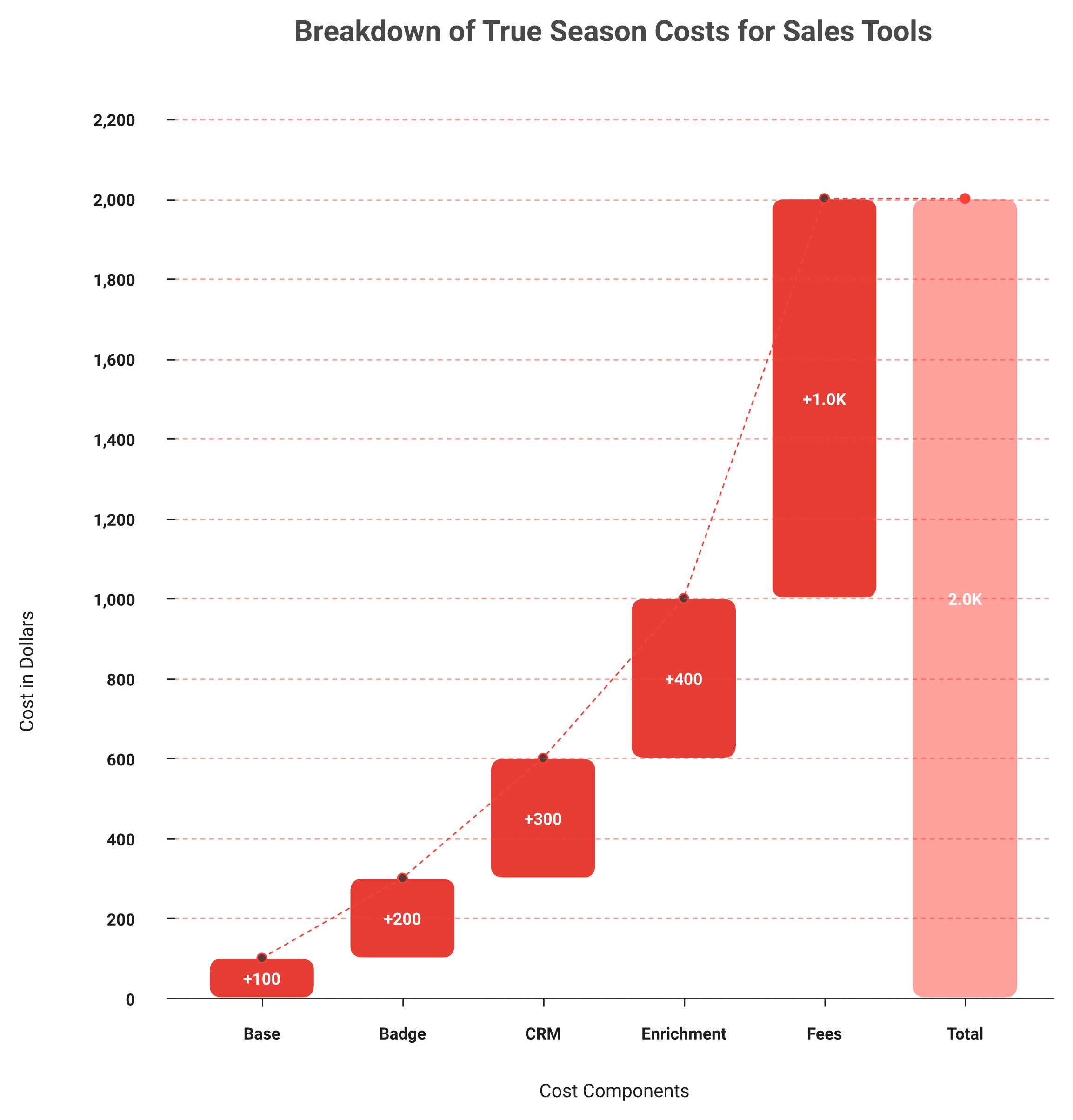
Blinq's badge scanning and CRM sync run on a credit system. Operator testing found a 100-badge event can rack up close to $1,000 in scan and sync fees. Popl keeps event capture and enrichment on its paid tiers, with base plans near $7.99 per user per month. If you want to see a model built the other way, here are our Show Pass and Pipeline plans.
Reviewers feel that gap directly. The sticker never matches the invoice.
"The price, $140 a year? No way, I would rather print thousands of business cards."
Fabian T. Popl G2 Verified Review
💰 Season cost for a 5-rep, 10-show team
Let me run the real math. Five reps, ten shows a year, roughly 100 leads per show. This is where per-seat plus per-credit pricing stops looking cheap.
| Cost line | Popl (est.) | Blinq (est.) |
|---|---|---|
| Base seats (5 reps, annual) | ~$480 to $900 | ~$600 |
| Badge scanning / event mode | Higher tier required | Credit-gated |
| CRM sync | Tier-dependent | Credit-gated |
| Enrichment | Add-on | Limited |
| Per-100-badge show fees | Variable | ~$1,000/show |
Across ten shows, the credit fees, not the seats, drive the bill. A tool that looks like a few hundred dollars a year can cross five figures once the floor gets busy.
⚖️ The metric that actually matters: cost per booked meeting
Now zoom out, because the cheapest scanner is still the wrong question. I have watched a founder spend over $35,000 just decorating a booth, before rental. He told me later that money could have worked so much harder. The app fee is a rounding error next to that.
So measure cost against pipeline, not against each other. The operator yardstick I trust is to spend $10K on a happy hour and expect $30K in closed-won. That 3x rule applies to your whole event budget, tools included.
The right number is cost per booked meeting, not cost per scan. A qualified event meeting costs roughly 60% of an outbound-sourced meeting, and about 40% of a paid-acquisition meeting. A scan that nobody acts on costs you the whole booth, which is why we frame the spend as offline to pipeline.
🎯 Why we price per event at B2Brain
This is exactly why we built B2Brain pricing around the event, not the seat or the credit. You are buying a show outcome, booked meetings and attributable pipeline, so the price should track that, not punish you for scanning more leads. You can see how the model maps to what B2Brain costs per event.
I could be wrong on where the market lands, but credit-metered scanning feels backwards to me. It charges you most at the precise moment you are creating the most value, mid-floor, mid-conversation. Tie the cost to the meeting, and the budget conversation gets a lot simpler.
Q6: Why Doesn't Capturing the Lead Solve the Real Problem? [toc=6. The Capture Trap]
Capturing a contact is not the finish line. It is the start of a decay clock. Up to 80% of event leads never reach the CRM, around 87% are never properly followed up, and conversion drops from roughly 85% within two hours to about 9% after a week. Popl and Blinq both hand you contacts to chase later. The teams that win book the meeting on the floor, before the badge cools.
⏰ The problem: captured is not converted
A scanned badge feels like progress. It is not. It is an IOU you promise to pay later, when the buyer has already forgotten your booth existed.
Contact information is not where anything happens. Pipeline is where your world actually moves. A CSV of 400 names is just a to-do list that nobody does, which is the gap that how event lead capture works is designed to close.
⚠️ The agitation: the decay clock is brutal
Here is what the numbers say, and they are ugly. Up to 80% of captured event leads never make it into the CRM at all. Around 87% are never properly followed up.
The timing is the killer. Lead-to-meeting conversion sits near 85% if you reach someone within two hours, then collapses toward 9% after a week. Every hour you wait, the show melts away.

One operator said it plainly. Do not trust the badge scan, because maybe one in 20 businesses ever acts on that lead list, and only months later. That is the shoe box, in data form.
"It doesn't sync all the leads I've scanned. Without those leads that I scanned but apparently didn't go through, we end up with a lot fewer than we expected."
Verified User in Events Services Mobly G2 Verified Review
✅ The solution: book the meeting before they walk away
So flip the model. Do not capture a contact to chase later. Capture the conversation and book the next step while the buyer is still standing there, which is the whole point of the booth-day workflow.
The spine is simple: Speed, then Commitment, then Pipeline. Speed means you act in the moment, not in the cab back to the hotel. One operator sends a verification email within 15 minutes of walking away, while the handshake is still warm.
Commitment means a calendar invite, not a hopeful "we'll be in touch." Sixty percent of lost sales trace back to poor qualification, so qualify and lock the meeting on the spot.
💡 Why we built B2Brain around the meeting, not the scan
This is the whole reason B2Brain exists. We book the 30-minute follow-up on the floor, route it to the right AE's calendar, and write the CRM record before the prospect leaves the aisle.
We track that as leads-to-meeting, or LTM, the share of booth leads that become a scheduled meeting. Our customers run about 52% LTM on the floor against an 8% industry average for post-event chasing. No competitor tracks LTM at all, and my honest read is that the number, not the scan count, is the only event metric that survives contact with a CFO.
Q7: Is There a Better Option Than Popl or Blinq for Event Lead Capture? [toc=7. The Better Option]
If your goal is contacts, Popl wins this matchup. If your goal is pipeline, look at the in-booth-meeting-booking category instead. B2Brain books the meeting on the floor, routes it to the right AE's calendar, syncs to Salesforce and HubSpot in real time, and runs the only Before, During, After shared layer. It turns a booth conversation into a calendar invite before the buyer walks away, not a CSV your SDRs chase six months later.
🧭 A different category, not a better card
Let me be direct. If you only need contacts, Popl is the stronger of the two. But if you are reading this article, your real problem is pipeline, and that is a different category of tool.
The category is in-booth meeting booking. It treats the booth conversation, not the contact record, as the unit of work. A digital card asks "how do I share my info?" This category asks "how do I leave the show with meetings on the calendar?", which is the job generate new pipeline from events is built for.
⭐ What B2Brain actually does differently
I expect the obvious objection: "BoothIQ books meetings too, so what." Fair. The answer is never the single feature. It is four things working together that no one else runs as one layer.
- ✅ In-the-moment booked meeting. We pull the AE's live calendar and lock the 30-minute follow-up before the prospect leaves, with a dual invite to both sides.
- ✅ The only Before, During, After shared layer. Pre-event briefing, on-floor capture, and post-event report all live on one intelligence layer, not three disconnected tools.
- ✅ CRM-grounded pre-event briefing. We build target lists from your own CRM pipeline, not a generic cold prediction database.
- ✅ Per-customer Next-Best-Action. Booking is just today's most common next step. We configure the action to mirror your sales process.
One field marketer told me she runs five different tools to execute a single show and would kill for one that consolidates them. That gap is the opening, and you can see how we close it across before, during, and after the show.
"Mobly was a breath of fresh air compared to conference scanners. I was able to not have to put notes into a spreadsheet."
Will N. Mobly G2 Verified Review
⚠️ When B2Brain is not your tool
Now the honest part, because a fair comparison names its own limits. B2Brain is built for B2B revenue teams with a CRM and a real sales motion. We are not the right call for everyone.
Skip us if you are a solo booth, a consumer-facing seller, a team with no CRM, or attending one show once. Same if you mainly want a polished digital business card, because we do not make one, our native app is iOS-first today, and our third-party enrichment depth is lighter than Popl or Mobly.
💡 The trade I would actually make
Here is my read. If brand-perfect cards are the job, Blinq wins and you should buy Blinq. If volume scanning with enrichment is the job, Popl is reasonable.
But if the boss asks "where is the pipeline?" on Monday, neither answers that. That is the trade B2Brain is built to win, and the fastest way to test it is to Book a Demo against your own last show.
Q8: How Do You Prove Per-Show Pipeline to Your CFO? [toc=8. Proving ROI]
A contact count will not survive a budget review. To defend event spend, you need per-show pipeline attribution: which conversations became meetings, which meetings became opportunities, and how much pipeline each show sourced. Popl and Blinq report scans and taps. Neither closes the loop to revenue. The metric a CFO accepts is leads-to-meeting and pipeline-per-show, delivered as a report the morning after the floor closes.
📉 The problem: scans are not an ROI story
Picture the Monday after a $70K booth. The CEO asks one question: "Where is the pipeline?" Nobody in that room wants the answer to be "we scanned 380 badges."
A scan count is an activity number. It tells you the booth was busy, not that the spend worked. Taps and badges do not roll up into anything a finance team recognizes as return.
That is the gap Popl and Blinq leave open. They report what happened at the surface, not what it became downstream.
🧮 The model: attribution a CFO will accept
To defend the budget, you need three connected numbers, not one vanity stat.
- Leads to meeting (LTM). What share of booth leads became a scheduled meeting. This is the conversion gate everything else depends on.
- Meetings to opportunity. How many of those meetings turned into real pipeline.
- Pipeline per show. Total sourced pipeline, attributed by show, booth area, rep, and segment.
Multi-touch attribution, crediting every touch in the buyer's journey, ties the booth conversation to the closed deal months later. Only 47% of exhibitors track leads through the sales cycle at all. So just having the chain gives you an edge most booths lack, the edge a real what gets captured on the floor workflow provides.
Think of it like debugging code. When a deal breaks, you want to see the exact phase where it fell off, discovery, meeting, or follow-up. A pipeline report does that for your event funnel.
📊 The payoff: the morning-after report
This is where B2Brain is built to make the field marketer the hero. We deliver an offline-to-pipeline report to the CMO by 9am the day after the show closes.
It lays out pipeline sourced, meetings booked, LTM, and attribution by show, booth area, rep, and segment. So when the CEO asks "where is the pipeline?", the answer is a number on a screen, not a promise to pull a CSV.
The owned metric carries it. Our customers run about 52% LTM on the floor against an 8% industry average for post-event follow-up. That contrast is the whole budget conversation in one line.
"Having all our leads from events go into one place which makes it easier for the reps. It's saving time on manually uploading leads."
RebeccaGrace K. Captello G2 Verified Review
💡 The number is the deliverable
My honest take is that the report is the product, not the scan. Reps will tolerate a capture app. A finance team funds a pipeline number it can trust. Build your event program around the number you can defend, and the tool choice mostly makes itself.
Q9: Popl vs Blinq: How to Decide and Turn Booths Into Booked Pipeline [toc=9. How to Decide]
Popl wins the literal matchup for trade-show lead capture. Blinq wins for design-led digital cards and email signatures. But whichever you pick, the workflow decides the result. Score every scan hot, warm, or cold on the spot, fire a first touch within 15 minutes while you are still in the aisle, and book the next meeting before the buyer leaves. Tools capture. Process converts.
🎯 The decision, in one line
So pick by the job in front of you. If reps scan badges all day and you want enrichment, choose Popl. If brand-perfect cards and email signatures matter most, choose Blinq. G2 reviewers split along exactly that line.
But here is the part both vendors leave out. The tool is maybe 20% of your result. The other 80% is what your reps do in the 30 seconds after the handshake, which is where the booth-day workflow earns its keep.
📋 The 5-step booth playbook for Monday
This is the workflow I would run at the next show, no matter which app is in your hand. As one operator put it, if you do not have a process for selling, you are at the mercy of your prospect's process for buying.
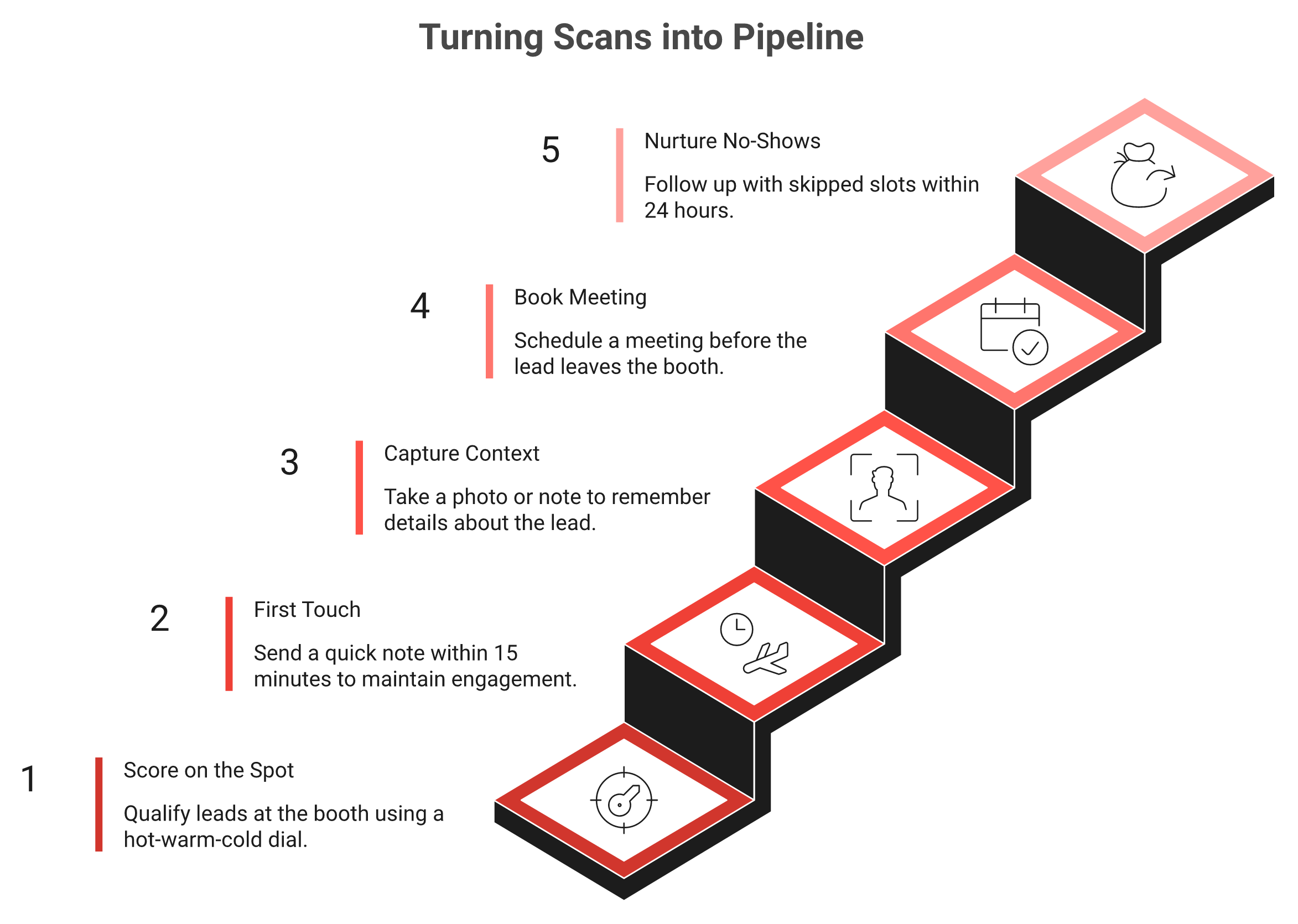
- ⭐ Score on the spot. Mark every lead hot, warm, or cold before they walk away. Qualification done at the booth means no guessing on Monday.
- ⏰ First touch in 15 minutes. Send a short "great meeting you, I'll reach out next week" while the conversation is fresh. Conversion stays near 85% within two hours and collapses toward 9% after a week.
- 📸 Capture context, not just contact. Snap a photo of them holding their card, or grab a quick selfie. One operator got a selfie message minutes later and remembered that person for years.
- ✅ Book the meeting before they leave. A calendar invite beats a hopeful follow-up every time. This single move is the difference between a contact list and pipeline.
- 💸 Nurture the no-shows too. Within 24 hours, message the people who skipped the booked slot. A simple "sorry we missed you, we'll be back next month" keeps the door open.
🤖 Where automation earns its keep
Run those five steps by hand and they work. The problem is Day 2 at 4pm, when the booth is slammed and nobody stops to take notes. That is when the process quietly dies.
This is the gap we built B2Brain to close. We let a rep capture context by voice in seconds, score the lead, fire the first touch, and book the meeting on the AE's live calendar, all without breaking the conversation. You can see how that runs across before, during, and after the show, so the reps do the right thing because the tool makes it the easy thing.
"The ability to scan a business card, conference badge, or just enter a name and company and Mobly automatically enriches the data and stores it to share to our CRM."
Verified User in Computer Software Mobly G2 Verified Review
💡 The question I am sitting with
Remember Jimmy and his shoe box of cards from the start of this guide. Six months later, somebody finds the box, and the show is long dead. That is still the default outcome at most booths, with or without a fancy app.
So here is what I keep turning over. If the meeting gets booked on the floor, does the capture tool even matter anymore? My read right now is that the category is shifting from "who captures the cleanest contact" to "who walks out with pipeline," the shift we frame as offline to pipeline. I could be wrong, and I would genuinely like to hear how your last show actually converted. If you want to pressure-test your number against what good looks like, Book a Demo and bring your last show's data. What was your leads-to-meeting number?
FAQ's
Popl vs Blinq: which is better for trade-show lead capture?
For a booth, Popl edges Blinq on capture intent. Popl was built with an event mode, badge scanning, contact enrichment, and CRM sync, while Blinq is a design-first digital business card that bolts capture on.
That said, the review data muddies it. Some G2 reviewers report Blinq retrieving leads more reliably than Popl, despite Popl's louder event marketing. So the honest read depends on your job to be done:
- Pick Popl if reps scan badges all day and you want enrichment.
- Pick Blinq if brand-consistent cards and email signatures matter most.
Here is the part both leave out. Neither one books the meeting at the booth. Both hand you a contact list, and that is the start of a decay clock, not the finish line. If your KPI is revenue pipeline rather than contacts, we think you are comparing the wrong two tools. That is why we built the three-motion workflow to book the meeting on the floor and report pipeline per show.
What is the real difference between Popl and Blinq?
The difference is orientation. Blinq optimizes how you look when you share contact information, with polished cards, an email-signature builder, and brand control. Popl optimizes what happens to the lead after the tap, with badge scanning, enrichment, and CRM sync.
Put plainly, they answer two different questions:
- A digital card asks, "How do I share my info without paper?"
- A capture tool asks, "How do I qualify, score, and route this person before they leave the aisle?"
Blinq is very good at the first. Popl reaches toward the second. By the standard that matters for a booth, though, neither fully captures, because both stop at "contact saved." Neither writes down why the conversation mattered, and neither books the next step.
We sit in a third orientation. We treat the booth conversation, not the contact record, as the unit of work, and we capture it with context before booking the meeting. You can see how that plays out for booth teams who measure success in meetings, not taps.
How much do Popl and Blinq really cost for an event team?
The sticker price misleads. Blinq starts around 9.99 dollars per user per month, and Popl runs about 8 to 15 dollars per user per month, but the cheap part is the seat. The expensive part is the add-ons that switch on at the show.
Watch these gotchas:
- Badge scanning and CRM sync are often credit-gated, and a 100-badge show can add roughly 1,000 dollars in fees.
- Enrichment sits on higher tiers, so a 5-rep, 10-show season balloons well past the headline number.
The number that actually matters is cost per booked meeting, not cost per scan. A qualified event meeting costs roughly 60 percent of an outbound-sourced meeting and about 40 percent of a paid-acquisition meeting. A scan nobody acts on costs you the whole booth.
That is why we price around the event, not the seat or the credit. You can compare the model against what B2Brain costs per event and judge it against the revenue pipeline a show should generate.
Does capturing a lead with Popl or Blinq actually convert to pipeline?
Capturing a contact is not the finish line. It is the start of a decay clock, and the numbers are brutal.
- Up to 80 percent of event leads never reach the CRM at all.
- Around 87 percent are never properly followed up.
- Conversion sits near 85 percent within two hours, then collapses toward 9 percent after a week.
Popl and Blinq both hand you contacts to chase later, which means the work happens after the buyer has forgotten your booth. The teams that win flip the model. They score on the spot, fire a first touch within 15 minutes, and book the meeting before the badge cools.
We built our approach on that spine of speed, then commitment, then pipeline. We book the follow-up on the floor and route it to the right AE's calendar, turning a booth conversation into a calendar invite. That is the heart of how we help teams move offline to pipeline instead of filling a spreadsheet.
Is there a better option than Popl or Blinq for booth pipeline?
If your goal is contacts, Popl wins this matchup. If your goal is revenue pipeline, the better fit is the in-booth-meeting-booking category, which is a different job than a digital card.
What that category does differently:
- Books the meeting on the floor and routes it to the right AE's calendar.
- Syncs to Salesforce and HubSpot in real time, not as a later CSV import.
- Reports per-show pipeline with leads-to-meeting, or LTM, as the CFO-accepted metric.
The contrast is the proof. Our customers run about 52 percent LTM on the floor against an 8 percent industry average for post-event chasing. We will also tell you when we are not the fit. Skip us if you are a solo booth, consumer-facing, have no CRM, or attend one show once.
If the boss asks "where is the pipeline?" on Monday, neither card tool answers that. To pressure-test your own numbers, Book a Demo and bring your last show's data.
.png)

.png)
.png)